
“It is not the man who has too little, but the man who craves more, that is poor.” · Seneca, Moral Letters to Lucilius, Letter 2 (trans. Richard Mott Gummere)
You have probably read the lists already. Drink water, go outside, get some sleep, call a friend. Nothing is wrong, exactly. You go to work, you answer messages, you laugh at the right moments. And still there is a low, foggy sense that you are running on less than you should be, and that the advice you have read is informative but has not changed how the weeks feel. Sound familiar?
The World Health Organization’s definition is a useful place to stand while we sort this out. It describes mental health as “a state of mental well-being that enables people to cope with the stresses of life, realize their abilities, learn and work well, and contribute to their community.” The US National Institute of Mental Health puts the important part plainly: it is more than the absence of a mental illness. In other words, not being unwell is not the same thing as being well.
That is good news, because it means being mentally healthy is something you can build and maintain, not a box you either tick or do not. This guide explains what it means, why it is not the same as being happy, why it can wobble even when you are doing everything right, and then five habits that hold it up, each with how strong the evidence is and one small thing to do this week.
The short version
Being mentally healthy means being able to cope, function and connect. It is more than not having a mental illness, and it is not the same as feeling happy all the time.
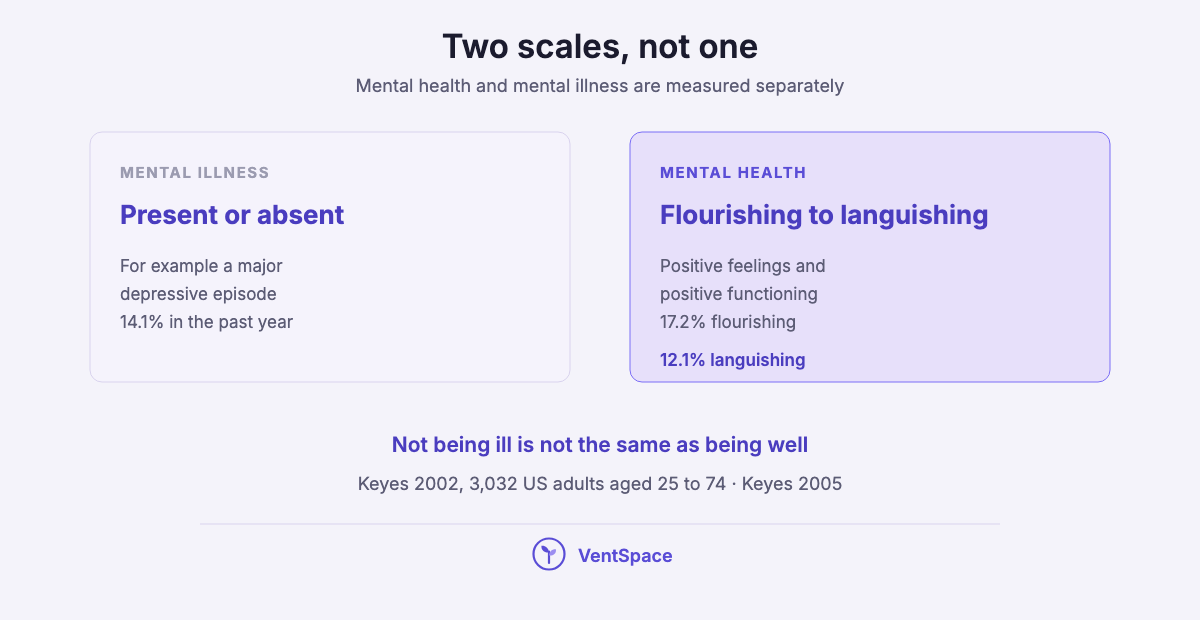
Health and illness are two different scales. In a large US study, only about 17% of adults met the criteria for flourishing.
It rests on several legs. Sleep, movement, people, something you are learning or giving, and noticing how you feel. Some of what knocks it, like money or an unsafe home, is outside your control.
The evidence is uneven. Improving sleep and getting more physical activity have the strongest trial evidence of anything on this page.
Start with one habit, not five, and give it weeks rather than days.
| Habit | How strong the evidence is | One small thing to do this week |
|---|---|---|
| 1. Protect your sleep | Strong: 65 randomized trials of sleep improvement | Pick one wake-up time and keep it for seven days |
| 2. Move most days | Strong: an umbrella review of 97 reviews | A ten-minute walk on three days |
| 3. Stay close to a few people | Strong but observational: links, not proof | Message one old friend and suggest a time to talk |
| 4. Keep one thing you are learning or giving | Recommended by the NHS, not trial-sized here | Choose one small thing to learn or one person to help |
| 5. Notice what you feel, and take stock | A lab finding about naming feelings, plus common sense | Write one line a night about how the day felt |
If you are struggling right now. If you are feeling hopeless, or having thoughts of harming yourself, please contact a crisis line now rather than reading on. In the US, call or text 988 (Suicide & Crisis Lifeline). Anywhere else, findahelpline.com lists free, confidential services by country. In an emergency, call 911 or your local emergency number. This page is not a substitute for that help.
What does it mean to be mentally healthy?
“Mental health includes emotional, psychological, and social well-being. It is more than the absence of a mental illness.” · National Institute of Mental Health, Caring for Your Mental Health (2026)
Being mentally healthy means being in a state of well-being that lets you cope with ordinary stress, use your abilities, learn and work, and take part in the life around you. That is the World Health Organization’s definition, and the WHO adds that mental health “exists on a complex continuum, which is experienced differently from one person to the next.” It is not a switch. It is a range you move along, sometimes in a single week.
Most of us carry a simpler picture in our heads. We assume there are two kinds of people: those with a mental illness and everyone else, who must therefore be fine. The research says the picture has two dimensions, not one.
The sociologist Corey Keyes spent years testing this. In a 2002 study of 3,032 American adults aged 25 to 74, he measured positive feelings and positive functioning in life, things like purpose, growth, warm relationships and a sense of belonging, alongside the usual measures of depression. Only 17.2% met his criteria for “flourishing.” Most people, 56.6%, were in the middle, which he called moderately mentally healthy. And 12.1% were “languishing”: not depressed, by the usual measures, but low on the positive side of the scale.
| Group in Keyes’s 2002 study | Share of adults | What it describes |
|---|---|---|
| Flourishing | 17.2% | High on positive feelings and positive functioning |
| Moderately mentally healthy | 56.6% | Neither flourishing nor languishing |
| Languishing | 12.1% | Low on positive feelings and functioning |
| Major depressive episode in the past year | 14.1% | Measured separately. 9.4% were not languishing and 4.7% were |
The table does not add up to 100%, and that is the point. Depression and languishing are measured on different scales, so a person can be on both, either or neither. Keyes found that languishing adults were about twice as likely to have a major depressive episode as moderately healthy ones, and nearly six times as likely as flourishing ones. In a 2005 analysis of the same survey, his models supported treating mental health and mental illness as separate but related dimensions.
What does languishing feel like from the inside? Often, like nothing much. The philosopher John Stuart Mill, describing a long winter of dejection in his Autobiography, wrote the line many of us could have written about an ordinary month:
“During this time I was not incapable of my usual occupations. I went on with them mechanically, by the mere force of habit.” · John Stuart Mill, Autobiography (1873)
You can be functioning and still not be well. This is one of the most common shapes it takes: the calendar is full, the work gets done, and the color has quietly gone out of it.
A note on what this page will not do. Many pages on this topic end with a quiz that tells you whether you are mentally healthy. We have left it out on purpose. Keyes’s categories come from validated questionnaires scored against a national sample, and nothing we could build here would have those norms behind it. A homemade score would only give you a number to feel bad about. What you can do instead is notice, in your own words, which parts of your life feel steady and which feel thin. Step 5 shows you how.
Quick Summary
Q: What does it mean to be mentally healthy?
A: Being mentally healthy means having a state of well-being that lets you cope with the normal stresses of life, use your abilities, learn and work well, and contribute to your community. It is more than not having a mental illness. Research by Corey Keyes treats mental health and mental illness as two separate scales, so someone can be free of illness and still be languishing.
Insight: Corey Keyes, reporting his analysis of the Midlife in the United States survey in the Journal of Consulting and Clinical Psychology (2005): “Confirmatory factor analyses supported the hypothesis that measures of mental health (i.e., emotional, psychological, and social well-being) and mental illness (i.e., major depressive episode, generalized anxiety, panic disorder, and alcohol dependence) constitute separate correlated unipolar dimensions.” In plain terms, removing an illness does not automatically add well-being. The second has to be built.
Is being mentally healthy the same as being happy?
“Men are disturbed not by things, but by the views which they take of things.” · Epictetus, The Enchiridion (trans. Thomas Wentworth Higginson)
No. Being mentally healthy is about being able to cope and function, including on the days you feel low, not about feeling happy all the time. The WHO definition does not mention happiness at all. It talks about coping with the stresses of life, which assumes the stresses will come.
This matters, because the happiness version sets a test you will fail every week. If mental health means feeling good, then every bad afternoon is evidence that something is wrong with you. If it means coping, then a bad afternoon you get through, talk about or sleep off is mental health doing its job. Sadness after a loss, worry before a hard conversation, frustration at a broken plan: these are not signs that your mental health is failing. They are signs that you are paying attention to your life.
Keyes makes the same point from the research side. He defined mental health as “a syndrome of symptoms of positive feelings and positive functioning in life.” Feelings are only half of it. The other half is functioning: having some direction, some growth, relationships that work, a sense that you belong somewhere. You can have a flat week and still be functioning well.
Epictetus’s line above is two thousand years old and still half right. How we read what happens to us shapes how it lands. The other half, which the next section is about, is that some things land hard whatever view you take of them.
From Sai, who writes this blog: what I used to think it was
I remember being a teenager with one goal in mind: to become rich and own luxurious material possessions. Somehow my brain associated owning an iPhone or a car with being cool and successful.
But should life be about these temporary pleasures rather than long-lasting fulfillment? As I traveled through my life, I realized there’s more to life than these possessions. I learned the importance of maintaining our inner balance.
Mental health is not about finding and remaining happy. It is about finding inner peace.
Sai’s version and Seneca’s, at the top of this page, are the same lesson arriving two thousand years apart. Wanting more is not the same as being well, and chasing the next thing can keep you from noticing what is already holding you up.
Quick Summary
Q: Is being mentally healthy the same as being happy?
A: No. Mental health is the ability to cope with stress, function and connect with others, and it includes the days when you feel sad, worried or frustrated. Feeling low sometimes is a normal response to life, not a sign that your mental health has failed. Researchers measure mental health through both positive feelings and positive functioning, such as purpose and good relationships.
Insight: Corey Keyes, introducing his model in the Journal of Health and Social Behavior (2002): “This paper introduces and applies an operationalization of mental health as a syndrome of symptoms of positive feelings and positive functioning in life.” Notice the second half of that sentence. Functioning, in his work, includes purpose, growth and relationships, which is why a good day and a healthy life are not the same measurement.
Why does mental health wobble even when you are doing everything right?
“No single factor can reliably predict mental health outcomes.” · World Health Organization, Mental health fact sheet (2026)
Mental health wobbles because it rests on many supports at once, and some of them, like money, work, safety and other people, are partly outside your control. When one support gets shorter, you feel it, even if you are doing everything else well.
It helps to picture a table standing on several legs. Sleep is a leg. So is your body, the people around you, something that gives the week a point, and your sense of what you are feeling. When one leg gets short, the table does not usually fall over. It wobbles. And the wobble is hard to locate, because from the top it just feels like the whole table is off.
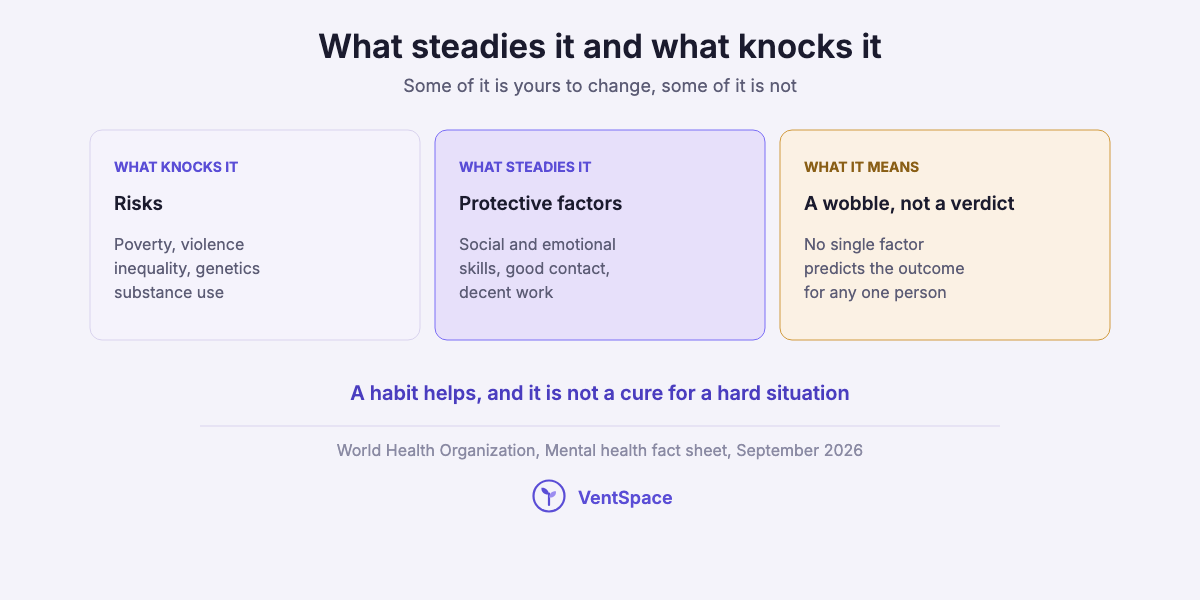
The WHO lists what tends to shorten the legs and what tends to strengthen them. On the risk side it names individual factors such as emotional skills, substance use and genetics, and social ones such as poverty, violence, inequality and environmental deprivation. On the protective side it names social and emotional skills, positive social interactions, access to quality education, decent work, safe neighborhoods and strong community ties. Then it adds the sentence at the top of this section: no single factor predicts the outcome. Many people exposed to risks never develop a mental health condition, and others are affected with no known risk at all.
Two things follow from that list, and both are worth saying out loud.
First, if your life is hard, a habit is not a cure for it. An early bedtime does not pay rent, and a walk does not make an unsafe home safe. The habits in this guide help most people, and they still help when life is hard, but they are not a test you are failing if the table keeps wobbling. Sometimes the leg that is short is not yours to fix alone.
Second, it is easy to lean everything on one leg. Sai put it this way about work and money in the first version of this page: “it is easy to spend so much time trying to win in this factor that you forget the other factors that make you mentally healthy and have a good quality of life.” A long table can still wobble if one leg is doing all the work.
When habits are not enough. The NIMH advises seeking professional help if you are experiencing severe or distressing symptoms that have lasted 2 weeks or more, such as trouble sleeping or difficulty getting out of bed in the morning because of mood, and suggests starting with a primary care provider, who can refer you on. Therapy is one option. For a lot of people it is the right one. If you are unsure whether you need it, our guide on whether you need therapy walks through the question, and if cost is the obstacle, what helps when you cannot afford therapy covers the options.
Quick Summary
Q: Why does my mental health get worse even when I am doing everything right?
A: Mental health depends on many factors at once, including sleep, physical health, relationships, work, money and safety. The World Health Organization says no single factor reliably predicts mental health outcomes, and some risks, such as poverty or violence, are outside a person’s control. A wobble is not a personal failure. If distressing symptoms last two weeks or more, the NIMH suggests seeing a professional.
Insight: The World Health Organization’s Mental health fact sheet (2026) describes the other side of the ledger: “Protective factors similarly occur throughout our lives and help build resilience. They include individual social and emotional skills, positive social interactions, access to quality education, decent work, safe neighbourhoods and strong community ties.” Only the first item on that list is mostly up to you. The rest is why mental health is also a matter for workplaces, schools and governments.
So where do you start?
How to be mentally healthy: five habits, one at a time
“The great thing, then, in all education, is to make our nervous system our ally instead of our enemy.” · William James, The Principles of Psychology (1890)
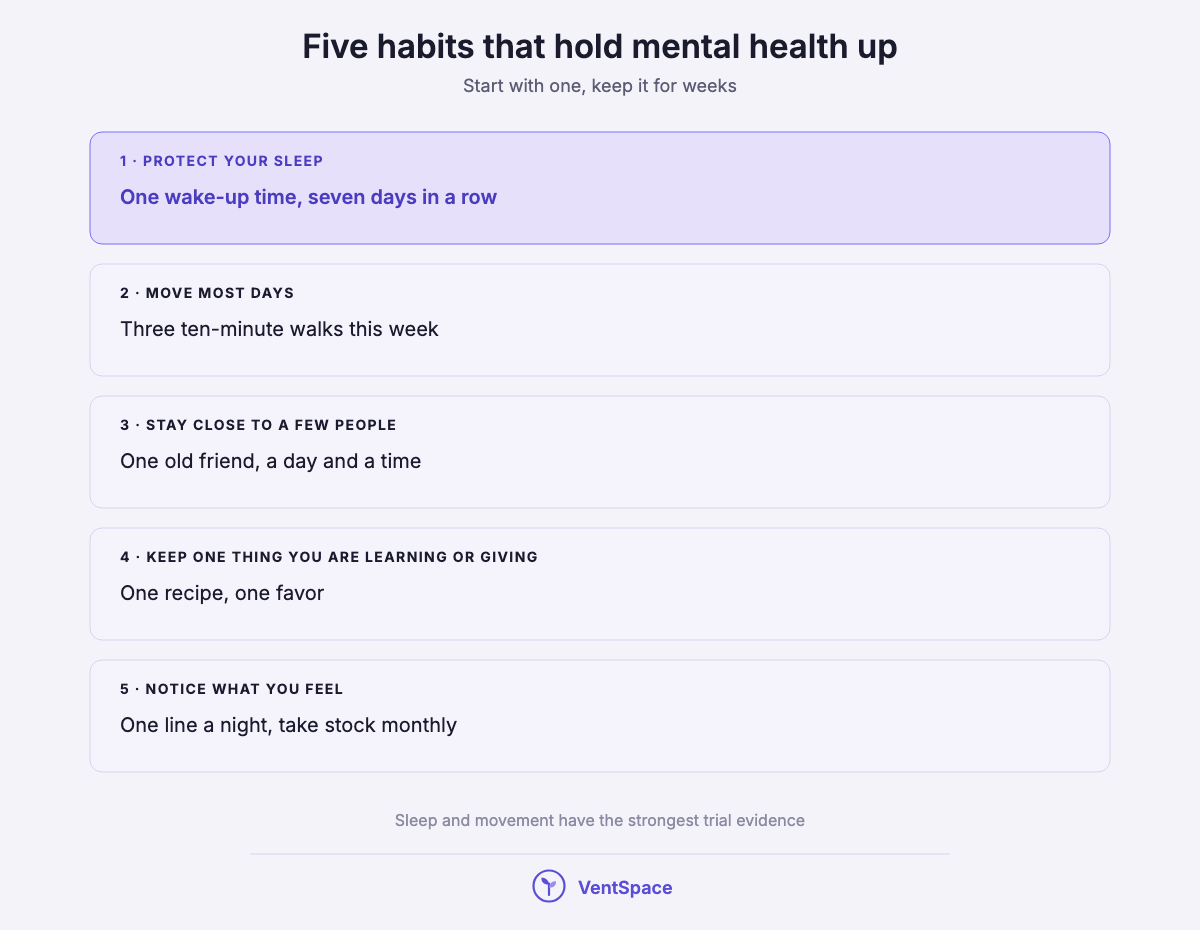
To be mentally healthy, protect your sleep, move your body most days, stay close to a few people, keep one thing you are learning or giving, and notice how you feel often enough to see a pattern. These five overlap with what the NHS, the NIMH and most public health pages recommend. The difference here is that each step tells you how strong the evidence is and gives you one thing to do before the week is out.
William James’s point, in 1890, was that the things we repeat become automatic, and that this is what makes them last. That is why the steps below are small. A habit you keep for six weeks will do more than a plan you abandon on Thursday.
Do them in any order, but do not try to do all five at once. Pick the one that feels easiest to start, not the one that feels most urgent.
1. Protect your sleep first
First action: choose one wake-up time and keep it for seven days, weekends included. Write it on a sticky note and put it where you will see it tonight.
Sleep goes first because it has some of the strongest evidence on this page. In a 2021 meta-analysis of 65 randomized trials with 8,608 participants, Alexander Scott and colleagues looked at what happened to mental health when an intervention improved people’s sleep. Better sleep led to medium-sized improvements in overall mental health, and in depression, anxiety and rumination, with smaller improvements in stress. They also found a dose-response pattern: the more sleep improved, the more mental health improved. The authors concluded that sleep is “causally related to the experience of mental health difficulties,” which is a strong claim for a field that is usually careful.
The NIMH’s own advice is short: stick to a schedule and make sure you are getting enough sleep. A fixed wake-up time is the easiest part of a schedule to control, because you cannot order yourself to fall asleep, but you can set an alarm.
Ask yourself:
- What time did I wake up on each of the last three days?
- What usually keeps me up past the point I meant to stop?
- Is there one thing I do in the last hour before bed that I could move earlier?
- If I slept well every night this week, what would I notice first?
Do not aim for a perfect night. Aim for the same wake-up time, and let the rest follow slowly.
If your sleep has been poor for weeks, or you lie awake most nights, that is worth raising with a doctor. Long-term insomnia has its own treatments, and a fixed alarm is not one of them.
2. Move your body most days, in small amounts
First action: take a ten-minute walk on three days this week. Put the three days in your calendar now, with a time next to each.
The evidence here is as large as it gets. A 2023 umbrella review led by Ben Singh pooled 97 reviews covering 1,039 trials and about 128,000 participants. Compared with usual care, physical activity had medium-sized effects on depression, anxiety and psychological distress, and the benefits showed up in healthy adults as well as in people with diagnosed conditions. Higher-intensity activity was linked to bigger improvements. Two honest limits come with it, both stated by the authors: 77 of the 97 reviews were rated “critically low” in quality, and most of the evidence concerned mild-to-moderate symptoms. Our own reading is that movement belongs alongside care for anything heavier, not instead of it.
The official US target is 150 to 300 minutes of moderate activity a week, such as brisk walking, plus muscle-strengthening activity on at least two days. That can sound like a lot. The same guidelines also say any amount of physical activity has some health benefits, and their second edition dropped the old rule that only bouts of ten minutes or more counted. Your ten-minute walk counts. So does the five-minute one.
From Sai, who writes this blog: what working out did for me
I have always felt more confident and secure when I work out. This especially helped when I had major anxiety about work and life. It was a game-changer for me.
That is one person’s experience, not a promise, but it lines up with what the research finds across many people. If you want the longer version, our guide to the role of exercise in mental health covers how much, which kinds, and what to do when you cannot get started.
Ask yourself:
- When did I last move enough to feel slightly out of breath?
- What kind of movement have I enjoyed before, even as a child?
- Which ten minutes of my day are easiest to give to a walk?
- Who could I walk with?
No one is asking you to join a gym. A walk to the store and back is a perfectly good start.
3. Stay close to a few people
First action: message one friend you have not spoken to in a while and suggest a specific time to talk. A day and a time, not “we should catch up.”
Here is an exercise from the first version of this page. Close your eyes and picture a few good moments from the past year. What do you see? Sai’s guess, which is usually right, was this: “Do you think about staring at a screen and working? Do you think about the moments you were alone? Or do you think about moments and memories with friends and family?”
The research on relationships is large, but it is a different kind of evidence from the first two steps. In a 2010 meta-analysis of 148 studies and 308,849 people, Julianne Holt-Lunstad and colleagues found that people with stronger social relationships had a 50% greater likelihood of survival over the follow-up periods studied. A 2016 review by Nicole Valtorta and colleagues found that poor social relationships were associated with a 29% higher risk of heart disease and a 32% higher risk of stroke. These are observational studies, so they show a link, not proof, and nobody has yet shown that fixing loneliness prevents either. They are still a good reason to treat friendship as part of your health, not as something extra.
The NHS’s first step to mental wellbeing is the same idea in plainer words: connect with other people. Its suggestions are small: a fixed time to eat dinner together, a day out with a friend you have not seen for a while, lunch with a colleague.
Sai’s own rule, from his original list, is the one we would put on the fridge: reach out to your old friends and talk to them once a week. One person, once a week. That is the whole habit.
Ask yourself:
- Who would I call if I had good news today?
- Who have I been meaning to message for months?
- Which friendship has drifted only because nobody made a plan?
- Do I see anyone in person, regularly, without needing a reason?
Do not wait until you feel sociable. Most people feel more like seeing others after they have done it, not before. If this step feels hard rather than just inconvenient, our guide to coping with loneliness goes further.
4. Keep one thing you are learning or giving
First action: write down one small thing you would like to learn and one person you could help this week. Then do the smaller of the two.
The NHS lists learning new skills and helping other people as two of its five steps to mental wellbeing. It says learning can boost self-confidence, help you build a sense of purpose and connect you with others, and that acts of giving and kindness can create positive feelings and a sense of reward, and help you connect with other people. We have not sized the trial evidence for these two steps ourselves, so we pass them on as the NHS’s recommendation rather than as a finding of ours. They earn their place here for a simpler reason: they give the week a point beyond getting through it.
Neither needs to be big. The NHS’s own examples include learning to cook something new, fixing something broken, saying thank you to someone, and asking a friend how they are and listening to the answer.
Sai’s advice on this, from the first version of this page, was to journal and reflect as you explore. Trying something new gives you something to notice, and writing a line about it afterward is how you find out whether it is worth keeping.
Ask yourself:
- What did I used to be curious about before life got busy?
- What would I like to be able to do a year from now?
- Who in my life could use a small hand this week?
- When did I last do something I was bad at, just to learn it?
Do not turn this into a self-improvement project. One recipe or one favor is enough.
5. Notice what you feel, and take stock now and then
First action: tonight, write one line about how the day felt, in your own words. Not what happened. How it felt.
There is a small, well-known lab finding behind this. Putting a feeling into words measurably quietens the brain’s threat response (Lieberman et al., 2007). In that study, putting a word to a negative emotional image went with a smaller response in the amygdala than processing the same kind of image in other ways. That is a finding about a lab task, not proof that a nightly line will change your life. Naming a feeling does not fix it. What it does is make it easier to see, and harder to mistake a bad Tuesday for a bad life.
Once a month or so, take stock of the legs of the table. Sai’s original list is a good one: physical health, the people around you, work and money, purpose and meaning, and how you are feeling day to day. For each one, write a sentence about how it has been lately. Do not give them scores. Ask instead:
- Which of these has been thin the longest?
- Which one would be easiest to move a little this month?
- Is anything on this list thin because of a season, like a move, exams or a new baby, rather than a problem?
- What is one leg that is holding up more than its share right now?
A thin area is often a season, not a failure, and you do not have to fix the thinnest one first. Start with the one you can reach.
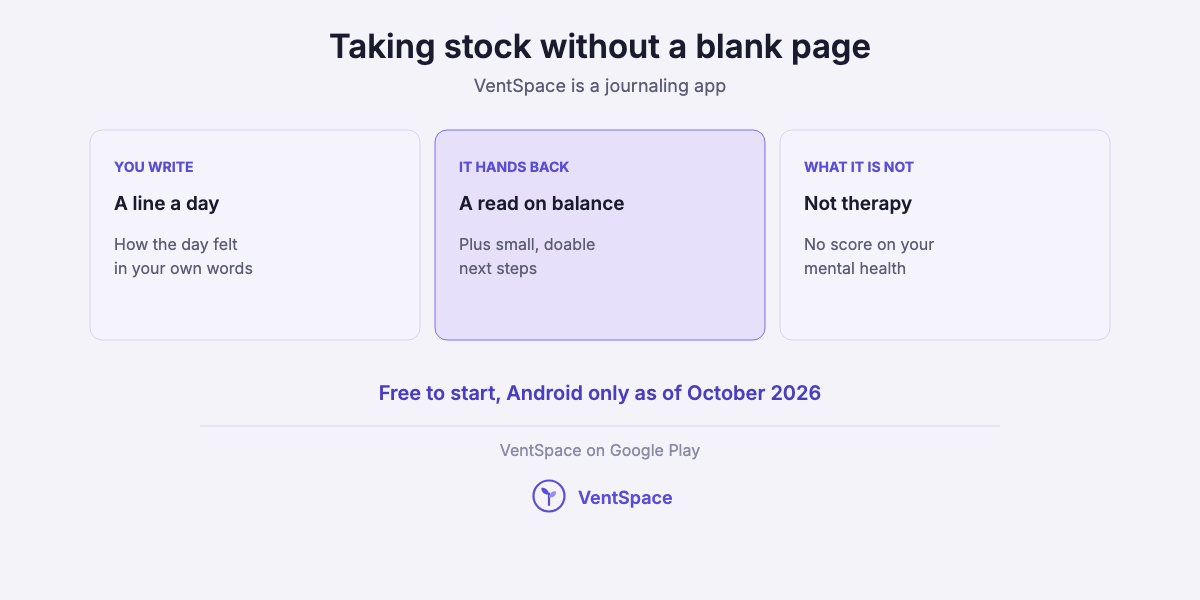
If you find it hard to see the pattern from memory, this is the step where a journal helps most, because it keeps the record for you. VentSpace is a journaling app that turns what you write into a clear read on your life balance, plus small, doable next steps. It is free to start and Android only as of October 2026. Not on Android, or at a desk? VentSpace Live runs in your browser, free, with nothing to install. It is not therapy, and it does not give you a score on your mental health. It is one way to do step 5 without starting from a blank page every month.
On the days when noticing turns into criticizing yourself, our self-compassion exercises for difficult days are a gentler place to go next.
Be honest with yourself here. No one else is reading it.
Quick Summary
Q: What are the best daily habits for mental health?
A: The habits with the strongest evidence are improving sleep and getting regular physical activity. Staying close to a few people is strongly linked to better health in observational studies. Learning something new and helping others are recommended by the NHS. Noticing and naming how you feel helps you see patterns. Start with one habit and keep it for several weeks.
Insight: Alexander Scott and colleagues, summarizing 65 randomized trials in Sleep Medicine Reviews (2021): “We also found a dose response relationship, in that greater improvements in sleep quality led to greater improvements in mental health. Our findings suggest that sleep is causally related to the experience of mental health difficulties.” Of the five habits, sleep is the one where the trials come closest to showing cause, which is why it comes first.
Pulling it all together
The five habits are one path, not five projects. Sleep and movement steady the body, people and purpose steady the week, and noticing tells you which leg needs attention next. Most people find it easiest to begin with one and add another after a few weeks.
Step 1 gives your days a fixed edge. Committed action: set one wake-up time tonight and keep it for seven days.
Step 2 gets your body involved. Committed action: put three ten-minute walks in your calendar for this week.
Step 3 keeps you close to people. Committed action: message one old friend today with a day and a time.
Step 4 gives the week a point. Committed action: write down one thing to learn and one person to help, and do the smaller one.
Step 5 shows you the pattern. Committed action: write one line tonight about how the day felt, and put a date in the calendar a month from now to take stock.
Quick Summary
Q: How do I start being more mentally healthy?
A: Pick one habit, such as a fixed wake-up time or a short daily walk, and keep it for several weeks before adding another. Stay in touch with at least one person you trust, and notice how you feel often enough to see patterns. If you have distressing symptoms for two weeks or more, talk to a doctor or a therapist.
Insight: Ben Singh and colleagues, concluding their umbrella review in the British Journal of Sports Medicine (2023): “Physical activity is highly beneficial for improving symptoms of depression, anxiety and distress across a wide range of adult populations, including the general population, people with diagnosed mental health disorders and people with chronic disease.” The same review found that effects shrank in longer programs, which is one more reason to keep the habit small enough to last.
Questions people ask about being mentally healthy
Does being mentally healthy mean you never feel sad or anxious?
No, and this is the most common misunderstanding. The World Health Organization defines mental health as being able to cope with the stresses of life, which assumes those stresses will come. Sadness, worry and frustration are normal responses to things that happen. Being mentally healthy means you can feel them, get through them and keep functioning, not that you never feel them.
What are the signs that you are mentally healthy?
There is no checklist that can tell you, and we have deliberately not made one. The research describes mental health as a mix of positive feelings and positive functioning: being able to cope with ordinary stress, having relationships that work, having some sense of purpose, and being able to learn and do your work. A more useful question than “am I mentally healthy?” is “which parts of my life feel steady, and which feel thin right now?”
Can you be mentally healthy and have a mental illness?
Researchers treat them as two separate scales. In Corey Keyes’s 2002 study, 9.4% of adults had a major depressive episode in the past year without languishing on the well-being scale. People living with a diagnosed condition can still have good relationships, purpose and good days, and treatment and well-being can grow side by side. If you have a diagnosis, the habits on this page are a support for your care, not a replacement for it.
How much sleep and exercise do you need for good mental health?
For activity, the US guidelines recommend 150 to 300 minutes of moderate activity a week, plus muscle-strengthening on two days, and they say any amount has some benefit. For sleep, the strongest finding is that improving sleep quality improves mental health, and the more it improves, the bigger the effect. If your sleep has been poor for weeks, speak to a doctor.
Is being mentally healthy the same as being happy?
No. Happiness is a feeling, and it comes and goes. Mental health includes how you function as well as how you feel: coping, connecting, learning and working. You can have an unhappy week and still be mentally healthy, and you can feel cheerful on the surface while languishing underneath.
When should I see a therapist or a doctor?
The NIMH suggests seeking professional help if you have severe or distressing symptoms that have lasted two weeks or more, such as trouble sleeping or difficulty getting out of bed because of mood, and recommends starting with a primary care provider. Therapy is one option, and for a lot of people it is the right one. If you are thinking of harming yourself, call or text 988 in the US, or find your local line at findahelpline.com.
In a nutshell
Being mentally healthy is not a mood you reach and hold. It is a table you keep steady, one leg at a time.
Two things to take with you. First, mental health is more than not being ill: it is coping, functioning and connecting, and it can be built even when nothing is wrong. Second, the honest timeline: a new habit takes weeks, not days, to feel like part of you, and some weeks the table will wobble anyway. That is not a sign the habits failed. It is a sign to check which leg got short.
Which one habit will you start this week?
About this article

Written by
Sai Subramaniam
Founder, VentSpace
I write these guides because I have been where you are. I am working through my own hard seasons, and I share the things that actually helped me, so that anyone going through it has a steady companion close by instead of facing it alone. VentSpace is the app I built for exactly that: a journaling app that turns what you write into a clear read on your life balance, plus small, doable next steps toward feeling more like yourself.
This writing is honest and every claim is sourced, and it is not a substitute for professional care. If you are struggling, reaching out to a professional is a strong move, not a failure.
Explore VentSpaceTry VentSpace LiveHow this one was checked. Every factual claim traces to a named source, and the source is printed next to the claim rather than kept in a footnote. Quotes are pinned to the work they come from, with the year, the letter or the chapter where one exists. Where a widely repeated claim could not be traced, it was left out and the omission recorded. Where a figure is contested, both sides are printed.
No affiliate links, no paid placements, and nobody paid to appear here. Where we mention our own app, we say that it is ours, we state its limits, and we never position it as a substitute for care.
Reviewed: October 2026. Prices, platforms and product availability move quickly, and anything we could not verify at the time of writing is marked as unverified rather than turned into a number.
Corrections. If something here is wrong, we would rather know. Corrections are made in place, with a note saying what changed.