
“How we spend our days is, of course, how we spend our lives.”
Annie Dillard, The Writing Life (1989)
You know what matters to you. Ask, and you could name it in a few seconds: your health, the people you love, the work you want to do well, a bit of time that is yours. Then you look at last week. The calendar is full of other people’s meetings, the evenings went to the phone, and the run you meant to go on stayed in your head. It is one of the most common shapes this takes, and it is maddening. Why does knowing what matters change so little?
Part of the answer is that values do not run your day. Habits do. Psychologists define a habit as an action your surroundings start automatically, through cues linked to it, and they find that habits keep going “even after conscious motivation or interest dissipates.” A value is a direction. A habit is the thing that moves you on an ordinary Tuesday, when the motivation is gone. What would change if your values had one of those?
So this guide does one thing. It takes one value you already hold and turns it into one small daily habit, over two weeks. The first version of this page, written in 2024, was a two-week challenge, and that part stays. What changed is that every step now rests on research you can check.
The short version
Knowing your values is not the missing step. Values mostly act outside conscious awareness, and habits run on cues, not on resolve.
Goals that fit your values get more sustained effort, in longitudinal research on self-concordant goals.
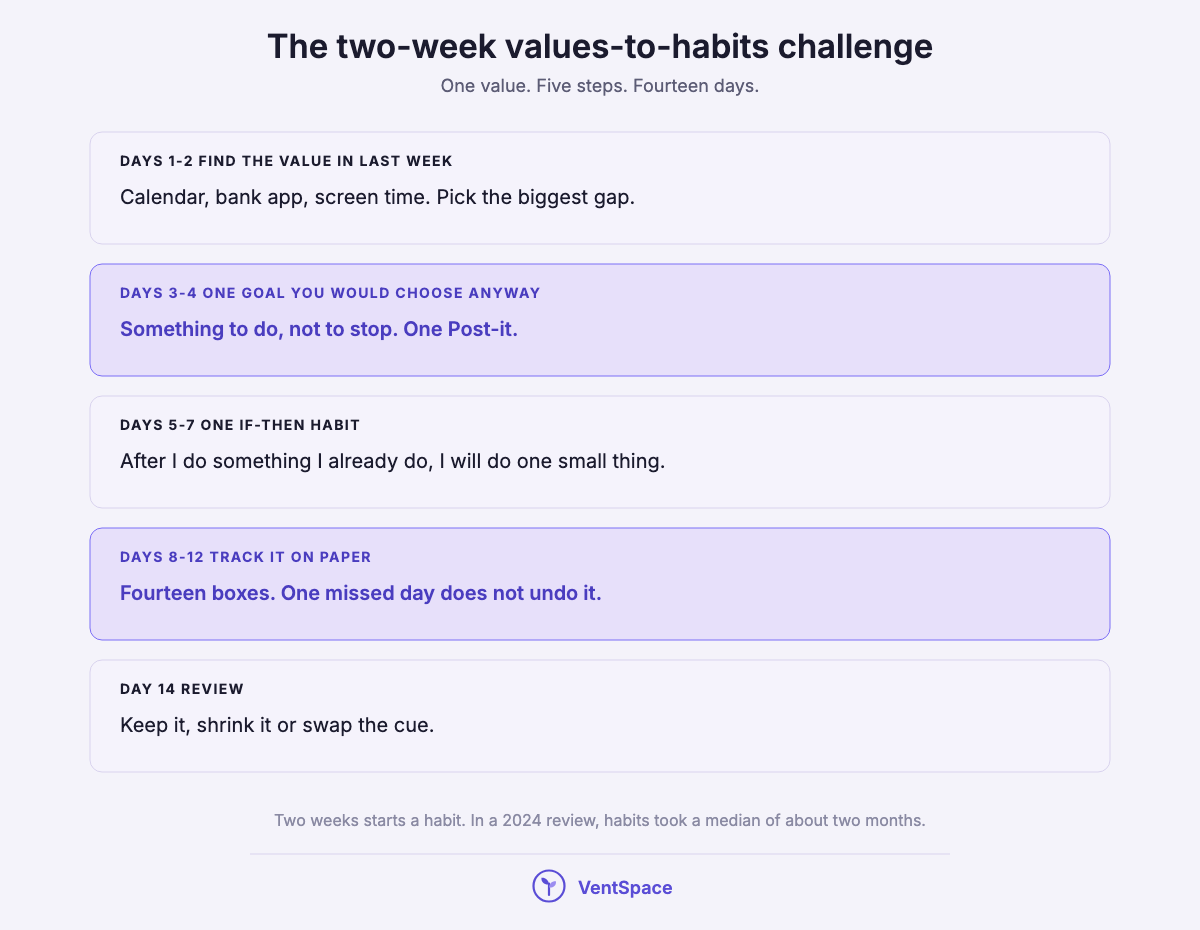
The challenge, in five steps: find the value in last week (days 1 and 2), turn it into one goal you would choose anyway (days 3 and 4), shrink it into one if-then habit (days 5 to 7), track it on paper (days 8 to 12), and review it on day 14.
Be honest about the timeline. In a 2024 review, health habits took a median of about two months to form, and individuals ranged from 4 to 335 days. Two weeks is the start.
Why knowing your values does not change your week
“The influence of values often occurs outside of conscious awareness.”
Shalom Schwartz, The Human Values Scale: Findings from the European Social Survey
Knowing a value and living it are two different jobs, and most advice only helps with the first. Shalom Schwartz’s account of human values is the most widely used one in psychology. It finds that we all recognize the same ten broad values and differ in how much weight we give each. It also says, plainly, that values mostly work on us without our noticing. That is why writing “health” on a list does not move you to the gym. The list lives in one part of your mind and Tuesday evening lives in another. So which one decides?
There is a second problem, and it is quieter. When people pick values from a list, a person shaped by years of doing well for others tends to pick the values they are supposed to have. Ambition, discipline, family. The words are true enough. They are just not always the ones that decide what you do with a free hour. Have you ever chosen a value because it sounded like the person you should be?
This matters because the fit between a goal and what you care about changes how hard you push for it. In 1999, Kennon Sheldon and Andrew Elliot described what they called self-concordant goals: goals consistent with a person’s “developing interests and core values.” Their model, tested on three longitudinal data sets, found that people pursuing goals like that put in more sustained effort and were more likely to reach them. It is a model fitted to data, not a law. It does suggest where the work is. The job is not to find better values. It is to pick goals your values would choose anyway, then make them automatic.
One honest limit, before we go further. Nobody has shown that naming your values, on its own, improves your life. The best-studied values exercise, a short piece of writing about what matters to you, has small effects in specific settings. So this guide does not ask you to write your values every morning. It asks you to do something with one of them.
Quick Summary
Q: Why don’t my values show up in my daily life?
A: Because values mostly act outside conscious awareness, and daily behavior runs on habits started by cues. Living your values takes goals that fit them, then habits attached to a cue. Research on self-concordant goals found that goals consistent with a person’s core values got more sustained effort and were more likely to be reached.
Insight: why the fit matters
“The self-concordance of goals (i.e., their consistency with the person’s developing interests and core values) plays a dual role in the model. First, those pursuing self-concordant goals put more sustained effort into achieving those goals and thus are more likely to attain them. Second, those who attain self-concordant goals reap greater well-being benefits from their attainment.” Kennon Sheldon and Andrew Elliot, Journal of Personality and Social Psychology, 1999.
What a habit is, and why your values need one
“‘Habits’ are defined as actions that are triggered automatically in response to contextual cues that have been associated with their performance.”
Benjamin Gardner, Phillippa Lally and Jane Wardle, British Journal of General Practice, 2012
A habit is an action your surroundings start for you. You get in the car and the seatbelt goes on. You use the toilet and you wash your hands. Gardner and his colleagues describe how repeating a simple action in the same context links the two, until the context starts the action without a decision. Once that happens, the action leans less on motivation, which is why habits are “likely to persist even after conscious motivation or interest dissipates.”
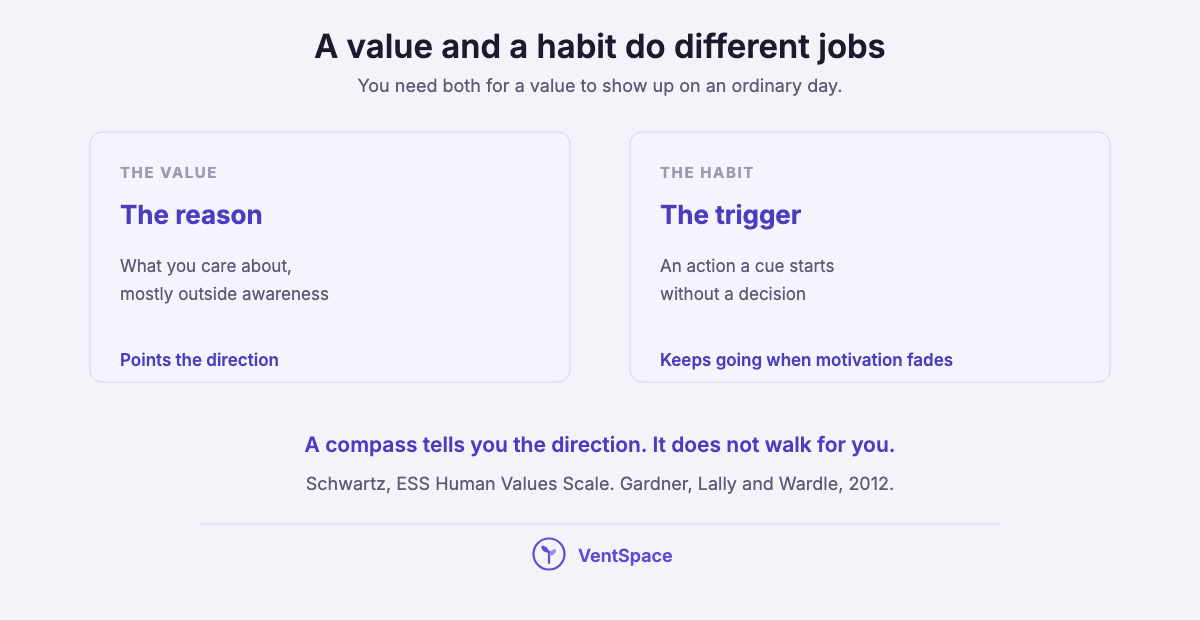
That is the piece your values have been missing. A value supplies the reason. A habit supplies the trigger. Without the reason, a habit is a chore you will drop. Without a cue, a value is a good intention you will forget by Thursday. Which have you been missing? This is Sai’s compass from the first version of this page: a compass tells you the direction, and it does not walk for you.
Two details from the habit research are worth carrying into the challenge. First, simple actions become automatic faster than elaborate ones. In the study Gardner’s team describes, drinking water peaked sooner than doing 50 sit-ups. Second, habits change how you see yourself. The first version of this page put it well: it is better to be someone who writes than someone who tries to write. Each small repeat is evidence about who you are. What would a month of that evidence say about you?
From Sai, who writes this site
That’s why I love crafting weekly challenges that are interesting and easier to follow. Mental health and personal development advice in general can be hard to follow, and hence it’s better to set challenges and work on them.
Quick Summary
Q: What is the difference between a value and a habit?
A: A value is what you care about, and a habit is an action started automatically by a cue in your surroundings. Values give a habit its reason. Habits carry a value through the days when motivation is low, because once a cue starts the action, it depends less on how motivated you feel.
Insight: small votes add up
“Every action you take is a vote for the type of person you wish to become. No single instance will transform your beliefs, but as the votes build up, so does the evidence of your new identity. This is one reason why meaningful change does not require radical change.” James Clear, Atomic Habits (2018).
So where do you start?
The two-week values-to-habits challenge
“Decide the type of person you want to be. Prove it to yourself with small wins.”
James Clear, Atomic Habits (2018)
Five steps, fourteen days, one value. Do not try to run all your values at once. Pick one this time. You can come back for the next.
1. Find the value in last week (days 1 and 2)
Open last week’s calendar, your bank app and your phone’s screen-time page, and write down where the time and money went. Do not judge it yet. You are reading what your week already says you value, which is often more honest than what a list says. Then write one line: “I want next week to show more ___.”
- What did I give the most hours to last week, and did I choose that?
- What did I spend money on that I was glad about afterward?
- When did I last feel like myself, and what was I doing?
- Which value would I be quietly embarrassed to see missing from this week?
- If someone read only my calendar, what would they think I care about?
The first version of this page asked you to think about your happiest moments first. That still works as a question. Just check the answer against the calendar. Pick the value with the biggest gap between how much it matters and how often it shows up. One value, not five. There is no wrong answer here, and nobody is grading the calendar.
If you would rather write it out than audit it. Some people find it easier to write about the week in their own words and read it back. If that is you, VentSpace is a journaling app that turns what you write into a clear read on your life balance, plus small, doable next steps. It is ours, so read that as a declared interest. It is Android only and free to start as of October 2026, it has no published evidence on outcomes, and it is not therapy. Not on Android, or at a desk? VentSpace Live runs in your browser, free, with nothing to install. A notebook and last week’s calendar do the same job.
2. Turn it into one goal you would choose anyway (days 3 and 4)
Write the value at the top of a page and three possible goals under it. Then circle the one you would want even if nobody ever saw it. That last test is the self-concordance idea in plain words: a goal you hold for your own reasons, not to look a certain way.
Two rules make the goal stronger. Phrase it as something to do, not something to stop. In a randomized study of 1,066 people making New Year’s resolutions, 58.9% of those with approach goals (“start running”) considered themselves successful a year later, against 47.1% with avoidance goals (“stop eating sugar”). Those figures are self-reported, among the people who answered at the end. Then make it specific: what, how much, by when. The old page used the SMART framework here, and it suggested writing each goal on a single Post-it note, because the small space forces you to be concise.
From Sai, who writes this site
Honestly, I hate doing this. I always feel like the more details you add, the more overwhelming it seems. But if you take your time to define it more, the easier it gets for you.
- Would I still want this goal if nobody knew I had it?
- Is it written as something I will do, not something I will stop?
- Could a stranger tell, at the end of the month, whether I did it?
- What is the first milestone, the one I could hit in two weeks?
If the goal feels too big, write the first milestone instead and treat that as the goal for now. Small is fine. Small is the point.
3. Shrink the goal into one if-then habit (days 5 to 7)
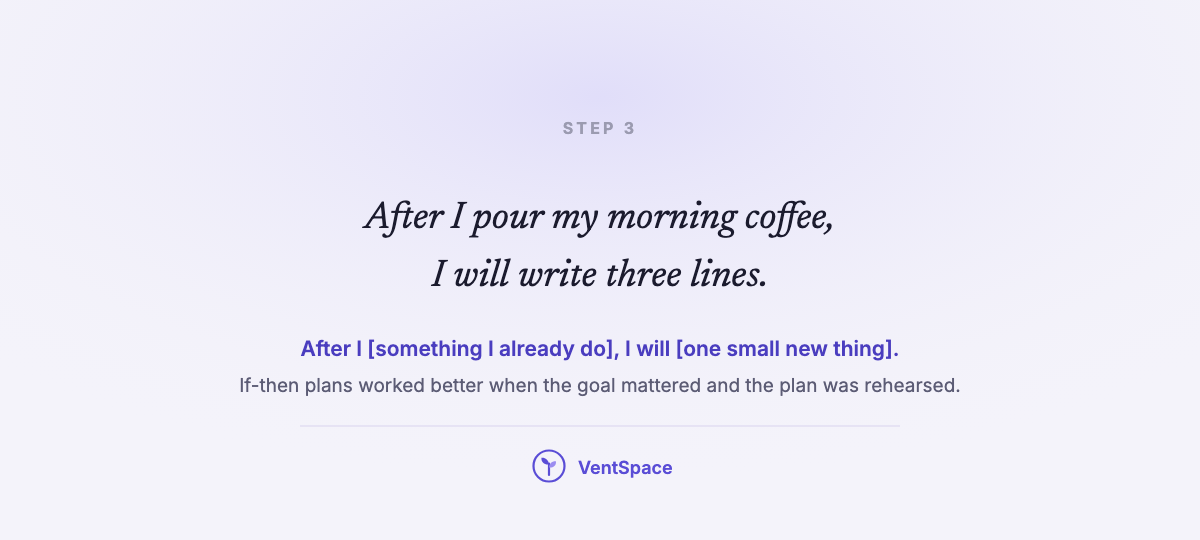
Pick something you already do every day, and write one sentence: “After I [existing routine], I will [new action].” “After I pour my morning coffee, I will write three lines about my day.” “After I get home from work, I will put my running shoes by the door and walk for ten minutes.” This is often called habit stacking, and it is an if-then plan with a cue you cannot miss.
If-then plans have a large research base. A 2024 meta-analysis by Paschal Sheeran, Olivia Listrom and Peter Gollwitzer pooled 642 independent tests and found these plans helped across behavior, thoughts and feelings, with effects from about d = .27 to .66. As they put it, “Effect sizes were larger when plans had a contingent (if-then) format, participants were highly motivated to pursue the goal, and plans were rehearsed.” That middle condition is where your value comes in. An earlier experiment by Sheeran and colleagues found if-then plans helped when people’s goals were strong, and not when they were weak. The value gives the plan its strength. The plan gives the value a time and a place.
Keep the action small enough that you could do it on your worst day. Gardner and his colleagues advise choosing “a time and place that you encounter every day of the week.” A 2024 review of habit studies found habits people chose for themselves, and morning practices, generally came out stronger, and in the one study that compared them, a clock time and an existing routine worked about equally well as cues.
- What do I already do every single day, without fail?
- What is the smallest version of my goal that still counts?
- What will I do if the cue happens and I do not feel like it?
- Where will I write the sentence so I see it tomorrow?
Say the sentence out loud a few times, or read it each morning. Rehearsal was one of the things that made plans work better. Do not worry if it feels silly.
4. Track it on paper (days 8 to 12)
Draw a row of fourteen boxes on a card and tick one each day you do the habit. That is the whole tracking system. Stickers and colors are optional, and the first version of this page was right that they make it more fun.
Tracking has good evidence behind it. A meta-analysis by Ben Harkin and colleagues gathered 138 randomized studies with 19,951 people and found that interventions that got people to monitor their progress helped them reach their goals, with an average effect of d = 0.40. The effects were larger when people wrote the information down physically, and when they reported their progress to others or made it public. So the card helps, and so does telling one person what you are doing.
If you miss a day, do not start over. One missed day does not undo the work. In the study Gardner’s team describes, missing the occasional chance to do the behavior “did not seriously impair the habit formation process,” and progress resumed after a single miss. Two missed days in a row? That is a signal to shrink the habit, not to quit.
- Did I do it today? Tick or blank, nothing in between.
- When I skipped, what happened right before the cue?
- Who is one person I can tell about this, and when will I tell them?
The card is not a test of your character. It is information about where the plan needs work.
5. Review on day 14 and plan the next two weeks
On day 14, look at the card and write three lines: what worked, what got in the way, and what you will change. Then decide one of three things for the next two weeks. Keep it as it is, shrink it to a smaller version, or swap the cue for one that fits your days better. Only add a second habit once the first one is ticking most days without a struggle.
- How many boxes did I tick, honestly?
- Did the habit feel more automatic in week two than in week one?
- Does this goal still serve the value I started with?
- Is there a second value that is asking for attention now?
Values themselves move, slowly. Schwartz writes that “both personal and collective values change quite slowly, but they do change.” If something has shifted, that is not failure. Our guide on evolving personal values is written for that moment. Whatever you decide, write it down before you close the card.
Quick Summary
Q: How do you turn values into daily habits?
A: Find the value with the biggest gap in last week’s calendar, turn it into one goal you would choose anyway, phrased as something to do. Shrink it into an if-then habit attached to a routine (“After I pour my coffee, I will write three lines”), track it on paper for two weeks, and review it on day 14. If-then plans and progress tracking both have meta-analytic evidence behind them.
Insight: what makes tracking work
“Moderation tests revealed that progress monitoring had larger effects on goal attainment when the outcomes were reported or made public, and when the information was physically recorded. Taken together, the findings suggest that monitoring goal progress is an effective self-regulation strategy, and that interventions that increase the frequency of progress monitoring are likely to promote behavior change.” Ben Harkin and colleagues, Psychological Bulletin, 2016.
When the habit does not stick
“you don’t have to go with the grain. The grain clearly will pay more, but the grain is not going to bring you any joy.”
A US medical resident, interviewed for a 2024 study of residents’ identity struggles (Sawatsky and colleagues, Perspectives on Medical Education)
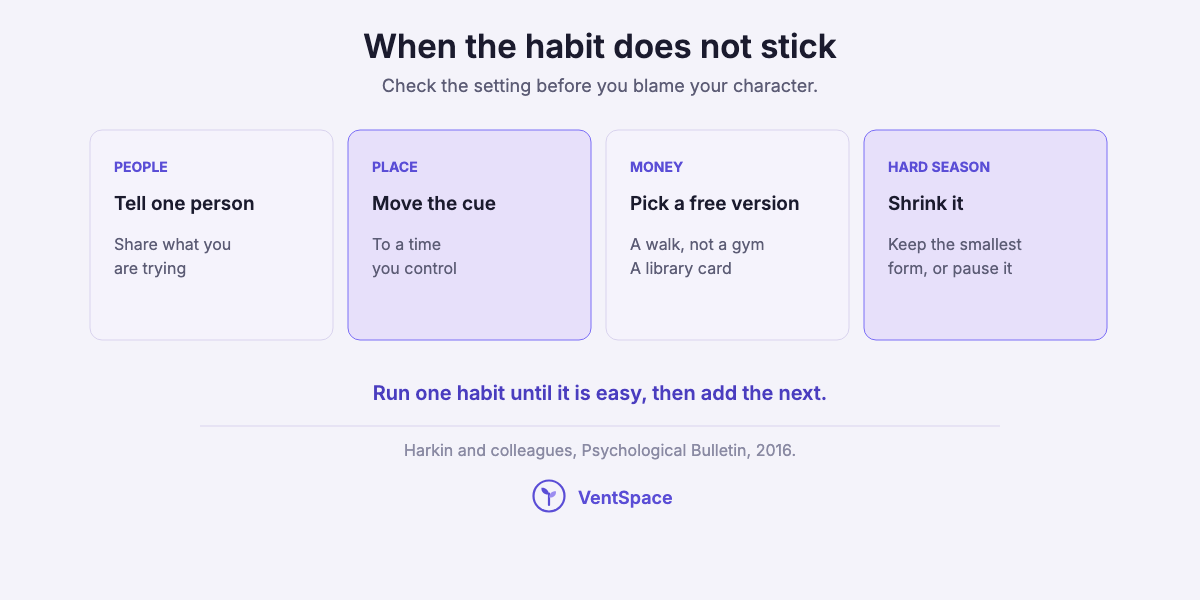
When a value-based habit keeps failing, check the setting before you blame your character. Why start there? Because you can change a setting today. The first version of this page named four settings that get in the way, and they still hold. Here is what to do about each.
The people around you. The first version of this page put it plainly: friends who share your values can be a motivator and an accountability partner, and friends who do not can pull your evenings toward things you do not value. You do not need new friends. You need one person who knows what you are trying, which is also what the tracking research suggests.
The place you live and work. If you want quiet growth and you live in a student dorm with late-night parties, the cue you picked may never arrive in peace. If your job runs on tight deadlines, an evening habit may lose every time. Move the cue to a part of the day you control, even if it is ten minutes before everyone else wakes up.
Money. Some value-based habits cost money, and, as the old page said, financial worries can become a distraction of their own. Pick a version that costs nothing for now: a walk instead of a gym, a library card instead of a course.
Hard seasons. Illness, job loss or a relationship ending can knock any habit over. That is not the moment to add more. Shrink the habit to its smallest form and keep only that, or pause it on purpose and write down the date you will restart.
Too many habits at once. The first version of this page called this the paradox of choice. Whatever the label, the fix is the same. Run one habit until it is easy, then add the next.
And plateaus. The old page said it best: growth is never a linear path. Some weeks the card looks worse than the week before. Expect it, and plan the occasional day off rather than waiting for one to happen to you. If your motivation has faded more widely, our piece on why motivation fades and how to rekindle it goes deeper. If the bigger question is what all of this is for, start with how to discover your life purpose.
Sometimes it is not a habit problem at all. If you have felt flat, empty or disconnected from yourself for weeks, and it is reaching your sleep, your work or the people you love, that is worth talking through with a doctor or a therapist. Therapy is one option. For a lot of people it’s the right one.
Quick Summary
Q: Why do my value-based habits keep failing?
A: Usually because of the setting: the people around you, a home or job that crowds out the cue, money, a hard season, or too many habits at once. Move the cue to a time you control, shrink the habit, and run one at a time. If you have felt flat or empty for weeks, talk to a doctor or therapist.
Insight: the timeline is wide on purpose
“Emerging evidence on health-related habit formation indicates that while habits can start forming within about two months, the time required varies significantly across individuals.” Ben Singh and colleagues, Healthcare, 2024, a systematic review of 20 studies with 2,601 participants.
Pulling it all together
The five steps make one path from a value you hold to a habit you keep.
| Days | Step | What you write down |
|---|---|---|
| 1 and 2 | Find the value in last week | “I want next week to show more ___.” |
| 3 and 4 | Turn it into one goal you would choose anyway | One approach goal and its first milestone, on a Post-it |
| 5 to 7 | Shrink it into an if-then habit | “After I ___, I will ___.” |
| 8 to 12 | Track it on paper | Fourteen boxes, one tick a day |
| 14 | Review and plan the next two weeks | Keep, shrink or swap, in three lines |
First, read last week. Calendar, bank app, screen time. Write the one value you want next week to show more of.
Then, pick one goal that value would choose anyway, phrased as something to do. Write it on a single Post-it.
Next, shrink it into one sentence: after I do something I already do, I will do the small new thing. Put the sentence where you will see it tomorrow morning.
From day 8, tick the card every day you do it, and tell one person what you are trying.
On day 14, read the card and decide: keep, shrink or swap. Write the decision down and start the next two weeks.
Questions people ask
Does it take 21 days to form a habit?
No source anyone can point to supports that number. A 2024 systematic review of 20 studies found health habits took a median of about two months to form, with means of up to five months and individuals ranging from 4 to 335 days, and its authors say the results refute the popular 21-day idea. Use two weeks to start the habit, not to finish it.
Did Gandhi say “your thoughts become your words, your words become your actions”?
We could not trace it to Gandhi, so we have not quoted it as his. Quote Investigator found the modern version of the saying in a 1977 Texas newspaper column that credited Frank Outlaw, the late president of a grocery chain, and found no support for versions credited to Emerson or the Buddha. The idea behind it, that small repeated actions shape who you become, is close to the James Clear line above.
How many value-based habits should I work on at once?
One, until it is easy. Then add the next. The if-then research found plans worked better when people were highly motivated to pursue the goal, and it is hard to keep that level of commitment for five new habits at once.
Do I need a habit app?
No. A paper card works. In the tracking meta-analysis, effects were larger when progress was physically recorded. If an app is what you will open every day, use the app. The best tracker is the one you look at.
What if two of my values pull in different directions?
That is normal. In Schwartz’s account, values sit in a circle and some pull against each other, like ambition and looking after others. You do not have to settle the conflict forever. Pick the one with the bigger gap for these two weeks, and give the other its turn in the next challenge.
In a nutshell
A value becomes daily life only when it is tied to a cue. Read the value in last week, turn it into one goal you would choose anyway, and attach it to something you already do. The compass points. The habit walks.
This takes longer than two weeks, and that is normal. In the best review we found, health habits took a median of about two months, and some people took far longer. Two weeks gets the habit started and shows you what to fix. Keep going after the card is full.
Open last week’s calendar today and write the one value you want next week to show more of.

About this article

Written by
Sai Subramaniam
Founder, VentSpace
I write these guides because I have been where you are. I am working through my own hard seasons, and I share the things that actually helped me, so that anyone going through it has a steady companion close by instead of facing it alone. VentSpace is the app I built for exactly that: a journaling app that turns what you write into a clear read on your life balance, plus small, doable next steps toward feeling more like yourself.
This writing is honest and every claim is sourced, and it is not a substitute for professional care. If you are struggling, reaching out to a professional is a strong move, not a failure.
Explore VentSpaceTry VentSpace LiveHow this one was checked. Every factual claim traces to a named source, and the source is printed next to the claim rather than kept in a footnote. Quotes are pinned to the work they come from, with the year, the letter or the chapter where one exists. Where a widely repeated claim could not be traced, it was left out and the omission recorded. Where a figure is contested, both sides are printed.
No affiliate links, no paid placements, and nobody paid to appear here. Where we mention our own app, we say that it is ours, we state its limits, and we never position it as a substitute for care.
Reviewed: October 2026. Prices, platforms and product availability move quickly, and anything we could not verify at the time of writing is marked as unverified rather than turned into a number.
Corrections. If something here is wrong, we would rather know. Corrections are made in place, with a note saying what changed.