
We had the thirty-six questions pasted into a draft of this page, and then we took them out again, which is worth explaining because it is the whole argument.
They are everywhere. Every page on this subject either reprints them or is quietly downstream of them, and what gets reprinted is always the list. But go back to the paper that produced them and the list turns out to be the least interesting part. The questions were arranged in three sets of twelve, they escalated in intensity across the sets, and the two people took turns, forty-five minutes, roughly a quarter of an hour at each level. The control group was not silence. It was thirty-six pieces of small talk. So what the experiment tested was not the questions. It was the shape.
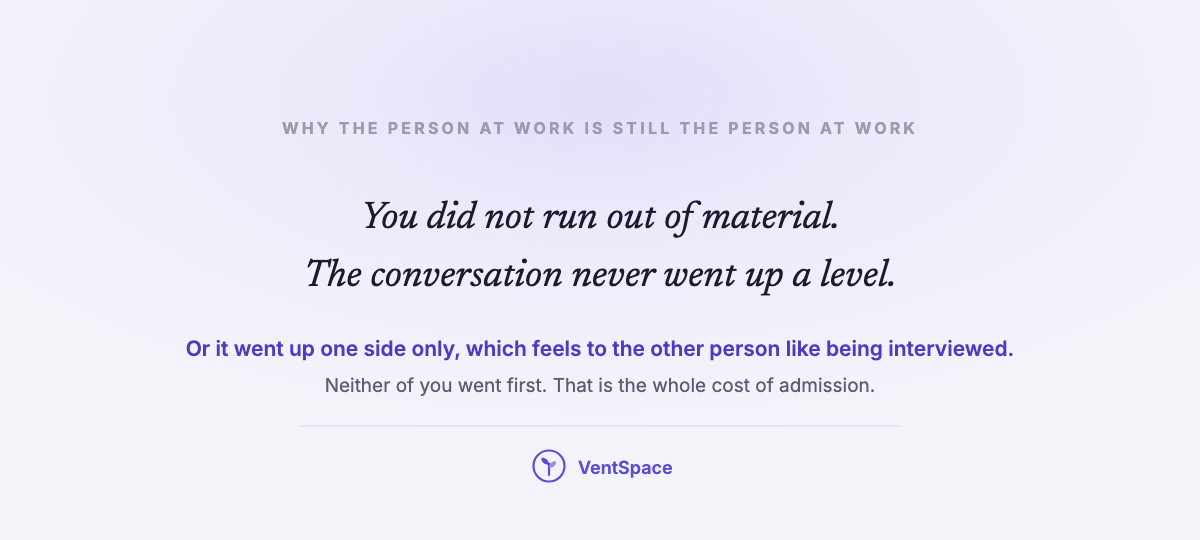
Which reframes the problem you probably arrived with. The reason the person at work has stayed at work for eight months is almost never that you ran out of material. It is that the conversation has never gone up a level, or that it went up one side only, which feels to the other person like being interviewed. So these sixty questions are sorted by level rather than by theme, and there is exactly one rule for using them. Do you want to guess what it is?
The short version
The order is the active ingredient, not the questions. Depth that rises in steps is the thing the research tested.
One rule: answer every question you ask, at the same depth, before asking another. A one-sided version produces the opposite of closeness.
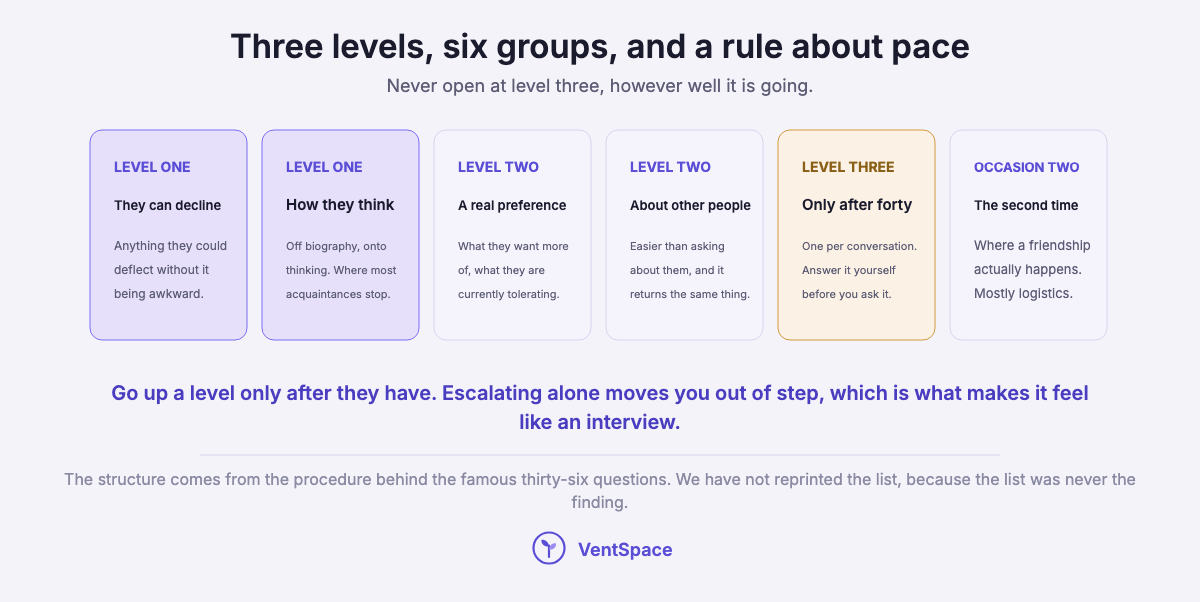
Sixty questions in six groups, across three disclosure levels.
The last ten are for the second and third occasion, because a laboratory produces closeness in forty-five minutes and a friendship does not.
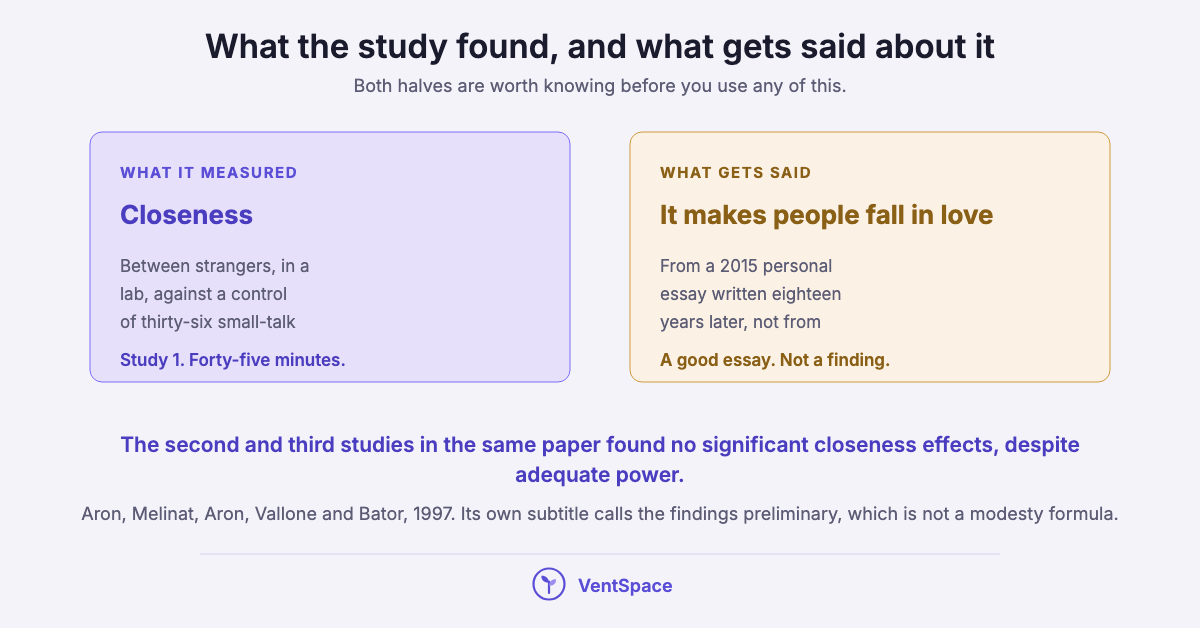
The famous study is more modest than its reputation. Two of its three studies found no significant effect, and it never measured love.
How to actually use these
Answer every question you ask, at the same depth, before you ask another. That is the rule, and everything else here is detail.
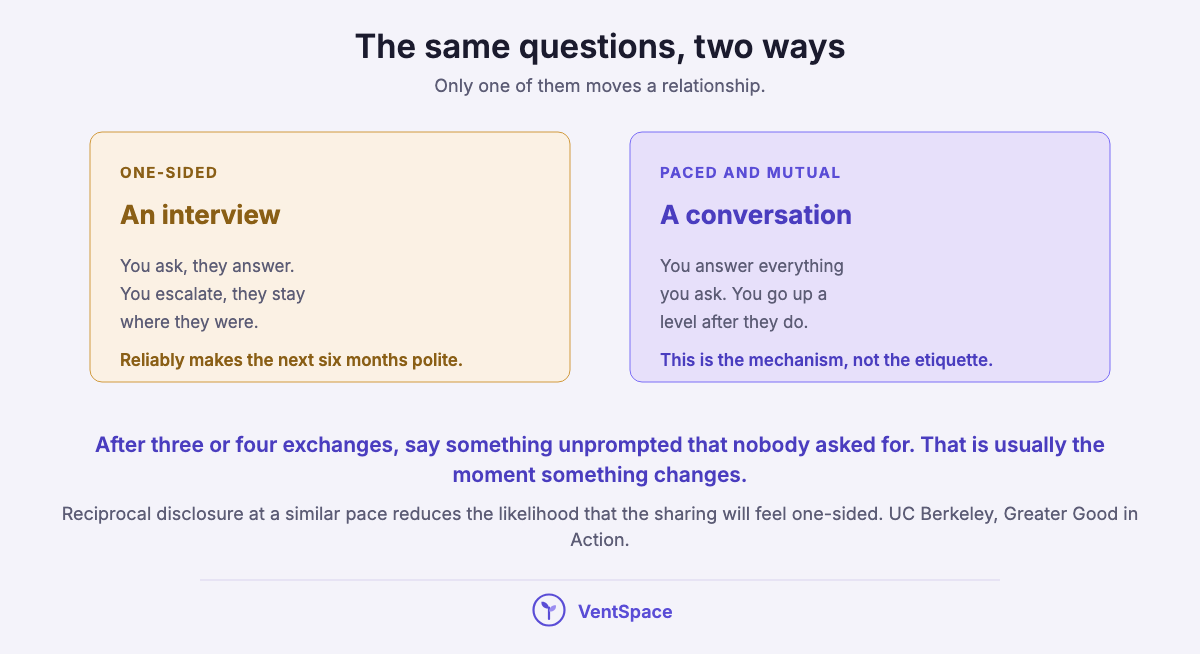
The failure mode has a shape and most of us have been on the receiving end of it. Somebody asks a level-three question at level one, usually with good intentions, and the other person gives a polite answer and then keeps the conversation at coffee for the next six months. Escalating alone does not pull anyone up. It moves you out of step with them, and being out of step is what makes a conversation feel like an interview.
So go up a level only after they have. If you answered question nine with something real and they answered theirs with a fact, stay at that level and be pleasant about it. Some people take three conversations to move, and moving at their pace is not a compromise. It is the mechanism.
A practical scale for the levels, since they are the page’s whole structure. Level one is anything they could deflect without it being awkward. Level two is anything that reveals a genuine preference or a current dissatisfaction. Level three is anything they would be able to name a reason for not answering. Never open at level three, however well the conversation is going.
And know when to stop asking and start talking. A question every ninety seconds is an interrogation. After three or four exchanges, say something unprompted about yourself that nobody asked for. That is usually the moment an acquaintance notices something has changed.
Where does this actually happen? Not over a list. Nobody has ever produced a phone at lunch and read out number twenty-three. Read a group before you see someone, pick two, and forget the rest.
Quick Summary
Q: How do you get past small talk with someone?
A: By escalating in steps and matching their pace, rather than by finding a better question. Answer everything you ask at the same depth before asking again, and go up a level only after they have. Asking a deep question too early is what makes a conversation feel like an interview.
What the famous experiment actually found
The thirty-six questions come from a 1997 paper by Arthur Aron and colleagues, and it is worth being precise about it, because this keyword’s whole reputation rests on a newspaper essay written about it eighteen years later.
A note on how we read it. The paper’s own PDF would not load: the publisher returned a block and the usual mirrors returned empty pages. What follows comes from the University of California, Berkeley’s own hosted version of the procedure, from the procedure document itself, and from a university course summary. Where we rely on those rather than on the paper, we say so.
The procedure. Forty-five minutes, three sets of twelve questions, escalating in intensity, with the two people taking turns. The comparison group did thirty-six small-talk questions for the same length of time.
The result, in Berkeley’s words: the closeness-question pairs reported a greater increase in closeness than the small-talk pairs, and their closeness afterwards matched the average level participants reported in their closest relationships.
Now the parts the reprints leave out. The course summary reports that the second and third studies in the same paper found no significant closeness effects, despite adequate power. The paper’s own subtitle describes its findings as preliminary, which is not a modesty formula. And nothing in it measured love. The outcome was closeness, in a laboratory, between strangers who had been told to do this. The love framing arrived in 2015 through a personal essay, which is a good essay and is not evidence.
Quick Summary
Q: Do the 36 questions actually work?
A: In one study, pairs who used them reported more closeness than pairs who made small talk for the same time. Two further studies in the same paper found no significant effect, the authors called the findings preliminary, and the outcome measured was closeness rather than love.
Insight
On why the order and the turn-taking matter, in the words of the University of California, Berkeley’s own hosted version of the procedure: the mechanism is reciprocal self-disclosure, revealing increasingly personal information at a similar pace as one’s partner, which “reduces the likelihood that the sharing will feel one-sided” and mirrors the ordinary getting-to-know-you process at an accelerated pace.
Greater Good in Action, UC Berkeley, on Aron et al., Personality and Social Psychology Bulletin 23(4), 1997. The thirty-six questions themselves are hosted there and we have not reprinted them.
How these are grouped
Three levels, six groups, ten questions each. Level one is where every acquaintance already lives. Level two is where a real preference shows and where most relationships either move or stop. Level three is not for a first conversation under any circumstances.
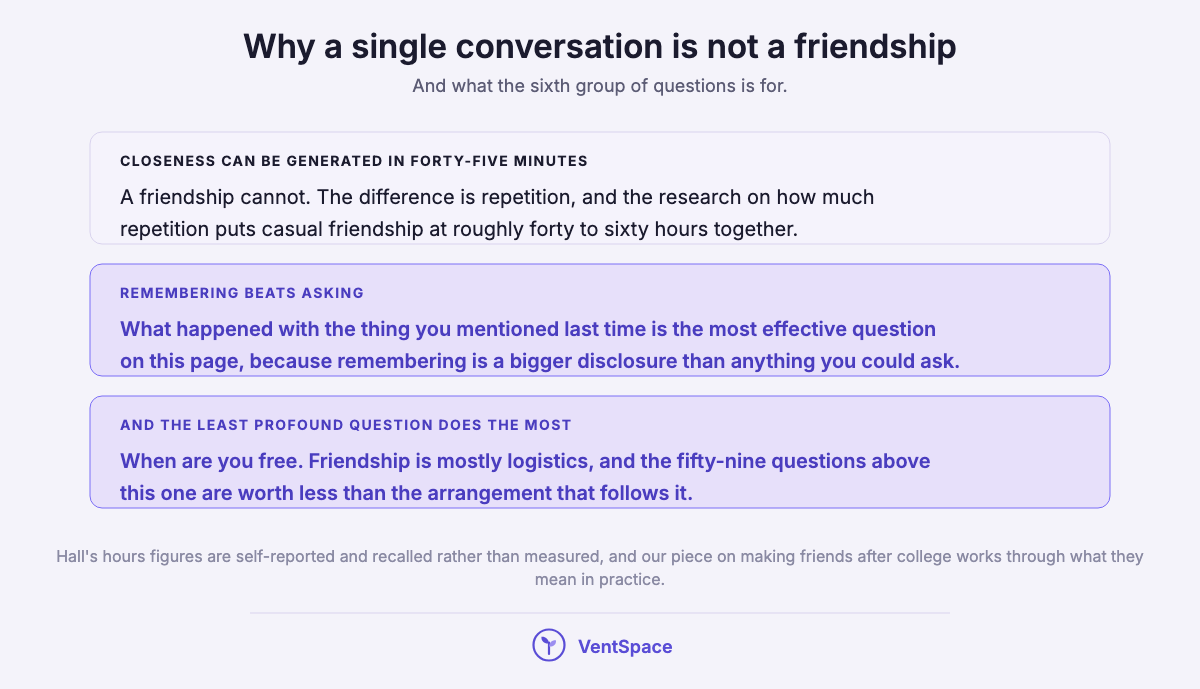
The sixth group is different and it is the reason this page exists rather than being another list. Those ten are for the second and third occasion, because closeness generated in forty-five minutes is not a friendship, and the difference is made of repetition.
Level one: the ones they can still decline
1.What has been taking up most of your week?
More useful than asking how they are, because it asks for a subject rather than a verdict, and almost nobody answers it with the word fine.
2.What did you do last weekend that you would do again?
The second clause does the work. It turns a report into a small preference, which is the first thing worth knowing about anybody.
3.What are you looking forward to?
Low cost and quietly revealing. What somebody puts in the future tense tells you what they are currently short of.
4.How did you end up doing what you do?
Not what they do, how they ended up. Almost every career has an accident in it, and the accident is the interesting part.
5.Where did you grow up, and what was it like to leave?
The first half is an icebreaker and the second half is not. Together they usually produce the first real sentence of the conversation.
6.What is the last thing you got properly absorbed in?
Absorption is specific and slightly private, and people are generally pleased to be asked about it because nobody ever is.
7.Who have you seen most of this month?
A factual question with a social answer. It tells you who is actually in their life without asking anything intrusive.
8.What is everyone around you doing that you have no interest in?
Mildly conspiratorial, entirely safe, and it produces a genuine opinion faster than almost any other level-one question.
9.What do you do with an unexpectedly free evening?
The honest answer here is more revealing than the answer to what they enjoy, because it describes what they actually do rather than what they endorse.
10.What is the best thing you have eaten recently?
Deliberately small. Not every question needs to earn its place, and a light one after a heavier one is how you avoid sounding like a form.
Quick Summary
Q: What are good questions to ask someone you just met?
A: Questions they could decline without awkwardness and that still ask for something specific. What has taken up their week, what they did that they would do again, what they got absorbed in. Asking for a subject rather than a verdict is what stops the answer being “fine”.
Level one: how they think, rather than what they do
11.What have you changed your mind about?
Still safely level one, and it moves the conversation from biography to thinking, which is where most acquaintances have never been taken.
12.What do you think you are unusually good at noticing?
Flattering without being flattery. It asks for a real self-assessment in a domain nobody feels defensive about.
13.What is a rule you follow that nobody asked you to?
You may have a few, and it is a question that rarely gets asked. The answers are consistently better than the question deserves.
14.What do you find interesting that most people find boring?
The quickest route to enthusiasm, and enthusiasm is what makes somebody memorable rather than pleasant.
15.How do you decide whether something is worth your time?
A thinking question dressed as a practical one, and the answer tells you most of what their next year will look like.
16.What is a compliment you do not believe?
Edging toward level two, so watch how they take it. If they answer properly you are further along than you thought.
17.What is the most useless thing you know a lot about?
Permission to be strange, which is the thing acquaintances almost never give each other and the thing friendship largely consists of.
18.What kind of problem do you enjoy?
Better than asking what they do for work, because it gets at the same material without the status attached.
19.What do you do when you cannot decide?
Everybody has a method and almost nobody has articulated it. Expect a pause, and let the pause happen.
20.What is a question you wish people asked you?
The hinge of level one. Whatever they say, ask it next, and you have moved a level without doing anything clever.
Quick Summary
Q: What questions make someone open up?
A: Questions about how they think rather than what they do. What they have changed their mind about, what rule they follow that nobody imposed, what problem they enjoy. These stay easy to answer while moving the conversation off biography, which is where most acquaintanceships are stuck.
Level two: where a real preference shows
21.What do you want more of at the moment?
The first properly level-two question. Wanting is a disclosure, and answering it honestly is a small act of trust.
22.What are you currently tolerating?
Unusually productive, because the things people put up with are more specific and less rehearsed than the things they complain about.
23.What did twenty-year-old you expect to be doing now?
Gentler than asking whether they are happy with their life, and it gets at the same gap without requiring anybody to admit to one.
24.What would you do with a completely free year?
Hypothetical, so it is safe, and the answer is rarely hypothetical at all. The answer can turn out to be something already half planned.
25.What have you stopped pretending to like?
Small, funny and genuinely level two, because it involves admitting to a previous pretence. Answer it yourself first.
26.What do you spend money on that other people find odd?
Money questions are usually intrusive and this one is not, because it asks about a choice rather than an amount.
27.What is the trade you keep making?
Everybody has one. Time for money, proximity for space, ambition for calm. Naming it out loud is not a small thing to do.
28.What kind of day leaves you in a good mood?
Practical and more useful than it sounds. It is also the question that most often leads to a second occasion being arranged.
29.What are you avoiding?
Right at the top of level two. Only ask if you are prepared to answer it first, and answer it first.
30.What would have to change for this year to feel different?
Big, but still about circumstance rather than about them, which is what keeps it inside level two rather than above it.
Quick Summary
Q: What is a good deep question that is not too much?
A: One about circumstance rather than character. What they want more of, what they are currently tolerating, what trade they keep making. These ask for a real preference without asking anybody to disclose something they might regret, which is the line between level two and level three.
Level two: about other people, which is easier than about them
31.Who do you admire that you actually know?
The qualifier is the question. Admiration for a stranger is a preference. Admiration for somebody they see every week is a confession about values.
32.Who has changed the way you think?
Easier to answer than a question about themselves and it returns the same information, which is what makes this group worth having.
33.What did your first job teach you about people?
Nostalgic, safe, and it produces a genuine observation about others that is really an observation about them.
34.Who do you talk to when something goes wrong?
Important and rarely asked. If the answer is nobody, do not make a thing of it. Note it and be the sort of person who could be the answer later.
35.What do your oldest friends know about you that newer people do not?
A level-three question in a level-two coat. It lets them choose the depth of their own answer, which is why it works.
36.Who do you owe a message to?
Light and disarmingly universal. Everyone has one and almost everybody feels slightly guilty about it, which is a nice thing to share.
37.What kind of person do you find it hard to be generous about?
Asks for an unflattering admission about themselves by pointing at somebody else, which is the easiest route to one there is.
38.Who would be surprised that you and I are talking like this?
Mildly bold, and it makes the conversation itself the subject, which is one of the few ways to acknowledge that something has shifted.
39.What did your family treat as normal that turned out not to be?
Everybody has one, it is usually funny before it is anything else, and it sits right at the top of level two.
40.Who do you miss?
The last question before level three, and the point to stop for the day if they have been answering briefly. Answer it yourself before asking.
Quick Summary
Q: How do you ask personal questions without being intrusive?
A: Point the question at somebody else. Who they admire, who changed how they think, who they owe a message to, what their oldest friends know. The answers are about them, and the shape of the question lets them set their own depth, which is what keeps it comfortable.
Level three: only after the first forty
Ten questions with a condition attached. Do not bring these to a first conversation, do not ask two of them in a row, and answer each one yourself before you ask it. If any of them lands badly, the right move is to answer it yourself at length and then change the subject.
41.What are you most proud of that nobody would guess?
A gentle way into level three, because pride is easier to disclose than difficulty and it opens the same door.
42.What is the hardest thing you have been through that you are happy to talk about?
The second clause is not politeness, it is the consent built into the question, and it must stay in when you ask it.
43.What do you think you are wrong about?
Rare and disarming. Almost nobody is asked this, and the willingness to answer it is itself the disclosure.
44.What are you afraid of that you do not say out loud?
High on the ladder. Ask it only if you have already answered something at this level, and expect a long pause.
45.When did you last feel properly understood?
Often the question that changes a friendship, and the answer is frequently a specific afternoon with a specific person.
46.What would you want said about you by somebody who knew you well?
Aspirational rather than confessional, which makes it the safest question in this group and a good one to open with.
47.What do you think you are like to be close to?
Difficult, and worth it. You may find they have a private answer to this and have never had occasion to say it.
48.What do you do when you are not coping?
Practical rather than dramatic, and it is the question most likely to turn an acquaintance into somebody you would actually call.
49.What has this year taken from you?
Direct, and only for somebody who has been meeting you at this level. If in doubt, ask 41 instead and come back to this another time.
50.What is the thing you would like me to understand about you?
The top of the ladder and the most generous question here, because it hands them the choice of what the disclosure is.
Quick Summary
Q: What are deep questions to ask a friend?
A: Questions with consent built into them. What is the hardest thing they are happy to talk about, what they think they are wrong about, what they do when they are not coping, what they would like you to understand. Ask one per conversation, and answer each one yourself first.
The second and third occasion, which is where a friendship happens
Ten questions that only exist because you met before. A laboratory produced closeness in forty-five minutes. A friendship is made of repetition, and how many hours that tends to take is covered further down.
51.What happened with the thing you mentioned last time?
The single most effective question in this entire article. Remembering is a bigger disclosure than anything you could ask.
52.What has changed since we talked?
Assumes continuity, which is itself the message. It quietly says that this is a series of conversations rather than a set of separate ones.
53.What has been the hardest part of this week?
Level two on a first meeting, level one by the third. The ladder moves down as the relationship moves up, which is worth knowing.
54.What are you working on that is going badly?
Asking about the failing thing rather than the going-well thing is a friendship move, and it can land as one.
55.What did you think about after we last spoke?
Slightly exposed, and the exposure is the point. It admits that the previous conversation mattered enough to be thought about.
56.What do you want to do that you have nobody to do it with?
Often produces the arrangement that turns this into a friendship, which makes it the most practically useful question on the page.
57.Can I ask how the thing with your family is going?
The pattern matters more than the subject. Asking permission to return to something heavy is what makes it safe to have mentioned.
58.What would you want from a friendship, if you could specify it?
Unusual and a little awkward, and worth the awkwardness with anybody you have already had two good conversations with.
59.What do you need that you would not ask for?
Near the top of the ladder, and answerable only by somebody who trusts you. Do not ask it before the third occasion.
60.When are you free?
The last and least profound question here, and it does more than the other fifty-nine combined. Friendship is mostly logistics.
Quick Summary
Q: How do you turn an acquaintance into a friend?
A: By meeting again, and by referring back. Remembering what somebody said last time does more than any question, and asking when they are free does more than remembering. Closeness can be generated in one conversation, but a friendship is made of repeated occasions.
Insight
On how much repetition this actually takes, Jeffrey Hall’s survey and follow-up work puts casual friendship at roughly 40 to 60 hours together, friendship at 80 to 100, and close friendship beyond 200. Those are estimates from recalled and self-reported hours rather than a stopwatch. Our piece on making friends after college works through what that means in practice.
Jeffrey A. Hall, Journal of Social and Personal Relationships, 2019.
A three-conversation run
| Occasion | Groups to draw from | How many questions | What you are doing |
|---|---|---|---|
| First | Level one, 1 to 20 | Two or three, no more | Establishing that you ask about subjects rather than states, and answering everything yourself |
| Second | Level two, 21 to 40, and 51 to 53 | Two, plus one that refers back | Moving up one level, and proving you remembered |
| Third | Level two, then one from level three | One at level three, at most | Testing whether they escalate back. If they do not, stay where you are and enjoy it |
| Fourth onwards | 54 to 60 | Whatever arises | Arranging the next occasion, which is the part that actually does the work |
Do not run this as a programme. Read a group before you see somebody, pick two, and leave the page behind. A conversation that feels administered is worse than small talk.
If you only ask five
1. What has been taking up most of your week? Asks for a subject rather than a verdict.
2. What is a question you wish people asked you? Moves a level without you having to do anything clever.
3. What are you currently tolerating? The most productive level-two question here.
4. What happened with the thing you mentioned last time? More powerful than any question on this page.
5. When are you free? Does more than the other fifty-nine combined.
Questions people ask
Do the 36 questions make people fall in love?
No, and the paper never claimed it. The measured outcome was closeness between strangers in a laboratory, two of the three studies in that paper found no significant effect, and the authors called the findings preliminary. The love framing comes from a 2015 personal essay, which is worth reading and is not a finding.
How many questions should I ask in one conversation?
Two or three, and answer each one yourself. A question every ninety seconds is an interview. The moment that usually shifts an acquaintanceship is not a question at all, it is saying something unprompted about yourself that nobody asked for.
What if they do not ask me anything back?
Then stay at the level you are at and be good company. Some people take three conversations to reciprocate, and a few never will, which is information rather than a verdict on you. The one thing not to do is escalate alone, which reliably makes it worse.
Is it weird to use a list?
It is weird to read from one. It is not weird to have read a group of ten before meeting somebody and remembered two. Nobody has ever objected to being asked a good question.
How long does it take to actually become friends?
Longer than people expect, and it is mostly a question of hours together rather than of conversational quality. Our piece on making friends after college has the figures and what to do about them.
What if I have plenty of acquaintances and no friends?
That is a common shape, and it is often about how rarely you see people without planning to, rather than about anything lacking in you. If the loneliness underneath it has been going on a long time or is getting heavier, therapy is a legitimate option and for some people the right one, and it is a reasonable thing to take to one.
One question to leave with
We took the thirty-six questions out of this page because the list was never the finding. The finding was that closeness responds to a shape: up in steps, in turns, at a pace both people set together.
Which has an implication worth sitting with, and it is not a comfortable one. If a relationship has not moved in eight months, the most likely explanation is not that the other person is closed or busy or uninterested. It is that neither of you has gone first, and going first is the entire cost of admission. If you would rather get your own side of that in order before the conversation than during it, a short private VentSpace entry is one place to work out what you actually want to say, which is a small and honest use of it. Android only as of September 2026, free to start, and not therapy or a substitute for the conversation itself. Not on Android, or at a desk? VentSpace Live runs in your browser, free, with nothing to install.
So the question to take into the next one is not which of these sixty to use. It is simpler and slightly harder: which of them are you prepared to answer first?
About this article

Written by
Sai Subramaniam
Founder, VentSpace
I write these guides because I have been where you are. I am working through my own hard seasons, and I share the things that actually helped me, so that anyone going through it has a steady companion close by instead of facing it alone. VentSpace is the app I built for exactly that: a journaling app that turns what you write into a clear read on your life balance, plus small, doable next steps toward feeling more like yourself.
This writing is honest and every claim is sourced, and it is not a substitute for professional care. If you are struggling, reaching out to a professional is a strong move, not a failure.
Explore VentSpaceTry VentSpace LiveHow this one was checked. Every factual claim traces to a named source, and the source is printed next to the claim rather than kept in a footnote. Quotes are pinned to the work they come from, with the year, the letter or the chapter where one exists. Where a widely repeated claim could not be traced, it was left out and the omission recorded. Where a figure is contested, both sides are printed.
No affiliate links, no paid placements, and nobody paid to appear here. Where we mention our own app, we say that it is ours, we state its limits, and we never position it as a substitute for care.
Reviewed: October 2026. Prices, platforms and product availability move quickly, and anything we could not verify at the time of writing is marked as unverified rather than turned into a number.
Corrections. If something here is wrong, we would rather know. Corrections are made in place, with a note saying what changed. Updated 15 October 2026: removed four unrelated reading links, softened an unsourced line about why acquaintances stay acquaintances, and tidied the author note.