
“Compassion is feeling for and not feeling with the other.”
Tania Singer and Olga Klimecki, “Empathy and compassion”, Current Biology, 2014
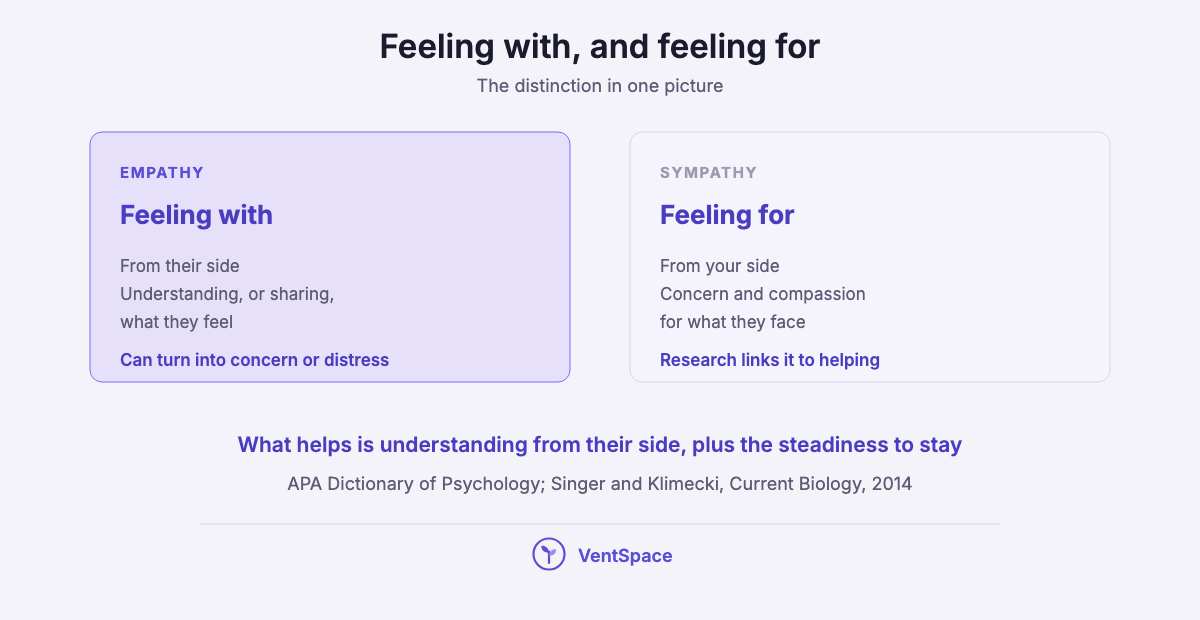
Empathy is feeling with someone: understanding what it is like from their side. Sympathy is feeling for them: concern from your own side. That is the whole distinction, and most pages stop there and declare empathy the winner. The research is kinder to sympathy than that. In psychology, sympathy is also called compassion or empathic concern, and it is the response research links to helping, while empathy on its own can tip into a distress that makes people back away. What a struggling person needs is both: someone who understands from their side, and stays steady enough to keep turning up.
The short version
Empathy is feeling with someone. Sympathy is feeling for them. Both are ordinary, decent responses.
In research, “sympathy” means compassion, and it is the response linked to helping more.
Empathy alone can become distress, which pushes people to withdraw.
What helps a struggling person is understanding from their side, plus the steadiness to stay.
There is a five-question check below for which one you are in. It is not a test of your character.
What empathy is
The APA Dictionary of Psychology defines empathy as “understanding a person from their frame of reference rather than one’s own, or vicariously experiencing that person’s feelings, perceptions, and thoughts.” Notice that it can be either: an act of understanding, or a feeling that arrives in you.
The same entry adds a line that rarely makes it onto the pages ranking for this question: “Empathy does not, of itself, entail motivation to be of assistance.” Feeling what someone feels is not the same as wanting to help them, and it does not always lead there.
What sympathy is
The APA defines sympathy as “feelings of concern or compassion resulting from an awareness of the suffering or sorrow of another.” You stay on your own side of the situation, and you care about the person on the other side.
That is not coldness. It is a stance we take all the time, toward a colleague’s bad news or a friend’s hard week, and it is where a great deal of practical kindness comes from: the meal, the lift, the message that asks for nothing back.
Empathy vs sympathy, side by side
| Empathy | Sympathy | |
|---|---|---|
| Where you stand | With them, from their side | Beside them, from your side |
| The short version | Feeling with | Feeling for |
| What it can sound like | “That sounds exhausting. Tell me what it’s been like.” | “I’m so sorry this is happening to you.” |
| What it asks of you | Imagining their situation from the inside | Caring, and showing it |
| The risk | Taking on their distress until you need to back away | Sounding distant, or rushing to make it better |
| What research calls it | Empathy, which can turn into concern or distress | Compassion, empathic concern or sympathy |
Feeling with versus feeling for
The difference is where you stand while you respond. In empathy you go, as far as you can, to the other person’s side. In sympathy you stay on yours and send care across.
Singer and Klimecki put the empathy half carefully: in empathy “one feels with someone, but one does not confuse oneself with the other.” That last clause matters. When the line between their feeling and ours disappears entirely, we are no longer understanding them. We are upset, and the conversation quietly becomes about our upset.
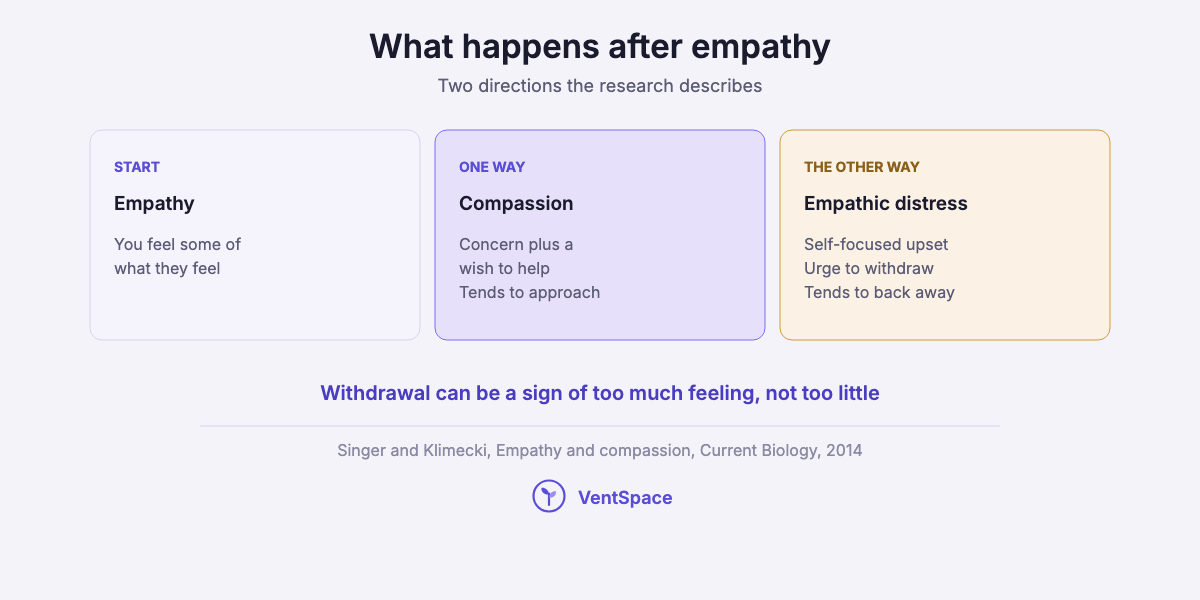
They describe what happens next as a fork. Exposure to someone’s suffering can lead to empathic distress, which they define as “a strong aversive and self-oriented response to the suffering of others, accompanied by the desire to withdraw.” Or it can lead to compassion, a feeling of concern accompanied by the motivation to help. And they note that research by Daniel Batson and Nancy Eisenberg found that people who feel compassion help more often than people caught in empathic distress.
None of this makes empathy the problem. Understanding someone from their side is what makes our care accurate rather than generic. The trouble comes only when understanding becomes drowning.
Quick Summary: feeling with versus feeling for
Q: What is the main difference between empathy and sympathy?
A: Empathy is feeling with someone, sympathy is feeling for them. Empathy means understanding their experience from their side, or feeling some of it yourself. Sympathy means concern from your own side. Research describes empathy as able to turn into either compassion, which tends toward helping, or distress, which tends toward withdrawing.
Insight: a definition worth keeping
Singer and Klimecki (Current Biology, 2014) note that in research, compassion “is also referred to as empathic concern or sympathy,” and that it is linked to approach and helping. Empathic distress, by contrast, comes with “the desire to withdraw.” The useful line is not between empathy and sympathy. It is between staying and backing away.
What each sounds like when someone is struggling
The words matter less than the direction they point. Here are some lines we wrote for a friend who has just said they are having a terrible time at work, with what each one does.
Lines that come from empathy:
- “That sounds exhausting. How long has it been like this?” It names the feeling from their side and asks for more.
- “I can hear how much you care about getting it right.” It reflects something they had not said out loud.
- “Do you want to talk it through, or do you want a distraction tonight?” It lets them steer.
Lines that come from sympathy:
- “I’m so sorry. That’s awful.” Warm and honest. It shows you care, from your side.
- “Is there anything I can take off your plate this week?” Practical concern, made specific.
Lines that come from neither, though they sound like both:
- “At least you still have a job.” It shrinks the problem before you have understood it.
- “The same thing happened to me last year.” It can help later. Said first, it moves the conversation to you.
- “Have you tried talking to your manager?” Advice, offered before they asked for any.
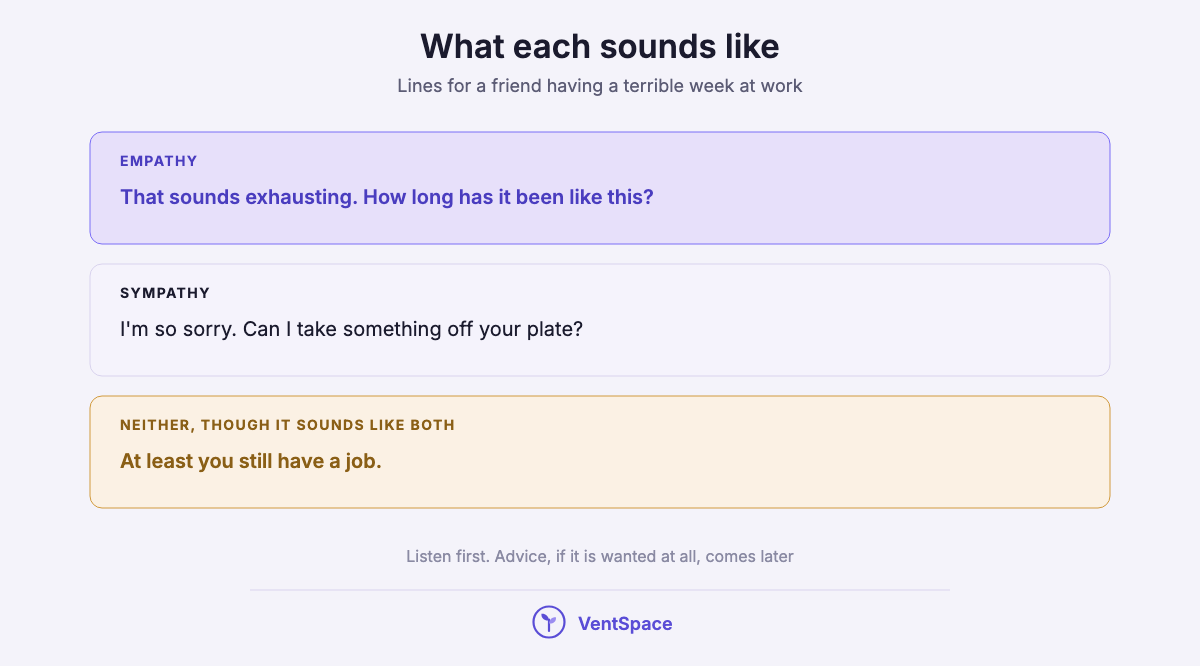
Silk and Goldman’s rule for talking to anyone closer to a crisis than we are is the simplest guide here: “Listening is often more helpful than talking.” Their shorthand for which way support should flow, “Comfort IN, dump OUT,” catches most of the lines in the third group, which tend to send something back toward the person who is struggling.
Quick Summary: empathy and sympathy examples
Q: What are examples of empathy and sympathy?
A: Empathy: “That sounds exhausting. How long has it been like this?” Sympathy: “I’m so sorry. That’s awful.” Both are fine. The lines that tend to land badly are neither: minimizing (“at least…”), turning to your own story first, or giving advice nobody asked for.
Insight: generosity about getting it wrong
Silk and Goldman’s 2013 Los Angeles Times piece describes a friend who visited a seriously ill woman in hospital, then told the woman’s husband she did not know if she could handle it. They are kind about her: she loved the patient, they write, “But it was the wrong thing to say.” Most of us have said the wrong thing out of love. The fix is the next sentence, not a verdict on ourselves.
What each costs you
In our view, sympathy is cheaper to give and easier to sustain. Empathy is expensive, and the bill comes due when we are close to someone whose pain goes on for a long time.
Singer and Klimecki report, from their own lab’s training studies, that a short empathy training increased participants’ negative feelings, and that compassion training afterwards reversed that, raising positive feelings even while people watched others in distress. These were short trainings with small groups, and they tell us about direction more than size. The direction is still worth knowing: feeling with someone, without anything to steady us, tends to wear us down.
That is why the person who cares most can be the first to go quiet. It is not that they stopped caring. It is that they could not keep feeling all of it. We think this is one of the most useful things to know about supporting someone through a long, hard stretch, because it turns a private failing into something ordinary and fixable.
Quick Summary: the cost of empathy
Q: Can empathy be exhausting?
A: Yes. Research describes “empathic distress,” a self-focused response to someone else’s suffering that comes with an urge to withdraw. In one research group’s training studies, practicing empathy raised negative feelings, and compassion training afterwards reversed it. Caring from a steady place is easier to sustain than absorbing everything.
Insight: why people back away
Singer and Klimecki define empathic distress as “a strong aversive and self-oriented response to the suffering of others, accompanied by the desire to withdraw.” It is a description of a common human reaction, not a diagnosis of anyone. Withdrawal can be a sign of too much feeling, not too little.
Why the internet and the research disagree
Online, sympathy has a poor reputation. One widely shared source of that framing is a 2013 animated short from the RSA, voiced by the researcher Brené Brown, which contrasts the two responses and argues that real connection needs us to get in touch with our own vulnerability. It is a good short and a useful nudge away from minimizing and fixing. We have not quoted it, because we could not find a transcript to check its wording against.
The trouble is the vocabulary. In everyday speech, “sympathy” has come to mean pity at a distance. In psychology, as the APA and Singer and Klimecki use it, sympathy means concern and compassion, the response linked to helping. Both camps agree on what helps a struggling person. They disagree only about which word to give it.
So if someone has told you that your “I’m so sorry” was the wrong kind of response, it may help to know that, in the research sense, it was the right kind. What makes it land is whether you then stay and listen.
Quick Summary: Brené Brown on empathy vs sympathy
Q: What does Brené Brown say about empathy and sympathy?
A: Her 2013 RSA animated short contrasts the two and argues that empathic connection depends on getting in touch with our own vulnerability. We have not quoted it because we could not verify a transcript. Note that research uses “sympathy” differently, as another word for compassion.
Insight: what the RSA says about its own short
The RSA’s page for the short, released 10 December 2013, describes it as showing that “we can only create a genuine empathic connection if we are brave enough to really get in touch with our own fragilities.” It credits Brené Brown for the voice and Katy Davis for the animation. That is the source, and it is the RSA’s summary rather than the script.
How to tell which one you’re in
This is a check for a single conversation, not a test of your character, and mixed answers are normal. Ask yourself, honestly, afterwards:
- Whose feelings was I describing? Theirs, or mine about them?
- Was I trying to understand, or to make it better?
- Did I tell my own story before I had heard theirs?
- Did I feel overwhelmed, and want to leave?
- Did I ask what would help, or assume?
If you were describing their feelings and asking questions, you were close to empathy. If you were caring from your side and offering something practical, that was sympathy, and it is fine. If you were overwhelmed, that is the distress end of empathy, and it is information about your own capacity, not about your character.
Some people find it easier to answer these in writing afterwards than in their head. If that is you, VentSpace is a journaling app that turns what you write into a clear read on your life balance, plus small, doable next steps. Prefer to try it on your laptop first? VentSpace Live runs in your browser, free, with nothing to install. Use it to think, then go back to the person. It is not a substitute for being with them, or for a person of your own to talk to.
What to do in each case
If you tend toward sympathy (warm, from your side):
- Ask one question before you offer anything. “What’s been the hardest part?”
- Make the care specific. Name a day, a task, a time.
If you tend toward empathy (deep, from their side):
- Notice when it is becoming yours. A racing chest or a need to leave is your signal.
- Steady yourself before the next conversation, and take your own worry outward, to someone further from the crisis.
Either way, listen first. Advice, if it is wanted at all, comes later.
Where the line blurs
In real conversations we move between the two within a minute, and the categories are tidier than people are. Some of what we say will land badly anyway, and showing up is still better than staying away for fear of the wrong word.
Two honest limits. If you are supporting someone through a long stretch and it is wearing you down, that is the distress end of empathy, and talking to someone yourself is an ordinary thing to do, including a therapist. Our guide to the alternatives to therapy covers lower-cost routes. And if the person you are supporting needs more than a friend can give, helping them find a professional is part of caring, not a handoff.
Questions people ask about empathy and sympathy
Is sympathy bad?
No. Online, sympathy is often painted as distant or pitying. In psychology, sympathy means concern or compassion, and research links it to helping. What lands badly is minimizing, fixing or turning the conversation to yourself, which can happen with either.
Can you feel empathy for something you have not been through?
Yes. The APA defines empathy as understanding a person “from their frame of reference.” That needs curiosity and imagination, not a shared history. Having been through something similar can help, and it can also tempt you to assume your experience was theirs.
What is the difference between empathy and compassion?
Empathy is feeling with someone. Compassion is feeling for them, with a wish to help. Singer and Klimecki describe compassion as “feeling for and not feeling with,” and note that research also calls it empathic concern or sympathy.
What can I say instead of “I’m sorry”?
“I’m sorry” is fine. Follow it with a question (“What’s been the hardest part?”) or a specific offer (“Can I bring dinner on Thursday?”). It is what comes after that does most of the work.
What if the person I’m supporting might be in danger?
Take it seriously and do not handle it alone. In the US, you or they can call or text 988, the 988 Suicide & Crisis Lifeline, free and confidential, at any hour. Anywhere else, findahelpline.com lists local services. If someone is in immediate danger, call emergency services.
Two things to take with you
First, understanding from their side matters more than finding the perfect words. A question asked with real interest does more than a polished sentence.
Second, look after your own steadiness. Empathy without it tips into distress, and that is when even loving people pull back. Staying is the skill, and it is easier from a steady place than from a flooded one, for all of us.
About this article

Written by
Sai Subramaniam
Founder, VentSpace
I write these guides because I have been where you are. I am working through my own hard seasons, and I share the things that actually helped me, so that anyone going through it has a steady companion close by instead of facing it alone. VentSpace is the app I built for exactly that: a journaling app that turns what you write into a clear read on your life balance, plus small, doable next steps toward feeling more like yourself.
This writing is honest and every claim is sourced, and it is not a substitute for professional care. If you are struggling, reaching out to a professional is a strong move, not a failure.
Explore VentSpaceTry VentSpace LiveHow this one was checked. Every factual claim traces to a named source, and the source is printed next to the claim rather than kept in a footnote. Quotes are pinned to the work they come from, with the year, the letter or the chapter where one exists. Where a widely repeated claim could not be traced, it was left out and the omission recorded. Where a figure is contested, both sides are printed.
No affiliate links, no paid placements, and nobody paid to appear here. Where we mention our own app, we say that it is ours, we state its limits, and we never position it as a substitute for care.
Reviewed: October 2026. Prices, platforms and product availability move quickly, and anything we could not verify at the time of writing is marked as unverified rather than turned into a number.
Corrections. If something here is wrong, we would rather know. Corrections are made in place, with a note saying what changed.