
“You can’t snap your fingers and make a friend.” · Jeffrey Hall, University of Kansas (2018)
It is Saturday morning in the new apartment. The boxes are mostly unpacked, the week at work went fine, and there is nobody in this city you could text to get coffee. Back home, a weekend like this would have filled itself. Here it stretches out, and by Sunday evening the quiet has started to feel like a verdict. Is this just what moving is like, or is something wrong?
It is mostly what moving is like, and there is research on exactly this situation. The US Surgeon General’s 2023 advisory defines loneliness as a gap between the connection you want and the connection you have, and a move widens that gap overnight. When the communication researcher Jeffrey Hall wanted to know how friendships form, one of the groups he studied was 355 adults who had moved in the previous six months and were looking for friends in their new homes. What he found was not a trick or a personality type. It was a number of hours.
That number changes what you do next. If friendship comes from hours spent together, then the job in a new city is not to become more likable or to find the perfect group. It is to arrange for the same people to see you again and again. This guide covers why the first months are this hard, roughly how long friendship takes, why the first move feels so risky, and then five steps you can start this week.
The short version
A move widens the gap overnight. It takes away your people and your routine at the same time, so loneliness after moving makes sense, and it is not a sign you chose wrong.
Friendship runs on hours. In one study of adults who had just relocated, it took roughly 50 hours together to become casual friends and more than 200 to become close friends.
People like you more than you think. After a conversation, we tend to underestimate how much the other person enjoyed it.
Contact matters more than occupation. A busy schedule is not the same as seeing the same faces every week.
Five steps. One recurring thing six times, one place where you are a regular, one invitation, one old friendship on a schedule, and a plan for the hard evenings.
If you are struggling right now. If loneliness after your move has turned into feeling hopeless, or you are having thoughts of harming yourself, please contact a crisis line now rather than reading on. In the US, call or text 988 (Suicide & Crisis Lifeline). Anywhere else, findahelpline.com lists free, confidential services by country. This page is not a substitute for that, and we would rather you closed this tab and called.
Why loneliness after a move hits so hard
“I had nobody to converse with, but now and then this neighbour; no work to be done, but by the labour of my hands; and I used to say, I lived just like a man cast away upon some desolate island, that had nobody there but himself.” · Daniel Defoe, Robinson Crusoe (1719)
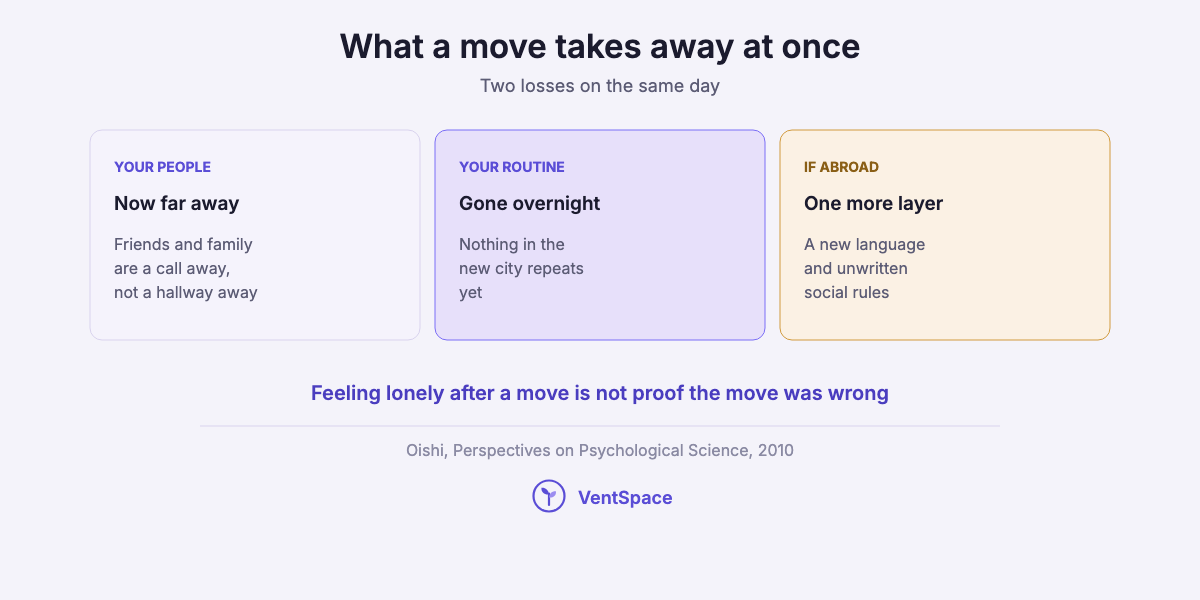
Loneliness after a move hits hard because a move removes two things at once: the people you saw without planning, and the routine that put them in front of you. Defoe gave that line to Crusoe years before the shipwreck, on a plantation in Brazil, with a neighbor nearby. He was not alone. He just had nobody to talk to, which is the version many of us meet in a new city.
Think about how your old life was built. You probably did not schedule most of your friendships. You saw people because you worked with them, lived near them, went to the same gym, or had known them since school. The seeing happened by itself, and the friendship grew in the repetition. A move cancels all of that on the same day. Your friends still exist, but they are now a phone call away instead of a hallway away, and nothing in the new city has started repeating yet.
That is why the first weeks can feel fine and the second month can feel worse. At first there are boxes, paperwork and a new job to fill the hours. Once the logistics are done, the evenings and weekends open up, and what is missing becomes easier to see. Does that mean you made a mistake? Not on this evidence. It means the old structure is gone and the new one has not been built yet.
The psychologist Shigehiro Oishi has spent years studying what moving does to people. In a 2010 review of the research, he described how frequent moving is associated with “duty-free” friendships, the kind we choose rather than the kind we are placed in, and with lower well-being on average. Those are associations across many people, not a prediction about you. But they fit what people describe. In a new city nobody is obliged to include you yet, and every connection has to be chosen by both sides.
And if you moved to another country, add a layer. A new language turns every small exchange into effort, and a different culture can change the unwritten rules: how quickly people invite you home, whether small talk with strangers is normal, how long it takes before “we should get coffee” means anything.
From Sai, who writes this blog: the move to Berlin
I am someone who is usually surrounded by family and friends, and it hit me hard when I moved to Berlin. Suddenly I was in Europe, surrounded by people who speak a different language. Feeling alone, far from your emotional and physical home, can be overwhelming.
What Sai describes is the double loss: the people and the familiarity at once. If your loneliness feels bigger than the move alone, our guide to loneliness itself covers what it is, how common it is and why it can appear even in a full life.
Quick Summary
Q: Why do I feel so lonely after moving to a new city?
A: A move removes the people you used to see without planning and the routine that put them in front of you, both at once. Your old friends are now far away, and nothing in the new city has started repeating yet. Loneliness after a move is an understandable response to that change, not a sign that the move was wrong.
Insight: Shigehiro Oishi, reviewing the research on moving in Perspectives on Psychological Science (2010), wrote that residential mobility “is also associated with ‘duty-free’ friendships and group memberships rather than obligatory friendships and group memberships. Overall, residential mobility is associated with lower levels of well-being at the individual level of analysis.” In a new city, nothing obliges anyone to include you yet. That is a description of the situation, not of you.
How long does it take to make friends in a new city?
“We have to put that time in.” · Jeffrey Hall, University of Kansas (2018)
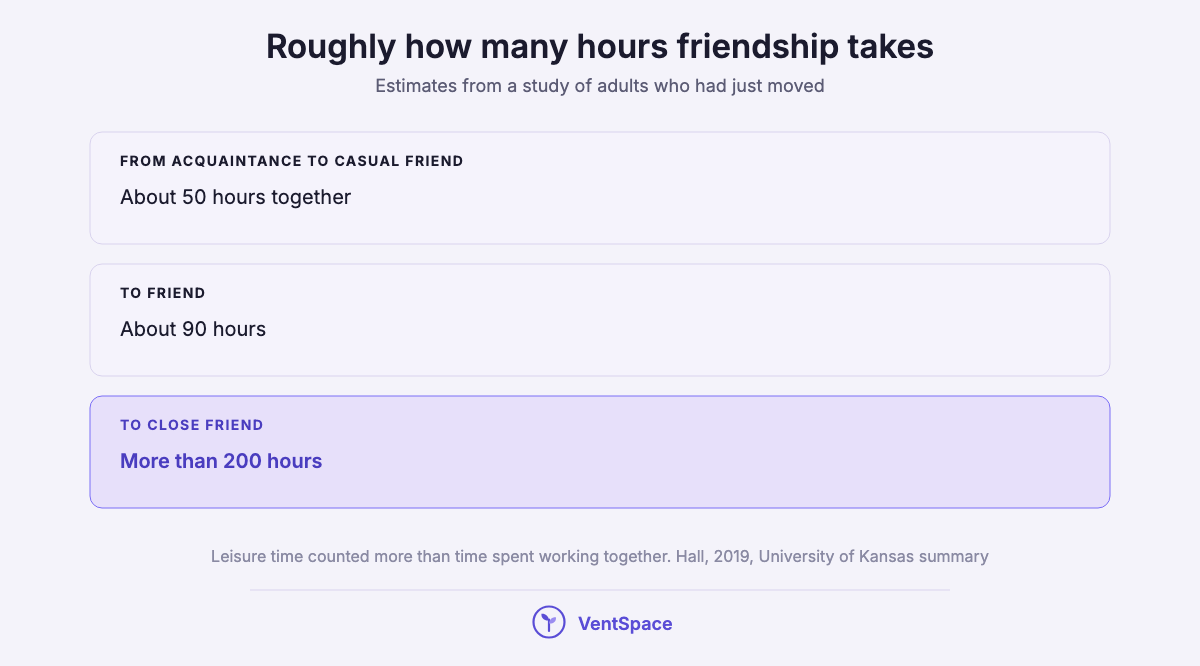
Making friends in a new city takes many hours together, and in Hall’s research the rough figures were about 50 hours to become casual friends, about 90 to reach friend and more than 200 to become close friends. These are estimates from people’s own reports, not a schedule, but they give a sense of scale that most advice leaves out.
Hall ran two studies, published in the Journal of Social and Personal Relationships in 2019. In the first, 355 adults who had moved in the last six months described a new acquaintance and estimated how much time they had spent together. In the second, 112 first-year students at the University of Kansas reported on two people they had met in their first two weeks, and were asked again four and seven weeks later. In both, more hours together went with closer friendships. The round numbers above come from the university’s summary of the paper, which combined both studies into ranges: 40 to 60 hours for a casual friend, 80 to 100 for a friend, and more than 200 for a close friend.
Two details matter more than the totals. First, the kind of time counts. Time spent on leisure, hanging out, joking around, doing something for fun, went with closeness. Hours spent working together did not count as much. So the colleague you see forty hours a week may stay a colleague unless you also spend time together outside the work itself. Second, the hours are with one person. Fifty hours spread across fifty people is fifty acquaintances.
Here is our own arithmetic, not Hall’s. If you see the same person for two hours a week, 50 hours takes about six months. If you see them for two hours a month, it takes about two years. That is not meant to discourage you. It is meant to explain why three good conversations in your first month did not turn into a friend, and why that is not evidence against you. It is evidence that the hours are still adding up.
What does that mean in practice? It means the question to ask is not “how do I meet people?” but “who will I see again next week, and the week after?” Repetition is the ingredient a new city lacks, and it is the one you can schedule.
Quick Summary
Q: How long does it take to make friends in a new city?
A: In a study of adults who had recently relocated, closer friendships went with more hours spent together, and the University of Kansas summary put it at roughly 50 hours to become casual friends and more than 200 to become close friends. Leisure time counted more than time working together. These are estimates, not a schedule, but they show why repetition matters.
Insight: Jeffrey Hall, summarizing his two studies in the Journal of Social and Personal Relationships (2019): “Hours together was associated with closer friendships. Time spent engaging in leisure activities also predicted closeness.” Two short sentences, and between them the whole strategy for a new city: the same people, more than once, doing something other than work.
Why the first move feels so hard
“after people have conversations, they are liked more than they know.” · Erica Boothby, Gus Cooney, Gillian Sandstrom and Margaret Clark, Psychological Science (2018)
The first move feels hard because we tend to underestimate how much other people want to connect and how much they liked talking to us. If you have ever walked home from a conversation replaying the awkward moments, you have met the effect researchers call the liking gap.
Boothby and her colleagues found it in strangers getting acquainted in a lab, in first-year college students getting to know their dorm mates, and in adults meeting at a personal development workshop. After a conversation, people consistently underestimated how much their partner liked them and enjoyed their company. Among the dorm mates, the gap lasted for several months, even as real friendships formed. What does that do in a new city? It quietly lowers the odds of a second conversation. If you think the first one went badly, you are less likely to start the next.
A related finding comes from commuters. Nicholas Epley and Juliana Schroeder asked people on trains and buses to talk to a stranger, to keep to themselves, or to commute as usual. The people who talked reported a more positive commute, and it was no less productive. A separate group, asked to predict, expected the opposite. Part of the reason, the researchers concluded, was that people underestimate other people’s interest in connecting. A commute conversation is not a friendship, but the error is the same one that keeps a newcomer from saying hello at the gym.
This matters because the standard advice on every page we read, get out and meet people, does not touch the prediction. In a 2011 analysis of loneliness programs, randomized trials that only created more chances for contact did not significantly reduce loneliness, and the programs that did best worked on how people read social situations. Those results rest on few trials, and our loneliness guide goes through them. For a new city, the practical point is narrow. Going out is necessary, and it is not enough on its own. You also have to notice the voice that says the conversation went badly, and act anyway.
From Sai, who writes this blog: what I learned about reading versus doing
I read numerous blogs and watched endless videos about overcoming loneliness. Gathering information and knowing how to escape something is not going to help anyone. Only action helps.
You can find a million methods online, but unless you act on one, it will not help.
Sai’s version is blunter than the research and points the same way. The prediction says stay home, and the evidence says the prediction is often wrong. The only way to find out is to test it, in small steps you can survive going badly.
Quick Summary
Q: Why is it so hard to make friends in a new city?
A: Partly because a new city has no built-in repetition, and partly because we misjudge other people. Studies find that after conversations people underestimate how much the other person liked them, and that commuters expect talking to a stranger to go worse than it does. Those predictions make the next conversation less likely, so it helps to notice them and go anyway.
Insight: Nicholas Epley and Juliana Schroeder, Journal of Experimental Psychology: General (2014): “This mistaken preference for solitude stems partly from underestimating others’ interest in connecting (Experiments 3a and 3b), which in turn keeps people from learning the actual consequences of social interaction (Experiments 4a and 4b).” The second half is the trap. If we never test the prediction, we never find out it was wrong.
So what do you do with this weekend?
How to overcome loneliness in a new city, in five steps
“You can’t make people spend time with you, but you can invite them.” · Jeffrey Hall, University of Kansas (2018)
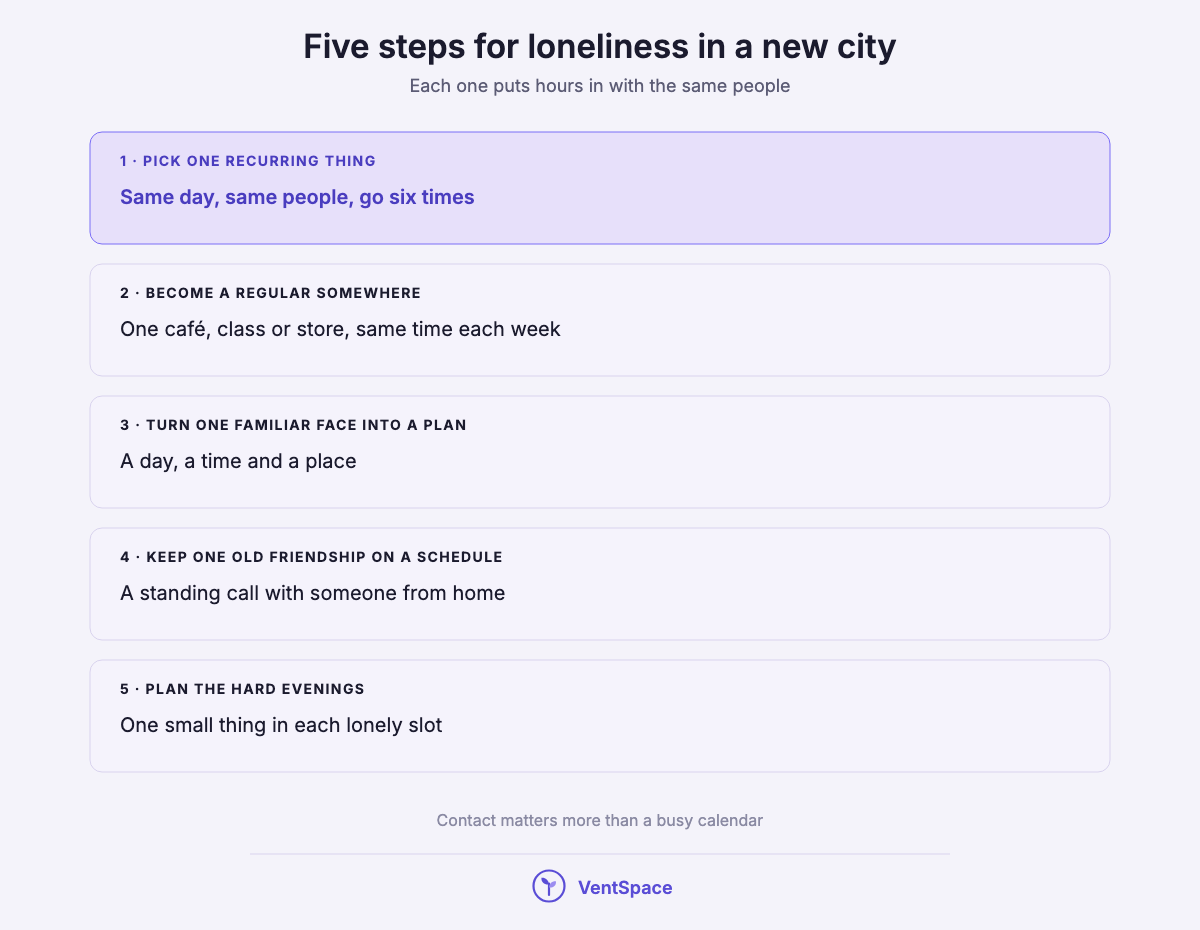
The five steps below are built around one idea: put hours in with the same people. None of them asks you to become more outgoing. Each one is a way to create repetition, or to use it once it exists. Start with step 1 this week and add the others over the next month.
1. Pick one recurring thing and go six times
Choose one activity that meets at the same time and place every week, with mostly the same people, and put the next six dates in your calendar today. A class, a run club, a choir, a volunteer shift, a language exchange, a climbing night, a weekly game. Meetup, which lists local groups and events, is one place to look, and so are community centers, libraries and the noticeboard of any café you like.
Ask yourself:
- What did I enjoy doing with other people before I moved?
- Is there something that meets weekly, not once?
- Will the same people be there next time, or is it a different crowd every week?
- Is it something I would enjoy even on a week when nobody talks to me?
- What time slot can I protect for six weeks?
You do not have to like the first one. You only have to go six times before you judge it.
Why six, and why the same group? Because a one-off event gives you a conversation, and a weekly one gives you hours. Hall’s work suggests that leisure time with the same person is what adds up, and a weekly class or club is the easiest way to get it without having to organize anything. This is contact rather than occupation. A calendar full of different events can keep you busy and still leave you with nobody, because you never see anyone twice.
We should be honest about one thing. In the trials, only creating more chances to meet people did not reliably reduce loneliness. A recurring thing is not a cure. What it does is give you familiar faces, and a familiar face is someone you can eventually invite somewhere, which is step 3.
2. Become a regular somewhere
Pick one ordinary place, a café, a bakery, a gym class at a set time, a market stall, a park bench where the same dog walkers pass, and go at the same time each week. Say hello. Learn one name. Let them learn yours.
Ask yourself:
- Where do I already go most weeks without thinking about it?
- Could I go at the same time, so I see the same staff or the same customers?
- Who in my building or on my street do I see often enough to greet?
- What is one small question I could ask a regular face this week?
It is fine if this feels small. Small is the point.
This step sounds too minor to matter, and it is the easiest one to skip. But the research on what psychologists call weak ties suggests it counts. Gillian Sandstrom and Elizabeth Dunn found that students felt happier and more like they belonged on days when they talked with more classmates than usual, and that everyday interactions with acquaintances were related to social and emotional well-being. Those findings are correlations, not proof that small talk causes belonging. But being recognized somewhere is the first sign that a place is becoming yours, and it costs almost nothing to try.
3. Turn one familiar face into a plan
Choose one person from step 1 or 2 you have seen at least three times, and invite them to one specific thing with a day and a time. Not “we should hang out sometime”. Something like: “A few of us are getting food after class on Thursday, want to come?” or “I’m trying the market on Saturday at ten, want to join?”
Before you send it, ask:
- Who have I enjoyed talking to more than once?
- What is a plan small enough that it costs them almost nothing to say yes?
- Can I name a day, a time and a place?
- If they say no, what will I suggest instead?
You are allowed to be the one who asks. Someone has to go first.
Hall’s advice was plain: you cannot make people spend time with you, but you can invite them. He also noticed that when a friendship moved up a stage, people tended to double or triple the time they spent together within about three weeks. An invitation is how that jump starts. It moves time from the shared activity into time that is about the two of you.
Remember the liking gap. The person you are inviting probably enjoyed your last conversation more than you think, and a specific plan is easier to accept than a vague one. If it helps to have something to talk about, our list of questions that turn an acquaintance into a friend is built for exactly this stage.
4. Keep one old friendship on a schedule
Choose one person from home and set a standing call or video chat, the same day every week or every other week. Put it in both calendars. It does not need to be long. It needs to be regular.
Ask yourself:
- Who from home do I miss most, and when did we last talk properly?
- Is there a time difference I need to plan around?
- Would a standing slot be easier for both of us than “let’s talk soon”?
- Who have I been meaning to message and not done it?
There is no rule that old friendships have to fade when you move. They just need a plan now.
This step does two jobs. It keeps you connected to people who already know you, which matters a lot while the new friendships are still a few hours old. And it is easier to reach out than you might expect. In a series of preregistered experiments, Peggy Liu and her colleagues found that people consistently underestimate how much others appreciate being reached out to, and the gap was larger between people who were less close. An independent team later repeated one of their key experiments and got the same result. The friend you have been meaning to message is probably more pleased to hear from you than you assume.
One caution. Calls home can comfort you, and they cannot replace the hours you need in the new city. If you notice that every free evening goes to people far away, keep the standing call and protect at least one evening for step 1.
5. Give the hard evenings a plan of their own
Take a page and write down which times of the week feel loneliest, then put one small plan into each of them. For some people it is Sunday evening, or the first hour after work, or the weekend mornings. A plan can be a walk to the same place, a class, a call from step 4, cooking something properly, or writing a few lines about how the week went.
Ask yourself:
- Which two or three times of the week feel heaviest?
- What is one thing I could put in each slot that I would not dread?
- Which of those involves another person, even briefly?
- What would I tell a friend who had just moved and felt like this?
You do not have to enjoy every evening. You just do not have to face each one from scratch.
This step is not about learning to love being alone. If you did not choose to be on your own, much of what is written about solitude does not apply to you, and we will not pretend it does. The aim is smaller: to stop the hardest hours from ambushing you, so you have the energy for steps 1 to 4.
And there is a point where a plan is not enough. If the loneliness has lasted for months, if it comes with low mood, or if it is getting in the way of sleep, work or eating, talking to a therapist is a legitimate next step. A move is an ordinary reason to book an appointment, and asking for help is not a sign that you have handled the move badly. Our guide to whether you need therapy walks through how to tell.
Pulling it all together
The five steps are one plan. Step 1 creates repetition, step 2 makes a place familiar, step 3 turns a face into a friend, step 4 keeps your old people close, and step 5 protects the hours in between. They work best in order, over a couple of months.
Step 1 gives you the same faces every week. Committed action: choose one weekly activity tonight and put the next six dates in your calendar.
Step 2 makes one place yours. Committed action: pick one café, class or store and go at the same time next week.
Step 3 turns time together into time that is about the two of you. Committed action: after your third time seeing someone, send one invitation with a day, a time and a plan.
Step 4 keeps your existing friendships from drifting. Committed action: message one person from home and suggest a standing call.
Step 5 stops the hardest hours from catching you unprepared. Committed action: write down your two loneliest times of the week and put one plan in each.
Quick Summary
Q: What is the best way to overcome loneliness in a new city?
A: Create repetition with the same people. Join one weekly activity and go six times, become a regular at one place, invite one familiar face to something specific, keep a standing call with one friend from home, and plan for your hardest evenings. If loneliness lasts for months or comes with low mood, talking to a therapist is a reasonable next step.
Insight: Gillian Sandstrom and Elizabeth Dunn, Personality and Social Psychology Bulletin (2014), on their studies of everyday interactions: “The current results highlight the power of weak ties, suggesting that even social interactions with the more peripheral members of our social networks contribute to our well-being.” In a new city, almost everyone starts out peripheral. That is where every friendship begins.
Questions people ask about loneliness in a new city
Is it normal to feel lonely after moving, or does it mean I made a mistake?
It is an understandable response, and on its own it says nothing about whether the move was right. A move removes your old people and your routine at the same time, and new friendships take many hours together to form. Research on moving links it with “duty-free” friendships that have to be chosen by both sides, which takes time. Feeling lonely in the first months is what that gap feels like.
How long does it take to make friends in a new city?
Nobody can give you a date. In Jeffrey Hall’s study of adults who had recently relocated, closer friendships went with more hours together, and the University of Kansas summary estimated roughly 50 hours to become casual friends and more than 200 to become close friends. Seeing the same people every week is the fastest way to build those hours.
Is it harder to make friends as an adult?
It often feels harder because adult life has less built-in repetition. School and college put the same people in the same rooms every week, while adult friendship usually depends on someone making a plan. Hall also found that time spent working together counted less than leisure time, so colleagues do not automatically become friends. The fix is to create repetition on purpose.
What if I am an introvert?
The steps still work, and some suit introverts well. A weekly class or a regular café gives you repeated contact with the same few people without needing a big social life, and one invitation to one person is enough to start. Being an introvert is not the reason you are lonely. Having had too few hours with anyone yet is.
Do friend-finding apps help?
They can be a way to find a first meeting, and services like Meetup list local groups and events. What an app cannot do is supply the hours. A match or a group chat becomes a friendship the same way any acquaintance does: by seeing the same person again and again. If you use an app, aim for something recurring rather than a string of one-off meetups.
When should I talk to someone about loneliness after a move?
If it has lasted for months, if it comes with low mood or hopelessness, or if it is affecting your sleep, work or eating, it is worth talking to a doctor or a therapist. A move is a reasonable reason to get support. If you are thinking of harming yourself, call or text 988 in the US, or find your local line at findahelpline.com.
In a nutshell
Loneliness in a new city is not a verdict on you or on the move. It is what the gap looks like before the hours have had time to add up.
Two things to take with you. First, friendship is built from repeated time with the same people, so the most useful thing you can do is arrange to see someone again next week. Second, the honest timeline: nobody can tell you how long this takes. The hour figures are estimates, and real friendships in a new city often take months. Count every sixth class, every second coffee and every standing call as progress, whatever happens next.
Which weekly thing will you go to six times?
Moving somewhere new and feeling alone in it is a lot to carry. If writing down what you miss, and what you want this new place to give you, would help you get to step 3, VentSpace is a journaling app that turns what you write into a clear read on your life balance, plus small, doable next steps. It is free to start and Android only as of October 2026, and it is not a person, so let it point you toward the people. Not on Android, or at a desk? VentSpace Live runs in your browser, free, with nothing to install.
About this article

Written by
Sai Subramaniam
Founder, VentSpace
I write these guides because I have been where you are. I am working through my own hard seasons, and I share the things that actually helped me, so that anyone going through it has a steady companion close by instead of facing it alone. VentSpace is the app I built for exactly that: a journaling app that turns what you write into a clear read on your life balance, plus small, doable next steps toward feeling more like yourself.
This writing is honest and every claim is sourced, and it is not a substitute for professional care. If you are struggling, reaching out to a professional is a strong move, not a failure.
Explore VentSpaceTry VentSpace LiveHow this one was checked. Every factual claim traces to a named source, and the source is printed next to the claim rather than kept in a footnote. Quotes are pinned to the work they come from, with the year, the letter or the chapter where one exists. Where a widely repeated claim could not be traced, it was left out and the omission recorded. Where a figure is contested, both sides are printed.
No affiliate links, no paid placements, and nobody paid to appear here. Where we mention our own app, we say that it is ours, we state its limits, and we never position it as a substitute for care.
Reviewed: October 2026. Prices, platforms and product availability move quickly, and anything we could not verify at the time of writing is marked as unverified rather than turned into a number.
Corrections. If something here is wrong, we would rather know. Corrections are made in place, with a note saying what changed.