
“Meaning is not something you stumble across, like the answer to a riddle or the prize in a treasure hunt. Meaning is something you build into your life.” · John W. Gardner, “Personal Renewal” (1990)
It tends to arrive on a Sunday evening. The week ahead is already planned, the work is fine, the people around you are fine, and nothing is wrong in any way you could explain to a doctor. And yet a question surfaces that has no obvious place in an ordinary life: what is all of this for? You scroll past someone who seems to have known since childhood what they were meant to do, and you feel a small, specific shame, as if everyone else had been handed something you missed. Is there a purpose out there that the rest of us found and you somehow did not?
Researchers have a plainer and kinder way of describing what we are looking for. In a 2003 paper that later reviews list among the field’s foundational papers, the psychologists William Damon, Jenni Menon and Kendall Bronk defined purpose as a stable intention to do something that matters to you and also matters to someone beyond you. Nothing in that definition is hidden. It is a direction, not a destination, and directions are made.
That is the turn this guide takes. Many of the pages that rank for this question treat purpose as a treasure hunt: look inward hard enough, follow your passion, and the answer will be there. The research points somewhere more modest and more hopeful. We do not find a purpose so much as build one, out of material most of us already have and rarely look at. This guide is about how to find your purpose in life by building it: what purpose is, why the passion advice makes it harder, what the evidence can and cannot tell you, when the emptiness is about something else, and then five small steps you could start tonight.
The short version
A purpose is a direction you hold, not a secret you uncover. Researchers define it as a stable intention that matters to you and to someone beyond you.
“Find your passion” makes it harder. In five studies, people who believed interests are fixed lost interest faster when something new got difficult.
Looking for purpose and having it are different things. Searching is only slightly linked to lower well-being, and in some countries the link runs the other way.
The health research is real and smaller than it is usually reported. It describes populations, not you.
Five steps: write down where last week went, list what you care about and why, name who beyond you it would matter to, develop one interest for four weeks, and write a dated working sentence.
What is a life purpose?
“Purpose is a stable and generalized intention to accomplish something that is at once meaningful to the self and of consequence to the world beyond the self.” · William Damon, Jenni Menon and Kendall Bronk, Applied Developmental Science (2003)
A life purpose is a lasting intention to do something that matters to you and that also makes a difference to someone or something beyond you. That is the definition above, put in everyday words. It is worth reading slowly, because it is far less grand than the word sounds.
Notice what the definition asks for and what it does not. It asks for an intention, which is something you hold and act on, rather than a fact about you waiting to be discovered. It asks for that intention to be stable, which means it shows up across months and years rather than in one inspired evening. And it has two halves. The first half is personal: the aim has to mean something to you. The second half faces outward: it has to be of some consequence to the world beyond yourself. Neither half says the consequence must be large. A teacher, a nurse, a parent, a person who keeps a community garden going and a person who writes code that keeps a hospital’s records straight can all meet it.
It also helps to know that researchers do not all agree on one definition. The psychologist Gabrielle Pfund, reviewing the field in 2023, pointed to “the inconsistent definitions used for this construct” as one reason the idea of purpose stays unclear. Some researchers stress the outward-facing half, as Damon and his colleagues did. Others, like Patrick McKnight and Todd Kashdan, describe purpose as a central aim that organizes your goals and your behavior. We are not confused because we have failed to think hard enough. We are confused partly because the word is used in more than one way, and the advice that reaches us inherits the muddle.
So it helps to separate a few words that are often used as if they were one. The sorting below is our own editorial summary, not a published classification.
| Word | What it refers to | The everyday version |
|---|---|---|
| Purpose | A lasting intention that organizes your goals and reaches beyond you | “I want the kids I teach to leave less afraid of math” |
| Meaning | The sense that your life makes sense and matters, whether or not you can name an aim | “My life feels like it adds up to something” |
| Goals | Specific things you are working toward, with an end point | “Finish the certification by June” |
| Values | What you care about and want to act from | “Fairness matters to me” |
| Passion | Strong interest and enjoyment in an activity | “I lose track of time when I’m drawing” |
The last row is where much of the trouble starts. Passion is a feeling about an activity. Purpose is a direction for a life. They can overlap, and often do, but one can exist without the other, and treating them as the same thing has a cost that the next section describes.
Quick Summary
Q: What is a life purpose?
A: A life purpose is a stable, long-term intention to do something that matters to you personally and also makes a difference beyond yourself. Researchers such as Damon, Menon and Bronk (2003) define it this way. It is a direction you hold and act on, and it does not need to be large or unusual.
Insight: Patrick McKnight and Todd Kashdan, in Review of General Psychology (2009), describe purpose as “a central, self-organizing life aim that organizes and stimulates goals, manages behaviors, and provides a sense of meaning.” Read that way, purpose is less a feeling than a structure. It is the thing that decides, quietly, what the week is arranged around.
Why “find your passion” makes purpose harder
“none but he knows what that is which he can do, nor does he know until he has tried.” · Ralph Waldo Emerson, “Self-Reliance” (1841)
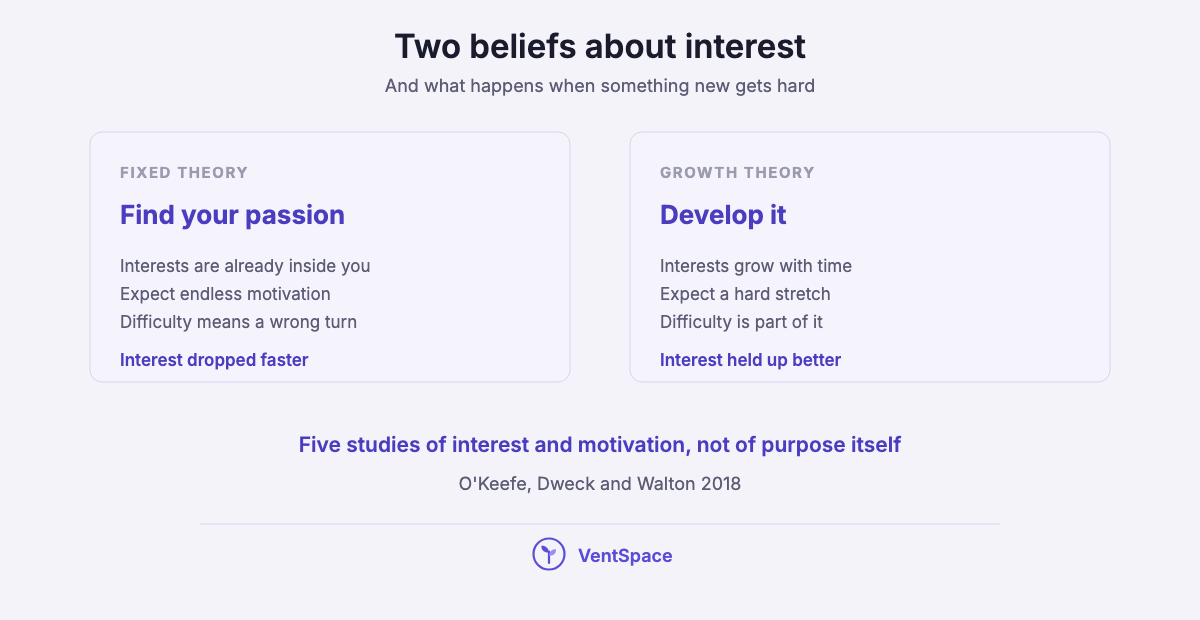
The advice to find your passion makes purpose harder because it teaches us that interests are fixed and waiting, so we give up on a new interest as soon as it gets difficult. That is not an opinion about self-help. It is close to what a set of experiments found.
In 2018 the psychologists Paul O’Keefe, Carol Dweck and Gregory Walton published five studies in Psychological Science on what they called implicit theories of interest. Some people hold a fixed theory: interests are already inside us, formed and complete, and the task is to discover them. Others hold a growth theory: interests develop as we spend time and effort on things. The researchers opened their paper with the problem in one sentence: people “are often told to find their passion, as though passions and interests are preformed and must simply be discovered.”
What they found is worth taking slowly. Whether the theory was measured or experimentally induced, people who held a fixed theory showed less interest in areas outside their existing interests. People with a fixed theory were also more likely to expect boundless motivation once a passion was found, and less likely to expect that it would ever be hard. And when the researchers made a new interest difficult to engage with, interest dropped significantly more for people who had been led to hold the fixed theory than for those led to hold the growth theory.
You may recognize some version of this. We start something with excitement, a language, an instrument, a volunteering shift, a side project, and three weeks in it becomes tedious or confusing. The fixed theory gives us a ready explanation: this must not have been my passion after all. We put the thing down, not because it failed us, but because the story we were told said difficulty is a sign of a wrong turn. We then go looking for the next thing, which will also become difficult, and the search starts to feel like evidence that we are the problem.
There is a gentler reading available. If interests grow with time and effort, then the absence of a burning passion at thirty or forty is not a verdict on you. It describes how few things you have been allowed, or allowed yourself, to stay with past the difficult part. The study does not tell us which interests will grow. It tells us that the belief we carry into the difficult part changes what happens next.
Two honest limits travel with this. The five studies tested interest and motivation, not whether people later found a purpose in life. And the study samples are not described in the abstract we read, so we do not print them. What the work does is remove the main premise of the genre. There is no evidence here that a passion is sitting inside you, finished, waiting to be found.
Quick Summary
Q: Should you follow your passion to find your purpose?
A: The research suggests caution. In five studies by O’Keefe, Dweck and Walton (2018), people who believed interests are fixed showed less interest in new areas, expected endless motivation once they found a passion, and lost interest faster when a new interest became difficult. Interests can be developed, and difficulty is not a sign you chose wrong.
Insight: O’Keefe, Dweck and Walton, summarizing their five studies in Psychological Science (2018): “Individuals endorsing a fixed theory were also more likely to anticipate boundless motivation when passions were found, not anticipating possible difficulties.” And their conclusion: “Urging people to find their passion may lead them to put all their eggs in one basket but then to drop that basket when it becomes difficult to carry.”
Having a purpose and looking for one are not the same thing
“while searching for life meaning may be adverse to SWB, the effect is small and conditional.” · Jian-Bin Li and Kai Dou, meta-analysis preprint (2020)
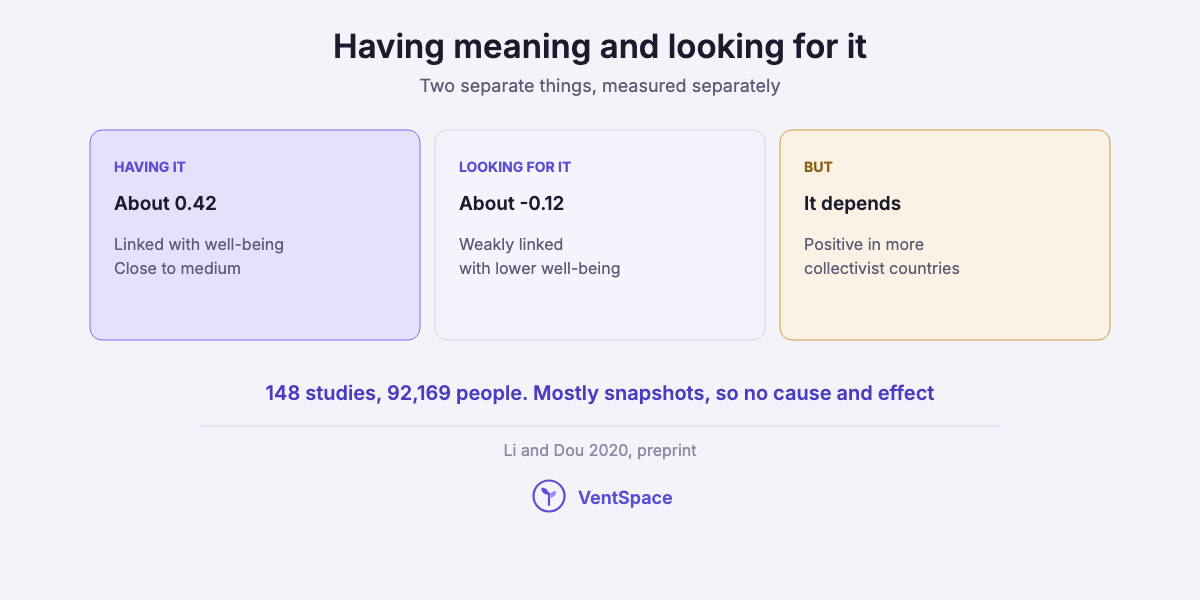
Having a sense of purpose and searching for one are separate things, and only having it is clearly linked to well-being. Searching is only weakly linked to lower well-being, and the link depends on where you live. This matters for anyone who has been searching for a while and has started to read the search itself as a symptom.
Much of this research uses a questionnaire developed by Michael Steger and colleagues, the Meaning in Life Questionnaire, which scores two things separately: how much meaning you feel you have, and how hard you are looking for it. In a meta-analysis of 148 studies, 726 effect sizes and 92,169 people, Jian-Bin Li and Kai Dou found that having meaning was associated with subjective well-being at about 0.42, which they describe as close to medium. Searching for meaning was associated with well-being at about −0.12, which is small. And in countries with a high collectivism index, searching was positively related to well-being. Two cautions belong here. What we read is the authors’ preprint, so the published figures may differ slightly. And most of the studies took a single snapshot, so they cannot say whether searching causes discomfort or discomfort sends people searching.
The useful sentence in all this is simple. Looking and having are two variables, not two ends of one line. You can be searching hard and already have more direction than you think. You can be searching and doing perfectly well.
It is also worth knowing how ordinary the search is. Writing in 2019, Bronk and her colleagues reported, citing a 2008 book by Damon, that only about one fifth of adolescents and one third of young adults report leading a life of purpose. We have not read the book’s own survey, so we treat the figures as Damon’s estimate rather than a census. If they are anywhere near right, most of us are, at most points in our lives, still building, and that is a statement about how hard the task is rather than about anyone’s character.
Then there are the health claims, which appear on almost every page about purpose. They come from real research and deserve to be read with their limits in view. The largest analysis so far, published in 2026 by Angelina Sutin and colleagues, pooled 25 samples, 488,765 people and 48,928 deaths, followed for up to 32 years in the United States, Europe and Asia. People reporting a higher sense of purpose had roughly a 30% lower risk of earlier death in the simplest model. That figure shrank to about 15% once the researchers accounted for behavioral and clinical risk factors, and to about 9% once they accounted for depression. A separate 2017 meta-analysis of 66 studies and 73,546 people by Karolina Czekierda and colleagues found that meaning in life and physical health were associated at about 0.26, weak to moderate, and that the link was strongest when people rated their own health and weakest against objective medical measures.
What does this mean for you? Not much, directly. These are associations in large populations, not experiments, and they say nothing about any one person’s future. Nobody has shown that writing a purpose statement changes anyone’s health. What the research does show is that purpose is an ordinary, measurable, widely shared part of human life, studied in hundreds of thousands of people. It is not a rare possession that a few lucky people were handed.
Quick Summary
Q: What does research say about having a purpose in life?
A: Having a sense of meaning is linked to well-being at about 0.42 across 148 studies, while searching for it is only weakly linked to lower well-being and is positively linked in more collectivist countries. A sense of purpose is also associated with lower mortality in large populations, though the link shrinks a lot once health behaviors and depression are taken into account.
Insight: Angelina Sutin and colleagues, concluding their 2026 analysis of 488,765 people in Psychological Medicine: “The association is due in part but not completely to behavioral, clinical, and psychological risk factors for earlier mortality.” In plain terms, the people with more purpose were also, on average, living differently and feeling differently, and those differences explain a large share of the gap.
When the emptiness is not about purpose
“We are worriers and puzzlers, and we want meaning in our lives.” · John W. Gardner, “Personal Renewal” (1990)
Sometimes the feeling that life has no point is not a missing purpose at all, and it helps to tell the two apart. Wanting meaning is ordinary. Gardner said so to a room of consultants in 1990, and he was describing almost everybody. But a flat, empty stretch can have other sources, and a purpose exercise is the wrong tool for some of them.
When Sai first wrote this page in 2023, he put his own version of the problem plainly. It is kept here, lightly edited, because it is the most honest paragraph the old page had.
From Sai, who writes this blog: what I wrote in 2023
External motivators lose their power over time as we grow and evolve. Without internal motivations backed by your interests and passions, you lose sight of goals and live just to pass the time. I know it because I have lived this way for many years of my life.
Notice what that describes. Not a lack of talent, and not a lack of a calling, but motivation that ran on outside rewards until the rewards stopped working. That is a recognizable shape, and our page on why motivation fades over time goes into it. If your output is fine and the point has gone, our page on purpose versus productivity is written for that exact week.
There is one more thing the research quietly shows. In the mortality analysis above, the purpose figure shrank most when the researchers took depression into account. That is our reading of their numbers, not their claim, but it fits what many people know from the inside: low purpose and low mood tend to travel together, and from the inside the two can feel almost identical. A purpose exercise cannot tell them apart. Two questions can help you notice, and they are the questions a clinician would ask. How long has the emptiness lasted? And is it reaching your sleep, your appetite, your work or the people close to you? If it has lasted for weeks and is reaching those places, or you find yourself drinking or using more to get through the evenings, that is worth taking to a doctor or a therapist rather than treating as a purpose problem. Therapy is one option. For a lot of people it’s the right one. Our page on whether you need therapy walks through it without a checklist.
If you are struggling right now. If the emptiness has turned into feeling hopeless, or you are thinking about harming yourself, please contact a crisis line now. In the US, call or text 988 (Suicide & Crisis Lifeline). Anywhere else, findahelpline.com lists free, confidential services by country. This page is not a substitute for that.
Quick Summary
Q: Is feeling like life has no purpose a sign of depression?
A: Not necessarily. Wanting meaning is ordinary, and a flat stretch on its own is not a diagnosis. But low purpose and low mood often appear together, so if the emptiness has lasted for weeks or is affecting your sleep, appetite, work or relationships, it is worth talking to a doctor or therapist.
Insight: Jordi Quoidbach, Daniel Gilbert and Timothy Wilson, in Science (2013), after studying more than 19,000 people aged 18 to 68: “People, it seems, regard the present as a watershed moment at which they have finally become the person they will be for the rest of their lives.” The finding is disputed, partly because the studies compared different people rather than following the same ones. But it names the trap of a flat month, which is believing it is the final shape of things.
So where do you start building?
How to find your purpose in life, in five steps
“How we spend our days is, of course, how we spend our lives.” · Annie Dillard, The Writing Life (1989)
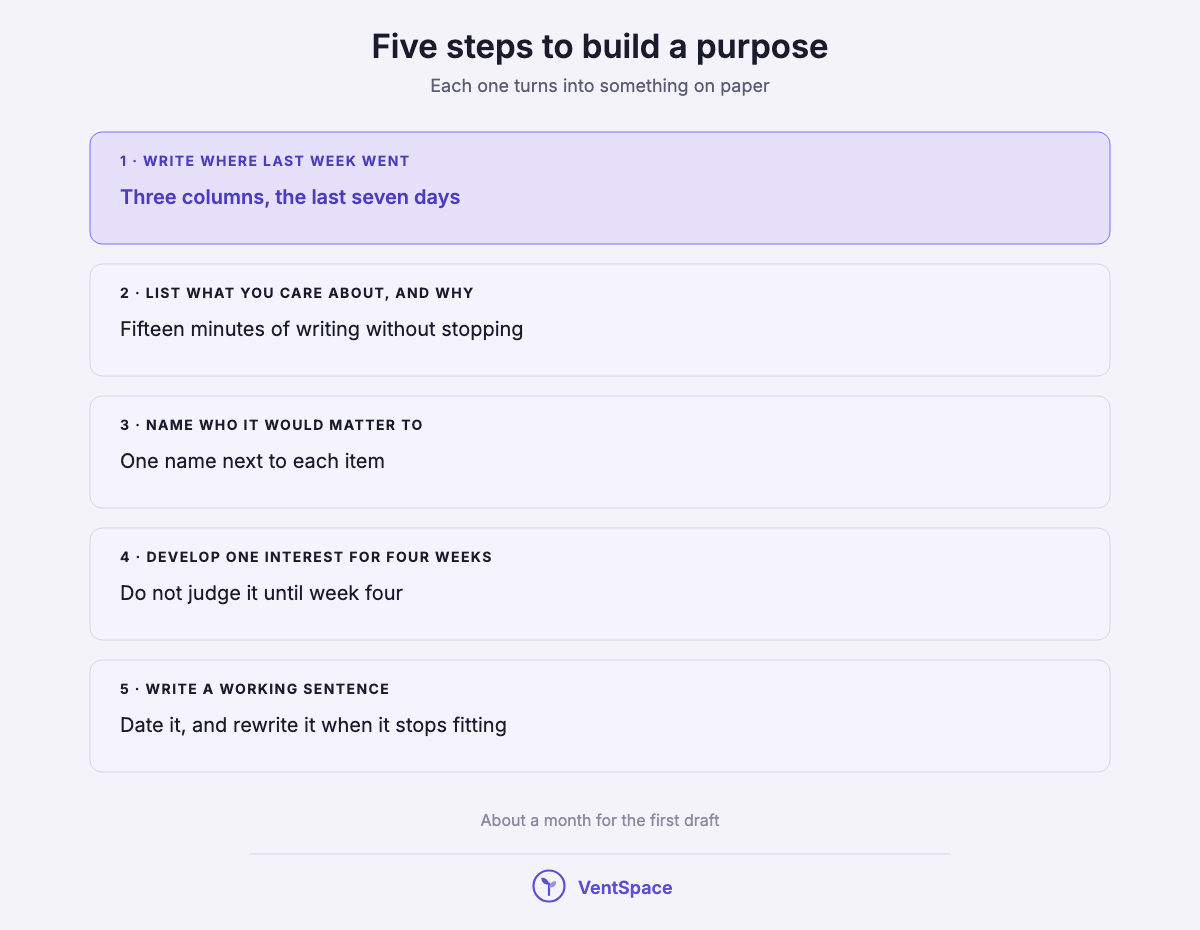
You find your purpose in life by building it: look at where your days already go, write what you care about and why, name who beyond you it would matter to, develop one interest past the difficult part, and write a dated working sentence you revise. The steps take the two halves of Damon’s definition and turn each into something you can do on paper.
They also borrow, loosely, from the few purpose exercises that have been tested. Bronk and her colleagues built two short online toolkits for young adults in 2019, one built around values exploration and goal setting and one using gratitude as a starting point, and reported that both seemed to spur the search for purpose and the identification of one. That was a young-adult study, and the abstract we read gives no effect size, so we lean on it for the shape of the exercises, not for a promise. Nothing below is guaranteed to produce a purpose. What it produces is material, and building needs material.
1. Write down where last week went
Before you ask what your purpose should be, write down what your last seven days were arranged around. This is Dillard’s sentence made physical. Take a page and draw three columns. In the first, list what took most of your time. In the second, list what you protected even when you were tired. In the third, list what you kept meaning to do and did not. Twenty minutes is enough.
Answer these in a line each:
- What did I give my best hours to this week?
- What did I make time for without being asked?
- What did I keep postponing, and what was I afraid of?
- Who did I spend time on, and did it feel like a choice?
- If a stranger read this page, what would they say I care about?
Be honest, no one is reading this but you.
The point is not to judge the week. Your days already contain a direction, the set of trade-offs you have been making without naming them. Sometimes the page shows a purpose you were already living and never called by that word. Sometimes it shows a gap between what you say matters and where the hours went, and that gap is information, not failure.
2. List what you care about, and why
Set a timer for 10 to 15 minutes and write, without stopping, about what you care about most and why. Do not worry about grammar or whether it sounds impressive. This is the first half of Damon’s definition, the part that has to mean something to you, and it is easier to reach by writing quickly than by thinking slowly.
Then add a few shorter answers:
- When did I last feel fulfilled or proud, and what was I doing?
- What makes me angry on someone else’s behalf?
- What have I kept coming back to, on and off, for years?
- What would I keep doing even if nobody noticed?
- Why does each of these matter to me?
The last question does most of the work. Two people can both care about “teaching”, one because they love explaining things and one because a single teacher once changed their life. The reason is the part you can build on. If you notice that what you care about has shifted over the years, our page on evolving personal values is about exactly that. Don’t overthink it. A messy page tonight is more useful than a tidy one you never write.
3. Name who, beyond you, it would matter to
For each thing on your list, write the name of one person, group or place that would be better off if you did more of it. This is the second half of the definition, the part that faces outward, and it is the half most of us leave out when we think about purpose as a private feeling.
It does not need to be large. A younger colleague who needs someone to explain the job. A parent who would like more of your time. Your street, your team, a cause you already donate to. The outward half asks only that the intention reach someone.
Work through these:
- Who already benefits when I do the things on my list?
- What am I good at that someone near me struggles with?
- Which problem near me do I complain about and could help with, a little?
- Who would notice if I stopped doing this?
There is no right answer here. A purpose that reaches one person is still a purpose. If the list feels small, that is usually a sign it is honest.
4. Develop one interest on purpose, for four weeks
Choose one thing from your list and give it a short, fixed amount of time, two or three times a week, for four weeks, and decide in advance that you will not judge it until week four. This is the growth theory from O’Keefe, Dweck and Walton, turned into a plan. The four weeks are our suggestion, not a figure from their research. The point is to stay past the moment when it gets difficult, because that is exactly where the fixed theory told us to quit.
Before you start, write down:
- What is the one thing, and when exactly will I do it?
- What will the difficult part probably be?
- What will I tell myself when it gets boring or hard?
- What would count as a sign, by week four, that it is worth continuing?
Expect a dull or frustrating stretch somewhere in the middle. Difficulty is not proof that you chose wrong. If by week four you still feel nothing for it, stop without guilt and choose the next thing from your list. That is not failure either. It is the building process doing its job.
Take your time with this one. It is fine to start next week.
5. Write a working sentence, and date it
At the end of the four weeks, write one sentence that names what you want to keep doing and who it is for, and put the date above it. A simple shape works: “Right now, I want to [what you do] for [who it matters to], because [why].” For example: “Right now, I want to help new nurses on my ward feel less alone in their first year, because nobody did that for me.”
Then check it against these:
- Does this sentence match where my week from step 1 went?
- Would I still want this if nobody praised me for it?
- Is there one small thing I could do toward it this week?
- What would make me rewrite it?
Call it a working sentence, because it is one. People tend to underestimate how much they will change, according to research by Quoidbach, Gilbert and Wilson, though that finding is disputed, and a sentence written at thirty will not fit at fifty. Read it once a month and rewrite it when it stops fitting. If you want to turn the sentence into daily habits, our page on turning values into daily habits picks up from here.
Quick Summary
Q: How do I find my purpose in life?
A: Treat purpose as something you build. Write down where your last week went, freewrite about what you care about and why, name who beyond you it would help, give one interest four weeks before judging it, and then write a dated working sentence about what you want to do and for whom, and revise it monthly.
Insight: Kendall Bronk and colleagues, describing their two online purpose toolkits for young adults in the Journal of Character Education (2019): “One toolkit approached purpose from the perspective of goal setting and values exploration, while the other used gratitude as a springboard. A test of these toolkits suggests they effectively spur both the search for purpose and identification of a purpose in life.” Note the verb they chose. Suggests, not proves.
Pulling it all together
“The meaning of life differs from man to man, from day to day and from hour to hour.” · Viktor E. Frankl, Man’s Search for Meaning
The five steps are one path, and they work best in order, over about a month rather than one evening. Frankl’s sentence is a reminder of why the last step asks for a date. Whatever you build this month is a draft, and a draft is supposed to change.
Step 1 gives you an honest record of what your days are already arranged around. Tonight’s committed action: draw the three columns and fill them in for the last seven days.
Step 2 gives you the personal half of a purpose, in your own words. Committed action: set a timer for 15 minutes and write about what you care about and why.
Step 3 gives you the outward half. Committed action: next to each item on your list, write one name.
Step 4 gives one interest the chance to grow past the difficult part. Committed action: put three short sessions in your calendar for next week, and write the date of week four.
Step 5 turns the material into a direction. Committed action: at the end of week four, write your working sentence and date it.
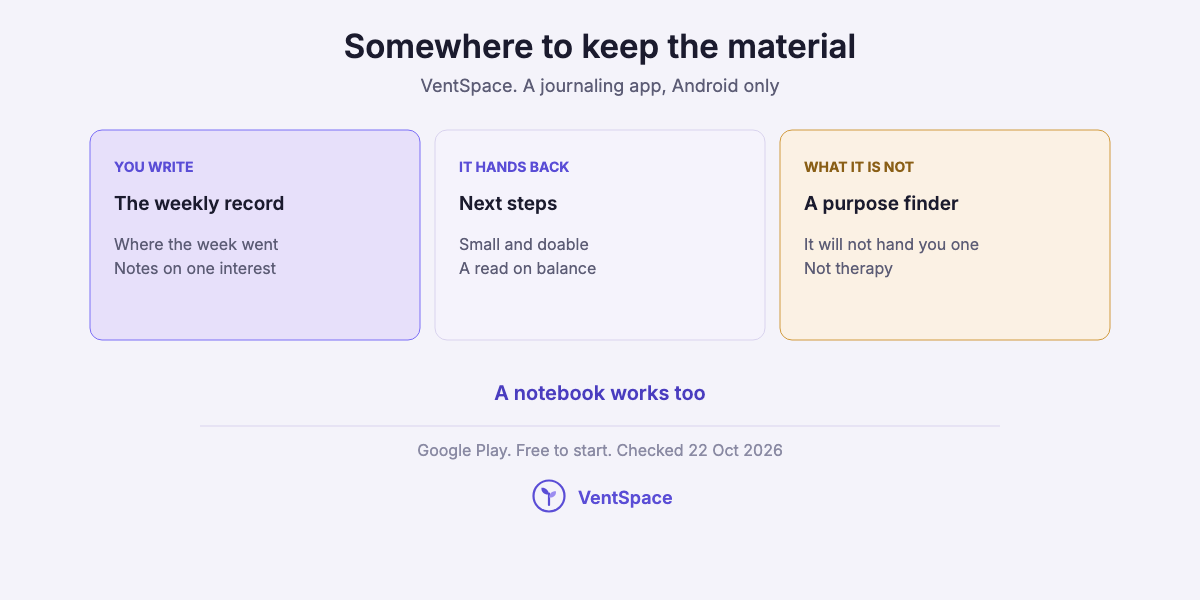
If you would like somewhere to keep the weekly record from step 1 and the notes from step 4, VentSpace is a journaling app that turns what you write into a clear read on your life balance, plus small, doable next steps. It is free to start and Android only as of October 2026. Not on Android, or at a desk? VentSpace Live runs in your browser, free, with nothing to install. It will not hand you a purpose, and it is not therapy. It is a place to keep the material you are building with. A notebook works too.
Quick Summary
Q: What is the first step to finding your purpose?
A: Tonight, write down what your last seven days were arranged around: what took your time, what you protected, and what you kept postponing. Your days already show a direction, and that page is the raw material for everything after it.
Insight: John Gardner, in the same 1990 talk, on where the material comes from: “You have to build meaning into your life, and you build it through your commitments”. He went on to name them: a religion, an ethical order, your life’s work, loved ones, your fellow humans. None of them is found. Each is chosen and then kept.
Questions people ask about finding their purpose
Is everyone meant to have one true purpose?
Not according to the research we read. The idea of something preformed waiting inside you is what O’Keefe, Dweck and Walton’s work questions, at least for interests: people who believed interests are fixed lost interest faster when things got hard. Definitions of purpose describe an intention you hold and act on, and nothing in them limits a person to one.
What is the difference between purpose and passion?
Passion is strong interest and enjoyment in an activity. Purpose, in Damon, Menon and Bronk’s definition, is a stable intention to do something that matters to you and to someone beyond you. You can feel passion for something that serves nobody else, and you can have a purpose in work you do not always enjoy. The research on interest suggests passion can grow out of time spent on something, rather than arriving first.
Why is it so hard to find your purpose?
Partly because we are told to look for the wrong thing. If you expect a finished passion to appear, ordinary difficulty feels like a sign of failure. Partly because it is common to be still building: Damon estimated that only about a third of young adults report a life of purpose. And partly because a flat stretch can have other causes, such as low mood, that a purpose exercise cannot fix.
Can your purpose change over time?
Yes. Researchers describe purpose as stable, meaning it lasts across months and years, not that it lasts forever. Roles end, children grow up, careers change, and the people a purpose was for may no longer need it. That is why step 5 asks you to date your sentence and rewrite it when it stops fitting.
Does a life purpose have to be something big?
No. The definition asks only that the aim matter to you and make some difference beyond you. Caring for a parent, mentoring one colleague or keeping a local group running all meet it. The large, public purposes we read about are the ones that get written about, not the only ones that count.
How long does it take to find your purpose?
No study we found gives a timeline, and we will not invent one. The five steps, as we have laid them out, take about a month to work through once. Researchers describe purpose as stable, something that holds across months and years, which we read as a reason to be patient rather than a reason to rush.
In a nutshell
A purpose is not a prize you missed. It is something we build, slowly, out of where our days go, what we care about, and the people we would like to make a difference to.
Two things to take with you. First, you already have material. Your last seven days, the things you protect when you are tired and the people you keep showing up for are the start of a direction, whether or not you have called it one. Second, the honest timeline: nobody can tell you how long this takes, and no study we found says. Expect a month for the first working sentence and years of quiet revision after it, and count the dated sentence on the page as real progress.
Tonight, fill in the three columns from step 1. What did your last week turn out to be arranged around?
About this article

Written by
Sai Subramaniam
Founder, VentSpace
I write these guides because I have been where you are. I am working through my own hard seasons, and I share the things that actually helped me, so that anyone going through it has a steady companion close by instead of facing it alone. VentSpace is the app I built for exactly that: a journaling app that turns what you write into a clear read on your life balance, plus small, doable next steps toward feeling more like yourself.
This writing is honest and every claim is sourced, and it is not a substitute for professional care. If you are struggling, reaching out to a professional is a strong move, not a failure.
Explore VentSpaceTry VentSpace LiveHow this one was checked. Every factual claim traces to a named source, and the source is printed next to the claim rather than kept in a footnote. Quotes are pinned to the work they come from, with the year, the letter or the chapter where one exists. Where a widely repeated claim could not be traced, it was left out and the omission recorded. Where a figure is contested, both sides are printed.
No affiliate links, no paid placements, and nobody paid to appear here. Where we mention our own app, we say that it is ours, we state its limits, and we never position it as a substitute for care.
Reviewed: October 2026. Prices, platforms and product availability move quickly, and anything we could not verify at the time of writing is marked as unverified rather than turned into a number.
Corrections. If something here is wrong, we would rather know. Corrections are made in place, with a note saying what changed.