

“The world will never starve for want of wonders; but only for want of wonder.”
G. K. Chesterton, Tremendous Trifles (1909)
When Sai, who founded VentSpace, wrote the first version of this page, he started with a list: “The good morning kisses, the music during our walk to work, the friendly neighbor who always says ‘Hi’, the lush green grass we sit on during lunch, our taxi friend, gym friend, or our morning routine, make our life beautiful.” Most of us could write a list like that. The harder question is this one. When did you last notice one of them?
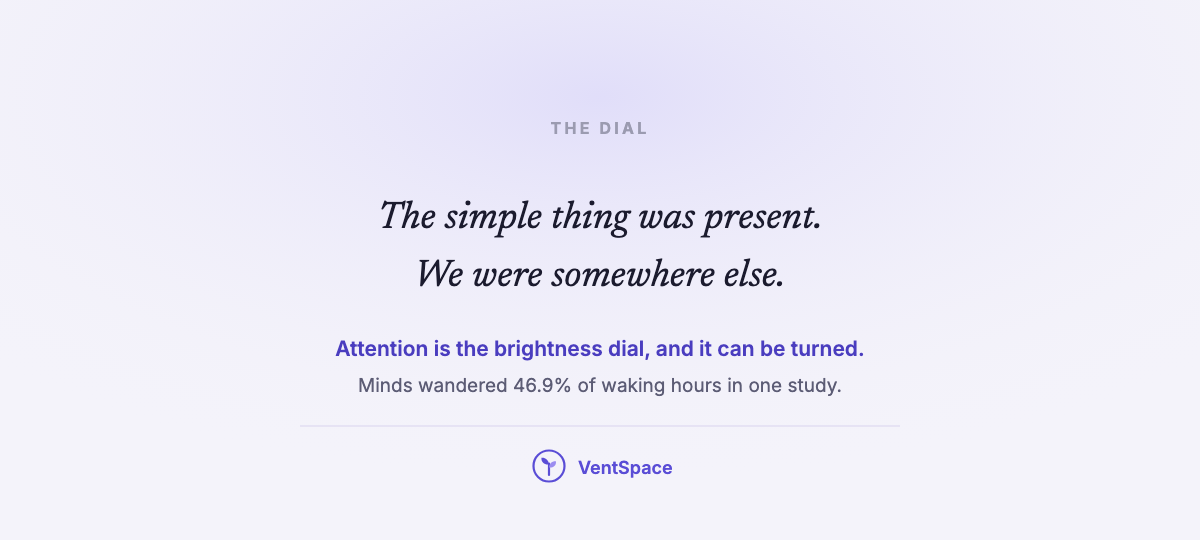
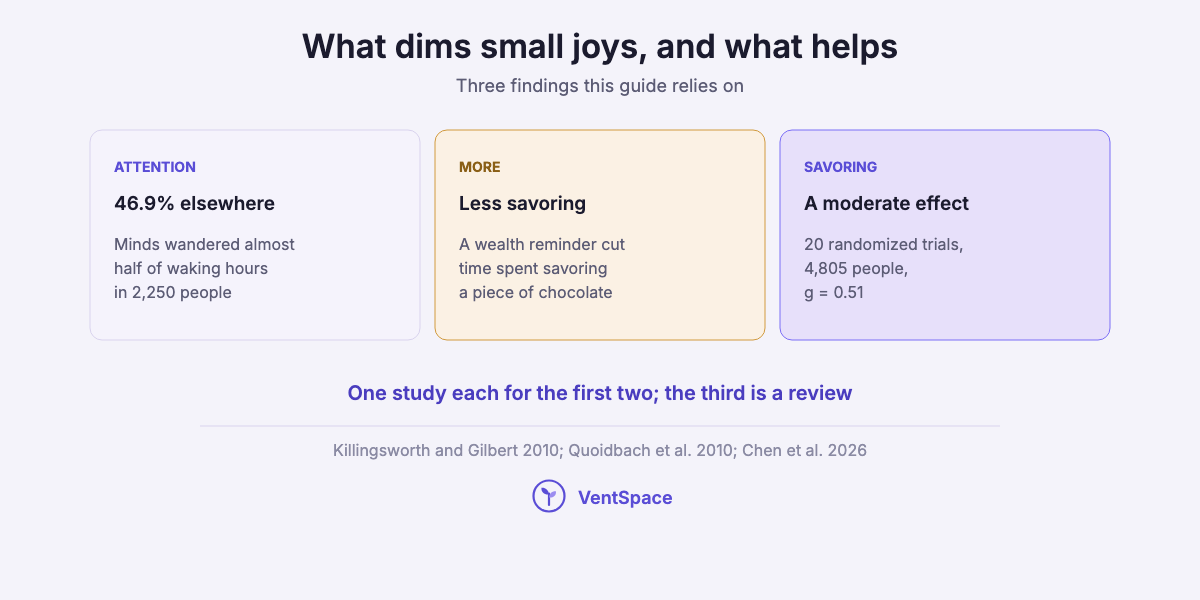
There is a documented reason the answer is often “I can’t remember”. In a study that pinged 2,250 people on their phones at random moments, Matthew Killingsworth and Daniel Gilbert found that people’s minds were on something other than what they were doing 46.9% of their waking hours, and that this wandering “typically makes them unhappy” (Science, 2010). The coffee was there. We were somewhere else.
So this guide is not about adding more pleasures to your life. It is about noticing the ones already in it, or, in Sai’s phrase from that first page, “turning up the brightness” on the world you already have. Below: why the brightness drops, what the research says about turning it back up, and five small ways to start this week.
Quick Digest
Why simple things stop registering: our attention is elsewhere almost half the time, and a “more and better” mindset can blunt how much we enjoy small pleasures.
What helps: savoring, which means stretching and deepening a good moment on purpose. Twenty randomized trials pooled in 2026 found a moderate effect.
Five small ways: slow one ordinary moment, catch where your mind went, write one small good thing down, keep an ordinary moment for later, and tell someone about it.
Gratitude is not a daily duty. In the largest review, how often people did it made no difference.
If nothing has felt good for a while, this is probably not about attention. Read “When small joys stop landing at all” further down.
Why the simple things stop registering
“the object of my school is to show how many extraordinary things even a lazy and ordinary man may see if he can spur himself to the single activity of seeing.”
G. K. Chesterton, Tremendous Trifles (1909)
Simple things stop registering mostly because we are not there when they happen. That sounds like a scolding. It is meant as the opposite. It means the pleasures have not gone anywhere, and that the brightness dial is attention, which is something you can turn.
The Killingsworth and Gilbert study is useful here because of how it was done. Instead of asking people to remember how happy they were, it asked them in the moment: what are you doing, what are you thinking about, how do you feel? People’s minds wandered during every kind of activity, at least 30% of the time in everything except making love, according to Harvard’s report on the study. And the wandering was not usually to pleasant places.
Think about what that means for a walk to work. Is the music on? Probably. Is the light doing that thing it does in October? Maybe. But if your mind is in the meeting at ten, the walk is happening to your body and not to you. The simple thing was present. You were not.
None of this makes you shallow or ungrateful. A mind that plans and replays is doing what minds do, and most of what it plans is genuinely worth planning. The cost is just higher than it looks. The study was correlational, and most of its participants were American, so it does not prove that wandering causes unhappiness for everyone. It does show that where your attention is turns out to be a better guide to how you feel than what you happen to be doing.
Quick Summary
Q: Why do I stop noticing the little things in life?
A: Mostly because attention is elsewhere. In a study of 2,250 people sampled on their phones, minds wandered 46.9% of waking hours, and people were usually less happy when they were not focused on what they were doing.
Insight: Matthew Killingsworth, speaking to the Harvard Gazette (2010) about the study he ran with Daniel Gilbert: “Mind-wandering is an excellent predictor of people’s happiness. In fact, how often our minds leave the present and where they tend to go is a better predictor of our happiness than the activities in which we are engaged.” What we are doing, in other words, matters less than whether we are there for it.
Why “more and better” does not fix it
“having access to the best things in life may actually undercut people’s ability to reap enjoyment from life’s small pleasures.”
Jordi Quoidbach and colleagues, Psychological Science (2010)
Reaching for bigger and better things can quietly turn the brightness down on small ones. The old version of this page put it in one line: “Memories last longer than an iPhone.” There is research on both halves of that.
In 2010, Jordi Quoidbach, Elizabeth Dunn and colleagues found that wealthier working adults reported less ability to savor everyday good moments. Then they tested it directly. People shown a reminder of wealth spent less time savoring a piece of chocolate and enjoyed it less than people who were not. It is one study, and priming experiments from that era have a mixed record when repeated, so treat it as a strong hint rather than a law. But the hint is a familiar one. When the next upgrade is always on your mind, the thing in your hand gets less attention.
The other half comes from Leaf Van Boven and Thomas Gilovich. In surveys and experiments, people said that experiences they had spent money on made them happier than things they had bought (Journal of Personality and Social Psychology, 2003). Why would a weekend away beat a new phone? Their answer was that experiences stay open to being remembered more kindly, become part of who we are, and are usually shared with someone.
Sai’s original page was clear that there is nothing wrong with owning things. The point is narrower. A walk, a meal, a conversation are experiences you already have every week. They are the cheapest version of the thing the research says lasts.
Quick Summary
Q: Does having more money or nicer things make it harder to enjoy small pleasures?
A: It can. In one 2010 study, people reminded of wealth spent less time savoring a piece of chocolate and enjoyed it less. Separate research found that experiences tend to make people happier than possessions.
Insight: Van Boven and Gilovich, Journal of Personality and Social Psychology (2003), on why experiences won in their studies: “experiences make people happier because they are more open to positive reinterpretations, are a more meaningful part of one’s identity, and contribute more to successful social relationships.”
What savoring is, and how much it helps
Savoring is the skill of stretching and deepening a good moment while it is happening, or when you remember it. Quoidbach’s team defined it as “the ability to enhance and prolong positive emotional experience.” It is the opposite of gulping. The first sip of coffee, tasted. The song, heard all the way to the end.
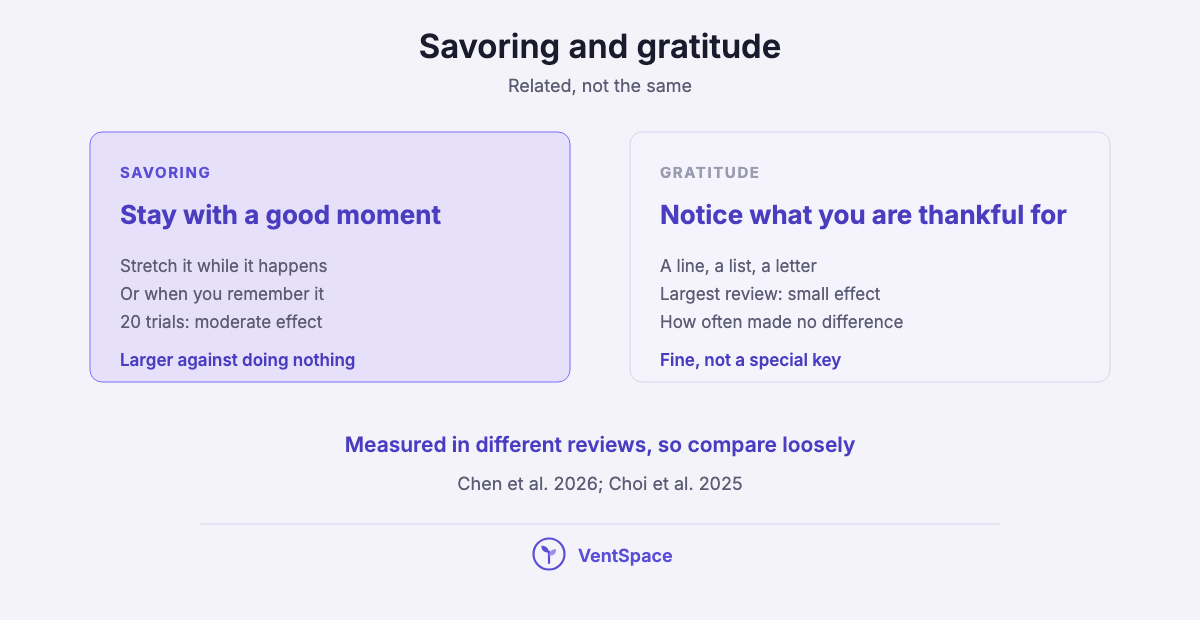
How much does it help? More than most wellness advice can show. A 2026 review pooled 20 randomized trials with 4,805 participants and found a moderate overall effect (g = 0.51), with a similar effect on positive states like enjoyment and well-being (Applied Psychology: Health and Well-Being). The honest caveat is in the same paper: the effects looked larger when savoring was compared with doing nothing than when it was compared with another active exercise, although that difference did not reach statistical significance.
Compare that with gratitude, which is the advice almost every page on this topic gives first. The largest review of gratitude exercises, by Choi and colleagues, covering nearly 25,000 people (PNAS, 2025), found a small effect (g = 0.19), no better than other positive activities, and found that how often people did it made no difference. Gratitude is fine. It is just not the special key it is sold as. If you have tried a gratitude journal and felt nothing, you have not failed at joy.
What does that leave us with? Savoring is a skill, not a mood, and like any skill it is built out of small repetitions. Which is where the rest of this guide goes.
Quick Summary
Q: What is savoring, and does it work?
A: Savoring is deliberately stretching and deepening a good moment. A 2026 review of 20 randomized trials found a moderate effect on well-being, larger against no activity than against another exercise.
Insight: Chen, Tung, Wu and Sie, Applied Psychology: Health and Well-Being (2026), on the comparison groups in the trials they pooled: “control group type did not reach statistical significance as a moderator (Δg = -0.47, p = .068), although point estimates were larger for passive than active controls.” In plain words, some of the effect may come from doing anything at all.
So where does the brightness come back from?
Five small ways to find joy in simple things
“It’s often the silly little things that we do that often make us who we are.”
Sai Subramaniam, founder of VentSpace, in the first version of this page (2024)
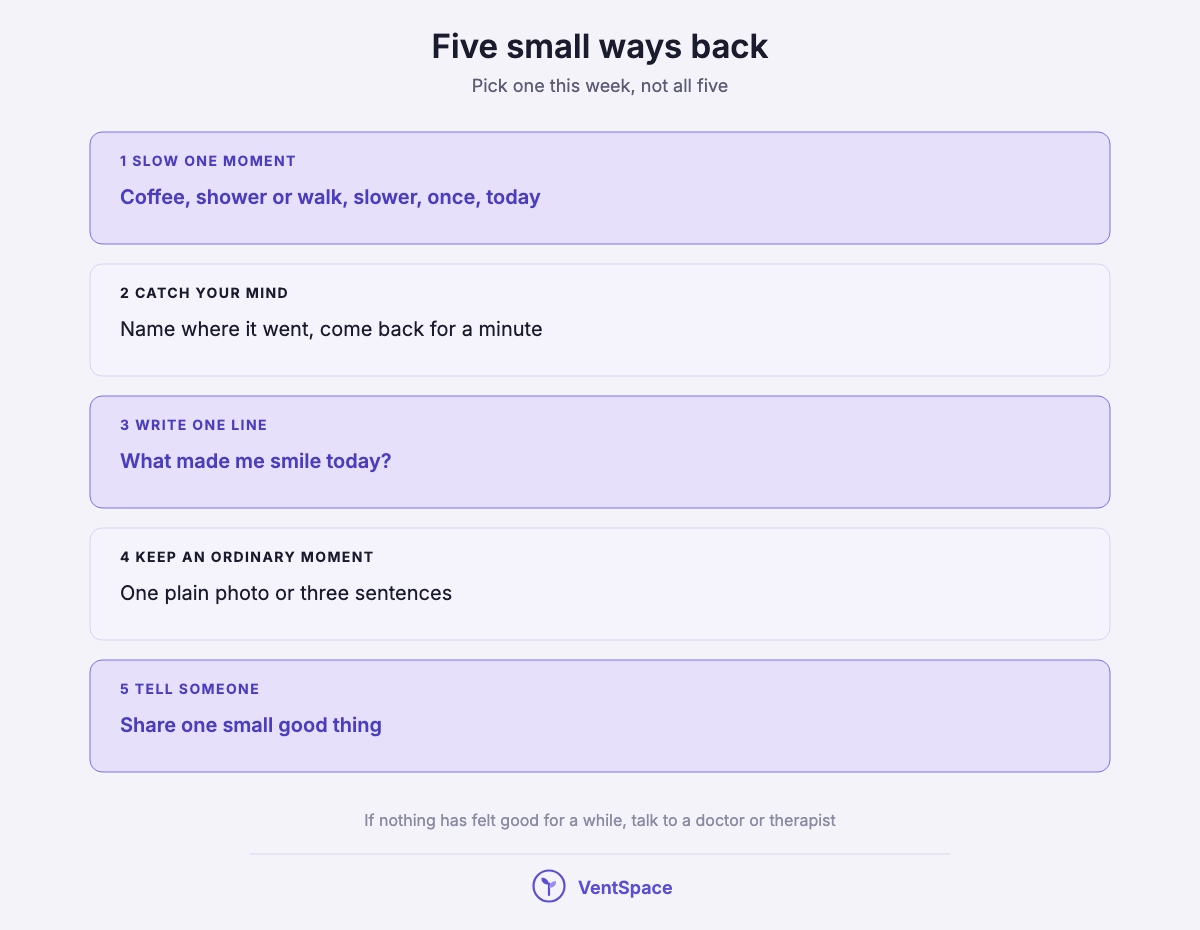
Joy in simple things comes back through small, repeated acts of attention, not through a new life. Each step below is a few minutes. Pick one. You do not need all five this week.
1. Slow down one ordinary moment today
Choose one thing you already do every day, a coffee, a shower, the first few minutes outside, and do it slower than usual, once, today. Notice three things about it: a taste, a temperature, a sound. That is the whole exercise. It is the chocolate study in reverse: instead of rushing past the small pleasure, you give it the extra seconds.
- Which daily moment do I usually rush that I like?
- What did it taste, sound or feel like today, specifically?
- What made me want to hurry it?
Permission: it will feel slightly silly the first time. That is normal, and it does not mean it is not working.
2. Catch where your mind went
Once a day, when you notice you are somewhere else, name where you went. “The meeting.” “That message.” “Next weekend.” Then come back to what is in front of you for one minute. You are not trying to stop your mind wandering, which would be impossible. You are turning the brightness up for sixty seconds.
- Where does my mind usually go on my walk, my commute, my lunch?
- Was where it went more useful than where I was?
- What was right in front of me that I missed?
Permission: you will drift again within seconds. Everyone does. Coming back is the practice, not staying.
3. Write down one small good thing
Tonight, write one line about one small good thing from today. Sai’s original page suggested a “joy diary” with questions like “What made me smile today?” and “What is a lesson or mistake that turned out to be valuable?” Both are good. One line is enough, and so is skipping a day. Remember that how often people did gratitude writing made no difference in the largest review.
- What made me smile today?
- What small thing went better than I expected?
- Who made today a little easier, even without knowing it?
Permission: if nothing comes, write “nothing yet”. A blank day is information, not a failure.
If you would like somewhere to keep these lines, VentSpace is a journaling app that turns what you write into a clear read on your life balance, plus small, doable next steps. Prefer to try it on your laptop first? VentSpace Live runs in your browser, free, with nothing to install. Over a few weeks, the small good things tend to show you which parts of your life are giving you the most. One caution about writing. In a review of expressive-writing studies, the average effect was moderate in healthy samples (0.47), small in clinical samples (0.19) and not significant in psychiatric samples (0.07), and it was detrimental for adult survivors of childhood abuse and a small sample of veterans (Baikie and Wilhelm, Advances in Psychiatric Treatment, 2005). Keep it short. If writing makes things heavier, stop and talk to someone instead.

4. Keep one ordinary moment for later
Take one photo, or write three sentences, about something completely ordinary this week. Not a celebration. A Tuesday lunch, the view from your desk, what you cooked. Then forget about it. Why bother recording something so plain? Because in four studies, Ting Zhang and colleagues found that people underestimate how much they will enjoy rediscovering ordinary moments later, more than they underestimate it for big events (Psychological Science, 2014). Sai’s original page called this “memory cherishing”, reliving a selfie with a high-school friend or a childhood birthday. The research suggests the everyday ones are worth keeping too.
- What is something ordinary about my life right now that will not last?
- What would I like to remember about this year that I would never think to photograph?
Permission: it does not need to be a good photo. It needs to exist.
Insight: Zhang, Kim, Brooks, Gino and Norton, Psychological Science (2014): “By documenting the present, people provide themselves with the opportunity to rediscover mundane moments that may otherwise have been forgotten.”
5. Tell someone about it
When something small and good happens, tell one person. A text is enough: the bread came out right, the neighbor said hi, you finished the book. Shelly Gable and colleagues found that sharing good news was linked to more positive feeling that day, beyond the event itself, and that the benefit was bigger when the other person responded with real interest (Journal of Personality and Social Psychology, 2004). It works in the other direction too. When someone tells you their small good thing, ask them about it.
- Who in my life would like to hear about a small good thing?
- When did someone last share one with me, and how did I respond?
Permission: it is not bragging. It is letting someone in on your day.
Insight: Gable, Reis, Impett and Asher, Journal of Personality and Social Psychology (2004): “when others were perceived to respond actively and constructively (and not passively or destructively) to capitalization attempts, the benefits were further enhanced.”
Pulling it all together
These five steps are one habit seen from different sides: noticing. Here is one way to string them into a week.
Slow one moment. Pick tomorrow’s coffee, shower or walk now, before the day starts. Write it down: “Tomorrow I slow down my ___.”
Catch your mind once. Choose the moment of the day when you are most often elsewhere. Commit to one sixty-second return there.
Write one line. Put a note by your bed or on your phone that says “What made me smile today?” Answer it on the nights you remember.
Keep one ordinary thing. Before Sunday, take one plain photo of your ordinary week.
Tell one person. Choose who it will be now, so that when the small good thing happens, you already know where to send it.
None of this needs to be done perfectly. Doing two of the five, most weeks, is a good outcome.
When small joys stop landing at all
If nothing has felt good for a while, even things you used to love, this is probably not about attention. Savoring is for pleasures that are there and getting missed. It is not built for a flatness that has settled over everything.
That kind of flatness has several possible causes. Low mood, depression, grief, exhaustion and some medications can all dull pleasure. In one survey, many people taking antidepressants said their emotions felt numbed. From the inside they can look alike. This page cannot tell them apart, and a doctor or therapist can. Therapy is one option, and for a lot of people it is the right one. If you are not sure where to start, our page on whether you need therapy is a fair first step.
If you are struggling right now. If you are thinking about harming yourself, or the flatness has turned into feeling hopeless, please contact the 988 Suicide & Crisis Lifeline now (US, call, text or chat 988), or find a line in your country at findahelpline.com. This article is not a substitute for that.
Questions people ask about finding joy in simple things
Why can’t I enjoy the little things anymore?
Often because attention is elsewhere, on work, plans or a phone, and the small pleasures pass unnoticed. If nothing at all feels good for a while, even things you used to love, that is different, and worth talking to a doctor or therapist about.
Is savoring the same as gratitude?
No. Gratitude is noticing what you are thankful for. Savoring is staying with a good moment and stretching it, while it happens or when you remember it. In the research, savoring exercises showed a larger effect than gratitude exercises, though the two were measured in different reviews.
Do I have to practice gratitude every day?
No. In the largest review of gratitude exercises, how often people did them made no difference to the effect. A line on the nights you remember is enough.
Can finding joy in simple things fix sadness or depression?
No, and nobody should promise it will. Savoring can add small good moments to an ordinary week. Persistent low mood is a different thing, and a doctor or therapist is the right place to take it.
What are some examples of simple joys?
The ones already in your week. A first coffee, a song on the way to work, a neighbor saying hi, food you cooked, a message from a friend. The examples matter less than whether you are there when they happen. If you want more ideas, our gratitude list groups a hundred by where your life is.
In a nutshell
First, joy in simple things is mostly attention, and attention can be practiced. The pleasures are usually still there. What drops is how often we are present for them, and a few minutes a day of slowing down, noticing and keeping small moments turns the brightness back up.
Second, it is small and slow. In the 2026 review the effect was moderate, not a transformation, and some of it may have come from doing anything at all. Expect a slightly brighter week, then another. That is what it looks like when it works.
About this article

Written by
Sai Subramaniam
Founder, VentSpace
I write these guides because I have been where you are. I am working through my own hard seasons, and I share the things that actually helped me, so that anyone going through it has a steady companion close by instead of facing it alone. VentSpace is the app I built for exactly that: a journaling app that turns what you write into a clear read on your life balance, plus small, doable next steps toward feeling more like yourself.
This writing is honest and every claim is sourced, and it is not a substitute for professional care. If you are struggling, reaching out to a professional is a strong move, not a failure.
Explore VentSpaceTry VentSpace LiveHow this one was checked. Every factual claim traces to a named source, and the source is printed next to the claim rather than kept in a footnote. Quotes are pinned to the work they come from, with the year, the letter or the chapter where one exists. Where a widely repeated claim could not be traced, it was left out and the omission recorded. Where a figure is contested, both sides are printed.
No affiliate links, no paid placements, and nobody paid to appear here. Where we mention our own app, we say that it is ours, we state its limits, and we never position it as a substitute for care.
Reviewed: October 2026. Prices, platforms and product availability move quickly, and anything we could not verify at the time of writing is marked as unverified rather than turned into a number.
Corrections. If something here is wrong, we would rather know. Corrections are made in place, with a note saying what changed.