
“This thing is a slot machine.” · Tristan Harris, former Google employee, on 60 Minutes (2017)
It is a Tuesday, 11:40 p.m., and you pick up your phone to check one message. The message takes four seconds. Then there is a notification under it, and a video under that, and somewhere in the next forty minutes you stop deciding anything and start being carried, and when you finally put the phone face down on the nightstand you feel slightly worse than when you picked it up. Nobody chose that forty minutes. So who did?
You are in large company, because in Pew Research Center’s 2025 survey 41% of US adults said they are online almost constantly, which means the forty minutes you lost last night were being lost, in some form, in millions of other bedrooms at roughly the same hour. That does not make it fine. It does make it ordinary.
The usual answer treats this as a willpower problem with a willpower solution: delete the apps, do a detox, try harder. The research points somewhere less heroic. This guide covers what “digital addiction” means and does not mean, why the pull is so strong, what the studies found that works, and then five steps you can set up on your own phone tonight, none of which require you to become a different person by Monday.
The short version
“Digital addiction” is an everyday phrase, not a diagnosis. The World Health Organization does recognize gaming disorder, with a high bar.
The pull is designed. A former Google employee compared the phone to a slot machine.
Cutting down beat quitting in a 2024 review of the research. A detox, one researcher says, is like a crash diet.
Friction works better than resolve. Grayscale, a pause before an app opens, alerts off.
Five steps. Watch a week, turn off alerts, add friction, cut down instead of quitting, and decide in advance what fills the gap.
Is digital addiction a real thing?
“Studies suggest that gaming disorder affects only a small proportion of people who engage in digital- or video-gaming activities.” · World Health Organization, gaming disorder FAQ
“Digital addiction” is a common phrase for heavy, hard-to-control use of phones, apps and the internet, but it is not a medical diagnosis. The World Health Organization does recognize gaming disorder by name. In the WHO’s words, gaming disorder is defined in ICD-11 “as a pattern of gaming behavior (“digital-gaming” or “video-gaming”) characterized by impaired control over gaming, increasing priority given to gaming over other activities to the extent that gaming takes precedence over other interests and daily activities, and continuation or escalation of gaming despite the occurrence of negative consequences.” For a diagnosis, the pattern has to cause significant impairment and “would normally have been evident for at least 12 months.”
That is a high bar. On purpose. Scrolling past midnight three times this week does not clear it.
For phones and social media more broadly, researchers still argue about whether “addiction” is the right word at all. In a 2018 review, Tayana Panova and Xavier Carbonell looked at the research on smartphone addiction and concluded they did not find enough support to confirm that it exists as an addiction. They suggested calling it problematic or maladaptive use instead. Not everyone agrees with them. But the fact that the argument is still going tells you something useful: the word on the page title is the word people search for, not a label anyone should pin on themselves.
None of this means the problem is small. Pew’s 2024 survey of 1,391 US teenagers found that nearly half said they are online almost constantly, up from 24% a decade earlier, and for adults the 2025 figure was 41%, so the thing you are trying to change is less a personal quirk than the default setting of modern life, which is exactly why it feels so hard to change on your own. Hard. Not hopeless.
If you are struggling right now. If your phone or gaming use sits alongside feeling hopeless, or you are thinking about harming yourself, please contact a crisis line now. In the US, call or text 988 (Suicide & Crisis Lifeline). Anywhere else, findahelpline.com lists free, confidential services by country. And if use is seriously hurting your work, school, money or relationships, and cutting down on your own has not worked, a doctor or a mental health professional can help. This page is not a substitute for that.
Quick Summary
Q: Is digital addiction a real disorder?
A: Not as a formal diagnosis. The World Health Organization’s ICD-11 includes gaming disorder, which requires impaired control and significant impairment, normally over at least 12 months. For phones and social media in general, researchers disagree about whether “addiction” fits, and some prefer “problematic use”.
Insight: Tayana Panova and Xavier Carbonell, reviewing the research in the Journal of Behavioral Addictions (2018): “We propose moving away from the addiction framework when studying technological behaviors and using other terms such as “problematic use” to describe them.” A different word does not make the forty minutes go away. It does change what you think the fix is.
Why it is so hard to put down
“And the problem is it becomes this race to the bottom of the brainstem, where if I go lower on the brainstem to get you, you know, using my product, I win.” · Tristan Harris, 60 Minutes (2017)
It is hard to put down because many apps are built to compete for your attention, and the phone works a little like a slot machine: you check because you might get something. That is not a moral failing on your part. It is the product working as designed.
Tristan Harris, who worked at Google before he began speaking about this, put it in a 2017 60 Minutes interview with an image that has stuck: “Well every time I check my phone,” he said, “I’m playing the slot machine to see, ‘What did I get?'” Sometimes the answer is a message from someone you love, sometimes it is a coupon, and most of the time it is nothing at all, and you cannot know which until you look. The not-knowing is the hook. And he was careful about blame: “it’s not because anyone is evil or has bad intentions. It’s because the game is getting attention at all costs.”
So here is the reframe. The problem is less your willpower than the machine’s design, and the fix is less a heroic act of resistance than a series of boring changes that make the machine worse at its job, because you are not going to out-discipline a product built by thousands of people whose whole job is keeping you on it. You can make it slower. Grayer. Quieter.
Before the fixes, it helps to know what the habit costs you. In your own terms. Not a checklist and not a score, just a few honest questions you can answer on the back of an envelope.
- Which app do you open without deciding to?
- What were you doing, or avoiding, right before you reached for the phone?
- What did the last long scroll cost you: sleep, a conversation, a task, a mood?
- When you put the phone down, do you usually feel better or worse than when you picked it up?
- What would you do with that time if the phone were in another room?
Write the answers down. You will use them in step 1.
Quick Summary
Q: Why is it so hard to stop using my phone?
A: Many apps are designed to capture as much attention as possible, and unpredictable rewards, like a message that may or may not be there, keep you checking. That is a feature of the product, not a flaw in your character, which is why changing the phone’s setup tends to work better than relying on willpower.
Insight: Tristan Harris, on 60 Minutes (2017): “And it’s not because anyone is evil or has bad intentions. It’s because the game is getting attention at all costs.” That sentence is the reason the steps below change the phone, not your personality.
What the research says works, and what doesn’t
“I am not a fan of digital detox because to me, it’s like a crash diet.” · Gloria Mark, on ReThinking with Adam Grant (2026)
The research so far favors cutting down over quitting, and changing the phone’s setup over relying on resolve. No single study settles it. Taken together, though, a handful of experiments point the same way, and they are worth knowing because they are far more specific than the advice you have probably already tried and abandoned.
| Study | What people did | What happened |
|---|---|---|
| Allcott, Braghieri, Eichmeyer and Gentzkow (2020) | Deactivated Facebook for four weeks | More offline time, higher well-being, and a lasting drop in Facebook use afterwards |
| Hunt, Marx, Lipson and Young (2018) | 143 students limited Facebook, Instagram and Snapchat to 10 minutes each a day for three weeks | Lower loneliness and depression scores than the usual-use group |
| Zimmermann and Sobolev (2022) | 112 people tried grayscale mode or time limits | Grayscale cut screen time straight away, time limits more slowly, and well-being did not change right away |
| Grüning, Riedel and Lorenz-Spreen (2023) | 280 people used one sec, an app that adds a pause before chosen apps open, for six weeks | App openings fell 57%. One author created the app |
| Kushlev, Proulx and Dunn (2016) | 221 people spent one week with alerts on and one with alerts off | Higher inattention and hyperactivity reported in the alerts-on week |
| Marciano, Jindal and Viswanath (2024) | Reviewed the research on “digital detox” | Reducing use did better than total abstinence, and the evidence is still limited |
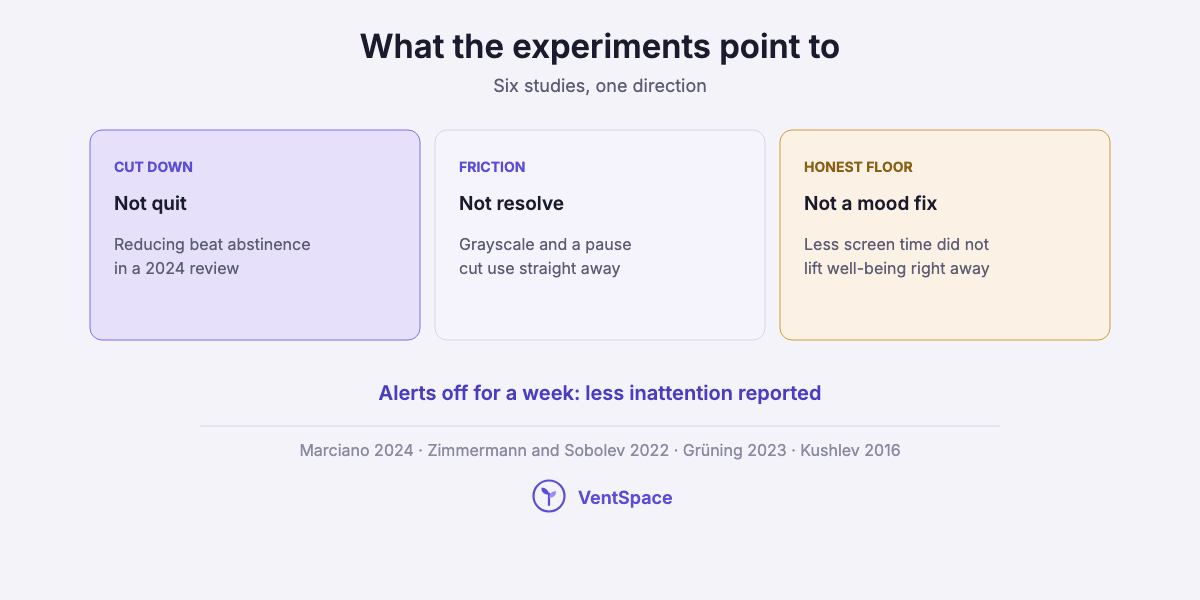
Three things stand out once you line them up.
First, less is better than none. The 2024 review in Pediatrics found that reducing social media or smartphone time, rather than promoting total abstinence, showed more benefit for well-being, and Hunt’s students, notably, did not quit anything, they capped each app at ten minutes a day and kept using all three. Smaller. Not zero. The first version of this page made the same point in plainer words: the aim is not to shun technology altogether, but to find a balance that works for your life.
Second, friction beats intention. In Zimmermann and Sobolev’s experiment, turning the screen gray reduced use immediately while setting time limits worked more slowly, and in the one sec study the follow-up experiment found that the option to dismiss the app at the pause had the strongest effect. Nobody needed more motivation.
Third, less screen time is not a guaranteed mood lift. That same grayscale study found no immediate effect on well-being or grades, and it is worth saying plainly because it is the part most guides leave out. Cutting down may give you back hours. It will not, on its own schedule, make you feel better by Friday.
There are caveats. The one sec study was co-authored by the app’s originator, which the paper discloses, Hunt’s sample was undergraduates at one university, and Allcott’s study covered four weeks around a US election, so these are good studies with real limits, and none of them is your life.
Quick Summary
Q: What actually works to reduce phone and social media use?
A: Experiments suggest cutting down rather than quitting outright, adding friction such as grayscale mode or a pause before apps open, and turning off notifications. A 2024 review found reducing use did better for well-being than total abstinence, though the evidence is still limited and less screen time does not always lift mood quickly.
Insight: Laura Marciano, Sanmit Jindal and Kasisomayajula Viswanath, reviewing the evidence in Pediatrics (2024), found that “reducing social media/smartphone time rather than promoting total abstinence showed more beneficial effects on well-being”. They also noted there is still no clear definition of a digital detox, which is part of why the word promises more than it delivers.
So what do you do with a slot machine you carry in your pocket?
How to overcome digital addiction, in five steps
“These findings highlight some of the costs of ubiquitous connectivity and suggest how people can reduce these costs simply by adjusting existing phone settings.” · Kostadin Kushlev, Jason Proulx and Elizabeth Dunn, CHI (2016)
You overcome heavy phone use by seeing it clearly for a week, cutting the alerts, making the worst apps slower to open, reducing rather than quitting, and deciding in advance what fills the time. Each step is small. Together they make the slot machine worse at its job.
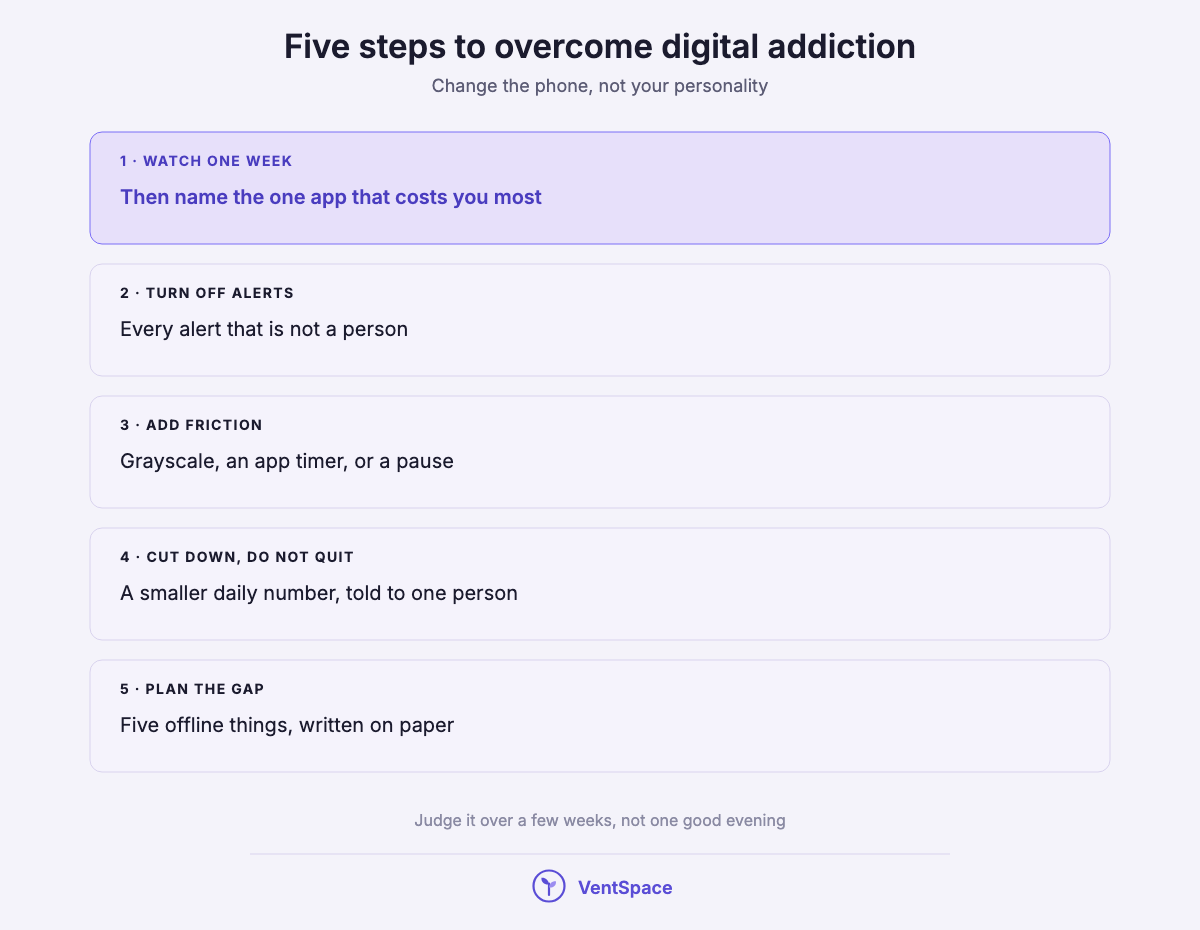
1. Watch one ordinary week, then name the one app that costs you most
Do nothing different for seven days. Just look. Open your phone’s screen time report each evening, or Digital Wellbeing on Android, and note the top three apps and roughly when you opened them, and keep the notes somewhere you will see them again on day seven, when the pattern is easier to read than it ever is from inside a single evening. The first version of this page called this identifying your triggers: the moments you reach for the phone without thinking, like a commercial break or a line at the store.
Looking does something on its own. In Hunt’s study, both groups, including the one that changed nothing at all about how they used their apps, reported less anxiety and less fear of missing out by the end, and the authors read that as a benefit of paying closer attention to their own use. One study. No promises. Still a cheap place to start.
At the end of the week, pick one app. Not five. The one that costs you most, by your own answers from the questions above.
- Which app took the most time, and at what hour?
- Which one did you open most often without meaning to?
- Which one left you feeling worst?
- What tends to happen right before you open it?
You are not on trial here. A week of honest numbers is the whole job.
2. Turn off every alert that is not a person
Go to your notification settings tonight and turn off every alert that is not a human being trying to reach you. Keep calls and messages from people. Turn off likes, recommendations, news, shopping, streaks and “you might have missed”.
This step has the cleanest experiment behind it. Kushlev, Proulx and Dunn had 221 people spend one week with alerts on and the phone within reach, and another week with alerts off and the phone away, and people reported higher inattention and hyperactivity in the alerts-on week, and that inattention went with lower productivity and lower well-being. The authors’ conclusion is the line at the top of this section. Settings you already have.
- Which alerts did you act on today, and which did you just look at?
- Which apps would you miss hearing from, honestly?
- Who needs to be able to reach you at night?
It feels drastic for about two days. Then it mostly feels quiet.
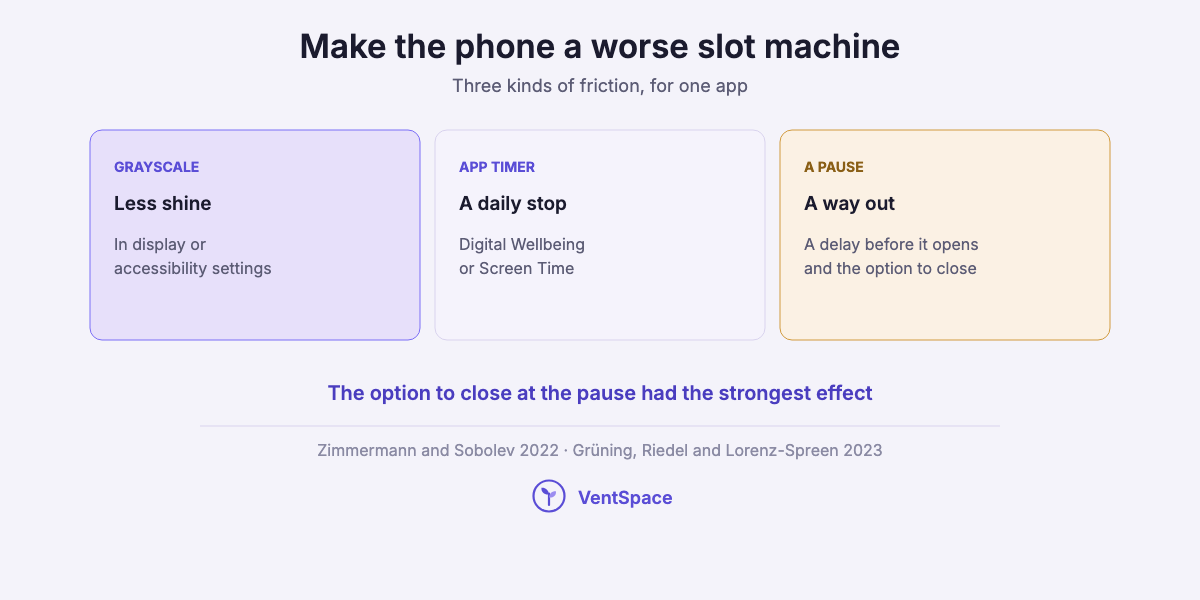
3. Make the phone a worse slot machine
Take the one app from step 1 and put friction between you and it. Some options, roughly in order of effort:
- Turn on grayscale. It is in your phone’s accessibility or display settings. In Zimmermann and Sobolev’s experiment it cut screen time immediately.
- Set an app timer. On Android, Digital Wellbeing’s app timers close the app when your time is up; in Google’s words, “the app closes and its icon dims.” On iPhone, Screen Time lets you set time allowances and schedules, though the menu names change between iOS versions.
- Add a pause. one sec (free on Google Play, with in-app purchases, as of 22 October 2026) shows a short delay and the option to close the app before it opens. Its own study is the one with the 57% drop, co-authored by its originator.
- Block it on a schedule. Freedom (free on Google Play, with in-app purchases) blocks chosen apps and sites during a session and can connect your other devices.
- Make staying away visible. Forest (free on Google Play, with ads and in-app purchases) grows a tree while you stay off your phone, and its listing says the tree will “wither” if you leave to scroll.
- Delete the app from your phone and use it only on a laptop, where it is slower and less comfortable.
We have no affiliate links and nobody paid to be named here, and we make no claim that any of these apps will fix anything, because none of them has been tested on your evenings. They make the easy thing slightly harder. Often enough.
- Which single change would annoy you the most? That is probably the one that will work.
- Can you still reach the app in an emergency if you need to?
- Which of these could you set up in the next five minutes?
Pick one. You can add a second next week.
4. Cut down instead of quitting
Set a daily amount for your one app that is smaller than now but not zero. If you want a number from the research, Hunt’s students used ten minutes per platform, about thirty minutes a day across three apps, and the authors suggested that limit may improve well-being. Write it down.
Quitting outright is tempting because it feels decisive and final and clean, the kind of decision you can announce, but the 2024 review found reducing did better than abstinence, and Gloria Mark’s view is that a detox is “like a crash diet” when what works better is for people “to change their routines.” Allcott’s Facebook study shows the other side of that coin, since four weeks away left people using Facebook less afterwards. A break can reset the baseline. The baseline is what you are building.
Say it out loud to someone. The first version of this page suggested sharing your goal with friends or family, so that someone else knows what you are trying to do, not to police you, but because a promise someone else has heard may be harder to quietly drop at 11:40 p.m. on a Tuesday.
- What daily amount for your one app feels smaller but realistic?
- Who could you tell, today, in one sentence?
- What will you do on the day you go over?
Going over is not failing. It is data for next week’s number.
5. Decide in advance what fills the gap
Before the free time arrives, write a short list of five things you could do instead, and keep it on paper, not on the phone. The first version of this page called it a personalized “offline” playlist. Make some of them tiny: stretch, make tea, text one person, read three pages.
Then make a few places and times phone-free. The first version suggested digital-free meals, a phone-free room, and leaving the phone at home for a jog or an evening with friends, and if you work at a desk, our guide on deep work covers the working-hours version of this, including where to put the phone during a focus block.
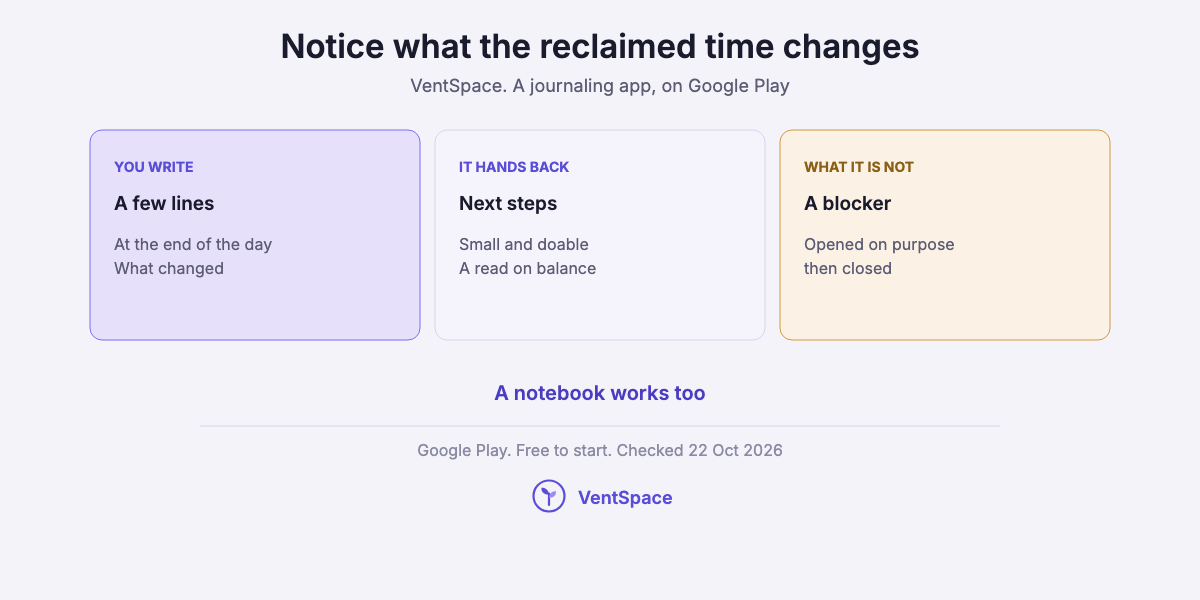
You can also use some of the reclaimed time to notice what changes. Writing a few lines at the end of the day is one way. If you want somewhere that does something with what you write, VentSpace is a journaling app that turns what you write into a clear read on your life balance, plus small, doable next steps. It is free to start, on Google Play for Android (checked 22 October 2026). Not on Android, or at a desk? VentSpace Live runs in your browser, free, with nothing to install. Yes, it is another app. It is one you open on purpose, for a few minutes, and close.
- What five things are on your offline list?
- Which meal or room could be phone-free starting this week?
- When during the week do you most want your attention back?
- What would you like to notice about yourself after a month of this?
The list will feel a bit silly. Use it anyway, because the moment you need it is the moment you will not think of anything.
Quick Summary
Q: How do I overcome digital addiction?
A: Watch your use for a week and pick the one app that costs you most, turn off every notification that is not a person, add friction such as grayscale, app timers or a pause before opening, set a smaller daily limit rather than quitting, and plan offline things to fill the time.
Insight: Cal Newport, defining digital minimalism in his 2019 book of that name: “A philosophy of technology use in which you focus your online time on a small number of carefully selected and optimized activities that strongly support things you value, and then happily miss out on everything else.” The word that does the work is “happily”.
Pulling it all together
Step 1 tells you where the problem is. Without a week of honest numbers you are guessing, and guessing is how most people end up deleting the wrong app, feeling virtuous for three days, and reinstalling it on the fourth. Open your screen time report tonight and write down the top app.
Step 2 removes the summons. Most pickups start with a buzz. Turn off every alert that is not a person.
Step 3 slows the reach. Friction works when resolve is asleep. Turn on grayscale or a pause for your one app.
Step 4 sets a number you can keep. Smaller, not zero. Write your daily amount and tell one person.
Step 5 gives the time somewhere to go. Empty gaps fill themselves. Put five offline things on paper and keep the list by your bed or your desk.
Questions people ask about digital addiction
Is a digital detox the best way to beat phone addiction?
Probably not. A 2024 review in Pediatrics found that reducing use did better for well-being than total abstinence, and noted there is no clear definition of a digital detox at all, while Gloria Mark compares a detox to a crash diet, so a short break may help reset habits but lasting change tends to come from changing your routine and your phone’s settings.
Is digital addiction a mental illness?
Not as a formal diagnosis. The World Health Organization’s ICD-11 includes gaming disorder, which requires impaired control and significant impairment, normally over at least 12 months. For phones and social media in general, researchers disagree about whether “addiction” fits. If your use is seriously hurting your life, a doctor or mental health professional can help work out what is going on.
How much screen time is too much?
There is no agreed number. One experiment found that limiting three social apps to ten minutes each a day lowered loneliness and depression scores, and another found that cutting screen time did not change well-being right away, which suggests total hours say little on their own. What the time costs you matters more than the total.
Do app blockers work?
Some have evidence. Most do not. The best-studied is one sec: in a six-week field study of 280 people, app openings fell 57%, though one of the authors created the app, and grayscale mode, which is free and built into most phones, cut screen time immediately in a separate experiment. Pick one tool and judge it by your own next two weeks.
How long does it take to cut down on phone use?
Nobody has measured a reliable timeline. The studies on this page ran for between two and six weeks, which is a sensible window to judge your own changes, and in one experiment grayscale cut screen time straight away. Some changes show up fast.
In a nutshell
You are not losing a fight with yourself. You are losing a fight with a machine designed to win it, so change the machine: fewer alerts, more friction, a smaller number, a plan for the gap.
Give it a few weeks, about as long as the studies that tested this ran, two to six. Judge it by whether the evenings feel more like yours, not by one good day.
The slot machine still works. It just pays out a lot less often.
About this article

Written by
Sai Subramaniam
Founder, VentSpace
I write these guides because I have been where you are. I am working through my own hard seasons, and I share the things that actually helped me, so that anyone going through it has a steady companion close by instead of facing it alone. VentSpace is the app I built for exactly that: a journaling app that turns what you write into a clear read on your life balance, plus small, doable next steps toward feeling more like yourself.
This writing is honest and every claim is sourced, and it is not a substitute for professional care. If you are struggling, reaching out to a professional is a strong move, not a failure.
Explore VentSpaceTry VentSpace LiveHow this one was checked. Every factual claim traces to a named source, and the source is printed next to the claim rather than kept in a footnote. Quotes are pinned to the work they come from, with the year, the letter or the chapter where one exists. Where a widely repeated claim could not be traced, it was left out and the omission recorded. Where a figure is contested, both sides are printed.
No affiliate links, no paid placements, and nobody paid to appear here. Where we mention our own app, we say that it is ours, we state its limits, and we never position it as a substitute for care.
Reviewed: October 2026. Prices, platforms and product availability move quickly, and anything we could not verify at the time of writing is marked as unverified rather than turned into a number.
Corrections. If something here is wrong, we would rather know. Corrections are made in place, with a note saying what changed.