
“the self-concept which the individual would most like to possess, upon which he places the highest value for himself”
Carl Rogers, defining the ideal self (1959, p. 200), as quoted in Ganesan, “Ideal Self”, Encyclopedia of Personality and Individual Differences (Springer, 2020)
Your real self is the person you believe you are now. Your ideal self is the person you would most like to be. The first is a description, the second is a wish, and the distance between them is what most of us mean when we say we are not where we hoped to be. That distance is not a verdict on anyone’s character. It is a gap between two pictures, both of them drawn by us, and the useful questions are about the second picture: whose wish it is, how loudly it speaks, and whether the step it asks for can be taken this week.
The short version
The real difference: the real self is how you see yourself now. The ideal self is how you would most like to be. Both are pictures you hold, not facts.
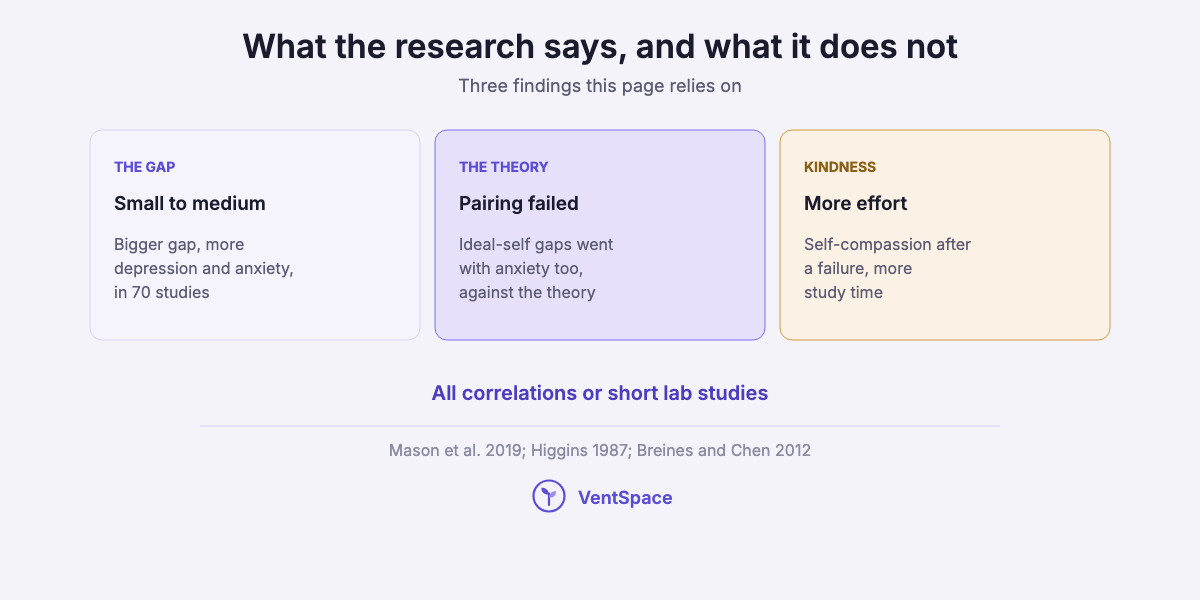
The gap tracks distress, modestly. Across 70 studies, a bigger gap went with more depression and anxiety, at a small-to-medium size. It is correlational.
Whose ideal it is matters. Higgins separated your own hopes for yourself from other people’s hopes for you, and both from what you believe you ought to be.
Kindness does not stop the climb. In four experiments, people guided toward self-compassion after a failure were more motivated to improve, not less.
The test: ask whether the ideal is yours, whether it is a hope or a duty, and what one step toward it looks like. Then decide whether to walk or to redraw.
What the real self is
The real self is the person you believe you are right now. In self-discrepancy research it is called the actual self, and E. Tory Higgins, whose 1987 paper in Psychological Review is a standard reference on the gap, defined it as “your representation of the attributes that someone (yourself or another) believes you actually possess.” He also wrote “the self-concept” beside it in brackets, as a plain equivalent. In other words, the real self is not the truth about us. It is our current description of ourselves, which can be generous or harsh, out of date or fairly accurate, and which we tend to mistake for a fact.
That small correction matters more than it looks. If we treat our self-description as a fact, a gap between it and the ideal can only mean that we have fallen short. If we treat it as a description, we are allowed to ask whether it is a fair one.
What the ideal self is
The ideal self is the person you would most like to be. Carl Rogers, the humanistic psychologist, called it “the self-concept which the individual would most like to possess, upon which he places the highest value for himself.” Higgins later made the definition more precise: the ideal self is “your representation of the attributes that someone (yourself or another) would like you, ideally, to possess (i.e., a representation of someone’s hopes, aspirations, or wishes for you).”
Look closely at that parenthesis: someone’s hopes for you. Not necessarily your own. The ideal self we carry around may be our own, or it may be a parent’s, a teacher’s, or a feed’s, and we usually do not notice the difference, because a wish feels like ours from the inside whoever first had it.
Ideal self vs real self, side by side
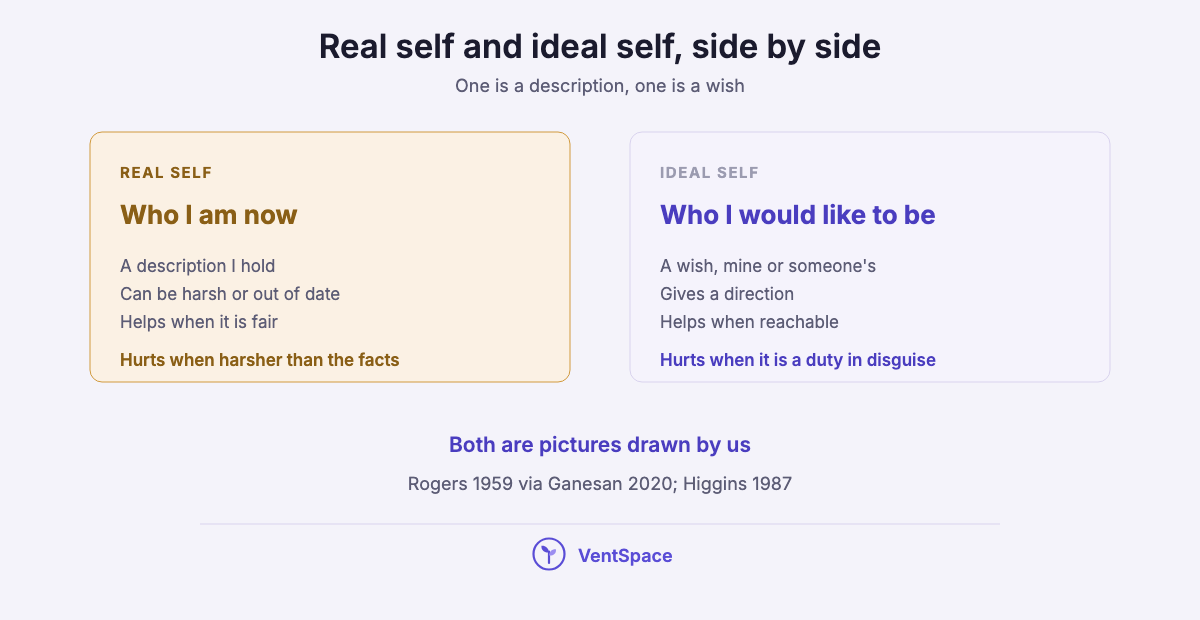
| Real self | Ideal self | |
|---|---|---|
| What it is | How you see yourself now | How you would most like to be |
| Its grammar | A description | A wish |
| Who drew it | You, from your own standpoint | You, or someone whose hopes you took on |
| What it asks of you | To be described fairly | A direction, and a first step |
| When it helps | When it is accurate and kind | When it is yours and reachable |
| When it hurts | When it is harsher than the facts | When it is someone else’s, or a duty in disguise |
Where each one comes from
The real self comes from our own reading of our lives. The ideal self often arrives from outside. This is the most useful thing in Higgins’s paper, and the part that most explanations leave out. He did not stop at three selves (actual, ideal and ought). He crossed them with two standpoints, your own and a significant other’s, so that an ideal self can be your own hopes for yourself or your sense of what your mother, your partner or your manager hopes you will become.
He drew a second line too, between the ideal self and the ought self. The ought self, in his words, is “your representation of the attributes that someone (yourself or another) believes you should or ought to possess (i.e., a representation of someone’s sense of your duty, obligations, or responsibilities).” A hope and a duty can describe the same person and feel completely different to live under. Higgins’s own example of the split is “the conflict between a hero’s ‘personal wishes’ and his or her ‘sense of duty.'”
The original version of this page asked readers to put each expectation to a simple question: “Who told me this was important?” That question survives every revision, because it is Higgins’s standpoint distinction in plain words. It is easy to carry an ideal we never chose, and to spend energy failing to reach it without once asking whether we wanted to go there.
To give our own example, not Higgins’s: “I should have a stable salaried job by thirty” might be a hope you hold, a duty you were handed, or a parent’s wish you have kept on their behalf. The sentence is the same in all three cases. The gap it opens is not.
Quick Summary
Q: Where does the ideal self come from?
A: Sometimes from us, often from other people. Higgins separated your own hopes for yourself from a significant other’s hopes for you, and both from what you believe you ought to be. A gap with someone else’s ideal is a different problem from a gap with your own.
Insight: Higgins (1987) borrowed a line from the psychoanalyst Roy Schafer to make the point that personal ideals and moral duty are different things: “ideals and superego morality have been confined together when each should long ago have had a place of its own.” Higgins also notes that Rogers (1961) “distinguished between what others believe a person should or ought to be (i.e., the normative standard) and a person’s own belief about what he or she would ‘ideally’ like to be.”
What the gap does to how we feel
A bigger gap goes with more distress, and the link is modest. In 2019, Mason and colleagues pooled 70 studies in a meta-analysis in Psychological Bulletin. The gap between how people saw themselves and their ideal or ought selves was associated with depression at r = .27, with anxiety at r = .23 and with low self-esteem at r = .29. The authors call it “a small-to-medium association.” Those are correlations: they do not tell us whether the gap brings the low mood, the low mood widens the gap, or both feed each other.
The same meta-analysis corrected the neatest part of the theory. Higgins had predicted that gaps with the ideal self would bring dejection and sadness, while gaps with the ought self would bring agitation and fear. Across the 70 studies, ideal-self gaps went with more depression and more anxiety than ought-self gaps did, a result the authors describe as “contrary to the tenets” of the theory. So the gap matters, and the tidy two-column version of what each gap feels like does not hold up.
Higgins’s own data, for what it is worth, came from about forty people. In that sample, the gap between the actual and ideal self predicted low self-esteem even after he controlled for how negative people’s self-descriptions were, which suggests it is the distance between the two pictures, not only a harsh self-picture, that hurts. One small study from 1987 cannot carry that point alone, which is why the 70-study figure is the one we lean on.
What none of this says is that wanting more is unhealthy. An ideal self is how we know which way to walk. The trouble starts when the gap stops being a direction and becomes a daily measurement of how far short we are.
If the gap has turned into something heavier. If thinking about who you are compared with who you should be has started to feel like proof that you are worthless, or you are thinking about harming yourself, please contact the 988 Suicide & Crisis Lifeline now (US, call or text 988), or find a line in your country at findahelpline.com. If you are in immediate danger, call 911.
Quick Summary
Q: Is a big gap between my ideal and real self bad for my mental health?
A: It is linked with more depression and anxiety, at a small-to-medium size, across 70 studies. It is a correlation, not proof that the gap causes anything, and the theory’s prediction about which gap brings which feeling was not supported.
Insight: Mason, Smith, Engwall and colleagues, Psychological Bulletin (2019), on the overall pattern: “a small-to-medium association … highly robust and similar in magnitude across domains.” And on the theory’s emotion pairing: effects “were greater for actual:ideal discrepancy compared with actual:ought discrepancy for both depression and anxiety, which was contrary to the tenets of SDT.”
How loudly each one speaks
The real self is with us all day. The ideal self speaks when something reminds us of it. Higgins’s theory does not only care about the size of a gap. His general hypothesis, in his words, is that “the greater the magnitude and accessibility of a particular type of self-discrepancy possessed by an individual, the more the individual will suffer the kind of discomfort associated with that type of self-discrepancy.” Accessibility is a researcher’s word for how easily something comes to mind, and Higgins said it depends on three things: how recently the gap was brought to mind, how often it is, and how closely the moment in front of us matches it. He also noted that people need not be aware of any of this.
That gives us two dials, not one. To put it in our own terms, a large gap we rarely think about may trouble us less than a modest gap we rehearse every evening. And some of our habits turn the second dial up without our choosing it: the scroll before bed through other people’s best days, the comparison at a reunion, the annual review, the birthday with a zero in it. None of those changes who we are. Each one makes the ideal louder.
To be honest about the limits, Higgins supported the accessibility idea with a couple of experiments with undergraduates in the mid-1980s, and the meta-analysis above pooled studies of how big people’s gaps were, not how often they came to mind. We offer the two-dial reading as a sensible way to use the theory, not as a settled finding. It does suggest one modest thing we can try: noticing when the ideal speaks up, not only what it says.
Quick Summary
Q: Why does the gap feel worse on some days than others?
A: Higgins proposed that how easily a gap comes to mind matters as well as how big it is, and that recent and frequent reminders make it more accessible. The early evidence was limited, but it fits the common experience that the same gap hurts more after a reunion or a long scroll.
Insight: Higgins (1987): “In sum, the accessibility of a self-discrepancy is determined by its recency of activation, its frequency of activation, and its applicability to the stimulus event.” He adds, quoting an older argument from Abelson, that inconsistencies in anyone’s beliefs “may lie dormant”, and that pressure operates “only when the issue is salient”.
What closes the gap: changing, or being kinder about it
The usual answer is to close the gap by improving. The research suggests that kindness toward the real self helps the improving. It can feel as if self-criticism is the engine and that being gentle with ourselves will let us off the hook. Breines and Chen tested this in four experiments published in Personality and Social Psychology Bulletin (2012). People who were guided to treat a mistake or a weakness with self-compassion, compared with people given a self-esteem boost or no intervention, believed more strongly that the weakness could change, were more motivated to make amends for a recent wrong, spent more time studying for a difficult test after failing a first one, and reported more motivation to change the weakness.
These were short laboratory experiments with immediate measures, and we have not loaded a replication of them, so the finding should be held at that size. But it points the opposite way from the self-criticism most of us use on ourselves, and it suggests that accepting the real self and reaching for the ideal one are not rivals.
Sai, who founded VentSpace and wrote the first version of this page, put the other half of the warning in his own terms:
From Sai, who wrote the first version of this page: “We have a saying in Tamil, my native language, which goes, ‘Too much of medicine can be poisonous too.'” His point was that ambition is a medicine of this kind. It moves us toward the ideal self, and in too large a dose it can cost balance and bring burnout and anxiety, which he listed as the dark side of unchecked ambition.
That is the case for walking toward the ideal at a pace we can keep, from a description of ourselves we can bear to read.
Quick Summary
Q: Should I accept my real self or work toward my ideal self?
A: Both, and the order matters. In four short experiments, self-compassion after a failure was linked to more motivation to improve, not less. Acceptance is the ground the improving stands on.
Insight: Breines and Chen, Personality and Social Psychology Bulletin (2012): “These findings suggest that, somewhat paradoxically, taking an accepting approach to personal failure may make people more motivated to improve themselves.”
How to tell what your gap is made of
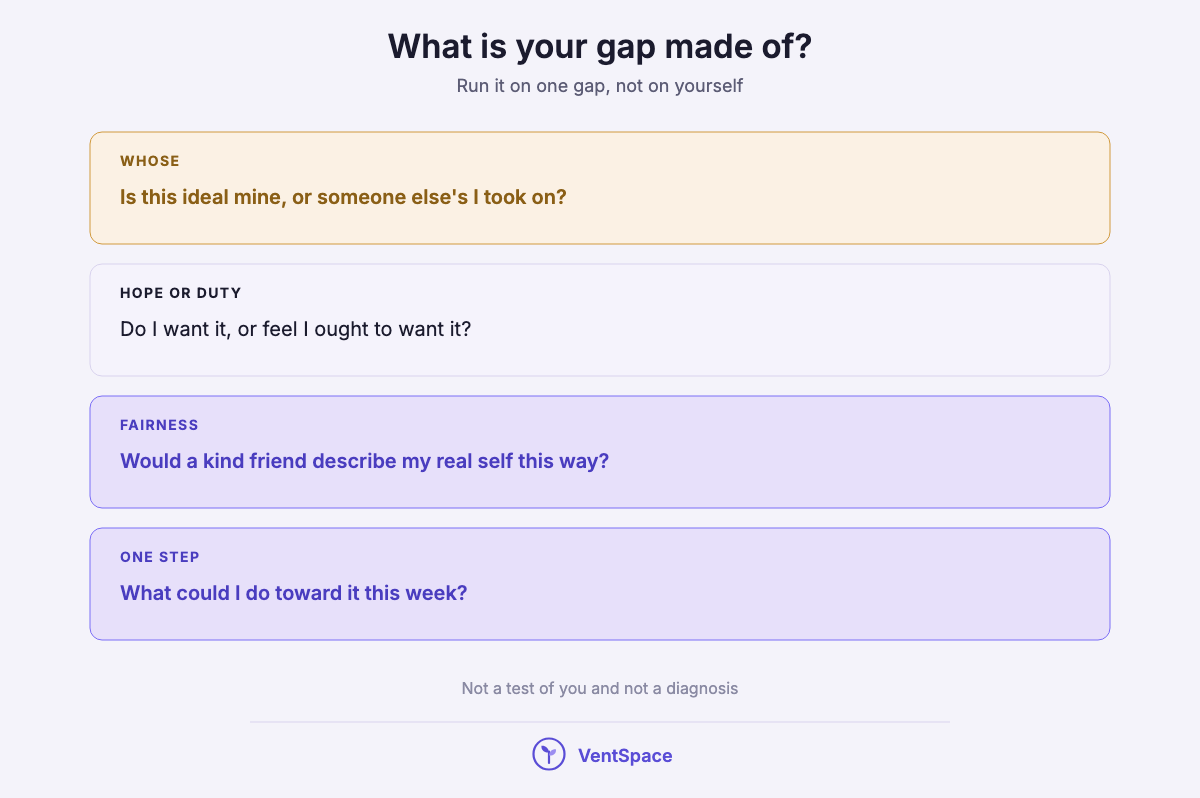
This is not a test of you, and it is not a diagnosis. It is a short check you can run on one gap, the one that bothers you most this month. Mixed answers are the usual result.
- What exactly is the ideal? One sentence, specific. “Be better” cannot be checked. “Run three times a week” can.
- Whose hope is it, first? Mine, or someone else’s that I took on?
- Is it a hope or a duty? Do I want it, or do I feel I ought to want it?
- How fair is my description of my real self? Would a friend who knows me well write the same sentence?
- When does this gap get loud? After what, and with whom?
- What is one step toward it I could take this week? If none exists, is the ideal reachable at all?
If the ideal is yours, it is a hope rather than a duty, and a step exists, you probably have a direction rather than a problem. If it came from someone else, or it is a duty dressed as a wish, the work is to renegotiate the ideal, not to close the gap. If your real-self sentence would make a kind friend wince, the gap may be smaller than it looks, because you are measuring from a harsh description.
What to do in each case
If the ideal is yours and reachable:
- Write the ideal as one action you can finish, not a trait you must become.
- Take the first step this week, and give it a day.
- Treat the first slip with the kindness Breines and Chen tested. Name what happened, what you would say to a friend, and the next try.
- Keep the dose sane. Pick one gap at a time. Sai’s Tamil proverb applies.
If the ideal is someone else’s, or a duty in disguise:
- Name whose voice it is. One sentence: “This is my father’s hope for me.”
- Decide what part of it you also want. Often some of it is yours too.
- Rewrite the ideal in your own words, keeping only that part.
- Notice what makes it loud, and turn that dial down where you can, by muting a feed or skipping one comparison.
If writing the two descriptions side by side would help, VentSpace is a journaling app that turns what you write into a clear read on your life balance, plus small, doable next steps. Prefer to try it on your laptop first? VentSpace Live runs in your browser, free, with nothing to install. A page is often where a vague sense of falling short becomes one sentence you can check against the questions above. One caution about writing. In a review of expressive-writing studies, the average effect was moderate in healthy samples (0.47), small in clinical samples (0.19) and not significant in psychiatric samples (0.07), and it was detrimental for adult survivors of childhood abuse and a small sample of veterans (Baikie and Wilhelm, Advances in Psychiatric Treatment, 2005). Our suggestion is to stop after twenty minutes. If writing makes the gap feel heavier, stop and talk to someone instead.
Where the line blurs
The real self and the ideal self are not fixed. The first version of this page made the point well: our values, goals and priorities change through the stages of life, so the ideal self changes with them. Sai called this the fluidity of the ideal self. We have no study to put a number on it, and we do not need one to see that the person we wanted to be at nineteen is rarely the person we want to be at forty. Our page on how personal values change over time goes further into that shift.
The line also blurs because the real self includes the reaching. Wanting to be kinder is already a fact about who we are. And the gap blurs into something else when it stops being about one goal: if falling short has become a constant, general feeling, most days, about most things, and it is getting in the way of work, sleep or people, a gap check will not fix it. Therapy is one option, and for a lot of people it is the right one. Our page on whether you need therapy is a fair place to start, and if the harder part is a harsh self-description, self-esteem vs self-confidence explains how those two differ.
Questions people ask about the ideal and real self
What is an example of the ideal self vs the real self?
Here is one of ours. Your real self might be “I work long hours and see my friends once a month.” Your ideal self might be “I keep one evening a week for people I love.” The gap is one evening, which is something you can test this week.
Is it bad to have an ideal self?
No. An ideal self gives direction. The research links a large gap with more distress, at a small-to-medium size, which is an argument for an ideal that is yours and reachable, not for having none.
What did Carl Rogers say about the ideal self?
Rogers described it as “the self-concept which the individual would most like to possess, upon which he places the highest value for himself” (1959, as quoted in Ganesan, 2020). The popular three-part model of self-image, self-esteem and ideal self is often credited to him, but we could not trace that model to a specific work of his, so we do not attribute it.
Do ideal-self gaps cause sadness and ought-self gaps cause anxiety?
That was the theory, and it did not hold up. Higgins proposed that pairing in 1987. A 2019 meta-analysis of 70 studies found ideal-self gaps linked with both more depression and more anxiety than ought-self gaps, which the authors called contrary to the theory.
Does self-compassion make you lazy?
The evidence we have points the other way. In four short experiments, people guided toward self-compassion after a failure were more motivated to improve and studied longer for a hard test. These were lab studies with immediate measures.
The short of it
First, both selves are pictures we hold. The real self is a description and the ideal self is a wish, and before we try to close the gap between them, it is worth checking that the description is fair and the wish is ours.
Second, this is slower than it sounds. One gap, one step a week, and a kind word for the weeks the step does not happen. The ideal will move while we walk toward it, which is not failure. It is what growing up looks like from the inside.
We do not have to become the person we imagined. We have to become someone we can live with, a little at a time.
About this article

Written by
Sai Subramaniam
Founder, VentSpace
I write these guides because I have been where you are. I am working through my own hard seasons, and I share the things that actually helped me, so that anyone going through it has a steady companion close by instead of facing it alone. VentSpace is the app I built for exactly that: a journaling app that turns what you write into a clear read on your life balance, plus small, doable next steps toward feeling more like yourself.
This writing is honest and every claim is sourced, and it is not a substitute for professional care. If you are struggling, reaching out to a professional is a strong move, not a failure.
Explore VentSpaceTry VentSpace LiveHow this one was checked. Every factual claim traces to a named source, and the source is printed next to the claim rather than kept in a footnote. Quotes are pinned to the work they come from, with the year, the letter or the chapter where one exists. Where a widely repeated claim could not be traced, it was left out and the omission recorded. Where a figure is contested, both sides are printed.
No affiliate links, no paid placements, and nobody paid to appear here. Where we mention our own app, we say that it is ours, we state its limits, and we never position it as a substitute for care.
Reviewed: October 2026. Prices, platforms and product availability move quickly, and anything we could not verify at the time of writing is marked as unverified rather than turned into a number.
Corrections. If something here is wrong, we would rather know. Corrections are made in place, with a note saying what changed.