
“There are more things, Lucilius, likely to frighten us than there are to crush us; we suffer more often in imagination than in reality.”
Seneca, Moral Letters to Lucilius, Letter 13, “On groundless fears”, Richard Mott Gummere translation
Ignoring a problem often starts as a small mercy. The letter from the bank stays sealed on the counter. The message from a friend you upset sits unanswered for a week, then a month. The appointment you know you should book stays unbooked. Nothing is decided, and for an evening that feels like relief. So why does the relief never last?
From Sai, who wrote the first version of this page: “I used to be great at avoiding my problems. I did it for different reasons but it seemed to work until it didn’t.”
We will be honest about why this page took a while to rewrite: the easy version tells you to stop avoiding things and face your problems, and anyone reading this already knows that. What researchers describe is more useful. Avoidance is mostly a way of repairing a bad mood right now, and the bill arrives later, addressed to a future version of you. This page explains why we do it, what it tends to cost, when stepping away is the right call, and five small steps for the problem you are not opening.
The short version
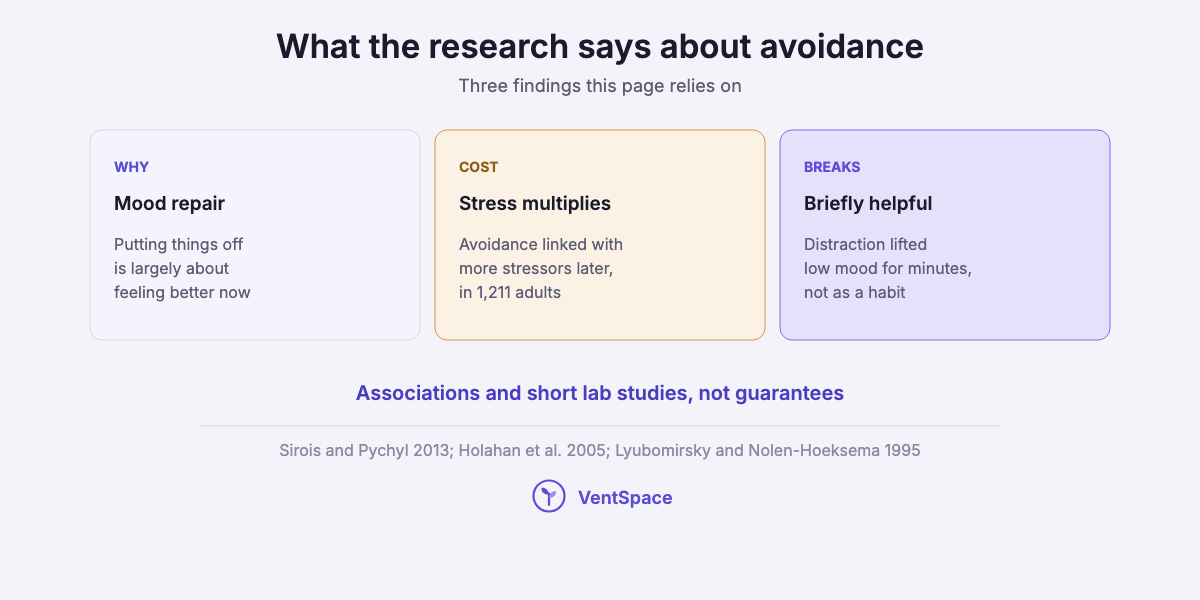
Why we ignore problems: to feel better now. Researchers describe procrastination as having a lot to do with short-term mood repair.
What it costs: in a 10-year study of 1,211 adults, avoidance coping was linked with more life stressors four years later, and through them with more depressive symptoms at ten years.
Not all stepping away is avoidance. A break you choose, with a return date, is different from a problem you hope will disappear.
Distraction works briefly. In the lab it lifted low mood for minutes. As a habit, it is not reliably linked with feeling better.
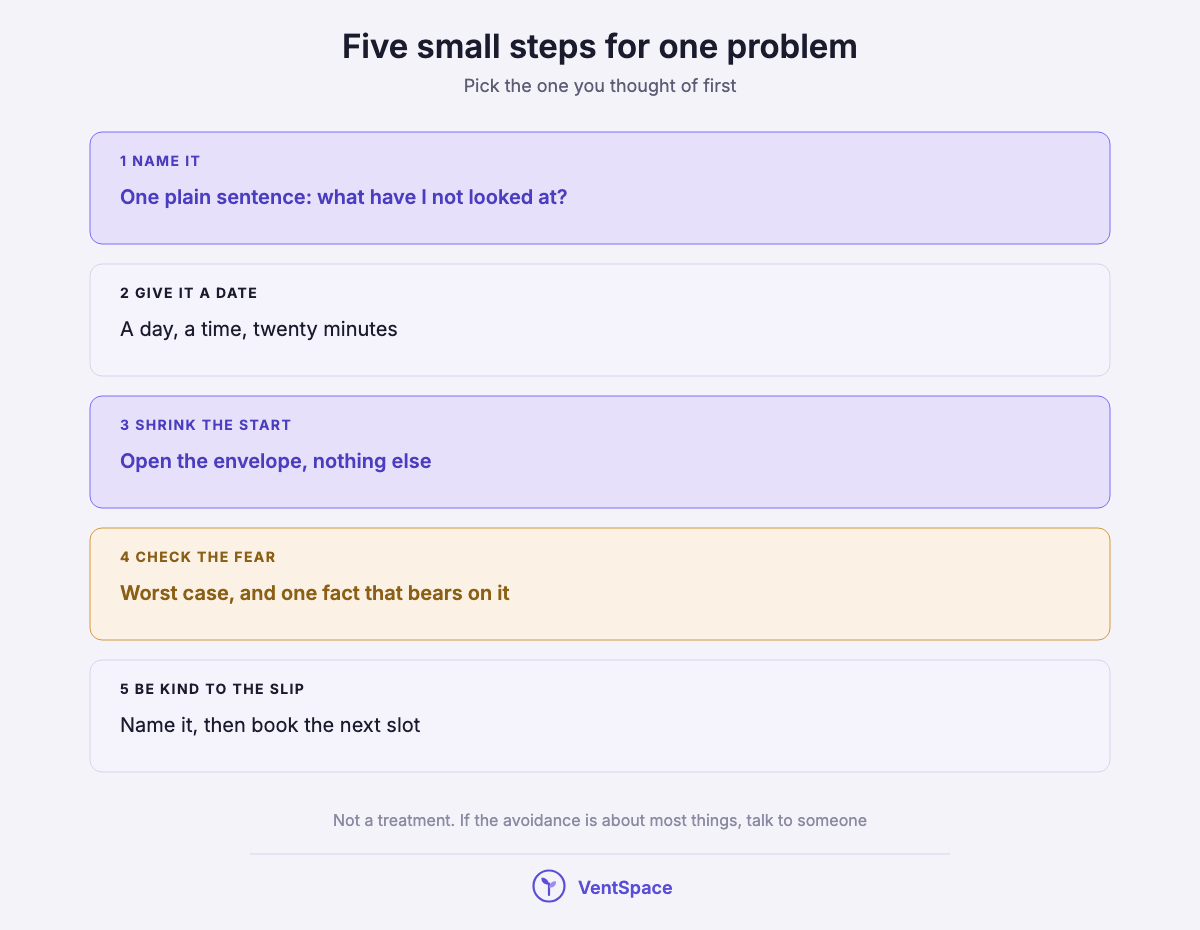
The way back: name the problem in one sentence, decide when you will deal with it, make the first step small, check the fear against facts, and treat the slip kindly.
Before you start. If the thing you have been avoiding is how bad you feel, or you are thinking about harming yourself, please contact the 988 Suicide & Crisis Lifeline now (US, call, text or chat 988), or find a line in your country at findahelpline.com. Two kinds of problem need more than this page. If the problem is someone hurting or threatening you, the National Domestic Violence Hotline (US, 800.799.SAFE (7233), or text START to 88788) is the place to start. If it is a health symptom you have been putting off, the first step is a doctor, not a worksheet. If you are in immediate danger, call 911.
Why we ignore problems
“we argue that as a form of self-regulation failure, procrastination has a great deal to do with short-term mood repair and emotion regulation.”
Fuschia Sirois and Timothy Pychyl, Social and Personality Psychology Compass (2013)
We ignore problems because looking at them feels bad, and not looking feels better, right now. The psychologists Fuschia Sirois and Timothy Pychyl, in a 2013 paper on the research on procrastination, note that putting things off “often occurs when people are faced with tasks that are seen as aversive”, and that it has “a great deal to do with short-term mood repair and emotion regulation”. The task is not the problem. The feeling attached to the task is. And the cost of the relief is paid by what they call the future self.
That reframe matters, because most of us explain our own avoidance as laziness. Is it? A lazy person would avoid everything equally. Most of us avoid something specific: the one email, the one bill, the one conversation. The avoidance is shaped like the feeling, not like the person.
The first version of this page named the feelings that do the most work, from Sai’s own experience: fear of the worst-case outcome, perfectionism, which he called fear of failure in a different coat, the emotional drain of a hard problem, and shame, which can turn into a loop when “feeling bad about putting things off can fuel avoidance, leading to more shame.” He also gave the pattern a name we have kept: dreaded dread, the way a problem grows scarier the longer it stays unopened.
Researchers have a name for the same move when it involves information. Thomas Webb, Betty Chang and Yael Benn called it the ostrich problem: a tendency to “intentionally avoid or reject information that would help them to monitor their goal progress.” Their examples are ordinary ones. People with diabetes avoid checking their blood glucose. Few people monitor their household energy use, check their bank balances or keep track of what they eat. Their explanation is not stupidity. It is a conflict between wanting to know where you stand and wanting to protect how you feel about yourself.
Quick Summary
Q: Why do I keep ignoring my problems?
A: Usually to repair a bad mood in the moment. Researchers describe procrastination as having a great deal to do with short-term mood repair, and the avoidance of checking on how things are going as a conflict between wanting accurate information and wanting to protect the self.
Insight: Webb, Chang and Benn, Social and Personality Psychology Compass (2013), on why people avoid checking how they are doing: “the decision to avoid monitoring often represents the product of an interaction between different motives. For example, the desire to accurately assess progress may conflict with the desire to protect or enhance the self.”
What ignoring a problem costs over time
“As predicted, baseline avoidance coping was prospectively associated with both more chronic and more acute life stressors 4 years later.”
Charles Holahan, Rudolf Moos and colleagues, Journal of Consulting and Clinical Psychology (2005)
Avoidance tends to create new problems, not only keep the old one. The clearest evidence comes from a study that followed 1,211 late-middle-aged adults over 10 years, published in 2005 by Holahan, Moos and colleagues. People who relied more on avoidance coping at the start reported more chronic and more acute life stressors four years later. Those new stressors, in turn, linked the early avoidance to more depressive symptoms ten years on, even after the researchers accounted for how depressed people were at the start.
Read that again slowly, because it is the whole argument of this page in one finding. The unopened letter does not only stay unopened. It tends to become a late fee, then a phone call, then an argument at home. The researchers called this stress generation: avoidance producing the stress it was meant to escape.
A wider picture comes from a 2002 meta-analysis by Penley, Tomaka and Wiebe of coping and health in non-clinical adults. Problem-focused coping was linked with better overall health, and avoidance with worse. But the same review found that the picture depended on the situation, including whether the stressor was controllable and how long it lasted. So the honest version is not that avoidance always harms. It is that avoiding a problem you could act on tends to go badly.
Both studies are correlational. They show that avoidance and later trouble travel together, and the 10-year study adds a plausible route, but neither shows that avoiding one particular problem will cause a particular outcome for you. The sample in the 10-year study was also late-middle-aged, so it may not describe a twenty-year-old’s week. What would it change if you saw avoidance as something that adds problems, rather than something that pauses one?
Quick Summary
Q: What happens if you keep ignoring your problems?
A: They tend to multiply. In a 10-year study of 1,211 adults, avoidance coping was linked with more life stressors four years later, and through them with more depressive symptoms at ten years. It is an association, not a guarantee.
Insight: Penley, Tomaka and Wiebe, Journal of Behavioral Medicine (2002), on the limits of their own finding: “type of health outcome (i.e., physical vs. psychological) and situational characteristics (i.e., stressor type, controllability, and duration) moderated many of the overall associations.” The same coping move does not mean the same thing in every situation.
When stepping away is the right call
“the need to take respite from dealing with either of these stressors, as an integral part of adaptive coping”
Margaret Stroebe and Henk Schut, describing the dual process model of grief, Death Studies (1999)
Not every step back is avoidance. Sai made this point in the first version of the page, and it is the part most writing on the subject leaves out: there is a healthy kind of not dealing with something, and it looks different from denial. He drew the line at intention. Healthy postponement is “a conscious choice we make to temporarily step away from a problem or situation with the intention of returning to it later.” Denial is the hope that the problem will disappear on its own.
Researchers who study grief have argued something close to this for years. Stroebe and Schut’s dual process model describes coping with loss as moving back and forth between facing the loss and getting on with a changed life, and it treats time off from grief as part of coping, not a failure of it. The model is a theory, still under-tested, and it was built for bereavement, not for an overdue tax form. But it gives a serious name to something many of us feel: you cannot look straight at a hard thing all day.
Distraction has a measured, and limited, place too. In a 1995 set of experiments, Sonja Lyubomirsky and Susan Nolen-Hoeksema found that eight minutes of distraction brought students in a low mood back to the mood levels of students who were not low, while eight minutes of ruminating kept them low. In their problem-solving experiment, the difference had almost disappeared by the end of a 30-to-40-minute task. And in a later review, Nolen-Hoeksema and colleagues noted that habitual positive distraction “has not consistently been correlated with lower levels of depressive symptoms.” A break can reset you. A life of breaks does not.
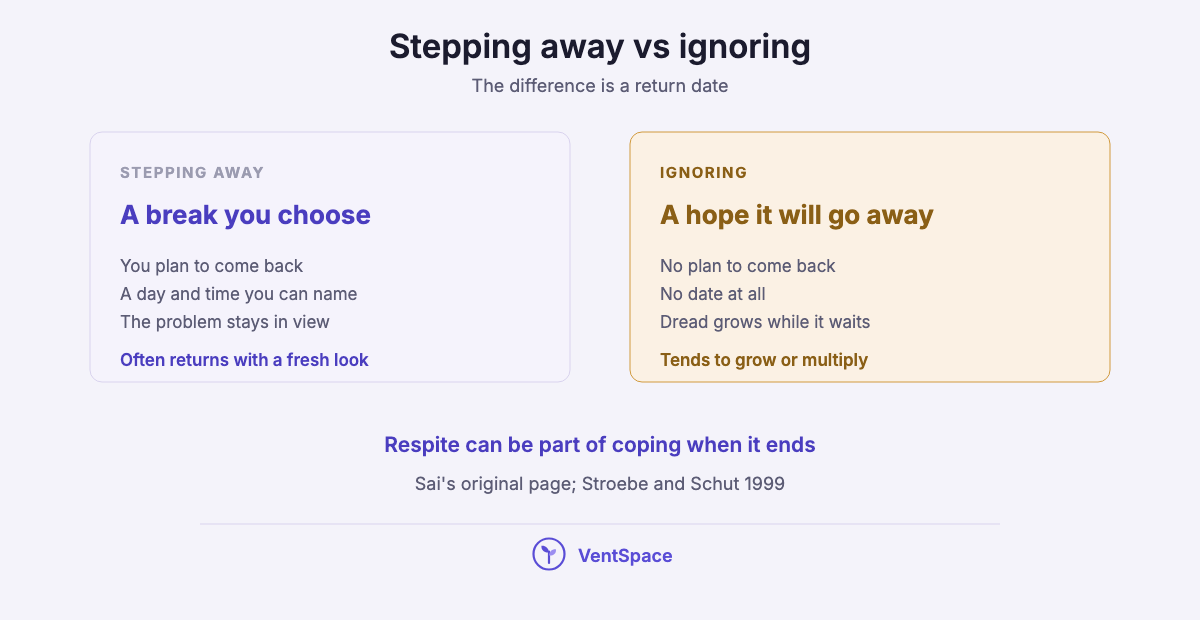
Here is the difference Sai set out, in a form you can check against:
| Stepping away | Ignoring | |
|---|---|---|
| The intention | A conscious choice to come back later | A hope that it will go away |
| The return | A day and time you can name | None |
| How it feels | Relief, with the problem still in view | Relief, then dread that grows |
| What happens to the problem | You come back to it, often with a fresh look | It tends to grow or multiply |
Quick Summary
Q: Is it ever okay to avoid a problem?
A: Yes, if it is a break with a return date. Grief researchers treat respite as part of coping, and short distraction lifts mood briefly. What goes badly is avoidance with no plan to come back, especially for a problem you could act on.
Insight: Lyubomirsky and Nolen-Hoeksema, Journal of Personality and Social Psychology (1995), on how long the benefit of a distraction lasted in their problem-solving study: the differences between groups “were greatest in students’ responses to the first situation and had almost disappeared by the time students responded to the last situation.” The tasks took 30 to 40 minutes.
So how do we come back to the thing we have been ignoring?
How to stop ignoring a problem: five steps
“What I advise you to do is, not to be unhappy before the crisis comes; since it may be that the dangers before which you paled as if they were threatening you, will never come upon you; they certainly have not yet come.”
Seneca, Moral Letters to Lucilius, Letter 13
Pick one problem. Not the whole pile, the one that comes to mind first when you read the word “avoiding”. Then take these steps in order, on that one problem only. Each one is small on purpose.
1. Name the problem in one sentence
Write down, in one plain sentence, what you have been avoiding. Not “my finances are a mess”, which is a mood. “I have not opened the two letters from the tax office” is a problem. A vague dread cannot be acted on. A sentence can.
- What, exactly, have I not looked at?
- When did I last look at it?
- What do I think I will find if I do?
- Who else is affected while it waits?
No one is grading this sentence. It is allowed to be embarrassing.
If writing it down helps, VentSpace is a journaling app that turns what you write into a clear read on your life balance, plus small, doable next steps. Prefer to try it on your laptop first? VentSpace Live runs in your browser, free, with nothing to install. A page is often where dreaded dread turns into a single sentence you can do something with. One caution about writing. In a review of expressive-writing studies, the average effect was moderate in healthy samples (0.47), small in clinical samples (0.19) and not significant in psychiatric samples (0.07), and it was detrimental for adult survivors of childhood abuse and a small sample of veterans (Baikie and Wilhelm, Advances in Psychiatric Treatment, 2005). Our suggestion is to stop after twenty minutes. If writing makes it heavier, stop and talk to someone instead.
2. Decide when, not whether
Give the problem a day and a time. This is the line Sai drew between stepping away and ignoring, and it is the cheapest step on this list. “Thursday at 7, before dinner, for twenty minutes” turns denial into a postponement you chose.
- Is this something I can act on, or something I cannot change?
- If I can act on it, when is the first slot this week?
- If I cannot change it, who could, or what part of it is mine?
You do not have to feel ready on Thursday. You only have to show up for twenty minutes.
3. Make the first step almost too small
Shrink the first action until it feels slightly silly. Open the envelope, nothing else. Write the first line of the message, not the whole thing. Find the clinic’s number, without calling yet. The first version of this page called this “small problems first”, and Sai’s reasoning was that finishing a small piece makes the next piece easier to start. We have no study to put a number on that for you, so treat it as his experience and ours: the hardest part of an ignored problem is usually the first minute.
- What is the smallest physical action that counts as starting?
- Could I do it in the next ten minutes?
- What will I let myself do once it is done?
Done badly still counts as done.
4. Check the fear against the facts
Write the worst outcome you are afraid of, then check how likely it is. Seneca’s advice was not to be unhappy before the crisis comes, because the danger “may” never arrive. That is not a promise that it will not. It is an invitation to find out. Sometimes what we open is smaller than the story we told ourselves about it. Sometimes it is not, and then at least we know its size.
- What exactly am I afraid will happen?
- What is that fear based on, a fact or a feeling?
- If it did happen, what would I do next?
- Who could I ask who has dealt with this before?
Knowing the size of a problem is a step, even when the size is bad.
5. Treat the slip kindly
When you slide back into avoiding it, name the slip without punishing yourself. This is not softness for its own sake. Shame was one of the reasons Sai gave for avoidance in the first place, and in four experiments Juliana Breines and Serena Chen found that people guided toward self-compassion after a failure were more motivated to improve, and spent more time studying for a hard test after failing a first one, than people given a self-esteem boost or nothing. Those were short lab studies, but they point the opposite way from the self-criticism most of us reach for.
- What happened, in one sentence, without adjectives about myself?
- What would I say to a friend who did the same thing?
- When is the next slot?
Sai’s own note on this, from the first version: “In my experience, it makes setbacks easier to recover from and keeps me moving.” A slip is information, not a verdict.
Pulling it all together
Step 1: write one sentence that names the problem, and stop there for today.
Step 2: put a day and a time in your calendar for it, even if the slot is short.
Step 3: when the slot comes, do the smallest physical action that counts as starting.
Step 4: write down the worst outcome you fear and one fact that bears on it.
Step 5: if you miss the slot, say so plainly, kindly, and book the next one.
Questions people ask about ignoring problems
Is ignoring problems a sign of laziness?
Usually not. Researchers describe procrastination as largely about repairing a bad mood in the moment, and the avoidance tends to be specific to the tasks that feel worst, which is not how laziness would look.
Is avoiding problems ever healthy?
Yes, when it is a chosen break with a return date. Grief researchers treat respite as part of coping, and short distraction lifts mood briefly. Habitual distraction is not reliably linked with feeling better, so the break has to end.
Does ignoring a problem make it go away?
Sometimes the worry turns out bigger than the problem, but the problem itself rarely leaves on its own. In a 10-year study, avoidance coping was linked with more life stressors later, which researchers call stress generation.
Why do I avoid checking my bank account or messages?
Researchers call it the ostrich problem. People avoid information about how they are doing when wanting to know conflicts with wanting to feel okay about themselves. Naming that conflict is often the first step.
When should I get help with avoidance?
If you are avoiding most things, most days, or the avoidance is getting in the way of work, sleep or the people around you, it is no longer about one problem. Therapy is one option, and for a lot of people it is the right one. Our page on whether you need therapy is a fair place to start, and overthinking vs problem solving may help if the avoidance comes wrapped in hours of thinking about it.
In a nutshell
First, you are not ignoring the problem. You are avoiding a feeling. Once you see that, the question changes from “why am I like this?” to “how small can I make the first look?”
Second, this takes longer than one good evening. One problem, one sentence, one slot, and probably a few slips before it is dealt with. The pile you have been avoiding did not form in a week, and it will not clear in one. What would one opened envelope this week be worth to you?
About this article

Written by
Sai Subramaniam
Founder, VentSpace
I write these guides because I have been where you are. I am working through my own hard seasons, and I share the things that actually helped me, so that anyone going through it has a steady companion close by instead of facing it alone. VentSpace is the app I built for exactly that: a journaling app that turns what you write into a clear read on your life balance, plus small, doable next steps toward feeling more like yourself.
This writing is honest and every claim is sourced, and it is not a substitute for professional care. If you are struggling, reaching out to a professional is a strong move, not a failure.
Explore VentSpaceTry VentSpace LiveHow this one was checked. Every factual claim traces to a named source, and the source is printed next to the claim rather than kept in a footnote. Quotes are pinned to the work they come from, with the year, the letter or the chapter where one exists. Where a widely repeated claim could not be traced, it was left out and the omission recorded. Where a figure is contested, both sides are printed.
No affiliate links, no paid placements, and nobody paid to appear here. Where we mention our own app, we say that it is ours, we state its limits, and we never position it as a substitute for care.
Reviewed: October 2026. Prices, platforms and product availability move quickly, and anything we could not verify at the time of writing is marked as unverified rather than turned into a number.
Corrections. If something here is wrong, we would rather know. Corrections are made in place, with a note saying what changed.