
There is a particular sentence that people arrive at, often late at night, often after months of not saying it to anyone. “I don’t know who I am anymore.” It turns up in every corner of the internet where people are honest, under a hundred different stories, and it often comes with a little embarrassment, as though it were a strange thing to feel. It isn’t. It is one of the most common human experiences there is, and it is usually not a sign that something is wrong with you. It is a sign that something happened to you, and the part of you that used to answer that question got quiet for a while.
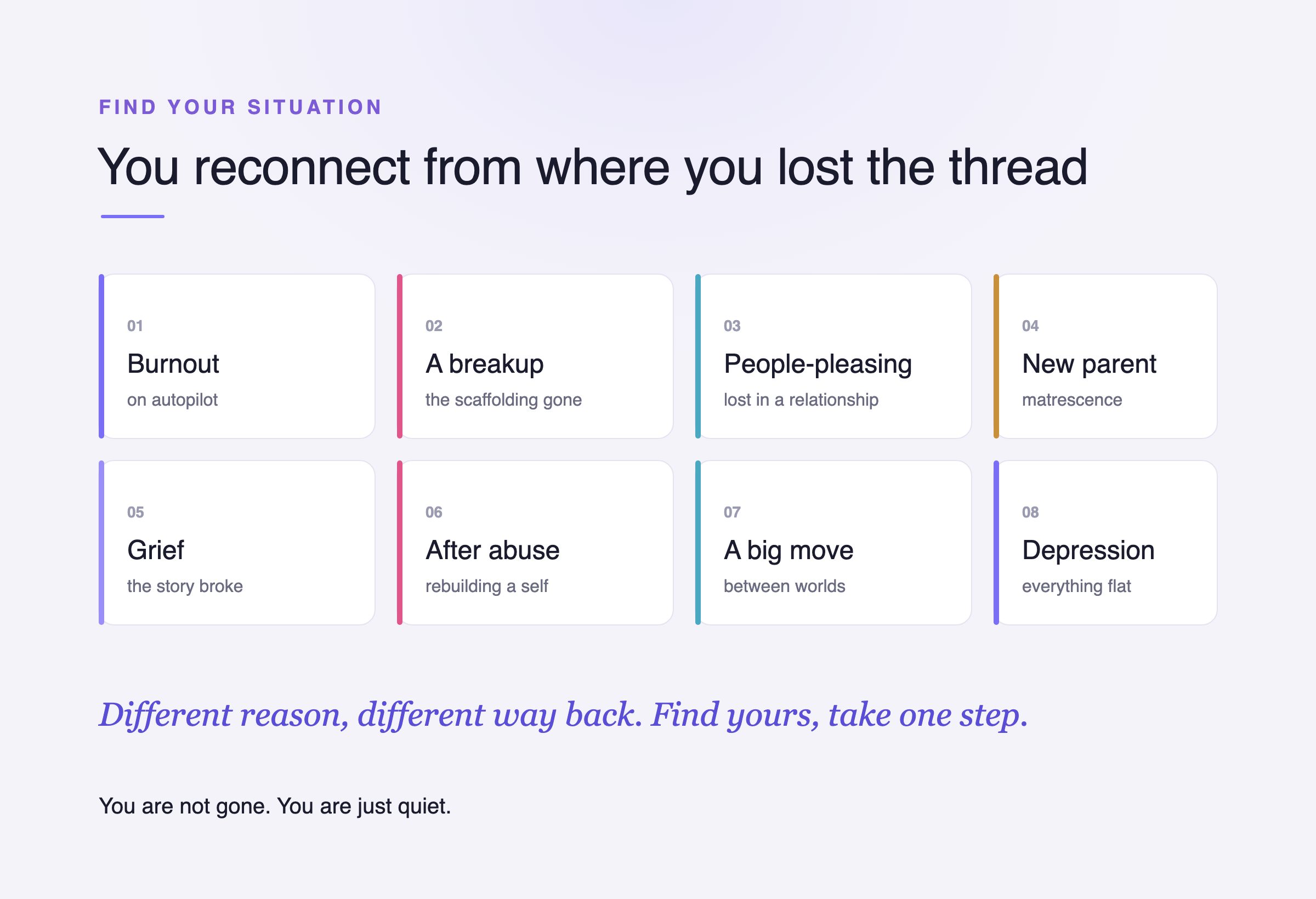
This guide is built around a simple idea: you don’t reconnect with yourself in general. You reconnect from wherever you actually lost the thread. The tips that help someone hollowed out by burnout are not quite the tips that help someone rebuilding after a breakup, or someone six months into new parenthood, or someone climbing out of a relationship that trained them out of having a self. So we have organized this by situation. Find the one that sounds like your life. The twenty practical steps below are numbered straight through, mapped to the situations they fit best, with a handful that fit most situations.
A note on what this is, and isn’t
This is a guide for reflection, not a diagnosis or a treatment. Feeling disconnected from yourself is often a normal response to a hard season. But if the numbness or detachment is persistent, getting worse, or interfering with your daily life, that is worth taking to a doctor or a therapist, and doing so is a strong move, not a weak one. If you are in crisis or thinking about harming yourself, please call or text 988 (the US Suicide and Crisis Lifeline), or contact your local emergency services.
Why we lose touch with ourselves in the first place
It helps to know that this has a shape, and a small body of research behind it. Psychologists have a term, self-concept clarity, for how clearly and confidently you can describe who you are. When a breakup, a loss or a big transition knocks it, it can feel like the self has gone. It isn’t that your self vanishes. It’s that the mirror you used to see it in got moved.
Most disconnection comes from one of a few quiet mechanisms. Sometimes we spend years living from other people’s “shoulds” instead of our own wants, and self-determination theory describes how a life run on borrowed obligation slowly stops feeling like ours. Sometimes we perform a version of ourselves for so long that it starts to feel like collecting masks to wear. Sometimes a role we loved, parent, partner, caregiver, grew so large that there was no room left for the person underneath it. And sometimes stress or depression simply flattens everything until nothing registers, and the absence of wanting gets mistaken for the absence of a self.
None of these mean you are broken. They mean the thread is findable, and that the way back depends on how it was dropped. Here is the map.
1. When burnout has put you on autopilot
You are competent. You are functioning. And you are not quite there. Burnout has a specific ingredient that researchers call depersonalization, a kind of self-protective detachment, and it is why you can be good at your life and still feel like you are watching it from across the room. The part of you that had preferences went quiet because, for a long time, preferences were a luxury you couldn’t afford.
The way back is to prove to yourself that you still exist outside of your output.
1. Audit whose voice your “shoulds” are in. Write your top five “I should” sentences, then next to each, honestly name who planted it: a manager, a parent, a feed, an old fear. You cannot choose what’s yours until you can see what was installed.
2. Guard one daily block that has no deliverable. Twenty minutes, no output, nothing to show for it: a walk, a record played all the way through, a window. Burnout convinces you that unproductive time is stolen time. It is actually where your own voice gets quiet enough to hear.
3. Do one thing badly on purpose. A clumsy sketch, an out-of-tune song, a recipe you’ll never post. When your identity has narrowed to being good at things, doing something with zero stakes reminds you there is a person here, not just a performance.
2. When a breakup or divorce has taken the scaffolding
A relationship is, quietly, one of the structures we build our identity on. When it ends, the missing person is only half of the ache. The other half is not knowing who is left. It can feel plainly like losing yourself and not being sure who you are anymore. It is not weakness. It is architecture, suddenly without a wall.
4. Rebuild the “before them” list. Write ten things you loved before that relationship existed: a music genre, a place, a way of spending a Sunday. Reintroduce one of them this week. You are not going backward. You are collecting the parts of yourself you loaned out.
5. Reclaim the physical territory you edited for them. The album you stopped playing, the food they hated, the way you actually like the room. Small, literal, yours. Re-editing your space re-edits the self that lives in it.
6. Write the sentence you keep avoiding, then close the notebook. The true one, the one about what you actually feel. You do not have to solve it or share it. Naming a feeling on paper can loosen its grip without asking you to fix it yet. (This is one of the few steps that helps in nearly every situation on this list.)
3. When you’ve slowly disappeared into a relationship
This one rarely arrives with a bang. It happens by a thousand small accommodations, each reasonable on its own, until your friends have drifted, your interests have dissolved into theirs, and there is no clear line where they end and you begin. Your identity gets tangled up with theirs, and your friends go by the wayside. In the language of self-determination theory, you started living from guilt and keeping-the-peace instead of from your own values, and that slowly stops feeling like your own life.
7. Practice the smallest honest no. Pick one low-stakes preference this week and say it out loud: “I don’t actually want that place.” The muscle that says what you want has atrophied, and it comes back the way muscles do, with small reps.
8. Run a “whose opinion is this?” check. The next three times you react strongly, pause and trace it: is this reaction mine, or one I absorbed? You are not looking to distrust yourself. You are learning your own handwriting again.
9. Rebuild one friendship that predates the relationship. Text the person today. The people who knew you before are holding a version of you that you can borrow back until it feels like yours.
4. When you’ve just become a parent
There is a word for this that far too few people are given: matrescence. It names the becoming of a mother (or a parent) as a major life transition, and some writers compare it to adolescence. Which is to say the disorientation is not a failure of gratitude or love. It is a self reorganizing itself, in real time, on no sleep. Parents describe being asked who they are outside of the role and finding no answer, and then feeling ashamed of the grief because they do love the child. Both things are true at once.
10. Name it as matrescence, not as failure. Simply knowing that this is a transition with a name, not a sign you are doing it wrong, takes a surprising amount of shame out of it.
11. Protect one fifteen-minute ritual that predates the baby. Coffee made your specific way, one song, a stretch by the window. Not self-care as a project. A thread of continuity to the person you still are.
12. Keep a “still me” note. In your phone, jot any moment you sounded like your pre-baby self: a joke, an opinion, a flash of the old you. You are collecting evidence that you did not disappear, only expanded.
On the heavier end of this
A hard, disorienting few months is one thing. But if you are numb most of the day nearly every day, or the low feeling is not lifting, that can be more than the ordinary transition, and postpartum depression and anxiety are common and very treatable. Please tell your doctor. Reaching out is part of taking care of the child, not a distraction from it.
5. When grief has broken the story
When someone who helped define you is gone, you lose two things at once: them, and the version of you that existed in relation to them. People in grief often say they no longer know who they are, or what their purpose, future or plan is. Researchers who study narrative identity, the evolving story we tell to link our past to our future, would say the story didn’t just lose a character. It lost the thread of what happens next.
13. Carry one of their habits or values forward on purpose. A phrase they used, a kindness they were known for, a Sunday ritual. Choosing to continue a piece of them is a way of keeping your own story continuous through the break.
14. Write your next chapter in the third person for ten minutes. “She was tired, and she was still here, and she did not yet know what came next.” Narrative distance makes a story you cannot bear in the first person possible to hold, and slowly re-threads it.
6. When you’re recovering from a toxic or abusive relationship
This is the most tender situation on the list, and the one to move through most gently. When you have spent years managing someone else’s moods to stay safe, you can be left suspecting something frightening: that you never really had a self of your own, only a set of adaptations. You may wonder whether you ever really knew who you were. If that is you, please read the note below as much as the tips.
15. Build a “my preferences” file from scratch, one entry a day. Start impossibly small: how you take your coffee, the temperature you like, a song that is yours. When a self has been erased, you rebuild it from the ground, one true preference at a time.
16. Catch the scan, and turn it around. Notice the old reflex, the instant “what do they want?”, and gently ask instead, “what do I want?” before you answer. You are retraining attention that was pointed outward for survival to come back home.
Please don’t do this part alone if it’s heavy
Identity loss rooted in abuse or trauma often needs and deserves professional support. If the detachment, numbness, or hypervigilance is persisting or worsening, a trauma-informed therapist can help in ways a guide cannot. That is not the failure of self-reliance. It is what strong recovery usually looks like.
7. When a big move has left you between worlds
Relocation strips away the entire context that used to reflect you back to yourself: the job, the regulars, the streets that knew you. You can find yourself carrying a version of yourself that doesn’t quite translate in the new place, feeling between worlds with nowhere to land.
17. Rebuild one “third place” quickly. Not home, not work: a café, a gym, a class where you become a regular. Being recognized somewhere can help rebuild a sense of self after a move.
18. Re-anchor with a portable ritual from before. The Saturday-morning thing, the walk, the way you make dinner. Doing an old ritual in the new place builds a bridge between the two versions of you so one can become the other.
8. When depression or long stress has flattened everything
This is the most common version of all, and the one to be most careful with. Depression and chronic stress can produce anhedonia, a genuine reduction in your ability to feel pleasure or interest, and it is a recognized core symptom, not a character flaw. From the inside it can feel empty and flat, even when nothing looks wrong with your life. The cruelty of it is that it removes the very wanting you would use to climb out.
19. Reduce the input before you add output. Cut one stream of noise for a day, the feed, the news, the notifications. When everything is loud, the faint signal of your own preferences can’t be heard. Quiet comes first.
20. Act before you feel like it. In depression, motivation often follows action rather than coming first. So do the five-minute version, before you want to: one walk, one dish, one text. You are not waiting to feel like yourself. You are doing one small thing, and letting the feeling catch up.
The honest line here
If the numbness or loss of interest has lasted most of the day, nearly every day, for two weeks or more, or is disrupting your work or relationships, that is the point where this stops being “a hard patch” and is worth taking to a professional. Depression is common and treatable, and you do not have to reach a crisis before you are allowed to ask for help.
A quicker way back in: the body, and what you value
Two practices don’t belong to any single situation, because they help in almost all of them.
The first is the body. When emotions have gone quiet, you can often reach yourself through physical sensation instead. Researchers call the sense of your internal signals interoception. Try sixty seconds of simply noticing your breath, your heartbeat, the weight of your feet. It sounds too simple to matter. It is often the shortest path back into yourself when words and feelings have gone numb.
The second is naming what you actually value. A great deal of feeling lost is really losing sight of what matters to you, underneath all the shoulds. Write your top three values, plainly, and then look honestly at whether your week reflects them. The gap you find is not a verdict. It is a direction.
This is also where a reflective journaling practice earns its place. Most of the steps above ask you to write things down and notice patterns, and doing that loosely in a notes app often goes nowhere. A tool built for it can help. VentSpace is a journaling app with prompts for questions like these, whose “shoulds” are yours, what you keep returning to, what you actually value, and it reads back what you write to show you the patterns: recurring realizations, and a simple map of how balanced your life is across the parts that matter. It is not therapy and does not pretend to be, it is free to start on Google Play, and it is Android-only for now. Not on Android, or at a desk? VentSpace Live runs in your browser, free, with nothing to install. But if the hard part is turning scattered reflection into something you can actually see about yourself, that is the exact thing it is built to do.
How to actually start
Don’t do all twenty. Pick your situation, pick one step, and do it today. Reconnecting with yourself is not a project you complete. It is a series of small, true moments of choosing your own preference, hearing your own voice, noticing you are still here. They accumulate. And one ordinary day, a little to your surprise, you realize the question that started all this has quietly answered itself.
FAQ
Why do I feel so disconnected from myself for no reason?
There is usually a reason, even when it isn’t obvious. Burnout, a breakup, new parenthood, grief, a long stretch of stress, any of these can leave you unsure who you are. If you genuinely can’t identify a cause and the feeling is persistent, it is worth talking to a professional, because ongoing detachment can also be a stress or depression response.
How do I reconnect with myself after a breakup?
Start by rebuilding the “before them” list and reclaiming the small territory you edited for the relationship (steps 4 and 5). A breakup can shake your sense of who you are, so the work is gently gathering back the parts of you that got merged, one at a time.
How do I reconnect with myself after burnout?
Protect one no-output block a day, and do one thing badly on purpose (steps 2 and 3). Burnout narrows you to your usefulness, so the way back is deliberately spending time that produces nothing but you.
Is feeling disconnected the same as depersonalization?
Not always. A passing, stressed sense of unreality is very common. But depersonalization as a clinical experience is persistent, distressing detachment from yourself or reality that interferes with daily life. If that description fits, and especially if it isn’t going away, please speak to a mental-health professional.
How long does it take to feel like yourself again?
There is no fixed timeline, and anyone who gives you one is guessing. What is reliable is the direction: small, consistent, honest steps move you back toward yourself, and the feeling tends to return gradually and then, one day, noticeably. If weeks pass with no shift at all, treat that as a signal to get support.
You are not gone. You are just quiet. Come back one small, true thing at a time.

Written by
Sai Subramaniam
Founder, VentSpace
I write these guides because I have been where you are. I am working through my own hard seasons, and I share the things that actually helped me, so that anyone going through it has a steady companion close by instead of facing it alone. VentSpace is the app I built for exactly that: a journaling app that turns what you write into a clear read on your life balance, plus small, doable next steps toward feeling more like yourself.
This writing is honest and every claim is sourced, and it is not a substitute for professional care. If you are struggling, reaching out to a professional is a strong move, not a failure.
Explore VentSpaceTry VentSpace Live