
Not everyone who is struggling wants to sit across from a stranger and talk about their childhood. Maybe therapy is too expensive, or the waitlist is months long, or a past experience left you cold. Maybe you are not in crisis at all, you just want to feel a bit less awful on an ordinary day, on your own, on your own schedule. That is a completely reasonable place to be, and there are real tools built for it.
This is an honest list, not an affiliate dump. Some of these apps have genuine research behind them. Some are lovely but unproven. A few market themselves far past what the evidence supports, and we will say so. The goal is simple: help you pick something that supports you before, between or alongside care, not instead of care you need, and be straight with you about what it can and cannot do. (If you also want the non-app options, movement, nature, connection, and more, see our companion guide, alternatives to therapy that actually help)
Please read this before you download anything
Every app here is for coping and self-awareness, not diagnosis or treatment. None of them replaces professional care for a serious or worsening condition, and none is a crisis service. If you are dealing with thoughts of suicide or self-harm, severe depression, trauma, psychosis, an eating disorder, or substance dependence, please treat that as the line where an app is not enough and reach out to a doctor or therapist. If you are in crisis, in the US you can call or text 988 (the Suicide and Crisis Lifeline) any time, free and confidential, and you do not have to be suicidal to use it.
How we judged these
Not by star ratings, and definitely not by marketing. By two questions that actually matter:
- Does it genuinely help you cope day to day? Is there real, named evidence behind it, or is it “helpful practice, no proof“? Does it give you something to do, not just something to track? Apps with an actual study rank above apps that merely sound clinical.
- Is it honest about its limits, and is it safe? Does it over-promise? Does it pretend to be therapy? Is there a clear crisis off-ramp? We down-rank hype and reward transparency.
Prices come from September 2026 secondary sources and most were not re-read off a store page, so treat every price as unverified and check before you pay. No app paid for placement here.
The tools at a glance
| Tool | Category | Best for |
|---|---|---|
| VentSpace | Journaling | Venting that gets reflected back as realizations and a life-balance read |
| Day One | Journaling | A beautiful, private, long-form journal |
| Stoic | Journaling | Prompts and reflections over a blank page |
| Daylio | Journaling | Tracking mood in 10 seconds, no writing |
| Wysa | Self-guided CBT | A judgment-free CBT chatbot at 2 a.m. |
| MindDoc | Self-guided CBT | Clinician-built check-ins to spot patterns |
| Moodfit | Self-guided CBT | A customizable “mental fitness” toolkit |
| Headspace | Meditation | Beginners who want a structured path |
| Insight Timer | Meditation | The biggest genuinely free library |
| Calm | Meditation | Sleep and relaxation first |
| 7 Cups | Peer support | A free human to listen, anonymously |
| TalkLife | Peer support | An always-on “you’re not alone” community |
| Finch | Gentle habits | Kind, low-pressure nudges to do small things |
| Fabulous | Gentle habits | Building steady daily routines |
The reflective journals (writing that does something with what you write)
Journaling is the most accessible tool here, and one of the most researched practices on the list (the expressive-writing work of James Pennebaker goes back decades). The catch is that most journals just store your words. The ones worth your time give something back.
VentSpace
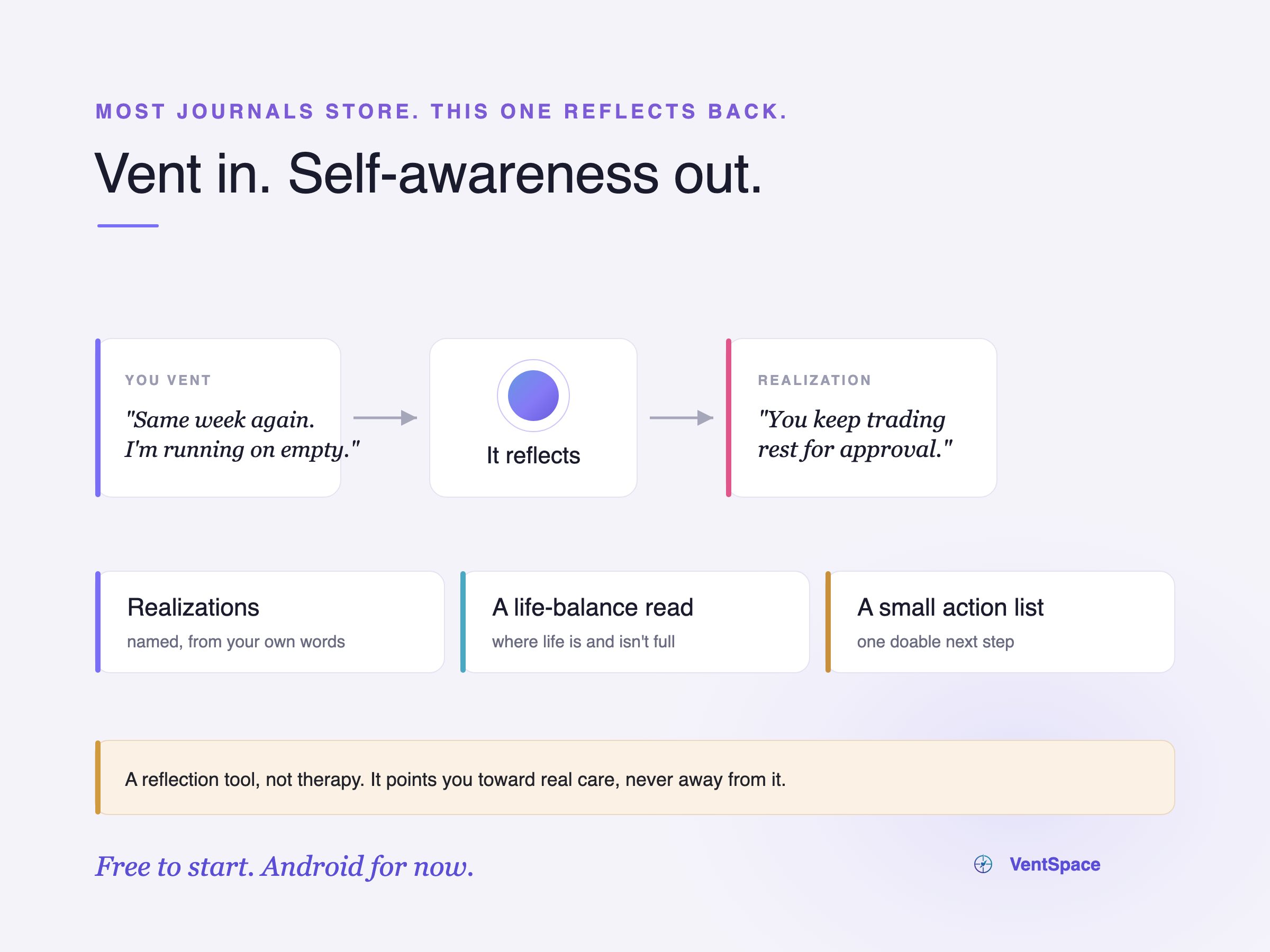
Most journals hand you a blank page and wish you luck. VentSpace starts from the opposite idea: you vent freely, or from a prompt, and the app reads what you wrote and reflects it back to you. That is the difference that matters when you are trying to understand yourself without a therapist in the room. It comes as an Android app and as a web tool, VentSpace Live, which runs in any browser on phone or desktop, free and with no account.
Instead of a diary that piles up unread, your writing becomes named realizations, a simple read on how balanced your life is across the parts that matter, and a small, doable action list. It is journaling that does the noticing with you, which is exactly the self-awareness that a blank-page journal and a tap-a-mood tracker cannot offer. The honest framing, which we hold to across this whole list: it is a reflection tool, not therapy, and not a crisis service. It is a place to think clearly and see your own patterns, and it points you toward real care, never away from it.
| Spec | Detail |
|---|---|
| Type | Reflective journaling app (free-form writing or prompts), AI surfaces insights |
| Platforms | Android app + web (VentSpace Live) |
| Price | Free to start |
| Best for | People who want venting to turn into self-awareness, not just a diary |
| Pros | Reads your entries and reflects back realizations, a life-balance map, and an action list; free to start; genuinely different from a blank-page journal |
| Cons | App is Android-only for now (VentSpace Live works in any browser, iPhone included, but does not keep your history), newer than the incumbents, no published outcome data, and not clinical or a crisis tool (by design) |
Who it’s for: anyone who has journaled before and watched it become a diary of complaints, and wants the writing to add up to something. Verdict: the strongest pick here if you want journaling that actually shows you the pattern. The honest catch: the app is Android-only for now, though VentSpace Live works in any browser, iPhone included, and does not keep your history. And like everything here, it supports you, it does not treat you.
Day One
The most polished blank-page journal there is: a beautiful, private, encrypted space for long-form entries with photos and audio, across every device you own.
| Spec | Detail |
|---|---|
| Type | Free-form multimedia journal |
| Platforms | iOS, Android, Mac, Windows, web |
| Price | Freemium; paid tiers [price unverified] |
| Best for | A private, long-form daily journal |
| Pros | Gorgeous and calm; strong encryption and privacy; excellent cross-platform sync |
| Cons | It is a blank page, so no guidance or insight; multi-device needs Premium; not therapeutic by design |
Who it’s for: people who already love to write and want a lasting record. Verdict: the best pure journal, but you do all the reflecting yourself.
Stoic
A journal that asks you questions instead of leaving you staring at nothing: morning and evening reflections, gratitude, and mood, framed with a light touch of Stoic philosophy.
| Spec | Detail |
|---|---|
| Type | Guided journaling + mood |
| Platforms | iOS, Mac (Android less prominent) |
| Price | Freemium; premium subscription [exact price unverified] |
| Best for | People who want prompts, not a blank box |
| Pros | Thoughtful prompts; combines journaling with mood; calm design |
| Cons | Prompt style will not suit everyone; price is not clear before download; no clinical evidence |
Who it’s for: people who freeze at a blank page but will answer a good question. Verdict: a fine guided option, if you like being asked.
Daylio
Journaling for people who will not write a sentence. You tap a mood and a few activities, it takes ten seconds, and over weeks it draws out the patterns between what you do and how you feel.
| Spec | Detail |
|---|---|
| Type | Micro mood and habit tracker |
| Platforms | iOS, Android |
| Price | Freemium; Premium ~$35.99/yr [unverified] |
| Best for | Tracking mood with almost no effort |
| Pros | Extremely low friction; useful mood-versus-activity charts; strong free tier |
| Cons | Shows you that you felt something, rarely why; can go rote; no clinical evidence |
Who it’s for: people who want the data without the writing. Verdict: great for spotting patterns, thin for understanding them.
Quick Summary: the journals
Q: Which journaling app should I pick?
A: VentSpace if you want the writing to reflect back as self-awareness, Day One for a beautiful long-form diary, Stoic if you need prompts, Daylio if you would rather tap than type. All four are support, not treatment.
The self-guided CBT and mood apps (skills, not just feelings)
This family teaches you something to do: the same cognitive behavioral skills a therapist would, reframing thoughts, tracking moods, working through structured exercises. It is the closest thing to “self-therapy,” with the honest reminder that a workbook or a bot is not a clinician.
Wysa
The most structured of the chatbots. Wysa is an anonymous AI companion that walks you through CBT and DBT exercises, good for late-night venting when you want structure, not just sympathy.
| Spec | Detail |
|---|---|
| Type | AI CBT/DBT chatbot + self-care toolkit |
| Platforms | iOS, Android |
| Price | Freemium; Premium ~$74.99/yr; optional human coaching add-on |
| Best for | Judgment-free, structured self-help any time |
| Pros | Genuinely useful CBT tools; anonymous; structured exercises rather than open chat |
| Cons | It is a bot, so replies can feel scripted; best content is paywalled; not for a crisis |
Who it’s for: people who want to work a real exercise at 2 a.m. Verdict: a solid self-guided CBT app, with two things stated precisely. Wysa holds an FDA Breakthrough Device Designation, which is an expedited-review pathway, not an FDA approval or clearance. And the UK’s NICE, in its 2023 assessments for depression and anxiety, said Wysa should only be used as part of an approved research study for now. Real signal, not a stamp of “proven cure.”
What happened to Sanvello?
This page used to recommend Sanvello, a broad CBT toolkit that was often free through health insurance. It is no longer an app you can install. Checked on 18 September 2026: its website does not resolve, its Google Play listing returns a 404, and an App Store lookup returns nothing, while the same checks run against a live app returned normally. We are not saying it shut down, because no company notice has been found and a Sanvello-derived programme is described elsewhere as continuing under another name. What we can say is narrower and more useful: you cannot download it, so we no longer recommend it. The lesson is the same one Woebot taught, and it is why this page now prints the date every claim was checked.
MindDoc
Built by clinicians and psychologists, MindDoc is the check-in app: regular, screening-style questions that help you see your depression and anxiety patterns over time.
| Spec | Detail |
|---|---|
| Type | Clinically-oriented mood tracking + self-assessment |
| Platforms | iOS, Android |
| Price | Freemium; MindDoc+ premium tiers [exact price unverified] |
| Best for | Understanding your patterns with validated check-ins |
| Pros | Built with clinical input; uses validated assessment logic; good pattern-spotting |
| Cons | A check-in is not a diagnosis; lighter on “what to do next”; full library needs premium |
Who it’s for: people who want to understand what they are feeling before deciding what to do. Verdict: a thoughtful tracker, best paired with an app that gives you actions.
Moodfit
A “fitness for your mental health” kit you customize to yourself: CBT thought records, gratitude, breathing, and mood drivers, with a genuinely useful free tier for the data-minded.
| Spec | Detail |
|---|---|
| Type | Customizable CBT + mood toolkit |
| Platforms | iOS, Android |
| Price | Freemium; Premium ~$35.99/yr |
| Best for | People who like to track and tinker |
| Pros | Highly customizable; strong free tier; includes real CBT exercises |
| Cons | No human element; setup-heavy; no independent trial behind it |
Who it’s for: people who want a build-your-own coping dashboard. Verdict: a solid free CBT toolkit, marketed as CBT-informed rather than proven.
Insight: which “CBT apps” actually have evidence?
Be a little skeptical here. Wysa holds an FDA Breakthrough Designation (an expedited pathway, not an approval), and NICE has placed it in its research-only category in the UK. Most of the rest are “CBT-informed,” which means the ideas are sound but the specific app is unstudied. That is not a reason to avoid them. It is a reason to judge by whether it actually helps you, not by how clinical it sounds. And note the cautionary tale below.
What happened to Woebot?
You may see older lists recommend Woebot, once one of the best-known therapy chatbots. On 30 June 2025 it closed its consumer app, affecting around 1.5 million people,, its founder citing the cost of meeting regulatory requirements as AI outpaced the rules. The lesson is worth keeping: even a well-known, carefully built app can vanish, and none of this is a substitute for care that does not.
The meditation and calm apps (steadying the body and mind)
Meditation will not fix everything, and the research is honest about that. The largest review of these apps found moderate benefit for some things, and thin evidence for others. Used realistically, they are a good way to steady a racing mind, especially for sleep and everyday stress.
Headspace
The best on-ramp for beginners, with structured, curriculum-style courses and the strongest research base of the meditation apps.
| Spec | Detail |
|---|---|
| Type | Guided meditation + sleep |
| Platforms | iOS, Android, web |
| Price | Freemium; Premium ~$69.99/yr |
| Best for | Beginners who want a structured path |
| Pros | Excellent onboarding; structured courses; the most-studied of the three |
| Cons | Limited free tier; subscription fatigue; meditation is not for everyone in acute anxiety |
Who it’s for: newcomers to meditation. Verdict: the best-evidenced meditation app, with an honest caveat: in the big JMIR Mental Health review (2022), Headspace improved depression in most studies that measured it, but half of its trials reported a company-related conflict of interest. Promising, and worth knowing who funded the promise.
Insight Timer
The budget champion: a genuinely enormous free library of over a hundred thousand meditations, timers, and teachers, without a hard paywall.
| Spec | Detail |
|---|---|
| Type | Meditation library + timer + community |
| Platforms | iOS, Android, web |
| Price | Freemium; Member Plus ~$39.99/yr (the cheapest of the three) |
| Best for | Variety without paying |
| Pros | Vast free content; huge teacher variety; the real free option here |
| Cons | Overwhelming and unstructured; quality varies by teacher; no app-specific trial |
Who it’s for: people who want free and plenty of choice. Verdict: the best free meditation app, if structure matters less than range.
Calm
The relaxation-and-sleep specialist, famous for its Sleep Stories and soundscapes. Lovely to use, and the least evidence-backed of the three.
| Spec | Detail |
|---|---|
| Type | Meditation, sleep, soundscapes |
| Platforms | iOS, Android, web |
| Price | Freemium; Premium ~$69.99/yr |
| Best for | Winding down and sleep |
| Pros | Excellent sleep and relaxation content; broad, polished library |
| Cons | Thin independent evidence; aggressive free-trial funnel; less structured than Headspace |
Who it’s for: people who mainly want help falling asleep. Verdict: great for relaxation, but honestly, the same JMIR review found just one small trial on Calm, and the authors said more research is needed before its efficacy can be judged. Enjoy it for calm, not as treatment.
The peer support apps (a human, not a clinician)
Sometimes you do not want an exercise, you want someone to hear you. These connect you to other people, which is genuinely valuable and comes with real cautions you should know before you lean on them.
7 Cups
Free, anonymous, and human, any time. 7 Cups connects you with trained volunteer listeners and a large support community, a low barrier when you just need to talk at 2 a.m. without paying.
| Spec | Detail |
|---|---|
| Type | Peer listening + community |
| Platforms | iOS, Android, web |
| Price | Free for listeners and community; paid therapy tier separate [pricing unverified] |
| Best for | A free, anonymous person to listen |
| Pros | Free, anonymous, 24/7 human contact; low barrier; a real community |
| Cons | Listeners are volunteers, not clinicians; reports of thin listener vetting and imperfect moderation; not a crisis service |
Who it’s for: people who want to be heard, cheaply and anonymously. Verdict: valuable as free human support, with eyes open: quality varies, it is not clinical, and it is not for emergencies.
TalkLife
An always-on peer community where you post what you are going through and hear from others who have been there. Good for the slow, ongoing “you are not alone” kind of support.
| Spec | Detail |
|---|---|
| Type | Asynchronous peer-support community |
| Platforms | iOS, Android |
| Price | Free, with optional paid extras [price unverified] |
| Best for | Ongoing “you’re not alone” support |
| Pros | Real validation from peers; always available; good for slow support |
| Cons | Not real-time; peer advice can be uneven or triggering; moderation-dependent; not a crisis tool |
Who it’s for: people who find comfort in shared experience. Verdict: a decent peer community, held to the same line: support, not treatment.
Free, human help that is not an app
If you want a person but not a paid subscription, two safer pointers for harder moments: warmlines are free, peer-run, non-crisis phone lines staffed by people in recovery (find one at warmline.org), and the NAMI HelpLine (800-950-6264) offers information and navigation. Both are support, not crisis lines. For an actual crisis, that is 988.
The gentle habit apps (tiny actions that lift mood)
When you are low, motivation follows action, not the other way around. These apps make the first small step easy, which is the whole idea behind behavioral activation, a real clinical principle even though the apps themselves are unstudied.
Finch
A self-care app built to be kind to you. You raise a small virtual pet by doing tiny self-care tasks, and the gentleness is the feature.
| Spec | Detail |
|---|---|
| Type | Gamified self-care + behavioral activation |
| Platforms | iOS, Android |
| Price | Freemium (generous free tier); Finch Plus sold at several price points in-app, and Finch does not publish one [unverified] |
| Best for | Gentle, low-pressure nudges to do small things |
| Pros | Genuinely warm and motivating; excellent free tier; tiny steps that build |
| Cons | Gamification is not for everyone; can feel childish to some; no clinical trial |
Who it’s for: people for whom shame-based streaks backfire. Verdict: if kindness works on you where pressure does not, start here.
Fabulous
A routine and habit coach with a behavioral-science framing, good for building steady morning and evening rhythms around energy, focus, and sleep.
| Spec | Detail |
|---|---|
| Type | Habit and routine builder |
| Platforms | iOS, Android |
| Price | Freemium; Premium roughly $16.99-$59.99 depending on plan |
| Best for | Building consistent daily routines |
| Pros | Polished; motivating “journeys”; sound habit-formation principles |
| Cons | The “science” pedigree is marketing, not proof; confusing pricing; can feel prescriptive |
Who it’s for: people who want structure and routine. Verdict: a capable habit app, judged on habits, not therapy.
All fifteen, side by side
| Tool | Category | Price | Platforms | Evidence | The watch-out |
|---|---|---|---|---|---|
| VentSpace | Journaling | Free to start | Android app + web (VentSpace Live) | None published | App Android-only, Live keeps no history; newer; not therapy |
| Day One | Journaling | Freemium [unverified] | All major | None (it’s a journal) | No guidance; premium for sync |
| Stoic | Journaling | Freemium [unverified] | iOS, Mac | None | Price unclear pre-download |
| Daylio | Journaling | Freemium ~$36/yr [unv.] | iOS, Android | None | Tracks what, not why |
| Wysa | Self-guided CBT | Freemium ~$75/yr | iOS, Android | FDA Designation, and NICE says research use only | It’s a bot; not a crisis tool |
| MindDoc | Self-guided CBT | Freemium [unverified] | iOS, Android | Clinician-built, validated screens | A check-in is not a diagnosis |
| Moodfit | Self-guided CBT | Freemium ~$36/yr | iOS, Android | CBT-informed, unstudied | No human element |
| Headspace | Meditation | Freemium ~$70/yr | iOS, Android, web | RCTs, ~50% company-conflicted | Subscription; not for acute anxiety |
| Insight Timer | Meditation | Freemium ~$40/yr | iOS, Android, web | General mindfulness base | Overwhelming; unstructured |
| Calm | Meditation | Freemium ~$70/yr | iOS, Android, web | ~1 small trial | Thin evidence; trial funnel |
| 7 Cups | Peer support | Free; paid therapy sep. | iOS, Android, web | Peer, non-clinical | Volunteer vetting; not a crisis tool |
| TalkLife | Peer support | Free + extras | iOS, Android | Peer, non-clinical | Uneven advice; not a crisis tool |
| Finch | Gentle habits | Freemium [unverified] | iOS, Android | Behavioral-activation principle | Gamification not for all |
| Fabulous | Gentle habits | Freemium ~$17-60 | iOS, Android | Habit principles, unstudied | “Science” is marketing |
Prices were gathered in September 2026 and most were not confirmed on a primary store page. Treat all of them as [unverified] and check before you pay.
How to actually choose one
Do not download ten of these. Pick by what you are actually reaching for:
- You want to understand yourself, not just track: a reflective journal from the list above, or MindDoc for validated check-ins.
- You want real skills to practice: Wysa for a structured CBT bot, or MindDoc for clinician-built check-ins.
- You want a human, cheaply: 7 Cups or a warmline, with the caveats above.
- You want to calm a racing mind or sleep: Headspace to learn, Insight Timer for free, Calm for sleep.
- You cannot get started at all: Finch, because tiny kind steps beat willpower.
And keep the floor in view: these are for coping and self-awareness. If things are severe, not improving, or getting worse, that is the signal to bring in a professional, and reaching out is the strong move, not the failure.
FAQ
Can an app really replace therapy?
For serious conditions, no, and any app claiming otherwise is one to distrust. For everyday stress, low mood, and self-awareness, some of these may help a little, and the research behind apps as a group finds small effects, not large ones. Think of them as the other 167 hours around a therapy session, or something to lean on while you wait for care, not a substitute for care you actually need.
Which of these apps are actually backed by science?
Wysa has the strongest position (an FDA Breakthrough Designation, which is a review pathway, not an approval, though NICE says it should be used only in research studies for now). Headspace has RCTs, though half reported a company conflict of interest. Most of the rest are “CBT-informed” or ride the general research on meditation and journaling, meaning the practice is supported even if the specific app is unstudied. Judge by whether it helps you.
What is the best free option?
For a free human, 7 Cups or a warmline. For free meditation, Insight Timer. For free mood journaling, Daylio’s free tier is strong. Watch for “free trial then $70 a year” funnels, which are not the same as free.
Are these apps safe to use instead of seeing someone?
For an ordinary hard stretch, they can help. But no app can handle a crisis, and an app that sounds therapeutic is not a therapist. Use them for daily support, and keep 988 and a real professional for the things that need real care.
Be gentle with yourself. Start with one, give it two weeks, and keep the door to real help wide open.
Related. Mental Health Apps in 2026.

Written by
Sai Subramaniam
Founder, VentSpace
I write these guides because I have been where you are. I am working through my own hard seasons, and I share the things that actually helped me, so that anyone going through it has a steady companion close by instead of facing it alone. VentSpace is the app I built for exactly that: a journaling app that turns what you write into a clear read on your life balance, plus small, doable next steps toward feeling more like yourself.
This writing is honest and every claim is sourced, and it is not a substitute for professional care. If you are struggling, reaching out to a professional is a strong move, not a failure.
Explore VentSpaceTry VentSpace Live