
If you are reading this, you are probably mid-cancellation, with the reason already in mind.
It is rarely “online therapy did not work”. It is something specific: the insurance turned out not to apply, or the messaging format was not what you needed, or the psychiatry side moved slower than expected, or the price after the covered period was a surprise. And the pages that answer this search hand you a list of four platforms, sorted by nothing, usually written by one of the platforms.
So why does every page answering this search give the same four names to everybody?
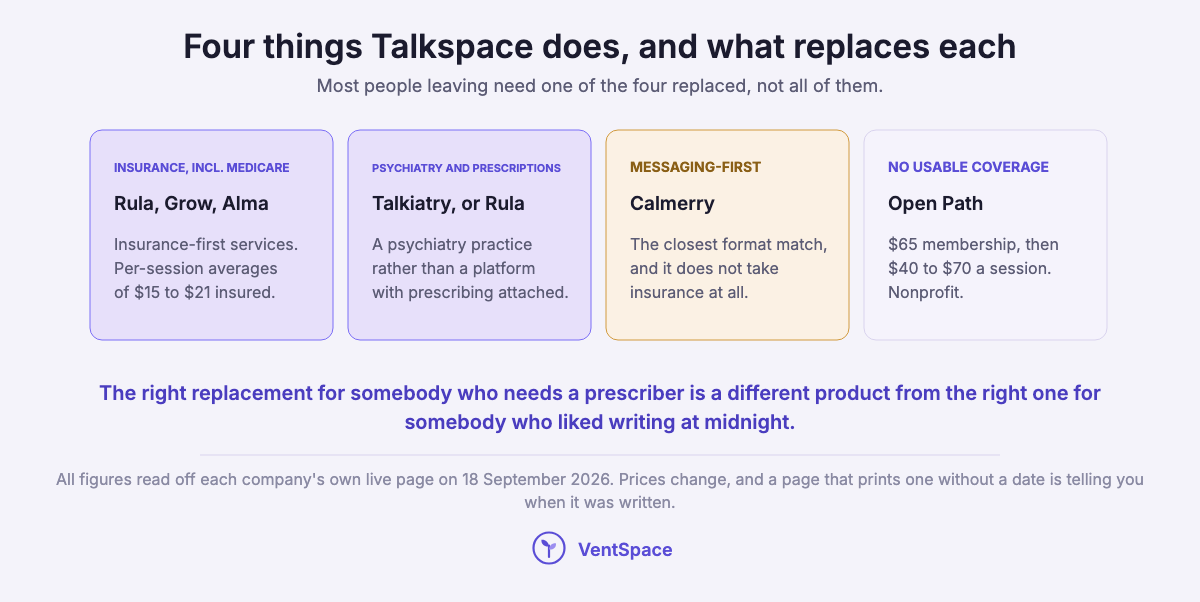
Because they are answering a question about brands, and the reader’s question is about functions. Talkspace is not one product. It does four separable things, and you may need only one of them replaced. It takes insurance, including Medicare. It offers psychiatry and prescriptions. It is messaging-first, which some people specifically want. And it covers teens from thirteen, and couples. The right replacement for somebody who needs insurance and a prescriber is a completely different product from the right replacement for somebody who liked writing to a therapist at midnight.
So which of the four are you actually replacing?
The short version
Sorted by function, not by brand. Four things Talkspace does, and what replaces each one.
Every price here was read off the company’s own live page on 18 September 2026, and carries that date. One product printed no price and is marked as unverified rather than guessed at.
Talkspace was acquired by Universal Health Services on 17 August 2026. Reported here because it is true and recent. Not speculated on, because nobody knows yet.
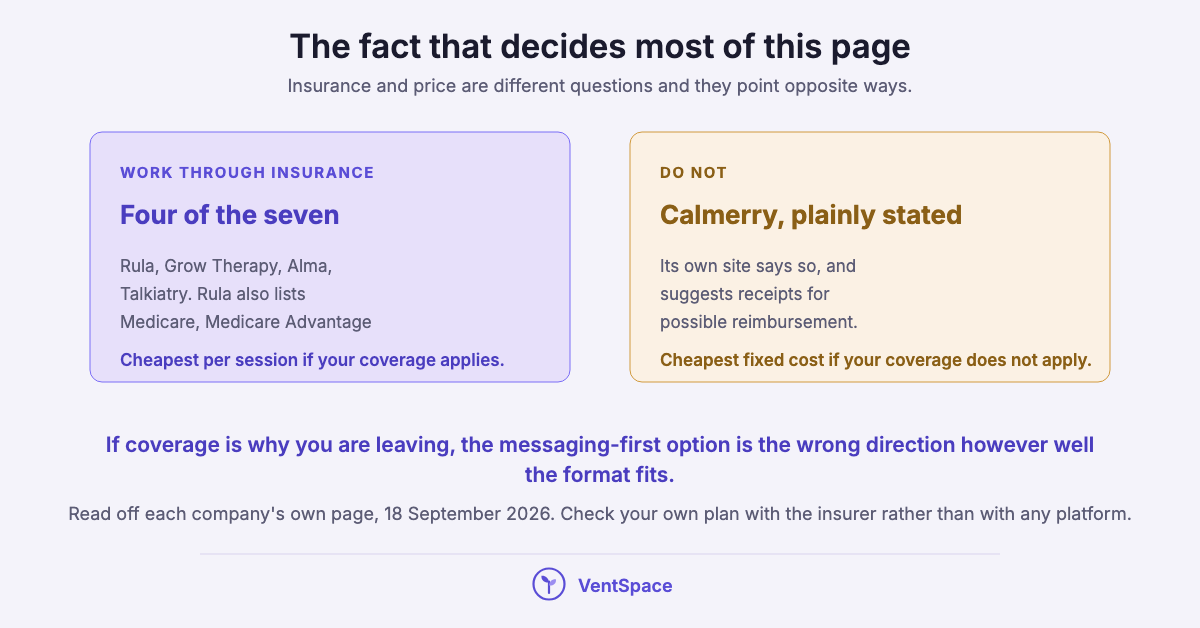
Two of the seven do not take insurance at all, and that is the single most consequential fact if coverage is why you are leaving.
Do not cancel before the replacement is booked. The gap is the actual risk and it does not appear in any features comparison.
If things are bad right now, please deal with that before dealing with a subscription. In the US you can call or text 988 for the Suicide and Crisis Lifeline. Elsewhere, findahelpline.com lists services by country. Changing platforms is not urgent. Being without support while you do it can be.
And the gap is the risk. The most common harm on this whole subject is not choosing the wrong alternative. It is cancelling one thing in September and starting the next one in November. Book the replacement first. If you take prescribed medication, that point is not optional and is covered below.
What changed in August, and what it does not tell us
Worth knowing before you compare anything, because none of the pages ranking for this search mentions it and one of them still carries 2025 in its title.
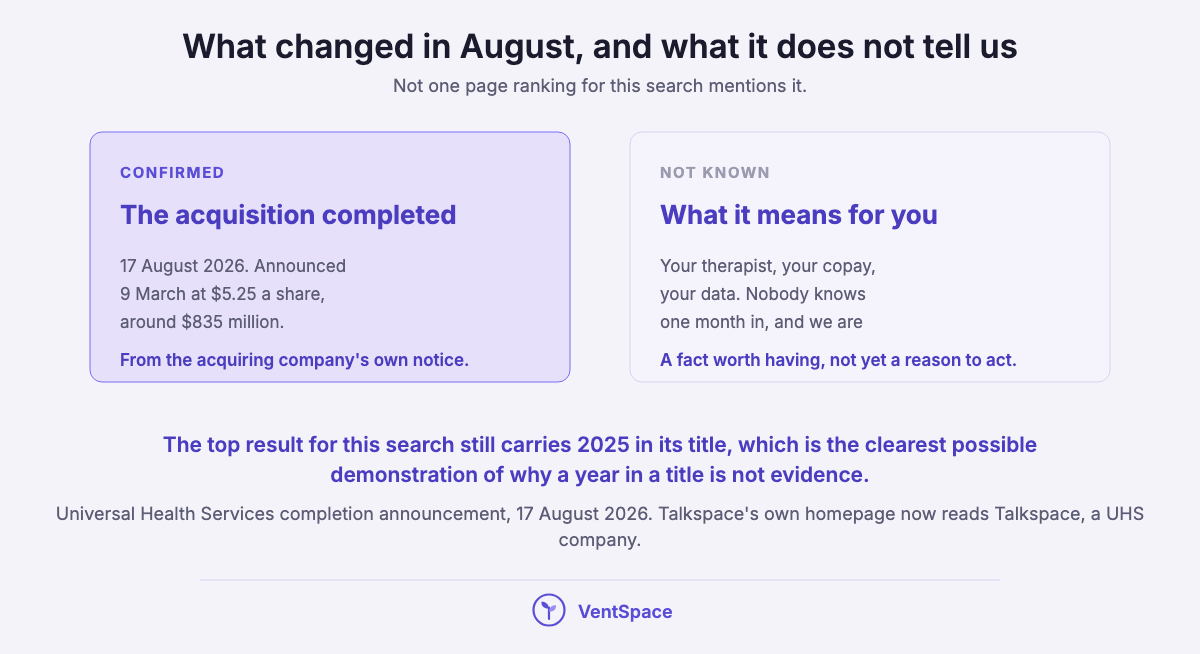
Universal Health Services completed its acquisition of Talkspace on 17 August 2026. The deal was announced on 9 March at $5.25 per share, an enterprise value of roughly $835 million, and Talkspace’s own homepage now reads “Talkspace, a UHS company”. The acquisition coverage puts the business at around 6,000 licensed therapists and psychiatrists, operating in all fifty states plus Washington DC and Puerto Rico, with $229 million in revenue and more than 1.6 million sessions in 2025.
What the companies said about continuity, verbatim from the completion announcement: they “will begin working together immediately to thoughtfully integrate capabilities while ensuring uninterrupted service for patients, providers and partners.”
What does that actually tell you about your own account?
Less than the news coverage will suggest. And here is what we are not going to do with that. We are not going to tell you what an acquisition means for your therapist, your copay or your data, because nobody knows yet, one month in. Ownership changes in this sector have gone several different ways and the honest position is that this is a fact worth having and not yet a reason to do anything. If you were already leaving for one of the four reasons below, leave. If you were not, this is not a new reason on its own.
Quick Summary
Q: Is Talkspace still running?
A: Yes. It was acquired by Universal Health Services on 17 August 2026, the acquisition has completed, and the companies stated that service would be uninterrupted for patients, providers and partners. Nothing about the transaction is a reason on its own to switch.
Insight
“Universal Health Services, Inc. today announced the successful completion of its acquisition of Talkspace, Inc.” And on continuity: the companies “will begin working together immediately to thoughtfully integrate capabilities while ensuring uninterrupted service for patients, providers and partners.”
Universal Health Services, completion announcement, 17 August 2026. Announced 9 March 2026 at $5.25 per share, enterprise value approximately $835 million.
Which of the four are you replacing?
Answer these before reading any further. They take a minute and they decide most of the page for you.
- Was your Talkspace covered by insurance, and did that coverage actually apply?
- Are you getting a prescription through it, or only therapy?
- Did you use the messaging, or did you only ever do the live sessions?
- Is the person in therapy a teenager, or a couple?
- Is the problem the price, or the coverage, which are not the same thing?
- Is the problem the platform, or the particular therapist you were matched with?
That last one is worth pausing on. Is the problem the platform, or is it the person you were matched with? A bad match is the one problem a different platform does not fix. Most services will rematch you, and doing that costs an email and a week.
And a second short list, before you cancel anything.
- Have you checked what your plan covers directly with your insurer rather than through the platform?
- Do you have your session notes or your prescriber’s details saved outside the app?
- Have you got a replacement booked, with a date?
- If you take medication, have you got enough to cover the changeover?
Do not panic about getting this perfect. Book the replacement first and cancel second, and nothing else on this page matters as much as that sentence.
Quick Summary
Q: How do I choose a Talkspace alternative?
A: By deciding which of four things you are replacing: insurance coverage, psychiatry and prescriptions, the messaging format, or teen and couples care. You may need one of the four replaced and not the others, and the recommendations for each are entirely different products.
How these were judged
Read off the live page, on 18 September 2026. Every price, every insurance claim and every service listed below was taken from the company’s own site on that date. None came from another roundup. Prices change, and a page that prints one without a date is telling you when it was written rather than what anything costs.
Sorted by function, because that is how people actually leave a platform.
Insurance treated separately from price. Why separate them? Because they point in opposite directions: the cheapest options here for somebody without coverage are among the most expensive for somebody with it.
And five relevant products are missing on purpose. Brightside Health, Headway, 7 Cups, TherapyDen and Psychology Today’s directory are all reasonable things to consider and all five returned an access error to us on the day we checked. We would rather have an obviously incomplete list than describe a product we could not read. BetterHelp is also absent, deliberately: routing somebody leaving one large direct-pay platform to the other one is the least useful advice available.
The alternatives at a glance
- Rula. Best for replacing the whole thing, therapy and psychiatry, with insurance.
- Grow Therapy. Best for insurance-covered therapy with medication management alongside.
- Alma. Best for finding an insured therapist and staying with them.
- Talkiatry. Best if the psychiatry is the part you need.
- Calmerry. Best if the messaging format is what you want, and it does not take insurance.
- Online-Therapy.com. Best if you want structure and worksheets rather than a person on a schedule.
- Open Path Collective. Best if you have no usable coverage and need a low fixed price.
- Community mental health and sliding-scale clinics. Not a product, and frequently the right answer.
If insurance is what you are replacing
Rula
The closest single replacement for everything Talkspace does. Therapy, couples, family, child and teen work, plus psychiatry and medication management, which is the combination that makes it the default suggestion here. It covers three of the four functions the rest of the page is sorted by, everything except messaging, which is a genuine convenience if you were using more than one of them and an irrelevance if you were not.
Who it suits better than Talkspace: anybody whose Talkspace coverage did not apply, or who needs therapy and a prescriber in the same place. Its site states it is in-network with 120 or more plans nationwide, naming Aetna, Anthem, most Blue Cross and Blue Shield plans, Cigna, Kaiser by referral, Optum, Oscar and United Healthcare, with Medicare, Medicare Advantage and Medicaid available in many states.
In practice: the site states that patients typically pay $15 per session with insurance. Self-pay is $150 per session for individual therapy, $165 for families or couples, and psychiatry is $225 for a sixty-minute intake and $175 for thirty-minute follow-ups. All read 18 September 2026.
The watch-out: what happens if your coverage does not apply here either? The self-pay figures are considerably higher than Talkspace’s out-of-pocket rate. This is an insurance answer, not a price answer, and if your coverage does not apply here either it is the wrong recommendation for you.
Grow Therapy
A large insurance-first marketplace offering talk therapy both virtually and in person, with medication management available through prescribers. The in-person option is the thing that distinguishes it here, because it is the one function Talkspace does not have at all, and for some people the discovery that they wanted a room rather than a screen is the actual reason they are leaving.
Who it suits better than Talkspace: people who want the option of seeing somebody in a room, which Talkspace does not offer, and people whose insurer is in its network.
In practice: the site states that sessions cost $21 on average with insurance, and that cash payment options exist where insurance is not accepted. Individual therapist rates are shown on each provider’s profile rather than set centrally. Read 18 September 2026.
The watch-out: is $21 your price? An average is not your price. Because rates sit with individual providers, the useful check is the specific therapist’s profile rather than the headline figure.
Alma
A matching platform rather than a therapy service, connecting people to therapists who take their insurance. Its own 2026 copyright line reads “Alma, a part of Spring Health”, which is an ownership change worth knowing when you are already thinking about who owns what. The distinction between a matching platform and a service matters more than it sounds: you are choosing a therapist who happens to be reachable through Alma, rather than being allocated one by it, and that changes what happens if the match does not work.
Who it suits better than Talkspace: people whose real complaint was the matching rather than the format, and who want to choose a therapist rather than be assigned one. It names more than seventy insurance plans including Aetna, UnitedHealthcare, Cigna and Anthem.
In practice: the site states that insured clients pay $20 per session on average, a figure it asterisks on the page itself. Read 18 September 2026.
The watch-out: psychiatry is not advertised on its homepage. If you need a prescriber, this is not the one, and that is the main reason it sits third rather than first here.
Quick Summary
Q: Which online therapy takes insurance?
A: Of the seven checked here, Rula, Grow Therapy, Alma and Talkiatry all work through insurance, and Rula additionally lists Medicare, Medicare Advantage and Medicaid in many states. Calmerry states plainly that it does not take insurance, and Open Path is built for people without usable coverage.
If the psychiatry is what you are replacing
Talkiatry
A psychiatry practice rather than a therapy platform with psychiatry attached, which is a real distinction when medication is the thing you need continued. On a general platform the prescribing sits alongside a therapy product and is scheduled around it. Here it is the product, and for somebody whose Talkspace complaint was that the psychiatry side moved slowly, that difference is the entire reason to look at it.
Who it suits better than Talkspace: anybody for whom the prescribing was the point. Its clinicians are described as in-network with major insurers, and the site is explicit that it is a psychiatry service, with therapy offered alongside rather than instead.
In practice: the site states that most patients pay around $30 out of pocket per visit, and offers a copay estimator. Read 18 September 2026.
The watch-out: it is not a cheap self-pay option and it is not trying to be. And what happens to the prescription in the meantime? And a clinical point rather than a product one: do not run out of a prescription while switching. Arrange the handover with your current prescriber before the last covered appointment, and treat that as the first task rather than the last.
If the messaging is what you are replacing
Calmerry
The closest format match to what Talkspace is known for. Text therapy where you write to your therapist and they reply, with video sessions available alongside. Worth saying that this format genuinely suits some people rather than being a lesser version of a call: writing gives you time to say the thing properly, and being able to send it at the moment it arrives rather than four days later is the whole appeal.
Who it suits better than Talkspace: people who genuinely wanted the asynchronous thing and want it cheaper. The site describes counsellors responding once or twice a day on working days, which is a useful expectation to have in advance.
In practice: plans start from $50 per week, with four thirty-minute video sessions at $74 per week and an additional sixty-minute session at $120. Read 18 September 2026.
The watch-out, and it is the big one: Calmerry states plainly on its own site that it does not take insurance. It suggests requesting receipts for possible reimbursement. If coverage is why you are leaving Talkspace, this is the wrong direction, however well the format fits.
Online-Therapy.com
A structured programme rather than a matching service. It is built around cognitive behavioural therapy, with worksheets, an activity planner, a journal, messaging and live sessions. The difference from everything else on this page is that the material is the spine and the therapist supports you through it, which is close to the opposite of the open-ended weekly conversation most platforms sell.
Who it suits better than Talkspace: people who want something to work through rather than somebody to talk to on a schedule, and people who found the open-ended format left them without direction.
In practice: the programme is the product, and the therapist supports it rather than leading it. No price was printed on the page we loaded, which carried only a first-month discount, so we have not printed one either. `[unverified]` Check the figure on their own pricing page before signing up.
The watch-out: insurance is not mentioned on the page we read, and a structured CBT programme is a specific thing that suits some people and frustrates others. It is closer to a course with a therapist attached than to therapy with materials attached.
If the price is what you are replacing
Open Path Psychotherapy Collective
Not a platform. A nonprofit that connects people to therapists who have agreed to charge a low fixed fee, for people without insurance that covers mental health adequately. It exists specifically for the gap that most of this page’s other options fall into, which is having insurance that technically exists and does not meaningfully cover therapy.
Who it suits better than Talkspace: anybody whose problem is cost rather than coverage, and anybody who fell into the gap of having insurance that does not meaningfully cover therapy.
In practice: a one-off membership of $65, then individual sessions at $40 to $70 and couples or family sessions at $40 to $80. Canadian figures are listed alongside. Read 18 September 2026.
The watch-out: how long does it take? Availability depends on which therapists near you have joined, so this is a search rather than a signup, and it takes longer than a platform does. Start it before you cancel anything.
Community mental health and sliding-scale clinics
Not a product, which is why this entry looks different. Publicly funded and nonprofit clinics, university training clinics, and therapists who hold sliding-scale slots. It is an easy route to overlook after using a consumer app, partly because it is not advertised anywhere and partly because it does not look like the thing they were using, and it is frequently the one that is still there in two years.
Who it suits better than Talkspace: people for whom no paid option works, and people who would benefit from being connected to services beyond one therapist.
What to expect: a referral or an intake call rather than a signup, a wait that is frequently weeks and occasionally months, and fees set by income. University training clinics are supervised and are often the shortest wait. It is not a fast route and it is a real one.
The watch-out: the wait is the whole problem, and it is the reason to start this while something else is still running rather than after it stops.
Quick Summary
Q: What is the cheapest alternative to Talkspace?
A: For somebody without usable coverage, Open Path’s $65 membership and $40 to $70 sessions is the lowest fixed cost among the seven checked, and community and sliding-scale clinics can be lower still. For somebody with coverage, the insurance-based services are cheaper per session than any self-pay option here.
All eight compared
| Option | Takes insurance | Psychiatry | Messaging | Price printed on their site, read 18 Sep 2026 | The watch-out |
|---|---|---|---|---|---|
| Talkspace | Yes, incl. Medicare | Yes | Yes, it is the format | $0 copay for most insured. $15 typical copay. Out-of-pocket from $69/week | Now owned by UHS. Continuity stated, consequences unknown |
| Rula | Yes, 120+ plans, Medicaid in many states | Yes | Not advertised | $15 typical insured. Self-pay $150, $165 couples. Psychiatry $225 intake, $175 follow-up | Self-pay is high. An insurance answer, not a price answer |
| Grow Therapy | Yes, plus cash options | Medication management | Not advertised | $21 on average with insurance | An average is not your price. Check the provider’s profile |
| Alma | Yes, 70+ plans | Not advertised | Not advertised | $20 per session on average, insured | No prescriber. Wrong choice if medication is the point |
| Talkiatry | Yes, major insurers | Yes, it is the service | Not advertised | Around $30 out of pocket per visit | Arrange prescription continuity before the last appointment |
| Calmerry | No, stated plainly | No | Yes | From $50/week. Four 30-min video sessions $74/week | No insurance at all. Wrong direction if coverage is the issue |
| Online-Therapy.com | Not mentioned | No | Yes, within the programme | No price printed on the page loaded `[unverified]` | A CBT course with a therapist attached, which suits some people |
| Open Path | Not needed | No | No | $65 membership. $40-70 individual, $40-80 couples | Depends on local therapists. Start the search early |
| Community and sliding-scale clinics | Often free or income-based | Sometimes | No | Set by income | The wait, which is weeks and sometimes months |
How to actually switch
In this order, and the order is the point.
1. Find out what your insurance actually covers, from the insurer rather than from any platform. This is the step that decides most of the rest.
2. Book the replacement. A date in a calendar, not an account created.
3. If you take prescribed medication, sort continuity first. Speak to your current prescriber about the handover and make sure you have enough to cover the changeover. This is a clinical matter and not a subscription matter, and it is the one step on this list with a real consequence attached.
4. Save anything you need out of the old app. Your prescriber’s name and details, any notes you wrote, the dates of your sessions.
5. Then cancel, and check the cancellation actually went through rather than assuming.
6. Give the new one three sessions before judging it. First sessions are unrepresentative of everything, and switching twice in a month is an expensive mistake.
Quick Summary
Q: How do I switch from Talkspace to something else?
A: Check your insurance directly first, book the replacement with a date, arrange medication continuity with your prescriber before anything lapses, save what you need out of the app, and only then cancel. Give the new service three sessions before deciding.
Questions people ask
Is Talkspace still running?
Yes. Universal Health Services completed its acquisition on 17 August 2026 and the companies said service would be uninterrupted for patients, providers and partners. It is not shutting down and nothing about the transaction is by itself a reason to leave.
Which alternative takes insurance?
Of the seven checked here, Rula, Grow Therapy, Alma and Talkiatry all work through insurance, and Rula additionally lists Medicare, Medicare Advantage and Medicaid in many states. Calmerry states on its own site that it does not take insurance. Open Path is designed for people whose coverage does not work.
What replaces the psychiatry part?
Talkiatry if the prescribing is the point, or Rula if you want therapy and psychiatry in one place. Whichever you choose, the important step is not the signup. It is arranging continuity with your current prescriber before anything lapses.
Is anything cheaper than Talkspace?
It depends entirely on your coverage, which is why the page keeps separating those two questions. With insurance, the marketplaces above quote average per-session costs well below Talkspace’s out-of-pocket rate. Without insurance, Open Path’s $65 membership and $40 to $70 sessions is the lowest fixed cost here. All figures read on 18 September 2026 and worth rechecking.
Why is BetterHelp not on this list?
Because sending somebody leaving one large direct-pay platform to the other large direct-pay platform does not answer any of the four questions this page is built around.
Does VentSpace belong on this list?
No, and that is why it is not in the table. VentSpace is a journaling app that turns what you write into a clear read on your life balance, plus small, doable next steps, and it is not therapy, so it cannot replace any of the eight options above and we are not going to suggest that it can. If what you actually want is somewhere to put things rather than a clinician, our piece on alternatives to therapy covers that properly. It is Android only, and not a substitute for care you are currently receiving. Not on Android, or at a desk? VentSpace Live runs in your browser, free, with nothing to install.
Two things to take away
The first is the honest timeline, and it is longer than a cancellation. Finding a therapist who takes your insurance and who has availability takes a few weeks in most places and longer in some. Open Path and community clinics take longer still. That is why the whole page keeps saying to book before you cancel, and it is the only piece of advice here that carries a real cost if ignored.
The second takes five minutes and you can do it now. Call your insurer, or open your plan documents, and find out exactly what your mental health coverage is: how many sessions, what copay, whether telehealth counts, and whether psychiatry is covered separately. Write the answers down. Nearly every recommendation on this page changes depending on what that call says.
About this article

Written by
Sai Subramaniam
Founder, VentSpace
I write these guides because I have been where you are. I am working through my own hard seasons, and I share the things that actually helped me, so that anyone going through it has a steady companion close by instead of facing it alone. VentSpace is the app I built for exactly that: a journaling app that turns what you write into a clear read on your life balance, plus small, doable next steps toward feeling more like yourself.
This writing is honest and every claim is sourced, and it is not a substitute for professional care. If you are struggling, reaching out to a professional is a strong move, not a failure.
Explore VentSpaceTry VentSpace LiveHow this one was checked. Every factual claim traces to a named source, and the source is printed next to the claim rather than kept in a footnote. Quotes are pinned to the work they come from, with the year, the letter or the chapter where one exists. Where a widely repeated claim could not be traced, it was left out and the omission recorded. Where a figure is contested, both sides are printed.
No affiliate links, no paid placements, and nobody paid to appear here. Where we mention our own app, we say that it is ours, we state its limits, and we never position it as a substitute for care.
Reviewed: October 2026. Prices, platforms and product availability move quickly, and anything we could not verify at the time of writing is marked as unverified rather than turned into a number.
Corrections. If something here is wrong, we would rather know. Corrections are made in place, with a note saying what changed. Updated 15 October 2026: Rula is now described as covering three of the four functions, not all four, because it does not advertise messaging. We removed a reference to a BetterHelp piece that does not exist, cut several claims about what most people do that we had no source for, corrected the VentSpace description, and removed an unrelated link.