
A diary is a dated record of a life, kept by the person living it, usually in private and usually in order. That is the whole definition. The English word dates from the 1580s, and the form has never required anything else of anybody.
A typical entry is short and plain. The date, what happened, and anything you want to remember about it. Something like: 14 October. Rain all day. Called Mom, she sounded tired. Finally sent the report. That is a diary entry, and it does not need to be more.
If you came for the definition, that is it. If you came because you are standing at the edge of starting one, put off by a word that manages to sound like a childhood object and a daily obligation at the same time, then what you probably want to know is what you would be signing up for.
So that is what the rest of this is.
The short version
The definition is one sentence. A dated record of a life, kept by the person living it.
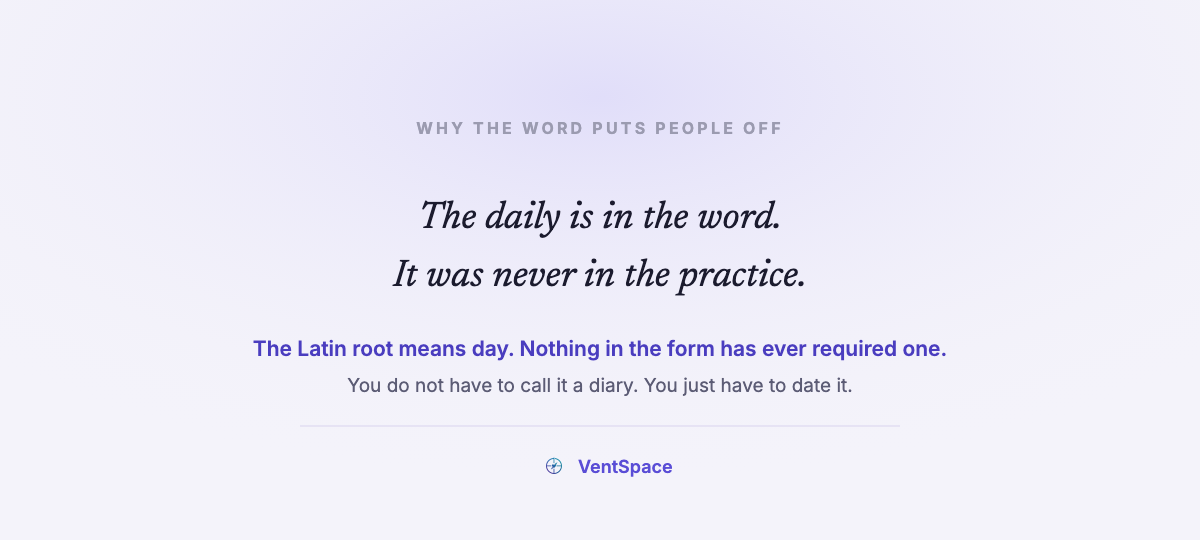
The daily part lives in the word, not in the practice. The root is the Latin for day, and nothing in the form requires one.
The most famous English diarist called his a journal, wrote it in shorthand, and stopped because he thought he was going blind.
In 1937 a research project recruited ordinary people to keep them, on the grounds that ordinary days were the data.
It is not a journal, a planner or a memoir, and the three confusions cause different problems.
And there is a point where the word stops helping, which is the moment it becomes a rule.
Where the word comes from
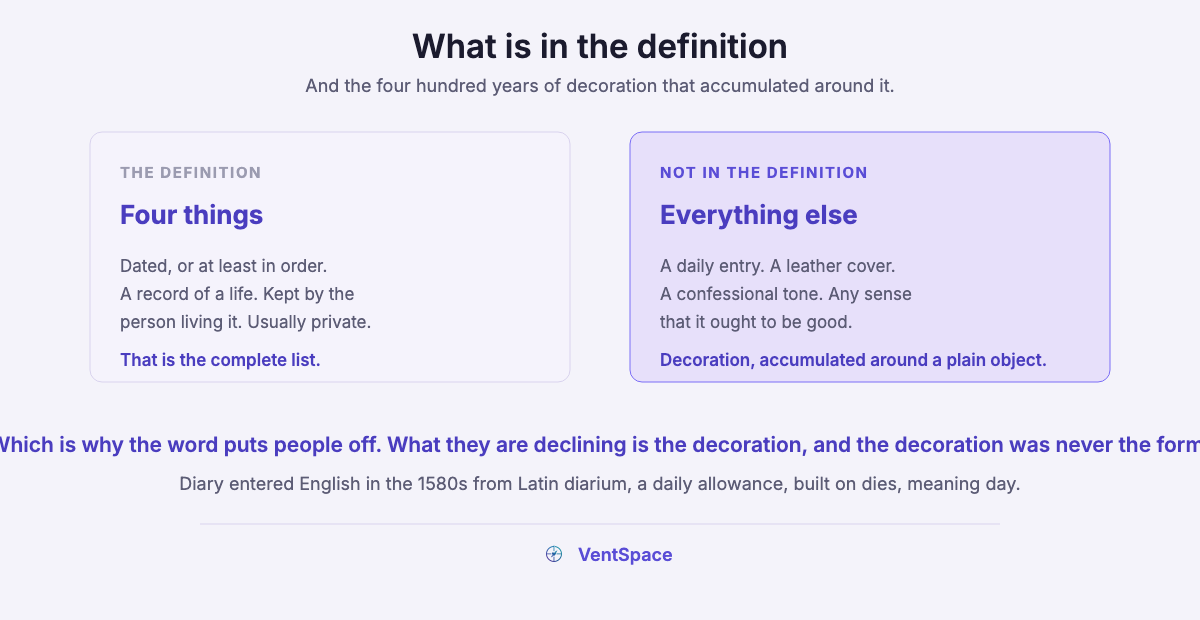
The daily is in the word, and that is the whole of the problem. Diary enters English in the 1580s from the Latin diarium, meaning a daily allowance, built on dies, the Latin for day. So the obligation people feel when they hear it is not imagined. It is etymological, and it has been sitting inside the word since before anybody used it for feelings. We argue that split properly in diary vs journal, and for this page two sentences are enough.
What matters more here is what the form has actually been, which is a different question from what the word has meant. And the form has a documented history that the usual pages on this question leave out.
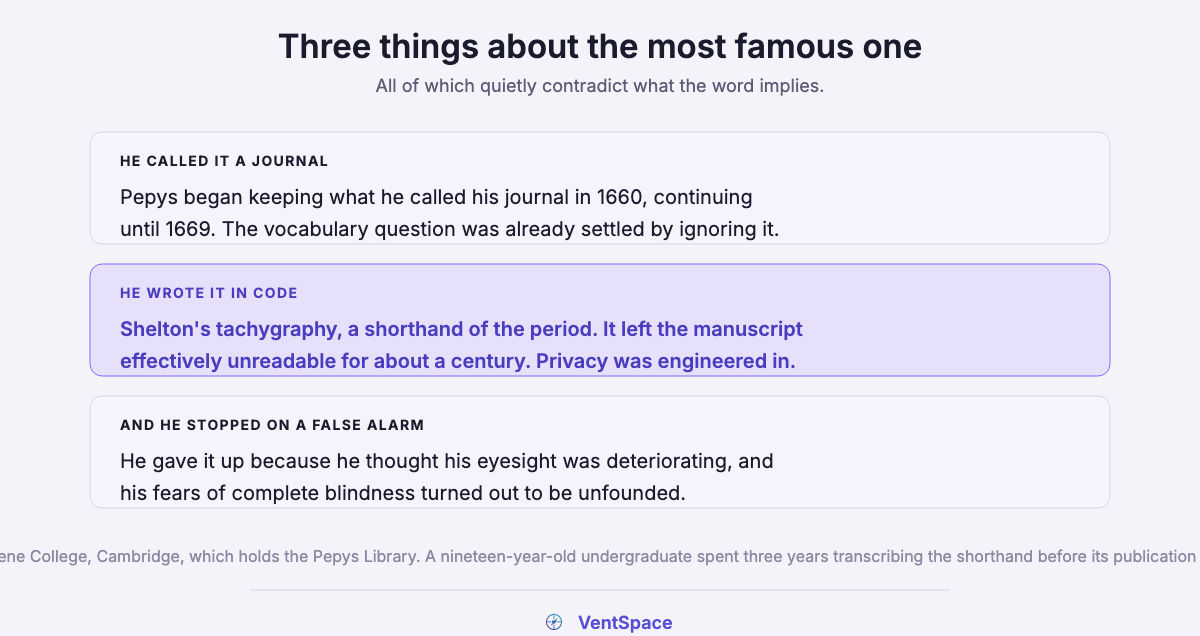
Start with Samuel Pepys, because everything surprising about the diary as a form is visible in his. According to Magdalene College, Cambridge, which holds the manuscripts, “Pepys began keeping what he called his ‘journal’ in 1660, continuing until 1669.”
Read that carefully. He called it a journal. The most famous diary in the English language was not called a diary by the man writing it, which ought to take some pressure off anybody currently stuck on the vocabulary.
Two more things about it are worth knowing. He wrote it in Thomas Shelton’s tachygraphy, a shorthand system of the period, which fell out of common use and left the manuscript effectively unreadable until a nineteen-year-old undergraduate named John Smith spent three years transcribing it, and it was finally published in 1825. And he stopped, in the college’s own words, “because he thought his eyesight was deteriorating, though his fears of complete blindness turned out to be unfounded.”
So the celebrated diary ends on a false alarm about the writer’s eyes. Not on a conclusion, not on a resolution, and not because the writer had run out of days. Does that sound like a form with rules in it?
Quick Summary
Q: Where does the word diary come from?
A: It entered English in the 1580s from the Latin diarium, a daily allowance, built on dies, meaning day. The sense of daily obligation people react to is genuinely in the root of the word, although nothing in the practice has ever required a daily entry.
Insight: what the man who wrote the most famous one called it
“Pepys began keeping what he called his ‘journal’ in 1660, continuing until 1669.” And: “It was Shelton’s tachygraphy or short writing system which Pepys used in his diary.” Magdalene College, Cambridge, which holds the Pepys Library. A nineteen-year-old undergraduate spent three years transcribing it before its publication in 1825.
What it is not
Three things get mistaken for a diary, and each mistake causes a different problem.
Not a journal. The two words have meant more or less the same thing since about 1600, which is why Pepys could use one for the other without anybody minding. Where people draw a line today, they usually mean recording the day versus working out what it meant, and that distinction is real as a description of two activities rather than as a definition of two objects. It is argued in full on the sibling page and does not need re-running here. What is worth saying is that choosing between the words settles nothing, and a fair amount of not-starting happens inside that choice.
Not a planner or a log. In British and Canadian English a diary is also an appointment book, which means some readers hear a calendar first. A log records what was done. A planner records what will be. A diary records what happened, including the parts nobody scheduled, and that last clause is the difference, because the unscheduled parts are where the interesting material always turns out to be.
Not a memoir. A memoir is written afterwards, for a reader, with the benefit of knowing how things turned out. A diary is written during, without that benefit, and is usually wrong about what will matter. That is not a weakness of the form. It is the only reason a diary is evidence of anything, because a person recording a Tuesday cannot yet shape it into a story.
Which of those three have you been quietly comparing yourself against?
Quick Summary
Q: What is the difference between a diary, a journal, a planner and a memoir?
A: A journal has meant more or less the same as a diary since about 1600. A planner records what will happen and a log records what was done. A memoir is written afterwards for a reader, with the ending known. A diary is written during, without that advantage.
How it actually shows up
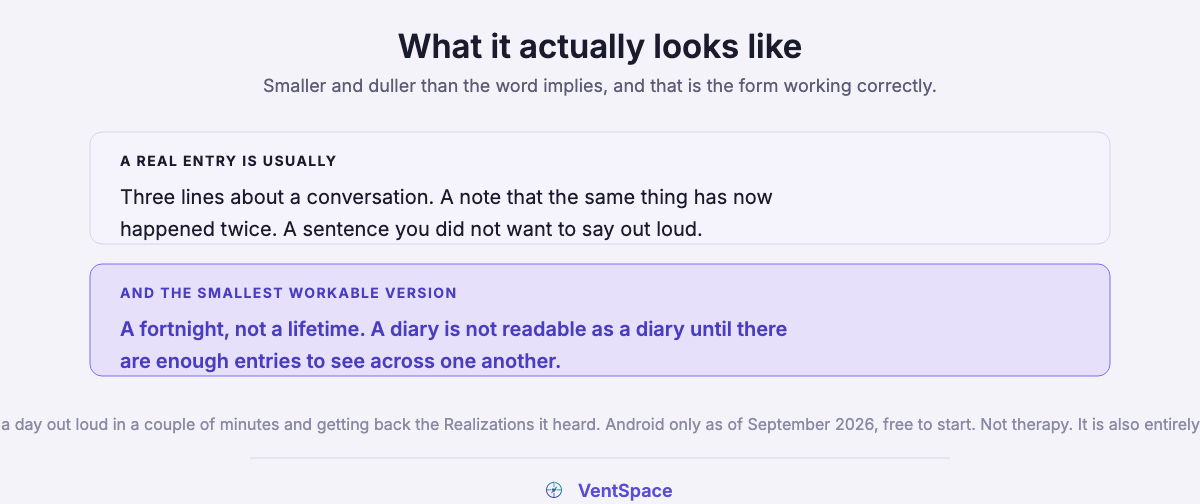
In practice a diary is much smaller and much duller than the word implies. Three lines about a conversation. A note that the same thing has now happened twice. The weather, if the weather was the thing that got you. A sentence you did not want to say out loud to anybody.
There is no minimum length, no required tone, and no rule that the entries connect to each other. Nobody needs to write beautifully, and the entries that turn out to matter are rarely the ones written with any sense of occasion.
And here is the strongest available answer to the objection that nothing interesting happens to you.
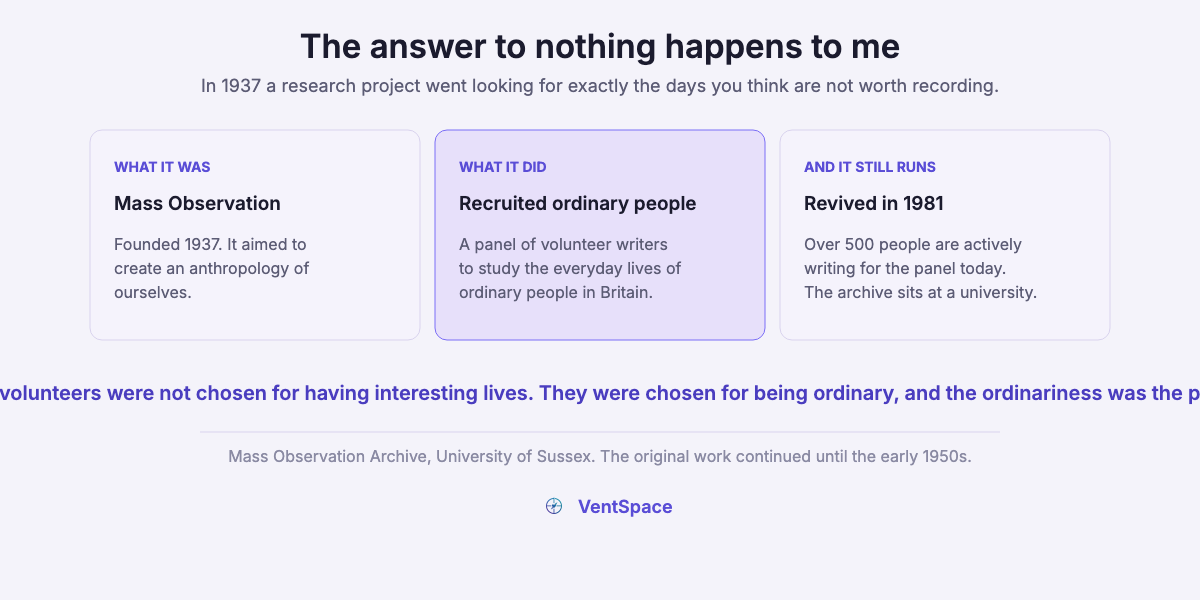
In 1937, three men founded a project called Mass Observation. Tom Harrisson, an anthropologist, Charles Madge, a poet and sociologist, and the film-maker Humphrey Jennings. Its aim, in the archive’s own words, was to create an “anthropology of ourselves”, and its method was to recruit “a team of investigators and a panel of volunteer writers to study the everyday lives of ordinary people in Britain.” That original work “continued until the early 1950s”, and the material now sits in an archive at a university.
The volunteers were not there because their lives were interesting. The project set out to study the everyday lives of ordinary people, and the ordinariness was the point, because what a research organisation wanted was exactly what none of us think is worth writing down. The project was revived in 1981 as the Mass Observation Project, and over 500 people are actively writing for the panel today.
So the question is not whether your Tuesday is interesting. It is whether you are the right person to judge that, and the answer is almost certainly no.
Quick Summary
Q: What do you actually write in a diary?
A: Usually much less than the word implies: a few lines about what happened, something that has now occurred twice, a sentence you did not want to say out loud. There is no minimum length and no required tone, and the entries that turn out to matter are rarely the ones written with a sense of occasion.
Insight: why ordinary days were the data
Mass Observation was founded in 1937 and “aimed to create an ‘anthropology of ourselves'”, recruiting “a team of investigators and a panel of volunteer writers to study the everyday lives of ordinary people in Britain. This original work continued until the early 1950s.” The Mass Observation Project was launched in 1981 to revive the national writing panel, and over 500 people currently write for it. Mass Observation Archive, University of Sussex.
Does this describe you
This is a description of a practice rather than a judgement about a person, and it is worth saying that plainly, because a great deal of writing in this area quietly hands the reader a verdict.
You are probably describing a diary, whatever you are calling it, if these are true of what you already do or are considering:
- You want a record of what happened rather than an interpretation of it.
- You want it dated, or at least in order, because the sequence is part of the information.
- You are the intended reader, and the only one.
- You are not writing towards a conclusion.
None of those is a requirement and none of them is a test. A person who wants to interpret as they go is not doing it wrong, they are doing the other activity, and the two often sit in the same notebook without anybody noticing the join.
What if none of it describes you? Then the word is not the thing you are looking for, and knowing that is a genuinely useful outcome for three minutes of reading.
Quick Summary
Q: How do I know whether what I want is a diary?
A: A diary suits somebody who wants a record of what happened rather than an interpretation, wants it in order, is the only intended reader, and is not writing toward a conclusion. None of those is a requirement, and recording and interpreting often sit in the same notebook.
What to do with the word
Use it or drop it, and do not let it set the terms. The one thing worth taking from the etymology is that the daily obligation is in the word rather than in the form, which means you are allowed to keep a diary badly, irregularly, in a notes app, in a voice memo, or in four entries across a whole autumn.
If the word itself is the obstacle, then call it something else. Pepys did. Nothing in the practice changes, and the practice is the part that does anything.
If it is the daily part rather than the word, then the smallest workable version is a fortnight, not a lifetime. Three lines, most days, for two weeks. The reason to fix a short period is not discipline. It is that a diary is not readable as a diary until there are enough entries to see across, and two weeks of short entries gives you a few to read against each other.
What would you write tonight, if nobody was ever going to read it and it did not have to be good?
And if the blank page is the part that stalls. VentSpace is ours: a journaling app that turns what you write into a clear read on your life balance, plus small, doable next steps. It has preloaded prompts for the evenings when nothing comes, and it reads back named Realizations from what you wrote. The limits, plainly: Android only, free to start, and it is not therapy. Not on Android, or at a desk? VentSpace Live runs in your browser, free, with nothing to install. It is also entirely unnecessary. The form described on this page has no requirements at all, and a notebook you already own will do it.
Quick Summary
Q: Do I have to write in a diary every day?
A: No. The daily sense comes from the word’s Latin root, meaning day, rather than from anything in the practice. One workable start is a fortnight of short entries, because a diary only becomes readable as a diary once there are enough entries to compare against each other.
Where the label stops being useful
The word stops helping at the moment it becomes a rule. That is the honest limit of it, and it is worth stating on a page whose entire job is explaining a word.
A label is a description, not an instruction. Once “keeping a diary” becomes a thing you are failing at, it has stopped being a container for your days and become one more item you are behind on, and at that point the most useful thing available is to drop the noun entirely and keep the practice. Nobody has ever been helped by feeling guilty about a notebook.
There is a second limit and it matters more. A diary is a record, and a record is not a resolution. Writing something down changes what you can see and does not, by itself, change the situation, and there is a version of this practice where a person writes the same difficulty out four hundred times and takes the writing as having addressed it. If something is genuinely not shifting, a diary is not the thing that will shift it, and talking to a therapist is a legitimate option rather than an escalation or an admission.
And there is a smaller limit, worth naming because it catches people. A diary kept for an imagined future reader stops being a diary somewhere in the second week. Pepys wrote his in a shorthand almost nobody could read. That is worth copying in spirit, if not in method.
Quick Summary
Q: When does calling it a diary stop being helpful?
A: At the point where it becomes a rule rather than a description, and being behind on it becomes another failure. It also stops being helpful if the record is mistaken for a resolution, since writing something down changes what you can see without changing the situation.
Questions people ask
Does a diary have to be written every day?
No. The daily sense is in the word’s Latin root rather than in the practice, and there is no tradition, authority or definition anywhere that requires it. A missed Tuesday is a missed Tuesday.
What is the difference between a diary and a journal?
Very little, historically. Both words have meant a personal daily record since about 1600, and Pepys used the second for the first without anybody objecting. The distinction people mean today is between recording the day and working out what it meant, which is real as a description of two activities. We argue it properly on diary vs journal rather than twice.
What do you actually write in one?
Less than you think. What happened, who was there, the thing that is now happening for the second time, and whatever you did not say out loud. The entries that turn out to matter later are often not the ones that felt significant while being written.
What if nothing interesting happens to me?
Then you are precisely the person Mass Observation went looking for in 1937. A research organisation recruited hundreds of ordinary people to record their ordinary lives, on the grounds that the ordinary was the thing nobody was capturing, and the resulting archive is now held at a university. You are not a reliable judge of whether your own Tuesday is worth recording.
Is a diary supposed to be private?
Usually, and historically the privacy has often been engineered rather than assumed. Pepys wrote his in a shorthand system that made it effectively unreadable to anybody who did not know it. If the fear of being read is what stops you, that is a solvable problem and it is the oldest one in the form.
Two things to take
The definition is one sentence and the rest was always optional. A dated record of a life, kept by the person living it. Everything else people attach to the word, the daily entry, the leather cover, the confessional tone, the sense that it ought to be beautiful, is decoration that accumulated around a very plain object over the centuries.
And the honest one. The form promises nothing. Most of what gets written in a diary is dull, the writer is usually wrong about which parts will matter, and the diarists whose work ended up in a university archive were not recording anything more remarkable than a Tuesday in 1938. If you are waiting to have something worth writing down before you start, that is the one condition the form genuinely cannot meet.
You do not have to call it a diary.
You just have to date it.
About this article

Written by
Sai Subramaniam
Founder, VentSpace
I write these guides because I have been where you are. I am working through my own hard seasons, and I share the things that actually helped me, so that anyone going through it has a steady companion close by instead of facing it alone. VentSpace is the app I built for exactly that: a journaling app that turns what you write into a clear read on your life balance, plus small, doable next steps toward feeling more like yourself.
This writing is honest and every claim is sourced, and it is not a substitute for professional care. If you are struggling, reaching out to a professional is a strong move, not a failure.
Explore VentSpaceTry VentSpace LiveHow this one was checked. Every factual claim traces to a named source, and the source is printed next to the claim rather than kept in a footnote. Quotes are pinned to the work they come from, with the year, the letter or the chapter where one exists. Where a widely repeated claim could not be traced, it was left out and the omission recorded. Where a figure is contested, both sides are printed.
No affiliate links, no paid placements, and nobody paid to appear here. Where we mention our own app, we say that it is ours, we state its limits, and we never position it as a substitute for care.
Reviewed: October 2026. Prices, platforms and product availability move quickly, and anything we could not verify at the time of writing is marked as unverified rather than turned into a number.
Corrections. If something here is wrong, we would rather know. Corrections are made in place, with a note saying what changed. Updated 15 October 2026: we added a plain example entry near the top, removed claims about the age of the form, how long the Pepys manuscript went unread and how many people never start, described our app as the journaling app it is, and removed a link that did not lead to the companion topic.