
“Not every feeling is an emotion: pain is a feeling but not an emotion, while love can be both.”
Neel Burton, psychiatrist and philosopher, “What’s the Difference Between a Feeling and an Emotion?”, Psychology Today, 2014, updated 2026
Most of us use the two words as one. We say we have strong feelings, or that we got emotional, and nobody stops us to ask which we meant. Then somebody draws the line between them, confidently, and we discover we were supposed to know.
Here is the answer on feelings vs emotions, before anything else. Yes, there is a real difference, and the people who study it disagree about where it falls. The closest thing to common ground is that feeling is the wider word. Hunger and pain are feelings that are not emotions. Past that, it depends on whose theory you read, which is why two definitions on the same search page can contradict each other. The useful question for your own evening turns out to be smaller and kinder: whether the state is about something.
The short version
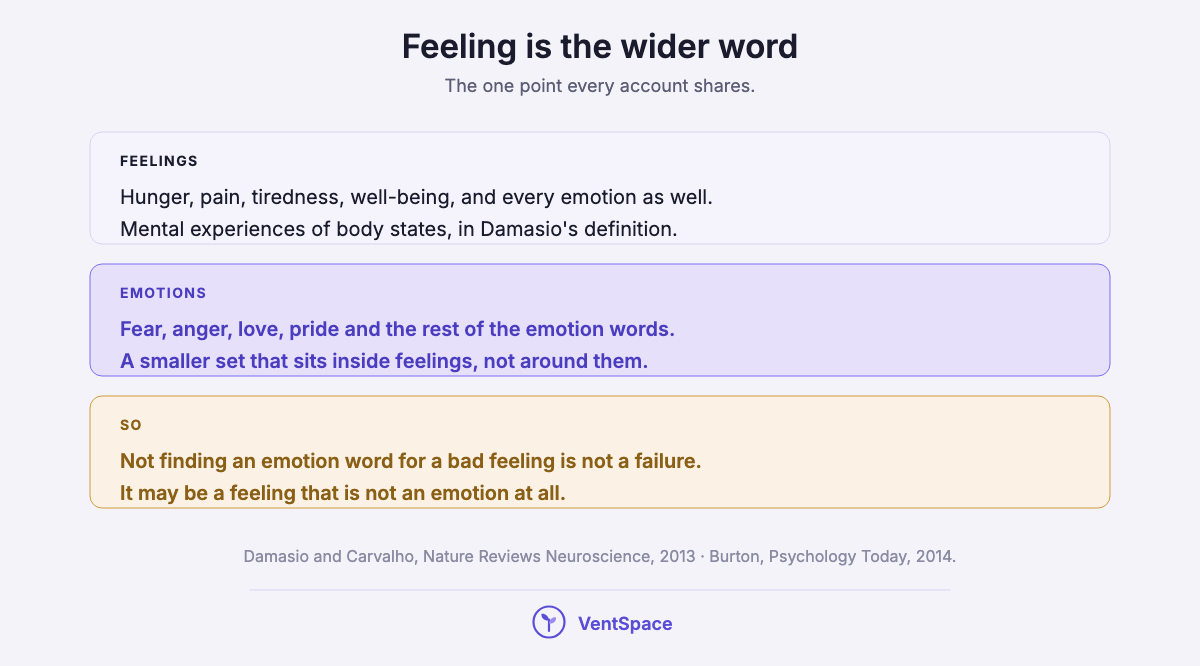
Feeling is the wider word. It covers hunger and pain as well as fear and love, in Damasio’s definition and in Burton’s.
Emotion is the contested word. It is something that plays out in the body for Damasio, the conscious experience itself for LeDoux, and a feeling that has found its cause for Russell.
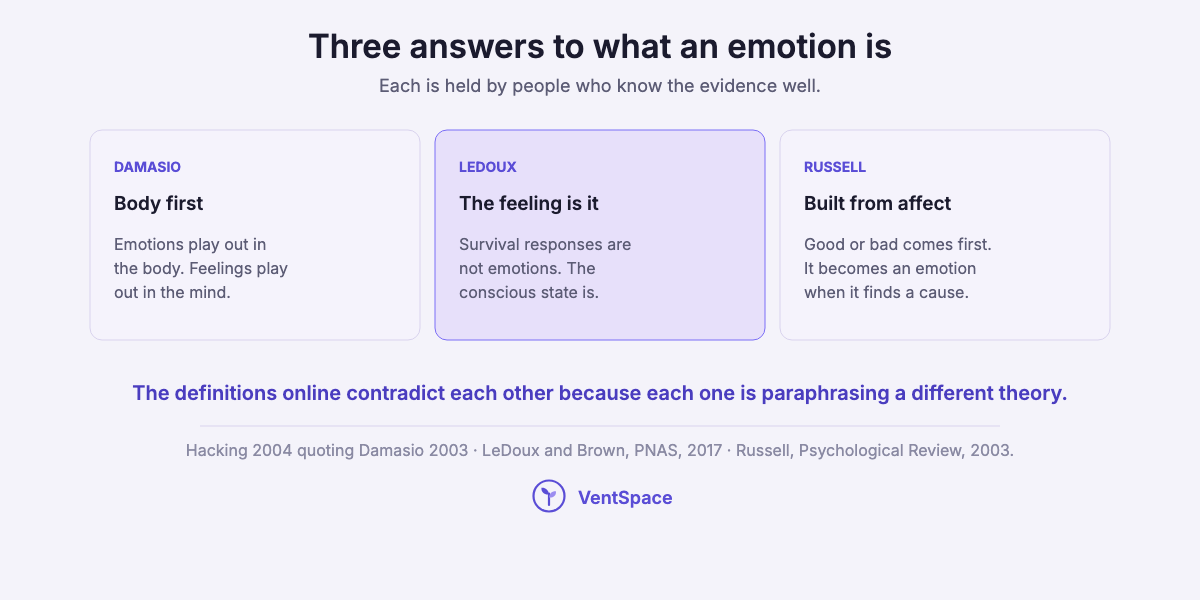
The definitions online contradict each other because each is quietly paraphrasing a different one of those theories.
The order is disputed too. Some accounts put the emotion first and the feeling after. Others put a feeling of good or bad first and the emotion after.
The usable test is one sentence: “I feel ___ about ___.” Whether the second blank fills tells you more than which word to use.
Finer words help a little, not a lot. The association is small, and one training trial found no direct effect.
What a feeling is
A feeling is the experience of a state of the body, registered by the mind. That is close to the definition given by the neuroscientist Antonio Damasio. In a 2013 review with Gil B. Carvalho in Nature Reviews Neuroscience, the opening line is plain: “Feelings are mental experiences of body states.”
What follows that line matters more than the line itself. Their examples run from hunger and pain through well-being to fear, anger, compassion, gratitude and love. On this account, a feeling is not a special emotional event. It is the whole category of things we register as going on in us, and only some of them have anything to do with emotion.
So when we say we feel tired, or cold, or sick, we are not misusing the word. We are using it in its broadest sense.
Quick Summary
Q: What is a feeling in psychology?
A: In Antonio Damasio’s definition, feelings are mental experiences of body states. That includes hunger, pain and well-being as well as fear, anger and love, which is why feeling is the wider of the two words.
What an emotion is
An emotion is the word the theories genuinely fight over. There are at least three serious answers, and each one is held by people who know the evidence well.
For Damasio, an emotion happens first in the body and the feeling is the mind’s reading of it. Ian Hacking, reviewing Damasio’s Looking for Spinoza (2003) in The New York Review of Books, quotes the line that sums it up: “Emotions play out in the theater of the body. Feelings play out in the theater of the mind.”
For the neuroscientist Joseph LeDoux, that has it the wrong way around. The body’s alarm responses belong, in his terms, to survival circuits, and the emotion is the conscious experience itself. His 2017 paper with the philosopher Richard Brown opens by treating the two words as one: “Although emotions, or feelings, are the most significant events in our lives”.
For the psychologist James Russell, an emotion is something built. A plain sense of good or bad comes first, and it becomes an emotional episode when it gets “attributed to some cause”.
Quick Summary
Q: What is an emotion?
A: It depends on the theory. Damasio treats an emotion as a response in the body that the mind then feels. LeDoux treats the conscious experience as the emotion. Russell treats an emotion as a feeling of good or bad that has been attributed to a cause.
Feelings and emotions side by side
| Feeling | Emotion | |
|---|---|---|
| What counts | Anything registered as going on in us: hunger, pain, well-being, fear, love (Damasio and Carvalho, 2013) | A narrower set: fear, anger, love, pride, grief, and the rest of the emotion words |
| Is it about something? | Not necessarily. A feeling of good or bad can be free-floating (Russell, 2003) | Usually yes. For Russell, attribution to a cause is what starts an emotional episode |
| Body or mind? | The mind’s experience of a body state (Damasio) | Something that plays out in the body for Damasio, a conscious state for LeDoux |
| Which comes first? | First, as raw affect, for Russell and Barrett | First, as a body response, for Damasio. The order is disputed |
| How long? | A conscious experience in the moment (Burton) | Can be an enduring state, as in being in love (Burton) |
| Do the experts agree? | Broadly, that it is the wider word | No. This is a live dispute in 2026 |
Feeling is the wider word
This is the closest thing to a solid floor in the subject, and it is worth standing on before we go further. Damasio’s list of feelings includes hunger and pain. Burton says outright that “pain is a feeling but not an emotion”. Russell’s starting point, which he calls core affect, is present in moods as well as emotions, so it too is wider than emotion.
That has a practical consequence we rarely hear. If we feel bad and cannot find an emotion word for it, we have not failed at anything. We may be holding a feeling that is not an emotion, such as exhaustion or a low hum of discomfort, and no amount of searching a list of emotion words will find it, because it is not on that list.
Burton puts the asymmetry neatly. In his words, “every emotional experience is a feeling, but not every feeling is an emotional experience.” The direction of that sentence is the whole point. Emotional experiences sit inside feelings, not the other way around. Burton goes further: an emotion itself need not be conscious, so it can run for years and only be felt through the experiences it gives rise to.
Quick Summary
Q: Are feelings and emotions the same thing?
A: Not quite. The accounts here broadly agree that feeling is the wider word: hunger and pain are feelings that are not emotions. Where the accounts disagree is in how emotion itself should be defined.
Insight: the definition, at source
“Feelings are mental experiences of body states. They signify physiological need (for example, hunger), tissue injury (for example, pain), optimal function (for example, well-being), threats to the organism (for example, fear or anger) or specific social interactions (for example, compassion, gratitude or love).” Antonio Damasio and Gil B. Carvalho, “The nature of feelings: evolutionary and neurobiological origins”, Nature Reviews Neuroscience, 2013.
Which comes first, the feeling or the emotion?
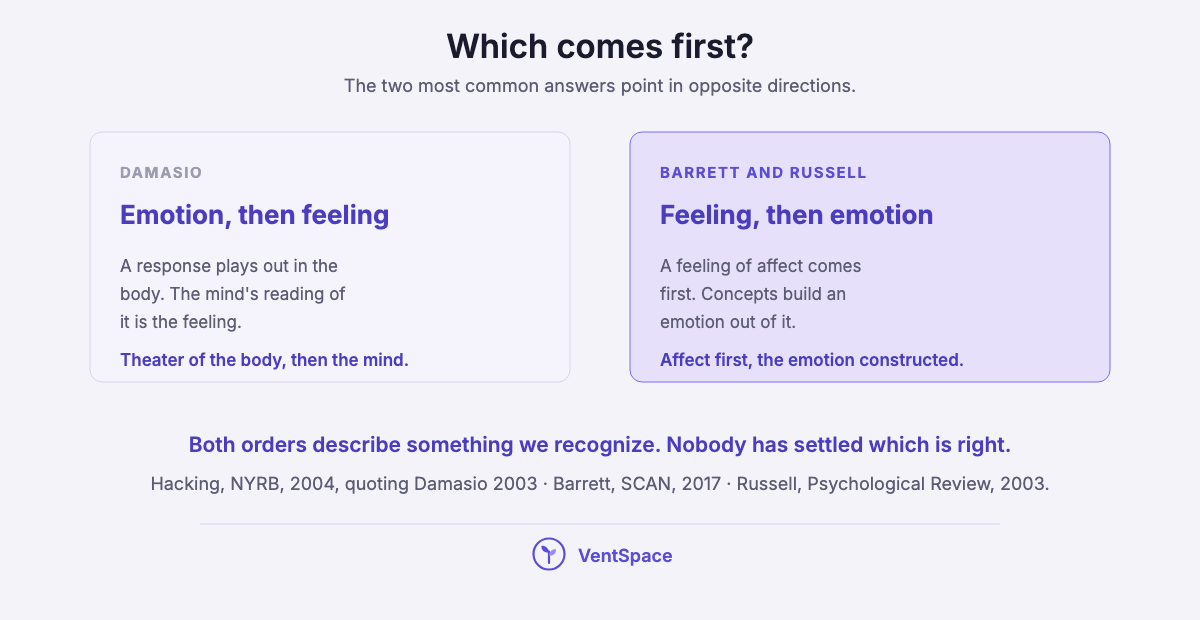
It depends on the theory, and the two most common answers point in opposite directions. This is the reason the definitions online contradict each other. One popular page says emotions “originate as sensations in the body” and feelings come from our thoughts. Another says feelings are the perceptions of body sensations. Neither is careless. Each is following a different school without saying so.
On Damasio’s account, as Hacking quotes him, the emotion plays out in the body and the feeling follows in the mind. Emotion first, feeling second.
On the constructionist account associated with Lisa Feldman Barrett, the order looks reversed, with one caution: she describes the brain as predicting sensations, not reacting to them in strict sequence. In her 2017 paper she writes that bodily sensations “are usually experienced as lower dimensional feelings of affect”, and that “the brain uses emotion concepts to categorize sensations to construct an instance of emotion.” Affect is always there, and an emotion is built from it.
We are not in a position to settle this, and nor is anyone else yet. What we can do is notice that both sequences describe something we recognize. Sometimes the jolt arrives before we know what it is. Sometimes a vague unease sits with us for an hour before it turns into a word.
Quick Summary
Q: Do emotions come before feelings?
A: In Antonio Damasio’s account, yes: the emotion plays out in the body and the feeling follows in the mind. In Lisa Feldman Barrett’s constructionist account, affect is always present and the brain builds an emotion from it using emotion concepts. The order is genuinely disputed.
Insight: the constructionist version
“Interoceptive sensations are usually experienced as lower dimensional feelings of affect.” And, later in the same paper: “the brain uses emotion concepts to categorize sensations to construct an instance of emotion.” Lisa Feldman Barrett, “The theory of constructed emotion”, Social Cognitive and Affective Neuroscience, 2017. This is one side of a live dispute with basic-emotion theory, and it is printed as a position, not a verdict.
An emotion is about something
The most usable difference is not where a state lives but whether it points at anything. Russell’s 2003 paper in Psychological Review puts it in one sentence. He describes core affect as states “experienced as simply feeling good or bad, energized or enervated”, and says it “can therefore be experienced as free-floating (mood) or can be attributed to some cause (and thereby begin an emotional episode).”
That gives us a test we can run without any theory at all. A free-floating heaviness on a Sunday is a feeling, and possibly a mood. The moment it attaches to the email we have not answered, it has become something closer to an emotion, because now it is about something.
Burton adds a second axis, which is time. For him “an emotion is an enduring psychological state, whereas a feeling is a conscious experience.” Being in love is an emotion we can hold for years, and it shows up as a series of separate feelings: tenderness on Tuesday, irritation on Thursday. The emotion is the weather system and the feelings are the days.
Russell also notes something humbling, which is that “people have no direct access to these causal connections.” We do not always know what a feeling is about, and inventing a cause to tidy it up is a mistake we all make.
Quick Summary
Q: What is the difference between a mood and an emotion?
A: In James Russell’s account, both start from core affect, a simple sense of feeling good or bad. When it stays free-floating it is experienced as a mood. When it is attributed to a cause it begins an emotional episode.
Insight: why the "about" matters
“At the heart of emotion, mood, and any other emotionally charged event are states experienced as simply feeling good or bad, energized or enervated.” James A. Russell, “Core affect and the psychological construction of emotion”, Psychological Review, 2003. In the same abstract he notes that people have no direct access to what causes these states, which is a reason not to force a story onto every one.
Does the brain draw the line?
Not cleanly, and the researchers who look hardest disagree about what they are seeing. LeDoux’s position is that the circuits most people call emotional, the ones that make us freeze or flinch, are better called survival circuits. In his 2012 paper in Neuron he writes that “survival circuit functions are not causally related to emotional feelings but obviously contribute to these, at least indirectly.” On that view the body’s alarm is not the emotion. The emotion is what we consciously feel.
There is one piece of pooled evidence that bears on the words themselves. Across 386 brain-imaging studies and 7,333 participants, tasks that put emotion words in front of people more often engaged a language-retrieval region, and tasks without them more often engaged the amygdala. The effect was specific to emotion words: the general affect words “pleasant” and “unpleasant” did not produce it (Brooks and colleagues, 2017).
That is suggestive, and we should be careful with it. It shows where activation appears across a literature, not how anyone felt. The authors read it in constructionist terms, and that reading is a theory. What it does suggest is that “pleasant or unpleasant” and “afraid” are not handled identically, which is close to the feeling and emotion split Russell describes.
Quick Summary
Q: Is there a difference between feelings and emotions in the brain?
A: Researchers disagree. Joseph LeDoux argues that the body’s survival responses are not themselves emotions and that the emotion is the conscious feeling. A 2017 analysis of 386 imaging studies found emotion words and general affect words such as pleasant or unpleasant were associated with different patterns, which shows where activation appears in a literature rather than what anyone felt.
Insight: the case for treating them as one word
“In this paper we challenge the conventional view, which argues that emotions are innately programmed in subcortical circuits, and propose instead that emotions are higher-order states instantiated in cortical circuits.” Joseph LeDoux and Richard Brown, “A higher-order theory of emotional consciousness”, Proceedings of the National Academy of Sciences, 2017. In the same statement they write “emotions, or feelings” as if the words were one, which, on their theory, they are.
How to tell which one you have
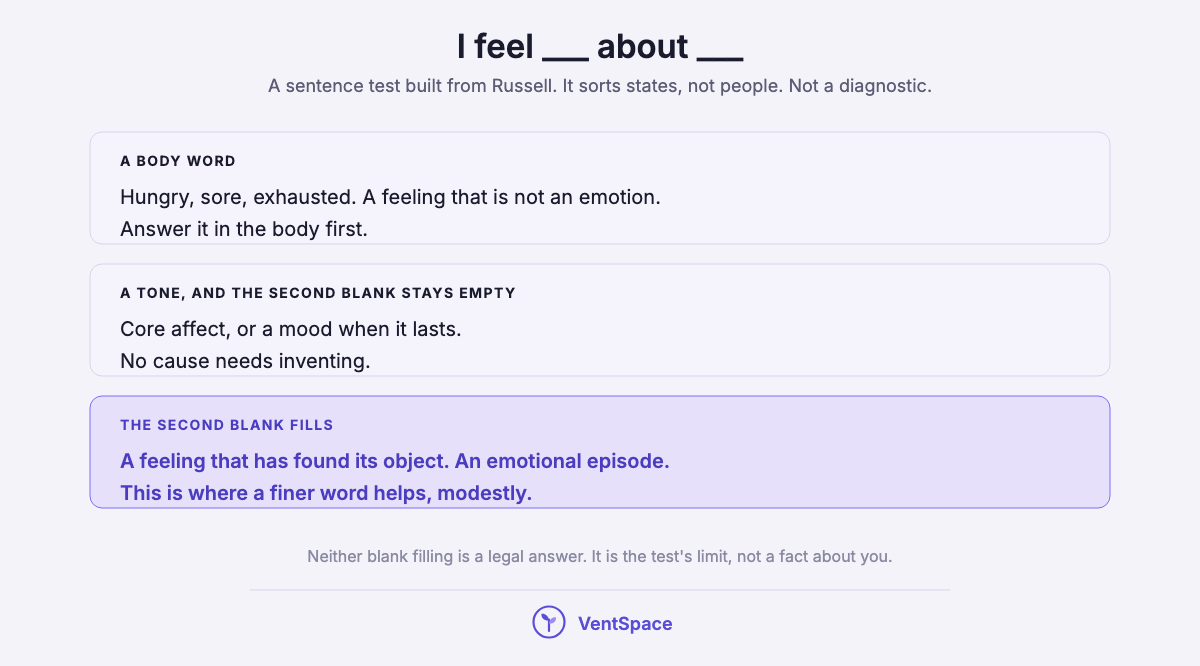
This is not a diagnostic and it cannot find anything wrong with you. It is a sentence-completion test built from Russell’s distinction, and it sorts states, not people.
Write one line, then try to finish a second one:
I feel ___.
About ___.
Then look at what happened to the second blank.
- The first word is a body word: hungry, sore, exhausted, cold. In Burton’s account, and in Damasio’s list, this is a feeling that is not an emotion. It is answered in the body before it is answered anywhere else.
- The first word is a tone, good or bad, wired or flat, and the second blank stays empty. Russell would call this core affect, and when it lasts he calls it a mood. Nothing has gone wrong because there is no cause to name.
- The second blank fills, with a person, an event or a thing ahead. This is an emotional episode in Russell’s sense: a feeling that has found its object. Now an emotion word usually helps.
- The second blank fills with the same person for months. This may be what Burton means by an enduring emotion, such as love or resentment, arriving as many separate feelings.
- Neither blank fills at all. That is a legal answer, and it is the test’s limit rather than a fact about you. The section on where the line blurs says more.
Mixed results are ordinary. A tired evening can carry a free-floating low tone and one sharp feeling about a single conversation, and both are true at once.
Where the sentence gets written down. If you want to come back to the second blank later, it helps to have the first line written somewhere. If that is useful, VentSpace is a journaling app that turns what you write into a clear read on your life balance, plus small, doable next steps. It is ours, so read this as a declared interest. The limits, plainly: Android only and free to start as of October 2026, no published evidence on outcomes, and it is not therapy. Not on Android, or at a desk? VentSpace Live runs in your browser, free, with nothing to install.
Quick Summary
Q: How do I know if I am having a feeling or an emotion?
A: Write “I feel ___” and then try “about ___”. A body word such as hungry or exhausted is a feeling that is not an emotion. A good or bad tone with no object is what James Russell calls core affect, or a mood when it lasts. If the second blank fills with a person or event, it is closer to an emotion. This is not a diagnostic.
What to do with each answer
If it was a body word, start there. A body feeling deserves a body answer before it deserves an interpretation, and it is worth checking the plain things before we build a story about our character.
If it was a tone with no object, resist inventing one. Russell’s point that we have “no direct access” to what causes core affect is a permission as much as a finding. A low Tuesday does not always mean something, and naming it as a mood, without a cause attached, is an accurate description rather than a failure to dig deep enough.
If it was about something, this is where a finer word earns its place. Not “bad” but which kind of bad: let down, embarrassed, dreading. The honest size of the benefit is small. Pooled across 17 studies, people who described negative feelings in more differentiated terms were slightly less likely to use harmful coping behaviors, at r = −.15, an association rather than a cause (Seah and Coifman, 2022). And the one randomized test of teaching adults emotion words that we could locate, with 150 university students, found no direct effect of the training (Matt, Seah and Coifman, 2024). A better word is a better handle, not a cure.
If the same state keeps coming back and the words are not shifting it, that is worth taking to a person. Therapy is one option. For a lot of people it’s the right one. Our guide on whether you need therapy gives a question with an answer in it rather than a checklist.
Quick Summary
Q: Does it matter whether I call it a feeling or an emotion?
A: For describing yourself, not much. What matters more is whether the state is about something. A body feeling is answered in the body, a free-floating tone does not need a cause invented for it, and a state with an object is where a more precise emotion word helps, modestly.
Where the line blurs
Ordinary English does not respect any of these lines, and it does not need to. We say “I feel angry” and “I have strong emotions about it” in the same breath, and nobody misunderstands. The distinctions above are tools for thinking, not rules for talking.
The line also blurs where the popular pages are most confident. Two of the pages we read list six, seven or eight universal emotions, and one ties them to “7 universal facial expressions”. The measured picture is weaker than that. Pooling studies that recorded both at once, the six classic emotions co-occurred with their predicted facial expression at about .13 when full expressions were coded, rising to .23 with partial ones (Durán and Fernández-Dols, 2021). That is not zero, and faces do carry information. It is too weak to treat a short list of emotions as a map of everything we can feel. A feeling that does not fit the list is the list’s limit.
And sometimes neither blank in the test fills at all. A flat grey nothing has no entry point on any chart. It is not a verdict on anyone, but if it has lasted a long time or arrived with other changes, it is worth telling a doctor or a therapist, because some of the things it looks like from the inside can only be told apart by a professional.
If you’re in crisis or thinking about harming yourself, please contact the 988 Suicide & Crisis Lifeline now (US, call or text 988), or find a line in your country at findahelpline.com. This article is not a substitute for that.
Quick Summary
Q: Can you have a feeling with no emotion attached?
A: Yes. Burton names hunger and pain as feelings that are not emotions, and a free-floating good or bad tone can exist without being about anything. If you cannot find any feeling at all for a long stretch, that is worth raising with a doctor or therapist.
Questions people ask
Which comes first, emotions or feelings?
It depends on the theory. Antonio Damasio puts the emotion first, as a response in the body, with the feeling following as the mind’s experience of it. James Russell starts from a feeling of good or bad, with the emotion beginning when it is attributed to a cause. Lisa Feldman Barrett treats that affect as always present, with the brain building an emotion from it. The order is genuinely disputed.
Is love a feeling or an emotion?
Both, on Neel Burton’s account. Being in love can be an enduring emotion, while feeling love in a given moment is a conscious experience. On this page’s “about something” test, love counts as an emotion because it is about someone.
Is anxiety a feeling or an emotion?
The word is used both ways. As a general unease with no clear object, it fits what Russell calls core affect or mood. Attached to something specific, such as tomorrow’s meeting, it behaves more like an emotion. This page cannot tell anyone whether what they feel is a clinical condition, and only a clinician can.
Are there six universal emotions?
That is one side of a live argument, not a settled fact. The six-emotion list comes from basic-emotion theory. When researchers pooled studies, those six emotions matched their predicted facial expressions only weakly, at about .13 to .23 (Durán and Fernández-Dols, 2021). Constructionists such as Barrett argue that emotion categories are learned concepts. Neither side has won.
Do I need to know the difference to understand myself?
No. For describing your own state, either word will do. The more useful question is whether the state is about something, which the “I feel ___ about ___” test checks in under a minute.
Two things worth keeping
The first is that the confusion is not ours. The experts disagree, publicly and in good faith, about where the line between feeling and emotion falls, and the contradictory definitions we meet online are their disagreement, paraphrased without credit. On one point they come closest to agreeing: feeling is the wider word, and a feeling that is not an emotion is not a failure to name one.
The second is about size and time. A finer word for a state that is about something helps, but modestly, and the evidence for learning more words quickly is thin. Getting fluent at this is slower than any list suggests. It is built one ordinary evening at a time, by asking what a feeling is about and accepting, more often than we would like, that it is not about anything we can name yet.
Therapy is one option, and for a lot of people it’s the right one. A notebook and the second blank are another.
About this article

Written by
Sai Subramaniam
Founder, VentSpace
I write these guides because I have been where you are. I am working through my own hard seasons, and I share the things that actually helped me, so that anyone going through it has a steady companion close by instead of facing it alone. VentSpace is the app I built for exactly that: a journaling app that turns what you write into a clear read on your life balance, plus small, doable next steps toward feeling more like yourself.
This writing is honest and every claim is sourced, and it is not a substitute for professional care. If you are struggling, reaching out to a professional is a strong move, not a failure.
Explore VentSpaceTry VentSpace LiveHow this one was checked. Every factual claim traces to a named source, and the source is printed next to the claim rather than kept in a footnote. Quotes are pinned to the work they come from, with the year, the letter or the chapter where one exists. Where a widely repeated claim could not be traced, it was left out and the omission recorded. Where a figure is contested, both sides are printed.
No affiliate links, no paid placements, and nobody paid to appear here. Where we mention our own app, we say that it is ours, we state its limits, and we never position it as a substitute for care.
Reviewed: October 2026. Prices, platforms and product availability move quickly, and anything we could not verify at the time of writing is marked as unverified rather than turned into a number.
Corrections. If something here is wrong, we would rather know. Corrections are made in place, with a note saying what changed.