
Someone has asked you to say a few words at the funeral, and you said yes before you had thought about it. Now there is a blank page, a date a few days away, and a person you loved who does not fit on a page. You are trying to learn how to write a eulogy while also grieving, which is two jobs at once.
So where do you start?
Not with the opening line. You start by gathering, then shaping, then writing, then practising, and each of those can be broken into steps small enough to do tonight. Below are sixteen of them. Do the first one now. It takes two minutes.
If you are struggling right now. If you are in crisis or thinking about harming yourself, please contact a crisis line now. In the US, call or text 988 (Suicide & Crisis Lifeline). Anywhere else, findahelpline.com lists free, confidential services by country. A eulogy can wait. You cannot.
The short version
A eulogy is not a biography. It is a few true, specific things said out loud by someone who knew them.
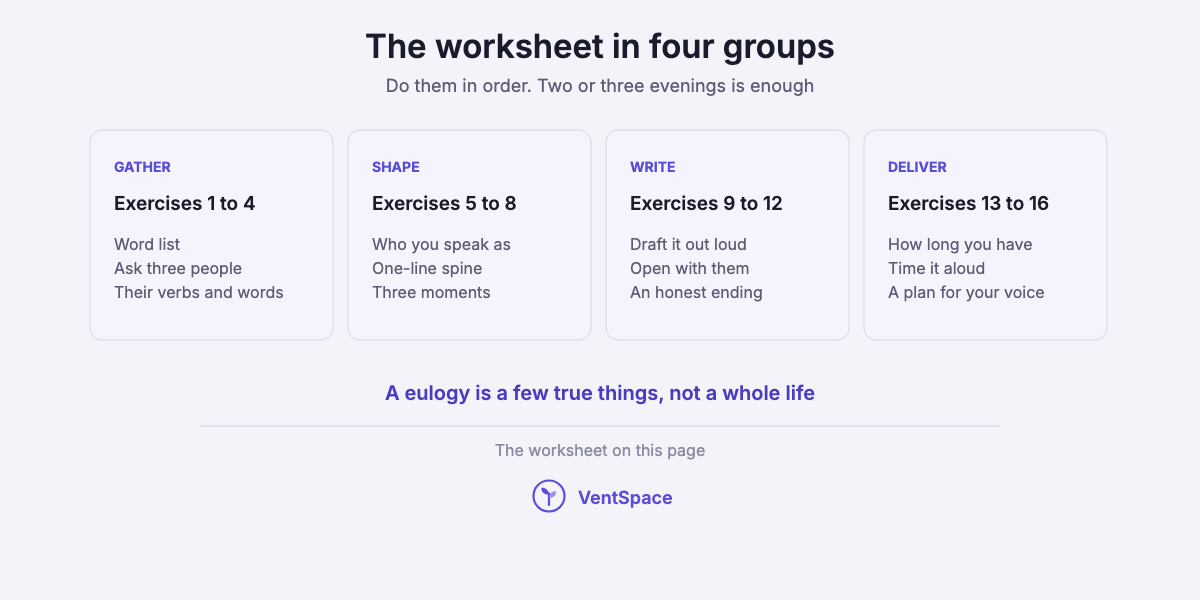
Gather first (exercises 1 to 4), shape second (5 to 8), write third (9 to 12), practise last (13 to 16).
There is no sample to copy here, on purpose. The exercises draw the material out of you.
Nobody agrees on the right length. Ask whoever is running the service how long you have, and time yourself.
If your voice goes, or you cannot speak at all, that is common, and exercise 16 plans for it.
What a eulogy is for, and what it is not
Merriam-Webster defines a eulogy as “a commendatory oration or writing especially in honor of one deceased”, from the Greek eulogia, “praise”. That is the formal version. In practice, the room is not waiting for an oration. It is waiting to hear the person described by somebody who knew them.
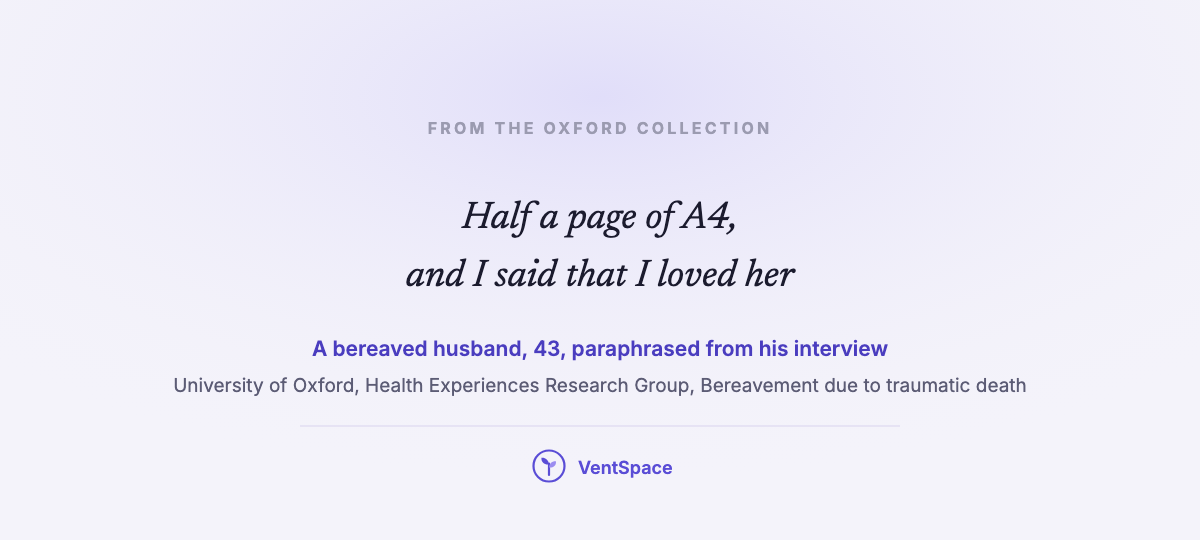
It does not have to be long or polished to do that. In the University of Oxford’s published collection of interviews with people bereaved by traumatic death, a man of 43 described speaking at his wife’s funeral:
“I managed to get up in church and I managed to read half a page of A4 that I’d managed to write, very stuttering emotional voice, and just about, just about got through it, but I just said in front of everyone that I loved her, and that’s all I wanted to say”
Half a page. A stutter. One true sentence. That was enough for him, and it is a useful measure for you.
What will writing it not do? Be honest with yourself here. Nobody has shown that writing about a death makes grief lighter, and this worksheet does not promise that. It is a job, and it can be done. Some people find it gives the days before the funeral a shape. That is all we would claim for it.
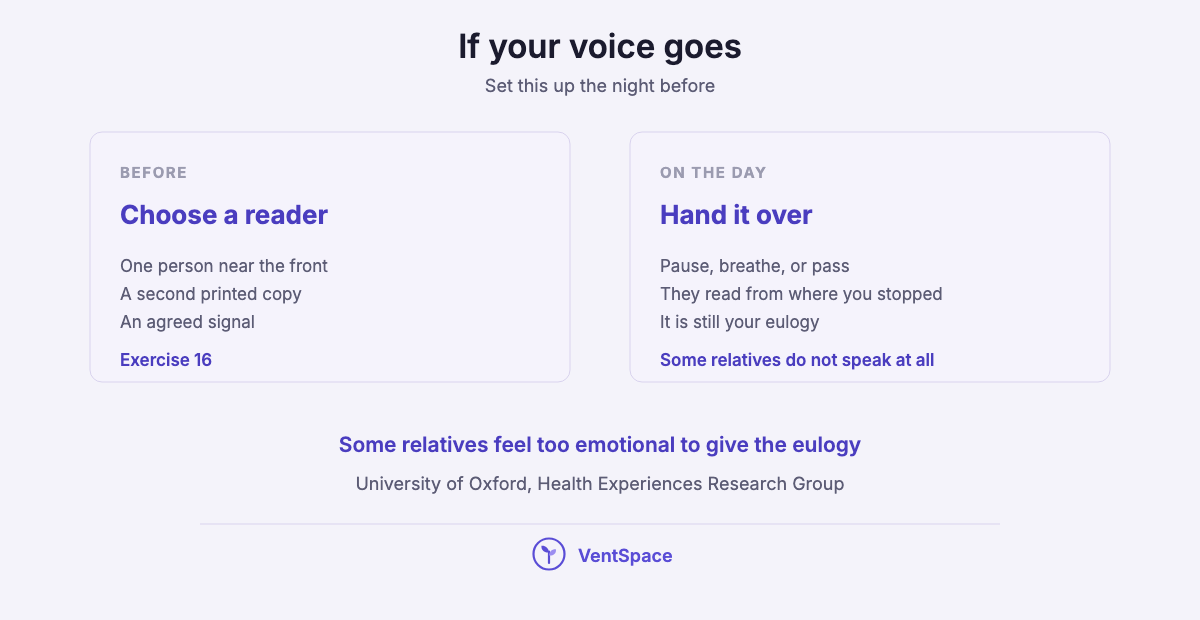
Insight: The same Oxford collection records that “at some funerals, a close relative had said a few words, but at others the relatives said that they had felt too emotional to give the eulogy.” Both are normal. A eulogy read by someone else is still a eulogy.
How we sorted them
- By order of work: gather, shape, write, deliver. Do the groups in order. Inside a group, do whatever you have time for.
- By time: every exercise has a real number of minutes. The whole worksheet fits into two or three evenings.
- By what you need: paper, a phone, a timer, and sometimes one other person.
- What is left out, on purpose: sample eulogies and fill-in-the-blank templates. They describe somebody else’s person.
- Every exercise has a “What it will not do” line, so you know its limits before you start.
Gather: getting the material out of your head
1. The two-minute word list
Before you can write anything, you need raw material, and most of it is already in your head in the wrong order. This exercise gets it onto paper without asking you to make sense of it yet. Do not write sentences. Do not judge what comes out. Words, objects, places, smells, sayings, a car, a dog’s name. You are not writing a eulogy here. You are emptying a drawer so you can see what is in it.
Do this:
1. Set a timer for two minutes.
2. Write every word that comes to mind when you think of them, one per line.
3. Do not stop until the timer goes.
4. Circle the three words that made you feel something as you wrote them.
| Time | 2 minutes |
| You need | Paper and a timer |
| Best for | The very first sitting, when the page is blank |
| What it will not do | It will not give you a structure. That comes in exercise 8 |
2. Ask three people one question
You knew one version of this person. Other people knew others, and some of the best eulogies stitch those versions together. The Oxford collection records one funeral where four speeches were made by people who had known the man at different stages of his life. You do not need four speakers. You need three short messages, from three different corners of their life.
Do this:
1. Pick three people who knew them in different places: work, childhood, a hobby, a neighborhood.
2. Send each the same question: “What is one thing they did or said that you still think about?”
3. Tell them a sentence or two is enough, and give them a day.
4. Copy their answers onto your word list, with their names.
| Time | 10 minutes to send, a day to wait |
| You need | A phone |
| Best for | When you knew one side of them well and the others less |
| What it will not do | It will not tell you which story to use. You still choose |
3. Their verbs
Adjectives flatten people. “Kind”, “generous” and “funny” could describe almost anyone, and the room knows it. Verbs bring someone back into the room, because they show what the person did with their hands and their days. Did they fix things? Feed people? Argue with the television? Drive everyone to the airport at five in the morning? This exercise swaps the adjectives for the actions underneath them.
Do this:
1. Write the word “They” at the top of a page.
2. Under it, write ten things they did often, each starting with a verb.
3. Next to each, add one specific time you saw them do it.
4. Star the two that only this person would have done in that way.
| Time | 10 minutes |
| You need | Paper |
| Best for | When everything you write sounds generic |
| What it will not do | It will not make the hard parts of them go away. See exercise 11 |
4. The things they said
People are remembered partly in their own voice: a catchphrase, a joke they told too often, the way they answered the phone. One line of theirs, said aloud at the funeral, can do more than a paragraph about them, because the room hears them for a moment instead of hearing about them. This exercise collects their words before you write your own, while the people who remember them are still close by.
Do this:
1. Write down every phrase, saying or habit of speech you can remember.
2. Ask one family member to add two more.
3. Check any you plan to use with someone who knew them well, so the wording is right.
4. Mark one you might open or close with.
Try these questions if you stall:
- What did they say when they answered the phone?
- What did they say when something went wrong?
- What did they call you?
- What advice did they give that nobody asked for?
| Time | 10 minutes |
| You need | Paper, and one other person |
| Best for | Anyone whose person had a distinctive way of talking |
| What it will not do | It will not work for everyone. Some people were quiet, and that is worth saying too |
Shape: deciding what this eulogy is
5. Decide who you are speaking as
A eulogy from a daughter sounds different from one by a colleague, and it should. The room needs to know, in your first sentence, why you are the one standing there. Deciding this early also tells you what you can leave out: you do not have to cover the parts of their life you did not share. Other speakers, the obituary or the order of service can carry those.
Do this:
1. Write one sentence: “I am speaking as their ___, and I knew them as ___.”
2. List what you know that others in the room may not.
3. List what you do not know, and cross it off your job list.
4. Ask whoever is organizing the service whether anyone else is speaking, and about what.
| Time | 5 minutes, plus one conversation |
| You need | Paper and a phone |
| Best for | Anyone worried about leaving things out |
| What it will not do | It will not settle family disagreements about who should speak |
6. Write the one-line spine
Most eulogies that work say one thing, with stories that prove it. What is yours? Not their whole character: the one thing you most want the room to remember about them. Write it badly first. You can polish it later, and you may never say it out loud in this form. It is for you, to keep everything else pointed in one direction.
Do this:
1. Look at the circled words from exercise 1 and the starred verbs from exercise 3.
2. Finish this sentence: “If people remember one thing about them, I want it to be that they ___.”
3. Write three versions of it, quickly.
4. Pick the one that sounds most like how you would say it to a friend.
| Time | 10 minutes |
| You need | Your notes from exercises 1 to 4 |
| Best for | When you have lots of material and no direction |
| What it will not do | It will not capture all of them. Nothing will, and that is not the job |
7. Pick three moments, not a life
A common trap is the biography: born here, went to school there, worked for thirty years. Much of the room already knows that, and a list of facts can bury the person. Three specific moments, each one showing the spine from exercise 6, will tell them more. A moment is a scene: a day, a place, something they did, told in a few sentences.
Do this:
1. From all your notes, list every story that shows the spine.
2. Choose three. Prefer small, specific ones over big, general ones.
3. For each, write one line: where it was, what they did, what it showed.
4. Put them in an order. Lightest first, most important last, often works.
| Time | 15 minutes |
| You need | Your notes |
| Best for | Anyone tempted to tell the whole life story |
| What it will not do | It will not please everyone. Someone will miss a story they love |
8. The four-part shape
A loose shape stops you writing yourself into a corner. This one is not a template, because every part is filled with your own material. It has four parts: who you are to them, the one thing, three moments that prove it, and a short ending. Several of the guides that rank for this search suggest something similar, with an introduction, a few stories and a close.
Do this:
1. Write four headings: “Who I am to them”, “The one thing”, “Three moments”, “The end”.
2. Under the first, paste your sentence from exercise 5.
3. Under the second, your spine from exercise 6.
4. Under the third, your three lines from exercise 7. Leave the fourth empty for now.
| Time | 10 minutes |
| You need | Your notes, or a blank document |
| Best for | Turning a pile of notes into something you can draft from |
| What it will not do | It will not write the sentences. That is the next group |
Write: turning notes into something you can say
9. Draft it out loud
You are writing for the ear, not the eye, and people write stiffly when they write for a ceremony. The fix is to talk first and type second. Say each part of your shape out loud, as if telling a friend over coffee, and record yourself. Then write down what you said. It will be looser, warmer and more like you than anything you would have typed.
Do this:
1. Open the voice recorder on your phone.
2. Talk through your four headings, one at a time, in your normal voice.
3. Play it back and type what you said, cleaning up only the stumbles.
4. Read the typed version once, and cross out anything that does not sound like you.
| Time | 20 minutes |
| You need | A phone with a voice recorder |
| Best for | Anyone who freezes at a keyboard |
| What it will not do | It will not produce a finished draft. Expect a second pass |
10. Open with them, not with you
Many first drafts start with the speaker: how hard this is, how unworthy they feel, how they did not know what to say. One sentence of that is honest, and the room will recognise it. More than one, and the person you are there to describe has not appeared yet. Try opening on them instead: something they did, said or loved, in the first breath.
Do this:
1. Read your current first paragraph.
2. Find the first sentence that is about them rather than you.
3. Move it to the very top.
4. Keep one short sentence about who you are to them, straight after it.
Ask yourself:
- Does my first sentence have their name in it?
- Would a stranger know something true about them after it?
- Is there a line of theirs from exercise 4 that could open instead?
| Time | 10 minutes |
| You need | Your draft |
| Best for | Drafts that take too long to get going |
| What it will not do | It will not fix a draft with no stories in it. Go back to exercise 7 |
11. The honest version, for a complicated person
Not everyone being buried was easy to love. If the relationship was hard, you do not have to pretend, and you do not have to air it either. There is a middle path: say true things, keep them few, and leave the rest unsaid. “He was not an easy man, and he loved this garden” is honest. Nobody in the room is owed a verdict on someone else’s life.
Do this:
1. Write down, privately, what you will not say. Then put that page away.
2. List only things you can say that are both true and fair.
3. If the list is short, let the eulogy be short.
4. Read it to one person who knew the relationship, and ask if it sounds honest.
| Time | 20 minutes |
| You need | Paper, and one trusted person |
| Best for | Estrangement, conflict, or a person who did harm |
| What it will not do | It will not resolve the relationship. That is not what a eulogy is for |
12. End on something they did, or something you will carry
Endings are hard because there is a pull to wrap the whole life up in a line. Resist it. The strongest endings are small: a thing they always said, a habit you are keeping, the last line you would have said to them. Avoid lines that pass judgment on the death, such as “everything happens for a reason” or “they are in a better place”, unless you know those were their words and their beliefs.
Do this:
1. Write three possible last lines, each under fifteen words.
2. One about them, one about something you will keep doing, one spoken to them.
3. Read each aloud and notice which you can say without rushing.
4. Put that one under “The end”.
| Time | 10 minutes |
| You need | Your draft |
| Best for | Drafts that trail off or end on a summary |
| What it will not do | It will not make the ending painless to say. Pausing before it is fine |
Deliver: getting through it on the day
13. Find out how long you have
How long should a eulogy be? There is no rule, and the guides do not agree. Dignity Memorial, a large US funeral network, says there is “no fixed amount of time or word count” and that most run about 5 to 10 minutes and about 700 to 3,000 words. By our own arithmetic, 3,000 words in 10 minutes would mean reading at 300 words a minute. The only number that matters is the one for your service.
Do this:
1. Ask whoever is running the service how long you have.
2. Ask how many other people are speaking.
3. Write the answer at the top of your draft.
4. If nobody can tell you, plan for short, and keep one story as optional.
| Time | 5 minutes |
| You need | A phone |
| Best for | Everyone, before the final edit |
| What it will not do | It will not tell you what to cut. Exercise 14 does |
14. Read it aloud with a timer
Your reading speed at a funeral may not be your reading speed at your kitchen table. You may slow down, pause, and lose your place, and that is fine. Timing a run-through tells you whether the draft fits the time you have, and reading aloud finds the sentences that are hard to say, which are usually the ones that are too long or have too many commas.
Do this:
1. Stand up, start a timer, and read the whole thing aloud at a slow pace.
2. Note the time, and compare it with the answer from exercise 13.
3. Mark every sentence where you stumbled, and split it in two.
4. If it runs long, cut a moment, not a sentence here and there.
| Time | 15 minutes |
| You need | Your draft and a timer |
| Best for | The night before, and once more on the day |
| What it will not do | It will not stop you crying. Nothing should have to |
15. Print it for shaking hands
On the day, your hands may shake and your eyes may blur, and a phone screen can lock at the worst moment. Paper, printed large, is easier to hold, easier to find your place on, and easier to hand to someone else. At least one funeral guide suggests a large font and double spacing, and that is sensible advice whoever gives it.
Do this:
1. Print the eulogy in a large font, double spaced, with wide margins.
2. Number the pages, and do not let a sentence run across a page break.
3. Mark the places to pause with a slash.
4. Give a second printed copy to the person you chose in exercise 16.
| Time | 10 minutes |
| You need | A printer, or a friend with one |
| Best for | Anyone reading at a lectern or outdoors |
| What it will not do | It will not make the room smaller. Look at one friendly face |
16. Plan for the moment your voice goes
This is the exercise most of the guides we read skip. What if you cannot get through it? Some relatives in the Oxford collection felt too emotional to give the eulogy at all. A woman of 65, whose son had died, said: “I didn’t speak, at that time I, I couldn’t have, I couldn’t have spoken, I couldn’t have said anything.” A plan makes it safe to try.
Do this:
1. Ask one person to sit near the front with a copy of your eulogy.
2. Agree on a signal: if you hand them the paper, they read from where you stopped.
3. Tell them it is fine if they read the whole thing.
4. Write “Breathe” at the top of each page.
| Time | 10 minutes |
| You need | One trusted person and a second copy |
| Best for | Anyone afraid of breaking down |
| What it will not do | It will not stop your voice going. It means it does not matter if it does |
The whole worksheet at a glance
| # | Exercise | What it is for | Time | Difficulty | Do it when |
|---|---|---|---|---|---|
| 1 | The two-minute word list | Raw material | 2 min | Easy | First |
| 2 | Ask three people one question | Other sides of them | 10 min + a day | Easy | First evening |
| 3 | Their verbs | Specifics, not adjectives | 10 min | Easy | First evening |
| 4 | The things they said | Their voice | 10 min | Easy | First evening |
| 5 | Decide who you are speaking as | Your job in the room | 5 min | Easy | Before shaping |
| 6 | The one-line spine | One direction | 10 min | Medium | Before shaping |
| 7 | Three moments, not a life | Choosing stories | 15 min | Medium | Second evening |
| 8 | The four-part shape | A structure | 10 min | Easy | Second evening |
| 9 | Draft it out loud | A first draft | 20 min | Medium | Second evening |
| 10 | Open with them | A better start | 10 min | Easy | Editing |
| 11 | The honest version | A complicated person | 20 min | Hard | If it applies |
| 12 | The ending | A last line | 10 min | Medium | Editing |
| 13 | Find out how long you have | Length | 5 min | Easy | Before the last edit |
| 14 | Read it aloud with a timer | Fit and flow | 15 min | Medium | Night before |
| 15 | Print it for shaking hands | Readability | 10 min | Easy | Night before |
| 16 | Plan for your voice going | A safety net | 10 min | Easy | Night before |
Questions people ask
How long should a eulogy be?
There is no rule. Dignity Memorial says most run 5 to 10 minutes, but its own word range (700 to 3,000) shows how loose these numbers are. Ask whoever is running the service how long you have, then time yourself reading aloud slowly.
What if I cry while giving it?
Then you cry, pause, and carry on, or hand it over. The man quoted above read in a “very stuttering emotional voice” and got through. The room is not judging your delivery.
Can someone else read it for me?
Yes. Some relatives feel too emotional to speak on the day, and a eulogy you wrote is still yours if someone else reads it. Exercise 16 sets this up in advance.
Can a eulogy be funny?
If they were funny, yes. Some families in the Oxford collection described funerals with “an element of humour running throughout the day” and “a lot of laughter” at times. Let the humor be theirs, not jokes at their expense.
Should I mention how they died?
That is the family’s choice, and families choose differently. If the death was sudden, violent or by suicide, you can name it plainly (“died by suicide”), mention it briefly, or leave it to others. Speak about their life either way.
What if I am not coping, and the funeral is only part of it?
Most people are carried through by the people around them, and needing more is not failure. If the grief is severe, is not easing and is stopping you living, a doctor or a bereavement service is the right next call. If some of what you are feeling does not belong in a public speech, our journal prompts for grief were written for that private space.
Two things to take with you
First, a eulogy is a few true things, not a whole life. Gather, shape, write, practise. Sixteen exercises, two or three evenings, and you will have something you can stand up and read.
Second, be honest with yourself about the day. You may shake, stall or hand the page to someone else, and none of that will be what people remember. And the grief does not end with the funeral. Do not expect the speech to close anything. It is one afternoon in a much longer stretch, and it is allowed to be imperfect.
You are writing about someone you have just lost, on a deadline, while grieving them. That is a heavy thing to carry. If writing some of the rest of it down privately would help, VentSpace, the journaling app we make, is a quiet place to do it. If you are on a computer, VentSpace Live runs in your browser, with nothing to install.
About this article

Written by
Sai Subramaniam
Founder, VentSpace
I write these guides because I have been where you are. I am working through my own hard seasons, and I share the things that actually helped me, so that anyone going through it has something steady to read instead of facing it alone. No ads, no affiliate links, and nothing here is a sales pitch.
This writing is honest and every claim is sourced, and it is not a substitute for professional care, bereavement support or medical advice. If this is heavy right now, the numbers above are a better answer than anything else on this page.
How this one was checked. The words from bereaved people come from the University of Oxford’s published interview collection and were checked against the original page. Length guidance is attributed to the guide that gives it, with its numbers checked. There are no sample eulogies on this page, on purpose.
No affiliate links, no paid placements, and nobody paid to appear here. Our own app is named once, in the last line, without a link.
Reviewed: October 2026.
Corrections. If something here is wrong, we would rather know. Corrections are made in place, with a note saying what changed.