
Somewhere in your home there may be a journal that stops in February. The first pages are full and careful, the handwriting is our best, and then there is a gap, then a guilty catch-up entry, then nothing. We tend to read that blank page as a verdict on our character. Our view is that it is a verdict on the design.
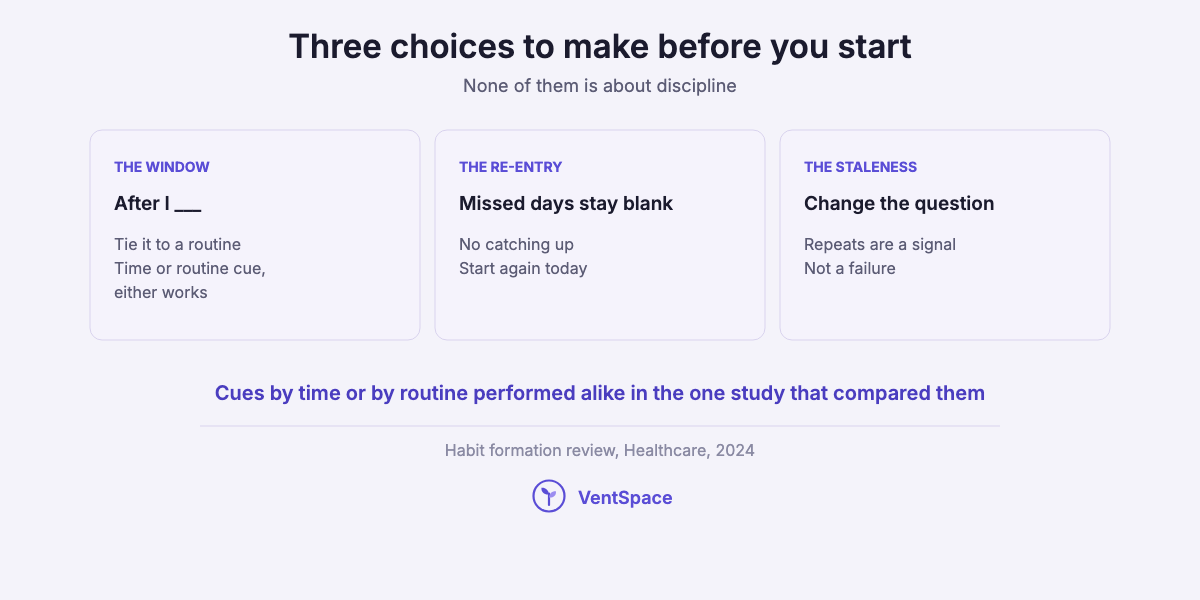
A one line a day journal is the smallest journal there is: one sentence, dated, every day or nearly every day. The best-known version is a five-year book where each page holds the same date across five years, but a notebook or a note on your phone works the same way. It is small enough to survive a bad week. Whether it survives a bad month depends on three things the format does not decide for you: when you write, what you do after you miss a day, and what you do when the lines start repeating. The twelve exercises below handle those three, then show you what to write and how to read it back.
The short version
One sentence, dated, most days. A book or a phone note both work.
Attach it to something you already do. The window matters more than the hour.
Decide now what happens after a missed day. No catching up, ever.
When the lines repeat, change the question. Staleness is a design signal.
The payoff is the reading. Same date, a year later.
How we sorted them
- Four families: set it up, what to write, keep it going, read it back. Do the first family tonight and the rest as you need them.
- Every exercise has a time: the times are our suggestions, and most are under five minutes.
- Every exercise says what it will not do: a one-line journal is a record, not a treatment.
- Left out on purpose: long prompt lists (one good question beats a hundred, see exercise 6), streak trackers, and any rule that you must write every single day.
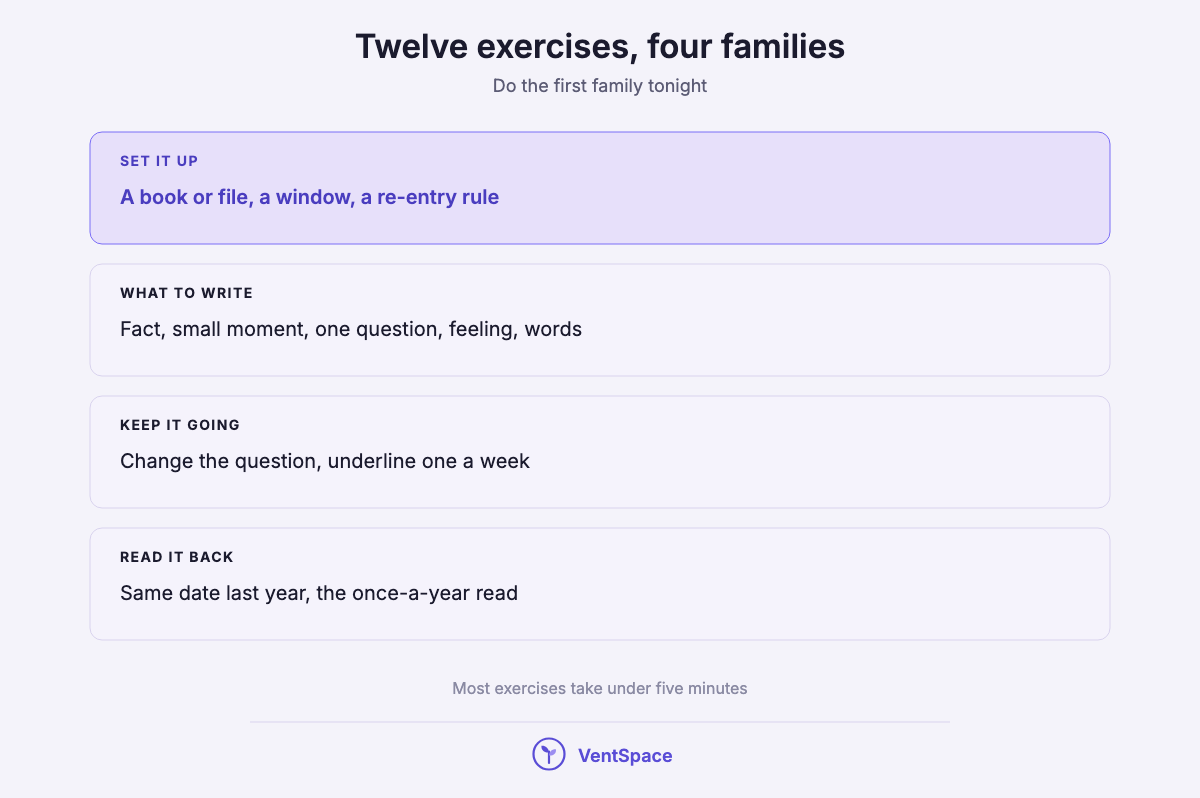
Set it up
1. Pick a book or a file
A one-line journal needs a place you will see every day and a shape that holds a date. The best-known version is One Line a Day: A Five-Year Memory Book from Chronicle Books, a small book in which, in the publisher’s words, each page “includes an entry for five successive years”, so every date shows you the same day across five years. A plain notebook does the same job if you write the date yourself, and so does one note on your phone. Choose the one you will open, not the one that looks best. Across 146 randomized writing studies, whether people wrote by hand, typed or spoke made no significant difference to the effects measured.
Do this:
1. Choose a five-year book, a notebook or one phone note.
2. Put it where your hand will be at your chosen moment (exercise 2).
3. Write tonight’s date and leave the line empty for now.
| Time | 5 minutes |
| You need | A book, notebook or phone |
| Best for | Anyone starting from nothing |
| What it will not do | Make you write. It only removes the first excuse |
2. Attach it to something you already do
The window you write in matters more than the hour on the clock. A line attached to the coffee maker, your toothbrush or the moment you get into bed has somewhere to live. In a 2024 review of habit research, cues tied to a time of day and cues tied to an existing routine performed no differently in the one study that compared them, so pick whichever moment is most reliably yours. Four minutes is a complete session, and for some of us the honest window is shorter than the advice assumes. One new mother in a writing trial put it plainly: “Quite frankly finding 15 min of predictable uninterrupted peace with a little baby is very difficult.”
Do this:
1. Name one thing you do every day without fail.
2. Write “After I ___, I write one line” inside the cover.
3. Leave the pen or the phone note open at that spot.
| Time | 3 minutes |
| You need | Your current routine |
| Best for | Busy, interrupted days |
| What it will not do | Survive a routine that changes. Re-attach it when your days change |
3. Write the rule for the day after you miss one
A journal can end at the re-entry rather than at the difficulty. One missed day becomes a debt, the debt becomes a verdict, and the notebook goes in a drawer. So decide the rule before you need it: a missed day stays blank, and you write today’s line as if nothing happened. No catching up, no apology entry. And if you stop for good one day because the thing the journal was for is over, a move, a year, a season of life, that is an ending, not a failure.
Do this:
1. Write inside the cover: “Missed days stay blank.”
2. Below it, write: “I start again with today.”
3. Read both lines once, then close the book.
| Time | 2 minutes |
| You need | The inside cover |
| Best for | Anyone with an abandoned journal behind them |
| What it will not do | Stop you missing days. It stops a missed day ending the journal |
Quick Summary
Q: How do I start a one line a day journal?
A: Pick a book, notebook or phone note you will see daily, attach the line to something you already do, like making coffee or getting into bed, and write a rule inside the cover that missed days stay blank and you start again with today.
Insight: A 2024 review of twenty studies and 2,601 people in Healthcare found health habits took a median of about two months to form, with individuals ranging from 4 days to 335, and time-based and routine-based cues performed no differently in the one study that compared them. Those were habits like flossing and exercise, not journaling.
What to write
Five kinds of line. Use one for weeks, or rotate. None is better than the others, and each keeps a different kind of record.
4. The fact line
The fact line records what happened, not what you felt about it. Who you saw, where you went, what the weather did, what you ate that was worth remembering. It sounds dull and it is the opposite: facts are what a future reader, you in five years, cannot reconstruct. A mood can be guessed at later. A name and a place cannot. Write it like a ship’s log, short and specific, with at least one proper noun.
Do this:
1. Ask yourself: what happened today that I could prove?
2. Write it in under twenty words, with one name or place in it.
3. Stop there, even if more comes.
| Time | 1 to 2 minutes |
| You need | Today |
| Best for | Building a record you can trust later |
| What it will not do | Capture how you felt. That is exercise 7’s job |
5. The smallest-moment line
The smallest-moment line catches the thing you would otherwise lose. Not the meeting or the bill, which your calendar and your bank will remember, but the stranger’s dog, the joke at dinner, the color of the sky on the drive home. These are easy details to lose. A one-line journal is unusually good at them, because one line is about the size of a small moment.
Do this:
1. Close your eyes for ten seconds and replay the day.
2. Stop at the smallest thing that made you look up.
3. Write it down plainly, without explaining why it mattered.
| Time | 2 minutes |
| You need | A moment of quiet |
| Best for | Days that otherwise blur together |
| What it will not do | Tell you what the day meant. It keeps a piece of it |
6. The same-question line
The same-question line answers one fixed question every day, which turns the journal into a slow survey of your own life. “What took my attention today?” or “What did I do for someone else?” works well. A question can do more than a blank page: across 146 randomized writing studies, instructions that gave people a directed question measured larger effects on psychological health than open instructions, inside a small overall effect. One good question, kept for months, beats a new prompt every night.
Do this:
1. Choose one question you would like answered for a year.
2. Write it on the first page.
3. Answer it in one line each night, without rereading the others yet.
| Time | 2 minutes |
| You need | One question |
| Best for | People who freeze at a blank line |
| What it will not do | Stay fresh forever. See exercise 9 |
7. The feeling-and-cause line
The feeling-and-cause line names one feeling and the thing that brought it. “Restless, because the call was moved again.” Pairing the two keeps the line from becoming a mood score, a number with no story attached, and keeps it from becoming a complaint with no feeling named. Use plain words: tired, glad, uneasy, proud. If the same heavy feeling arrives most nights for weeks, that is worth noticing, and the limits section below says what to do.
Do this:
1. Write one feeling word.
2. Add “because” and finish the sentence with an event, not a judgment.
3. If no feeling comes, write “flat” and the reason, if you know it.
| Time | 2 minutes |
| You need | One honest word |
| Best for | Seeing what moves you, over months |
| What it will not do | Explain the feeling, or change it |
8. Someone else’s words
Some days the best line is something somebody else said. A child’s question, a colleague’s aside, a sentence from a book or a song title playing in a store. Writing it in quotation marks with the speaker’s name keeps a record of the people around you, which a line about your own day can leave out. Five years of other people’s sentences is its own portrait of a life, drawn by the people who were in it.
Do this:
1. Listen for one sentence today that you want to keep.
2. Write it in quotation marks, with who said it.
3. Add nothing else.
| Time | 1 minute |
| You need | Ears |
| Best for | Keeping the people in your days |
| What it will not do | Record your own view. Mix it with exercise 4 on other days |
Quick Summary
Q: What do you write in a one line a day journal?
A: One sentence. A fact about the day, the smallest moment you would otherwise forget, the answer to one fixed question, one feeling and its cause, or something someone else said. Pick one kind and keep it, or rotate.
Insight: Joanne Frattaroli’s 2006 meta-analysis in Psychological Bulletin pooled 146 randomized studies of writing and speaking about experiences. Instructions that included a directed question measured larger effects on psychological health than those without one (r = .094 against .011), inside a small overall effect. That is a reason to keep one question, not proof that a journal helps.
Keep it going
A one-line journal can stall in a familiar place: the lines start repeating. These two are for that point.
9. Change the question when the lines repeat
When a week of lines reads the same, the format has gone stale, not you. Repetition is information about the cadence, not a failure of discipline. In gratitude research, the number of sessions people completed made no difference to the effect, which is one reason “try harder” is the wrong answer. Change the question or the kind of line instead: swap the fact line for someone else’s words, or the fixed question for a new one, for a month.
Do this:
1. Read the last seven lines in one go.
2. If four or more say much the same thing, circle them.
3. Choose a different kind of line from exercises 4 to 8 for the next month.
| Time | 5 minutes, when it happens |
| You need | The last week of lines |
| Best for | The second or third week, when it starts to feel pointless |
| What it will not do | Prevent staleness. It treats it as a signal |
10. Underline one line a week
Once a week, read the seven lines and underline one. It takes three minutes and it starts the habit that makes the journal worth keeping, which is reading it. The underlined lines become a shortlist of your year, and at the end of it you will have about fifty sentences that you chose. Choosing is a small act of reflection that writing alone does not ask of you, and it costs almost nothing.
Do this:
1. Pick a weekly moment, Sunday evening or Monday morning.
2. Read the week’s lines.
3. Underline the one you would most want to find again.
| Time | 3 minutes a week |
| You need | A pen |
| Best for | Anyone who never rereads |
| What it will not do | Tell you what the year meant. It gives you the shortlist |
Quick Summary
Q: How do I keep a one line a day journal going?
A: When the lines repeat for a week, change the kind of line rather than trying harder, and once a week read the seven lines and underline one. Repetition is a sign to change the format, not a sign you have failed.
Read it back
11. Read the same date last year
This is what the five-year format was built for: before you write today’s line, read the line above it. In a five-year book it is on the same page. In a notebook or a phone note, search for the date. The comparison is the payoff, a year compressed into two sentences, and it is where a one-line journal can stop feeling small. Resist the urge to edit the older line. It was true when you wrote it.
Do this:
1. Before writing tonight, find this date last year.
2. Read that line once, slowly.
3. Write today’s line underneath, without changing last year’s.
| Time | 1 minute |
| You need | At least a year of lines |
| Best for | Year two onward |
| What it will not do | Work in year one. The first year is the deposit |
12. The once-a-year read
Once a year, read every line in one sitting: on your birthday, on New Year’s Day, or on the anniversary of the first entry. Then write a single sentence about the year on the inside back cover. One sentence about 365 is enough, and it gives next year’s read a starting point. If the read turns into replaying everything that went wrong, stop and come back to it another day.
Do this:
1. Choose the date and put it in your calendar now.
2. On the day, read every line, with your underlines from exercise 10.
3. Write one sentence about the year and date it.
| Time | 30 to 60 minutes, once a year |
| You need | A year of lines |
| Best for | Seeing the shape of a year |
| What it will not do | Give the year a meaning it did not have |
Quick Summary
Q: What do you do with a one line a day journal after a year?
A: Read this date’s line from last year before you write each night, and once a year read every line in one sitting and write a single sentence about the year. The reading is where the format pays off.

All twelve at a glance
| # | Exercise | What it is for | Time | Difficulty | Do it when |
|---|---|---|---|---|---|
| 1 | Pick a book or a file | A place you will open | 5 min | Easy | Tonight |
| 2 | Attach it to a routine | A window that holds | 3 min | Easy | Tonight |
| 3 | Write the re-entry rule | Missed days do not end it | 2 min | Easy | Tonight |
| 4 | The fact line | A record you can trust | 1–2 min | Easy | Any night |
| 5 | The smallest-moment line | What you would lose | 2 min | Easy | Blurred days |
| 6 | The same-question line | A slow survey | 2 min | Easy | Blank-page nights |
| 7 | Feeling and cause | What moves you | 2 min | Medium | Any night |
| 8 | Someone else’s words | The people in your days | 1 min | Easy | When you hear it |
| 9 | Change the question | Staleness | 5 min | Medium | Lines repeat |
| 10 | Underline one a week | The habit of rereading | 3 min | Easy | Weekly |
| 11 | Same date last year | The comparison | 1 min | Easy | Year two on |
| 12 | The once-a-year read | The shape of a year | 30–60 min | Medium | Once a year |
Why one line works, and what it cannot do
The usual journaling advice assumes a length that was never tested. The fifteen-to-twenty-minute session repeated online comes from a research protocol, and two researchers who looked for its basis wrote that it “has been driven primarily by convention rather than empirical evidence”. In the largest meta-analysis of that literature, only nine of 146 studies used sessions shorter than fifteen minutes, so short writing has barely been studied rather than shown not to work. The same meta-analysis found that how sessions were spaced made no significant difference, which gives us no reason to believe a daily rule is the active ingredient.
The long version is also hard to keep. In one trial across fourteen NHS hospitals, 29.3% of the new mothers asked to write for fifteen minutes on three days completed the full instruction. That is one population with an unusually hostile time budget, but it is a measured number, and it is the case for something smaller.
What it cannot do: nobody has studied a one-line journal. We found no trial of it, and none of the research we read studied people journaling on their own at home without a protocol. So we do not claim it improves your mood, your memory or your health. It produces a record, and the record is the point. If the lines keep coming out heavy for weeks, and the heaviness is reaching your sleep, your work or the people around you, that is worth taking to a doctor or a therapist. Therapy is one option. For a lot of people it’s the right one. Our page on journaling statistics covers what is and is not measured about journaling.
Insight: Chad Burton and Laura King, in the British Journal of Health Psychology (2008): “The time period spent for writing has been driven primarily by convention rather than empirical evidence and no studies have sought to identify the minimum dosage required to reap the benefits of writing.”
Insight: Susan Ayers and colleagues, reporting a randomized trial in BMC Pregnancy and Childbirth (2018), found adherence to the full three-session writing instruction was 29.3% in the expressive-writing group and 23.5% in the control-writing group.
What to do with a year of lines
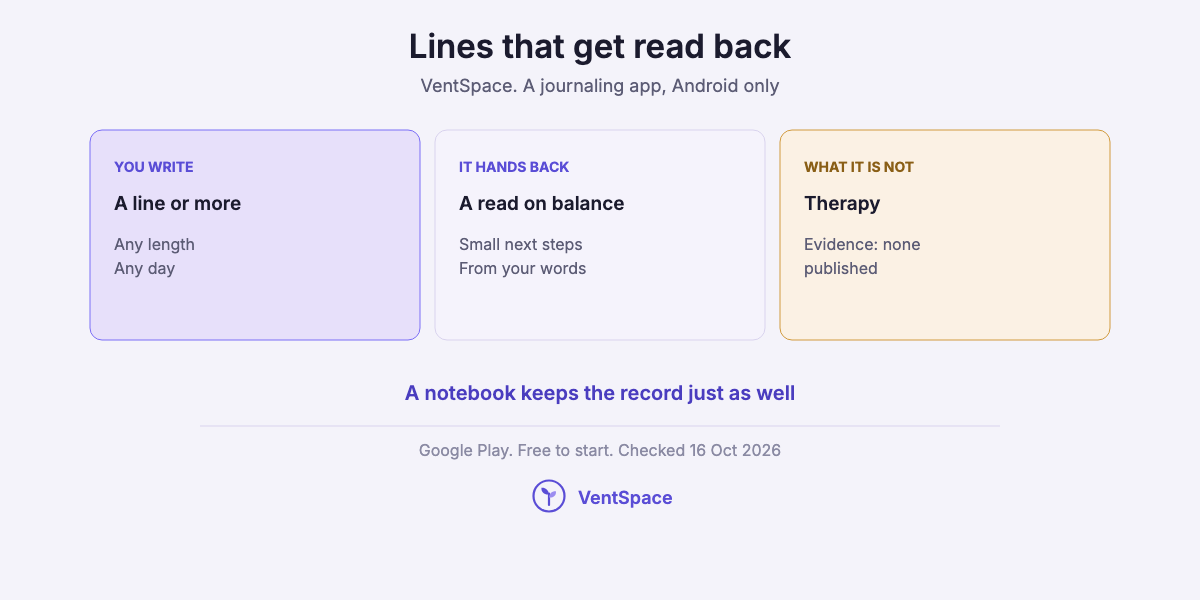
A year of lines is a small archive, and it is yours. Keep the book somewhere you will find it in five years. If you keep it on your phone, export or copy the note once a year so it does not vanish with a device. And if you would rather your lines were read back to you, VentSpace is a journaling app that turns what you write into a clear read on your life balance, plus small, doable next steps. It is free to start, Android only as of October 2026, and not therapy. Not on Android, or at a desk? VentSpace Live runs in your browser, free, with nothing to install. A notebook keeps the record just as well.
Questions people ask
What do you write in a one line a day journal?
One sentence about the day: a fact, a small moment, the answer to one fixed question, a feeling and its cause, or something someone said. Exercises 4 to 8 give you each kind with steps.
Do you have to write every day?
No, and the belief that you must can end a journal. Missed days stay blank, and you start again with today. In the largest meta-analysis of writing studies, how sessions were spaced made no significant difference to the effects measured, so a daily rule is a preference, not a requirement.
Is a five-year one line a day journal worth it?
If you will open it, yes. The five-year book’s design puts the same date from five years on one page, which makes exercise 11 effortless. A notebook or a phone note can do the same with a little more work. Choose the one you will see every day.
Can I keep a one line a day journal on my phone?
Yes. One running note, with each line starting with the date, works well and is searchable. Our page on digital vs paper journaling covers the trade-offs.
What if I keep stopping?
Look at the design before you look at yourself: the window (exercise 2), the re-entry rule (exercise 3) and staleness (exercise 9). If it still will not stick, our page on journaling roadblocks goes through the other reasons people stop.
A small, respectable record
We began with a journal that stops in February, and the blank pages we read as a judgment. A one-line journal does not make us more disciplined. It asks so little that our ordinary lives can keep up with it, and that is a kind of dignity in a practice: it fits the people we are rather than the people we meant to be.
Some years it will be full and some years it will have gaps, and both kinds are a true record of a life. Write tonight’s date, and one line.
About this article

Written by
Sai Subramaniam
Founder, VentSpace
I write these guides because I have been where you are. I am working through my own hard seasons, and I share the things that actually helped me, so that anyone going through it has a steady companion close by instead of facing it alone. VentSpace is the app I built for exactly that: a journaling app that turns what you write into a clear read on your life balance, plus small, doable next steps toward feeling more like yourself.
This writing is honest and every claim is sourced, and it is not a substitute for professional care. If you are struggling, reaching out to a professional is a strong move, not a failure.
Explore VentSpaceTry VentSpace LiveHow this one was checked. Every factual claim traces to a named source, and the source is printed next to the claim rather than kept in a footnote. Quotes are pinned to the work they come from, with the year, the letter or the chapter where one exists. Where a widely repeated claim could not be traced, it was left out and the omission recorded. Where a figure is contested, both sides are printed.
No affiliate links, no paid placements, and nobody paid to appear here. Where we mention our own app, we say that it is ours, we state its limits, and we never position it as a substitute for care.
Reviewed: October 2026. Prices, platforms and product availability move quickly, and anything we could not verify at the time of writing is marked as unverified rather than turned into a number.
Corrections. If something here is wrong, we would rather know. Corrections are made in place, with a note saying what changed.