
“There are more things, Lucilius, likely to frighten us than there are to crush us; we suffer more often in imagination than in reality.”
Seneca, Moral Letters to Lucilius 13.4, translated by Richard Mott Gummere
Some of us know this question from the inside. It turns up around the third replay of a conversation, or the fifth what-if about money, and it sounds like this: is this overthinking, or is this anxiety?
Here is the short answer. Overthinking is not a diagnosis. It is an everyday word for going over the same ground again and again. Anxiety means two things: a feeling all of us have, and the name of a group of diagnoses. The two meet at worry, and the diagnosis that sits closest to overthinking is defined partly by worry.
So the more useful question is not which word fits. It is whether what has been happening has gone on long enough, come often enough and cost enough to take to someone. First, the two words.
The short version
Overthinking is a description, not a diagnosis. No diagnostic classification lists it.
Anxiety has two meanings. An ordinary feeling, and the name of several diagnoses.
Worry is where they meet. The WHO’s classification defines generalized anxiety disorder partly by excessive worry.
The tidy splits do not sort people. Future versus past is a real tilt, and a small one. Body versus head does not hold.
There is no checklist here, on purpose. If this has gone on a while and is costing you, talk to a doctor or therapist.
If you are struggling right now. If you are in crisis or thinking about harming yourself, please contact a crisis line now. In the US, call or text 988 (Suicide & Crisis Lifeline). Anywhere else, findahelpline.com lists free, confidential services by country. This page is not a substitute for that help.
What overthinking is
Overthinking is an everyday word for thinking that keeps going over the same ground without arriving anywhere. It is our word, not a clinician’s. It appears in no diagnostic classification, which is a statement about how it is filed, not about how much it can hurt.
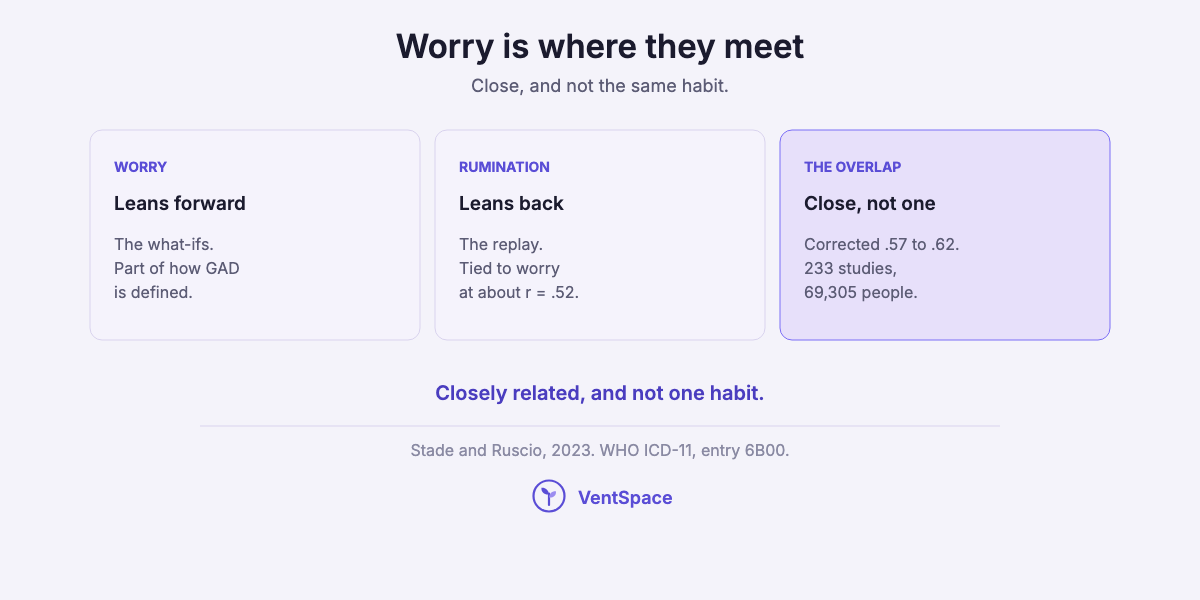
The studies we read do not measure the word itself. What it describes, they study as two habits that the rest of us lump together. Worry leans forward: the what-ifs, the rehearsal of things that have not happened yet. Rumination leans back: the replay of a conversation, the audit of what we said and why. Both are thinking styles that researchers measure with questionnaires. Neither is a thing a person has.
What anxiety is
Anxiety is, first, a feeling. The US National Institute of Mental Health puts it without fuss: “Feeling anxious is a normal part of life.” The same page adds the second meaning in its next breath: “But anxiety disorders involve more than occasional worry or fear.”
That second meaning is a family, not one thing. In the World Health Organization’s classification, the ICD-11, the group called anxiety or fear-related disorders includes generalized anxiety disorder, panic disorder, social anxiety disorder, specific phobia and several others. When we ask ourselves whether we “have anxiety”, we may be asking about one of these without knowing which.
Overthinking vs anxiety, side by side
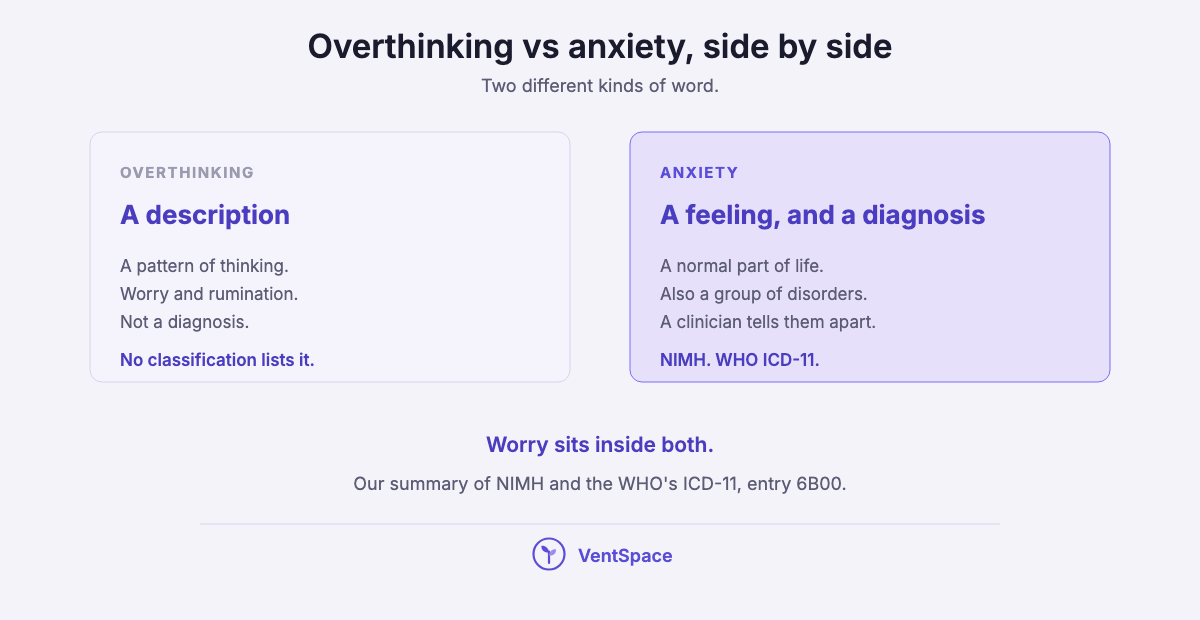
| Overthinking | Anxiety | |
|---|---|---|
| What the word names | A pattern of thinking that goes over the same ground | A feeling everyone has, and the name of a group of diagnoses |
| Is it a diagnosis? | No. No diagnostic classification lists it | The feeling, no. The disorders, yes (ICD-11) |
| Where worry sits | Worry is one of the two habits it covers | Excessive worry is part of how generalized anxiety disorder is defined |
| In the head or the body? | Described as thinking | Can be thinking, body symptoms, or both |
| Who can tell you which it is | Nobody needs to | A doctor or a mental health professional |
Quick Summary
Q: What is the difference between overthinking and anxiety?
A: Overthinking is an everyday word for going over the same thoughts, and it is not a diagnosis. Anxiety is both a normal feeling and the name of a group of diagnoses. They overlap at worry, which is part of how generalized anxiety disorder is defined.
Is overthinking a diagnosis? One word describes, the other can diagnose
No. Overthinking describes what a mind is doing. Anxiety, in its second meaning, is something a clinician can diagnose, and the line between the everyday feeling and the disorder is theirs to draw, not ours.
The National Institute of Mental Health draws that line in a single sentence about generalized anxiety disorder: “It is not the same as occasionally worrying about things or experiencing anxiety due to stressful life events.” Read it slowly. It says that occasional worry is ordinary, and that anxiety after something stressful is not the disorder either. The same page describes what the disorder usually involves instead: “a persistent feeling of anxiety or dread that interferes with how you live your life.” Persistent, and interfering. In our reading, those two words carry most of the weight.
What separates them, in the clinical description, is less what our thoughts are about than how long the anxiety has lasted, how much of the time it is there, what else comes with it, and what it is costing us. Those are judgments a clinician makes with you in the room.
We find that more consoling than it first sounds. It means the word you use for the last few weeks commits you to nothing. And it means the question “do I have it?” is one we cannot answer from here, for you or for anyone. A clinician can.
Quick Summary
Q: Is overthinking a mental illness?
A: No. Overthinking is an everyday word for a pattern of thinking and is not a diagnosis. Generalized anxiety disorder is a diagnosis, and the US National Institute of Mental Health says it is not the same as occasional worry. Only a clinician can tell whether someone has it.
Insight: worry is ordinary first
“Occasional anxiety is a normal part of life. Many people worry about things such as health, money, school, work, or family.” National Institute of Mental Health, Generalized Anxiety Disorder: What You Need to Know, revised 2025.
Worry is where overthinking and anxiety meet
The two words overlap at worry. Worry is one of the two habits overthinking covers. And the World Health Organization’s ICD-11 describes generalized anxiety disorder as “manifested by either general apprehension (i.e. ‘free-floating anxiety’) or excessive worry focused on multiple everyday events”.
So in one precise sense the answer to this page’s title is yes. The part of anxiety that is a thinking pattern looks a great deal like overthinking. In another sense it is no, because the classification asks for more than worry: how long it has persisted, how much of the time, what comes with it and what it costs. Worry is overthinking pointed at the future. It is also the word that sits inside the diagnosis.
The research says the two kinds of overthinking are closer than our vocabulary suggests. A 2023 meta-analysis pooled 719 effect sizes from 233 studies, covering 69,305 people, and found that worry and rumination correlated at about .52. Corrected for measurement error, the figures ran from .57 to .62. That is a strong relationship, and it is not the same thing as one habit. The authors offer a benchmark that helps: none of their figures reached the correlation of .64 that earlier research had found between generalized anxiety disorder and depression themselves. In other words, the two kinds of overthinking are about as entangled as the two diagnoses the authors call most strongly linked to them, and slightly less. One part of the picture did stand apart. The reflective kind of going back over things, which researchers measure separately as reflection, was far less tied to worry, at r = .28. Overthinking is not one texture, and the closer a habit sits to brooding, the closer it sits to worry. The authors add that their figures “may be best understood as lower-bound estimates”, because, they argue, features of the questionnaires themselves likely held the correlations down.
Quick Summary
Q: Is overthinking a sign of anxiety?
A: It can be part of it. Worry, one of the two habits overthinking covers, is part of how generalized anxiety disorder is defined. But worry on its own is not the diagnosis, and worry and rumination also travel together outside anxiety.
Insight: close, and not the same
“Worry and rumination, as indexed by current self-report measures, reflect closely related but nonredundant constructs.” Elizabeth Stade and Ayelet Meron Ruscio, Clinical Psychological Science, 2023.
The future-versus-past split is a tilt, not a sorting rule
Several of the pages we read say anxiety is about the future and overthinking is about the past. There is something in it. It does not sort people.
The most careful test of this we found followed 70 women aged 18 to 50 for one week. A handheld device asked them, eight times a day, to rate how much they were worrying and ruminating, and what those thoughts were like. Some had been diagnosed by interview with depression, some with generalized anxiety disorder, some with both, and some with neither. The depressed group worried as much as the anxious group. The anxious group ruminated as much as the depressed group. All three diagnosed groups did far more of both than the healthy group did.
Within the diagnosed groups, worry did lean toward the future and toward words, and rumination toward the past and the self. Those leanings were real and small, explaining a sliver of the variation (pseudo-R² values of about .01 to .03). Several expected findings did not appear at all. More worry went with more concrete thoughts, not more abstract ones. How much people worried was not linked to how much control they felt over their thoughts. And how much they ruminated was not linked to how abstract their thoughts were. The authors report that most of the textbook picture held up. These parts did not.
It is one study, of seventy women, over a week. It is also the only one we found that tracked both habits in daily life in people diagnosed by interview, which is why we give it room.
Quick Summary
Q: Is anxiety about the future and overthinking about the past?
A: Only as a small tilt. In a week-long study of 70 women assessed by interview, depressed people worried as much as anxious people, and anxious people ruminated as much as depressed people. The future and past leanings were real but explained very little.
Insight: both habits cut across the diagnoses
“Both rumination and worry emerged as transdiagnostic processes that cut across MDD, GAD, and MDD-GAD.” Katharina Kircanski and colleagues, Clinical Psychological Science, 2015. MDD is major depressive disorder and GAD is generalized anxiety disorder.
Is anxiety in the body and overthinking in the head?
Not cleanly. Half the pages we read lean on this split, and it fails at the exact diagnosis people are asking about.
Generalized anxiety disorder is defined first by apprehension or worry, which is to say by thinking. And the same ICD-11 entry records the reverse case: some people with the diagnosis mainly report a background unease and body symptoms, and cannot say what they are worrying about. Anxiety can be mostly thoughts, mostly body, or both. Overthinking can sit inside it or outside it.
That conclusion is ours, drawn from the classification’s own wording. It matters because the body test is an easy one to run on ourselves late at night: my heart is not racing, so it must be overthinking. The classification does not support that shortcut, in either direction.
Quick Summary
Q: Can you have anxiety without overthinking?
A: Yes. The World Health Organization’s ICD-11 notes that some people with generalized anxiety disorder report mainly unease and body symptoms without being able to say what they are worried about. Anxiety can be mostly thoughts, mostly body, or both.
Insight: the case the body test misses
“Some individuals with Generalized Anxiety Disorder may only report general apprehensiveness accompanied by chronic somatic symptoms without being able to articulate specific worry content.” World Health Organization, ICD-11, entry 6B00.
A panic attack is a different event
A panic attack is not a bad bout of overthinking. The National Institute of Mental Health describes panic attacks as “a sudden wave of fear or discomfort or a sense of losing control even when there is no clear danger or trigger.”
Where overthinking goes round and round, a panic attack is described as a surge. The two do meet, though, and in a way that is easy to miss. NIMH notes that “Many people with panic disorder worry about the possibility of having another attack”. The attack is one event, and NIMH says attacks “can occur as frequently as several times a day or as rarely as a few times a year.” The worrying about the next one is something much closer to overthinking. The same page says panic attacks “often include physical symptoms that might feel like a heart attack, such as trembling or tingling in the body or a rapid heart rate.” That alone is reason to take chest symptoms or a pounding heart to a doctor rather than settle them with a web page. When someone sees a provider about anxiety, NIMH notes, the provider may do a physical exam “to ensure that an unrelated physical problem is not causing your symptoms.” In a life-threatening situation, NIMH’s own advice is to call 911, or your local emergency number outside the US.
Quick Summary
Q: Is a panic attack the same as overthinking?
A: No. The National Institute of Mental Health describes a panic attack as a sudden wave of fear or discomfort, sometimes with symptoms that feel like a heart attack. Chest symptoms or a racing heart are worth taking to a doctor.
Insight: one attack is not a disorder
“Not everyone who experiences a panic attack will develop panic disorder.” National Institute of Mental Health, Panic Disorder: When Fear Overwhelms, revised 2025.
Why there is no checklist here, and the question that does help
Several of the pages that rank for this question offer a list of signs or questions to sort yourself with. We have left it out deliberately. A list of symptoms, read by someone who already half recognizes themselves in it, works like a diagnosis delivered without the person qualified to make it. This is not a test, and nothing on this page can rule anything in or out.
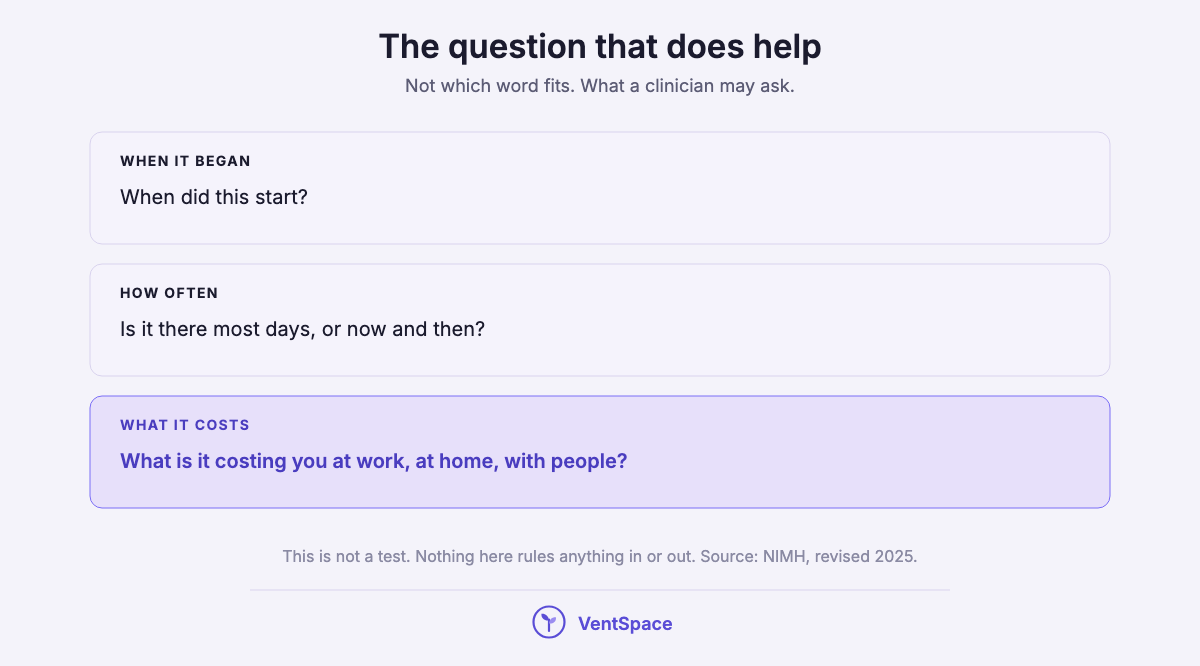
The question that does help is one a clinician may ask anyway. In the National Institute of Mental Health’s words, “the provider may ask when your symptoms began, how long they have lasted, how often they occur, and their impact on your life.”
Those are not boxes to score. They are things worth noticing, in your own words, before you go: when this started, whether it is there most days, and what it is costing you. If it has been going on for a while, is there most of the time and is costing you, that is a reason to talk to someone. If you honestly cannot tell, that is a reason too. And if your answers do not line up neatly, that fits the research above.
Quick Summary
Q: How do I know if my overthinking is anxiety?
A: No checklist can tell you, and this page does not offer one. What a clinician may ask about is when it began, how long it has lasted, how often it comes and what it is costing you. If it has gone on a while and is costing you, or you cannot tell, talk to someone.
What to do in each case
If it is a few rough days of going over something: two honest things first. We know of no technique shown to stop overthinking, and no researched number for how long is too long. What we can offer is a way of looking: is the thinking moving you toward a decision, or circling one already made? Our piece on overthinking vs problem solving takes that question apart. And if someone has told you to stop thinking about it, notice that the advice names the outcome and leaves out the method. That is our argument, not a finding.
If it has been going on for a while, most days, and it is costing you: the National Institute of Mental Health’s advice is plain. “If you have concerns about your mental health, talk to a primary care provider.” They can refer you to a mental health professional. Treatment exists: “GAD treatment typically involves psychotherapy, medication, or both.” Which one, if any, is for you and a clinician to decide. Therapy is a legitimate route, not a last resort.
Quick Summary
Q: What should I do if I can’t tell whether it’s overthinking or anxiety?
A: If it is a few rough days, notice whether the thinking is moving toward a decision or circling. If it has gone on a while, comes most days and is costing you, talk to a primary care provider, who can refer you to a mental health professional.
Where the line blurs
The categories overlap where you are standing. In the week-long study above, worry and rumination cut across depression and generalized anxiety alike, so overthinking can go with a low mood as much as with anxiety. The 2023 meta-analysis is honest about its limit too: “These results cannot shed light on the temporal relationships between the constructs.” Nobody we read can tell you which comes first.
And our summary is a summary. “Overthinking describes, anxiety can diagnose, worry is the overlap” is how we put together a classification, a public-health agency and two papers. Use it to aim. It rules on nobody.
That is why the page cannot sort you. Only a conversation can.
Questions people ask
Is overthinking a mental illness?
No. It is an everyday word for a pattern of thinking, and no diagnostic classification lists it. This page cannot tell you whether you have a condition. A clinician can.
Is overthinking a sign of anxiety?
It can be part of it, because excessive worry is part of how generalized anxiety disorder is defined. It also travels with low mood. A sign is not a diagnosis.
Can overthinking cause anxiety?
The research we hold cannot say which comes first. A 2023 meta-analysis of 233 studies says its results “cannot shed light on the temporal relationships” between worry and rumination.
Can you have anxiety without overthinking?
Yes. The ICD-11 notes that some people with generalized anxiety disorder report mainly unease and body symptoms, with no specific worry they can name.
Is anxiety physical and overthinking mental?
A common myth. Generalized anxiety disorder is defined first by apprehension or worry, which is thinking, and anxiety can also show up mostly in the body. The split sorts nobody.
Two things to take with you
Overthinking describes. Anxiety can also diagnose. Worry is where they overlap, which is why the question is so hard to answer from the inside, and why none of us should feel foolish for asking it.
You do not have to settle it alone, and it may take more than one conversation. If it has gone on a while and is costing you, ask a doctor or a therapist. NIMH is candid that finding the right treatment “may take trial and error”. Therapy is one option, and a legitimate one.
We did not choose minds that rehearse. We can choose who we tell.
One line from us. If you want a place to write down what the last few weeks have been like and get a read on it, VentSpace is a journaling app that turns what you write into a clear read on your life balance, plus small, doable next steps. Prefer to try it on your laptop first? VentSpace Live runs in your browser, free, with nothing to install. It is ours, free to install on Google Play as of October 2026, with no published evidence on outcomes. It is not a diagnosis and not a substitute for seeing someone, and writing is not a reliable way out of a loop, as our piece on why journaling doesn’t always stop overthinking explains.
About this article

Written by
Sai Subramaniam
Founder, VentSpace
I write these guides because I have been where you are. I am working through my own hard seasons, and I share the things that actually helped me, so that anyone going through it has a steady companion close by instead of facing it alone. VentSpace is the app I built for exactly that: a journaling app that turns what you write into a clear read on your life balance, plus small, doable next steps toward feeling more like yourself.
This writing is honest and every claim is sourced, and it is not a substitute for professional care. If you are struggling, reaching out to a professional is a strong move, not a failure.
Explore VentSpaceTry VentSpace LiveHow this one was checked. Every factual claim traces to a named source, and the source is printed next to the claim rather than kept in a footnote. Quotes are pinned to the work they come from, with the year, the letter or the chapter where one exists. Where a widely repeated claim could not be traced, it was left out and the omission recorded. Where a figure is contested, both sides are printed.
No affiliate links, no paid placements, and nobody paid to appear here. Where we mention our own app, we say that it is ours, we state its limits, and we never position it as a substitute for care.
Reviewed: October 2026. Prices, platforms and product availability move quickly, and anything we could not verify at the time of writing is marked as unverified rather than turned into a number.
Corrections. If something here is wrong, we would rather know. Corrections are made in place, with a note saying what changed.