
Somebody told you to try mindfulness. Maybe it was a friend, maybe a doctor, maybe an app store banner that turned up at the exact moment you were awake at the wrong hour, searching for anything, and so you downloaded something, pressed play, sat still while your mind ran through the same three worries in a slightly calmer voice, and wondered, at the end of ten minutes, whether you had done it wrong. You had not. Nobody had told you what it was for.
Here is the honest answer about mindfulness for overthinking. As an eight-week course it has some of the best-replicated evidence we found for anything aimed at rumination, and it is not clearly better than other real treatments over time, while a single exercise is a much smaller thing than a course and borrows none of its evidence. None of it makes thoughts stop.
What it can do is change how you stand next to a thought. Twelve exercises follow, each with what it will not do.
The short version
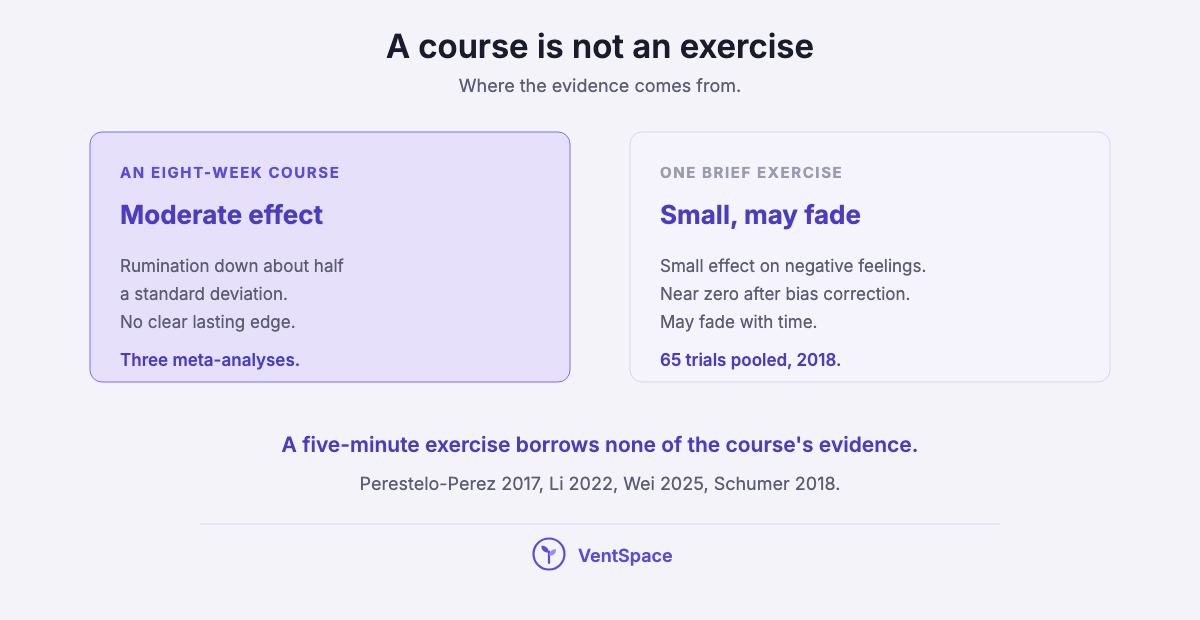
Courses work, modestly. In three meta-analyses, structured mindfulness courses reduced rumination by about half a standard deviation against usual care.
They are not clearly better than other real treatments in the long run. Against another real treatment there was no difference, or a small edge over CBT that was gone at follow-up.
One exercise is not the course. Brief practice has small effects that shrink once publication bias is accounted for, and they may fade with time.
Letting it be did more than noticing it, in lab studies. Nothing here stops a thought.
Does mindfulness work for overthinking?
Yes, as a course, modestly, and not clearly better than other real treatments over time. Three separate meta-analyses agree on the first part: one pooled 11 studies and found an effect on rumination of g = −0.59 against usual care, another pooled 19 trials and 1,138 patients at −0.46, and the largest, 29 trials and 2,535 people, found −0.51, a moderate effect. One review was limited to patients with depression, and the largest pooled people with conditions from depression to cancer and migraine.
The second part matters as much. In the first review, the three trials that compared mindfulness with medication, CBT or behavioral activation found essentially no difference (g = −0.02). The 2025 review found a small edge over CBT right after treatment, in three trials, gone at follow-up, and no difference from psychoeducation. Its edge over medication rests on two trials, and at least one added the course to medication rather than replacing it. Good. Not clearly better.
And these were courses. A standard program runs eight weekly sessions of two to two and a half hours, plus about 40 minutes of recorded practice a day, and when 65 trials of brief mindfulness training, from a single session up to two weeks, were pooled, the effect on negative feelings, rumination included, was small (g = .21), dropped to .04 once publication bias was accounted for, and may fade with time, though the authors found the drop over time was not statistically significant. A five-minute exercise borrows none of the course’s evidence.
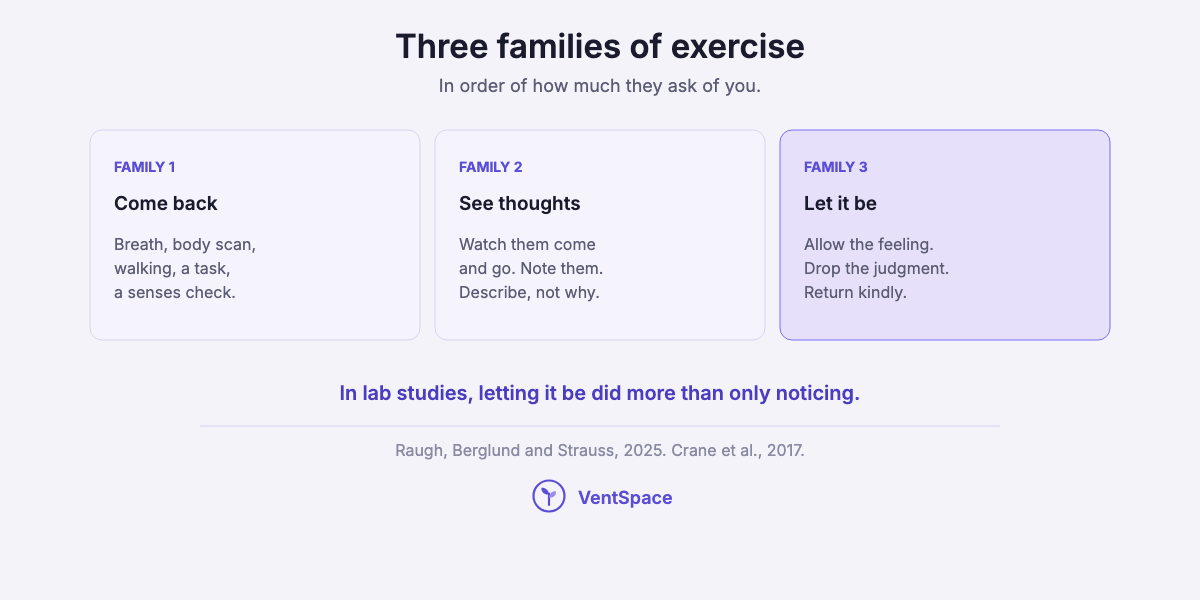
One finding is worth carrying into every exercise below. Across 110 lab studies with 8,105 people, the accepting family of instructions, letting a feeling be there, did more (g = .30) than only noticing it (g = .17), and the review flags publication bias.
Small. Real.
Quick Summary
Q: Does mindfulness help with overthinking?
A: As an eight-week course, yes, modestly, with no clear lasting advantage over other real treatments. A single brief exercise has much smaller effects that may fade.
Insight: what a program is
“MBSR is scheduled over eight weekly sessions lasting 2.5 h with 40 min of guided mindfulness meditation home practice per day. MBCT is the same but with 2 h long sessions.” R. S. Crane and colleagues, Psychological Medicine, 2017.
How we sorted them
- Three families, in order of how much they ask of you. Coming back to the present, then seeing thoughts as thoughts, then letting a feeling be there.
- Times are our suggestions, not doses from research.
- Left out on purpose: anything that asks you to push a thought away, breathing counts sold as proven, anything aimed at sleep, and writing exercises, because writing is not a reliable way out of a loop.
- Also left out: self-compassion routines, covered by our self-compassion exercises.
Quick Summary
Q: Which mindfulness exercise is best for overthinking?
A: No single exercise has evidence of its own for overthinking. In lab studies, accepting a feeling did more than only noticing it.
Before you start
If you are struggling right now. If you are in crisis or thinking about harming yourself, please contact a crisis line now. In the US, call or text 988 (Suicide & Crisis Lifeline). Anywhere else, findahelpline.com lists free, confidential services by country. These exercises are not a substitute for that help.
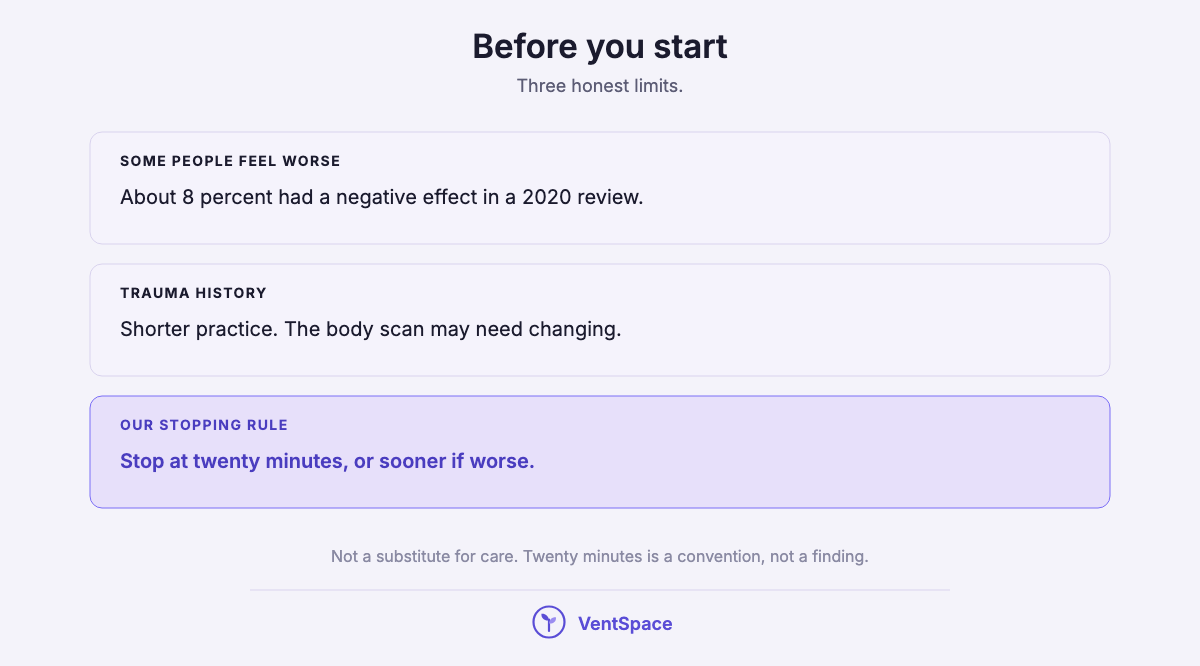
Some people feel worse. The US National Center for Complementary and Integrative Health says few studies have looked for harm, “so it isn’t possible to make definite statements about safety.” It reports a 2020 review of 83 studies in which about 8 percent of participants had a negative effect, a rate it calls similar to psychological therapies, and anxiety and depression were the most common.
If you have a history of trauma, a 2025 paper on mindfulness programs for depression reports suggestions from the research of shorter practice and, especially for survivors of childhood sexual abuse, changing or skipping the body scan.
Our stopping rule: stop at twenty minutes, or sooner if you feel worse, and if what comes up during practice is a memory or a feeling you cannot step back from, open your eyes, look around the room, and leave the exercise for another day, because pushing through is not something we are suggesting. Twenty is a convention. It is not a finding. Therapy is one option, and a legitimate one.
Quick Summary
Q: Can mindfulness make overthinking worse?
A: It can make some people feel worse. In a 2020 review of meditation studies, about 8 percent of participants had a negative effect, most often anxiety or depression. Stop if you feel worse, and talk to a doctor or therapist.
Family 1: Mindfulness exercises for overthinking that bring you back
1. Breath as an anchor
This is the plainest version of sitting practice, one of the three formal practices in mindfulness programs, and the instruction is not to breathe in any special way but to use the breath as somewhere to put your attention, so that when it wanders off into the same argument for the fortieth time, which it will, you have somewhere to bring it back to. The wandering is not failure. Noticing it and returning is the whole exercise. Five minutes is plenty.
Do this:
1. Sit upright and set a timer for five minutes.
2. Feel the breath at one spot: the nose, the chest or the belly.
3. When you notice you are thinking, return your attention to that spot.
4. Keep the count of returns in your head if it helps, then let the count go.
5. When the timer goes, notice one thing about how your attention feels now, and get up without grading the session.
| Time | 5 minutes |
| You need | a timer |
| Best for | a gap in the day when the loop has room to start |
| What it will not do | Calm your body by itself. A month-long trial found no change in heart rate variability or resting heart rate with daily mindfulness practice |
2. The body scan
The body scan is a core practice in the eight-week programs, in which you move your attention slowly through the body from the feet up, noticing whatever sensation is there without trying to change it, and it suits an overthinking mind for a dull, practical reason: it gives that mind something specific and physical to do. That is the point. It is also the practice that some researchers suggest changing or skipping, especially for survivors of childhood sexual abuse, so treat that as a real caution, not small print. Eyes open is fine. So is stopping halfway.
Do this:
1. Sit or lie down and set a timer for ten minutes.
2. Start with the feet. Notice pressure, warmth, tingling or nothing.
3. Move up slowly: legs, belly, chest, hands, arms, shoulders, face.
4. When a thought pulls you off, note where you were and go back there.
5. If any part of the body feels hard to stay with, move on to the next part, or stop the exercise.
| Time | 10 minutes |
| You need | a quiet room |
| Best for | an evening after a day spent in your head (not as a sleep aid) |
| What it will not do | Work quickly. Pooled across brief-training trials, the body scan on its own showed no effect on negative mood (g = −0.09) |
3. Mindful walking
Mindful movement is the third core practice in the programs, and walking is the easiest version of it, because instead of walking somewhere while rehearsing a conversation you walk in order to walk, paying attention to the lift of one foot, the shift of weight and the contact with the ground, which is about as unglamorous as attention gets. It suits anyone who cannot sit still with their own mind yet. A hallway works. So does the walk to the bus stop, if the phone stays in your pocket. Five minutes will do.
Do this:
1. Walk at about half your normal pace.
2. Feel each foot lift, move and land.
3. When you notice you are replaying something, name the next step you take.
4. Keep going for five minutes, then walk normally.
5. If a thought keeps winning, slow down further for ten steps, then return to your normal pace.
| Time | 5 minutes |
| You need | ten steps of floor |
| Best for | restlessness that makes sitting practice impossible |
| What it will not do | Count as exercise in the fitness sense, or carry its own evidence. We found no trial of walking practice for overthinking |
4. One everyday task, with attention
Mindfulness programs ask participants to bring awareness “in particular ways to everyday activities”, which they call informal practice, and the version that fits a real week is to pick one routine task, washing a mug, brushing your teeth, making coffee, and do only that, noticing what it feels like in your hands while your mind tries, repeatedly, to drag you off to the inbox. It costs no extra time. It also teaches the skill where you need it, inside an ordinary day. Pick something you already do without thinking.
Do this:
1. Choose one task you do daily.
2. While doing it, notice temperature, sound, weight and smell.
3. When a thought arrives, let it be there and return to the task.
4. Do the same task this way every day for a week.
5. At the end of the week, notice whether you remember to do it without being reminded.
| Time | 2 minutes |
| You need | a task you already do |
| Best for | people who will never sit down to meditate |
| What it will not do | Change anything on its own in one go. It is practice, and practice is repetition |
5. A senses check
You will have seen this one as 5-4-3-2-1, five things you can see, four you can hear, three you can feel, two you can smell and one you can taste, and it turns up on several of the pages that rank for this search because it does one honest thing, which is to drag attention out of your head and into the room you are sitting in. We could not find a trial of it. On a bad enough day it is also hard to start, which is worth knowing before you rely on it. Small spikes only.
Do this:
1. Name three things you can see, out loud or in your head.
2. Name two things you can hear.
3. Name one thing you can feel against your skin.
4. Pick the one you noticed most and stay with it for ten seconds.
5. If you cannot get started at all, look at one object and describe its color to yourself, and leave it there.
| Time | 1 minute |
| You need | nothing |
| Best for | a spike at a desk or on a train |
| What it will not do | Rest on evidence. It is a common habit, not a tested treatment, and it is not for a crisis |
Quick Summary
Q: What is the simplest mindfulness exercise for overthinking?
A: Using the breath as an anchor: five minutes of noticing when your attention has wandered and bringing it back. The wandering is part of the exercise.
Family 2: Seeing thoughts as thoughts
6. Watching thoughts come and go
This is the move mindfulness teachers call decentering, in which you “attend to thoughts and feelings as mental events by noticing how they come and go in the mind”, so that the thought “I handled that meeting badly” stops being a fact about you and becomes something your mind is producing right now, one of many, arriving and leaving like traffic outside a window. You do not argue with it. You watch it. Even the people who define these programs say there is no compelling evidence yet that its proposed mechanisms are specific to mindfulness. Watch anyway.
Do this:
1. Sit for five minutes with your eyes closed or lowered.
2. Let thoughts come without following them.
3. Notice each one arrive and, eventually, fade.
4. If you get carried off, notice that too, and go back to watching.
5. When the timer goes, open your eyes and notice the first thing you see.
| Time | 5 minutes |
| You need | a timer |
| Best for | the same thought on repeat |
| What it will not do | Make the thought untrue or make it leave. It changes your distance from it |
7. Noting “thinking” and coming back
Noting is decentering with a label: each time you catch your attention drifting into a story, you say one word to yourself, “thinking”, and return to the breath or the body, which is close to how the lab studies phrase it when they ask people to focus on physical sensations and gently return attention whenever it wanders. The word is the point. It marks the moment you stepped out of the story, which is a moment that is easy to miss when you are busy being in it. Catch it often.
Do this:
1. Rest attention on the breath.
2. When you catch yourself in a thought, say “thinking” silently.
3. Return to the breath without judging how long you were gone.
4. Repeat for five minutes.
5. If the label starts to feel like a scolding, say it more quietly, the way you would read a sign.
| Time | 5 minutes |
| You need | nothing |
| Best for | noticing how often the loop starts |
| What it will not do | Reduce the number of thoughts. It may show you there are more than you thought, and that is information, not a setback |
8. The concrete version
This one comes from the research on rumination itself. In a study described in a 2008 review, depressed patients told to think about “the causes, meanings, and consequences of their feelings” were compared with others told to “think about the concrete experience of x”, and the reviewers conclude that the harmful part of rumination “may be its abstract analytical aspects”, which turns into a simple swap you can make today: stop asking why this keeps happening, and describe what is happening. Describe. Do not judge. It takes about five minutes.
Do this:
1. Pick the thing you keep going over.
2. Describe, in your head, only what you can sense right now about it: where it sits in the body, what it is like.
3. When a “why” question arrives, swap it for “what is this like right now?”
4. Stop after five minutes.
5. If you notice yourself building a theory about it, call that “thinking” and come back to the description.
| Time | 5 minutes |
| You need | nothing |
| Best for | replaying a conversation or a mistake |
| What it will not do | Lift a low mood. In the reviewers’ words, “Watkins’ experiential induction does not lift participants’ depressed moods, but it does improve the quality of their thinking.” |
9. A thought, set beside you
The lab studies include a family of instructions to “attend to reactions and emotions as separate from oneself”, and in practice that is a small shift in grammar, so that “I am a failure” becomes “I am having the thought that I am a failure”, which sounds like a trick, and is, a little, but a trick that puts one inch of space between you and the sentence. Sometimes an inch is enough. Try it on the thought that has been loudest this week. Keep it short.
Do this:
1. Name the loudest thought in one short sentence.
2. Put “I am having the thought that” in front of it.
3. Say the new version slowly, twice.
4. Notice whether anything about it feels different, and leave it there.
5. Do this once a day with the same thought for a week, without expecting it to disappear.
| Time | 2 minutes |
| You need | nothing |
| Best for | a harsh thought about yourself |
| What it will not do | Prove the thought wrong. It is not an argument with the thought, and it will not win one |
Quick Summary
Q: How do you use mindfulness to stop ruminating?
A: It does not stop rumination. It can change how you relate to it: watching thoughts come and go, labeling them “thinking”, or describing what is happening instead of asking why.
Family 3: Letting it be there
10. Noticing a feeling without holding on
In the lab studies, one kind of instruction asks people “to be aware of reactions and emotions without ‘holding onto them’ or with allowing them to pass naturally”, which is noticing applied to feeling rather than thought: you find the knot of dread or the heat of embarrassment, give it a word if one comes, and let it do whatever it does next without feeding it a story. This is still the noticing half. In those studies it was the weaker one, so treat it as a step toward the next two. Start here if acceptance sounds too much.
Do this:
1. Find where the feeling sits in your body.
2. Give it one word if you can: dread, heat, tightness.
3. Watch it for a minute without explaining it to yourself.
4. Notice whether it changes, stays or moves.
5. If it grows sharp or frightening, open your eyes, look around the room and stop.
| Time | 3 minutes |
| You need | nothing |
| Best for | a feeling that keeps restarting the same thoughts |
| What it will not do | Make the feeling go away. In the lab, noticing alone was the smaller effect (g = .17) |
11. An accepting stance
This is the accepting half, from the family of instructions that did most in the lab studies: instructions to adopt “an accepting or non-judgemental stance” toward your own reactions, where accepting does not mean agreeing and does not mean giving up, but dropping the second layer, the judgment about the feeling (“I should not still be upset about this”), and letting the first layer be whatever it is. In our reading, a lot of overthinking lives in that second layer. Take it away. There is less to think about. It feels odd at first.
Do this:
1. Notice the feeling, as in exercise 10.
2. Notice any judgment about it (“this is stupid”, “I should be over it”).
3. Silently say: “This is here. It can be here for now.”
4. Stay with that for two minutes, then return to what you were doing.
5. If accepting it feels impossible today, accept that, and go back to exercise 1.
| Time | 3 minutes |
| You need | nothing |
| Best for | when you are angry at yourself for still thinking about it |
| What it will not do | Solve the problem underneath. In the lab, the family that includes acceptance had the larger effect (g = .30), and that is still a small one |
12. Kindness toward the moment
Mindfulness programs describe practice as a chance to try “eliciting kindness, openness, and patience toward immediate experience”, whether that experience is pleasant, unpleasant or neutral, and for an overthinker the unpleasant version is the one that matters, because the habit is to come back to the breath impatiently, sighing at yourself. Try it differently. This is not a self-compassion routine, which is a separate thing. It is only a change in the tone of each return. It costs nothing extra.
Do this:
1. During any exercise above, notice the moment you realize you drifted.
2. Return to the anchor the way you would guide a distracted friend back.
3. If you catch a harsh tone, soften it once, on purpose.
4. Carry that tone into the next return.
5. At the end, notice whether the session felt like a test, and let that be one more thing you noticed.
| Time | built into any exercise |
| You need | nothing |
| Best for | people who meditate like they are being graded |
| What it will not do | Carry its own evidence. It is a description of how programs ask people to practice, not a tested exercise |
Quick Summary
Q: Is it better to notice my thoughts or accept them?
A: In lab studies of 8,105 people, accepting a feeling had a larger effect than only noticing it, though both were small.
All twelve at a glance
| Exercise | What it is for | Time | Difficulty | Do it when |
|---|---|---|---|---|
| 1. Breath as an anchor | Somewhere to return attention | 5 min | Easy | A quiet gap in the day |
| 2. The body scan | A physical focus for a busy mind | 10 min | Medium | Evening, after a day in your head |
| 3. Mindful walking | Practice for people who cannot sit still | 5 min | Easy | Restless and unable to sit |
| 4. One everyday task | Practice inside an ordinary day | 2 min | Easy | Daily, during a routine task |
| 5. A senses check | Attention out of your head | 1 min | Easy | A spike at a desk |
| 6. Watching thoughts | Distance from a thought | 5 min | Medium | The same thought on repeat |
| 7. Noting “thinking” | Seeing how often it starts | 5 min | Medium | To learn your own loop |
| 8. The concrete version | Swapping why for what | 5 min | Medium | Replaying a mistake |
| 9. A thought beside you | Space from a harsh thought | 2 min | Easy | A thought about yourself |
| 10. A feeling without holding on | Noticing the feeling under the thought | 3 min | Medium | A feeling that restarts it |
| 11. An accepting stance | Dropping the judgment layer | 3 min | Harder | Angry at yourself for still thinking |
| 12. Kindness toward the moment | The tone of each return | any | Harder | Practicing like you are graded |
One line from us. If you want somewhere to write down what came up after a practice, VentSpace is a journaling app that turns what you write into a clear read on your life balance, plus small, doable next steps. Prefer to try it on your laptop first? VentSpace Live runs in your browser, free, with nothing to install. It is ours, free to install on Google Play as of October 2026, with no published evidence on outcomes. It is not a mindfulness course, and writing is not a reliable way out of a loop, as our piece on why journaling doesn’t always stop overthinking explains.
Questions people ask
Does mindfulness help overthinking?
As an eight-week course, modestly, with no clear lasting advantage over other real treatments. A single exercise borrows none of that evidence.
Can mindfulness make overthinking worse?
It can make some people feel worse: about 8 percent of participants had a negative effect in a 2020 review of meditation studies, as reported by the US National Center for Complementary and Integrative Health. In nine trials of mindfulness-based cognitive therapy with 1,258 people in remission or partial remission from recurrent depression, the course did not raise the odds of depressive symptoms getting worse compared with controls.
How long does mindfulness take to work?
The tested courses run eight weeks with daily practice. Brief practice showed its largest effect right afterwards and far smaller effects a day or more later, though that drop was not statistically significant.
Is a meditation app the same as a mindfulness course?
No. The evidence above comes from structured courses, and in the 2025 meta-analysis, two trials of online mindfulness-based cognitive therapy did not show a significant effect on rumination.
Is mindfulness about emptying your mind?
A myth. The programs teach people to notice thoughts as they “come and go in the mind”, not to get rid of them.
The short of it
A course helps, modestly, and is not clearly better than other real treatments over time. A single exercise is practice, not treatment.
Expect weeks, not a session, and stop if it makes you worse. If the thinking is costing you, talk to a doctor or a therapist. Therapy is one option, and a legitimate one.
The thought does not have to leave. You do not have to follow it. That is the whole skill.

About this article

Written by
Sai Subramaniam
Founder, VentSpace
I write these guides because I have been where you are. I am working through my own hard seasons, and I share the things that actually helped me, so that anyone going through it has a steady companion close by instead of facing it alone. VentSpace is the app I built for exactly that: a journaling app that turns what you write into a clear read on your life balance, plus small, doable next steps toward feeling more like yourself.
This writing is honest and every claim is sourced, and it is not a substitute for professional care. If you are struggling, reaching out to a professional is a strong move, not a failure.
Explore VentSpaceTry VentSpace LiveHow this one was checked. Every factual claim traces to a named source, and the source is printed next to the claim rather than kept in a footnote. Quotes are pinned to the work they come from, with the year, the letter or the chapter where one exists. Where a widely repeated claim could not be traced, it was left out and the omission recorded. Where a figure is contested, both sides are printed.
No affiliate links, no paid placements, and nobody paid to appear here. Where we mention our own app, we say that it is ours, we state its limits, and we never position it as a substitute for care.
Reviewed: October 2026. Prices, platforms and product availability move quickly, and anything we could not verify at the time of writing is marked as unverified rather than turned into a number.
Corrections. If something here is wrong, we would rather know. Corrections are made in place, with a note saying what changed.