
“The best moments usually occur when a person’s body or mind is stretched to its limits in a voluntary effort to accomplish something difficult and worthwhile.” · Mihaly Csikszentmihalyi, Flow (1990)
You sit down at nine with one demanding thing to do. A report, a design, a chapter, a piece of code that needs real thought. You open the file, then a message arrives, and it is quick to answer, so you answer it. Then you check whether anyone replied. By lunch you have written two paragraphs and sent a dozen replies, and you are tired in a way that does not match the work you can show for it. Where did the morning go?
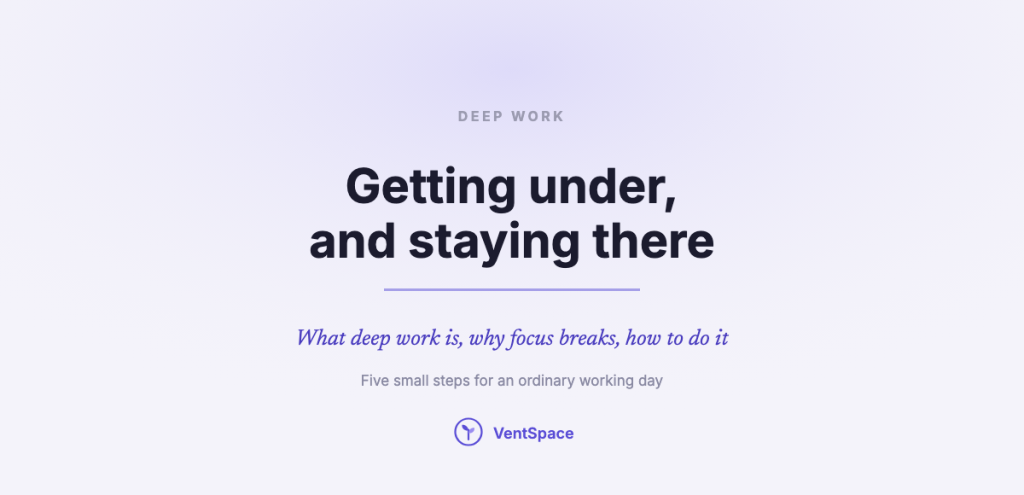
The computer scientist Cal Newport gave the missing thing a name. Deep work, as he defines it, is “the act of focusing without distraction on a cognitively demanding task”. The founder of this site once described it as diving into a pool of concentration, and the image holds up. Deep work is being under the surface. Every message, tab and quick check pulls you back up for air, and getting back down takes longer than it feels like it should.
This guide covers what deep work is, why focus breaks so easily, why that is not only a matter of willpower, and then five small steps you could try in tomorrow’s working day. None of them needs a cabin in the woods.
The short version
Deep work is focusing without distraction on a demanding task. The term is Cal Newport’s, from his 2016 book Deep Work.
Switching tasks leaves part of your attention behind. The researcher Sophie Leroy called it attention residue.
Interrupted people often work faster and feel worse. Speed is not the cost. Stress is.
A lot of the fragmentation is how the job is set up. It is not only your discipline.
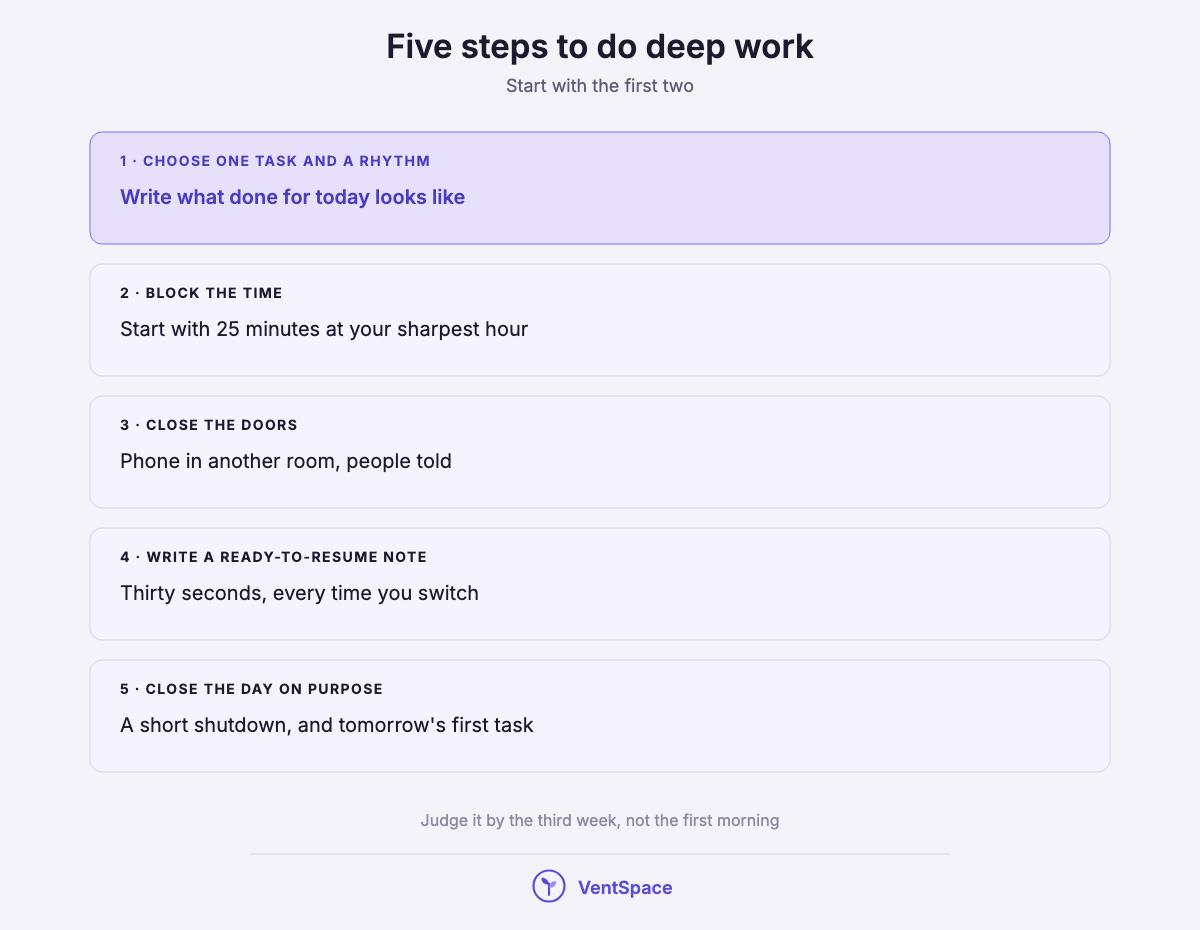
Five steps. Pick one task and a rhythm, block the time, close the doors, write a ready-to-resume note before you switch, and close the day on purpose.
What is deep work?
“Deep work is becoming increasingly valuable at the same time that it’s becoming increasingly rare.” · Cal Newport, announcing Deep Work on his blog (2015)
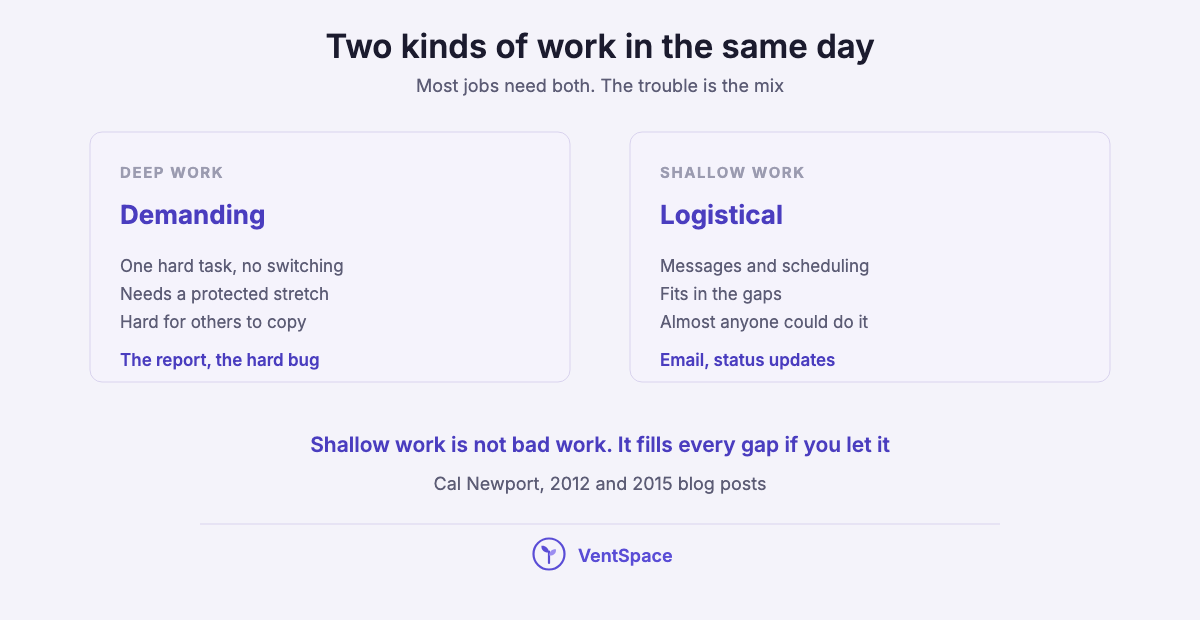
Deep work is focusing without distraction on a cognitively demanding task, in Cal Newport’s own definition. Shallow work is the rest: the logistics, the messages, the tasks that, in his words, “almost anyone, with a minimum of training, could accomplish”. Newport is an MIT-trained computer science professor at Georgetown University, and he set the idea out in Deep Work: Rules for Focused Success in a Distracted World, published in January 2016.
His argument is a bet about the working world. Demanding, undistracted work produces the things that are hard to copy, and the same working world that rewards those things makes them harder to do. That is the line quoted above, which he called the deep work hypothesis. The book then gives four rules, listed by its publisher as Work Deeply, Embrace Boredom, Quit Social Media and Drain the Shallows.
It helps to see the two kinds of work side by side, because most jobs are a mix and the mix is the point.
| Deep work | Shallow work | |
|---|---|---|
| What it is | Demanding thinking, done without switching | Logistical tasks, often done while distracted |
| Examples | Writing the report, solving the hard bug, planning the project | Email, scheduling, status updates, quick replies |
| Who could do it | Someone with your training | In Newport’s words, “almost anyone, with a minimum of training” |
| What it needs | A protected stretch of time | Gaps between other things |
| What it feels like at its best | Absorbing, sometimes close to flow | Busy, often scattered |
Shallow work is not bad work. Most jobs could not run without it. Busy is not the same as meaningful either, which our page on purpose versus productivity takes up. The trouble starts when it fills every gap, so there is never a stretch long enough to get under.
There is also a reason people come back to deep work once they have had it. The psychologist Mihaly Csikszentmihalyi, who studied the absorbed state he called flow, wrote the line at the top of this page. The best moments, on his account, usually come from stretching toward something difficult. The first version of this page put it more plainly: flow feels rewarding, which makes you want to come back to it. Deep work and flow are not the same thing, and the FAQ below says why. But deep work is often where flow gets its chance.
Quick Summary
Q: What is deep work?
A: Deep work is Cal Newport’s term for focusing without distraction on a cognitively demanding task. He contrasts it with shallow work, the logistical tasks almost anyone could do, and argues that deep work is becoming more valuable and rarer at the same time.
Insight: Cal Newport, writing on his blog in 2012, before the book, defined deep work as “cognitively demanding activities that leverage our training to generate rare and valuable results” and shallow work as “tasks that almost anyone, with a minimum of training, could accomplish”. The difference he draws is not effort. It is whether the work could be handed to someone else.
Why focus breaks so easily
“As revealed by two experiments, people need to stop thinking about one task in order to fully transition their attention and perform well on another.” · Sophie Leroy, Organizational Behavior and Human Decision Processes (2009)
Focus breaks easily because switching tasks leaves part of your attention on the task you left, and that leftover attention makes the next task harder. The researcher Sophie Leroy called this attention residue. In two experiments, she found it was hard for people to move their attention away from an unfinished task, and their performance on the next one suffered.
One detail in her paper is worth holding on to. Finishing the first task was not enough on its own. What helped people let go was finishing it under some time pressure. A task you close firmly releases you. A task you drift away from keeps pulling at you. In the pool picture, you can be in the water and still have your head above the surface.
The second thing the research shows is less obvious. In a 2008 study, Gloria Mark, Daniela Gudith and Ulrich Klocke found that people who were interrupted finished their tasks in less time, with no difference in quality. That sounds like good news until the next sentence: they paid for the speed in more stress, frustration, time pressure and effort. Have you ever finished a day fast and frazzled at once? That is the pattern they measured.
And the interruptions are not all coming from outside. In a 2026 interview, Mark said that “people are about as likely to self-interrupt” as to be interrupted by someone else. She also described how the time people spend on one screen before switching has shrunk across her team’s studies, from about two and a half minutes in 2004 to around 75 seconds in 2012, and to figures she summarized as averaging about 47 seconds in later work. Those are her spoken summaries of several studies, not one measured number, so we print them as she said them.
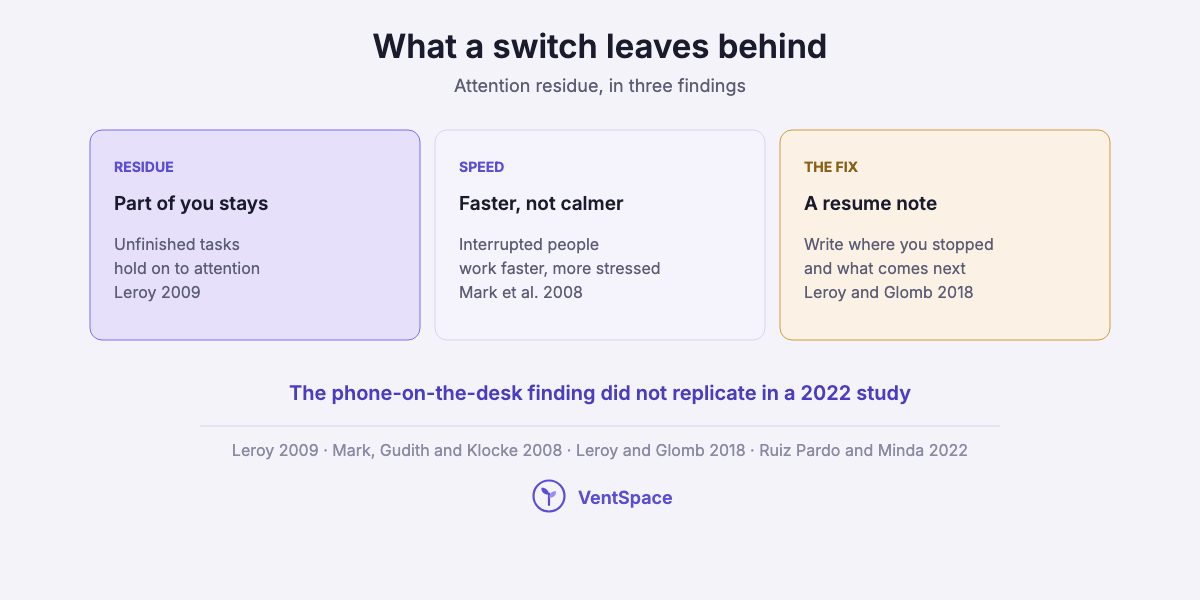
What about the phone sitting next to you? In 2017, Adrian Ward and colleagues reported two experiments in which the mere presence of people’s own smartphones reduced their available mental capacity, even when they did not check them, and most for people who depended on their phones most. The finding spread quickly. It has a complication that rarely travels with it. In 2022, Ana Cecilia Ruiz Pardo and John Paul Minda ran a preregistered direct replication of the second experiment and found that the effect did not replicate. A 2023 meta-analysis by Tobias Böttger, Michael Poschik and Klaus Zierer, across 22 studies and 43 effects, did find an overall negative effect of smartphone use and presence, but the results varied widely and not every kind of thinking was affected equally.
So the honest reading is this. Using the phone mid-task clearly costs you. Whether its silent presence alone costs you is still argued over. Putting it in another room is cheap insurance either way. If the phone pulls at you well beyond work hours, our guide on how to overcome digital addiction picks up from here.
Quick Summary
Q: Why is it so hard to focus on one task?
A: Switching tasks leaves attention residue, part of your mind still on the task you left, especially when that task is unfinished. Interruptions also tend to make people work faster at the cost of more stress, and many interruptions are self-started.
Insight: Gloria Mark, Daniela Gudith and Ulrich Klocke, in their 2008 study of interrupted work: “Our data suggests that people compensate for interruptions by working faster, but this comes at a price: experiencing more stress, higher frustration, time pressure and effort.” A fast day is not always a good one.
Why it is not only your willpower
“We know, as Brooks observed, that brilliant creative work requires repeated long periods of uninterrupted depth.” · Cal Newport, on his blog (2014)
Deep work is hard partly because many jobs are built around being reachable, and no amount of personal discipline fully overrides a team that expects replies within minutes. That is worth saying plainly, because most advice on focus treats it as a private failing.
In a 2014 post, Newport set two pictures next to each other. On one side, the poet Maya Angelou writing in a hotel room she kept only for that purpose. On the other, a well-known piece of corporate advice that treats quick email replies as the mark of an effective person. The same culture that admires the first rewards the second. Newport also doubted the compromise most of us live in, answering messages all day and carving out depth in between, because the mind does not switch as easily as that plan assumes. Leroy’s residue findings are one reason why.
The reachability does not stop at five o’clock either. A 2024 scoping review by Blake and colleagues found that using a smartphone for work after hours went with more clash between work and home life in 19 of the 23 studies it covered, with small to moderate effects. That is a count of studies, not one big measured effect. It still says the always-on pattern is common, and that it reaches past the desk.
What does that mean for you? Some of your fragmented day is a working condition, not a character trait. You can change what is yours to change, and steps 2 and 3 below are mostly about that. Some of it belongs to your team, your manager and how your workplace decides things should be answered. Who set the rule that every message gets an answer within minutes, and did anyone ever say it out loud? It is fair to treat that as a conversation to have, not a weakness to fix alone.
There is one more honest line here. If focusing stays hard after the basics are in place, for weeks, across work and home, it is worth talking to a doctor. Trouble concentrating can have many causes, and only a professional can tell them apart. ADHD is one possibility among several. As the US National Institute of Mental Health puts it, its symptoms “begin in childhood and usually continue into the teen years and adulthood.” No guide, this one included, can sort that out for you.
Quick Summary
Q: Why can’t I do deep work at my job?
A: Many jobs reward being reachable, and constant replies leave little uninterrupted time. Part of the fix is personal, like blocking time and moving your phone. Part of it is a workplace norm, which is worth raising with your team rather than blaming yourself for.
Insight: Blake, Hassard, Singh and Teoh, reviewing 23 studies from nine countries in PLOS Digital Health (2024), found that after-hours smartphone use for work was linked with more work-life conflict in 19 of them, with small-to-moderate effect sizes. Put simply, the more people use their phones for work after hours, the more their work and home lives tend to clash.
So how do you get under, and stay there?
How to do deep work, in five steps
“giving yourself at least two or three hours with zero distractions” · Cal Newport, on what real depth needs, on his blog (2015)
You do deep work by choosing one demanding task, protecting a stretch of time for it, removing the easy exits, and closing the session deliberately. The five steps below do that in order. You do not need all of them on day one. Start with the first two and add the rest as they make sense.
1. Choose one demanding task, and a rhythm you can keep
Tonight, write down the one task that would matter most if it got two uninterrupted hours tomorrow, and next to it, one sentence describing what “done for today” looks like. Not the whole project. Today’s piece of it.
Then pick how depth fits into your weeks. Newport describes four ways people schedule it, and they suit different jobs. Which one matches the week you have, rather than the week you want?
| Approach | What it looks like | Who it suits |
|---|---|---|
| Monastic | Cutting most shallow obligations out, so depth is the default | People whose whole job is one kind of deep work, which is rare |
| Bimodal | Long deep stretches alternating with ordinary ones. Newport calls the economist Milton Friedman’s months away to write “an extreme version of the bimodal method” | People who can take whole days or weeks out |
| Rhythmic | The same block at the same time, every day. The “monk mode morning” Newport has written about is one version, with no meetings, calls or email before noon | Most people with a steady schedule |
| Journalistic | Fitting depth into whatever gap appears | People whose days are unpredictable. Usually harder to start with |
For most of us, rhythmic is the one to start with, because a habit at a fixed time does not need a fresh decision every morning.
- What is the one task that would change your week if it got done?
- What does “done for today” look like, in one sentence?
- Which part of your day is the most predictable?
- Who would notice if you were unreachable for that block?
- Is there a day each week you could protect more than the others?
Do not overthink the choice of approach. You can change it after a week.
2. Block the time, and start smaller than you think
Open your calendar and put the block in as a meeting with yourself, with the task’s name on it. Then decide how long it is. Newport has written that real depth needs “at least two or three hours with zero distractions”, and that he aims for one stretch of six to seven hours a week himself. That is a destination, not a starting point. The first version of this page suggested 25 to 90 minutes, which is a kinder place to begin. Francesco Cirillo, who created the Pomodoro Technique in the 1980s, built it around 25-minute timed stretches, and a single one is a fine first block.
When should the block go? Gloria Mark’s advice is to “discover when your attentional peak is”, and to put the demanding work there. For some people that is early morning. For others it is late evening, which the first version of this page also suggested. Watch yourself for a week before you decide.
A short ritual can help mark the start. What could tell your mind, every time, that the block has begun? The first version of this page suggested trying exercise, journaling and meditation every morning for a week as one such ritual. It does not have to be that. It needs to be the same each time, so that it becomes the signal.
- When in the day do you feel sharpest?
- How long could you protect without anyone needing you?
- What would a realistic first block be, honestly: 25 minutes, 45, 90?
- What small act could mark the start of every session?
Be honest about the first block. A 25-minute session you finish beats a three-hour one you abandon.
3. Close the doors before you start
Before the block begins, put your phone in another room, or at least in a drawer, and close every tab the task does not need. The phone research is mixed, as the section above explains, but using the phone mid-session clearly costs you, and distance removes the easiest exit.
Then deal with the people. Who is most likely to need you in the next hour? The first version of this page gave advice that still holds: tell the people who might call you about your focus time, so they know when not to expect you, and keep your phone away during those hours. If your job expects quick replies, that is a conversation worth having with your manager. Ask what response time is needed during your focus block, not whether you may have one.
From the first version of this page. Sai, who founded this site, wrote: “Here are my favorite focus apps.” His two were Forest, which grows a tree while you stay off your phone, and Beeminder, which puts a price tag on your goal. As of 22 October 2026, Forest’s Google Play listing says the tree will “wither” if you leave to scroll, and that through its partner Trees for the Future you can spend focus coins to plant real trees. It is free to download there, with ads and in-app purchases. Beeminder’s listing says you pledge actual money and pay it if you go off track. We make no claim that either app improves focus. They are tools some people like, not treatments.
- What is the first thing you reach for when a task gets hard?
- Where could your phone live during a session?
- Who needs to know when you are unavailable?
- What reply time does your job need, as opposed to what you assume it needs?
- Would a small cost, like Beeminder’s pledge, help you or just add pressure?
Nobody is judging how many tabs you had open. Close them and start.
4. Write a ready-to-resume note before you switch
When something pulls you away mid-task, spend thirty seconds writing where you are and what you will do first when you come back. One line is enough: “Halfway through section 3, next is the cost table.” This is the most evidenced step on the page. In four studies, Sophie Leroy and Theresa Glomb found that when people expected to return to an interrupted task under time pressure, they struggled to focus on the interruption. A brief ready-to-resume plan fixed that.
“A ready-to-resume intervention, in which one briefly reflects on and plans one’s return to the interrupted task, mitigates this effect such that attention residue is reduced and performance on the interrupting task does not suffer.” · Sophie Leroy and Theresa Glomb, Organization Science (2018)
A 2025 field study by Ward van Zoonen and Yuri Scharp followed 50 employees over four days each, 200 working days in all. Writing these plans reduced attention residue, and weakened its daily link with the exhaustion the employees reported. It is a small study. The step costs half a minute.
The note does a second job, too. In the pool picture, it is a rope tied at the spot where you came up, so you can find your way back down.
- Where exactly did you stop?
- What is the next action, small enough to start cold?
- What do you need to remember that is only in your head right now?
Do not polish the note. Scrappy is fine. It only has to be readable by you.
5. Close the day on purpose
At the end of your working day, take five minutes to close it. Newport has described his own version, which he calls a shutdown ritual: he updates his task lists, reads them over, checks his calendar for the next two weeks and reviews his plan for the week, then says a fixed phrase, “schedule shutdown, complete.” The phrase sounds odd, and that is partly the point. It marks the end.
This is also where Newport’s second rule, Embrace Boredom, fits. One way to read it, ours rather than his: if every idle minute goes to the phone, there is no practice at staying with one thing, and leaving the line at the store unfilled is a small rehearsal for the next deep session.
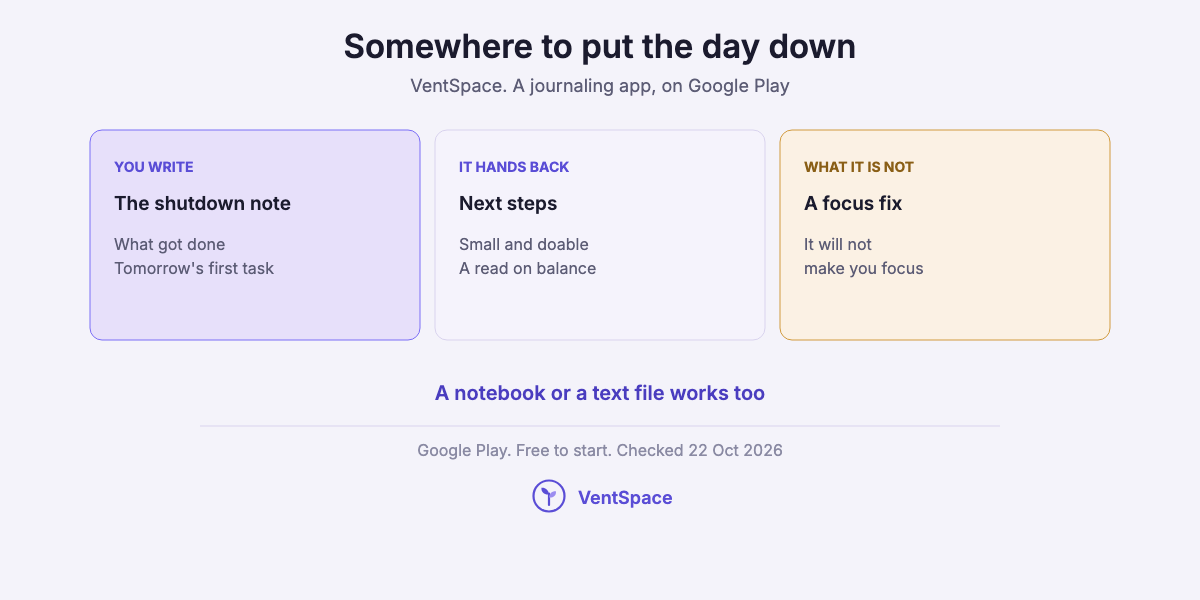
You can do your shutdown in a notebook or a text file, and our productivity journaling prompts give you questions to start from. If you would like somewhere that does something with what you write, VentSpace is a journaling app that turns what you write into a clear read on your life balance, plus small, doable next steps. It is free to start, on Google Play for Android (checked 22 October 2026). Not on Android, or at a desk? VentSpace Live runs in your browser, free, with nothing to install. It will not make you focus. It is a place to put the day down.
- What got done in the deep block today?
- What is the first task for tomorrow’s block?
- What is still open, and where is it written down?
- What phrase or act will mark the end of your workday?
Some days the deep block will not happen. Close the day anyway. The first task you write down is where tomorrow’s block starts.
Quick Summary
Q: How do you do deep work?
A: Pick one demanding task and a schedule you can keep, block the time in your calendar, put your phone in another room and tell people when you are unavailable, write a quick ready-to-resume note whenever you are pulled away, and end the day with a short shutdown ritual.
Insight: Cal Newport, describing a “monk mode morning” on his blog in 2017: “Between when you wake up and noon: no meetings, no calls, no texts, no email, no Slack, no Internet.” Most jobs cannot give up a whole morning. Almost any job can give up one hour of it, once, as an experiment.
Pulling it all together
Step 1 decides what the depth is for. Without one named task, a protected block turns into tidying. Write tonight’s task and its “done for today” sentence.
Step 2 gives it a place in the week. A block that lives only in your intentions gets eaten by the first message. Put one block in tomorrow’s calendar, at your sharpest hour.
Step 3 removes the easy exits. The phone in another room and the people who know your hours do more than willpower can. Tell one person when your block is.
Step 4 protects the work when the day interrupts it anyway. Interruptions will come. The note makes the return cheaper. Keep a pad or a file open for ready-to-resume lines.
Step 5 closes the loop. A day that ends deliberately gives unfinished work a written place to wait. Choose your end-of-day phrase.
Questions people ask about deep work
Does it take 23 minutes to refocus after an interruption?
No, and the number is often misquoted. It comes from a 2006 Gallup interview with Gloria Mark, who said that most interrupted work, 81.9 percent, was resumed the same day, on average in 23 minutes and 15 seconds, and that there were “about two intervening tasks” before people went back. It measures the time until people returned to the task, not the time it took their focus to recover. The cost of switching is real. That particular number describes something else.
Is deep work the same as flow?
No. Deep work is Cal Newport’s name for a kind of work and the conditions it needs: one demanding task, no distraction. Flow is Mihaly Csikszentmihalyi’s description of an experience, the absorbed state where effort and enjoyment meet. Deep work sessions can lead to flow, and often feel better when they do, but you can do deep work on a day it never arrives.
How long should a deep work session be?
There is no single right length. Newport has written that real depth needs two or three hours without distraction, and he aims for one six-to-seven-hour stretch a week himself. For a beginner, a 25-minute block is a reasonable start, which is the length Francesco Cirillo’s Pomodoro Technique uses. Lengthen it when the shorter block starts to feel easy.
Do I need to put my phone in another room?
Probably it helps, but the evidence is less certain than the headlines. A 2017 study found that a phone’s mere presence reduced available mental capacity. A 2022 preregistered replication did not find the effect, and a 2023 meta-analysis found an overall negative effect with wide variation. Using the phone during a session clearly costs you. Moving it is the simplest way not to.
Can I do deep work if my job needs me to reply quickly?
Yes, in smaller pieces. Find out what reply time is needed during a focus block, agree it with your manager or team, and protect even one hour a day. Write a ready-to-resume note whenever you are pulled away. If the job allows no uninterrupted time at all, that is a working condition, and worth raising as one.
In a nutshell
Deep work is mostly about conditions, and some of the conditions belong to your team. Choosing one task, blocking time, moving your phone and writing resume notes are yours. How quickly your workplace expects replies is shared, and worth talking about.
Nobody has measured how long the skill takes to build. Newport calls it a skill to cultivate, which means weeks, not one good morning. Judge it by the third week of blocks, not the first.
Tomorrow, try one block. Then notice how long you stayed under.
About this article

Written by
Sai Subramaniam
Founder, VentSpace
I write these guides because I have been where you are. I am working through my own hard seasons, and I share the things that actually helped me, so that anyone going through it has a steady companion close by instead of facing it alone. VentSpace is the app I built for exactly that: a journaling app that turns what you write into a clear read on your life balance, plus small, doable next steps toward feeling more like yourself.
This writing is honest and every claim is sourced, and it is not a substitute for professional care. If you are struggling, reaching out to a professional is a strong move, not a failure.
Explore VentSpaceTry VentSpace LiveHow this one was checked. Every factual claim traces to a named source, and the source is printed next to the claim rather than kept in a footnote. Quotes are pinned to the work they come from, with the year, the letter or the chapter where one exists. Where a widely repeated claim could not be traced, it was left out and the omission recorded. Where a figure is contested, both sides are printed.
No affiliate links, no paid placements, and nobody paid to appear here. Where we mention our own app, we say that it is ours, we state its limits, and we never position it as a substitute for care.
Reviewed: October 2026. Prices, platforms and product availability move quickly, and anything we could not verify at the time of writing is marked as unverified rather than turned into a number.
Corrections. If something here is wrong, we would rather know. Corrections are made in place, with a note saying what changed.