
“The title or combination of title and thumbnail with the highest watch time will be shown to all viewers.”
YouTube Help, “A/B test video titles and thumbnails” (read 29 October 2026)
Last updated: October 2026.
The thumbnail got redesigned three times, the title has a keyword at the front, and the video still sits at a few hundred views after a month. Meanwhile the Shorts tab shows numbers ten times larger that never turn into subscribers or long-form watch time. Is the channel packaged wrong, or is the content wrong?
Usually it’s the gap between the two. YouTube’s own tools judge packaging by what happens after the click. When you A/B test titles and thumbnails in YouTube Studio, the winner is the version with the highest watch time share, not the highest click-through rate, per YouTube Help (read 29 October 2026). YouTube’s search page names relevance, engagement and quality as its main ranking factors, and it defines engagement as signals such as the watch time of a particular video for a particular query. Its recommendations page says the system reads viewing behaviour, likes, dislikes, subscriptions and feedback “including from satisfaction surveys”.
On YouTube, the click only counts if the watch pays it back. Packaging earns the impression, the first 30 seconds keep it, and satisfaction earns the next one. That one law organises this guide: how YouTube says it decides, how Shorts and long-form feed each other, five steps for a channel you run as a marketer, how to read it in YouTube Analytics, and one bounded section on YouTube ads for consumer brands.
How we know: YouTube’s own documentation, read on 29 October 2026: the How YouTube Works recommendations page, YouTube Help pages on search, A/B testing, impressions and click-through rate, audience retention key moments, chapters, tags, Shorts length, Shorts views, related videos, the fake engagement policy and the YouTube Partner Program, plus the YouTube Official Blog (September 2021 and 14 July 2026) and Google Ads Help on Demand Gen. Audience data from Pew Research Center (5,022 US adults, February to June 2025). Paid measurement data from one vendor’s geo-holdout tests (Haus, 14 October 2026, number of tests not disclosed). Two first-party examples, labelled, from roles and channels I have run. The limit: YouTube lists signals, never weights, and has published no data on whether Shorts help or hurt a channel’s long-form views. Where this guide reads past the documentation, it says “my read”.
Quick Digest
– How YouTube decides: recommendations read viewing behaviour, likes, dislikes, subscriptions and survey feedback, and search ranks on relevance, engagement and quality. Watch time for the viewer decides even your own packaging tests.
– Shorts and long-form: Shorts run up to three minutes (uploads from 15 October 2024), count a view on every start since 31 March 2025, and can carry one clickable related-video link to your long-form.
– The five steps: give the channel one job, package before you film, earn the first 30 seconds, build for search where intent exists, and run Shorts as the top of the funnel.
– Measurement: impressions CTR for packaging, the Intro metric and retention for the first 30 seconds, traffic sources for the channel’s job, engaged views for Shorts.
– Paid: Video Action campaigns are gone, Demand Gen replaced them (final upgrades April 2026), and platform reporting under-credits YouTube in one vendor’s geo tests.
– The honest timeline: judge a channel strategy on two quarters of uploads, not on one video.
YouTube says it recommends for satisfaction, not for clicks or subscribers
“Understanding a user’s viewing behaviour, likes, dislikes, subscriptions and feedback, including from satisfaction surveys,”
How YouTube Works, “Recommendations” (read 29 October 2026)
YouTube recommends the video it predicts a particular viewer will value, reading their viewing behaviour, likes, dislikes, subscriptions and satisfaction-survey feedback, per its How YouTube Works page (read 29 October 2026). A click with no watch behind it is a weak signal, and a channel’s subscriber count is not named as a lever.
The most detailed public explainer is still from September 2021. In it, Cristos Goodrow, YouTube’s VP of Engineering, listed clicks, watch time, survey responses, sharing, likes and dislikes as the signals, and said only watch time that viewers rate four or five stars in surveys counts as “valued watchtime”. He also wrote that YouTube doesn’t connect viewers to content through their social network. Five years later the How YouTube Works page names the same family of signals, which is the best evidence that the design has held.
YouTube ranks differently on each surface, so it helps to keep them apart:
| Surface | What YouTube says decides it | What that means for you | Source, read 29 Oct 2026 |
|---|---|---|---|
| Home and Up next (recommendations) | Viewing behaviour, likes, dislikes, subscriptions, satisfaction surveys | Packaging gets the click, satisfaction earns the next impression | How YouTube Works, Recommendations |
| YouTube search | Relevance (title, tags, description and video content against the query), engagement (watch time for that query), quality (expertise, authoritativeness and trustworthiness on the topic) | A query-matching title is necessary, not sufficient | YouTube Help, “How YouTube search works” |
| Search personalisation | Search and watch history, when the viewer has it on | Two people see different results for the same query, so rank checks from your own account mislead | YouTube Help, “How YouTube search works” |
| Shorts feed | Shorts appear in a swipe feed, and a view counts on every start or replay since 31 March 2025 | Raw Shorts views no longer tell you anyone watched | YouTube Help, “Get started creating YouTube Shorts” |
Here’s the reason the click-chasing playbook stalls. A misleading thumbnail can lift impressions click-through rate for a day, but if viewers leave, the watch time and survey signals that the system reads next go the other way. YouTube’s own A/B tool won’t even pick the higher-CTR version if it loses on watch time share.
The condition that splits this advice is how viewers arrive. A browse-led channel (entertainment, commentary, consumer products that show well on video) lives on Home and Up next, where packaging and satisfaction carry everything. A search-led channel (tutorials, software walkthroughs, B2B explainers) lives on queries, where relevance comes first and engagement for that query decides the order. If you run a brand channel, it is probably search-led at the start, because nobody browses into a brand they haven’t heard of, unless the brand already has a following elsewhere.
What none of this tells you is the weighting. YouTube lists signals and never publishes how much each counts, and it can change them without notice.
Satisfaction is the target. Clicks are the entry fee.
Quick Summary
Q: How does the YouTube algorithm decide what to recommend?
A: YouTube says it predicts which video a particular viewer will value, using viewing behaviour, likes, dislikes, subscriptions and satisfaction-survey feedback (How YouTube Works, read October 2026). Search ranks on relevance, engagement for the query and quality. Subscriber count and raw clicks are not named as levers.
Insight In YouTube’s September 2021 explainer, Cristos Goodrow wrote that the system uses “over 80 billion” signals and that only watch time rated four or five stars in viewer surveys counts as valued watchtime. YouTube Official Blog, “On YouTube’s recommendation system” (15 September 2021). The survey layer is the part a packaging trick can’t game.
Shorts and long-form are two formats on one channel, and the link between them is yours to build
“may never naturally click on a 10-minute video.”
Julia Lee Harter, YouTube Official Blog, on Shorts-only viewers (14 July 2026)
Shorts and long-form share a channel but not an audience by default. YouTube’s own blog said in July 2026 that some Shorts viewers may never click a 10-minute video on their own, and its answer is a deliberate bridge: the related video link, a clickable link on a Short that sends viewers to a video on your channel.
The Short itself changed twice in six months. From uploads on 15 October 2024, a square or vertical video up to three minutes long counts as a Short, per YouTube Help. From 31 March 2025, a Shorts view counts every time a Short starts to play or replay, with no minimum watch time, and the older metric lives on as engaged views. Any Shorts comparison across that date is broken unless it uses engaged views.
What YouTube gives you to connect the two formats, all per YouTube Help, read 29 October 2026:
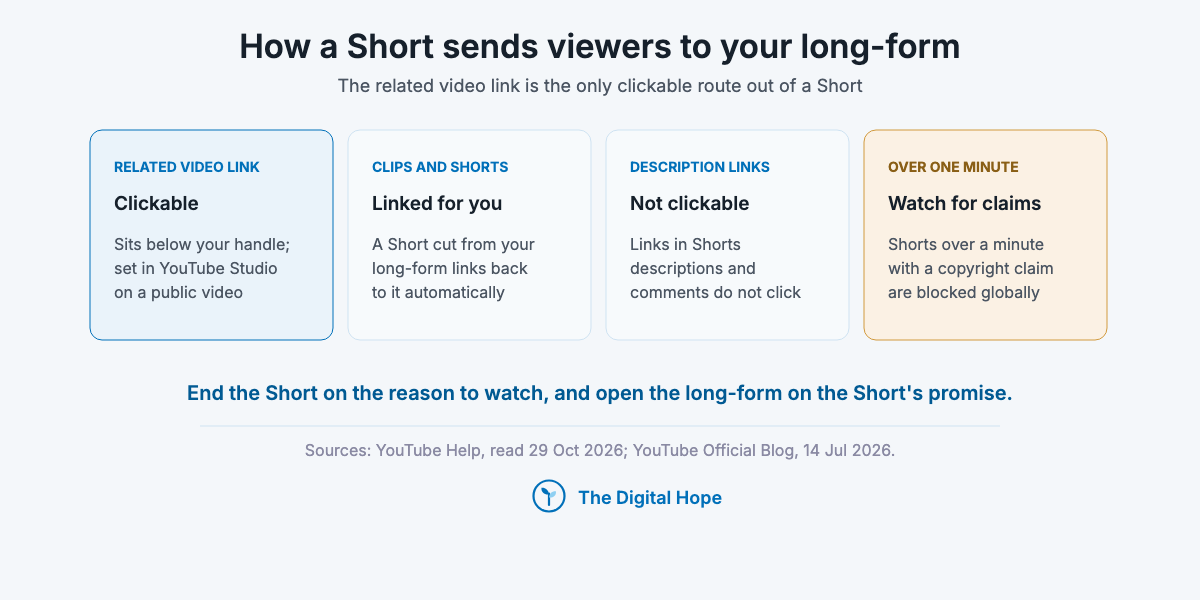
- The related video link sits below your channel handle in the Shorts player and is clickable. You add it in YouTube Studio, under Content, on a public or unlisted video, and it needs advanced feature access.
- Shorts cut from your own long-form with the Clips and Shorts tool in Studio get the source video added as the related video automatically, unless the Short is private, unlisted or made for kids.
- Links in Shorts descriptions and comments are not clickable, which YouTube says is to reduce spam and scams. The related video link is the only clickable route.
- Shorts over one minute with an active copyright claim are blocked globally, so a three-minute Short built on licensed music is a risk a 50-second one is not.
Whether posting Shorts hurts your long-form views is an open question. YouTube has published no data either way, and the July 2026 blog post doesn’t address it. My read: the formats are ranked on different surfaces, so a Short competes with other Shorts, not with your long-form. The real risk is a Shorts audience that never watches long-form, which shows up as a subscriber count that rises while long-form views per upload stay flat. Read the split in Analytics before deciding Shorts are working.
The buyer decides how much Shorts carry. For a consumer brand with a product that shows in seconds, Shorts can be the main surface and long-form the depth. For a B2B or explainer channel, Shorts work as trailers for long-form answers, and the related video link is the whole point of making them. How Shorts sit beside Instagram Reels and TikTok in a wider plan is covered in the organic social media marketing guide.
Quick Summary
Q: Do YouTube Shorts help or hurt long-form videos?
A: YouTube has published no data on it. Shorts and long-form are recommended on different surfaces, and YouTube’s own advice (July 2026) is to bridge them with the related video link, which sends Shorts viewers to a video on your channel. Measure the split in Analytics before deciding.
Insight YouTube Help, “Get started creating YouTube Shorts” (read 29 October 2026): “Starting 3/31/2025, we’re updating how Shorts views are counted. Views will count the number of times a Short starts to play or replay, with no minimum watch time requirement.” Since then, a Shorts view is a play, not a watch. Read engaged views when you judge a Short.
Here is what a channel built on this looks like, week to week.
How to grow a YouTube channel in five steps
“Your video’s title, thumbnail, and description are more important pieces of metadata for your video’s discovery.”
YouTube Help, “Add tags to your YouTube videos” (read 29 October 2026)
A marketing channel grows when each upload is packaged for one viewer, keeps them past the opening, and points them to the next video. The five steps below run in that order, each with a first action in YouTube Studio or YouTube Analytics. They assume a channel you run for a business, with a few uploads a month, not a full-time creator schedule.
1. Give the channel one job, and one viewer
First action: open YouTube Analytics, go to the Reach tab and write down your top three traffic sources for the last 90 days. If YouTube search leads, your channel is search-led today. If browse features and suggested videos lead, it’s browse-led.
The audience is rarely the constraint. In Pew Research Center’s 2025 survey of 5,022 US adults (February to June 2025), 84% used YouTube, the highest share of any platform in the report. So the question for most consumer and B2B channels is how viewers arrive, not whether they are there.
Then write one sentence: “This channel helps [viewer] do [job], and a good month is [metric].” For a search-led channel the metric is views from YouTube search on the queries you chose. For a browse-led channel it’s returning viewers and watch time per upload.
Skip this step only when the channel already has a single format and audience that work. Re-run it the day you add a second audience.
- Could a new viewer tell from your last five titles who the channel is for?
- Do your top three traffic sources match the job you wrote down?
- Are you making two channels’ worth of topics under one name?
- Which of your videos would you send a buyer, and does it get search traffic?
- What do viewers ask for in your comments, and in the comments under the top videos on your topic?
Be honest about which kind of channel you have. Most brand channels start search-led.
2. Package the video before you film it
First action: write the title and sketch the thumbnail before you script. If you can’t state the promise in the title in under ten words, the video doesn’t have one yet.
Packaging is a promise the first minute has to keep. YouTube’s A/B test for titles and thumbnails, in YouTube Studio on desktop with advanced features, lets you test up to three titles, three thumbnails or both, and shows the version with the highest watch time share to all viewers, per YouTube Help. Tests usually finish within two weeks, Shorts are excluded, and changing the title or thumbnail mid-test stops it.
Read click-through rate against the right baseline. YouTube Help says half of all channels and videos have an impressions click-through rate between 2% and 10%, warns against judging CTR right after upload, and notes that impressions on external sites and end screens aren’t counted. A 4% CTR can be healthy when you run a search-led channel, and a falling CTR as a video reaches a wider, colder audience is normal.
- Does the thumbnail show the outcome, not the setup?
- Does the title use the words the viewer would search, if the channel is search-led?
- Would a viewer feel misled at 0:30?
- Is the title different enough from your last three that the viewer can tell them apart?
Don’t overthink the first version. The test exists so you don’t have to guess.
3. Earn the first 30 seconds
First action: open your last five long-form videos in YouTube Analytics, go to the audience retention report, and note the Intro figure for each: the percentage of viewers still watching after the first 30 seconds, per YouTube Help on key moments.
The opening’s job is to confirm the click was right. State the promise of the title in the first sentence, show the outcome early, and cut the channel intro, the sponsor read and the “before we start” housekeeping out of the first 30 seconds. In the retention graph, dips mark where viewers abandon or skip and spikes mark parts they rewatch or share, per the same page, so the graph tells you what to cut next time.
Compare against your own channel first. YouTube’s typical retention view compares a video with your 10 latest videos of similar length, and its wider comparison is against videos of similar length across YouTube. Length is the baseline YouTube itself uses, so a 25-minute video and an 8-minute one should never be judged on the same retention number.
Add chapters if you publish anything over a few minutes long. Manual chapters need a first timestamp at 00:00, at least three timestamps in ascending order and a minimum chapter length of 10 seconds, per YouTube Help. Chapters let a viewer skip to the part they came for instead of leaving.
- Does the first sentence repeat the title’s promise in plain words?
- Where is the first dip, and what is on screen at that second?
- Is anything in the first 30 seconds there for you rather than the viewer?
- Would a chapter list let a viewer find their answer without leaving?
You will cut things you liked. That’s the job.
4. Build for YouTube search where the intent exists
First action: in YouTube Analytics, open Reach, select the YouTube search traffic source and export the search terms for the last 90 days. These are the queries viewers already used to find you.
YouTube search ranks on relevance, engagement and quality, in that order on the help page, and relevance reads the title, tags, description and the video content itself against the query. Engagement means watch time for that query, so a video that matches the words but loses viewers in the first minute drops. Quality means signals of expertise, authoritativeness and trustworthiness on the topic, which favours channels with a body of work on one subject.
Tags play a minimal role. YouTube Help says tags help mainly when a topic is commonly misspelled, and that title, thumbnail and description matter more for discovery. Adding excessive tags to a description is against YouTube’s spam policies, per the same page. So write the description for the viewer: what the video answers, the chapters, and links to the next video.
Search is personalised by watch and search history, so checking your own rank from your own account tells you little. Use the search terms report instead.
This is the step where the old SEO habits transfer best. In one role I held, Senior SEO Analyst at Galvanize Test Prep, an EdTech company, from June 2020 to September 2022, YouTube SEO sat inside the same remit as the website and app store optimisation. The result I can publish from that period is a website number (organic visitors from about 4,000 to 28,000+ a month, per my portfolio), not a YouTube one, and I don’t have a YouTube-only figure to share. My read, not a measured finding: the query research transfers, because the search terms report shows the same kind of plain questions a site’s Search Console does.
- Which three queries in the search terms report have the most views and the shortest watch time?
- Does each target query have one video that answers it directly in the first minute?
- Does the description say what the video answers, in the viewer’s words?
- Are two of your videos competing for the same query?
If you run a browse-led channel, this step is a light touch. Don’t force search titles onto entertainment.
5. Run Shorts as the top of the funnel
First action: pick your three best-performing long-form videos, cut one Short from each with the Clips and Shorts tool in YouTube Studio, and check that each Short carries its source video as the related video, per YouTube Help.
A Short earns its keep when it sends viewers somewhere. YouTube’s July 2026 blog guidance is to put a clear call to action in the final five seconds of the Short and to open the linked long-form video on the exact topic the Short promised, so the viewer who clicks through is rewarded straight away. A Short about one tip should link to the full tutorial on that tip, not to the channel’s most popular video.
Judge Shorts on engaged views and on what happens next. Since 31 March 2025 a Shorts view counts on any start, so read engaged views, and check how many viewers reached the related video from the Short.
The condition is your product. For B2C brands with a product that shows in seconds, Shorts can run as a standalone channel and long-form is optional. For B2B and explainer channels, make fewer Shorts, each cut from a long-form answer and linked back to it.
- Does each Short end on the reason to watch the long-form?
- Does the long-form open on the Short’s promise?
- Are you comparing Shorts made after 31 March 2025 with older ones on engaged views?
- Is any Short over one minute using claimed music?
Start with three. A pattern needs a handful, not one.
Quick Summary
Q: How do you grow a YouTube channel as a marketer?
A: Give the channel one job and read your traffic sources, package the title and thumbnail before filming and A/B test them on watch time share, keep viewers past the first 30 seconds, write for YouTube search where your viewers search, and cut Shorts from long-form with the related video link pointing back. Judge it over two quarters.
Insight YouTube Help, “Impressions & click-through-rate FAQs” (read 29 October 2026): “Half of all channels and videos on YouTube have an impressions CTR that can range between 2% and 10%.” The same page warns that the suggestions reflect aggregate patterns and don’t guarantee any outcome for a specific channel. A CTR baseline is a range, not a target.
Measure a YouTube channel in YouTube Analytics, metric by question
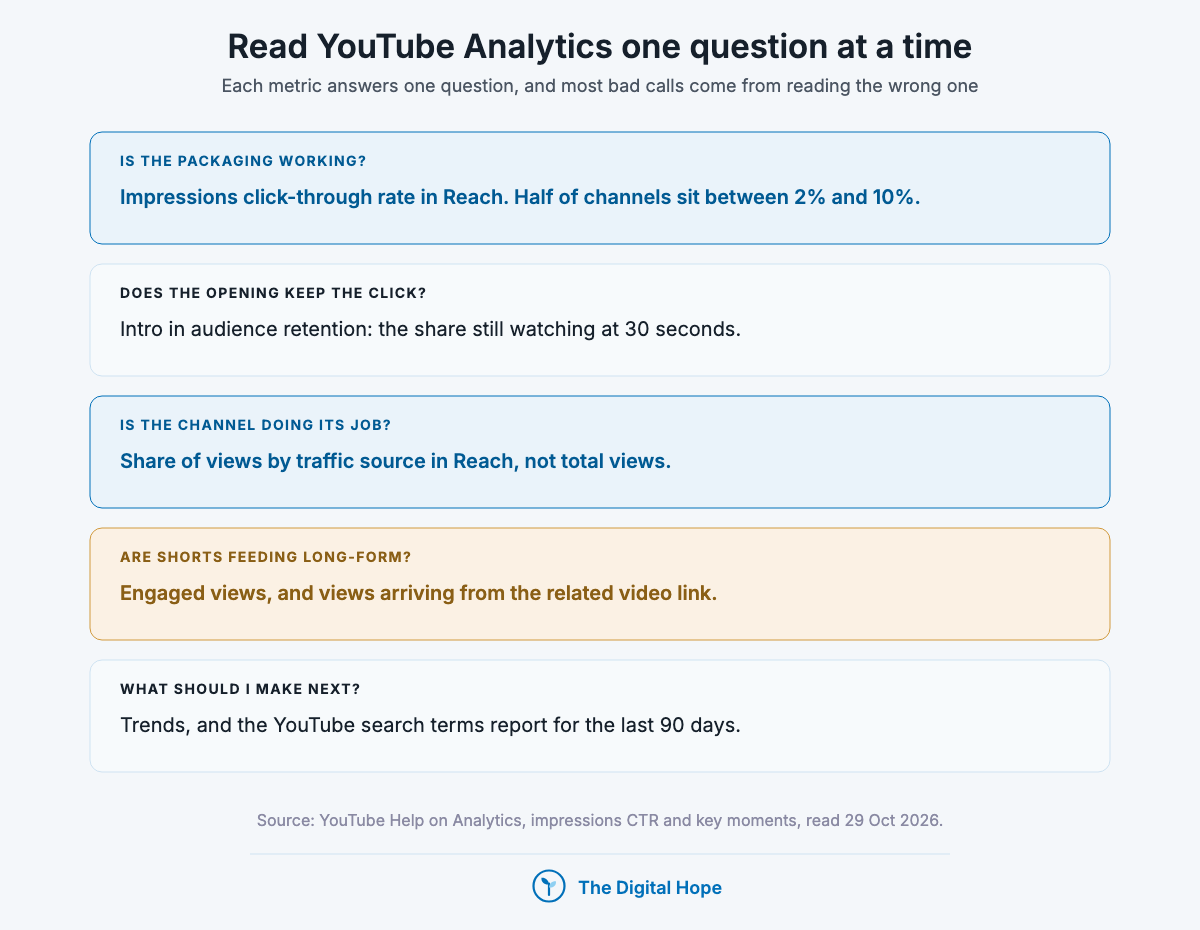
Each YouTube Analytics metric answers one question, and most bad decisions come from reading the wrong one. YouTube Help lists the Analytics tabs as Overview, Content, Reach, Engagement, Audience, Revenue for Partner Program members, and Trends (read 29 October 2026). The table maps the question you have to the metric that answers it.
| Your question | Metric to read | Where | What misleads |
|---|---|---|---|
| Is the packaging working? | Impressions click-through rate, after a substantial number of impressions | Reach | CTR in the first hours, or CTR compared across formats |
| Does the opening keep the click? | Intro (% still watching at 30 seconds), retention dips | Per-video analytics, audience retention | Average view duration across videos of different lengths |
| Is the video better than my usual? | Typical retention against your 10 latest videos of similar length | Per-video analytics, audience retention | Comparing against channels in other niches |
| Is the channel doing its job? | Share of views by traffic source (search vs browse vs suggested vs Shorts feed) | Reach | Total views |
| Am I building an audience? | New, casual and regular viewers | Audience | Subscriber count alone |
| Are Shorts feeding long-form? | Engaged views, and views arriving from the related video link | Content, filtered by type | Shorts views after 31 March 2025 |
| What should I make next? | Trends, and the YouTube search terms report | Trends, Reach | Your own guesses about demand |
Subscribers are a lagging number. They follow good videos and don’t, on YouTube’s own statements, decide recommendations. The one point where the count matters is the YouTube Partner Program: 1,000 subscribers plus either 4,000 qualified public watch hours in 12 months or 10 million qualified Shorts views in 90 days, per YouTube Help (read 29 October 2026). Watch hours from Shorts in the Shorts feed don’t count toward the 4,000.
Perspective TV, one of the YouTube channels I run myself, has passed 1,000 subscribers, per my portfolio. That’s a small channel and one data point, and I cite it for one reason: at that size, the useful numbers are the per-video ones in the table above, because a few hundred subscribers more or less changes nothing about what the next upload should be.
Use the right time window. A single video can find its audience weeks after upload through search or suggested views, so read new uploads at 28 days, and read the channel by quarter.
Read per video, decide per quarter.
Quick Summary
Q: Which YouTube Analytics metrics matter most?
A: Impressions click-through rate for packaging, the Intro metric and retention for the first 30 seconds, typical retention against your own similar-length videos, traffic sources for whether the channel does its job, new and returning viewers for audience, and engaged views for Shorts. Subscribers lag.
Insight YouTube Help, “Measure key moments for audience retention” (read 29 October 2026): “Intro tells you what percentage of your audience still watched your video after the first 30 seconds.” It is the closest thing YouTube offers to a packaging check, because it measures whether the click got what the title promised.
YouTube ads for consumer brands: Demand Gen, and why the platform under-reports it
For consumer advertisers, YouTube conversion campaigns now run as Demand Gen. Google removed the option to create Video Action campaigns in April 2025, started upgrading existing ones to Demand Gen in July 2025, and finished the final upgrades by April 2026, per Google Ads Help (read 29 October 2026).
What Demand Gen gives a consumer advertiser, per the same page:
- Inventory beyond YouTube: Discover, Gmail and the Google Display Network, with YouTube Shorts among the placements.
- Lookalike segments built from your own first-party seed list.
- Conversion bidding: Maximize conversions, Target CPA, Maximize conversion value and Target ROAS, plus Maximize clicks for advertisers without conversion goals.
The measurement problem is the bigger decision. In Haus’ geo-holdout tests of ecommerce brands (published 14 October 2026, number of tests not disclosed), the incremental direct-to-consumer sales from YouTube were typically 2.3 times what Google Ads reported (80% interval 1.7x to 2.9x), down from 3.4x in its March 2025 edition, and Demand Gen tests indexed at about 0.98x of the same brands’ other channels, with a larger Amazon and retail halo. That’s one vendor’s customers and an undisclosed sample, so read it as direction: YouTube is more likely to be under-credited by in-platform reporting than over-credited.
The condition that decides whether to run it is conversion volume and a way to measure lift. A consumer brand with steady conversions and the budget to run a geo holdout can judge YouTube fairly. If you judge it on in-platform conversions alone, unless your volume is high enough to read a holdout, you will probably cut it too early. The campaign, ad set and ad levels that apply here are covered in the performance marketing fundamentals guide, and the same page is where B2B video sits, because a B2B buyer is a different question with different volume.
My read: give YouTube ads the measurement plan before the budget.
Quick Summary
Q: What replaced Video Action campaigns on YouTube?
A: Demand Gen. Google removed Video Action campaign creation in April 2025 and upgraded the last ones to Demand Gen by April 2026 (Google Ads Help, read October 2026). Demand Gen adds Discover, Gmail and Display inventory, lookalike segments and conversion bidding, and its results need a lift test, because one vendor’s geo tests found YouTube under-reported in-platform.
What stopped being true
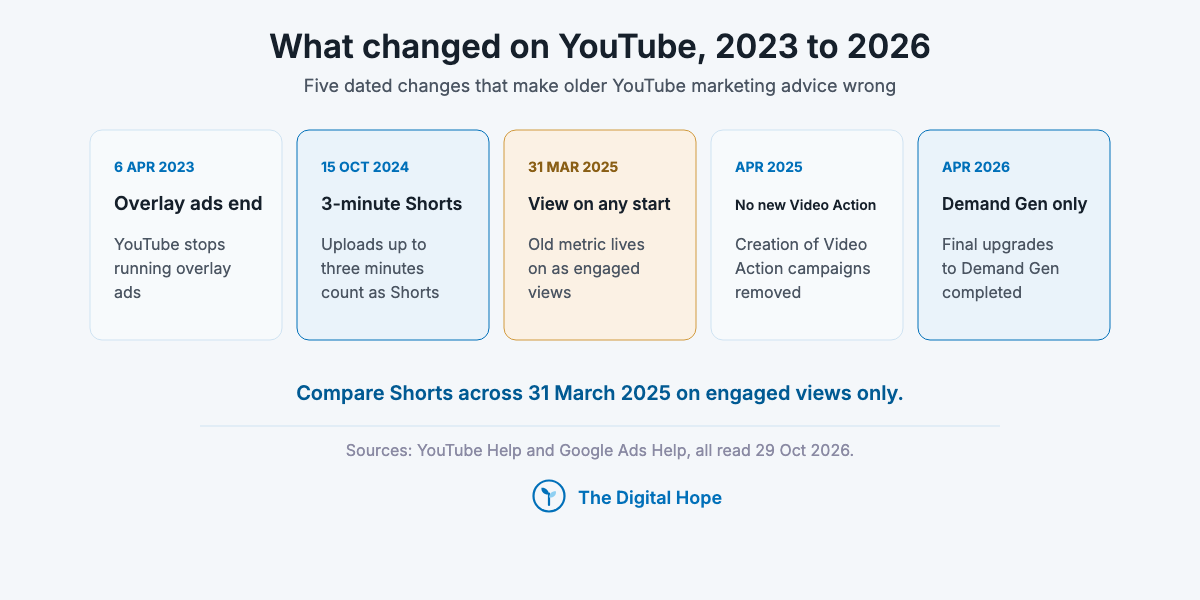
| What | When | Primary source |
|---|---|---|
| Tags as a main YouTube ranking lever | Tags “play a minimal role” in discovery, mainly for misspellings | YouTube Help, “Add tags to your YouTube videos”, read 29 October 2026 |
| Shorts capped at 60 seconds | Up to three minutes for uploads from 15 October 2024 | YouTube Help, Shorts length page, read 29 October 2026 |
| A Shorts view meaning someone watched | Any start or replay counts from 31 March 2025, the old metric is “engaged views” | YouTube Help, read 29 October 2026 |
| Links in Shorts descriptions as a traffic route | Not clickable, the related video link is the clickable route | YouTube Help, “Add a related video to your YouTube Shorts”, read 29 October 2026 |
| Picking the thumbnail with the best CTR | YouTube’s A/B tool picks the title and thumbnail with the highest watch time share | YouTube Help, read 29 October 2026 |
| Video Action campaigns for YouTube conversions | Creation removed April 2025, final upgrades to Demand Gen by April 2026 | Google Ads Help, read 29 October 2026 |
| Overlay ads | YouTube stopped running overlay ads on 6 April 2023 | YouTube Help, “YouTube advertising formats”, read 29 October 2026 |
| Bots, bought views and “sub4sub” swaps | Prohibited under YouTube’s fake engagement policy | YouTube Help, fake engagement policy, read 29 October 2026 |
Pulling it all together
One job for the channel. Read your top three traffic sources in Reach and write the sentence that names the viewer, the job and the metric.
Packaging before production. Write the title and sketch the thumbnail before the script, then A/B test up to three versions and let watch time share pick.
The first 30 seconds. Note the Intro figure for your last five videos and cut whatever sits before the first dip on the next upload.
Search where it exists. Export the YouTube search terms for 90 days and give your top three queries one direct answer each.
Shorts that point somewhere. Cut three Shorts from your best long-form videos, check the related video link on each, and read engaged views.
Measurement by question. Put the seven questions from the Analytics table in a sheet and fill it per video at 28 days.
Frequently asked questions
What is a YouTube marketing strategy? It is a plan that gives a channel one job for one viewer, packages each video around a promise the opening keeps, uses YouTube search where viewers search, connects Shorts to long-form, and measures each step in YouTube Analytics. Paid video sits beside it with its own measurement plan.
Are tags important for YouTube SEO? No, not much. YouTube Help says tags play a minimal role in discovery and help mainly with commonly misspelled topics, while the title, thumbnail and description matter more. Excessive tags in a description break YouTube’s spam policies.
Do longer videos rank better on YouTube? Not on YouTube’s own statements. YouTube describes engagement as watch time for a particular query and satisfaction for a particular viewer, and it benchmarks retention against videos of similar length. A video should be as long as the answer, and no YouTube document names length as a ranking factor.
Should a business channel post Shorts? Yes, if each Short is cut from a long-form answer and carries the related video link back to it, or if the product shows well in seconds. YouTube has published no data saying Shorts hurt long-form views, so watch the split between Shorts and long-form audiences in Analytics.
Is it against the rules to ask viewers to subscribe? No. YouTube’s fake engagement policy allows encouraging viewers to subscribe, like, share or comment. What it prohibits is artificial inflation: bots, bought views or subscribers, services that inflate metrics, and “sub4sub” swaps.
How many subscribers do you need to make money on YouTube? 1,000 for the YouTube Partner Program, plus either 4,000 qualified public watch hours in 12 months or 10 million qualified Shorts views in 90 days, per YouTube Help (read October 2026). For a business channel, monetisation is rarely the point unless the channel is the product.
In a nutshell
On YouTube, the click only counts if the watch pays it back. YouTube’s own A/B tool picks packaging on watch time share, its search ranks on engagement for the query, and its recommendations read satisfaction surveys. So the channel that grows is the one whose titles promise what the first 30 seconds deliver, whose Shorts lead somewhere, and whose metrics are read per question.
Give it two quarters of uploads before you judge it. If you publish two long-form videos and four Shorts a month, that is about 36 uploads, enough to see which traffic source carries the channel and whether Shorts feed long-form. If neither moves after two quarters, change the viewer or the job before you change the thumbnails. What would change this call is YouTube publishing data on how Shorts affect long-form, which it has not done as of October 2026.
About this article

Written by
Sai Subramaniam
SEO, GEO and Paid Ads Manager · 8+ years in growth marketing
I have run SEO, paid media and ABM for B2B AI companies, consumer apps and live-entertainment brands, from a solo operator at an AI infrastructure company to a team of 20 recovering a million-visitor site after a Google update. I write these guides from that work, and every number in them carries its source.
See my portfolioConnect on LinkedInHow this one was checked. Every number traces to a named source with its dataset and period, and every platform feature, policy or limit cites the platform’s own documentation with the date it was verified. Where the author’s own results appear, they are labelled as one account’s results, with the budget and context, not as a rule.
No affiliate links and no paid placements. Tools are named because they are what practitioners use, not because anyone paid to appear here.
Reviewed: October 2026. Ad platforms and search features change every few months; anything we could not verify at the time of writing is marked as unverified rather than turned into a number.
Corrections. If something here is wrong or has changed since, we would rather know. Corrections are made in place, with a note saying what changed.