
Open your phone and look at the last self-care app you installed. Check the store page, under “In-App Purchases”, and see how long the list is. That takes about forty seconds and it will tell you more than the review that sent you there.
You downloaded it because it said free.
For three or four days it was. Then you reached for the one thing you actually came for, the sleep story or the pattern view or the second habit, and there was a small friendly wall with a price on it. Not a scam. Not hidden, exactly. Just not what you understood the word to mean when you tapped install.
And then there is the second thing, which nobody puts in these lists at all. The apps with no wall are being paid some other way. Not all of them, and not always badly, but never by nothing, and that is worth knowing before you type anything honest into one.
So this page does three things. It sorts fifteen apps into four tiers of free, it maps exactly where each wall falls, and it hands you a two-minute check you can run on any app, including ones that do not exist yet.
Before any of that, one question, and it is worth answering for yourself rather than reading past.
What do you actually mean by free?
Do not overthink it. There is a right answer for you and it is probably one of four.
The short version
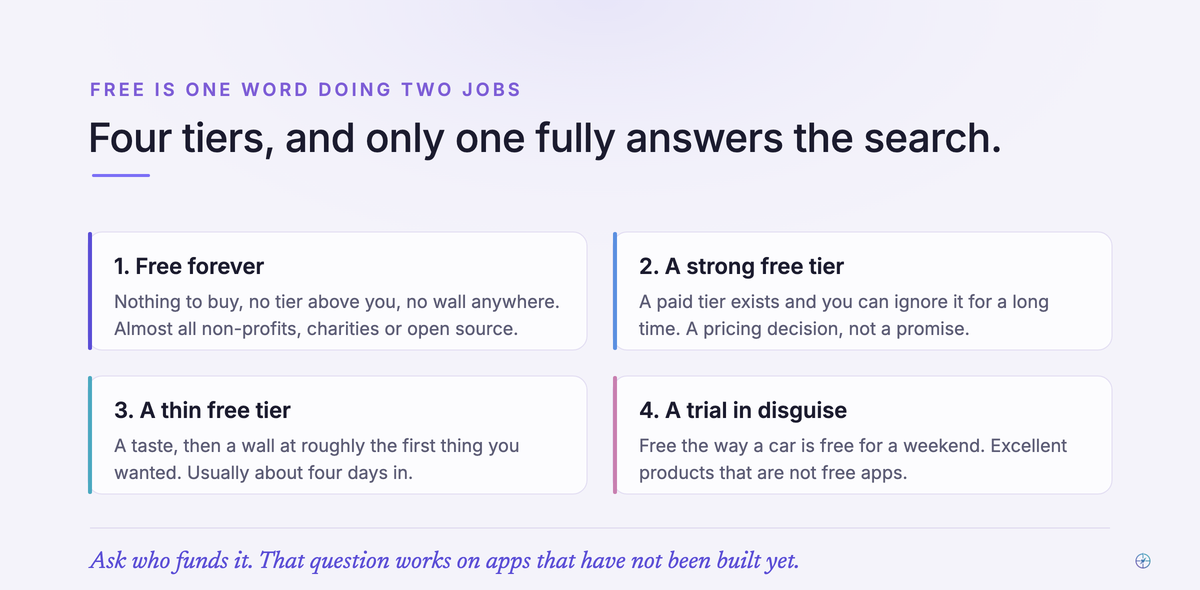
Free is one word doing two jobs. Free forever with no in-app purchases is a different product from a free tier.
Four tiers, and only the first fully answers this search: free forever, strong free tier, thin free tier, and trial in disguise.
The genuinely-free-forever apps are almost all non-profits, charities or open source. That is the most useful pattern on this page, and it works on apps invented after it.
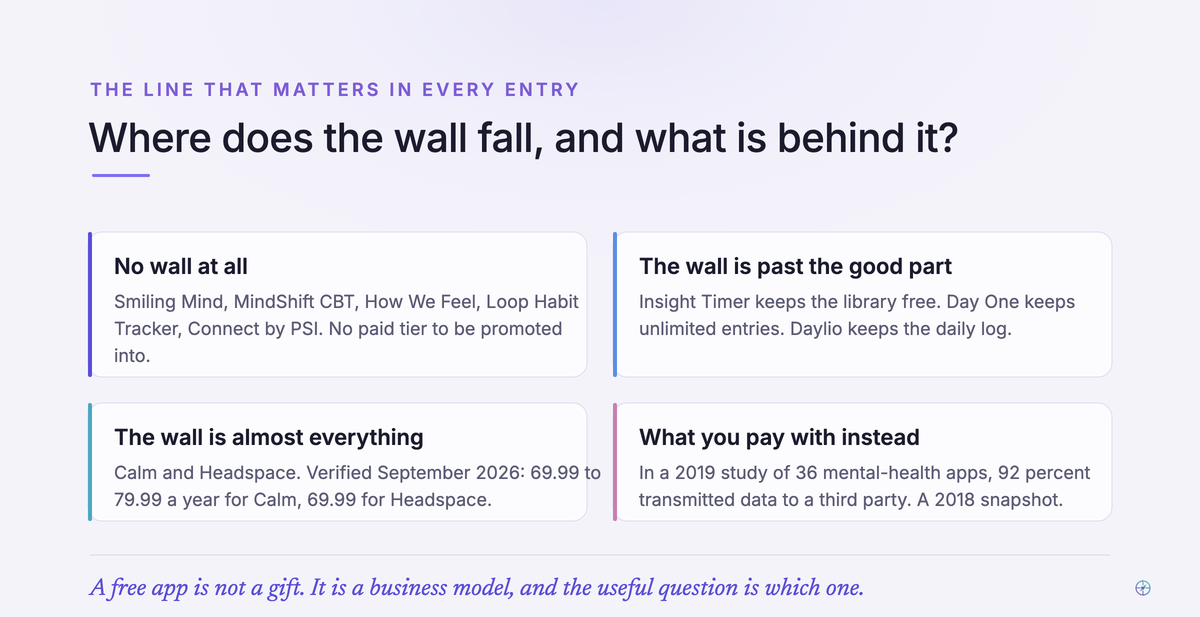
If you are not paying, something else is. In a 2019 study of 36 mental-health apps, 92% transmitted data to a third party, with caveats worth reading.
A free tier is a commercial decision, not a promise. Do not build a two-year habit on one free feature with no fallback.
The two-minute check at the end outlasts every price in this article.
Please read this part first
This is a roundup of tools, not treatment, and we are not clinicians. Therapy is an ordinary option, and cost is a real barrier for a lot of people, so sliding-scale and community routes are worth asking about rather than assuming out of reach. If you are in crisis or thinking about harming yourself, please reach out now: in the US, call or text 988 for the Suicide & Crisis Lifeline, free and any hour. Outside the US, findahelpline.com lists the equivalent where you are.
What do you actually mean by free?
Four different things, and the search that brought you here almost certainly means the first one.
- Free forever, no in-app purchases. Nothing to buy, no tier above you, no wall anywhere. The only group that fully answers the query.
- A free tier that genuinely carries you. A paid tier exists and you can ignore it for a long time, or permanently.
- A thin free tier. A taste, then a wall at roughly the first thing you wanted.
- A trial in disguise. Free the way a car is free for a weekend.
All four get filed together under one word, and the difference only shows up about four days in, at the feature you downloaded the thing for. That is the entire problem this page exists to fix.
It is also worth widening the word slightly before the shopping starts. The World Health Organization defines self-care as “the ability of individuals, families and communities to promote and maintain their own health, prevent disease, and to cope with illness, with or without the support of a health or care worker.”
Nothing in that definition is a software category. Which is a useful thing to have said out loud on a page about apps, and it licenses the last section of this one.
Quick Summary: what free means here
Q: What is the difference between a free app and a free tier?
A: A free app has nothing to buy. A free tier is the unpaid level of a paid product, and the wall usually sits at the feature you came for. This page sorts fifteen apps into free forever, strong free tier, thin free tier, and trial in disguise, and states exactly where each wall falls.
Insight: the definition worth borrowing
The World Health Organization describes self-care as “the ability of individuals, families and communities to promote and maintain their own health, prevent disease, and to cope with illness, with or without the support of a health or care worker.” That is broader and less commercial than the way the app category uses the word, and it is worth keeping in view while reading a list of downloads, because most of what it describes is free in a way no app is.
If you are not paying, what are you paying with?
Attention, sometimes. Data, frequently. This is the half of the question the rest of the internet leaves out, and it belongs before the list rather than after it.
So what is the actual arrangement when nothing is being charged? The clearest evidence available is Huckvale, Torous and Larsen (2019) in JAMA Network Open. They examined 36 apps, and found that 25 of 36 (69%) had a privacy policy at all. Of those that did, 88% described primary data uses but only 64% described secondary uses. They detected third-party data transmission in 33 of 36 (92%), and 29 of 36 (81%) transmitted data to Google and/or Facebook for advertising, marketing or analytics.
Two caveats, and they matter as much as the numbers.
It is a January 2018 app-store snapshot. Practices, policies and regulation have all moved since, in some places substantially.
It covered apps for depression and smoking cessation, not self-care apps specifically. It is the nearest available evidence on this question rather than a perfect match, and it should be read as a fact about how this kind of software has behaved as a category.
And a rule this article holds to: none of that is a statement about any app named on this page. The finding is categorical. Applying it to a specific product would be both unsupported and unfair, and we are not doing it. What the study licenses is a general expectation, not an accusation.
The plain version. A free app is not a gift. It is a business model, and the useful question is which one. When the answer is “a non-profit funds it” or “volunteers wrote it”, that is a different business model from “advertising”, which is why the pattern in tier one below is the most useful thing on this page.
Quick Summary: what free apps cost
Q: If a self-care app is free, what am I paying with?
A: Frequently data. In a 2019 study of 36 mental-health apps, 92% transmitted data to a third party and 81% transmitted to Google and/or Facebook for advertising, marketing or analytics, with only 69% having a privacy policy at all (Huckvale, Torous & Larsen, 2019). That was a January 2018 snapshot of depression and smoking-cessation apps, so read it as a pattern in the category rather than a claim about any named product.
Insight: the number to hold on to
Twenty-five of thirty-six apps had a privacy policy. Thirty-three of thirty-six transmitted data to a third party. Set those two next to each other and the gap is the point: more apps were sharing data than were explaining themselves. That is a 2018 picture of a specific slice of the category, and it is still the best reason to prefer an app whose funding you can name.
Free tiers move
Short section, because the point is small and important.
What happens if the thing you rely on moves behind a wall next spring? A free tier is a commercial decision, not a promise. Products get repriced. Features that were free for three years move up a tier when somebody looks at the numbers, and nothing about that is a betrayal. It is a company changing its mind about a thing it always owned.
We are not naming an example, because the one we had was one blog deep and printing a dated claim about another company’s pricing on that basis is exactly the sloppiness this page is arguing against. The pattern itself is uncontroversial and every long-time user of anything has seen it.
The practical implication is not cynicism. It is one sentence. Do not build a two-year habit on a single free feature without knowing what you would do if it moved. Which usually means: prefer tier one when you can, and export your data occasionally when you cannot.
Quick Summary: will it stay free
Q: Can a free app start charging later?
A: Yes, and it happens routinely, because a free tier is a pricing decision rather than a commitment. The safest options are the ones with no paid tier to be promoted into, which in practice means non-profits, charities and open-source projects. Everywhere else, check that you can export your data before you build a long habit on it.
How we judged them
Five questions, and the second one is the article.
- Which of the four tiers is it, exactly?
- Where is the wall, and what is behind it? The single most useful line in every entry below.
- What does it cost a year if you cross? Stated where we could confirm it, flagged where we could not.
- What does it say about your data? Reported plainly, and left blank rather than guessed where we could not check.
- Does it run on the phone you own?
Before the tiers, answer these five for yourself. They take a minute and they decide which section you should actually be reading.
- Would I ever pay for this, honestly? If the answer is no, only tier one applies to you.
- What is the one feature I am downloading this for? Name it, because that is where the wall usually sits.
- How much of my own writing am I going to put in? The more honest it gets, the more the funding question matters.
- Am I on iOS or Android? Three entries here are one platform only.
- What would I do if this stopped being free next spring? If there is no answer, prefer tier one.
Prices marked verified were read off the App Store listing in September 2026. Everything else is marked [unverified] and is a description rather than a number. We are not clinicians and this is not a clinical assessment. Nobody paid, there are no affiliate links, and our own app is not on the list for the reason given further down.
The fifteen at a glance
| App | Tier | Where the wall is |
|---|---|---|
| Smiling Mind | Free forever | No wall. Non-profit |
| MindShift CBT | Free forever | No wall. Built by Anxiety Canada, now sold by a company |
| How We Feel | Free forever | No wall. Non-profit |
| Loop Habit Tracker | Free forever | No wall. Open source, Android only |
| Connect by PSI | Free forever | No wall. Postpartum Support International |
| Insight Timer | Strong free tier | Offline downloads and courses. $59.99/yr verified |
| Daylio | Strong free tier | More moods, backups, some analysis [unverified] |
| Day One | Strong free tier | Multi-device sync and extras. Free tier is unlimited entries |
| Finch | Strong free tier | Cosmetics and some features [unverified] |
| Moodfit | Strong free tier | Deeper tools and analysis [unverified] |
| FitOn | Strong free tier | Personalised plans and extras [unverified] |
| Aloe Bud | Strong free tier | Extra features [unverified] |
| Calm | Thin free tier | Almost everything. $69.99–$79.99/yr verified |
| Headspace | Thin free tier | Almost everything. $69.99/yr verified |
| Streaks | Paid, not free | It is a paid app [unverified] |
Tier one: free forever, no in-app purchases
The only group that fully answers this search, and the shortest one on every other list. Why is it always short? Because there is nobody with a marketing budget arguing for these five.
Smiling Mind
A full mindfulness and meditation programme, with structured courses for adults and for young people, funded by an Australian non-profit and carrying no paid tier and no in-app purchases at all. That last clause is the whole entry. There is nothing above you, nothing to be promoted into, and no point at which the app’s interests and yours start pulling apart. What you trade for that is breadth, because it is smaller and plainer than the commercial libraries, and if you are asking this question that may be an easy trade.
| Type | Structured mindfulness and meditation programme, Australian non-profit |
| Platforms | iOS, Android, web |
| Price (Sept 2026) | Free forever. No paid tier, no in-app purchases. There is no wall |
| Best for | Anybody who never wants to be asked for money |
| Pros | Genuinely free forever, real course structure, separate programmes for adults and young people, non-profit funding |
| Cons | Smaller and plainer than the commercial libraries. You trade breadth for the absence of a funnel |
Who it’s for: the reader whose actual requirement is never seeing a paywall.
In practice: the absence of any upsell is what people name first, which is telling in a category where that is remarkable rather than normal.
Verdict: the single best answer to this search, and the one almost nobody lists first.
MindShift CBT
The most structured free thing on this page, built by the non-profit Anxiety Canada and free in the plain sense with nothing to buy. Anxiety Canada has since ceased operations, per a closure notice on its own site, and the App Store now lists the seller as 247 Labs Inc. The listing still says no subscriptions and no hidden costs (checked 15 October 2026). What you get is exercises drawn from cognitive behavioural approaches, including thought journals and stepped practice, which is a genuinely different proposition from an app that plays you something calming. Be clear about that before you install it. It is work, not comfort, and if you want the second thing today, take one of the others and come back to this.
| Type | Structured cognitive behavioural exercises, built by the non-profit Anxiety Canada, now sold by 247 Labs Inc |
| Platforms | iOS, Android |
| Price (Sept 2026) | Free forever. There is no wall |
| Best for | Someone willing to do structured work rather than looking for immediate relief |
| Pros | Free with nothing to buy, genuinely structured, thought journals and stepped practice |
| Cons | It is work, not comfort. Expect exercises rather than soothing |
Who it’s for: the person who has decided to actually work on something.
In practice: the structure is what people credit, and the effort is what makes it the one people put off opening.
Verdict: the most structured free thing here.
How We Feel
Free forever, non-profit, and built around a small idea that turns out to matter: “fine” is doing far too much work, and a more precise word makes a state smaller, and something you can do something about. There is nothing to buy and nothing above you. It is lighter on analysis than the data-heavy trackers, which is a fair criticism and also not really what it is for.
| Type | Emotion-naming and check-in app, non-profit |
| Platforms | iOS, Android |
| Price (Sept 2026) | Free forever, non-profit. There is no wall |
| Best for | A more precise word than “fine” |
| Pros | Genuinely free with no tier above it, widens the vocabulary quickly, quick daily use |
| Cons | Lighter on analysis than the data-heavy trackers |
Who it’s for: anyone who wants mood tracking without a pricing page attached.
In practice: the vocabulary is the useful part, more than the tracking wrapped around it.
Verdict: the best free mood app on this page, and genuinely free.
Loop Habit Tracker
The closest thing to a permanent guarantee anywhere on this page, and the reason is structural rather than a matter of anybody’s good intentions. It is open source, which means there is no company that could reprice it and no tier that could be introduced above you, because the code is already yours. The mechanic is kinder than most too: a strength score that dips and recovers rather than a counter that resets to zero. It is Android only, and deliberately unglamorous.
| Type | Open-source habit tracker with a recovering strength score |
| Platforms | Android only |
| Price (Sept 2026) | Free and open source. There is no wall, and no company to build one |
| Best for | Anybody who wants a guarantee rather than a current price |
| Pros | Cannot be repriced, no account, no upsell, and the strength score is fairer than a streak |
| Cons | Android only, and deliberately plain |
Who it’s for: Android users who never want this decision to be revisited.
In practice: the strength score is what people name when explaining why they left counter-based apps for it.
Verdict: the closest thing to a permanent guarantee on this page, because open source cannot be repriced.
Connect by PSI
From Postpartum Support International, free, and under-listed almost everywhere, which is why it is here. It offers peer support and connection for people in the perinatal period, sitting alongside the organisation’s HelpLine and groups, so the app is a route to people rather than a replacement for them. It is built for a specific population, which is exactly why it works for that population and why it will be irrelevant to a lot of readers.
| Type | Peer support and connection app from Postpartum Support International |
| Platforms | iOS, Android |
| Price (Sept 2026) | Free. There is no wall |
| Best for | Peer connection during the perinatal period |
| Pros | Free, backed by an established non-profit, connects you to people rather than content |
| Cons | Built for a specific population, so it is irrelevant outside it. Privacy specifics not verified here, so read the policy |
Who it’s for: people in the perinatal period, and nobody else.
In practice: the connection to actual peers is the reported value, which is what distinguishes it from a content library.
Verdict: worth knowing exists, and under-listed everywhere.
And here is the pattern, which is worth more than any single entry. Every app in this tier was built by a non-profit, a charity or an open-source project, and that is not a coincidence. One of them, MindShift CBT, is now sold by a company after its non-profit closed, which is a reminder that funding can change. When you are wondering whether a new app will still be free in two years, ask who funds it. That question works on apps that have not been built yet, which is more than can be said for the prices further down this page.
Quick Summary: completely free self-care apps
Q: What is the best completely free self-care app?
A: Smiling Mind for a full mindfulness programme, MindShift CBT for structured anxiety exercises, How We Feel for mood, and Loop Habit Tracker on Android for habits. All four are free forever with no in-app purchases, and all four were built by non-profits, charities or open-source projects, though MindShift CBT’s original non-profit has closed and a company now sells it. That funding pattern is the most reliable predictor available of whether an app will still be free later.
Insight: the heuristic that outlasts this page
Every price in this article has a shelf life. The funding question does not. A non-profit has no paid tier to promote features into, and an open-source project cannot be repriced by anybody, because the code is already yours. Before you install anything, spend ten seconds finding out who pays for it. That single question sorts this category better than any review, including this one.
Tier two: a free tier that genuinely carries you
Real products with real paid tiers, where the unpaid version is enough for a long time or forever. So how do you tell a strong free tier from a generous-looking sample? Ask whether the free side contains the thing the product is famous for.
Insight Timer
The reason this one has stayed the answer to this question for years is not generosity, it is where the wall sits. The free tier contains the library, which is the thing anybody comes here for, and the paid tier adds offline downloads, courses and extras around the edges rather than unlocking the content. That is an unusual arrangement and it is worth understanding as the test to apply elsewhere: a free tier holds when it contains the thing the product is famous for.
| Type | Very large guided meditation and sleep library |
| Platforms | iOS, Android, web |
| Price (Sept 2026) | Free tier holds the library. Insight Premium $59.99 a year or $9.99 a month, family plan $89.99, all read off the App Store listing. The wall sits at offline downloads, courses and some features |
| Best for | Getting the most free content of anything in this category |
| Pros | The free tier contains the thing the product is famous for, tens of thousands of sessions, no paywall on the library itself |
| Cons | Uncurated, so quality swings by teacher, and the size is both the appeal and the problem |
Who it’s for: anyone unwilling to subscribe to settle down.
In practice: regular users advise finding two or three teachers and ignoring the rest of the catalogue.
Verdict: the most free content of anything on this page, and it is not close.
Daylio
Ten seconds a day, a mood and a few activity icons, and after a few weeks a pattern that nobody could have assembled from memory. The free tier is genuinely usable for months, which matters more here than in most entries, because the thing you are trying to see only appears across time and an app you abandon in week two produces nothing at all.
| Type | Icon-based mood and activity tracker |
| Platforms | iOS, Android |
| Price (Sept 2026) | Free, Premium [unverified]. The wall sits at more mood options, backups and some analysis |
| Best for | Building a visible pattern with almost no daily cost |
| Pros | About ten seconds a day, free tier usable for months, correlations across weeks |
| Cons | Icons only, so nuance goes the moment a day is complicated, and the premium price could not be verified |
Who it’s for: anyone who has tried journaling and stopped by day four.
In practice: the speed is what keeps it installed, which is why it produces enough data to be worth reading.
Verdict: the lowest-effort habit here, and the free tier is genuinely usable for months.
Day One
An unusually generous free tier for what is a mature commercial product: unlimited entries and end-to-end encryption on one device, with the wall sitting at multi-device sync and the extras around it rather than at the writing itself. If you want a private long-term record and only use one device, you may never meet the wall at all. It stores rather than responds, which is a limitation for some people and precisely the specification for others.
| Type | General-purpose journaling app and long-term archive |
| Platforms | iOS, Android, macOS |
| Price (Sept 2026) | Free tier with unlimited entries, paid [unverified]. The wall sits at multi-device sync and extras |
| Best for | A private long-term record on a single device |
| Pros | Unlimited entries free, end-to-end encryption on one device, excellent search across years |
| Cons | It stores rather than responds, and the paid price could not be verified here |
Who it’s for: archive-keepers on one device.
In practice: the long-range search is the feature that earns its place.
Verdict: an unusually generous free tier for a private long-term record.
Finch
Warm, well made, and unusually kind for this category, with small self-care tasks attached to a companion that responds to whether you did them. The wall sits mostly at cosmetics, which is a genuinely fair place to put it and means the free tier is not a sample. The thing to know before you build a habit on it is not about price at all. The companion mechanic works well early and becomes an obligation for some people later.
| Type | Self-care task app with a companion character |
| Platforms | iOS, Android |
| Price (Sept 2026) | Free tier, Finch Plus [unverified]. The wall sits at cosmetics and some features |
| Best for | Anyone who returns more easily to something warm than to a grid |
| Pros | Free tier is a real product rather than a sample, genuinely warm, small tasks |
| Cons | The companion mechanic can become an obligation over months, and the paid price could not be verified |
Who it’s for: people who need company more than structure.
In practice: the warmth is what people move to it for, and the sense of owing it something is what they describe months later.
Verdict: warm and well made, and worth knowing the mechanic first.
Moodfit
The generalist of this tier: tracking plus a toolkit of exercises attached to what you log, so the record leads somewhere rather than sitting there. Breadth is the offer and breadth is also the honest criticism, because it does several things and none of them is the deepest in class. For a reader who wants one app instead of three, that is a reasonable trade rather than a failing.
| Type | Mood tracker with an attached exercise toolkit |
| Platforms | iOS, Android |
| Price (Sept 2026) | Free tier, Premium [unverified]. The wall sits at the deeper tools and the analysis |
| Best for | Wanting tracking and exercises in one place |
| Pros | Exercises attached to what you log, broad toolkit, usable free tier |
| Cons | Nothing here is deepest in class, and the premium price could not be verified |
Who it’s for: the consolidator.
In practice: breadth is the reported appeal, and depth is the recurring wish.
Verdict: does several things, none of them deepest in class.
FitOn
The best free movement library on this page, and worth including because a startling amount of what people mean by self-care is physical and gets left off lists like this one. The class library itself is free, with the wall at personalised plans and extras, which means the substantive thing is on the free side of the line.
| Type | Workout class library |
| Platforms | iOS, Android |
| Price (Sept 2026) | Free tier, paid [unverified]. The wall sits at personalised plans and extras |
| Best for | Free structured movement without equipment |
| Pros | The class library is free, large range, no equipment needed for much of it |
| Cons | Personalised plans are paid, and the price could not be verified |
Who it’s for: anyone whose self-care is physical.
In practice: the size of the free library is what gets named, which is the whole case for it.
Verdict: the best free movement library here.
Aloe Bud
The quietest thing on this page, deliberately. Gentle self-care reminders with no pressure attached, no streak, no character and nothing that accumulates against you, which for a reader who has been worn down by an app that kept score is the entire specification. The wall sits at additional features rather than at the reminders themselves.
| Type | Gentle self-care reminder app |
| Platforms | iOS |
| Price (Sept 2026) | Free tier, paid [unverified]. The wall sits at additional features |
| Best for | Reminders with nothing keeping score |
| Pros | No streak, no character, no pressure, and the core reminders are free |
| Cons | iOS only, minimal by design, and the price could not be verified |
Who it’s for: anyone who left a louder app and does not want another one.
In practice: the quietness is the reported appeal, which is unusual praise in a category built on engagement.
Verdict: the quietest thing on this page, and that is the point.
The honest limit for this tier. “Strong” is a judgement about today, and today is a commercial decision. Everything in this group could move next year, which is not a prediction about any of them and is what a paid tier is for.
Quick Summary: the best free tiers
Q: Are free self-care apps any good?
A: Some are excellent. Insight Timer has the largest free meditation library in the category, verified as free with paid extras at $59.99 a year. Daylio is free for mood tracking, and Day One’s free tier includes unlimited entries. The caveat is that a strong free tier is a pricing decision rather than a promise, so check you can export your data.
Insight: what "strong" is actually measuring
A strong free tier means the company has decided the unpaid version is good marketing. That is a perfectly reasonable arrangement and it is not a commitment. The tell for whether it will hold is not the app’s tone or its reviews. It is whether the free tier contains the thing the product is famous for. Insight Timer’s does, which is why it has survived as the answer to this question for years.
Tiers three and four: thin, and trials in disguise
Descriptive, not punitive. Is this a criticism of the apps? No. Two of the three below are among the best-made apps in this whole category. They are not free, and saying so plainly makes the rest of this page worth trusting. Nothing here implies anybody is being deceptive.
Calm
Genuinely excellent at sleep content, and genuinely not a free app, and both halves of that sentence are said without any implication that anybody is being deceptive. The free layer is a small rotating sample, and the wall sits at almost everything else. If you know that going in, this is a straightforward subscription decision. If you found out four days in, that is the fault of the list that filed it under “free”.
| Type | Sleep, meditation and wind-down audio, subscription |
| Platforms | iOS, Android, web |
| Price (Sept 2026) | Free with in-app purchases, verified on the App Store. Calm Premium listed at $79.99 and $69.99 annual, $14.99 and $16.99 monthly. The wall sits at almost everything |
| Best for | Sleep content, if you are willing to subscribe |
| Pros | The strongest sleep library in this article, high production quality, works with the lights off |
| Cons | The free layer is a small rotating sample. This is a subscription product, not a free app |
Who it’s for: people who have decided to pay for sleep help.
In practice: the sleep content is what gets named consistently, and the paywall is what surprises people who arrived from a free-apps list.
Verdict: excellent at sleep content. Not a free app.
Headspace
The best-taught meditation curriculum in this article, and a paid product, listed here so that nobody meets that fact accidentally. There is a real curriculum, an order to it and something that resembles being taught a skill, which is a genuine difference from a catalogue of audio. The free layer is small enough that you may meet the wall in the first week.
| Type | Guided meditation with a structured curriculum, subscription |
| Platforms | iOS, Android, web |
| Price (Sept 2026) | Free with in-app purchases, verified on the App Store. Annual $69.99, monthly $12.99, Headspace Plus $94.99. The wall sits at almost everything beyond an introductory sample |
| Best for | Being taught to meditate rather than handed audio |
| Pros | A real curriculum rather than a catalogue, high production quality, courses that build |
| Cons | The free layer is an introductory sample, and you may meet the wall in week one |
Who it’s for: people who want teaching and will pay for it.
In practice: the structure is what people credit for building the habit, and the wall is what they mention arriving from lists like this one.
Verdict: the best-taught meditation curriculum here, and a paid product.
Streaks
It is here for one reason: it appears on free-app lists constantly and it is not free. That is not a criticism of the app, which is well built, honestly named and sold as a one-off purchase rather than a subscription, and a one-off purchase is a genuinely good deal by the standards of everything above it. It is still a purchase, and a list that files it under “free” is doing its readers no favours.
| Type | Streak-based habit tracker, one-off purchase |
| Platforms | iOS only |
| Price (Sept 2026) | A paid app [unverified]. The wall is the app itself |
| Best for | People who want a habit tracker without a subscription |
| Pros | One-off purchase rather than recurring, well built, honestly named |
| Cons | It is not free, it is iOS only, and the price could not be verified here |
Who it’s for: iOS users who would rather buy once than subscribe.
In practice: the build quality is what people praise, and nobody is confused about what the app costs except the lists that recommend it.
Verdict: honestly priced, honestly named, and on the wrong lists.
Quick Summary: which ones are not really free
Q: Are Calm and Headspace free?
A: Both are free to download with in-app purchases, and the free layer is small. Verified on the App Store in September 2026, Calm Premium is listed at $79.99 and $69.99 annually, and Headspace at $69.99 annually or $12.99 monthly. Both are excellent products. Neither belongs on a list of free self-care apps, and Streaks is a paid app that appears on them anyway.
Insight: why the thin tier is not a trick
A small free layer is a sample, and samples are an ordinary way to sell something. The problem is never the app. It is the list that files it under “free” and lets you find the wall yourself, four days in, at the feature you downloaded it for. Knowing where the wall sits before you install turns a disappointment into a decision, which is the entire purpose of this page.
Reflection and mood, and where we sit
Three of the apps above do double duty for anybody who wants a record of the week rather than a routine. How We Feel is free forever and gives you a more precise word for a state. Daylio builds a pattern from ten seconds a day. Day One’s free tier holds unlimited entries with end-to-end encryption on one device.
And this is where our own app would have gone.
VentSpace is not listed on this page. It is a journaling app that turns what you write into a clear read on your life balance, plus small, doable next steps. It is Android only as of September 2026, its voice input is for short sessions only, and it is free to start. Not on Android, or at a desk? VentSpace Live runs in your browser, free, with nothing to install. That last phrase is the problem. This article’s entire standard is that an entry states exactly where the wall falls, and we could not state ours to that standard at the time of writing.
So it got cut. A page that audits everybody else and gives itself a vague line is not worth reading, and the rule we applied to Calm, Headspace and Streaks applies to us in exactly the same terms.
All fifteen, side by side
| App | Tier | What is free | Where the wall is | Annual price if you cross (Sept 2026) | What it says about data | Platforms |
|---|---|---|---|---|---|---|
| Smiling Mind | Free forever | Everything | No wall | None | Non-profit. Read the policy, we did not verify specifics | iOS, Android, web |
| MindShift CBT | Free forever | Everything | No wall | None | Built by a non-profit that has since closed. Not verified in detail | iOS, Android |
| How We Feel | Free forever | Everything | No wall | None | Non-profit. Not verified in detail | iOS, Android |
| Loop Habit Tracker | Free forever | Everything | No wall | None | Open source. The code is inspectable | Android only |
| Connect by PSI | Free forever | Everything | No wall | None | Not verified. Check the policy | iOS, Android |
| Insight Timer | Strong free tier | The library | Offline, courses | $59.99 verified | Not verified. Check the policy | iOS, Android, web |
| Daylio | Strong free tier | Daily logging | Moods, backups, analysis | [unverified] | Not verified | iOS, Android |
| Day One | Strong free tier | Unlimited entries | Multi-device sync | [unverified] | End-to-end encryption on one device | iOS, Android, macOS |
| Finch | Strong free tier | Core tasks | Cosmetics, features | [unverified] | Not verified | iOS, Android |
| Moodfit | Strong free tier | Basic tracking | Deeper tools | [unverified] | Not verified | iOS, Android |
| FitOn | Strong free tier | The class library | Plans, extras | [unverified] | Not verified | iOS, Android |
| Aloe Bud | Strong free tier | Reminders | Extra features | [unverified] | Not verified | iOS |
| Calm | Thin free tier | A rotating sample | Almost everything | $69.99–$79.99 verified | Not verified | iOS, Android, web |
| Headspace | Thin free tier | An introductory sample | Almost everything | $69.99 verified | Not verified | iOS, Android, web |
| Streaks | Paid | Nothing | It is a paid app | One-off [unverified] | Not verified | iOS only |
Every “not verified” in that privacy column is an honest blank rather than a guess. We could not confirm those claims first-party, and repeating an unverified privacy claim in an article about privacy accuracy would be the worst available error. Read the policy for anything you install, which the next section shows you how to do quickly.
The two-minute check
This is the part worth keeping. It outlasts every price above.
Three steps, in this order, before you install anything.
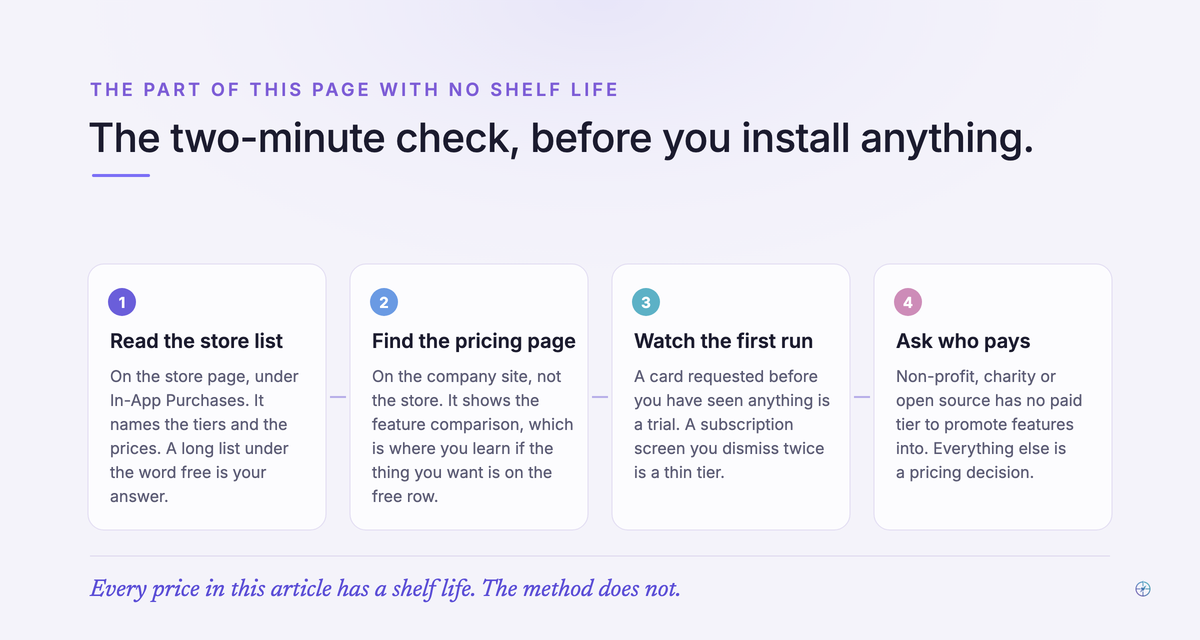
One. Read the in-app purchase list on the store page. Both stores show it, usually under a heading like “In-App Purchases”, and it names the tiers and their prices. If that list is long and the app calls itself free, you have found your answer without downloading anything. If the list is empty, the app has nothing to sell you.
Two. Find the pricing page on the company’s own site. Store listings show prices and rarely show what is behind them. A pricing page shows the feature comparison, which is where you find out whether the thing you actually want is on the free row.
Three. Open it and watch the first run. Does it ask for a card before you have seen anything? That is a trial. Does it push a subscription screen you have to dismiss twice? That is a thin tier. Does it just start? That is usually tier one or a strong tier two.
And while the first run is happening, answer these four. They are the whole audit, compressed.
- Is there a purchase list, and how long is it?
- Is the feature I came for on the free row of the pricing page?
- Was I asked for a card before I saw anything?
- Who pays for this app, and can I name them?
Two minutes, three checks, and it works on apps that have not been written yet. What would you have wanted to know four days in? That is the whole design brief for this section.
Quick Summary: checking a paywall before installing
Q: How do I find out where an app’s paywall is before I download it?
A: Three checks, about two minutes. Read the in-app purchase list on the store page, which names the tiers and prices. Then find the pricing page on the company site, which shows what each tier includes. Then open the app and watch the first run to see whether a card is requested. A long purchase list under the word “free” is the answer on its own.
How to actually pick one
Find the sentence that is closest and follow it.
- “I never want to be asked for money.” Tier one. Smiling Mind for mindfulness, How We Feel for mood, MindShift CBT for structured work, Loop on Android for habits.
- “I will pay eventually, just not yet.” Tier two, and check you can export your data.
- “I want the biggest free library.” Insight Timer, and it is not close.
- “I care most about what happens to my data.” Tier one, and the funding heuristic. Open source first, then non-profits.
- “I want to see what my week actually looked like.” How We Feel or Daylio, both free.
- “I do not want another app.” A legitimate answer, and the next section is for you.
The rule: one app from tier one, and the two-minute check before anything else. One install. Then stop.
When the free answer is not an app
Short, and offered without smugness. Does a free app have to be the answer at all?
The WHO definition at the top of this page describes something considerably larger than a download. Promoting and maintaining your own health, with or without a health worker. Almost none of that is software.
So the genuinely free options include a walk, an actual phone call to somebody who knows you, a nap taken deliberately rather than accidentally, and a library card, which is the most under-rated free wellbeing resource in most countries and comes with a building attached.
And therapy is an ordinary option, not a last resort. Cost is a real barrier and it is worth saying plainly rather than glossing, which is also why it is worth asking about sliding-scale fees, community mental health services, employer schemes and university provision before deciding it is out of reach. Nothing on this page is a substitute for that, and none of it is trying to be.
Questions people ask
What is the best completely free self-care app?
Smiling Mind, if you want one answer. A full mindfulness programme from a non-profit, with no paid tier and no in-app purchases. For mood specifically, How We Feel. For structured anxiety work, MindShift CBT. For habits on Android, Loop Habit Tracker. All four are free forever rather than free to start.
Are free self-care apps any good?
Several are excellent. The largest free meditation library in the category belongs to Insight Timer, and the best free mood app on this page is a non-profit. The caveat is the one running through this article: check which kind of free it is, because “free” covers everything from an open-source project to a weekend trial.
If an app is free, what am I paying with?
Frequently data. In a 2019 study of 36 mental-health apps, 92% transmitted data to a third party and 81% transmitted to Google and/or Facebook for advertising, marketing or analytics, with only 69% having a privacy policy at all (Huckvale, Torous & Larsen, 2019). That was a January 2018 snapshot of depression and smoking-cessation apps, so treat it as a pattern in the category rather than a claim about any named product. The reliable move is to prefer an app whose funding you can name.
Which self-care apps have no in-app purchases at all?
On this page, Smiling Mind, MindShift CBT, How We Feel, Loop Habit Tracker and Connect by PSI. All five were built by non-profits, charities or open-source projects (MindShift CBT is now sold by a company after Anxiety Canada closed), which is the pattern rather than a coincidence, and it is the fastest way to predict whether something new will still be free in two years.
Is Insight Timer really free?
The library is, and it is enormous. The app is listed as free with in-app purchases, and Insight Premium is $59.99 a year or $9.99 a month, verified on the App Store in September 2026. The paid tier adds offline downloads, courses and extras rather than unlocking the content, which is why the free version has stayed the answer to this question for years.
How do I check where an app’s paywall is before I install it?
Three checks, two minutes. The in-app purchase list on the store page names the tiers and prices. The pricing page on the company site shows what each tier includes. The first run shows whether a card is requested before you have seen anything. A long purchase list on an app calling itself free tells you most of what you need.
Related. Best Free Mental Health Apps.
Related. Apps Like Finch for People Who Are Done With Streaks.
Two things to take away
The first is to install one thing from tier one. Not four things from four tiers. One free-forever app, from a non-profit or an open-source project, that has no wall to reach and nothing above you to be sold.
The second is the two-minute check, which is the only part of this page with an indefinite shelf life. Store listing, pricing page, first run. Run it on anything anybody recommends to you, including us.
And the honest timeline. Every price in this article will go out of date, some of them within months, because pricing is something companies change and not something they promise. The funding question does not go out of date, and neither does the check.
Who pays for this? Ask it before you install anything, and most of this page becomes unnecessary. How long will this take to feel like a habit? Longer than a week, and longer than the app will imply, which is another reason to pick the one with nothing to sell you while you find out.
About this article

Written by
Sai Subramaniam
Founder, VentSpace
I write these guides because I have been where you are. I am working through my own hard seasons, and I share the things that actually helped me, so that anyone going through it has a steady companion close by instead of facing it alone. VentSpace is the app I built for exactly that: a journaling app that turns what you write into a clear read on your life balance, plus small, doable next steps toward feeling more like yourself.
This writing is honest and every claim is sourced, and it is not a substitute for professional care. If you are struggling, reaching out to a professional is a strong move, not a failure.
Explore VentSpaceTry VentSpace LiveHow this one was checked. Every factual claim traces to a named source, and the source is printed next to the claim rather than kept in a footnote. Quotes are pinned to the work they come from, with the year, the letter or the chapter where one exists. Where a widely repeated claim could not be traced, it was left out and the omission recorded. Where a figure is contested, both sides are printed.
No affiliate links, no paid placements, and nobody paid to appear here. Where we mention our own app, we say that it is ours, we state its limits, and we never position it as a substitute for care.
Reviewed: October 2026. Prices, platforms and product availability move quickly, and anything we could not verify at the time of writing is marked as unverified rather than turned into a number.
Corrections. If something here is wrong, we would rather know. Corrections are made in place, with a note saying what changed. Updated 15 October 2026: MindShift CBT’s non-profit maker, Anxiety Canada, has closed and the app is now sold by a company, so the non-profit claims are corrected. The platform count is fixed, the opening disclosure is folded into the section on our own app, and a link to a page being reworked is removed.