
“I find myself getting agitated very easily these past three days and I don’t know if it’s work frustration or withdrawal”
A member of an online porn abstinence forum, quoted in Fernandez, Kuss and Griffiths, Archives of Sexual Behavior (2021)
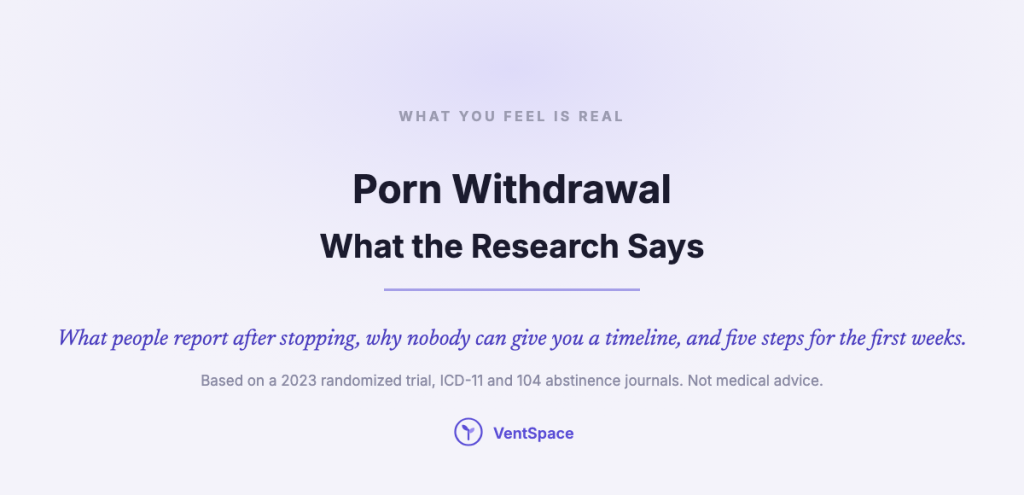
You stopped. Maybe it was a decision you made at 2 a.m., maybe a promise to someone, maybe a streak counter on your phone. And now, a few days in, you feel worse than you expected. You snap at people. You lie awake. Your head feels foggy, your mood drops for no clear reason, and the urge shows up at the exact moments it always did. The forums tell you this is withdrawal and hand you a chart with day numbers on it. Is this withdrawal?
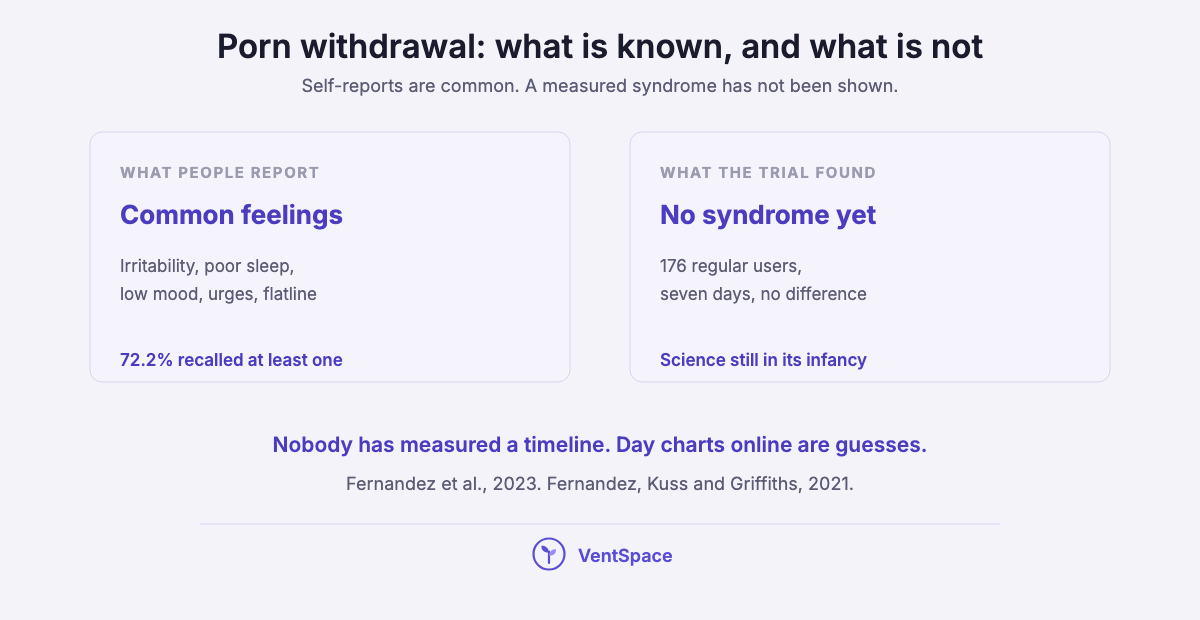
The most careful answer so far comes from a randomized trial published in 2023. David Fernandez and colleagues took 176 regular porn users and asked half of them to stop for seven days while the other half carried on as usual. Every night, both groups rated their craving, their mood and their withdrawal symptoms. The researchers found no evidence of withdrawal-related symptoms in the group that stopped. Only at the extreme, among people with the most problematic use who were watching daily, did craving look higher, and the authors warn that this finding needs caution.
That does not mean what you feel is imaginary. It means the feelings are real and the label is still being argued about. People who quit describe irritability, low mood, restlessness and urges that rise and fall like waves, and it helps to treat them that way. This guide explains what people report, what the research can and cannot say, why nobody can give you a reliable timeline, and then five steps for getting through the first weeks, plus exactly when to see a doctor or therapist.
The short version
What you might feel: irritability, restlessness, poor sleep, low mood, brain fog, a drop in sex drive (the “flatline”) and strong urges. These are commonly reported by people who quit.
What the research says: the only randomized trial, over seven days, found no evidence of a withdrawal syndrome. Researchers call the science “still in its infancy.”
Is porn addiction real? It is debated. The WHO’s ICD-11 lists compulsive sexual behavior disorder as an impulse control disorder, not an addiction, and only a clinician can diagnose it.
How long it lasts: nobody has measured a timeline. Day charts online are guesses.
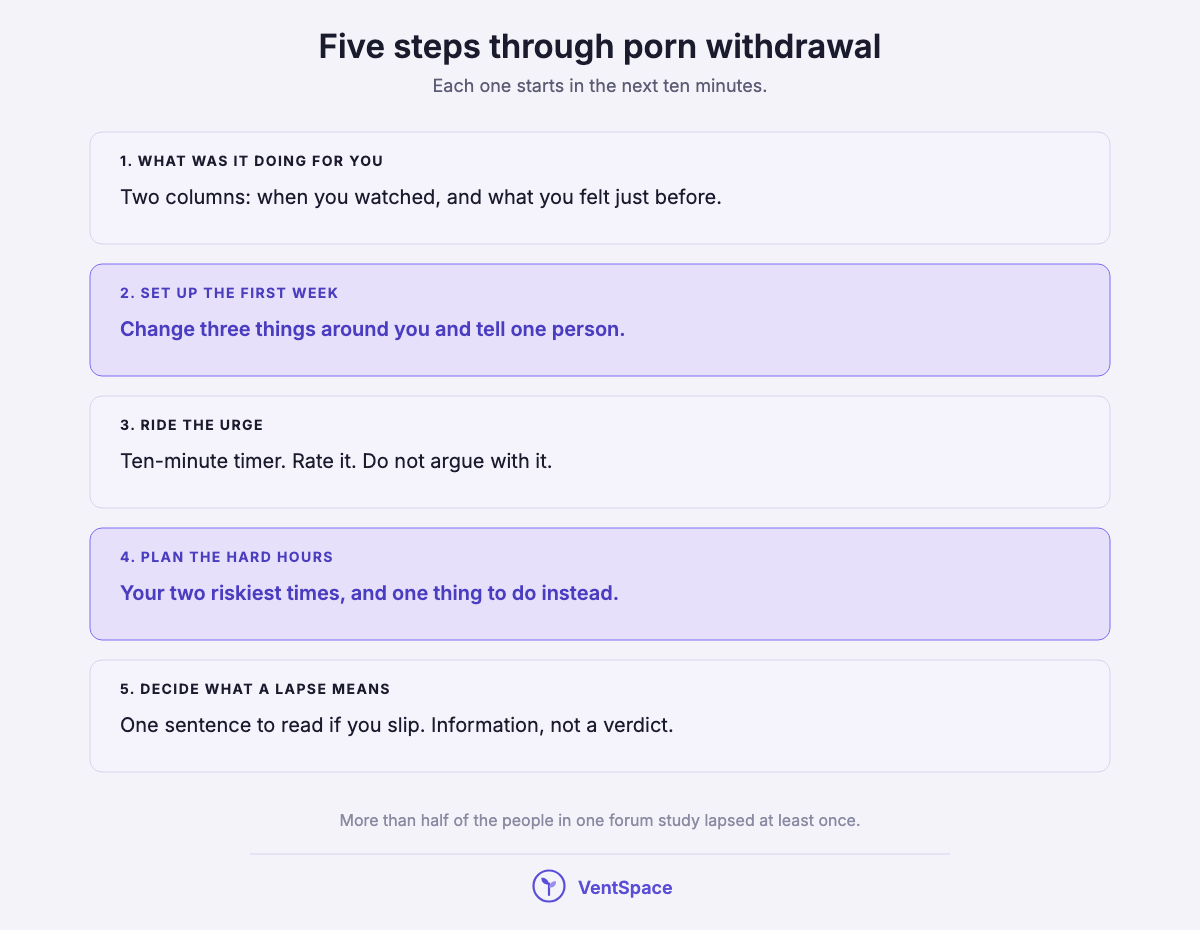
The five steps: write down what porn was doing for you, set up the first week, ride the urge, plan for the hard hours, and decide now what a lapse will mean.
See someone if you cannot stop despite trying, you have sexual difficulties, or low mood lasts two weeks or more.
If you’re in crisis or thinking about harming yourself, please contact the 988 Suicide & Crisis Lifeline now (US, call or text 988, or chat at 988lifeline.org), or find a line in your country at findahelpline.com. Shame and guilt about porn can get heavy. If they ever turn into thoughts of hurting yourself, that is a reason to reach out tonight, not something to push through alone.
New from The Digital Hope · Try it
Urge AI: notice the urge, choose again
For anyone doing NoFap, or cutting down on porn and masturbation. A free, private tool for the moment an urge hits. Tap one button, ride it out with a small challenge, and write one line before and after. Over a few weeks it shows you your own pattern: when it happens, what sits underneath, and what to put in that hour instead. Nothing ever resets to zero, and you can use it without an account.
What porn withdrawal can feel like
“I feel like I’m probably in a flatline right now as the desire to engage in any sort of sexual activity is almost nonexistent.”
A member of an online porn abstinence forum, quoted in Fernandez, Kuss and Griffiths, Archives of Sexual Behavior (2021)
The most common things people describe after stopping porn are irritability, restlessness, poor sleep, low mood, trouble concentrating and strong urges. Some also notice a sudden drop in sex drive, which forum members call the “flatline.” These are self-reports, not measured symptoms, but they are consistent across the places researchers have looked.
The richest record comes from 104 abstinence journals kept by men on a “rebooting” forum, which Fernandez, Kuss and Griffiths analyzed in 2021. Some members described what they took to be withdrawal: depression, mood swings, anxiety, “brain fog,” fatigue, headache, insomnia, restlessness, loneliness, frustration, irritability, stress and decreased motivation. Close to one-third described the flatline, a loss of sexual desire where they had expected the opposite.
A large survey points the same way. Among Polish students who had tried to stop at least once (2,169 people), 72.2% recalled at least one withdrawal-like symptom. The most common were erotic dreams (53.5%), irritability (26.4%) and trouble paying attention (26.0%). That survey asked people to remember a past attempt, so it is open to recall bias, and the 2023 trial’s authors say exactly that.
| What people report | How often, where measured | What it may be |
|---|---|---|
| Irritability, frustration | 26.4% recalled it in the student survey | Losing a habit that used to settle you |
| Trouble concentrating, “brain fog” | 26.0% recalled attention problems | Urges and poor sleep take up attention |
| Low mood, anxiety, mood swings | Described in forum journals, not counted | Feelings the habit used to cover |
| Poor sleep | Described in forum journals, not counted | Nights were often when the habit happened |
| Low or no sex drive (the “flatline”) | Close to one-third of 104 journal-keepers | Reported, not explained by research yet |
| Strong urges | In the 2023 trial, craving rose only at daily, highly problematic use (an exploratory finding) | The old cue meeting a new answer |
The third column is our reading, not a research finding. Notice how ordinary most of the list is. The 2023 trial’s authors point out that these self-reported feelings “overlap to a considerable extent” with what people feel when they stop smoking. When a habit has been doing a job in your day, taking it away leaves the job undone for a while. What job was it doing for you?
Quick Summary
Q: What are the symptoms of porn withdrawal?
A: People who stop most often report irritability, restlessness, poor sleep, low mood, trouble concentrating, strong urges and sometimes a temporary drop in sex drive called the “flatline.” These come from surveys and forum journals, so they are self-reports rather than measured symptoms.
Insight: what the science can say so far
“Current understanding of the potential manifestation of withdrawal-related symptoms during abstinence from pornography is still in its infancy. The present study is the first to prospectively examine the manifestation of withdrawal-related symptoms in abstaining participants in comparison to a non-abstaining control group, in contrast to previous research that has relied on retrospective self-report of perceived abstinence effects.” David Fernandez and colleagues, Archives of Sexual Behavior, 2023.
Is porn withdrawal real, and is porn addiction a real diagnosis?
“For this reason, compulsive sexual behaviour disorder is not included in the ICD-11 grouping of disorders due to substance use and addictive behaviours, but rather in that of impulse control disorders.”
Shane Kraus and colleagues, World Psychiatry (2018)
The feelings are real, but a withdrawal syndrome from porn has not been shown, and “porn addiction” is not a formal diagnosis. The World Health Organization’s ICD-11 does include compulsive sexual behavior disorder, and it files it with impulse control disorders, not with addictions. Researchers are still arguing about where it belongs.
Start with withdrawal. A 2020 systematic review of 47 studies on stopping behaviors like gaming, social media, exercise and porn found “a paucity of prospective studies” for most of them. The 2023 trial was designed to fill that gap for porn, and over seven days it found nothing that set the abstaining group apart. One week is short, and most participants were women, which the authors list as a limitation. So the honest position is that withdrawal from porn has not been demonstrated, not that it has been ruled out forever.
Now the diagnosis. In ICD-11, compulsive sexual behavior disorder is described as “a persistent pattern of failure to control intense, repetitive sexual impulses or urges, resulting in repetitive sexual behaviour over an extended period (e.g., six months or more) that causes marked distress or impairment” in daily life. The writers of that guidance describe “heated debate” about the whole category, and they chose impulse control because “we do not yet have definitive information” on whether it works like substance use, gambling or gaming. In the US, gambling disorder is the first behavior officially recognized as an addiction in the DSM-5. Porn is not on that list.
How common is the struggle? In a nationally representative US survey of 2,325 adults aged 18 to 50, 8.6% scored above a screening cut point for distress or impairment about controlling sexual feelings, urges and behaviors (10.3% of men, 7.0% of women). That is a screening score, not a diagnosis, but it says this is far from rare.
There is one more finding worth knowing, because it changes how many people read their own situation. Joshua Grubbs and colleagues found that feeling addicted to porn was predicted by religiosity and moral disapproval of porn, even when people’s actual use was taken into account. Among people who watched porn, religiousness was unrelated to how much they watched. The ICD-11 guidance makes the same point from the clinic side: the disorder “should not be diagnosed based on psychological distress related to moral judgments or disapproval” alone.
That is not a judgment of anyone’s values. If porn conflicts with what you believe, that conflict is real and worth taking seriously. It just means that how much this hurts and how much you watch are two different questions, and it helps to know which one you are trying to answer. Which one is it for you?
Quick Summary
Q: Is porn addiction a real diagnosis?
A: Not under that name. ICD-11 includes compulsive sexual behavior disorder, placed with impulse control disorders rather than addictions, and only a clinician can diagnose it. Withdrawal from porn has not been shown in the one randomized trial so far, though the feelings people report after quitting are real.
Insight: why the label feels bigger than the habit
“Through an examination of recent literature, the present work reviews evidence that moral incongruence about IPU is a common phenomenon and that it is associated with outcomes relevant to current debates about pornography addiction. Specifically, moral incongruence regarding IPU appears to be associated with greater distress about IPU, greater psychological distress in general, greater reports of problems related to IPU, and greater reports of perceived addiction to IPU.” Joshua Grubbs and Samuel Perry, The Journal of Sex Research, 2019. (IPU is their shorthand for internet pornography use.)
How long does porn withdrawal last?
Nobody can tell you, because nobody has measured it. The only controlled study lasted seven days. The day-by-day timelines on recovery sites, the 30, 60 and 90-day phases, are not drawn from research. If one of them has been worrying you, you can set it down.
From Sai, who writes this site
Based on my research and understanding of the human brain and behavior, it does not make sense to expect a fixed timeline for this. Every person is different. Your personality, your support, your goals and your genes all change how it goes, and even one person’s control over their thoughts can shift within months or days.
What the forum journals do show is the shape of it. More than half of the 104 members (55 of them) reported at least one lapse during their attempt. Some lapses seemed to “just happen” on “autopilot,” and others came after a long argument with themselves. One member described the inner bargaining in words many people will recognize: “this could be last time,” “just today, and from tomorrow I stop again.”
The journals also record what people felt when they kept going: improved mood, more energy, mental clarity, focus, confidence and motivation, and some felt closer to partners and friends. Those are self-reports too, and the researchers say future studies are needed “to rule out possible third variable explanations” for them. Still, this is a fair picture: a hard stretch, often with setbacks, that many people found worth it.
So is there a point when it gets easier? Some members who kept going reported that, after a while, the craving and the pull of the habit decreased. “My porn desires are way down and it is way easier to fight my urges,” one wrote. None of them got there on a schedule. That is the most anyone can honestly say, and it is enough to work with.
Quick Summary
Q: How long does porn withdrawal last?
A: There is no measured timeline. The only controlled trial ran seven days, and day-by-day charts online are not based on research. People who kept going in one forum study reported that craving decreased after a while, with lapses common along the way.
Insight: where the evidence stops
“Findings of the review showed that there is a paucity of prospective studies investigating abstinence effects in relation to potential behavioral addictions, except for exercise. Across all behaviors, exercise demonstrated the clearest pattern of withdrawal-related symptoms mainly related to mood disturbances.” David Fernandez, Daria Kuss and Mark Griffiths, Clinical Psychology Review, 2020.
So what do you do with day four?
How to get through porn withdrawal, in five steps
“In the acquisition of a new habit, or the leaving off of an old one, we must take care to launch ourselves with as strong and decided an initiative as possible.”
William James, The Principles of Psychology (1890), Chapter IV, “Habit,” summarizing a maxim of the philosopher Alexander Bain
The steps below do not need a streak counter or a perfect record. Each one starts with something you can do in the next ten minutes with a notebook or your phone’s notes app. Do them in order the first time, then come back to whichever one the day calls for.
1. Write down what porn was doing for you
Before you fight the habit, find out what it was for. Take a page and write two columns: “When I usually watched” and “What I was feeling just before.” Fill in the last week from memory. Most people find the second column says more than the first. Why?
This matters because, in the forum journals, uncomfortable feelings had become a cue in their own right. Members who had used porn to manage stress, boredom or loneliness found that the feeling alone was enough to bring the urge. If porn was how you got to sleep, or how you came down after a bad day, stopping takes away the tool and leaves the bad day.
- When did you usually watch: late at night, after work, when alone in the house?
- What were you feeling in the ten minutes before?
- What did you want to feel afterward?
- Is there anything else in your week that gives you that feeling, even a little?
Be honest with this page. Nobody else has to read it.
2. Make the first week easier before it starts
Change three things about your surroundings today, before you need them. Move the phone charger out of the bedroom. Put a blocker on the browser you use most. Tell one person you trust what you are doing, even in a single sentence.
In the same passage, James advised putting yourself “assiduously in conditions that encourage the new way.” The forum journals agree, with a twist. Blocking apps were described as “somewhat useful,” but social support and accountability “appeared to be the external resources that were most instrumental” in helping members keep going. Friction helps a little. Another person helps a lot. So who would you tell, if you told one person?
- Where and when is the urge strongest for you?
- What is one change that would put a step between you and that moment?
- Who is one person you could tell, and what would you say?
- What would make telling them feel less risky?
You do not have to explain everything to the person you tell. “I am cutting something out and it is harder than I thought” is enough.
3. Ride the urge instead of arguing with it
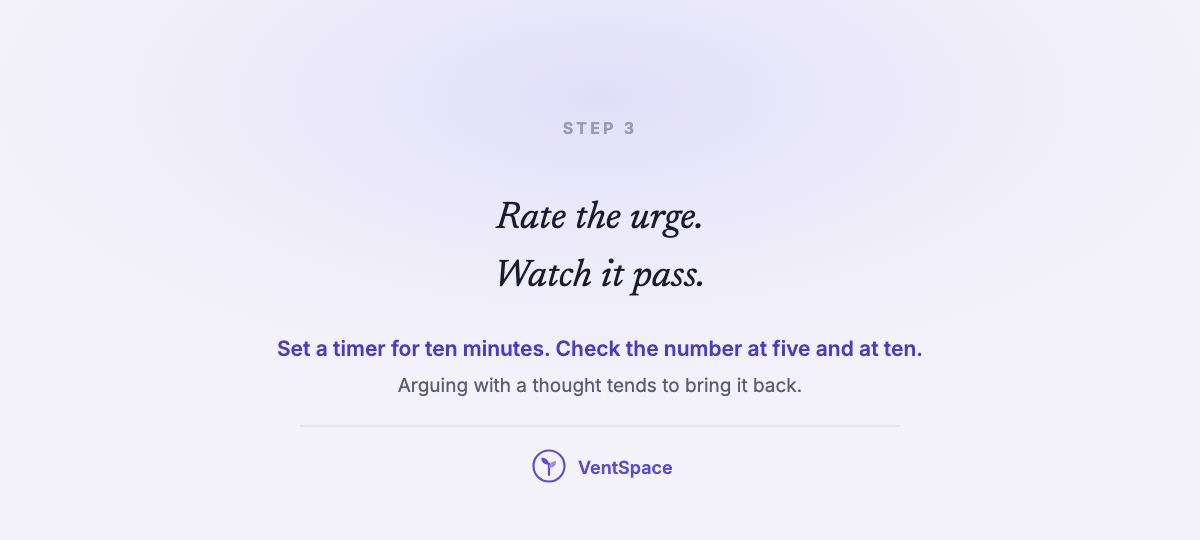
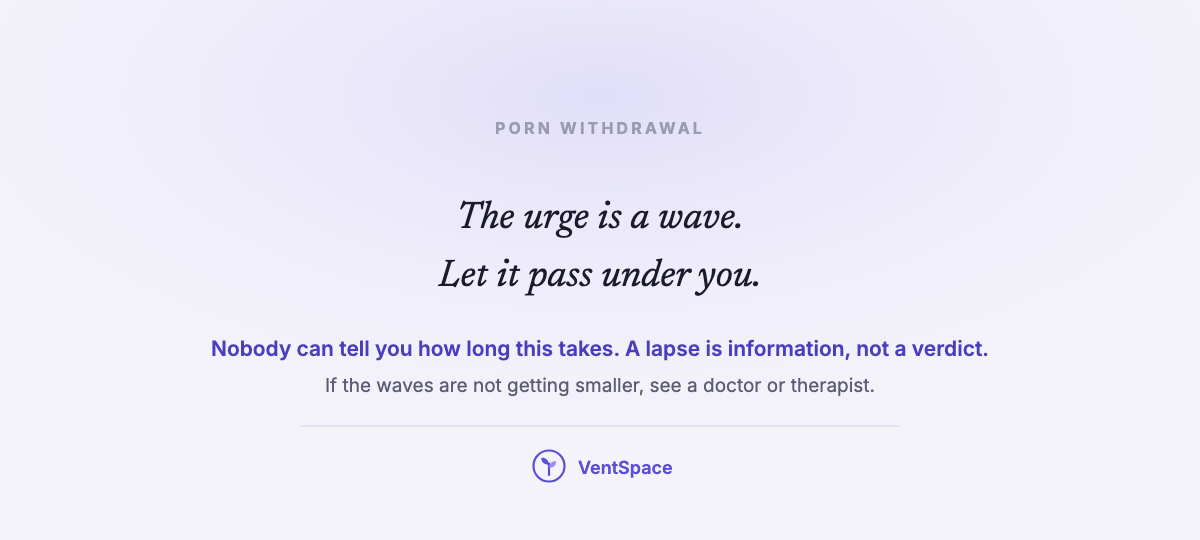
When the urge comes, set a timer for ten minutes and watch it instead of answering it. Notice where you feel it in your body. Rate it from one to ten. Check again at five minutes, and again at ten. You are not trying to make it go away. You are watching a wave rise, peak and fall.
This is a version of “urge surfing,” a technique from the addiction researcher Alan Marlatt. In a 2009 trial with 123 student smokers, Sarah Bowen and Marlatt found that a short mindfulness instruction did not reduce the urges people felt, but the people who learned it smoked fewer cigarettes over the following week. That study was about cigarettes, not porn, so take it as a reasonable thing to try rather than proof. What would change if you stopped trying to win the argument?
Arguing with the urge tends to backfire. One forum member put it plainly: repeating “don’t think about PMO” to himself, he wrote, “makes me crazy and gets me to thinking about PMO.” A meta-analysis by Jonathan Abramowitz and colleagues found “a small to moderate rebound effect” when people tried to push a thought away. The urge is not an order. It is a wave, and you can let it pass under you.
- What number would you give the urge right now, from one to ten?
- Where do you feel it: chest, stomach, hands, face?
- What is it telling you to do, word for word?
- What number is it at after ten minutes?
If the timer goes off and you are still at an eight, that is fine. Get up, change rooms, and start the timer again.
4. Plan for the hard hours
Write down the two or three times of day when you are most likely to slip, and next to each, one thing you will do instead. Be specific: “11 p.m., in bed with my phone” and “phone charges in the kitchen, I read a paper book.” A plan made in daylight is easier to follow at night. Which hour are you already dreading?
The forum journals named the danger zones clearly. One member wrote that “just lying in bed when I wake up and have nothing to do is a serious trigger.” The day-to-day strategies members used were ordinary: exercising, meditating, socializing, keeping busy, going out more often and having a healthier sleep routine. Nothing on that list is clever. The point is to fill the hours the habit used to fill.
- What are your two highest-risk times of day?
- Where are you, and who is with you, at those times?
- What is one thing you could do instead that takes no willpower to start?
- What will you do on a night when you cannot sleep?
If sleep stays bad, talk to a doctor before you reach for sleeping pills. A doctor is the right person to see if it does not settle.
5. Decide now what a lapse will mean
Write one sentence today that you will read if you slip. Something like: “A lapse is information, not a verdict. I will write down what happened and start again tomorrow.” Put it where you will see it.
Lapses are common. More than half of the journal-keepers in the forum study reported at least one. What seemed to help most was writing: the researchers found that writing in their journals “as they were experiencing craving or immediately after a lapse” gave members “a particularly useful avenue” for motivating self-talk and reframing unhelpful thinking. If shame tends to follow a lapse for you, the self-compassion exercises for difficult days are a good place to start.
From Sai, who writes this site
Reading all of this right now might seem like a lot, and that is partly because of how the habit has been sitting in your head. Trust me, I have been there.
- What happened in the hour before the lapse?
- What were you feeling, and what did you need?
- What is one thing you would change about that hour next time?
- What would you say to a friend who told you about the same lapse?
A lapse does not erase the days before it. You still learned what you learned.
When to see a doctor or therapist
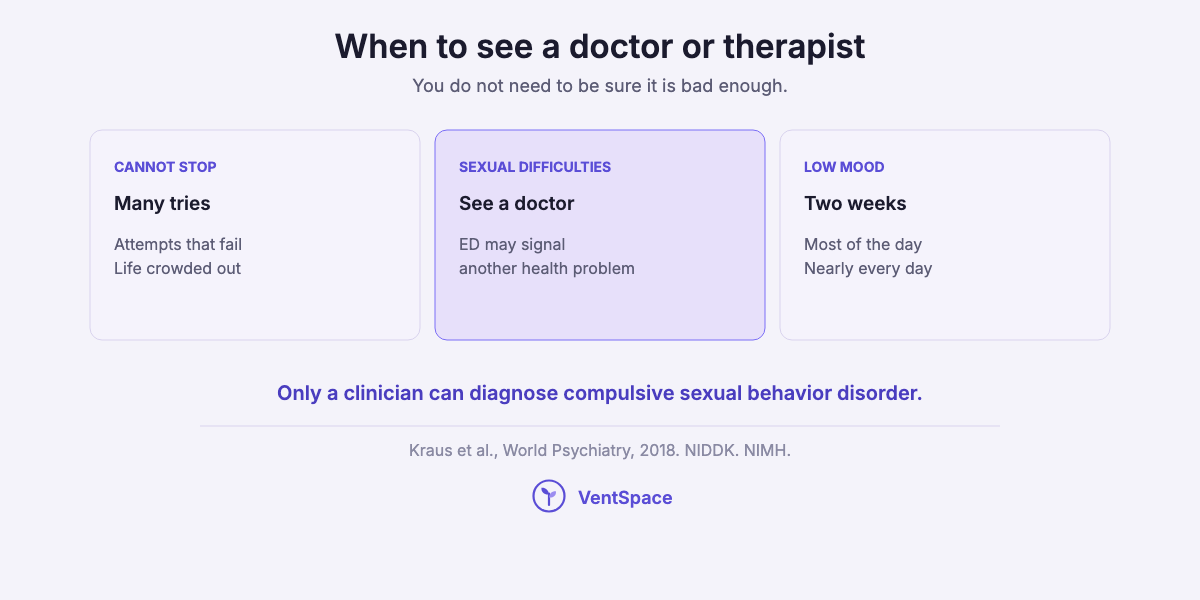
See a professional if you keep trying to stop and cannot, if porn is crowding out the rest of your life, if you have sexual difficulties, or if low mood lasts two weeks or more. You do not need to be sure it is “bad enough.” A doctor or therapist is the right person to sort out what is going on, and this page cannot.
ICD-11 describes what clinicians look for in compulsive sexual behavior. It is not a checklist to score yourself on, but these are fair things to bring to an appointment:
- Has sex or porn become so central that you are neglecting your health, other interests or responsibilities?
- Have you made many attempts to cut down that have not worked?
- Do you keep going despite real consequences, such as relationship or work problems?
- Do you keep going even when you get little or no satisfaction from it?
Sexual difficulties are a reason to see a doctor, not a reason to blame yourself. Online, erectile problems are often said to be caused by porn. A study of four large samples of younger men in Croatia, Norway and Portugal found “little evidence” of that link. More importantly, the National Institute of Diabetes and Digestive and Kidney Diseases notes that “ED may be a symptom of another health problem,” including heart and blood vessel disease. That is worth checking whatever you think the cause is.
Low mood that lasts is also worth raising. The National Institute of Mental Health describes depression as symptoms “most of the day, nearly every day, for at least 2 weeks,” and advises that if signs “persist or do not go away, talk to a health care provider.” Quitting a habit can bring hard feelings to the surface, and you do not have to carry them alone.
Therapy can help. In a small trial, Jesse Crosby and Michael Twohig gave 28 men 12 sessions of acceptance and commitment therapy (ACT) for problematic porn use. Viewing fell by 93%, compared with 21% for those on a waiting list, and at three months 35% had stopped completely. Nearly all the men were members of one church, so the results may not carry over to everyone. If you are not sure whether you need therapy or just someone to talk to, our guide on whether you need therapy walks through that question.
Quick Summary
Q: When should I see someone about porn use?
A: When you keep trying to stop and cannot, when it is crowding out your life, when you have sexual difficulties, or when low mood lasts two weeks or more. A doctor can check for physical causes of sexual problems, and therapy such as ACT has been tested for problematic porn use.
Insight: what a diagnosis is not
“The proposed diagnostic guidelines also emphasize that compulsive sexual behaviour disorder should not be diagnosed based on psychological distress related to moral judgments or disapproval about sexual impulses, urges or behaviours that would otherwise not be considered indicative of psychopathology.” Shane Kraus and colleagues, World Psychiatry, 2018.
Pulling it all together
The five steps make one path through the hard weeks.
First, find the job porn was doing. Two columns, one page, the last seven days. Write it today.
Then, change three things about your surroundings and tell one person. Do the charger tonight.
When the urge comes, set a ten-minute timer and rate the wave instead of arguing with it.
For the hard hours, write down your two riskiest times and one thing you will do instead of each.
Before you need it, write the one sentence you will read after a lapse, and put it where you will see it.
Questions people ask
Is porn withdrawal real?
The feelings people describe after stopping are real and commonly reported. Whether they add up to a withdrawal syndrome is unproven: the one randomized trial, which lasted seven days, found no evidence of withdrawal-related symptoms compared with people who kept watching.
How long does porn withdrawal last?
No study has measured it. Day-by-day timelines online are not based on research. In one study of forum journals, people who kept going reported that craving decreased after a while, and more than half had at least one lapse along the way.
What is the flatline?
It is a forum term for a loss of sex drive after stopping porn. Close to one-third of the members in one study of 104 abstinence journals described it. Research has not explained it. If low desire or sexual difficulties worry you, a doctor can check for other causes.
Does quitting porn cure erectile dysfunction?
That is a common claim, but it is not established. A study of younger men in three countries found little evidence that porn use was linked to erectile problems. Because ED may be a symptom of another health problem, including heart and blood vessel disease, see a doctor rather than waiting it out.
Am I a porn addict?
This page cannot tell you, and neither can a quiz. “Porn addiction” is not a formal diagnosis. ICD-11 lists compulsive sexual behavior disorder as an impulse control disorder, and only a clinician can assess it. Feeling distressed about porn because it conflicts with your values is real, but distress from values alone is not a diagnosis.
In a nutshell
What you feel after stopping is real, and the label is still being argued about. The research has not shown a withdrawal syndrome, and nobody can tell you your brain is damaged. What you can work with is in front of you: the urge, the hour it comes, and what it was covering.
This takes longer than a week, and nobody can tell you how long. The urges come in waves. Some days will be easy and some will not, and a lapse is part of the path for more than half of the people who try. If the waves are not getting smaller, or the low feelings are not lifting, that is the moment to see a doctor or therapist.
Tonight, write down the one hour you are most worried about, and what you will do instead.
Quitting something you have used to get through hard days can leave you feeling raw, and a lot of people go through it quietly. If writing some of it down would help, VentSpace is a journaling app that turns what you write into a clear read on your life balance, plus small, doable next steps. Prefer to try it on your laptop first? VentSpace Live runs in your browser, free, with nothing to install.
About this article

Written by
Sai Subramaniam
Founder, VentSpace
I write these guides because I have been where you are. I am working through my own hard seasons, and I share the things that actually helped me, so that anyone going through it has a steady companion close by instead of facing it alone. VentSpace is the app I built for exactly that: a journaling app that turns what you write into a clear read on your life balance, plus small, doable next steps toward feeling more like yourself.
This writing is honest and every claim is sourced, and it is not a substitute for professional care. If you are struggling, reaching out to a professional is a strong move, not a failure.
Explore VentSpaceTry VentSpace LiveHow this one was checked. Every factual claim traces to a named source, and the source is printed next to the claim rather than kept in a footnote. Quotes are pinned to the work they come from, with the year, the letter or the chapter where one exists. Where a widely repeated claim could not be traced, it was left out and the omission recorded. Where a figure is contested, both sides are printed.
No affiliate links, no paid placements, and nobody paid to appear here. Where we mention our own app, we say that it is ours, we state its limits, and we never position it as a substitute for care.
Reviewed: October 2026. Prices, platforms and product availability move quickly, and anything we could not verify at the time of writing is marked as unverified rather than turned into a number.
Corrections. If something here is wrong, we would rather know. Corrections are made in place, with a note saying what changed.