
Last updated: October 2026.
“we are unable to reliably estimate an ad campaign’s causal effect”
Brett Gordon, Robert Moakler and Florian Zettelmeyer, on 663 large Facebook ad experiments, Marketing Science (2023).
The ads run on Meta and Google, the leads land in a form tool, and the “website” is a page builder template nobody has touched in a year. Each platform reports its own conversions under its own rules. When the numbers disagree, there’s nothing of yours to check them against.
Your website is the one marketing surface where you own the data, the measurement and the rules, and the CMS you pick decides how much of that ownership you keep. Here’s the reason. Every platform you rent counts conversions its own way and changes its rules on its own schedule. A site you control is where orders, leads and consent records sit, and it’s the page search engines and AI answers read. WordPress is the most common way to own one: W3Techs counts it on 39.5% of all websites (checked 29 October 2026). That’s a market share, not a recommendation.
This guide covers why a business needs its own website in the first place, where WordPress is strong for a marketer, what it costs you in plugin risk, maintenance and speed, how it compares with Webflow, Shopify and hosted builders, and five steps to choose and set one up. It’s written for whoever owns the budget and will live with the platform for years.
Quick Digest
– Own the source of record: platform dashboards are each platform’s claim. Orders, CRM leads and consent records on your own site are what you check them against.
– Rules you don’t control change: Meta dropped 7-day and 28-day view-through windows from its API on 12 January 2026. Your site’s tracking changes when you change it.
– WordPress is about 40% of all sites (W3Techs, October 2026), and 58.3% of sites with a known CMS.
– Its strengths are workflow, SEO control, the ecosystem, cost and portability. Its costs are plugin risk, maintenance, mobile speed and page-builder lock-in.
– Choose by condition: content-heavy with someone to patch it, WordPress. Product catalogue first, Shopify. Design-led marketing site with a small team, Webflow or a hosted builder.
How we know
Sources: W3Techs CMS usage data (29 October 2026), Patchstack’s State of WordPress Security in 2026 (11,334 vulnerabilities in 2025, vendor research with partial method), HTTP Archive’s Web Almanac CMS chapters (2024 and 2025 editions, millions of mobile sites with Chrome field data), Gordon, Moakler and Zettelmeyer’s 663 Facebook experiments (2023), and Google, Meta, Shopify and WordPress documentation opened on 29 October 2026.
The limit: share and speed figures are platform averages that mix cheap hosting with well-built sites. No dataset here shows that a CMS choice causes more revenue. The first-party examples are one site I run, n=1.
Why a business needs its own website: owned data, owned measurement, owned rules
A business needs its own website because it’s the only place where the customer data, the conversion record and the rules belong to the business rather than to a platform. Social profiles, marketplaces and ad accounts are rented. They’re useful, and they can change terms, counting rules or reach without asking.
What a website gives you that a platform profile can’t:
- A source of record: orders and leads you can count yourself, so platform-reported conversions have something to be checked against.
- Measurement you configure: your own analytics property, your own conversion definitions, your own consent banner.
- A destination you control: the landing page for every ad, email and post, with the offer, the form and the follow-up in your hands.
- A surface search and AI can read: indexed pages that Google, Bing and AI answers can cite.
- Portability: your content and customer list move with you if a platform changes or closes the door.
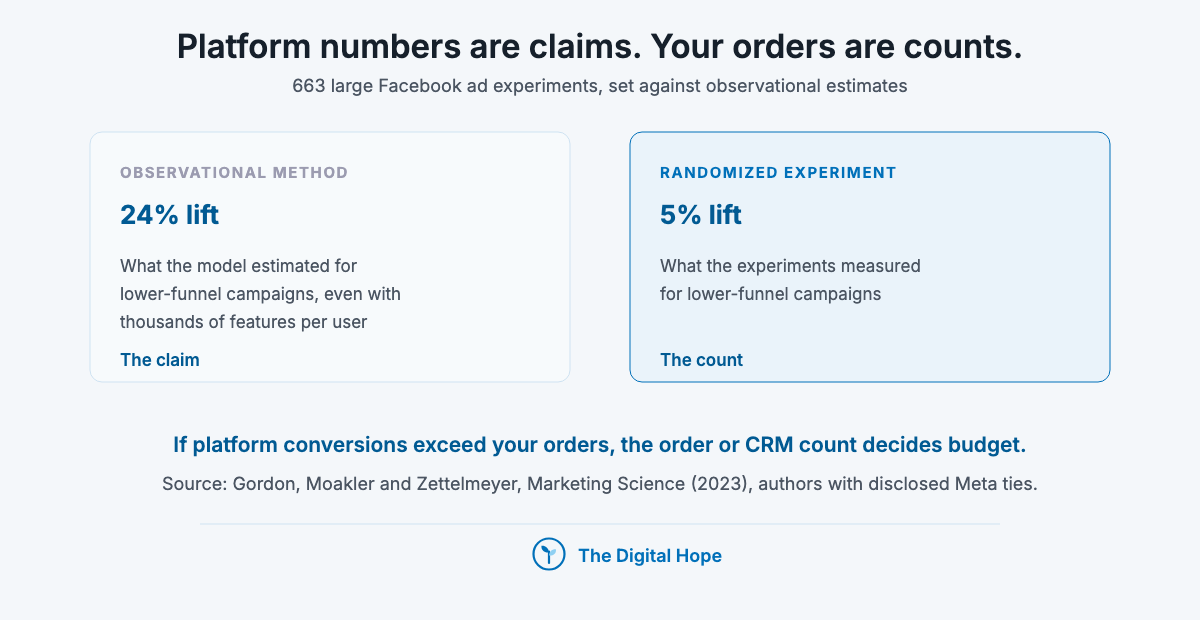
Platform numbers are claims, not counts. Across 663 large Facebook ad experiments, Gordon, Moakler and Zettelmeyer found observational methods put lower-funnel lift at 24% where the experiments measured 5%, even with thousands of features per user (Marketing Science, 2023, authors with disclosed Meta ties). When two platforms both report more conversions than your orders show, the order or CRM count is the number that decides budget. You only have that number if the conversion happens somewhere you own.
Rented rules change on the platform’s calendar, not yours. Four dated examples:
- Meta stopped returning 7-day and 28-day view-through conversions in its Ads Insights API on 12 January 2026, which broke any historical comparison built on them.
- Google Ads keeps day-level reporting for 37 months from mid-2026, per its Help text reported by PPC Land (secondary, May 2026). Longer history has to be exported somewhere you own.
- Instagram cut the hashtag limit from 30 to five per post in December 2025 (secondary, Social Media Today).
- Google Business Profile can block new reviews, unpublish existing ones and show a public warning on profiles that break its fake engagement policy (Google Business Profile Help, checked 29 October 2026).
Consent is yours to run, and it decides what you can measure. If you advertise to people in the EEA, UK or Switzerland, Google requires you to collect consent and pass it through consent mode, or you lose personalised ads and remarketing for those users (Google Ads Help, checked 29 October 2026). Enforcement began in March 2024 (Search Engine Journal, 19 February 2024). On your own site you choose the banner, the default state and the record. On a rented page you get whatever the platform decided.
Search sends fewer clicks, and the site still has to exist. SparkToro’s Similarweb data put US zero-click Google searches at about 68% in early 2026, up from about 60% in 2024 (different panels in the two years). Fewer clicks raise the value of being the page that gets cited, and Google says a page needs to be indexed and snippet-eligible to appear in AI Overviews, with no special markup. A profile on someone else’s platform can’t be that page.
The condition: a business still testing whether anyone will buy can start on a marketplace, a lead form or a social shop and learn faster. Once there’s spend to defend or a customer list worth keeping, it needs a site it owns. For B2B companies with long cycles the need comes earlier, because the CRM and the site are where the pipeline gets counted.
Rent the reach. Own the record.
Quick Summary
Q: Why does a business need its own website?
A: Because it’s the only place the business owns its customer data, its conversion record, its consent setup and its content. Ad platforms and social profiles report under their own rules and change them on their own dates, so a site you control is what you check their numbers against.
Insight
“no data is transferred to Google at all, not even the consent status”
Google tag platform documentation on basic consent mode, when a visitor declines (page updated 30 July 2026). How you set consent on your own site decides what any platform can see.
Where WordPress is strong for a marketer
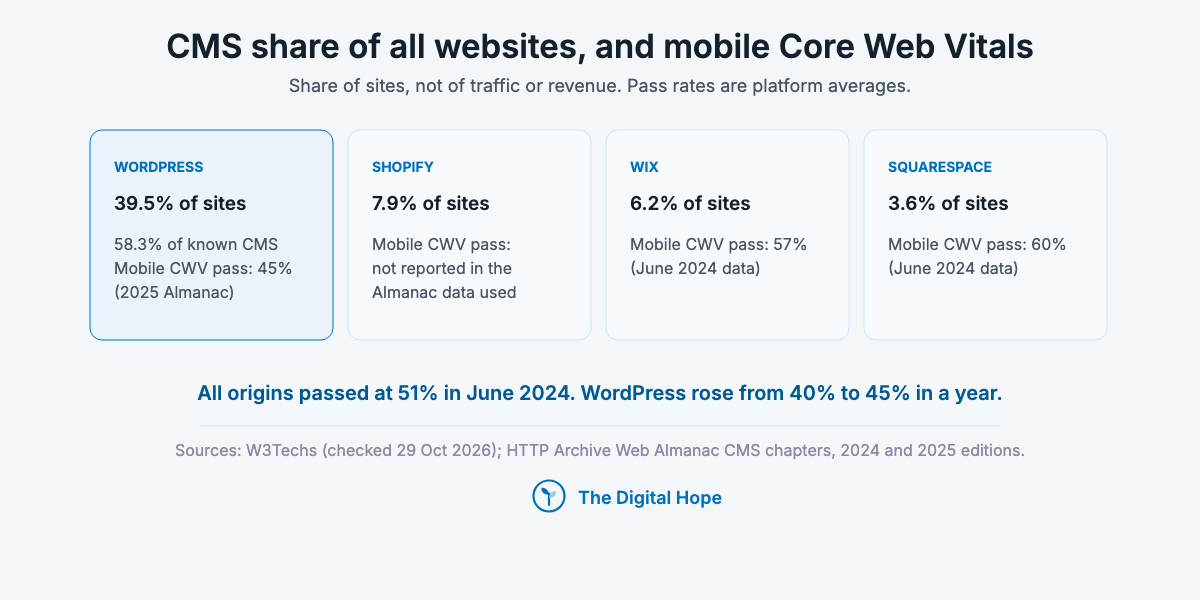
WordPress is strong where marketing is content-heavy: it gives you the publishing workflow, full control of SEO settings, the largest plugin and integration ecosystem, free software and a site you can move. W3Techs counts it on 39.5% of all websites and 58.3% of sites whose CMS it can detect, ahead of Shopify (7.9%), Wix (6.2%) and Squarespace (3.6%) (checked 29 October 2026). That’s share of sites, not of traffic or revenue.
One distinction first. The open-source software from WordPress.org runs on hosting you choose. WordPress.com is a hosted service built on it, with plans that decide which plugins and themes you can install. Everything below is about the self-hosted version unless it says otherwise.
The content workflow. Posts, pages, categories, scheduled publishing, revisions you can restore, and user roles (administrator, editor, author, contributor) come in core. For a team publishing weekly, that means a writer drafts, an editor approves and nobody needs admin rights to ship a post.
SEO control. You set the URL structure, titles, meta descriptions, canonicals and redirects, usually through an SEO plugin. Core has done some of this itself since 2020: WordPress 5.5 added a sitemap at /wp-sitemap.xml, and since 5.3 the “Discourage search engines” box adds a noindex tag rather than editing robots.txt (Make WordPress Core, 2019 and 2020). The full checklist lives in the technical SEO guide.
The ecosystem. Analytics, consent banners, CRM forms, email capture, WooCommerce for a shop, and most marketing tools ship a WordPress plugin or a documented integration. Since July 2025 there’s an official route for AI agents too: the WordPress MCP Adapter turns registered Abilities (WordPress 6.9 and later) into tools an agent can call, authenticated with application passwords and limited to what that WordPress user is allowed to do (WordPress.org AI team, 17 July 2025).
Cost. The software is free under the GPL. You pay for hosting, a domain, any premium theme or plugins, and the time to maintain it. Compare that with a commerce platform’s fees: Shopify’s pricing page lists a 2% fee on Basic, 1% on Grow and 0.6% on Advanced for stores using a third-party payment provider instead of Shopify Payments (Shopify India pricing page, checked 29 October 2026; plans and fees vary by country). WooCommerce charges no platform fee, and your payment processor still does.
Ownership and portability. The database, the files and the URLs are yours. WordPress exports content from Tools, Export, and you can move hosts without changing a URL. I run this site on WordPress and migrated it on my own [FIRST-PARTY, n=1]. The move kept the URLs, which is the part that protects rankings, and taught me to map dates and authors as carefully as redirects (the detail is in the technical SEO guide). It’s one small site, so it says nothing about migrating a large one.
The condition: these strengths pay off only when the site publishes often, needs SEO control and expects to add tools over time. A five-page brochure site that changes twice a year uses almost none of them.
Content-heavy is where it earns its keep.
Quick Summary
Q: What are the main advantages of WordPress for marketing?
A: A built-in publishing workflow with roles and revisions, full control of URLs and SEO settings, the largest plugin and integration ecosystem, free software, and a site you own and can move between hosts. W3Techs counted it on 39.5% of all websites in October 2026.
Insight
“There are no additional requirements to appear in AI Overviews or AI Mode, nor other special optimizations necessary.”
Google Search Central, AI features and your website, checked 29 October 2026. No CMS or plugin buys AI visibility, and an indexed, crawlable WordPress page is eligible like any other.
What WordPress costs you: plugin risk, maintenance, speed and lock-in
WordPress’s trade-offs are the price of its openness: most of its security risk sits in plugins, someone has to patch it, the average site is slower on mobile than several hosted builders, and page builders can lock your layouts in. None of these is a reason to avoid it. Each is a cost to budget for.
Plugin risk. Patchstack counted 11,334 new WordPress-ecosystem vulnerabilities in 2025, up 42%. 91% were in plugins, 9% in themes and 6 in core. 46% had no fix at disclosure, and for heavily targeted bugs the weighted median time to first mass exploitation was 5 hours (State of WordPress Security in 2026, 25 February 2026, vendor research that sells virtual patching). So the risk scales with how many plugins you run and how fast you patch, not with WordPress itself. Where that risk lives and which controls help is in is WordPress secure.
Maintenance. Core, theme and plugin updates, backups, PHP versions and the occasional conflict after an update are your job, or your host’s or developer’s if you pay for it. Hosted builders and Shopify do most of this for you, which is a large part of what their subscription buys. The agent route adds its own maintenance: on the host this site uses, application passwords are stripped [FIRST-PARTY, n=1], so the official MCP Adapter’s login method doesn’t work there without a host change. Check your host before you plan any agent workflow.
Mobile speed. In HTTP Archive’s 2025 Web Almanac, 45% of WordPress mobile sites passed Core Web Vitals, up from 40% a year earlier and among the lowest of the CMSs compared (published 15 January 2026). In the 2024 edition’s June 2024 data, Wix passed at 57%, Squarespace at 60% and Duda at 73%, against 51% for all origins. Those are averages across cheap hosting and heavy themes. If you run WordPress on good hosting with a light theme, the site can pass. The data shows you’re more likely to start behind, not that you have to stay there.
Page-builder lock-in. Visual page builders store layouts in their own shortcodes or block formats. Switch builders or themes later and those pages need rebuilding, and on a site with hundreds of landing pages that’s a project, not a setting. The native block editor keeps content in standard WordPress blocks, which travel better between themes.
Governance. WordPress.org and Automattic leadership news made headlines in 2026. We haven’t seen a primary source that changes the advice for a site owner, so this guide doesn’t weigh it.
The condition: if nobody owns updates, plugin risk and maintenance land on whoever notices the site is down. A marketing team with no developer and no managed host pays these costs in incidents instead of hours.
Budget for the upkeep or don’t pick it.
Quick Summary
Q: What are the disadvantages of WordPress?
A: Plugin risk (91% of new 2025 vulnerabilities were in plugins, per Patchstack), ongoing maintenance you or your host must do, a lower average mobile Core Web Vitals pass rate than several hosted builders (45% in HTTP Archive’s 2025 data), and page-builder lock-in that makes later redesigns expensive.
So the choice isn’t whether WordPress is good. It’s whether its trade-offs fit your team.
WordPress, Webflow, Shopify or a hosted builder: the decision table
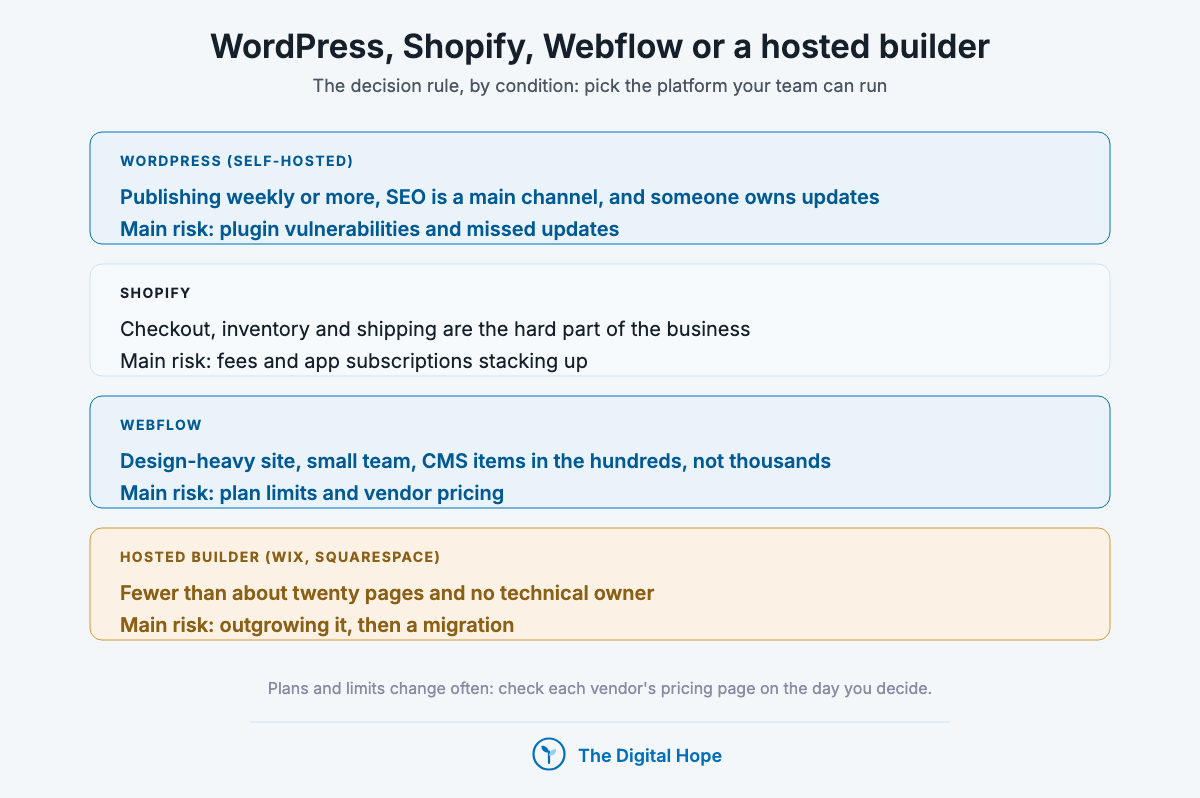
Choose WordPress for content-led sites with someone to maintain them, Shopify when the catalogue and checkout are the business, Webflow when design control matters and the content load is moderate, and a hosted builder (Wix, Squarespace) for a small site that has to run with no maintenance. The table sets them side by side on what a marketer lives with. Plan prices and limits change often, so check each vendor’s own pricing page on the day you decide.
| WordPress (self-hosted) | Webflow | Shopify | Hosted builders (Wix, Squarespace) | |
|---|---|---|---|---|
| Best fit | Content and SEO-led sites, blogs, lead generation, WooCommerce shops | Design-led marketing sites, moderate CMS content | Stores where catalogue, checkout and inventory are the core | Small business and brochure sites with no technical owner |
| Who maintains it | You, your host or developer | Webflow hosts and updates | Shopify hosts and updates | The vendor hosts and updates |
| How you pay | Free software, plus hosting, premium plugins and time | Site plan subscription, CMS items capped by plan | Subscription, plus a 2% / 1% / 0.6% fee on Basic / Grow / Advanced with third-party payments (pricing page, 29 Oct 2026) | Subscription |
| SEO control | Full, via core and plugins | Strong, set in the designer | Good for products and collections | Basic to good, inside the vendor’s options |
| Integrations | Largest plugin ecosystem, plus the official MCP Adapter (WordPress 6.9+) | Integrations and API | App store and API | Vendor app markets |
| Mobile CWV pass (field data) | 45% (2025) | Not reported in the Almanac data we used | Not reported in the Almanac data we used | Wix 57%, Squarespace 60% (June 2024) |
| Portability | Highest: full database and files, export tool, any host | CMS collections export to CSV (Webflow feature page, 2022) | Product and customer CSV export | Check what the export includes before you build |
| Main risk | Plugin vulnerabilities and missed updates | Plan limits and vendor pricing | Fees and app subscriptions stacking up | Outgrowing it, then a migration |
The decision rule, by condition:
- Publishing weekly or more, SEO is a main channel, and someone owns updates: WordPress.
- Selling physical products where checkout, inventory and shipping are the hard part: Shopify. A WooCommerce shop makes sense when content drives the sales and you already run WordPress well.
- Design-heavy marketing site, a small team, and content in the hundreds of items rather than thousands: Webflow.
- Fewer than about twenty pages, no technical owner, no plans to scale content: a hosted builder.
Where the line blurs. Many companies run two: Shopify for the store and WordPress for the content, or Webflow for the marketing site and a separate product app. That’s fine only when one domain carries both and the tracking joins them up. A split you can’t measure is worse than one platform.
Pick the platform your team can run.
Quick Summary
Q: Should I use WordPress, Webflow, Shopify or Wix?
A: WordPress for content-led sites with someone to maintain them, Shopify when products and checkout are the business, Webflow for design-led sites with moderate content, and Wix or Squarespace for small sites with no technical owner. Check each vendor’s pricing page on the day you decide, because plans change.
How to choose and set up your site: five steps
Five steps, in the order the decision gets made. Each has a first action, a check you can run, and when to skip it.
1. Write down what the site must own
The first action: open your CRM and your GA4 property and list every conversion you count today, where it’s recorded, and which platform reports it. Mark which of them happen on a page you control.
This list is the brief for the CMS. If the conversions that matter happen in a platform’s lead form or a third-party checkout, you can’t audit them. The site’s first job is to bring the record home.
- Which conversion is our source of record, and where does it live?
- Which platform-reported numbers have we never checked against it?
- Do we have EEA, UK or Swiss visitors, and who owns the consent setup?
Skip it if you’re a single-channel advertiser with a short cycle whose orders already land in a store you own.
2. Size the content and commerce load
The first action: count your current pages, posts and products, and write down how many you’ll add per month in the next year.
Load decides the platform faster than features do. Thousands of posts and a weekly publishing rhythm point to WordPress. A catalogue with variants and inventory points to Shopify. A few hundred CMS items and heavy design work fit Webflow’s plan caps.
- How many items will the CMS hold in two years?
- Is the shop the business, or a side line to the content?
- Who publishes, and do they need roles and approvals?
Skip it if the site will stay under twenty pages.
3. Price the year, including time
The first action: put twelve months of costs in one sheet for each candidate: subscription or hosting, premium plugins or apps, transaction fees at your expected sales, and hours of maintenance at your team’s rate.
Free software isn’t a free site. On WordPress the time line is usually the biggest. On Shopify the fees and app subscriptions are. Seeing both on one sheet ends most of the debate.
- What’s our expected monthly revenue through checkout, and what fee applies?
- Who updates the site, and how many hours a month does that take?
- Which paid plugins or apps are we committing to?
Skip it if the platform is already fixed by an existing contract or team skill.
4. Test the exit before you commit
The first action: on a trial site, run the platform’s export: Tools, Export in WordPress, CSV export of collections in Webflow, product and customer export in Shopify. Open the files and check what’s missing.
Portability is the ownership test. If the export loses your layouts, your URLs or your metadata, that’s what a future migration will cost you. Plan the redirect map and the metadata fields (dates, authors, schema) before you need them.
- Does the export carry content, URLs, dates and authors?
- Can we keep every URL that has clicks or links if we move?
- How much of the design would need rebuilding?
Skip it if you’re on a short-lived campaign site that won’t be migrated.
5. Set the maintenance and measurement routine on day one
The first action: in WordPress, set a monthly update window, cap the plugin list to what you use, and turn on backups. In GA4, raise data retention to 14 months, because explorations can’t look back further than the setting allows (Google Analytics Help, checked 29 October 2026). Then set up consent mode if you have EEA, UK or Swiss traffic.
The routine is what keeps ownership from turning into risk. A site with 40 plugins and no update owner is where Patchstack’s 5-hour exploitation window bites.
- Who owns updates, and when do they happen?
- Which plugin could we remove this month?
- Does our consent banner default and record match what we tell Google?
Skip it if you’re on a fully hosted platform, though the GA4 and consent part still applies.
Quick Summary
Q: How do I choose the right CMS for my business?
A: List the conversions the site must own, size your content and catalogue, price twelve months including maintenance time, test the platform’s export before committing, and set the update and measurement routine on day one.
Pulling it all together
Step 1, what to own: list every conversion, its source of record and the platform that reports it, and bring the record onto a page you control.
Step 2, the load: count pages, posts and products now and in a year, and let that narrow the platforms.
Step 3, the year’s cost: one sheet per candidate with fees, plugins and maintenance hours.
Step 4, the exit: run the export on a trial site and note what it loses.
Step 5, the routine: a monthly update window, a short plugin list, 14-month GA4 retention and consent mode where it applies.
What stopped being true
| What | When | Primary source |
|---|---|---|
| “WordPress powers 43% of the web” | W3Techs shows 39.5% of all websites, checked 29 October 2026 | W3Techs, WordPress usage statistics |
| WordPress risk framed as “WordPress itself” | 91% of new 2025 vulnerabilities in plugins, 6 in core | Patchstack, State of WordPress Security in 2026 (Feb 2026) |
| WordPress far behind on mobile speed | Pass rate rose from 28% (2023) to 40% (2024) to 45% (2025) | HTTP Archive Web Almanac, CMS chapters |
| No official way to connect AI agents to WordPress | MCP Adapter exposes the Abilities API, WordPress 6.9+ | WordPress.org AI team, 17 July 2025 |
| Universal Analytics goals and bounce rate as the site’s measurement | UA stopped processing 1 July 2023, data deleted after 1 July 2024 | Google Analytics Help |
| Consent as a banner question only | Consent mode v2 enforced for EEA traffic | Google Ads Help, March 2024 |
| Meta 7-day and 28-day view-through windows in reporting | No longer returned from 12 January 2026 | Meta for Developers |
Frequently asked questions
Why is a website important for a business? It’s the one marketing asset whose customer data, conversion record, consent setup and content the business owns. Ad platforms and social profiles report under their own rules and change them on their own dates, so the site is where you check their numbers.
Do I need a website if I have social media pages? To test demand, not yet. Once you spend on ads or build a customer list, yes, because a profile can’t be your source of record, your consent setup or a page search engines and AI answers cite.
Does WordPress still power 43% of the web? No. W3Techs counted WordPress on 39.5% of all websites and 58.3% of sites with a known CMS on 29 October 2026. That’s share of sites, not of traffic.
Is WordPress free? The software is free under the GPL. Hosting, a domain, premium themes or plugins, and maintenance time are not, and WordPress.com is a separate paid hosted service.
Is WordPress insecure? Not in core, which had 6 low-priority vulnerabilities in 2025 per Patchstack. 91% of new vulnerabilities were in plugins, so the risk depends on how many you run and how fast you patch.
WordPress or Webflow for a marketing site? WordPress if you publish a lot, want full SEO control and have someone to maintain it. Webflow if design control matters more, the content load is moderate and you’d rather pay a subscription than run updates.
In a nutshell
Own the site, then pick the CMS your team can run. A website is where your conversion record, consent and content belong to you, and that’s the reason to have one before any platform comparison. WordPress gives the most control and portability for content-led sites, at the cost of plugin risk, maintenance and a slower average start on mobile. Shopify, Webflow and hosted builders trade some of that control for less upkeep. This guide doesn’t apply if you’re still testing whether anyone will buy: a marketplace or lead form teaches you that faster.
Expect a quarter, not a weekend. Choosing, building and moving content takes weeks, and the measurement setup (conversions, consent, retention) needs a full month of data before you can trust it against the platforms. What would change this advice: a hosted platform matching WordPress’s export and SEO control, or new data showing WordPress’s mobile pass rate catching up with the builders.
About this article

Written by
Sai Subramaniam
SEO, GEO and Paid Ads Manager · 8+ years in growth marketing
I have run SEO, paid media and ABM for B2B AI companies, consumer apps and live-entertainment brands, from a solo operator at an AI infrastructure company to a team of 20 recovering a million-visitor site after a Google update. I write these guides from that work, and every number in them carries its source.
See my portfolioConnect on LinkedInHow this one was checked. Every number traces to a named source with its dataset and period, and every platform feature, policy or limit cites the platform’s own documentation with the date it was verified. Where the author’s own results appear, they are labelled as one account’s results, with the budget and context, not as a rule.
No affiliate links and no paid placements. Tools are named because they are what practitioners use, not because anyone paid to appear here.
Reviewed: October 2026. Ad platforms and search features change every few months; anything we could not verify at the time of writing is marked as unverified rather than turned into a number.
Corrections. If something here is wrong or has changed since, we would rather know. Corrections are made in place, with a note saying what changed.