
We almost kept the old title as it was, and the reason is worth admitting up front. The first version of this page promised nine lessons and gave you eight. It also spelled the author’s name wrong and quoted about a dozen lines as his that we could not find in the book, at least not in those words. Fixing a title is easy. Fixing the trust underneath it meant going back to the book, line by line.
The book mattered too much to leave it like that. Sai, who founded VentSpace, wrote the first version because Awaken the Giant Within had stayed with him: “It has helped me personally in different stages of life.” In high school, it helped his young mind make sense of emotions and look at life from a better angle. Later, “in adulthood when people often lose themselves in their work, it helped me understand my core values and craft a life around that.” That is a big claim for a self-help book. Is it one you would make about any book on your shelf?
So this is the rewrite. Nine lessons, each traced to the chapter where Robbins makes it, checked against the research, with one thing to try for ten days, which happens to be the book’s own favorite unit of time. We also say where we would not follow him. Which of the nine does your year need?
The nine lessons at a glance
- 1. Your decisions shape more than your conditions: Chapter 2, and the line the whole book hangs on.
- 2. A belief is a decision about what something means: Chapter 4, two prisoners and one prison.
- 3. Pain and pleasure run the habit, so use them on purpose: Chapters 3 and 6, and his six steps for change.
- 4. Change the question, change the focus: Chapter 8, with five questions for a bad day.
- 5. The words you pick turn the volume up or down: Chapter 9, and why a businessman said “peeved”.
- 6. Every bad feeling carries a message: Chapter 11, his ten Action Signals and six steps for handling them.
- 7. Goals are for who you become: Chapter 12, five minutes of lists and two minutes of why.
- 8. Try the Ten-Day Mental Challenge, gently: Chapter 13, borrowed from a 1935 original.
- 9. If you’re not happy, check your rules: Chapters 15 and 16, values and the rules you attach to them.
How we chose and checked them
Every lesson had to pass three checks, because the 2023 version of this page did not.
- It is in the book, and we can say where: we searched the text through Google Books, which shows short publisher-approved snippets. We used the 2012 Simon & Schuster ebook and cross-checked wording against the updated 35th-anniversary edition published in May 2026. The book first came out in 1991.
- The research gets its own row: where a study speaks to the idea, it is named with its size. Where nothing direct exists, the row says “none direct” and the lesson stands on judgment.
- You can try it: every lesson ends with one small action and one honest watch-out.
We left some of the book out on purpose. “Where we part ways with the book” explains which lines and why, and a separate section lists the famous quotes that circulate as his but did not turn up in the text.
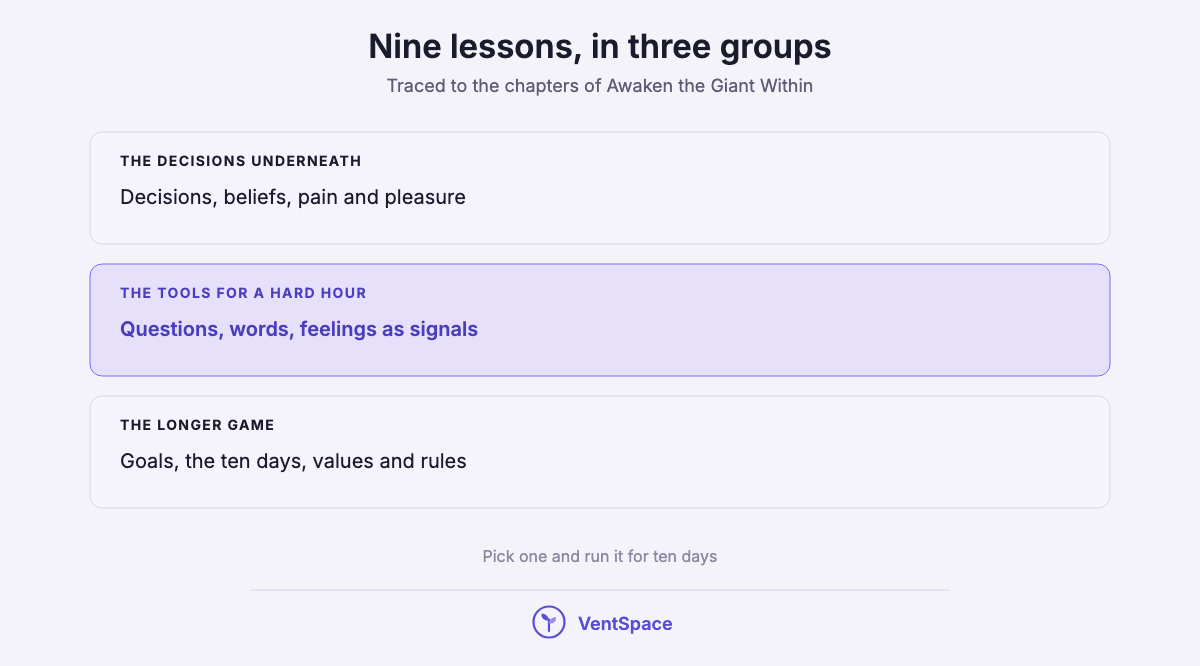
The decisions underneath everything
The first three lessons are the book’s foundation. Before any technique, Robbins wants you to see what is already steering you: a decision, a meaning, a pull toward pleasure or away from pain.
1. Your decisions shape more than your conditions
Chapter 2 is called “Decisions: The Pathway to Power”, and it carries the line the whole book hangs on. “It is in your moments of decision that your destiny is shaped.” Robbins’s point is plain: where you end up depends less on what happened to you than on what you decided to do next. He boils it into what he calls the Ultimate Success Formula: decide what you want, take action, notice what is working or not, and change your approach until you get there. When did you last make a decision and keep it for a full year?
| Where in the book | Chapter 2, “Decisions: The Pathway to Power”. Chapter 1 sets it up: Robbins says what changed his life was writing down “all the things I would no longer accept” |
| The idea | A real decision, followed by action and adjustment, moves a life more than circumstances do |
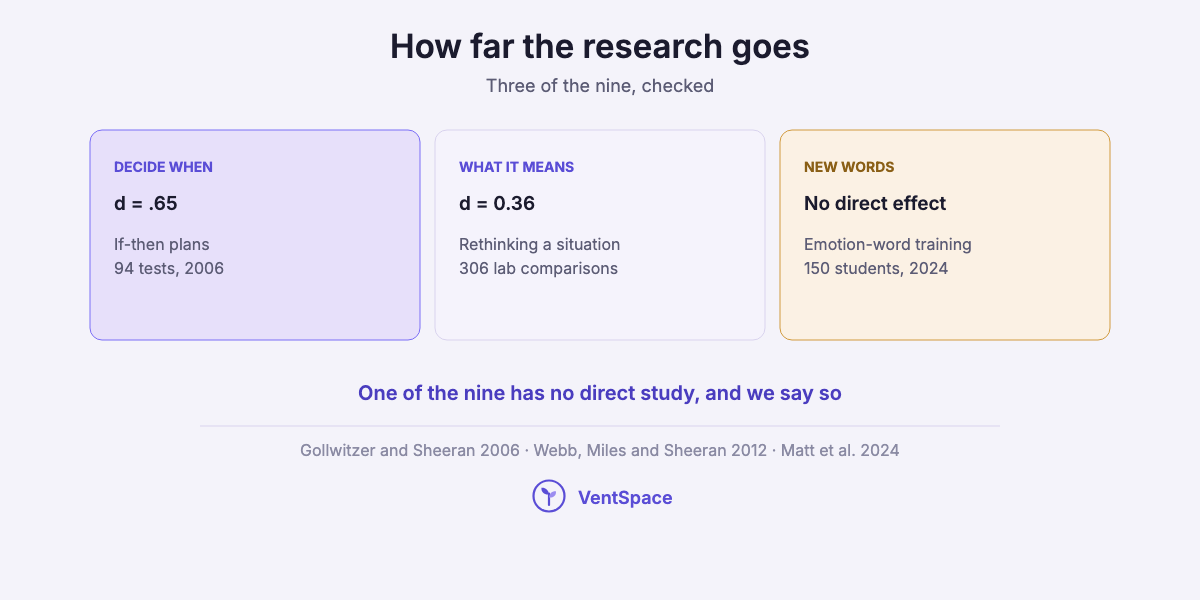
| What the research says | Supportive for the “decide exactly when and how” part. A 2006 meta-analysis by Peter Gollwitzer and Paschal Sheeran pooled 94 tests of if-then plans, which name when, where and how you will act, and found a medium-to-large effect on reaching goals (d = .65) |
| Try this | Write one decision as an if-then line: “If it is 7 pm on Tuesday, then I will walk for 20 minutes” Check it each evening for ten days |
| The watch-out | Circumstances are real. A decision gives you some say in what happens next, not total control over it |
Who it’s for: anyone who keeps “deciding” the same thing every January.
In practice: the line people skip is his fourth step. “Stay committed to your decisions, but stay flexible in your approach,” he writes in the same chapter. The decision is the fixed part. The method is allowed to change. If you want the version of this idea from his TED talk, our page on Tony Robbins lessons covers his three decisions as he tells them on stage.
Verdict: the best-supported lesson in the book, as long as “decide” also means “decide when”.
2. A belief is a decision about what something means
Early in Chapter 4, Robbins tells of two men shot down in Vietnam and held in the same prison, Hoa Lo. They received the same abuse, Robbins writes, and formed “radically different beliefs” about it. His summary is the most quoted sentence in the book: “It’s not the events of our lives that shape us, but our beliefs as to what those events mean.” He also borrows, and credits, three patterns from the psychologist Martin Seligman’s Learned Optimism: seeing a problem as permanent, as pervasive, and as personal. What do you tell yourself a setback means about you?
| Where in the book | Chapter 4, “Belief Systems: The Power to Create and the Power to Destroy” |
| The idea | The meaning you attach to an event shapes how you feel and what you do next |
| What the research says | Two strands. A 2012 meta-analysis by Thomas Webb, Eleanor Miles and Paschal Sheeran (306 lab comparisons) found that rethinking the situation itself had a small-to-medium effect on emotion (d = 0.36) and taking another person’s perspective had the largest (d = 0.45). Separately, a 2015 meta-analysis by Tian-Qiang Hu and colleagues (86 studies) found that explaining bad events as internal, stable and global went with more depression. That second finding is a correlation |
| Try this | After one setback this week, write three lines: is this permanent, does it spread to everything, is it all about me? Then write the truest answer to each |
| The watch-out | Some meanings are accurate. The aim is a truer reading, not a cheerful one |
Who it’s for: anyone whose bad day turns into a verdict on their whole life.
In practice: the three questions are the usable part, and they are Seligman’s, which Robbins says openly. Notice how often a single bad event quietly becomes “always” and “everything”. Writing it down slows that slide enough to catch it.
Verdict: a strong lesson with real research cousins. Keep it about accuracy.
3. Pain and pleasure run the habit, so use them on purpose
Chapter 3 makes the claim the rest of the book builds on. “Everything you and I do, we do either out of our need to avoid pain or our desire to gain pleasure.” Chapter 6 turns that into a method he calls Neuro-Associative Conditioning, in six steps: decide what you want and what is stopping you, link pain to not changing and pleasure to changing, interrupt the old pattern, create a new alternative, condition the new pattern until it is consistent, and test it. His reasoning for step two is one of his best lines: about 20 percent of change is knowing how, and 80 percent is knowing why. What is the old habit still giving you?
| Where in the book | Chapter 3, “The Force That Shapes Your Life”, and Chapter 6, “How to Change Anything in Your Life” |
| The idea | Habits stay because they pay you something. Change the payoff and give yourself a replacement, not just a ban |
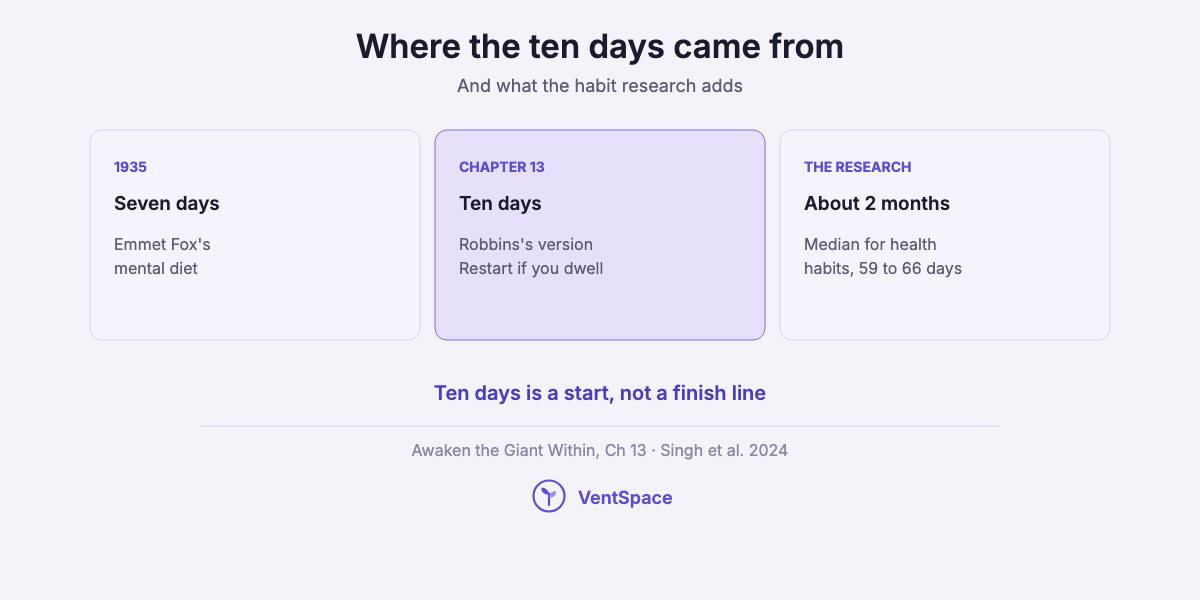
| What the research says | Partly. A 2024 review by Singh, Murphy, Maher and Smith (20 studies, 2,601 people) found health habits took a median of 59 to 66 days to form, with individuals ranging from 4 to 335 days, and habits people chose for themselves tended to be stronger. Nothing tests his six steps as a set |
| Try this | Pick one habit. Write what it gives you, then one replacement that gives you some of the same thing. Practice the replacement for ten days |
| The watch-out | “Massive pain” is his phrase. We would use a clear reason, not a beating. A strong reason is not the same as shaming yourself |
Who it’s for: anyone who has quit the same habit several times.
In practice: step four is the one that matters most, and Robbins says so himself: most people fail because they have nothing to replace the old pattern with. A gap left empty tends to fill back up with the old habit.
Verdict: step four is solid. The timeline is longer than the book makes it sound.
Quick Summary
Q: What is the main message of Awaken the Giant Within?
A: That decisions shape a life more than conditions do. Robbins builds on three foundations: what you decide (Chapter 2), what you believe events mean (Chapter 4), and what you link to pain and pleasure (Chapters 3 and 6). If-then plans have strong research support. Research on health habits puts the median at about two months, with wide variation, not one moment.
Insight: Tony Robbins, Awaken the Giant Within, Chapter 2: “Stay committed to your decisions, but stay flexible in your approach.”
The tools for a hard hour
The next three are for the evening when something has already gone wrong. What you ask yourself, the words you use, and what the feeling is trying to tell you.
4. Change the question, change the focus
Chapter 8, “Questions Are the Answer”, is the most practical chapter in the book. “Quality questions create a quality life,” Robbins writes, and asks you to “burn this idea into your brain.” He gives a set of Problem-Solving Questions, starting with “What is great about this problem?”, “What is not perfect yet?” and “What am I willing to do to make it the way I want it?” The honest detail is that, by his own account, the first time he asked himself the first one, his answer was that nothing was great about it. What question did you ask yourself the last time things went wrong?
| Where in the book | Chapter 8, “Questions Are the Answer”, with Problem-Solving, Morning Power and Evening Power Questions |
| The idea | The question you ask decides what you notice, and what you notice shapes how you feel |
| What the research says | Related, without a number we can print. A research program led by Ethan Kross found that how far back you stand from an experience matters more than whether you ask “what” or “why”. Asking about yourself from a step back produced less distress in their studies of social stress |
| Try this | For ten nights, answer his three evening questions in writing: what have I given today, what did I learn today, and how has today added to my life? |
| The watch-out | “What is great about this problem?” can feel insulting in a real loss. Skip it there. “What is not perfect yet?” is gentler and just as useful |
Who it’s for: anyone whose mind replays “why does this always happen to me” at night.
In practice: the evening questions are the easiest entry point in the whole book. Three questions, a few lines each, before bed. If you want more prompts in the same spirit, our list of end-of-day journaling prompts has them.
Verdict: the most usable chapter. Ask the questions from a step back, not from inside the worst of it.
5. The words you pick turn the volume up or down
Chapter 9, “The Vocabulary of Ultimate Success”, turns on a story about the word “peeved”. Robbins heard a wealthy, successful businessman describe himself as “a little bit peeved”, and thought it was the stupidest word he had ever heard. He would never have used a word that mild for his own emotional intensity, and that was the point. His claim is that changing the habitual words you use for your emotions changes how intensely you feel them. He calls this Transformational Vocabulary and describes spending ten days catching himself on old words and swapping in milder ones. Which word do you reach for when you are only a little annoyed?
| Where in the book | Chapter 9, “The Vocabulary of Ultimate Success” |
| The idea | Swapping a loud word for a quieter one can lower the intensity of a feeling |
| What the research says | Thin, and one test points the other way. In a randomized trial by Matt, Seah and Coifman (2024, 150 university students), training people on emotion words had no direct effect on how finely they described their feelings or on their distress. We found no study that tests his swap-the-word method directly |
| Try this | Notice your top two loud words this week (“furious”, “devastated”). For ten days, try a quieter word when the moment honestly fits it |
| The watch-out | Don’t shrink a word that is accurate. “Peeved” about a betrayal is not calm, it is hiding |
Who it’s for: anyone who notices they describe every inconvenience as a disaster.
In practice: the useful part is the noticing, not the new word. Hearing yourself say “I’m dying” about a slow line is already information. Our page on feelings vs emotions goes further into the language of feelings.
Verdict: a good experiment, with a weak evidence base. Try it, but do not expect a vocabulary list to do the work.
6. Every bad feeling carries a message
Chapter 11, “The Ten Emotions of Power”, starts with ten feelings Robbins calls Action Signals: discomfort, fear, hurt, anger, frustration, disappointment, guilt, inadequacy, overload and loneliness. His argument is that each one is telling you something, usually that what you are doing is not working. He gives six steps for handling them: identify what you are feeling, appreciate the emotion instead of fighting it, get curious about its message, get confident you can handle it, get certain you can handle it in the future, and take action. When did a bad feeling last turn out to be right about something?
| Where in the book | Chapter 11, “The Ten Emotions of Power” |
| The idea | Unpleasant feelings are signals to read, not enemies to beat |
| What the research says | Related, and small. A 2022 meta-analysis by Tatum Seah and Karin Coifman (17 studies) found that people who described negative feelings in more precise terms were slightly less likely to use harmful coping behaviors (r = −.15). It is a correlation, not proof that naming feelings causes anything |
| Try this | The next time one of the ten shows up, write its name and one line on what it might be telling you. Do it for ten days |
| The watch-out | Some feelings are not messages about you. Grief after a loss is not a signal that you are doing life wrong |
Who it’s for: anyone who spends more energy fighting a feeling than listening to it.
In practice: step one does most of the work. “Bad” is not a feeling. “Disappointed in myself” is. Once the word is precise, the message is usually easier to read.
Verdict: one of the kindest ideas in a loud book. The research is small but points the same way.
Quick Summary
Q: What questions does Tony Robbins recommend asking yourself?
A: In Chapter 8 he gives Problem-Solving Questions (“What is great about this problem?”, “What is not perfect yet?”), Morning Power Questions (“What am I happy about in my life now?”) and Evening Power Questions (“What have I given today?”, “What did I learn today?”). His rule is “Quality questions create a quality life.” Research suggests asking from a step back matters more than the exact wording.
Insight: Tony Robbins, Awaken the Giant Within, Chapter 8, the first two Evening Power Questions: “What have I given today? In what ways have I been a giver today?” and “What did I learn today?”
The longer game
The last three are about direction. What you are chasing, what you practice daily, and the rules that decide whether any of it feels good.
7. Goals are for who you become
Chapter 12 is called “The Magnificent Obsession: Creating a Compelling Future”, and its exercise is concrete. Robbins asks you to spend about five minutes writing every goal you can think of in each area of life, then pick your top goals and take two minutes each to write a paragraph on why you are committed to them this year. “Setting goals is the first step in turning the invisible into the visible,” he writes. Then he says something more interesting about what goals are for. What would you still want if nobody ever saw you get it?
| Where in the book | Chapter 12, “The Magnificent Obsession: Creating a Compelling Future” |
| The idea | Write goals down, give each a reason, and remember the goal is a tool for growth, not the point |
| What the research says | Supportive of his second point. Christopher Niemiec, Richard Ryan and Edward Deci (Journal of Research in Personality, 2009) followed a post-college sample for a year. Reaching intrinsic goals, like growth and close relationships, went with better psychological health. Reaching extrinsic goals, like money, fame and image, did not, and went with more signs of ill-being |
| Try this | Do his five-minute list for one area of your life. Pick one goal and write two minutes on why. Then mark it “inside” (growth, relationships, health) or “outside” (money, status, image) |
| The watch-out | Outside goals are not bad goals. The finding is about what reaching them did and did not do for people |
Who it’s for: anyone with goals that look great on paper and feel flat once reached.
In practice: the line to keep is at the end of the chapter. “The only reason we really pursue goals is to cause ourselves to expand and grow.” Read your list with that sentence beside it, and some goals start to look like someone else’s.
Verdict: a strong lesson, and the research makes its quieter half the more important one.
8. Try the Ten-Day Mental Challenge, gently
Chapter 13 is the book’s best-known exercise, and it is borrowed. Robbins credits Emmet Fox’s The Seven Day Mental Diet, published in 1935, which asked readers to go seven days without holding a negative thought, an idea Robbins admits he first found “so Pollyanna”. His version runs ten days: do not dwell on unhelpful thoughts or feelings, focus on solutions rather than problems, and if you catch yourself dwelling, change immediately. His Rule 4 says “don’t beat yourself up”, but if you dwell “for any measurable length of time”, you start the ten days again the next morning. By his own account, his first attempt ended after about five minutes of anger, and he had to start over. Could you go one day without replaying the same worry?
| Where in the book | Chapter 13, “The Ten-Day Mental Challenge” |
| The idea | Ten days of catching yourself early builds the habit of noticing a spiral before it runs |
| What the research says | Mixed, in a useful way. In the Webb, Miles and Sheeran meta-analysis (306 lab comparisons), concentrating attention on the feelings did not help (d = −0.26), which supports not dwelling. Suppressing thoughts of the upsetting event did not help either (d = −0.12), while distraction did (d = 0.27). And the Singh review suggests real habits take closer to two months than ten days |
| Try this | Run the ten days, but swap “never think it” for “notice it, name it, turn to the next step”. Write one line each evening on what you caught |
| The watch-out | The restart rule can turn into a shame loop. If you restart three times, keep counting the days you caught it, not the days you missed |
Who it’s for: anyone who knows their mind runs the same worry every night.
In practice: the instruction that matters is hidden near the end. Robbins says it would be ideal to keep a written journal during the ten days, recording each day how you dealt with the hard moments. The writing is where you see the pattern.
Verdict: worth trying for the noticing. Drop the “zero negative thoughts” goal and keep the catching.
9. If you’re not happy, check your rules
Chapters 15 and 16 come late, in Part Two, and they may be the wisest in the book. Chapter 15 asks you to rank your values, the states you most want to feel (moving-toward values) and the ones you most want to avoid (moving-away-from values). Chapter 16 argues that unhappiness often comes from the rules attached to them. He describes an executive whose rules for success included earning $3 million a year in salary, among other requirements. Robbins’s advice is to set rules “so that it’s incredibly easy for you to feel good, and incredibly hard to feel bad.” What has to happen for you to feel you had a good day?
| Where in the book | Chapter 15, “Life Values: Your Personal Compass”, and Chapter 16, the chapter on rules |
| The idea | You can hold good values and still feel miserable if your rules for meeting them are impossible |
| What the research says | None direct. This one stands on judgment |
| Try this | Write your rule for “a good day”. If it has more than two conditions, or depends on other people, write a version you could meet by yourself tonight |
| The watch-out | Easy rules for feeling good are fine. Easy rules for avoiding what matters are not. Lowering a standard you care about is a different thing |
Who it’s for: anyone who does most things right and still ends the day feeling behind.
In practice: most of us never write the rule down, so we never notice how strict it is. A rule on paper is easier to argue with than a rule in your head. If the values half is where you get stuck, our guide to turning values into habits picks it up from there.
Verdict: the quietest lesson in the book, and the one Sai’s story points back to: knowing your values, then building a life around them.
Quick Summary
Q: What is the Ten-Day Mental Challenge?
A: An exercise from Chapter 13 of Awaken the Giant Within: for ten days, do not dwell on unhelpful thoughts or feelings, focus on solutions, and restart the next morning if you dwell. Robbins adapted it from Emmet Fox’s The Seven Day Mental Diet (1935) and suggests keeping a written journal during it. Research supports not dwelling, but not trying to suppress the thoughts.
Insight: Tony Robbins, Awaken the Giant Within, Chapter 12: “Goals are a means to an end, not the ultimate purpose of our lives. They are simply a tool to concentrate our focus and move us in a direction.”
All nine lessons, side by side
| # | Lesson | Where in the book | Research behind it | Try for ten days | The watch-out |
|---|---|---|---|---|---|
| 1 | Decisions over conditions | Ch 2 | Gollwitzer and Sheeran 2006, d = .65 | One if-then line | Some say, not total control |
| 2 | Beliefs are meanings | Ch 4 | Webb et al. 2012, d = 0.36 and 0.45 · Hu et al. 2015, correlational | Permanent, pervasive, personal? | Truer, not just cheerful |
| 3 | Pain, pleasure and six steps | Ch 3, Ch 6 | Singh et al. 2024, 59 to 66 days | One habit, one replacement | Shame wears off |
| 4 | Better questions | Ch 8 | Kross program, no number | Three evening questions | Skip “what is great” in a real loss |
| 5 | Quieter words | Ch 9 | Matt et al. 2024, no direct effect | Swap one loud word | Don’t shrink an accurate word |
| 6 | Feelings as signals | Ch 11 | Seah and Coifman 2022, r = −.15 | Name it, read it | Not every feeling is a verdict |
| 7 | Goals for growth | Ch 12 | Niemiec et al. 2009 | Five-minute list, two-minute why | Outside goals are not bad |
| 8 | Ten-Day Mental Challenge | Ch 13 | Webb et al. 2012, mixed · Singh et al. 2024 | Notice, name, next step | The restart can become shame |
| 9 | Values and rules | Ch 15, Ch 16 | None direct | Rewrite your good-day rule | Don’t lower what matters |
Where we part ways with the book
Robbins is at his best when he hands you a question and at his weakest when he promises total control. Three places where we did not follow the book, said plainly.
- On depression: in Chapter 6 he writes that “Depression can be replaced with a focus on how to help others who are in need.” Helping others can lift a day. Depression is not a habit to swap out, and a low mood that has lasted weeks deserves a doctor or a therapist. Therapy is one option. For a lot of people it’s the right one, and nothing on this page replaces it.
- On medication: in Chapter 7 he writes that “drugs can be overpowered by the chemicals you create in your own body” by changing your focus and physiology. We would not repeat it as advice. If you take prescribed medication, do not change or stop it without your prescriber, however good a book makes you feel.
- On instant change: Chapter 5 is titled “Can Change Happen in an Instant?” and argues “we must adopt the belief that we can change in a moment.” A decision can happen in a moment. The habit research in lesson 3 suggests the change that follows usually takes weeks to months, and taking longer is normal, not failure.
Lines credited to the book that we could not find in it
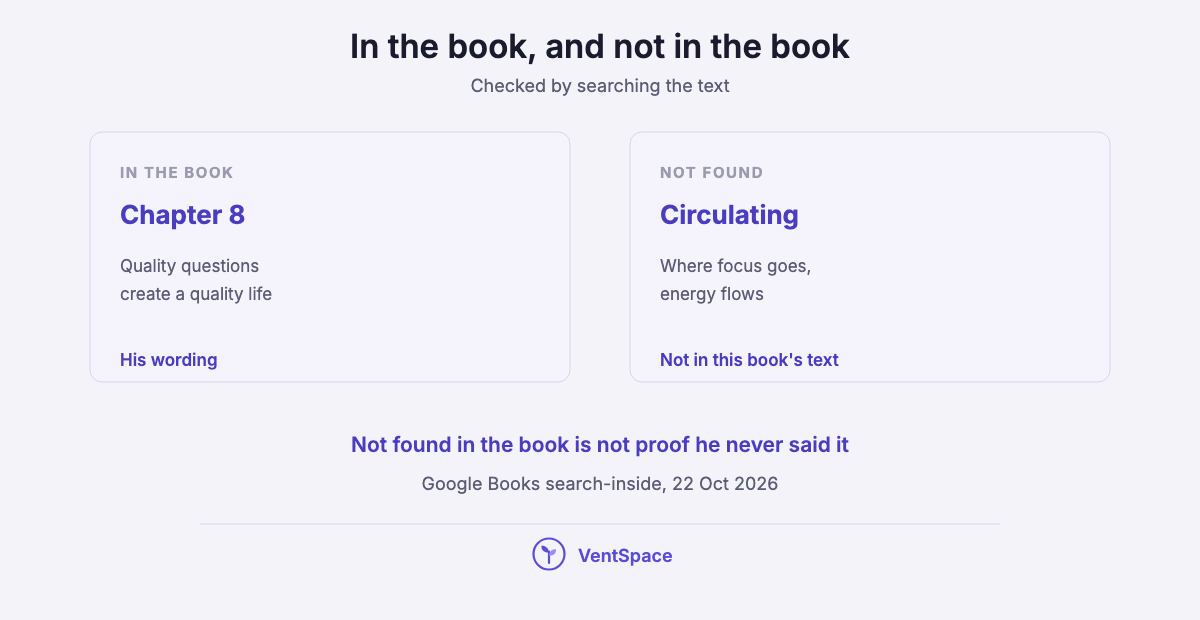
The 2023 version of this page quoted several lines as Robbins’s from this book. We searched the text for each. Some are real, some are close, and several did not turn up. “Not found” means not found in a search of this book’s text, not proof that he never said them anywhere.
| Line as it circulates | What we found in the book |
|---|---|
| “Setting goals is the first step in turning the invisible into the visible.” | In it, Chapter 12 |
| “It’s not the events of our lives that shape us, but our beliefs as to what those events mean.” | In it, Chapter 4 |
| “It’s not knowing what to do, it’s doing what you know.” | Close. The book says “knowing what to do is not enough: you must do what you know” |
| “The quality of your life is directly proportional to the quality of the questions you ask yourself.” | Not as quoted. The book says “Quality questions create a quality life” |
| “The past does not equal the future unless you live there.” | Not as quoted. The book suggests adopting the belief that “your past does not equal your future” |
| “Where focus goes, energy flows.” | Not found. The book says “whatever we focus on will determine how we feel” |
| “If you ask a lousy question, you will get a lousy answer.” | Not found |
| “By changing nothing, nothing changes.” | Not found |
| “The path to success is to take massive, determined action.” | Not found as quoted. The book does use “massive action” |
| “Rapport is the ability to enter someone else’s world” | Not found |
| “It’s not the lack of resources, it’s your lack of resourcefulness.” | Not found in the book. A version appears in his 2006 TED talk |
Which lesson to start with
Pick by what your week keeps doing to you, not by which line you like best. One lesson for ten days is enough.
- If you keep deciding the same thing every January: lesson 1.
- If one bad event becomes a verdict on everything: lesson 2.
- If you have quit the same habit several times: lesson 3.
- If your mind replays “why me” at night: lesson 4, then lesson 8.
- If every inconvenience sounds like a disaster: lesson 5.
- If you spend your energy fighting a feeling: lesson 6.
- If your goals feel flat once you reach them: lesson 7.
- If you do everything right and still feel behind: lesson 9.
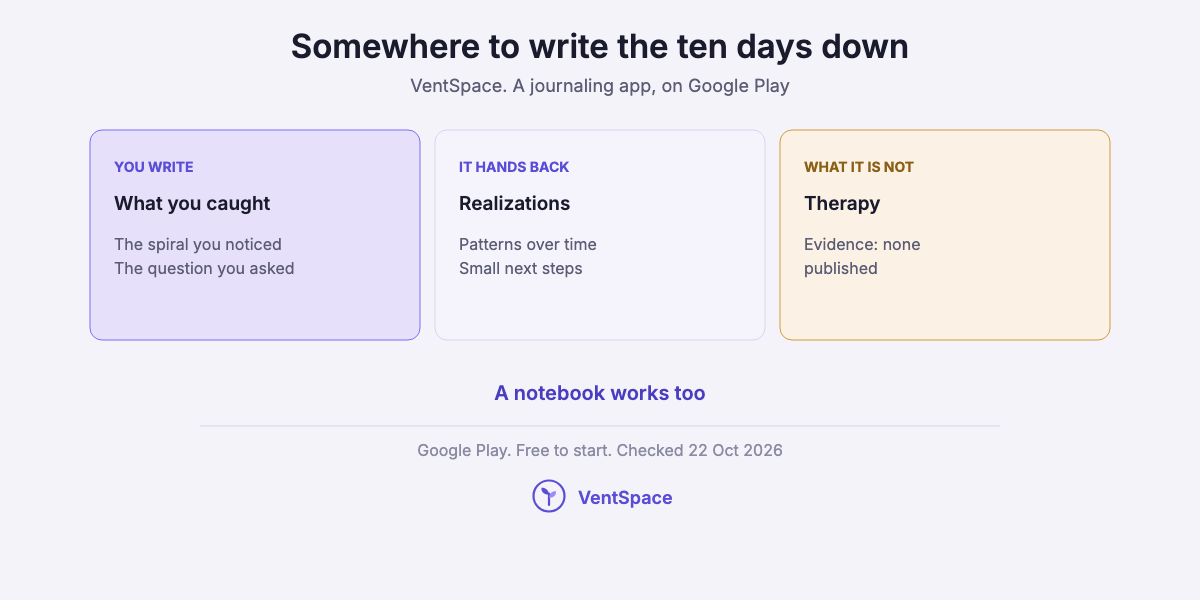
Several of these ask you to write something each night: the if-then line, the evening questions, what you caught during the ten days. Robbins himself suggests keeping a written journal for the challenge. A notebook works. So does VentSpace, a journaling app that turns what you write into a clear read on your life balance, plus small, doable next steps. It is free to start on Google Play for Android (checked 22 October 2026), and it is not therapy. Not on Android, or at a desk? VentSpace Live runs in your browser, free, with nothing to install.
Questions people ask
What are the main lessons of Awaken the Giant Within?
That decisions shape a life more than conditions do, that beliefs are about what events mean, that habits run on pain and pleasure, and that your questions, words and rules shape how you feel. The book’s best-known exercise is the Ten-Day Mental Challenge in Chapter 13. The nine above are the ones we could trace to a chapter.
Is it a seven-day or a ten-day challenge?
Ten. The Ten-Day Mental Challenge is Robbins’s version. The seven-day version is Emmet Fox’s The Seven Day Mental Diet, from 1935,, which Robbins credits as his source. Some summaries mix the two up.
Is Awaken the Giant Within backed by science?
Parts of it. Planning exactly when and where you will act has strong research support, and rethinking what a situation means has a small-to-medium effect in lab studies. His six-step change method and his vocabulary swap have no direct test we could find, and habit research suggests change takes longer than the book implies.
Why does this page’s address say “9 lessons” and “Antony”?
The address dates from the 2023 version, which promised nine lessons, delivered eight and misspelled the name. This version has nine, and the author is Tony Robbins. Older printings of the book credit him as Anthony Robbins. The address stays the same so old links keep working.
Is Awaken the Giant Within worth reading in 2026?
If you like a loud, practical book and can take the useful chapters without the promises, yes. Chapters 8, 12 and 13 hold many of its exercises. An updated 35th-anniversary edition came out in May 2026. If you would rather start with his talk, our page on Tony Robbins lessons works from his 2006 TED talk. For a quieter book, our page on the lessons in The Power of Now is a different register entirely.
The one thing underneath all nine
Read the nine together and they ask one habit of you: notice what is steering you before it steers you. The decision you keep making. The meaning you keep choosing. The question, the word, the rule. Robbins says it with capital letters. It works just as well in a quiet notebook at night.
That is also the honest limit of a book like this. It can make a stuck year feel movable for an evening, and the year is still there in the morning. Sai’s point about the book was never that it fixed him. It was that it kept being useful at different ages, which is about the most a book can do.
So pick one lesson. Run it for ten days, Robbins’s own unit. What will you notice by day ten that you could not see on day one?
About this article

Written by
Sai Subramaniam
Founder, VentSpace
I write these guides because I have been where you are. I am working through my own hard seasons, and I share the things that actually helped me, so that anyone going through it has a steady companion close by instead of facing it alone. VentSpace is the app I built for exactly that: a journaling app that turns what you write into a clear read on your life balance, plus small, doable next steps toward feeling more like yourself.
This writing is honest and every claim is sourced, and it is not a substitute for professional care. If you are struggling, reaching out to a professional is a strong move, not a failure.
Explore VentSpaceTry VentSpace LiveHow this one was checked. Every factual claim traces to a named source, and the source is printed next to the claim rather than kept in a footnote. Quotes are pinned to the work they come from, with the year, the letter or the chapter where one exists. Where a widely repeated claim could not be traced, it was left out and the omission recorded. Where a figure is contested, both sides are printed.
No affiliate links, no paid placements, and nobody paid to appear here. Where we mention our own app, we say that it is ours, we state its limits, and we never position it as a substitute for care.
Reviewed: October 2026. Prices, platforms and product availability move quickly, and anything we could not verify at the time of writing is marked as unverified rather than turned into a number.
Corrections. If something here is wrong, we would rather know. Corrections are made in place, with a note saying what changed.