
The story most people tell about Tony Robbins is that he is a motivator. He told a TED audience in 2006 that he is not. “I’m not here to motivate you,” he said. “I’m the “why” guy. I want to know why you do what you do.” That is a more useful man to learn from, and a quieter one than the stage suggests.
The 2022 version of this page was written by Sai, who founded VentSpace, after watching Robbins’s talks. It had good instincts and a lot of capital letters. It also credited Robbins with several famous lines that turned out to belong to other people. So we went back to what he said, in his own words, starting with the full transcript of that 2006 talk, and asked of every lesson whether the research agrees.
What follows is ten Tony Robbins lessons that held up as his, each with a source, a research check, something to try this week and an honest watch-out. Some have strong research behind them. Some have none, and we say so. Which one does your week need?
The lessons at a glance
- 1. Six needs sit under every goal: certainty, variety, significance, love and connection, growth, contribution.
- 2. Notice which need is in the driver’s seat: we all have all six, but one usually leads.
- 3. Growth and giving are where fulfillment lives: his “needs of the spirit”.
- 4. Three decisions shape a hard moment: what you focus on, what it means, what you do.
- 5. Resourcefulness, not only resources: the story of what you lack is not always the whole story.
- 6. Count the emotions you live in: in his seminars, people list fewer than 12 for an average week.
- 7. Achievement is a science, fulfillment is an art: getting what you want and feeling good about your life are different skills.
- 8. Put the dream on the calendar: “If you schedule it, it’s real.”
- 9. Trade expectation for appreciation: notice what is here before you measure it against what should be.
- 10. Don’t settle for the crumbs of connection: love is the risk most people avoid.
How we chose and checked them
Every lesson had to pass three checks, because the 2022 version of this page did not.
- He said it, and we can show where: each lesson is traced to the 2006 TED transcript or a page on his own website. Lines we could not trace are in a separate section near the end.
- The research gets its own row: where a study speaks to the idea, it is named with its size. Where nothing direct exists, the row says “none direct” and the lesson stands on judgment.
- It has to be something you can try: every lesson ends with one small action for this week and one honest watch-out.
We also left some of him out, on purpose. The section “Where we part ways with him” explains which parts and why.
What is driving you
The first three lessons are about motive. Not what you want, but what the wanting is for.
1. Six needs sit under every goal
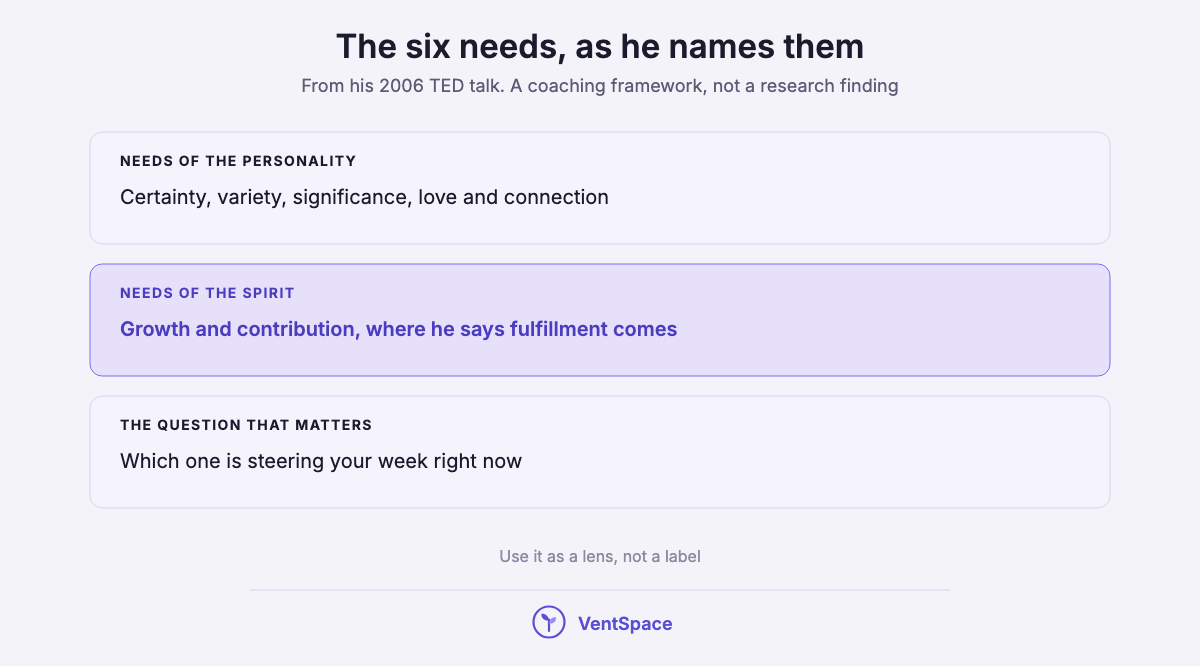
Robbins’s central idea is that goals are the surface. In the 2006 talk he asks whether anyone has reached a goal and thought, “is this all there is?” His answer is that underneath the goals sit needs: “I believe there are six human needs.” Certainty, so you can “avoid pain and at least be comfortable”. Uncertainty, or variety, because total certainty is boring. Significance, the need to “feel important, special, unique”. Connection and love. Growth. And contribution, “to contribute beyond ourselves.” Look at the last thing you chased hard. Which of the six was it feeding?
| Where he says it | TED2006, “Why we do what we do”, February 2006 |
| The idea | Six needs drive behavior underneath the goals people name |
| What the research says | We found no study that tests his six as a set. The closest test is Kennon Sheldon and colleagues (Journal of Personality and Social Psychology, 2001), who compared 10 candidate needs across three studies in U.S. and South Korean samples. Autonomy, competence and relatedness came out among the top four, and self-esteem mattered too, while popularity or influence and money-luxury mattered less |
| Try this | Write down the last three things you worked hard for. Next to each, write the one need it was mostly feeding |
| The watch-out | It is a coaching framework, not a measured model. Use it as a lens, not as a label for who you are |
Who it’s for: anyone who keeps reaching goals and feeling flat on the other side of them.
In practice: the research overlap is worth noticing. Relatedness looks like his love and connection, and competence sits near his growth. In that research, popularity or influence, close to his significance in its loudest form, ranked low.
Verdict: a useful lens with partial research overlap. Hold it lightly.
2. Notice which need is in the driver’s seat
Robbins says everyone needs all six, and one of them usually steers. “We all need all six, but what your lead system is tilts you in a different direction.” Someone who leads with certainty builds a different life from someone who leads with variety, even if they want the same job. Sai’s 2022 version of this lesson asked the right question and then said why it mattered: “But do you know your priorities? That’s more important.” When you are tired and choosing on autopilot, which need wins?
| Where he says it | TED2006 |
| The idea | The order of your needs, not just the needs, shapes the direction your life takes |
| What the research says | None direct. This one stands on judgment |
| Try this | Look back at one decision from this month that surprised you. Ask which need it served. Do the same for one decision you regret |
| The watch-out | Ranking yourself can harden into a type. You are allowed to lead with a different need next year |
Who it’s for: anyone who keeps making choices that look odd on paper and make sense in the moment.
In practice: Sai’s 2022 note still holds, so we kept it. “This social media world is actually messing up your need hierarchy.” His point was that a feed can turn up the volume on significance for people who never cared much about it. Is the need you are feeding this month yours, or the feed’s?
Verdict: the most personal lesson on the list, and the one that only works if you are honest with the answer.
3. Growth and giving are where fulfillment lives
Robbins splits the six into two groups. “I call the first four needs the needs of the personality. The last two are the needs of the spirit. And this is where fulfillment comes.” His claim is that you can meet the first four in a hundred ways, some of them harmful, and still feel empty. Growth and contribution are the two that fill the gap. When did you last learn something, or give something, that nobody asked you for?
| Where he says it | TED2006 |
| The idea | Fulfillment comes from growing and from giving beyond yourself |
| What the research says | For the giving half, yes, at a modest size. A 2018 meta-analysis led by Oliver Scott Curry (27 studies, 4,045 people) found acts of kindness had a small-to-medium effect on the wellbeing of the person doing them (δ = 0.28) |
| Try this | Do one unrequested kind thing for someone this week. Write down how you felt an hour later |
| The watch-out | Giving that leaves nothing for you stops helping either of you |
Who it’s for: anyone who has the first four needs roughly covered and still feels like something is missing.
In practice: his own example is concrete. At 17, by his account, he fed two families on Thanksgiving, then four the next year, then eight. That is giving at a size a person can start.
Verdict: true at the size the research measured. Do not expect more from it than that.
Quick Summary
Q: What are Tony Robbins’s six human needs?
A: In his 2006 TED talk he names certainty, uncertainty or variety, significance, connection and love, growth, and contribution. He calls the first four needs of the personality and the last two needs of the spirit, where fulfillment comes from. We found no study that tests his six as a set. The closest test of a needs list found autonomy, competence and relatedness mattered most.
Insight: Tony Robbins, TED2006, “Why we do what we do”: “And I believe the reason we grow is so we have something to give of value. Because the sixth need is to contribute beyond ourselves. Because we all know, corny as that sounds, the secret to living is giving.”
How you meet a hard moment
The next three are for the day something goes wrong. What you focus on, what you tell yourself you lack, and how many feelings you have words for.
4. Three decisions shape a hard moment
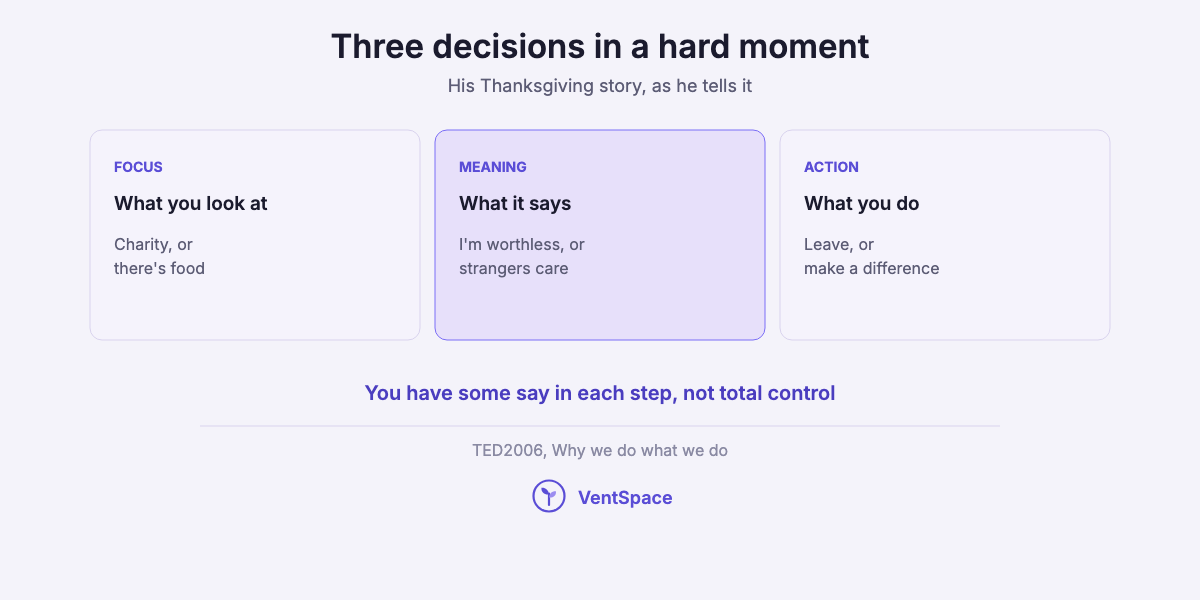
The best-known story in the talk is about Thanksgiving. By his own account, when Robbins was 11 there was “no money, no food,” and a stranger came to the door with a delivery of food. His father read it as charity. Robbins put his father’s three decisions in a line: “His focus was “This is charity. What does it mean? I’m worthless. What do I have to do? Leave my family,” which he did.” The boy made different ones. “I set focus on “There’s food.”” The meaning he took was “that strangers care.” Think of the last bad day you had. What did you focus on, and what did you decide it meant?
| Where he says it | TED2006: “What will you focus on? … the minute you decide to focus, you must give it a meaning, and that meaning produces emotion” |
| The idea | Focus leads to meaning, meaning leads to emotion, and emotion leads to what you do |
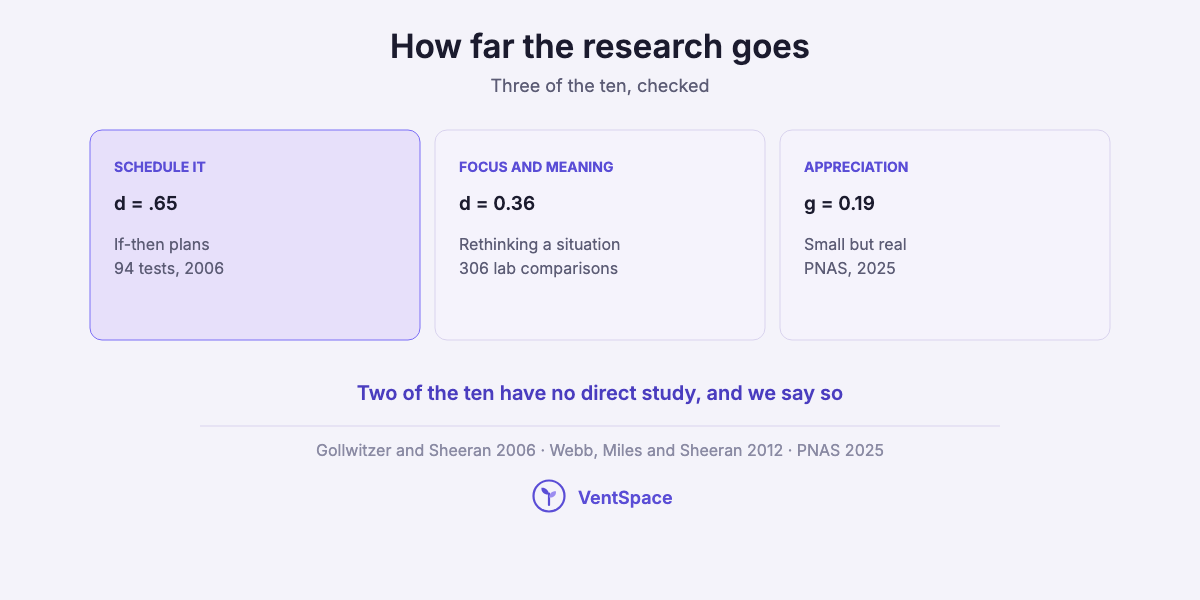
| What the research says | A 2012 meta-analysis by Thomas Webb, Eleanor Miles and Paschal Sheeran (306 lab comparisons) found that changing how you think about a situation had a small-to-medium effect on emotion (d = 0.36), and taking another person’s perspective had the largest (d = 0.45). These were single lab episodes, not a whole hard year |
| Try this | After one difficult moment this week, write three lines: what I focused on, what I decided it meant, what I did next |
| The watch-out | Some meanings are accurate. If the situation is unfair, a kinder meaning is not the goal. A truer one is |
Who it’s for: anyone whose bad moments turn into bad weeks because of the story told about them.
In practice: the three lines are the useful part, because they slow the chain down enough to see it. You may not change the meaning. You will at least see that one was chosen.
Verdict: the best-supported lesson in this group, as long as you hold it to “some say” and not “total control”.
5. Resourcefulness, not only resources
Robbins asks a room why people fail to reach what they want, and lists the answers. Not enough knowledge, money, time or technology. Then he concedes the point before turning it: “They are a claim to you missing resources, and they may be accurate. You may not have the money … but that is not the defining factor.” His turn is the line people remember: “The defining factor is never resources; it’s resourcefulness.” What reason have you been giving yourself this year?
| Where he says it | TED2006 |
| The idea | Creativity and determination can sometimes find a way around a missing resource |
| What the research says | None direct. This one stands on judgment |
| Try this | Take the one goal you have filed under “can’t afford it” or “no time”. Write one version of it that needs half the resources |
| The watch-out | A real lack of money, time or support is real. This lesson is not a verdict on anyone who has less, and “never” is his word, not a fact |
Who it’s for: anyone who has said “when I have more time” about the same thing for three years.
In practice: the honest version keeps both halves. The resource may be missing. The question is whether it is the only thing missing.
Verdict: worth asking, and worth refusing as an accusation.
6. Count the emotions you live in
This one comes from his seminars, not a study. Robbins says that when he asks a room to write down every emotion they feel in an average week, people list “Less than 12,” and about half are unpleasant. His point is that most of us live in a small, repeating set of feelings and call it our personality. If you wrote yours down tonight, how long would the list be?
| Where he says it | TED2006, describing an exercise from his events |
| The idea | Noticing how few emotions you cycle through is the first step to noticing the pattern |
| What the research says | Related, and small. A 2022 meta-analysis by Tatum Seah and Karin Coifman (17 studies) found that people who described their negative feelings in more differentiated terms were slightly less likely to use harmful coping behaviors (r = −.15). It is a correlation, not proof that naming feelings causes anything |
| Try this | Each evening for a week, write the two or three emotions you felt most that day, in the most precise words you can find |
| The watch-out | The goal is accuracy, not more pleasant words. A precise “resentful” is more useful than a vague “fine” |
Who it’s for: anyone who answers “how are you” with “tired” every single day.
In practice: after a week, the list itself is information. The same three words, seven days running, tell you something no single day could.
Verdict: a good exercise with a small, honest research cousin. His “less than 12” is his observation, not a finding.
Quick Summary
Q: What are Tony Robbins’s three decisions?
A: In his 2006 TED talk, Robbins says every hard moment involves three decisions: what you focus on, what it means, and what you do. He tells it through a Thanksgiving when he was 11, when a stranger delivered food to his family. Research on changing how you think about a situation finds a small-to-medium effect on emotion in the lab.
Insight: Tony Robbins, TED2006, on what the Thanksgiving delivery taught him: “It made me believe this: that strangers care. And that made me decide, if strangers care about me and my family, I care about them. I’m going to do something to make a difference.”
What you are chasing
These three are about the goals themselves. Whether getting them will help, how to make them real, and what to do with the gap between how it is and how it should be.
7. Achievement is a science, fulfillment is an art
Robbins opens the talk with what he calls “two master lessons”. The first is the science of achievement: “How do you make your dreams happen?” The second, “rarely mastered”, is the art of fulfillment, which he says is “about appreciation and contribution.” The 2022 page put it well in its own words: from the outside a life can look extraordinary, and on the inside the person can be miserable. Have you ever reached something and felt nothing change?
| Where he says it | TED2006 |
| The idea | Getting what you want and feeling good about your life are separate skills |
| What the research says | Supportive, in an interesting way. Christopher Niemiec, Richard Ryan and Edward Deci (Journal of Research in Personality, 2009) followed 147 young adults from one year to two years after college. Reaching intrinsic goals, like personal growth and close relationships, went with better psychological health. Reaching extrinsic goals, like money, fame and image, did not, and went with more signs of ill-being |
| Try this | List your three biggest goals for this year. Mark each one “inside” (growth, close relationships, community, health) or “outside” (money, fame, image) |
| The watch-out | Money and recognition are not bad goals. The finding is about what reaching them did and did not do for people |
Who it’s for: anyone who is doing well on paper and cannot work out why it does not feel like it.
In practice: the study gives his slogan a mechanism. It is not that achievement is empty. It is that some achievements feed the needs that matter and some do not.
Verdict: one of his strongest lessons, and the research makes it sharper.
8. Put the dream on the calendar
Robbins’s site carries a line that is more practical than it sounds. “If you talk about it, it’s a dream. If you envision it, it’s possible. If you schedule it, it’s real.” It is the science-of-achievement half of lesson 7 in one sentence. What is the thing you keep talking about and have never given a date?
| Where he says it | tonyrobbins.com, his collection of motivational quotes (read 22 October 2026) |
| The idea | A plan with a time and a place gets done far more often than an intention |
| What the research says | Strong. A 2006 meta-analysis by Peter Gollwitzer and Paschal Sheeran pooled 94 tests of “if-then” plans, which name when, where and how you will act, and found a medium-to-large effect on reaching goals (d = .65) |
| Try this | Take the dream you talk about most. Give its first step a 30-minute slot on a named day this week, and write “if it is 7 pm on Thursday, then I will…” |
| The watch-out | A calendar full of other people’s priorities is still a full calendar. Schedule one thing that is yours |
Who it’s for: anyone with a “someday” list longer than their “this week” list.
In practice: the research is about the if-then line, not about dreaming bigger. Pick a slot small enough that you would be embarrassed to skip it.
Verdict: the best-supported lesson on the list.
9. Trade expectation for appreciation
This is the lesson Tony and Sage Robbins built a 2020 holiday conversation around. The page on his site sets out the problem plainly: “We have rules and beliefs about how things are supposed to be or how people are supposed to be. And when they do not meet our expectations, we suffer.” Their answer is to “Trade your expectations for appreciation”. One of their examples is ordinary enough to use tomorrow: instead of fixing on the relative who shows up late, notice you have people who care enough to show up at all. Who in your life are you measuring against a rule they never agreed to?
| Where he says it | tonyrobbins.com podcast page “Trading expectations for appreciation” (2020), and his relationship quotes page |
| The idea | Disappointment often comes from an unspoken rule, and appreciation loosens it |
| What the research says | Small and real. The largest meta-analysis of gratitude practices (PNAS, 2025, 145 papers, nearly 25,000 people) found a small effect on wellbeing (g = 0.19), no difference by how many sessions people did, and effects no larger than other positive activities |
| Try this | The next time someone disappoints you this week, write the rule they broke. Then write one thing about them you are glad of |
| The watch-out | Appreciation is not the same as accepting everything. Some expectations are fair, and naming them is healthier than swallowing them |
Who it’s for: anyone whose evenings end in a quiet list of how other people fell short.
In practice: writing the rule down is the useful part. Some of our expectations sound unreasonable once they are on paper. Our gratitude list has ideas for the appreciation half.
Verdict: worth doing, at the size the research measured.
Quick Summary
Q: What does Tony Robbins mean by the science of achievement and the art of fulfillment?
A: In his 2006 TED talk he calls them two master lessons: achievement is knowing how to make your goals happen, and fulfillment, “rarely mastered”, is about appreciation and contribution. A study of 147 recent graduates found reaching intrinsic goals went with better psychological health, while reaching wealth and image goals did not.
Insight: Tony and Sage Robbins, from the 2020 fireside-chat page on tonyrobbins.com: “Most people never decide in advance of an experience the qualities that they are committed to experiencing. They let their past experiences color the present without even being conscious of it.”
Who you let close
The last lesson is about love. Robbins thinks it is the need people most often settle on half of.
10. Don’t settle for the crumbs of connection
In the talk, Robbins says of love that “most settle for connection, love’s too scary.” His website puts the same thought more gently: “when we lose love, the pain is so great that most people settle on connection, the crumbs of love.” The 2022 page made the same point: intimate relationships bring the most happiness and the most pain, so they are worth learning rather than running from. Is there someone you keep at the friendly, safe distance because closer feels like a risk?
| Where he says it | TED2006, and tonyrobbins.com relationship quotes (quote 4) |
| The idea | Love carries the risk of being hurt, and avoiding that risk often means settling for less |
| What the research says | Close relationships matter a great deal, though not in a way that proves his point about love specifically. A 2010 meta-analysis by Julianne Holt-Lunstad and colleagues (148 studies, 308,849 people) found people with stronger social relationships had about a 50% greater likelihood of survival over the study periods. It is observational and cannot show that adding relationships adds years |
| Try this | Pick one relationship that has stayed polite for too long. Tell that person one true thing this week that you would normally keep to yourself |
| The watch-out | Closeness is not owed to anyone who has hurt you. Choose someone safe to start with |
Who it’s for: anyone with a full contact list and nobody they would call at 2 a.m.
In practice: his own line on keeping score is worth adding here: “The minute you start keeping score, you start destroying the relationship.” Closeness tends to grow from small true things, not big gestures. If loneliness is the heavier part for you, our page on coping with loneliness goes further.
Verdict: right about the risk. Start small.
Quick Summary
Q: What does Tony Robbins say about relationships?
A: He says love and connection is one of the six human needs, and that most people settle for connection because love is “too scary”. Research on social relationships finds people with stronger ones had about a 50% greater likelihood of survival, though the studies are observational.
Insight: Tony Robbins, from his relationship quotes on tonyrobbins.com: “When we love completely we feel alive, but when we lose love, the pain is so great that most people settle on connection, the crumbs of love.”
All ten lessons, side by side
| # | Lesson | Where he says it | Research behind it | Try this week | The watch-out |
|---|---|---|---|---|---|
| 1 | Six needs | TED 2006 | Partial: Sheldon et al. 2001, 10 needs tested | Three goals, three needs | A lens, not a label |
| 2 | Your lead need | TED 2006 | None direct | One surprise, one regret | Ranking hardens into a type |
| 3 | Growth and giving | TED 2006 | Curry et al. 2018, δ = 0.28 | One unrequested kindness | Nothing left for you |
| 4 | Three decisions | TED 2006 | Webb et al. 2012, d = 0.36 | Focus, meaning, action | Truer, not just kinder |
| 5 | Resourcefulness | TED 2006 | None direct | Half-resource version | Real lack is real |
| 6 | Count your emotions | TED 2006 | Seah and Coifman 2022, r = −.15 | Two precise words a night | Accuracy, not niceness |
| 7 | Achievement vs fulfillment | TED 2006 | Niemiec et al. 2009 | Mark goals inside or outside | Money is not the villain |
| 8 | Schedule it | tonyrobbins.com | Gollwitzer and Sheeran 2006, d = .65 | One 30-minute slot | Schedule one thing that is yours |
| 9 | Expectation to appreciation | tonyrobbins.com, 2020 | PNAS 2025, g = 0.19 | Write the broken rule | Some expectations are fair |
| 10 | Not the crumbs | TED 2006, tonyrobbins.com | Holt-Lunstad et al. 2010, observational | One true thing | Start with someone safe |
Where we part ways with him
Robbins is at his best when he asks questions and at his weakest when he promises total control. Three places where we did not follow him, said plainly and without a grudge.
- “Every problem is a gift”: the full line on his site is “Every problem is a gift – without problems we would not grow.” Problems can teach you something. Calling every one of them a gift asks people in hard seasons to feel grateful for what is hurting them, and we would rather say what is true. A problem can be information without being a present.
- Deciding not to suffer: the 2022 page quoted him, from a video we have not re-opened, on deciding not to suffer and living in “a beautiful state”. We left it out. You have some say in what you focus on, not total say in how you feel, and a low mood that has lasted weeks is not something you can decide away. If that is where you are, talking to a doctor or a therapist is the better next step.
- “We live in a therapy culture”: in the TED talk he says the culture has “the mindset that we are our past” and that “most of society thinks biography is destiny.” We agree the past is not a sentence. We do not agree that therapy is the belief that it is. Therapy is one option. For a lot of people it’s the right one. The questions in this list can sit alongside it. They are not a replacement for it.
Lines that circulate as his, but are not
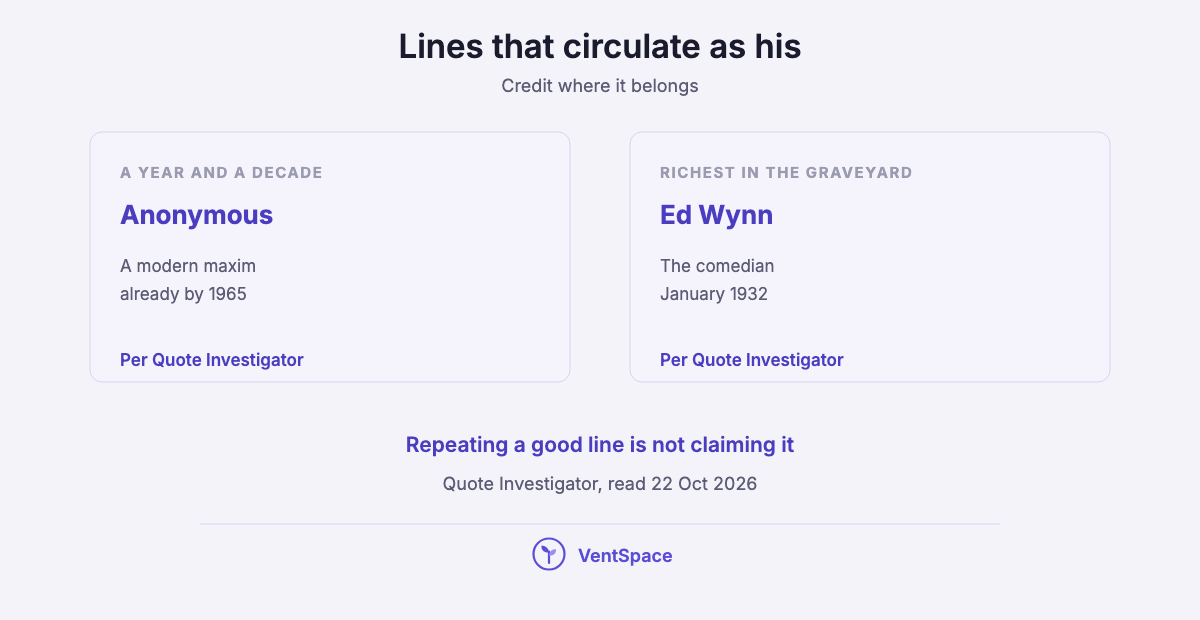
Several famous lines travel under Tony Robbins’s name, and four of them were on the 2022 version of this page. We checked each. This is about getting the credit right. A speaker who repeats a good line is not claiming it.
- “People overestimate what they can do in a year and underestimate what they can do in a decade”: Quote Investigator traces the idea to 1965, in J. C. R. Licklider’s book Libraries of the Future, where it is already called “a modern maxim” with no author. Licklider disclaimed credit, so the earliest known version is anonymous.
- “You don’t want to be the richest man in the graveyard”: Quote Investigator credits the comedian Ed Wynn, who said in January 1932, “I have no ambition to be the wealthiest man in the cemetery.” Colonel Harland Sanders and Steve Jobs used versions of it later.
- “Most people mistake movement for achievement”: we could not find a source for it under Robbins’s name or anyone else’s. Similar lines circulate credited to John Wooden and Ernest Hemingway, also without a source we could check, so we credit nobody.
- “Success without fulfillment is the ultimate failure”: this one is widely credited to Robbins, including in an Inc. headline, and it fits his talk. We could not load where he first said it, so we quote his TED wording instead: the art of fulfillment is “rarely mastered”.
Which lesson to start with
Pick by what your week keeps doing to you, not by which line you like best. One lesson for seven days is enough.
- If you keep reaching goals and feeling flat: lesson 7, then lesson 1.
- If a bad moment keeps turning into a bad week: lesson 4.
- If you are always waiting for more time or money: lesson 5, then lesson 8.
- If every evening ends in a list of who let you down: lesson 9.
- If the same few feelings run every day: lesson 6.
- If your relationships are pleasant and shallow: lesson 10.
Lessons 2 and 6 both ask you to write something down most nights for a week: which need ran the day, and which emotions came with it. A notebook works. So does VentSpace, a journaling app that turns what you write into a clear read on your life balance, plus small, doable next steps. It is free to start on Google Play for Android (checked 22 October 2026), and it is not therapy. Not on Android, or at a desk? VentSpace Live runs in your browser, free, with nothing to install.
Questions people ask
What are Tony Robbins’s main lessons?
Across his 2006 TED talk and his own website, the recurring ideas are six human needs underneath every goal, three decisions in every hard moment (focus, meaning, action), resourcefulness over resources, the difference between achievement and fulfillment, and trading expectation for appreciation. The ten above are the ones we could trace to his own words.
What are the 6 human needs according to Tony Robbins?
Certainty, uncertainty or variety, significance, connection and love, growth, and contribution. He calls the first four needs of the personality and the last two needs of the spirit. It is a coaching framework, and we found no study that tests it as a set. For using it as a self-awareness tool, our guide to self-awareness has a worked example.
Is Tony Robbins’s advice backed by science?
Some of it is and some is not. Planning when and where you will act has strong research support, and changing how you think about a situation, acts of kindness and gratitude have support at small-to-medium sizes. His six needs overlap only partly with the needs research has tested. Several lessons stand on judgment, which is fine as long as nobody calls them science.
Did Tony Robbins say “people overestimate what they can do in a year”?
Not originally. Quote Investigator’s earliest known version is from 1965, already described as “a modern maxim”, with no author. The same is true of “the richest man in the graveyard”, which goes back to the comedian Ed Wynn in 1932.
Which Tony Robbins talk or book should I start with?
The 2006 TED talk, “Why we do what we do”, holds most of the ideas on this page. If you want the book version of his thinking, our page on 9 lessons from Awaken the Giant Within goes through it.
The one thing underneath all ten
Read the ten together and they are about one habit: looking at the story before you live inside it. Which need it serves. What you focused on. What you decided it meant. What rule someone broke. Robbins says it with a stage and a microphone. It works just as well with a pen.
That is also the honest limit of any list like this. A talk can make a hard week feel lighter for twenty minutes, and the week is still there afterward. Sai closed the 2022 page with a line worth keeping: “There’s time. There’s always time. Don’t be too hard on yourself.”
So pick one lesson. Run its “Try this” for seven days. What story will you notice yourself telling by Sunday?
About this article

Written by
Sai Subramaniam
Founder, VentSpace
I write these guides because I have been where you are. I am working through my own hard seasons, and I share the things that actually helped me, so that anyone going through it has a steady companion close by instead of facing it alone. VentSpace is the app I built for exactly that: a journaling app that turns what you write into a clear read on your life balance, plus small, doable next steps toward feeling more like yourself.
This writing is honest and every claim is sourced, and it is not a substitute for professional care. If you are struggling, reaching out to a professional is a strong move, not a failure.
Explore VentSpaceTry VentSpace LiveHow this one was checked. Every factual claim traces to a named source, and the source is printed next to the claim rather than kept in a footnote. Quotes are pinned to the work they come from, with the year, the letter or the chapter where one exists. Where a widely repeated claim could not be traced, it was left out and the omission recorded. Where a figure is contested, both sides are printed.
No affiliate links, no paid placements, and nobody paid to appear here. Where we mention our own app, we say that it is ours, we state its limits, and we never position it as a substitute for care.
Reviewed: October 2026. Prices, platforms and product availability move quickly, and anything we could not verify at the time of writing is marked as unverified rather than turned into a number.
Corrections. If something here is wrong, we would rather know. Corrections are made in place, with a note saying what changed.