
It is a Tuesday, 11:40 p.m. You opened a game “for five minutes” to come down from the day, and you are now on your third run, jaw tight, annoyed at a cartoon fruit. Was that relaxing?
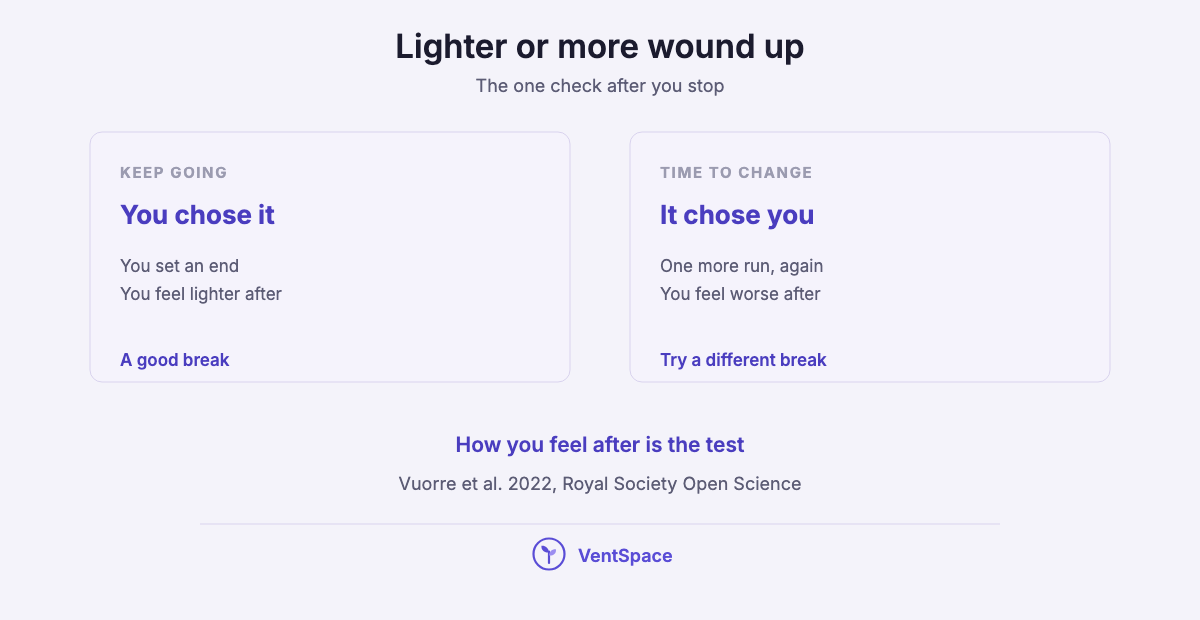
Here is the turn. The game is rarely the problem, and it is rarely the cure either. A large study tracked 38,935 players through the game companies’ own records. Hours played barely moved how they felt. What did matter was why they were playing: choosing to play for the fun of it went with feeling better, and feeling like you had to play went with feeling worse.
So this list does two jobs. It gives you eleven games that tend to calm rather than wind up, sorted by the kind of calm they give, with prices and platforms checked on both stores on 22 October 2026, and it tells you plainly how to use them, how long a break is worth taking, what the research does and does not say about any of this, and when a game has stopped being the right tool, so that you put the phone down lighter instead of more wound up than when you picked it up. Ready?
Stress relief games at a glance
- 1. Alto’s Odyssey: best for drifting. Zen Mode removes scores and coins.
- 2. Neko Atsume: Kitty Collector: best for doing almost nothing. Leave food out, cats visit.
- 3. Fishing and Life: best for the sound of waves at the end of the day.
- 4. Monument Valley: best for a short, beautiful puzzle with no rush.
- 5. Mini Metro: best for a busy mind that needs one job. Endless mode to relax.
- 6. Blockudoku: best for two minutes at a desk.
- 7. Art Puzzle: best for slow, picture-by-picture calm.
- 8. Cryptogram: best for word people. Decode a quote.
- 9. Candy Crush Saga: best if you already know and like it.
- 10. Fruit Ninja: best for a quick release. Has a Zen mode.
- 11. Super Mario Run: best for a familiar one-handed break.
How we chose and checked them
Every game had to pass three tests. We started from the 2022 version of this page, which Sai, who founded VentSpace, built around games he and his family played, kept the ones that still made sense for someone who wants to come down rather than wind up, added a few the old page only mentioned in passing, and then checked every remaining game again on both stores. Three tests:
- It calms more than it winds up: a relaxed mode, no forced timers, or a pace you set. Games built around weekly tournaments were left out.
- It is still on the store: every listing was loaded on 22 October 2026. Three games the old page linked no longer load, and they are named near the end.
- The facts are the stores’ facts: price and platform are as listed that day, for the US stores. Prices change, and some games change their model, so check before you pay.
We did not read reviews. So the closing notes are In practice, our honest read, not “what users say”.
Slow and calm
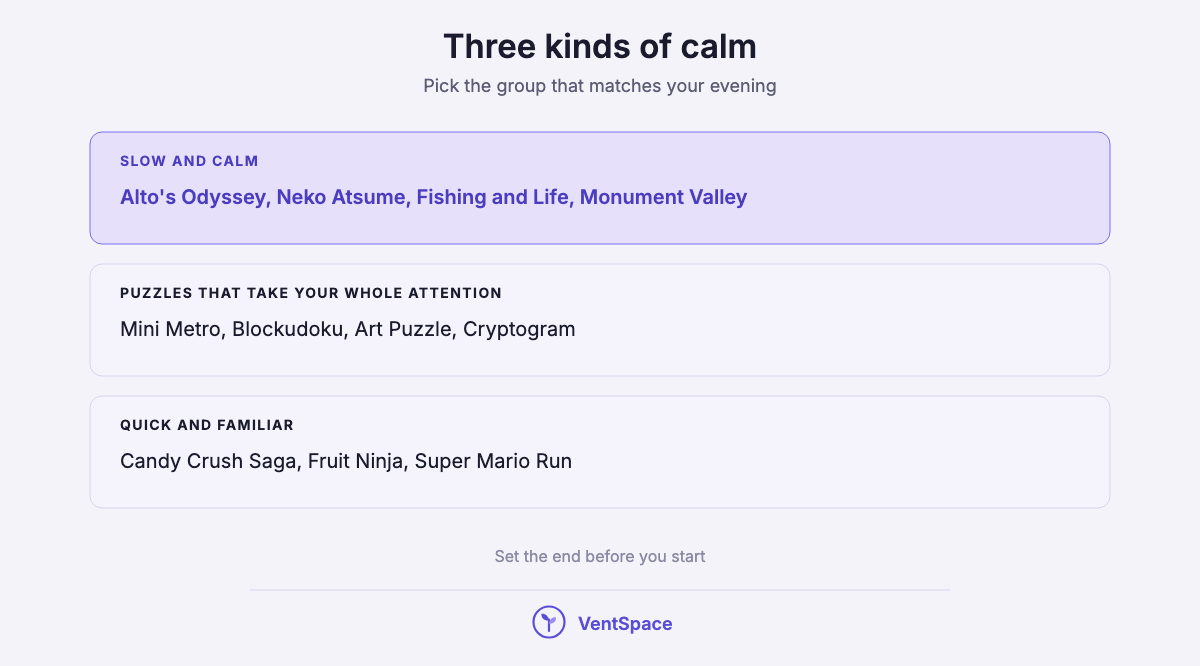
These four ask almost nothing of you. No clock, no score you have to care about, and in two of them, barely any input at all. If your evening so far has been a long run of other people’s demands, from the inbox to the commute to whatever is waiting in the group chat, a game that wants nothing from you can be the first thing all day that does not. Start here.
1. Alto’s Odyssey
Alto’s Odyssey is an endless sandboarding game across a desert, and on a normal run it is a score chase like any other, with coins to collect, tricks to chain and a little voice in the back of your head that starts keeping count of how far you got last time and whether you can beat it before you let yourself put the phone down for the night. The reason it is here is one mode. Its store listing describes Zen Mode as distilling the game “down to its purest elements: no scores, no coins, and no power-ups.” Sai’s 2022 tip was the same move in the first game, Alto’s Adventure: “I recommend the Zen mode for stress relief.”
| Type | Endless sandboarding game with a Zen Mode |
| Platforms | Android (Google Play) and iOS (App Store) |
| Price | Google Play: free, with ads and in-app purchases. App Store: $4.99, listed as a premium game with no ads or in-app purchases |
| Best for | Drifting for ten minutes without anything to win |
| Pros | Zen Mode has its own soundtrack and no scores · beautiful, slow-changing scenery |
| Cons | The normal mode is a score chase · the free Android version carries ads |
Who it’s for: anyone who wants motion without pressure.
In practice: the normal mode, with its coins and its tricks and its quiet pressure to beat the last run, is a perfectly good game that happens to be the wrong one for a night when you are already wound tight, so skip the menu and go straight to Zen Mode. Then just ride.
Verdict: the best pure wind-down here.
2. Neko Atsume: Kitty Collector
The whole game, in the developer’s own words, starts with “Place playthings and snacks in your yard.” Step two is waiting for cats to visit, and more than 40 kinds might turn up. You do almost nothing, and that is the point. Sai’s 2022 reaction is probably everyone’s: “When I first heard what the game was about I was shocked that such games existed.”
| Type | Idle cat-collecting game |
| Platforms | Android and iOS. A sequel, Neko Atsume 2, is on the App Store |
| Price | Free on both stores. Google Play lists ads and in-app purchases |
| Best for | A thirty-second check-in that asks nothing of you |
| Pros | No skill needed · checking in is the whole loop |
| Cons | The original’s Google Play listing was last updated in March 2024 |
Who it’s for: anyone who wants something gentle to look at, not something to do.
In practice: it works best as a pause rather than a session, the kind of thing you open while the kettle boils, glance at to see which cat turned up and which toy it is playing with, and close again before anything in you has had time to get competitive about it. Open, look, close.
Verdict: lowest effort, and that’s the point.
3. Fishing and Life
Fishing and Life (the old page called it Fishing Life) is a simple fishing game with day turning to night and, in its own listing’s words, “The natural ASMR waves sound”. The game even has a motto: “Fishing is to Heal your heart.” Take the motto as the game’s mood, not a promise. You cast, you catch, you upgrade the boat, you listen to the sea.
| Type | Casual fishing game |
| Platforms | Android and iOS |
| Price | Free on both stores. Google Play lists ads and in-app purchases |
| Best for | Ending the day with sound and slow repetition |
| Pros | Calm visuals and sound · simple controls |
| Cons | Upgrades and a season pass pull you toward spending and grinding |
Who it’s for: anyone who finds the sound of water calming.
In practice: play with the sound on and the upgrades ignored, because the moment you start counting coins toward a better rod and checking what the season pass would unlock, the game quietly turns from listening to the sea into another small list of things you have not finished yet. Ignore the shop.
Verdict: gentle, if you resist the store.
4. Monument Valley
Monument Valley has you guide a silent princess through buildings that could not exist, rotating stairs and paths until an impossible route connects. It is a puzzle you move through at your own pace. The old page tucked it into a list of extras at the bottom, beside a handful of names with no description at all, and it has earned more than that, because it is one of the few games anyone recommends for calm that is also a genuinely lovely thing to look at. It gets one.
| Type | Puzzle exploration game |
| Platforms | Android and iOS |
| Price | $3.99 on both stores (Google Play also lists in-app purchases) |
| Best for | One beautiful level when you have fifteen quiet minutes |
| Pros | No ads flag on Google Play · striking art |
| Cons | Paid up front, and its listing sells expansions (Forgotten Shores, Ida’s Dream) on top |
Who it’s for: anyone who wants absorption without a clock.
In practice: one level a night is about right, because stopping at the end of a level, rather than in the middle of a puzzle you have half worked out, tends to feel like finishing something instead of abandoning it, and that feeling is most of what you came for. Then put it down.
Verdict: the most beautiful one here.
Quick Summary
Q: What are the most relaxing mobile games for stress?
A: Games with no clock and no score to protect tend to calm rather than wind up. Alto’s Odyssey in Zen Mode, Neko Atsume, Fishing and Life and Monument Valley all fit, and each was checked on Google Play and the App Store on 22 October 2026. Monument Valley costs $3.99, the others are free to start on Android.
Insight: Matti Vuorre and colleagues, Royal Society Open Science (2022), after tracking the play time of 38,935 players across seven games: “Simply put, the subjective qualities of play may be more important than its quantity.”
Puzzles that take your whole attention
These four work differently. They do not soothe you. They occupy you, and a mind with one clear, solvable job, a subway line to redraw or a letter to place, has less room left over for the conversation it was replaying, the email it has not sent or the thing someone said at lunch that it keeps turning over. That is the mechanism. Nothing more mysterious.
5. Mini Metro
Mini Metro is, in its listing’s words, “a game about designing a subway map for a growing city.” Stations appear, lines get crowded, you redraw. It sounds like more work. It is a different kind of work, the kind with a visible answer. The App Store listing names the mode you want: “Endless to relax.”
| Type | Minimalist strategy puzzle |
| Platforms | Android and iOS |
| Price | Paid. Listed at $0.99 on Google Play and $3.99 on the App Store on 22 October 2026. The Google Play description says “No ads or in-app purchases” |
| Best for | A racing mind that needs one problem it can solve |
| Pros | Clean, quiet design · an Endless mode · no ads |
| Cons | Normal mode builds to a failure point that can feel tense |
Who it’s for: anyone who relaxes by organizing things.
In practice: Endless mode is the stress relief version, and the scored mode, where the city keeps growing until a station overflows and the game ends on you, is a fine challenge on a good day and exactly the wrong thing on a day that has already gone like that. Pick Endless.
Verdict: busy hands, quiet head.
6. Blockudoku
Blockudoku is “an original combination of sudoku and block puzzle games” on a 9×9 board. You place shapes, clear lines, repeat. A round can be short, which makes it the most desk-friendly game on the list. One honest flag: its own store copy calls it “addictive”, and the makers mean that as a selling point.
| Type | Block puzzle |
| Platforms | Android and iOS |
| Price | Free on both stores. Google Play lists ads and in-app purchases |
| Best for | Two minutes between meetings |
| Pros | Simple rules · a 9×9 board familiar to sudoku players · a round fits a short break |
| Cons | Ads between rounds · built to make “one more” easy |
Who it’s for: anyone who wants a short, clean reset at work.
In practice: decide on one round before you open it, out loud if you have to, because a game whose own description promises you will not be able to put it down is telling you plainly how it has been designed to treat your evening. Believe it.
Verdict: excellent, if you set the end.
7. Art Puzzle
Art Puzzle mixes jigsaw and coloring: you fit pieces until a picture comes to life. Its developer says it is “designed to help players calm down and relax”. That is their claim, not a study. Still, nothing chases you.
| Type | Picture puzzle |
| Platforms | Android and iOS |
| Price | Free on both stores. Google Play lists ads and in-app purchases |
| Best for | Slow, visual calm before bed |
| Pros | Unhurried pace · pleasing images |
| Cons | Ads, per its Google Play listing |
Who it’s for: anyone who likes jigsaws and coloring books but not the mess.
In practice: one picture is a natural stopping point, and finishing a picture and closing the app gives you the small, clean sense of completion that a long day at work so rarely hands you, which is part of why a puzzle like this can feel calming at all. Stop there.
Verdict: calm, pretty, does what it says.
8. Cryptogram
Cryptogram hands you “encoded quotes” in a simple substitution code, and you crack them letter by letter. Word people, this one is yours. The reward at the end is a quotation.
| Type | Word puzzle |
| Platforms | Android (Google Play). We did not confirm an iOS version from the same maker |
| Price | Free on Google Play, with ads |
| Best for | Readers and crossword people |
| Pros | Fully absorbing for word lovers · one quote is one puzzle |
| Cons | Ads · the quotes’ attributions are the app’s, not checked by us |
Who it’s for: anyone who would rather solve a sentence than stack a block.
In practice: for some people, decoding a sentence one letter at a time seems to take up the same attention that would otherwise go to replaying a conversation from this afternoon, which is the whole reason a word puzzle can work where a soothing game does not. Try one quote.
Verdict: the word lover’s pick.
Quick Summary
Q: Do puzzle games help with stress?
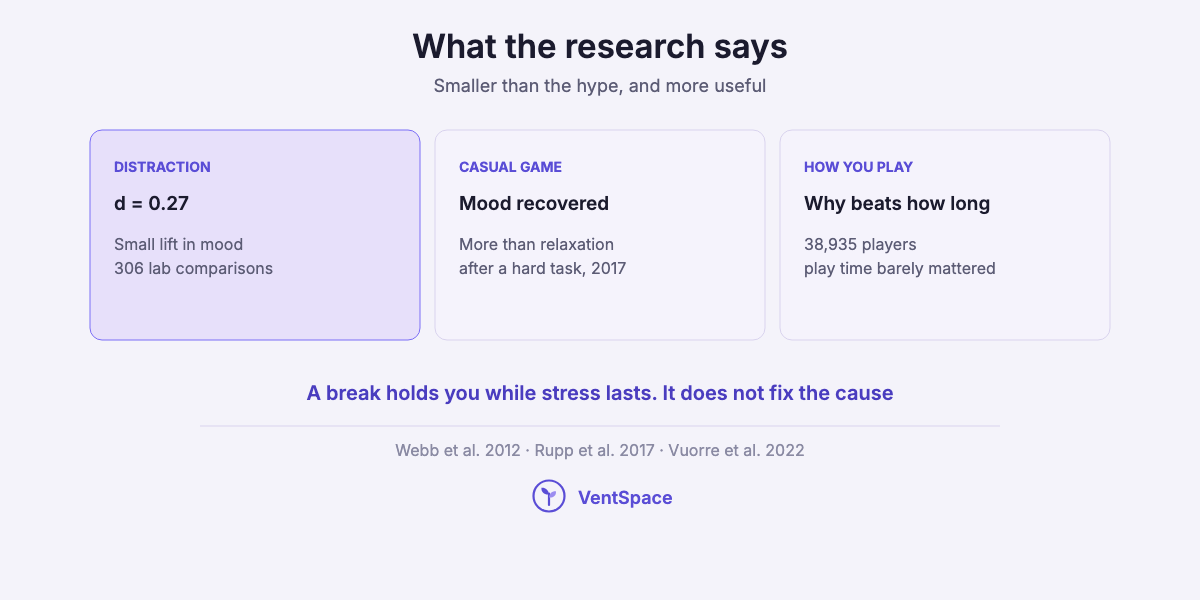
A: They can take your mind off it for a while. In a 2012 analysis of 306 lab comparisons, distraction had a small positive effect on emotion (d = 0.27), while concentrating on the feeling had a small negative one (d = −0.26). Puzzles like Mini Metro, Blockudoku, Art Puzzle and Cryptogram are distraction with a clear task.
Insight: Thomas Webb, Eleanor Miles and Paschal Sheeran, Psychological Bulletin (2012): “Whereas distraction was an effective way to regulate emotions (d(+) = 0.27), concentration was not (d(+) = -0.26).”
Quick and familiar
The last three are games you probably already know. Familiar is underrated when you are stressed, because a game you learned years ago asks for no new rules, no tutorial and no decisions about how it works, which leaves the whole of your attention free for the one thing you came for, which is a few minutes that feel easy. No learning curve.
9. Candy Crush Saga
Candy Crush needs no introduction, and if you are honest it probably also needs no recommendation from us, since you have almost certainly met it on someone’s phone in an office, on a bus or in a waiting room and already formed a firm view of whether it relaxes you or drives you up the wall. It is on this list for a personal reason. Sai’s 2022 note: “It’s so popular that my mom plays it often during her work hours to let go of some stress.” That is the use case. A short, known game between tasks.
| Type | Match-three puzzle |
| Platforms | Android and iOS |
| Price | Free on both stores. Google Play lists ads and in-app purchases |
| Best for | A known, low-effort break |
| Pros | Familiar · plays offline, per its App Store listing · levels are short |
| Cons | Lives, boosters and “Daily Rewards: Log in every day” are built to bring you back |
Who it’s for: anyone who already enjoys it.
In practice: the daily-reward loop is the thing to watch, because playing for ten minutes because you want a break is a different act from opening the game at 11 p.m. because a streak, a free booster or a reminder told you to, even when your thumb is doing the same thing. Notice which one.
Verdict: fine, if it is not setting your schedule.
10. Fruit Ninja
Fruit Ninja is swipe, slice, splash. It is the closest thing on the list to hitting a pillow. The App Store listing names the calmer option: you can “simply practise your fruit-slicing skills in Zen mode.”
| Type | Arcade slicing game |
| Platforms | Android and iOS |
| Price | Free on both stores. Google Play lists ads and in-app purchases |
| Best for | A quick physical release |
| Pros | Instant, satisfying, no learning curve · a Zen mode |
| Cons | Arcade and Classic modes are fast and can wind you up |
Who it’s for: anyone whose stress feels physical and restless.
In practice: Zen mode is the one for relief and the faster modes are the ones for fun, and knowing which of the two you need tonight is most of the skill involved in using a game like this well. Choose before you swipe.
Verdict: the best short burst here.
11. Super Mario Run
Super Mario Run is, in Nintendo’s words, “A new kind of Mario game that you can play with one hand.” Mario runs on his own and you tap to jump. Sai’s 2022 note, lightly edited: “Super Mario is my all-time favorite. I remember playing it on PC, PlayStations, and now on mobiles.” Familiarity is the whole appeal.
| Type | Auto-running platform game |
| Platforms | Android and iOS |
| Price | Free to download on both stores. Google Play lists in-app purchases |
| Best for | A one-handed break with a character you already love |
| Pros | One-handed · no ads flag on Google Play |
| Cons | Some of the game sits behind in-app purchases |
Who it’s for: anyone with Mario nostalgia and one free hand.
In practice: one world, then stop, because nostalgia is relaxing right up to the moment it turns into a completion list of coins you missed and levels you have not cleared, and at that point you are working again, just for a plumber. One world.
Verdict: a warm, familiar break.
Quick Summary
Q: Are casual games like Candy Crush good for stress?
A: They can be a good short break, especially if you already enjoy them. In one experiment, people who played a casual video game after a demanding task showed more mood recovery than people who did a relaxation activity. The catch with familiar casual games is the daily-reward loop, which can turn a choice into a habit.
Insight: Michael Rupp and colleagues, Human Factors (2017), comparing a break, a relaxation activity and a casual video game after a demanding task: “Playing a casual video game even briefly can restore individuals’ affective abilities, making it a suitable activity to restore mood in response to stress.”
All eleven, side by side
| # | Game | Type | Price (22 Oct 2026) | Platforms | Best for | The watch-out |
|---|---|---|---|---|---|---|
| 1 | Alto’s Odyssey | Endless, Zen Mode | Free on Android with ads · $4.99 on iOS | Android, iOS | Drifting | Normal mode is a score chase |
| 2 | Neko Atsume | Idle | Free | Android, iOS | Doing almost nothing | Original last updated 2024 |
| 3 | Fishing and Life | Casual fishing | Free | Android, iOS | Waves at night | Upgrade grind |
| 4 | Monument Valley | Puzzle exploration | $3.99 | Android, iOS | One quiet level | Expansions cost extra |
| 5 | Mini Metro | Strategy puzzle | $0.99 Android, $3.99 iOS | Android, iOS | One clear problem | Scored mode is tense |
| 6 | Blockudoku | Block puzzle | Free | Android, iOS | Two minutes at a desk | Built for “one more” |
| 7 | Art Puzzle | Picture puzzle | Free | Android, iOS | Slow visual calm | Ads |
| 8 | Cryptogram | Word puzzle | Free | Android | Word people | Ads |
| 9 | Candy Crush Saga | Match-three | Free | Android, iOS | Known, easy break | Daily rewards loop |
| 10 | Fruit Ninja | Arcade | Free | Android, iOS | Quick release | Fast modes wind you up |
| 11 | Super Mario Run | Auto-runner | Free to download | Android, iOS | One-handed nostalgia | In-app purchases |
What the research says about games and stress
The honest summary is smaller and more useful than the hype. Three findings are worth knowing, and none of them is the line that circulates most, which usually claims some chemical in your brain does the work, a claim that sounds scientific and that we could not trace to anything we were able to read. Here is what we could.
- A casual game can lift your mood after a hard task: Michael Rupp and colleagues (Human Factors, 2017) gave people a demanding task, then randomly assigned a passive break, a relaxation activity or a casual video game. The game group showed “greater engagement and affective restoration than the relaxation condition”, and the plain break “slightly decreased affect”. The authors add that none of the options restored thinking performance.
- Distraction helps a little, dwelling hurts a little: across 306 lab comparisons, distraction had a small positive effect on emotion (d = 0.27), and concentrating on the feeling had a small negative one (d = −0.26). A game is distraction with a task attached. That is the mechanism, and it is modest.
- How you play matters more than how long: in the study of 38,935 players, play time had “limited if any impact on well-being”, while playing for its own sake went with feeling better and feeling pressured to play went with feeling worse. A 2025 follow-up with 703 adults across 150 Nintendo Switch games found the same about hours, and that how people judged the place of games in their life, which the authors call “gaming life fit”, did relate to wellbeing. An earlier study of Animal Crossing and Plants vs. Zombies players found a small positive link between play and mood.
One more number belongs here, because it is about breaks in general rather than games in particular, and it is the closest thing we have to an answer to the question people are asking when they search for this, which is whether stopping for ten minutes to play something is a sensible thing to do or just a way of putting things off. Short answer: sensible. Short breaks of any kind help how you feel, not what you produce. A 2022 meta-analysis of micro-breaks (22 samples, 2,335 people) found gains in vigor and less fatigue (d of about 0.35 for each), and no reliable gain in performance. A game is one way to take that break.
What none of this says: that games treat stress, anxiety or anything else. They are a break. A break holds you while the stress lasts. It does not change what is causing it.
How to pick one
Pick by where you are and how long you have, not by which game looks prettiest. Short list:
- If you have two minutes at a desk: one round of Blockudoku, or one Neko Atsume check-in. Set the end before you start.
- If your head will not stop rehearsing something: Mini Metro in Endless mode, or Cryptogram if you are a words person. Give the busy part of your mind a job.
- If you are winding down for bed: Alto’s Odyssey in Zen Mode or Fishing and Life, sound on, and a stop point decided in advance.
- If the stress feels physical and restless: Fruit Ninja, Zen mode first.
- If you want something quiet and finished: one level of Monument Valley.
Then check one thing when you put the phone down. Do you feel lighter, the same, or more wound up? That answer is more useful than any review, including ours.
When a game is not the right tool
Sometimes the game stops being a break. It usually happens quietly: you play longer than you meant to, you feel worse rather than better when you finally stop, the hour you meant to spend sleeping or calling someone back goes into one more run, and after a few weeks of that the game is no longer something you reach for but something that reaches for you. That does not make you a “gaming addict”. It means the tool stopped working.
The World Health Organization describes gaming disorder, in ICD-11, as a pattern with “impaired control over gaming, increasing priority given to gaming over other activities to the extent that gaming takes precedence over other interests and daily activities, and continuation or escalation of gaming despite the occurrence of negative consequences.” For a diagnosis, it has to cause “significant impairment” in areas like family, work or study, and would normally have been evident for at least 12 months. WHO also says studies suggest it affects “only a small proportion” of people who play. This page cannot tell you which side of that line you are on. If gaming is crowding out sleep, work or people and you cannot cut back, a doctor or counselor can help you look at it. Therapy is one option. For a lot of people it’s the right one.
The same goes for the stress itself. If the stress has lasted weeks and a game, a walk and a night’s sleep no longer touch it, that is worth taking to a doctor or a therapist rather than to a longer playlist of games, because a break is built to help with a bad evening, and asking it to carry a bad season is asking it to be something it was never designed to be and then blaming yourself when it fails. Breaks have limits.
If things feel heavier than stress
If you are in crisis or thinking about harming yourself, please reach out now. In the United States you can call or text 988 for the Suicide and Crisis Lifeline. Outside the US, findahelpline.com lists the number where you are. This page is not a substitute for that.
Not in the mood for a game?
Games are one kind of break, and for plenty of people they are not the best one, especially on the days when a screen is the thing you have been staring at since breakfast and the last thing your eyes or your head want is another one. Sai’s own two go-tos in 2022 were older ones. On music: “I have been using music to cope with stress for over 20 years. I remember how I used to take 10-minute breaks between my study sessions to lay in bed, listen to my favorite songs, and get back up refreshed.” And on running: “If you are a runner like me, you know that it always feels good after a good run.”
Neither needs a study. A ten-minute break you take on purpose is the common thread, whether it holds a game, a song or a run.
Three games the 2022 page linked that no longer load
When we checked Google Play on 22 October 2026, the listings the old page linked for these three returned “not found”: Paint by number (the coloring game the page linked), Piano Tiles (Sai’s line: “I used to love this game back in the day”) and Chessplode. We have not checked whether they live on under a new listing, so we took them off the list.
Questions people ask
Do video games relieve stress?
They can take the edge off for a while, which is a smaller claim than most pages make and a more useful one, because it tells you what to expect when you open a game after a hard day and what not to expect from it next week. In one experiment, people who played a casual video game after a demanding task showed more mood recovery than people who did a relaxation activity, and lab research finds distraction has a small positive effect on emotion. Large studies of real players find that how and why you play matters more than how long. Games do not treat stress or its causes.
What are the best free stress relief games?
From this list, free to start on both Android and iOS: Neko Atsume, Fishing and Life, Blockudoku, Art Puzzle, Candy Crush Saga, Fruit Ninja and Super Mario Run. Alto’s Odyssey is free on Android with ads. Every free game on this list carries ads or in-app purchases on Google Play, which is worth knowing if ads stress you out.
What are good relaxing games to play offline?
Candy Crush Saga’s App Store listing says it plays offline. For the others, check the listing for offline play before you rely on it on a flight, because we did not confirm it for each game.
How long should I play to relieve stress?
There is no magic number. The research on breaks supports short, deliberate ones, and the study of 38,935 players found play time itself barely moved wellbeing. Decide on one round, one level or ten minutes before you start, and notice how you feel when you stop.
Is gaming to cope with stress just escapism?
Sometimes. That is allowed. The useful question is whether you chose to play and feel lighter afterward, or whether you feel pulled to play and worse afterward. The second pattern is the one worth paying attention to, and if it has taken over, a doctor or counselor can help.
Put the phone down lighter
A good stress relief game is a door you can walk back out of. Pick one from the right group, decide where the end is before you start, play it the way it is meant to be played rather than the way the reward screens would like you to, and then notice, honestly and without scoring yourself, how you feel in the minute after you stop. That noticing is the part that tells you whether it is working. Nothing else does.
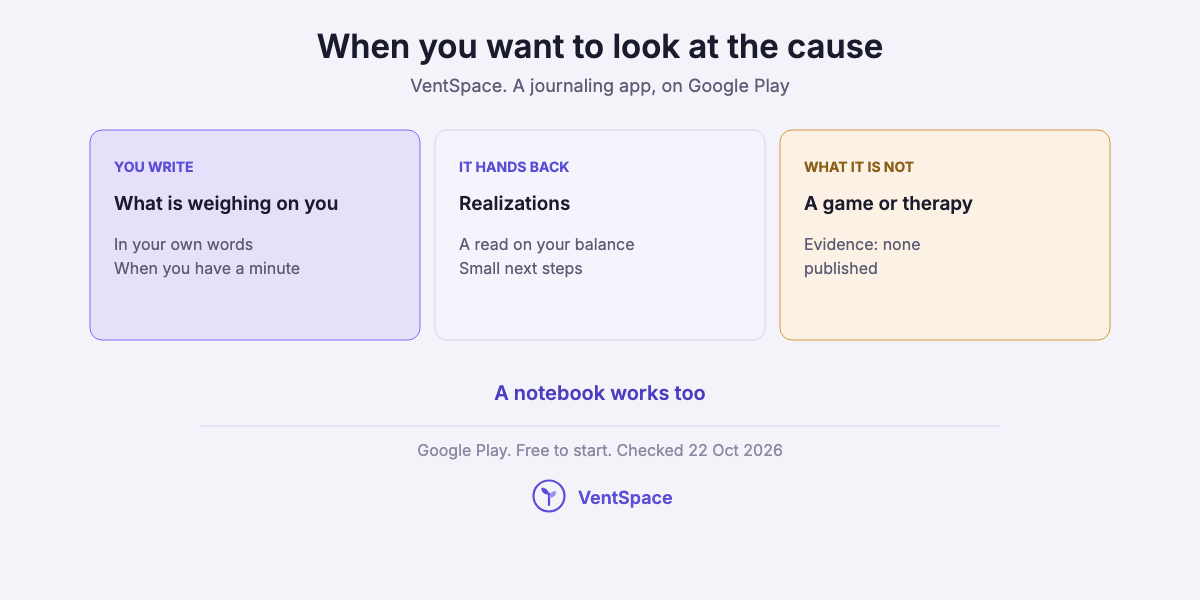
And if what you want this week is less a break from the stress and more a look at what is behind it, VentSpace is one place to start. It is a journaling app that turns what you write into a clear read on your life balance, plus small, doable next steps. It is not a game, it is not therapy, and it is free to start on Google Play for Android (checked 22 October 2026). Not on Android, or at a desk? VentSpace Live runs in your browser, free, with nothing to install.
About this article

Written by
Sai Subramaniam
Founder, VentSpace
I write these guides because I have been where you are. I am working through my own hard seasons, and I share the things that actually helped me, so that anyone going through it has a steady companion close by instead of facing it alone. VentSpace is the app I built for exactly that: a journaling app that turns what you write into a clear read on your life balance, plus small, doable next steps toward feeling more like yourself.
This writing is honest and every claim is sourced, and it is not a substitute for professional care. If you are struggling, reaching out to a professional is a strong move, not a failure.
Explore VentSpaceTry VentSpace LiveHow this one was checked. Every factual claim traces to a named source, and the source is printed next to the claim rather than kept in a footnote. Quotes are pinned to the work they come from, with the year, the letter or the chapter where one exists. Where a widely repeated claim could not be traced, it was left out and the omission recorded. Where a figure is contested, both sides are printed.
No affiliate links, no paid placements, and nobody paid to appear here. Where we mention our own app, we say that it is ours, we state its limits, and we never position it as a substitute for care.
Reviewed: October 2026. Prices, platforms and product availability move quickly, and anything we could not verify at the time of writing is marked as unverified rather than turned into a number.
Corrections. If something here is wrong, we would rather know. Corrections are made in place, with a note saying what changed.