
“Let right deeds be Thy motive, not the fruit which comes from them.”
The Bhagavad Gita, Chapter II, translated by Edwin Arnold (1885)
We almost left this page alone, and the reason is worth admitting. The first version, written in 2022, suggested fasting, meditating in heat and cold, and traveling with no food, shelter or money as ways to practice detachment. Some of that is unsafe, and all of it made detachment sound like a test of endurance. When we sat down to rewrite it, we kept asking the same question. Is detachment about needing less, or about gripping less?
You probably know the feeling that sends people searching for this. You refresh the inbox for the reply. You replay what someone said and what it meant. You need the launch, the grade, the relationship, the plan to go one particular way, and every hour it might not feels like a small emergency. Have you noticed how much of the pain is the gripping rather than the thing itself?
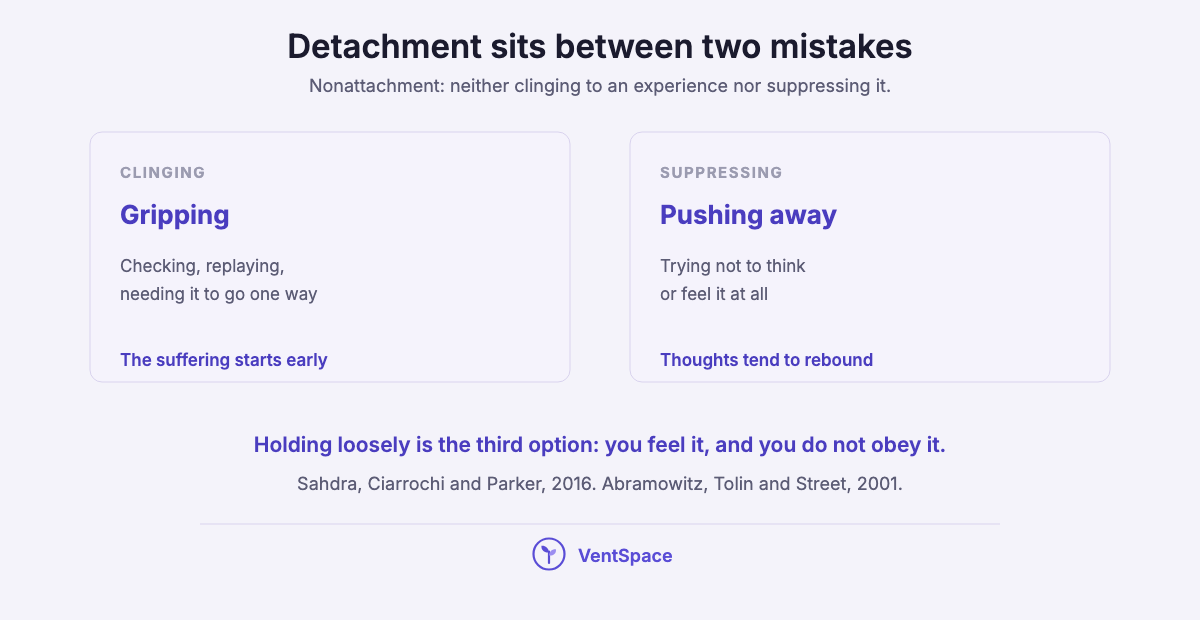
Psychologists who study this have a word for the alternative, nonattachment, and a definition worth holding on to: relating to your experience “without clinging to or suppressing” it. That second half matters. Detachment is not going cold. This guide explains what it is, why holding on hurts, how it works with the people you love, and then five small experiments you can try this week.
The short version
Detachment is gripping less, not caring less. In the research, nonattachment means neither clinging to experiences nor pushing them away.
Pushing a thought away is not detachment. Thought suppression tends to bring the thought back.
With people, detachment means loving them without trying to control them, never cutting them off as a technique.
The five experiments: name one grip, sort your part from the rest, watch the thought instead of obeying it, go without one small thing for a week, and swap something in, then look back.
If you’re in crisis or thinking about harming yourself, please contact the 988 Suicide & Crisis Lifeline now (US, call or text 988), or find a line in your country at findahelpline.com. If “detaching” has started to mean feeling nothing at all, or not wanting to be here, that is a reason to reach out tonight, not to keep practicing.
What detachment is, and what it is not
“Nonattachment was defined as a flexible, balanced way of relating to one’s experiences without clinging to or suppressing them.”
Baljinder Sahdra, Joseph Ciarrochi and Philip Parker, Psychological Assessment, 2016
Detachment, in the sense people mean when they search for it, is holding your experiences loosely. You still want things. You still feel things. What changes is the grip: a hope does not have to become a demand, and a painful thought does not have to become an order.
Psychology borrowed this idea from Buddhism. In 2010, Baljinder Sahdra, Phillip Shaver and Kirk Warren Brown published a Nonattachment Scale and described nonattachment as “release from mental fixations”, based on “insight into the constructed and impermanent nature of mental representations.” That is a dense phrase for a simple observation. The stories we tell ourselves about how things must go are stories, and they change.
How does that show up in ordinary life? In a nationally representative sample of 7,884 Americans, Sahdra and her colleagues found that nonattachment was related to every facet of mindfulness they measured, but was a distinct thing, and that it carried much of the link between mindfulness and life satisfaction. That is a correlation in one survey, not proof that practicing detachment makes life better. It does suggest that the loosening, not only the noticing, is part of what people mean by a settled mind.
There is a related idea in psychology called decentering. In a 2015 review, Amit Bernstein and colleagues described it as three linked capacities: noticing what your mind is doing, not identifying with it, and reacting less to what the thought says. That is a useful working definition of detachment. You see the thought, you know it is a thought, and you do not have to do what it says.
What detachment is not matters just as much.
- It is not suppression. Trying not to think about something tends to backfire. A meta-analysis of controlled studies by Jonathan Abramowitz and colleagues found “a small to moderate rebound effect” when people tried to push a thought away.
- It is not numbness. Feeling less of everything is a different experience, and it has different causes. More on that below.
- It is not cutting people off. Detachment from a person’s choices is not detachment from the person.
Quick Summary
Q: What does it mean to practice detachment?
A: It means holding thoughts, outcomes and things loosely: neither clinging to them nor pushing them away. Researchers call this nonattachment and measure it as a distinct trait. It is not suppressing feelings, going numb or withdrawing from people.
Insight: an old idea, measured
“The Buddhist notion of “nonattachment” (release from mental fixations) is related to but distinguishable from the Western construct of attachment. Secure (or insecure) attachment is based on internal working models related to security (or insecurity), whereas nonattachment is based on insight into the constructed and impermanent nature of mental representations.” Baljinder Sahdra, Phillip Shaver and Kirk Warren Brown, Journal of Personality Assessment, 2010.
Why holding on hurts
“Men are disturbed, not by things, but by the principles and notions which they form concerning things.”
Epictetus, The Enchiridion, 5, translated by Elizabeth Carter
Most of the pain of attachment comes from tying our peace to something we do not control. Epictetus opened his handbook with the line that the rest of Stoicism hangs on: “Some things are in our control and others not.” In his list, opinion, pursuit, desire and our own actions are ours. Body, property, reputation and command are not. When we stake our calm on the second list, we have handed it to chance.
The Bhagavad Gita makes the same cut from a different direction. Its advice to Arjuna, in Edwin Arnold’s translation, is to let right action be the motive and not “the fruit which comes from them.” Do the work fully. Hold the result loosely. Two traditions, far apart in place and time, landing on the same distinction. What do you think it would change if you applied it to the thing you are gripping right now?
From Sai, who writes this site
Being a guy who has been running after excitement and pleasure my whole life, this realization mattered a great deal to me: we are not just our desires. When we step back from them, we see ourselves more clearly.
It helps to be honest about why letting go is hard. Gripping feels like caring. If we stop checking, stop replaying, stop planning for every way it could go wrong, it can feel as if we have stopped loving the thing. But is the checking protecting anything? Most of the time it is only making us suffer earlier and longer.
Quick Summary
Q: Why is attachment a source of suffering?
A: Because it ties your peace to things you do not control: outcomes, other people’s choices, reputation. Epictetus and the Bhagavad Gita draw the same line, between doing your part fully and holding the result loosely.
Insight: why pushing it away fails
“Research has shown that attempts to suppress a thought can cause an increase in the frequency of the thought. These paradoxical effects of thought suppression play a key role in cognitive-behavioral models of several emotional disorders.” Jonathan Abramowitz, David Tolin and Gordon Street, Clinical Psychology Review, 2001.
Detachment with the people you love
“I have learned that instead of cutting my son off from my life and my heart, I can love him without loving the disease of alcoholism.”
An Al-Anon member, writing in The Forum, August 2020
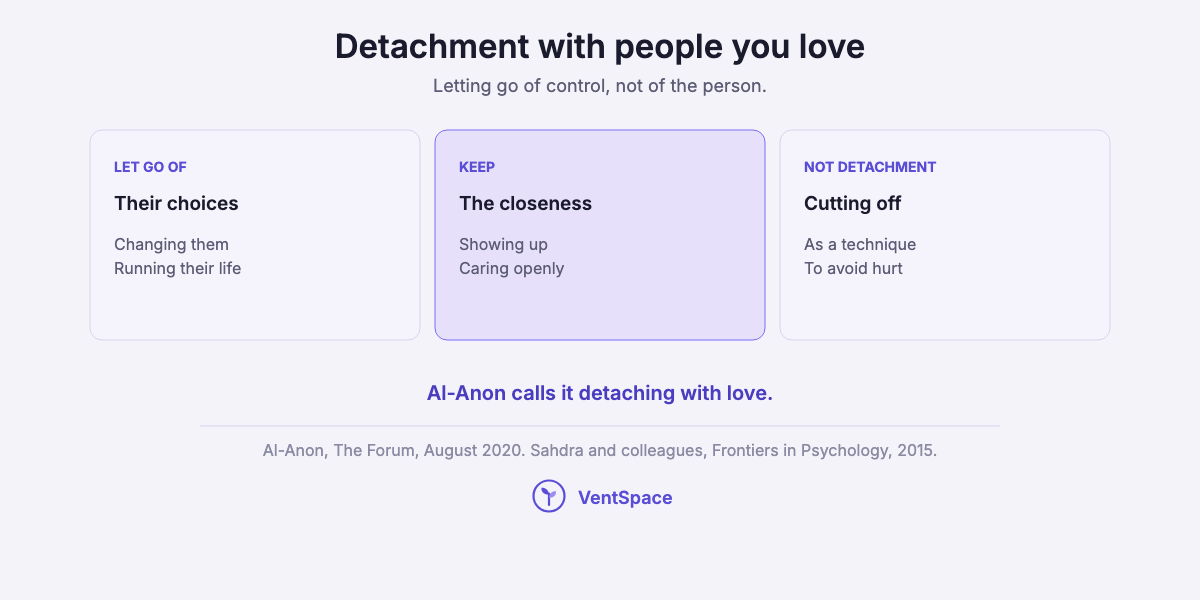
With people, detachment means letting go of controlling their choices, not letting go of them. The question we get most about detachment is how it works in a marriage, a friendship or a family. Does practicing it mean caring less about your partner, your parents, your kids?
No. The clearest version of the answer comes from Al-Anon, the support groups for people affected by someone else’s drinking, which talk about learning to “practice detaching with love.” In the piece quoted above, a mother describes walking into her first meeting after distancing herself from her son because it hurt too much to watch, and learning that she had been “detaching from my sick son in a very unloving manner.” What she learned instead was to stop judging and trying to change him while staying his mom.
That is the shape of healthy detachment with a person. You stay close. You stop trying to run their life. You let them make their choices and face their consequences, and you stop measuring your own peace by whether they do what you hoped.
There is research that fits this. In a study of 1,831 fifteen-year-olds, Sahdra and her colleagues found that nonattachment predicted being seen as helpful and kind by peers, independently of empathy, with one exception in how boys rated girls. The authors’ reading is that loosening your grip on your own concerns leaves more room “to be there for others in need.” Detachment, done well, tends to make people more available, not less.
This page will never tell you to cut someone off. Whether to see less of a family member, end a relationship or keep going is a decision about a situation we cannot see, and it is yours. If someone you live with frightens you or controls you, that is not a detachment question at all. You can call The National Domestic Violence Hotline at 1-800-799-7233, or text START to 88788.
Quick Summary
Q: How do you practice detachment in a relationship?
A: Let go of controlling the other person’s choices, not of the person. Al-Anon calls this detaching with love: staying close and caring while no longer trying to change them. In one study of teenagers, nonattachment predicted being seen by peers as more helpful and kind.
Insight: loosening makes room for others
“Nonattachment implies high cognitive flexibility and sufficient mental resources to step out of excessive self-cherishing to be there for others in need. Multilevel Poisson models using a sample of 15-year olds (N = 1831) showed that empathy and nonattachment independently predicted prosocial behaviors of helpfulness and kindness.” Baljinder Sahdra and colleagues, Frontiers in Psychology, 2015.
So how do you practice it, day to day?
Five detachment techniques to try this week
“Some things are in our control and others not.”
Epictetus, The Enchiridion, 1, translated by Elizabeth Carter
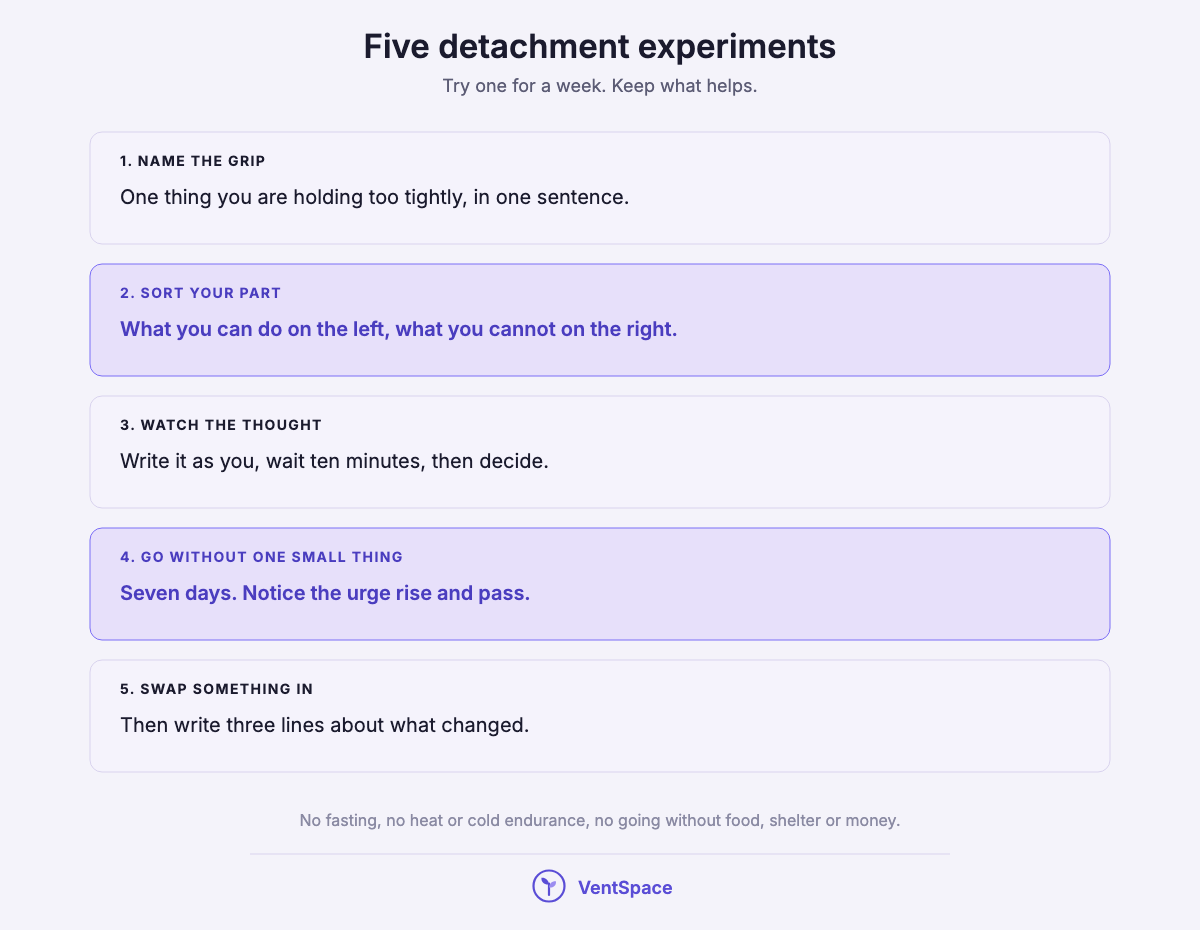
Each of these is an experiment, not a vow. Try one for a week, notice what happens, and keep what helps. None of them asks you to suffer to prove anything.
1. Name one thing you are gripping
Write down one thing you are holding too tightly right now, in a single plain sentence. Not your whole life. One thing: “I need my sister to apologize.” “I need this launch to hit its number.” “I need to know what he meant.”
- What am I checking, replaying or rehearsing most often this week?
- What do I believe will happen if it does not go my way?
- How much of my day is spent on it, honestly?
- Is this a hope, or has it become a demand?
Do not judge what you write. Gripping is ordinary, and naming it is already a step back.
2. Sort your part from the rest
Draw a line down a page. On the left, write what you can do about it. On the right, write what you cannot. This is Epictetus’s first lesson turned into a worksheet. Your effort, your words, your preparation and your next action go on the left. Other people’s choices, the result and what anyone thinks of you go on the right.
- What is the next action on the left side that I could do in under an hour?
- Which item on the right side have I been treating as if it were on the left?
- If I did everything on the left well, could I live with whatever happens on the right?
Then do the one action on the left. Give the right side your attention less often, and notice that it does not become less important when you do.
3. Watch the thought instead of obeying it
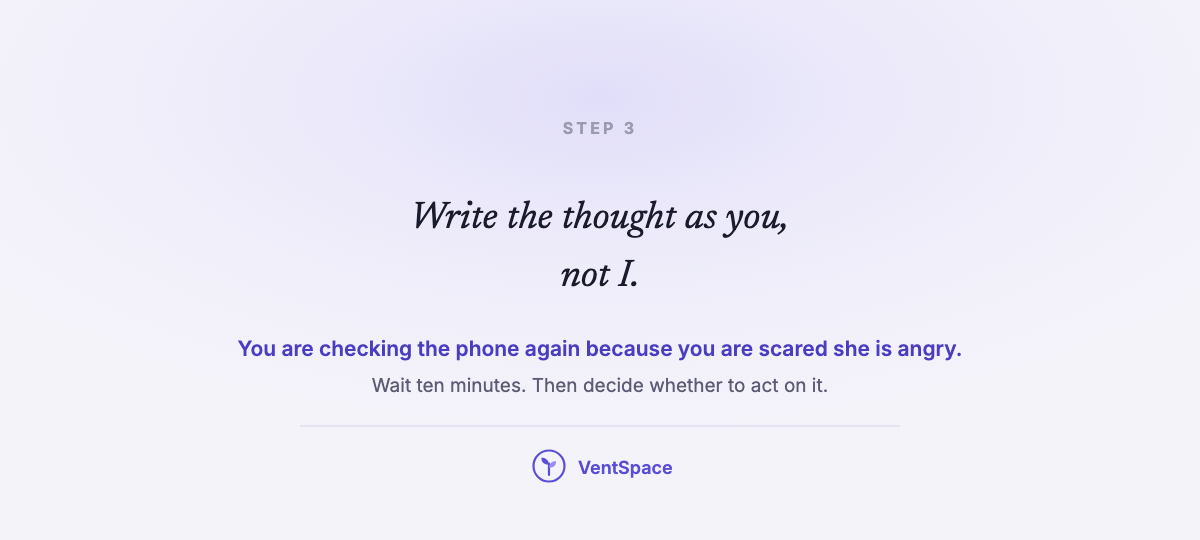
When the gripping thought arrives, write it down in the second person, as if you were watching someone else have it. “You are checking the phone again because you are scared she is angry.” This is the decentering move from the research above: you notice the thought, you see that it is a thought, and you do not have to act on it.
There is evidence that the grammar helps. In seven studies with 585 people, Ethan Kross and colleagues found that people who talked themselves through a stressful social task using their own name or “you” instead of “I” showed less distress and performed better, according to objective raters. One research group ran these studies, in the context of social stress, so treat it as a thing to try rather than a promise.
- What is the thought, word for word?
- What is it asking me to do right now?
- What would happen if I waited ten minutes before doing it?
You are not trying to stop the thought. You are only declining to follow it every time.
Where the watching can live. Paper works. If you would rather keep it on your phone, VentSpace is a journaling app that turns what you write into a clear read on your life balance, plus small, doable next steps. It is ours, so read that as a declared interest. It is Android only and free to start as of October 2026, it has no published evidence on outcomes, and it is not therapy. Not on Android, or at a desk? VentSpace Live runs in your browser, free, with nothing to install. The practice works without it.
4. Go without one small thing for a week
Pick one small comfort you reach for automatically and set it aside for seven days. The old version of this page listed some good candidates: TV and streaming, the phone in certain rooms, sweets, and the habits of gossip, comparison and complaining. The point is not deprivation. It is to see who you are when the thing is not there, and to notice that the urge rises, peaks and passes.
There is some evidence on what a break like this can do. In a randomized experiment run by economists Hunt Allcott, Luca Braghieri, Sarah Eichmeyer and Matthew Gentzkow, people who deactivated Facebook for four weeks before the 2018 US midterm election spent more time offline, including with friends and family, reported higher subjective well-being, and used Facebook less afterward. That is one platform and one month, but it is a real trial of exactly this kind of experiment.
- What do I reach for without deciding to?
- What do I expect to feel in the first two days without it?
- What did I find out about the urge by day five?
From Sai, who writes this site
When I personally tried detachment experiments, I often tried to avoid feeling the discomfort of the experiment. But the whole point of these experiments is to practice detachment and let go of these thoughts and cravings.
Some experiments are off this list on purpose. We no longer suggest fasting, long exposure to heat or cold, or going without shelter, food or money, as the first version of this page did. Each carries real physical risk, and none is needed to practice letting go. If the thing you want to go without is alcohol and you drink heavily every day, do not stop suddenly on your own. The National Institute on Alcohol Abuse and Alcoholism describes alcohol withdrawal as “a potentially life-threatening process” after prolonged heavy drinking, and a doctor can help you stop safely.
5. Swap something in, then look back
Fill the space you made with something you choose, and at the end of the week write three lines about what changed. The old page called this swapping in a new behavior. It might be a walk, a call to someone you miss, or an evening where you stop thinking about work.
That last one has some of the best evidence behind it. In a meta-analysis of 91 employee samples and more than 38,000 people, Johannes Wendsche and Andrea Lohmann-Haislah found that switching off from work in your own time was linked to less exhaustion and better sleep. The same study found people who switched off well were slightly less creative and less likely to do discretionary extras at work, and the results varied widely between studies. It is an association, not proof, but it is an honest one.
- What did I do with the time I got back?
- What did I miss, and what did I not miss at all?
- Do I want to keep going without it, bring it back, or bring it back smaller?
You are allowed to bring the thing back. The experiment was about choosing, not giving up.
Quick Summary
Q: What are some detachment techniques?
A: Five small experiments: name one thing you are gripping, sort what you control from what you do not, write the gripping thought in the second person instead of obeying it, go without one small habit for a week, and swap something in, then review what changed.
Insight: what a month without one app did
“In a randomized experiment, we find that deactivating Facebook for the four weeks before the 2018 US midterm election (i) reduced online activity, while increasing offline activities such as watching TV alone and socializing with family and friends; (ii) reduced both factual news knowledge and political polarization; (iii) increased subjective well-being; and (iv) caused a large persistent reduction in post-experiment Facebook use.” Hunt Allcott and colleagues, American Economic Review, 2020.
When detachment is the wrong tool
Detachment helps with gripping. It is the wrong tool for grief, for numbness and for danger.
If you are grieving, you do not need to detach from the person you lost. Missing someone is not a grip to loosen. Our journal prompts for grief are written for that.
If you already feel nothing much about anything, practicing detachment is not what you need. Feeling flat across the board is a different experience from holding things loosely. It has several possible causes, including medication effects, that look alike from the inside, and only a clinician can tell them apart. That is a conversation for a doctor or therapist. Therapy is one option. For a lot of people it’s the right one. Our guide on whether you need therapy asks one useful question instead of handing you a checklist.
If detachment has become a way of never needing anyone, notice that too. Avoiding closeness so that nobody can hurt you can look like detachment from the outside. It is closer to the opposite: a grip on safety.
And if you are trying to detach from someone who is harming you, what you need is support and a plan, not a technique. The Hotline numbers are in the section on people above.
Quick Summary
Q: Can detachment be unhealthy?
A: Yes, when it becomes numbness, avoiding closeness, or a way to skip grief. Feeling flat about everything is worth raising with a doctor or therapist. If you are trying to detach from someone who harms you, contact a hotline rather than practicing a technique.
Pulling it all together
The five experiments make one path from gripping to holding.
First, name the grip. One sentence on paper. Write it today.
Then, sort it. Your part on the left, the rest on the right, and one action from the left done this week.
When the thought comes back, watch it. Write it down as “you”, wait ten minutes, and decide whether to act.
For seven days, go without one small thing, and notice the urge rise and pass.
At the end of the week, swap something in and write three lines about what changed. Then choose what to keep.
Questions people ask
Does detachment mean not caring?
No. In the research definition, nonattachment means neither clinging to experiences nor suppressing them. You care fully about the person or the work, and hold the outcome loosely. In one study of teenagers, those who scored higher on it were rated by peers as more helpful and kind, not less.
Is detachment the same as emotional detachment?
Not in the sense this page means. “Emotional detachment” usually describes feeling cut off or numb, which is a different experience and sometimes a reason to talk to a doctor or therapist. Practicing detachment is about loosening a grip while still feeling.
Is “detachment is not that you should own nothing, but that nothing should own you” a real quote?
It is widely shared online and often credited to Ali ibn Abi Talib, but we could not trace it to a primary source, so we have not used it as a quotation. The idea is a fair summary of the Stoic and Gita passages quoted above.
How long does it take to learn detachment?
Nobody can give you a number. It is a practice you repeat, not a state you reach, and the same grip can return on a hard day.
What did Jay Shetty say about detachment?
This page does not summarize him. We keep a separate page of lessons from Think Like a Monk, his book built around monk teachings, for readers who came here from it.
In a nutshell
Detachment is gripping less, not caring less. Do your part fully, hold the result loosely, and watch the gripping thought instead of obeying it. If it ever starts to mean feeling nothing or needing no one, it has turned into something else.
It is a practice, not a destination. Nobody can tell you how long it takes, and the same grip can come back on a bad day. That is not failure. It is the next thing to notice.
Write down the one thing you are gripping, and try one experiment this week.
About this article

Written by
Sai Subramaniam
Founder, VentSpace
I write these guides because I have been where you are. I am working through my own hard seasons, and I share the things that actually helped me, so that anyone going through it has a steady companion close by instead of facing it alone. VentSpace is the app I built for exactly that: a journaling app that turns what you write into a clear read on your life balance, plus small, doable next steps toward feeling more like yourself.
This writing is honest and every claim is sourced, and it is not a substitute for professional care. If you are struggling, reaching out to a professional is a strong move, not a failure.
Explore VentSpaceTry VentSpace LiveHow this one was checked. Every factual claim traces to a named source, and the source is printed next to the claim rather than kept in a footnote. Quotes are pinned to the work they come from, with the year, the letter or the chapter where one exists. Where a widely repeated claim could not be traced, it was left out and the omission recorded. Where a figure is contested, both sides are printed.
No affiliate links, no paid placements, and nobody paid to appear here. Where we mention our own app, we say that it is ours, we state its limits, and we never position it as a substitute for care.
Reviewed: October 2026. Prices, platforms and product availability move quickly, and anything we could not verify at the time of writing is marked as unverified rather than turned into a number.
Corrections. If something here is wrong, we would rather know. Corrections are made in place, with a note saying what changed.