
“there is no hope unmingled with fear, and no fear unmingled with hope.”
Baruch Spinoza, Ethics, Part III, Definitions of the Emotions, R. H. M. Elwes translation (1677)
Hope and fear are not two options you pick between. They are two ways of looking at the same uncertain future: fear is aimed at what could go wrong, and it tends to make the bad outcome look more likely and the safe path look better, while hope is aimed at what could go right, and at its most useful it comes with a plan for getting there. They usually arrive together. Same decision, same night.
So the useful question is not “which one should I choose?” It is which one is making this particular decision, and whether the danger it is pointing at is real. That is what this page helps you check.
The short version
The real difference: fear is about what might go wrong, hope is about what might go right. Both are about a future you cannot see yet.
They travel together. Spinoza and Seneca both argued that you rarely get one without the other.
What fear does to a decision: in a classic set of experiments, fearful people made more pessimistic risk estimates and safer choices. A 2026 replication confirmed the pessimism, not the safer choices.
What hope needs to be useful: a goal, a route, and the energy to use it. Hope with no plan is mostly waiting.
The test: ask whether the danger fear is pointing at is real, and whether your hope has a first step. The answer is often “a bit of both”.
Before you use this to decide something big. If fear has become constant, or you are thinking about harming yourself, please contact the 988 Suicide & Crisis Lifeline now (US, call or text 988), or find a line in your country at findahelpline.com. This page is not written for deciding whether to leave a situation where you are not safe. If someone is hurting or threatening you, no hope-or-fear test applies, and the National Domestic Violence Hotline (US, 800.799.SAFE (7233), or text START to 88788) is the right place to start. If you are in immediate danger, call 911.
What fear is
“Fear is an inconstant pain arising from the idea of something past or future, whereof we to a certain extent doubt the issue.”
Baruch Spinoza, Ethics, Part III, Definitions of the Emotions, XIII
Fear is the pain of a bad outcome you cannot rule out yet. Spinoza’s definition still holds up because of its last clause, the part about doubting the issue, which is a seventeenth-century way of saying that you only fear what you are not sure about, so that a bad thing you know for certain is coming tends to get dread, grief or resignation instead. Nobody fears a certainty.
It is also, in its plain form, useful. Sai, who founded VentSpace and wrote the first version of this page, put it plainly: “fear is actually not always the enemy. Fear is a mechanism to keep us from danger.” The trouble is that fear does not come with a label telling you which dangers are standing in front of you and which ones are stories you are telling yourself at one in the morning about a meeting, a message, a test result or a conversation that has not happened yet. It sounds identical.
What hope is
“Hope is an inconstant pleasure, arising from the idea of something past or future, whereof we to a certain extent doubt the issue.”
Baruch Spinoza, Ethics, Part III, Definitions of the Emotions, XII
Hope is the pleasure of a good outcome you cannot guarantee yet. Same uncertainty, opposite direction. Modern psychology adds something Spinoza did not: the psychologist C. R. Snyder and colleagues defined hope as “a positive motivational state that is based on an interactively derived sense of successful (a) agency (goal-directed energy) and (b) pathways (planning to meet goals).” In plain words, hope, in the research sense, is a goal plus a route plus the energy to take it. A warm feeling about the future, with no route, is not what they were measuring.
Sai’s original page called hope “our spiritual compass whose presence itself will guide us through the darkness.” Snyder’s version is less poetic and more demanding. A compass still needs someone to walk.
Hope vs fear, side by side
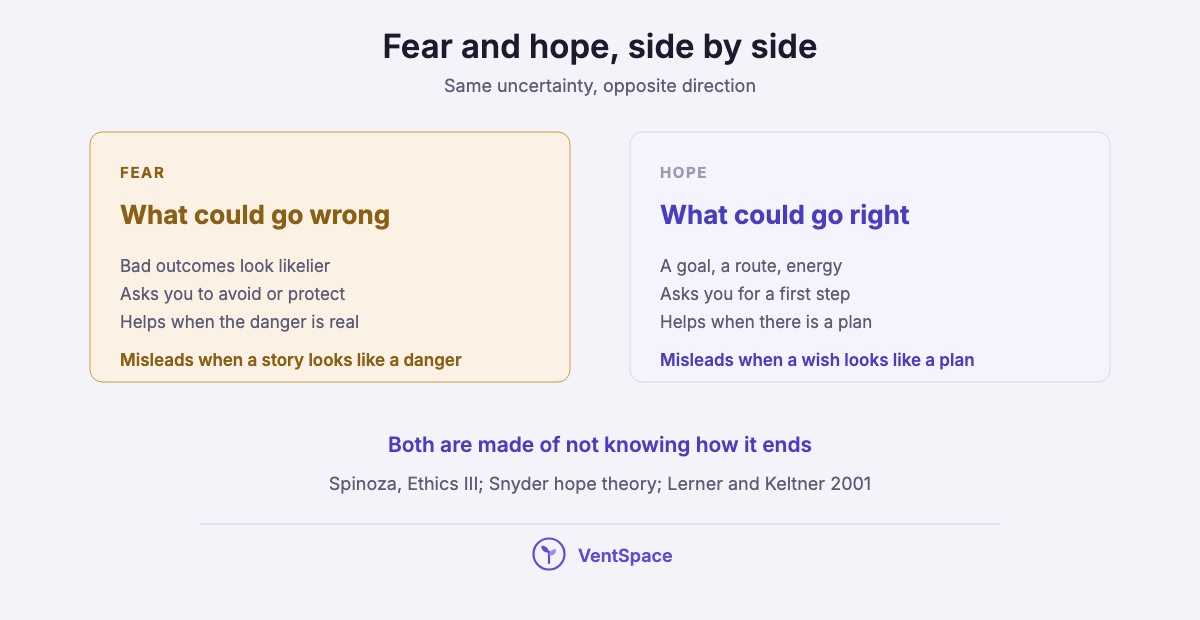
| Fear | Hope | |
|---|---|---|
| Aimed at | What might go wrong | What might go right |
| What it does to risk | Makes bad outcomes look more likely | Not reliably measured (see below) |
| What it asks of you | Avoid, protect, check | A goal, a route, and energy |
| When it helps | A real, present danger | A goal with a first step |
| When it misleads | A story mistaken for a danger | A wish mistaken for a plan |
| Made of | Not knowing how it ends | Not knowing how it ends |
What each one does to how risky things look
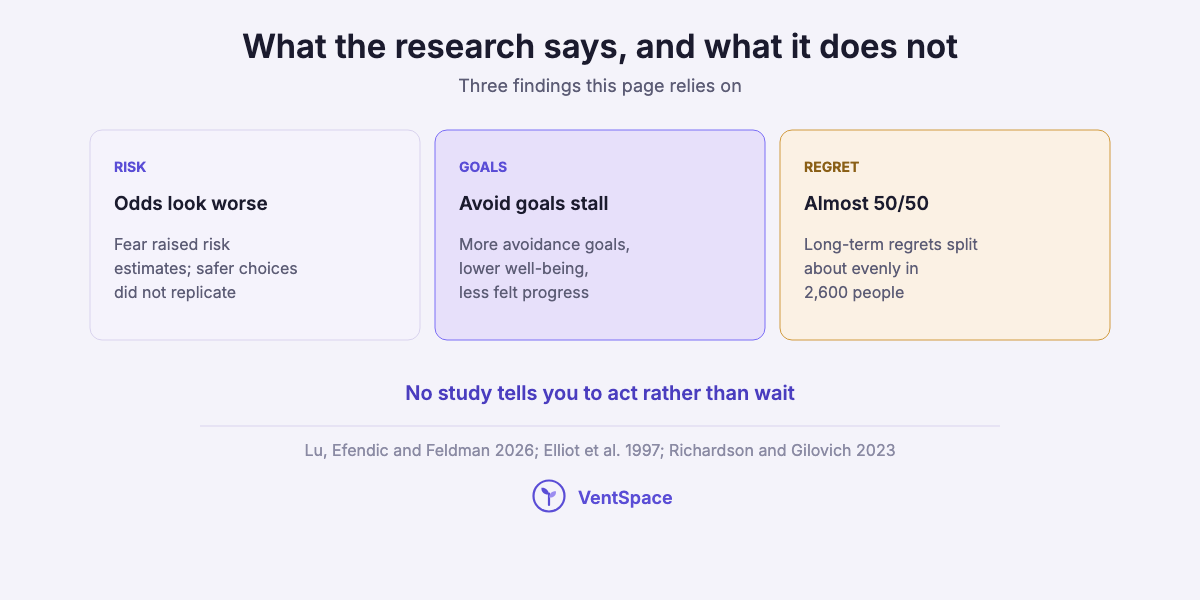
Fear makes bad outcomes look more likely. That is the most solid part of the research. In 2001, Lerner and Keltner reported a set of experiments in which “fearful people expressed pessimistic risk estimates and risk-averse choices, angry people expressed optimistic risk estimates and risk-seeking choices” (Journal of Personality and Social Psychology). The effect showed up both for fear people already carried and for fear the researchers induced in the lab, and their analysis pointed to two judgments, how certain a situation feels and how much control you feel you have, as the route by which the emotion shaped the way people read the next risk in front of them.
Here is the part most pages leave out. In a registered replication published in the same journal (online December 2025), a team led by Lu, with Efendić and Feldman, re-ran three of those experiments with 780 US adults online. The pessimism held up. The safer choices did not. In their words, they found support “for risk optimism in general, risk optimism for positive events, and risk optimism for ambiguous events, but not for risk preference and risk optimism for negative events.” They also added hope to the study, and hope did not behave the way the theory predicted either.
So the honest version is this. Fear reliably changes how the odds look to you. Whether it changes what you then choose is less settled than the original page assumed, when it said fear “makes us choose safer paths”. It might. The newest test did not find it. And there is no solid evidence yet that feeling hopeful does the reverse.
There is a detail in the replication worth sitting next to for a moment. The researchers added hope as an emotion with low certainty and low control, the same two judgments the original study used to explain the effect of fear, so if any positive emotion was going to tilt the odds the way the theory predicts, hope was a fair candidate to test. It did not. That fits an older point, the one Spinoza made in a single line: hope and fear are both made of not knowing.
That matters because the odds are the part you can check: if fear is making the odds look worse than they are, you can test that with facts, by looking up how often the thing goes wrong, asking someone who has done it, or writing down what happened the last few times you were this sure it would go badly. You cannot argue with a feeling. You can argue with a number.
Quick Summary
Q: Does fear make you take fewer risks?
A: Fear makes bad outcomes look more likely. That finding replicated in 2026. The original finding that fearful people also choose safer options did not replicate in the same study, and hope did not show the predicted pattern either.
Insight: Lu, Efendić and Feldman, Journal of Personality and Social Psychology (2026), on adding hope to the replication: “we added hope as a positive-valence dispositional emotion with low certainty and control and failed to find support for the assumptions of the appraisal-tendency framework.” In other words, the tidy idea that hope is fear’s mirror image, nudging you toward risk the way fear nudges you away, was tested and not found.
What each one points you at
Fear points you away from something. Hope points you toward something. Psychologists call these avoidance goals and approach goals, and the difference sounds like wordplay until you live inside one for a semester.
In two studies that followed people over a semester, Elliot, Sheldon and Church found that participants with a greater share of avoidance goals reported lower well-being over the semester, and their well-being declined from the start to the end of it (Personality and Social Psychology Bulletin, 1997). To give our own example, not the study’s, that is the difference between “avoid being lonely” and “make two friends this term”. The link ran through perceived progress, which makes sense once you say it out loud, because it is hard to feel you are getting anywhere when your whole target is something not happening, and there is no evening on which not being lonely is finished and you get to cross it off a list. Progress needs a finish line.
The same study found something about who tends to set fear goals in the first place. In the authors’ words, “neuroticism was positively related to the adoption of avoidance personal strivings”, and people with lower perceptions of their own life skills were more likely to choose avoidance projects. That is not a verdict on anyone. It does mean that the people most likely to frame a goal around fear are often the people who already feel least equipped, which is exactly when a small, finishable version of the goal helps most.
Picture it. A Sunday night, a job you have been meaning to leave for two years. “Don’t get stuck here forever” is a fear goal. It has no finish line, so every Monday you are exactly as stuck as you were. “Send three applications before Friday” is the hope version of the same wish. It can be done. Then it can be done again.
The study was observational, it ran over one semester, and it measured the share of avoidance goals people held rather than any single choice they made, so it does not prove that switching your wording will make you happier, only that a fear goal is a hard thing to make progress on, and progress is where a lot of the good feeling comes from. That is worth knowing.
Quick Summary
Q: Is it better to be motivated by hope or by fear?
A: Goals aimed at avoiding something were linked to lower well-being in a semester-long study, largely through people feeling less progress. Turning “don’t let X happen” into “do Y by Friday” gives you something you can finish.
Insight: Elliot, Sheldon and Church, Personality and Social Psychology Bulletin (1997): “Avoidance regulation proved deleterious to both retrospective and longitudinal subjective well-being (SWB), as participants with a greater proportion of avoidance goals reported lower SWB over the course of the semester and evidenced a decrease in SWB from the beginning to the end of the semester.”
What the regret argument gets right, and what it gets wrong
The first version of this page made one big argument. If you keep choosing fear, you end up on “the top of a mountain called regret”, wishing you had stayed on your own trail. It is the most repeated idea in decision writing: you will regret the things you did not do. It is half right.
The idea comes from Thomas Gilovich and Victoria Medvec’s work in the 1990s. In the study behind the famous number, 84% of 32 people said their biggest regret over their life so far was something they had not done. In 2023, Richardson and Gilovich himself ran a registered replication with 2,600 visitors to a science museum (Royal Society Open Science). The short-term half held: people were more troubled by a recent thing they did than a recent thing they failed to do. The long-term half did not. 51% named an action and 49% an inaction, statistically a coin flip. The authors suggest the sample skewed young, and they put it this way: “The long term not being so long for younger respondents, there is less time for the processes that lead to greater regret over inaction to take hold.” In other words, the original pattern may still show up later in life. It has just not earned the certainty the slogan gives it.
Notice what neither study says. Neither the original nor the replication tells anybody to act rather than wait. They describe which of two regrets troubles people more, at two points in time. They do not measure how much regret anyone has, and they cannot tell you which choice you will regret, because that depends on what happens next, which nobody knows yet.
So “you will regret playing it safe” is not a research finding you can lean on. Regret runs both ways. Some people regret the leap, some regret staying put, and if fear is keeping you from something you want, the honest case for moving is that you want it and have checked the risk, not that a study promised you would one day stand on a mountain of regret for staying where you were. We go deeper into this on our page about the pain of discipline vs the pain of regret.
Quick Summary
Q: Will I regret it if I let fear win?
A: Maybe, but not because research says so. The famous finding that people mostly regret what they did not do came from 32 people. A 2023 replication with 2,600 found long-term regrets split almost evenly between actions and inactions.
Insight: Richardson and Gilovich, Royal Society Open Science (2023), on their own replication: the results “can be considered a successful replication in the sense that action regrets loom larger in people’s minds in the short term than with the passage of time.” But “the difference in the simple effects obtained by Gilovich and Medvec and in the present study means that the present effort should be viewed as a partial replication.”
Why they arrive together
You rarely get one without the other, and that is not a modern insight. The philosopher Seneca, writing to his friend Lucilius almost two thousand years ago, passed on a line from the Stoic Hecato: “Cease to hope,” he says, “and you will cease to fear.” His point was that both come from the same place, a mind living in a future it cannot see.
That is why hope can feel anxious. The more you want something, the more there is to lose, so wanting it hard and fearing it hard often come as a pair. If you notice fear spiking just as something starts to matter, that is not a sign the hope is wrong. It may be a sign the hope is real.
Seneca’s own cure was to want less and to live more in the present, and you do not have to buy the whole Stoic program to take the useful part of it, which is this: when both are loud, pull your attention back to the next concrete step, the one you can take this week, and let the long future stay as uncertain as it was always going to be. Then take the step.
Quick Summary
Q: Is hope the opposite of fear?
A: Not quite. They point in opposite directions, toward a good outcome or away from a bad one, but they share the same root: uncertainty about the future. Spinoza and Seneca both argued that one rarely comes without the other.
Insight: Seneca, Moral Letters to Lucilius, Letter 5, Richard Gummere translation: “Just as the same chain fastens the prisoner and the soldier who guards him, so hope and fear, dissimilar as they are, keep step together; fear follows hope. I am not surprised that they proceed in this way; each alike belongs to a mind that is in suspense, a mind that is fretted by looking forward to the future.”
How to tell which one is deciding
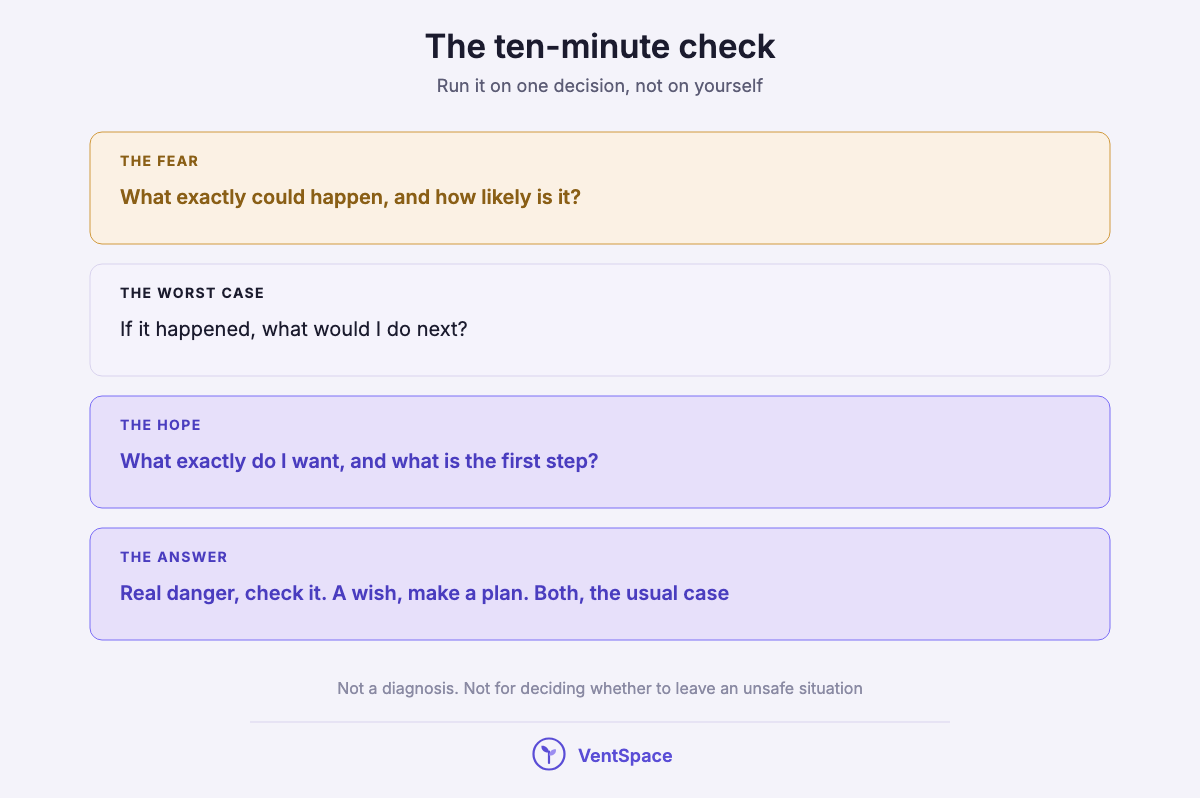
This is not a test of you, and it is not a diagnosis. It is a short check you can run on one decision. Mixed answers are the common result.
Sai’s original page had the best example of it, from a hike with his brother:
From Sai, who wrote the first version of this page: “I was actually hiking once and we went into a thick forest area which was off trail and heard hyena laughter sound. Fear crept into me and my brother. We were alone with no weapons or even any cell phone tower to call for help. While my brother panicked and wanted to flee the place, I somehow tried to stay calm and analyze if there’s actually danger there. So we stood there for 10 mins without making any noise and realized it was probably some other sound that panicked us and went ahead through the forest and had one of the unforgettable experience of our lives.”
Ten minutes of standing still. That is the whole method. Check whether the danger is real before you let it choose. Sometimes it is, and then fear did its job. On a different night, the right call is to turn back.
Run the same check on your decision:
- What exactly am I afraid will happen? One sentence, specific.
- How likely is it, honestly, and what is that based on? A fact, or a feeling?
- If it happened, what would I do next? Can I survive the bad version?
- What exactly am I hoping for? One sentence, specific.
- What is the first step toward it, and can I take it this week?
- Would I still want this if nobody else ever knew I had done it?
If the fear is specific, likely and hard to survive, it is probably protecting you. If it is vague and mostly a feeling, it may be a story. If the hope has no first step, it may be a wish. If both are strong, you are probably in the ordinary case: something you want, with a real risk attached.
What to do in each case
If fear is doing the deciding:
- Name the specific danger in one sentence. Vague fear cannot be checked.
- Check the odds with facts, not mood. Fear tilts the estimate, so look up the number or ask someone who has done it.
- Plan the bad outcome. Write what you would do if it went wrong. A survivable worst case usually shrinks.
- Shrink the step until the risk is one you can afford, and take that one.
If hope is doing the deciding:
- Write the goal as something you can finish, not something to avoid.
- Write the route: the first three steps, and the first one with a date.
- Name one obstacle and one way around it. Snyder’s model treats planning routes to a goal, including around obstacles, as part of hope.
- Check the cost honestly. Hope is not a reason to ignore a real danger.
If writing the fear and the hope down side by side would help, VentSpace is a journaling app that turns what you write into a clear read on your life balance, plus small, doable next steps. Prefer to try it on your laptop first? VentSpace Live runs in your browser, free, with nothing to install. A page is often where a vague fear turns into one specific sentence you can check. One caution about writing. In a review of expressive-writing studies, the average effect was moderate in healthy samples (0.47), small in clinical samples (0.19) and not significant in psychiatric samples (0.07), and it was detrimental for adult survivors of childhood abuse and a small sample of veterans (Baikie and Wilhelm, Advances in Psychiatric Treatment, 2005). Our suggestion is to stop after twenty minutes. If writing makes it louder, stop and talk to someone instead.
Where the line blurs
Most real decisions are both. You hope the new city works and you fear it will not, you hope they say yes and you fear what happens if they do, and you hope the new job is better while quietly fearing it is the same job with a different parking lot, which is exactly Spinoza’s point: the two are made of the same uncertainty, so a clean line between them is rare. Expect both.
The line also blurs when fear stops being about one decision. If fear is there most days, about many things, and it is getting in the way of work, sleep or people, that is no longer a hope-or-fear question, and a decision check will not fix it. Therapy is one option, and for a lot of people it is the right one. Our page on whether you need therapy is a fair place to start, and if the problem is mostly a loop of thinking, overthinking vs problem solving covers how to tell the two apart.
Questions people ask about hope and fear
Is it better to act out of hope than out of fear?
Not always. Fear is the right driver when the danger is real and present. Goals aimed only at avoiding something were linked to lower well-being in one semester-long study, so when you can, phrase the goal as something to move toward. But a hope that ignores a real danger is not the better choice.
Is fear always bad?
No. Fear is often protective. The problem is that it feels the same whether the danger is real or imagined, which is why checking it matters more than suppressing it.
Does hope make you take more risks?
There is no good evidence that it does. When a 2026 replication added hope to a classic study of emotions and risk, hope did not show the predicted pattern.
Do people regret the things they didn’t do more than the things they did?
That is the popular version, and it is weaker than it sounds. It came from 32 people. In a 2023 replication with 2,600 people, long-term regrets were split almost evenly between actions and inactions.
Can hope be harmful?
It can keep you waiting. Hope in the research sense includes a route and the energy to take it. A hope with no first step, held for years, can become a reason not to move. The fix is not less hope. It is a smaller first step.
The short of it
First, you do not have to pick one. Hope and fear are two views of the same uncertain future, and they usually arrive together. The question is which one is making this decision, and whether the danger it points at is real.
Second, this is slower than it sounds. Checking a fear takes minutes. Building a hope into a route can take weeks of small steps, and fear will usually still be there, a little quieter, while you take them. That is not failure. It is what wanting something feels like.
Fear gets a vote. It does not get a veto until it has been checked.
About this article

Written by
Sai Subramaniam
Founder, VentSpace
I write these guides because I have been where you are. I am working through my own hard seasons, and I share the things that actually helped me, so that anyone going through it has a steady companion close by instead of facing it alone. VentSpace is the app I built for exactly that: a journaling app that turns what you write into a clear read on your life balance, plus small, doable next steps toward feeling more like yourself.
This writing is honest and every claim is sourced, and it is not a substitute for professional care. If you are struggling, reaching out to a professional is a strong move, not a failure.
Explore VentSpaceTry VentSpace LiveHow this one was checked. Every factual claim traces to a named source, and the source is printed next to the claim rather than kept in a footnote. Quotes are pinned to the work they come from, with the year, the letter or the chapter where one exists. Where a widely repeated claim could not be traced, it was left out and the omission recorded. Where a figure is contested, both sides are printed.
No affiliate links, no paid placements, and nobody paid to appear here. Where we mention our own app, we say that it is ours, we state its limits, and we never position it as a substitute for care.
Reviewed: October 2026. Prices, platforms and product availability move quickly, and anything we could not verify at the time of writing is marked as unverified rather than turned into a number.
Corrections. If something here is wrong, we would rather know. Corrections are made in place, with a note saying what changed.