

A gratitude list is not a verdict on whether our life is good enough. It is a record of what we noticed. That difference matters, because most of us come to a gratitude list on a week when noticing is hard, and a page that tells us how lucky we are only adds a second weight to the first. So what follows is a list of 100 things to be grateful for, grouped by the part of life they come from, with a way to make each one specific and an honest note on what to watch for.
From Sai, who writes this blog
When I first came across the idea of gratitude, and explored the meaning and the perspective behind it, it changed how I looked at my own life. This page is the one I wish I had read then: less about how lucky we are, more about how to notice.
Quick Digest
– What a gratitude list is: a short written record of specific things you were glad of, kept on paper or a phone.
– What to put on it: small, specific, recent things from any part of your life. The 100 below are grouped so you can find the ones that fit your week.
– How often: the largest review of gratitude exercises found that doing more sessions made no difference to the effect. Weekly is enough.
– What it can do: a small lift in well-being on average, no larger than other positive activities. Small is still something.
– What it is not: a test you can fail. A blank week is information, not a verdict on you.
The gratitude list at a glance
Things to be grateful for every day
- An ordinary day: the first warm drink, a song that came on at the right time, a bus that waited.
- First thing in the morning: light through a window, a few quiet minutes, a day that has not gone wrong yet.
- Before you sleep: something that went better than you feared, a meal, a clean sheet.
People to be grateful for
- The people around you: someone who checked in, a friend who remembers, a stranger who held a door.
- A partner or spouse: a chore done without asking, a joke only the two of you understand.
The things we live inside
- Your body, as it is: hands that carried something today, a sense that still works, rest.
- Home, work and the things that run quietly: running water, a coworker who covered for you, a paycheck.
- Outside: weather, a tree on your street, a place you love.
The harder parts
- Recovery and sobriety: a clear morning, a meeting, a day counted.
- Yourself, and the hard seasons: something you got through, a mistake you forgave yourself for.
How this list is built
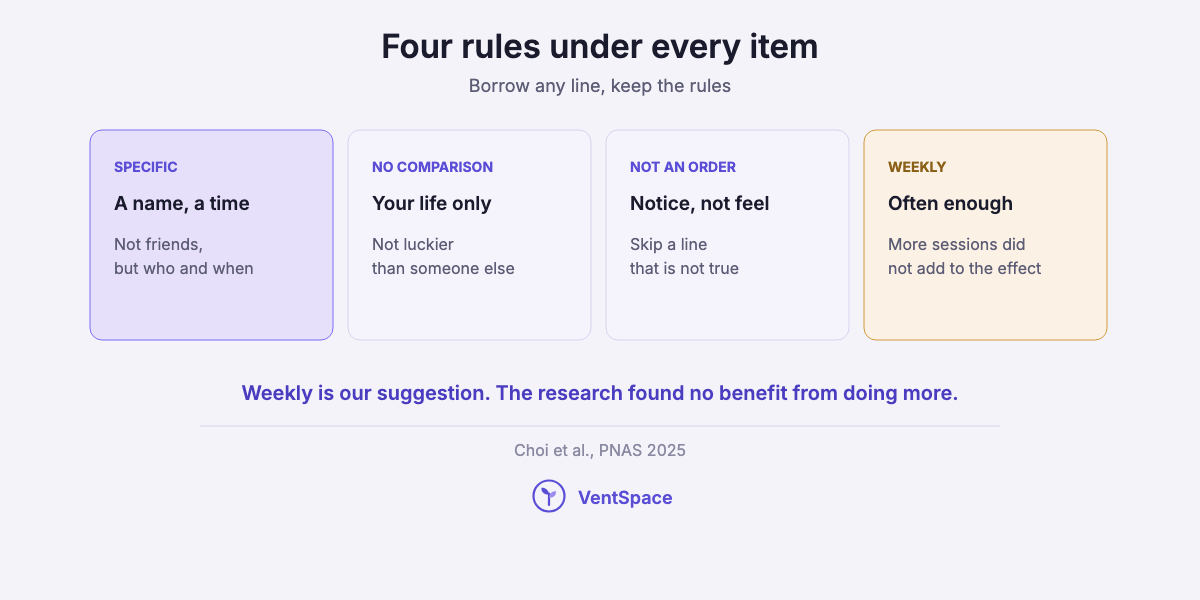
Four rules sit underneath every item, and they are worth knowing before you borrow any of them.
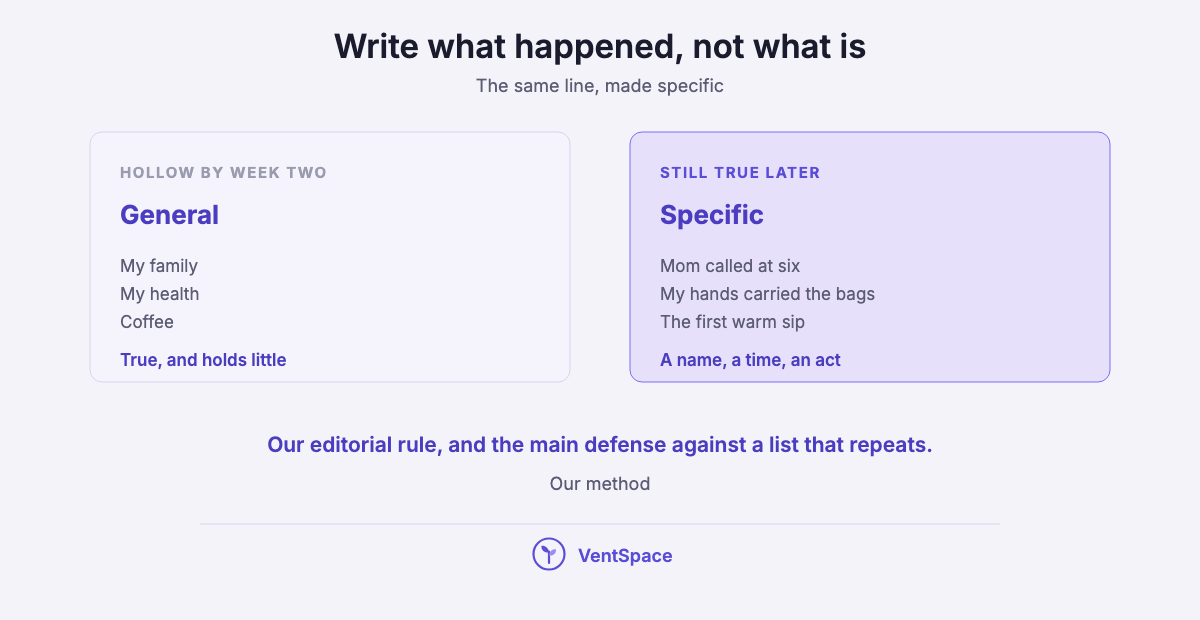
- Specific beats general: “the friend who texted when my train was late” holds more than “friends”. This is our editorial rule, and it is the main defense against a list that repeats.
- No comparison with people who have less: many gratitude lists work by reminding you that others are homeless, ill or alone. We have left that out. Gratitude borrowed from someone else’s suffering can arrive with guilt attached.
- Nothing you are told to feel: an item is something to notice. If it does not feel true this week, skip it.
- Weekly is enough: in the largest review of gratitude exercises, the number of sessions people completed did not change the size of the effect. We suggest once a week, and that is our suggestion, not a finding.
Quick Summary
Q: What should I put on a gratitude list?
A: Small, specific, recent things from any part of your life: a person who did something, a moment in your day, something your body or your home did for you. Specific lines last longer than general ones, and nothing on the list needs to be compared with anyone else’s life.
Things to be grateful for every day
The everyday groups are where most gratitude lists begin, because they need nothing to have gone well. They only need us to have been there.
An ordinary day
An ordinary day is the part of life we are least likely to write down, because nothing in it asked to be noticed. Yet most of what we would miss, if it went, lives here: the small rituals and minor kindnesses that make a Tuesday bearable. This group asks for nothing more than a look back over the last few hours.
| Best moment to write it | Any evening, looking back over the day |
| Make it specific by | Naming the time and the place |
| Watch for | The same three items every week. Swap one for something new |
| A first line to try | “At about four o’clock today, I was glad of ___” |
- The first warm drink: the minute you hold it before you drink it.
- A song that came on at the right moment: on the radio, in a store, in your headphones.
- A bus or train that waited: or the one that came on time on the day you needed it to.
- A meal someone else made: a coworker’s leftovers, a parent’s cooking, a cafe’s soup.
- A conversation that went better than you expected: the call you had been dreading.
- Something that made you laugh: a message, a clip, a thing a child said.
- Ten quiet minutes: in the car, on a bench, before anyone needed you.
- A task finished: one email sent, one drawer cleared, one form done.
- A good smell: rain on a sidewalk, bread, clean laundry.
- A small kindness from a stranger: a held door, a returned glove, directions given patiently.
Who it’s for: anyone starting a list for the first time, or restarting one.
In practice: the time-and-place rule keeps these lines from turning into “coffee, again”.
Verdict: the easiest group to start with, and the one most likely to repeat, so rotate it.
First thing in the morning
A morning gratitude list is a short look at the day before it has had a chance to go wrong. It suits people who write better early, before the inbox. It is not a better time than the evening. It is a different one, and the items it surfaces are different too.
| Best moment to write it | Before you check your phone, if that is possible |
| Make it specific by | Writing what you can see or hear right now |
| Watch for | Turning it into a to-do list. Keep plans for another page |
| A first line to try | “This morning, before anything else, there is ___” |
- Light through a window: the color of it today.
- Having slept at all: even a broken night had a stretch of rest in it.
- A few minutes before anyone needs you: the house still quiet.
- Hot water: a shower, a kettle, a sink.
- A day that has not gone wrong yet: whatever yesterday was, this one is new.
- Someone you will see today: a coworker, a friend, the person at the coffee counter.
- Something to look forward to: a lunch, an episode, a phone call later.
- Clothes that fit and feel right: the sweater you reach for first.
- The sound outside: birds, traffic, rain, a neighbor’s radio.
- Your breakfast: toast, fruit, whatever is there.
Who it’s for: early writers, and anyone whose evenings are already full.
In practice: two or three lines here can be finished before the coffee is.
Verdict: good for setting the tone of a day, as long as it stays short.
Before you sleep
A before-bed gratitude list is a way of closing the day on what went right as well as what went wrong. We tend to replay the difficult parts at night. Writing three good ones down does not erase the others. It gives them company.
| Best moment to write it | In bed, or just before |
| Make it specific by | Picking one moment and writing what happened in it |
| Watch for | Using it to grade the day. A hard day can still have one line |
| A first line to try | “Today did not go well, and still ___” |
- Something that went better than you feared: the meeting, the appointment, the drive.
- A meal you ate today: where, and with whom.
- A clean sheet and a pillow: the bed itself, at the end of a long day.
- Someone who made you laugh: what they said.
- A moment you were proud of: even a small one, like staying patient.
- A paycheck, or the job that brings it: whatever part of work held today.
- Being warm, or cool enough: heat in winter, a fan in summer.
- A message you were glad to get: and who sent it.
- Something you learned today: a word, a shortcut, a fact about someone.
- That the day is over: some days the ending is the good part.
Who it’s for: people who replay the day at night.
In practice: the line “and still ___” is the one that makes this group work on bad days.
Verdict: the most forgiving group, because a single line counts.
Quick Summary
Q: What are simple things to be grateful for every day?
A: A warm drink, a song at the right moment, a meal someone made, ten quiet minutes, light through a window, a clean bed, something that went better than you feared. The more specific the time and place, the less the list repeats.
People to be grateful for
A list with names on it reads differently from a list of things. It also asks a little more of us, because people are complicated, and gratitude for someone sits beside everything else we feel about them.
The people around you
The people around us are the part of a gratitude list most likely to fall into one word: “family”, “friends”. The word is true and it holds almost nothing. A name and one thing they did holds a great deal more, and it is often the line we are gladdest to reread.
From Sai, who writes this blog
Having lost some close family members in the pandemic, I am now grateful for every member of my family. I spend more time with each of them, because I know how easy it is to lose it all.
| Best moment to write it | After you have seen or heard from someone |
| Make it specific by | Writing their name and one thing they did |
| Watch for | Listing people you feel you ought to thank. Write the ones you mean |
| A first line to try | “[Name], for the time you ___” |
- Someone who checked in: a text, a call, a knock on the door.
- A friend who remembers things: your sister’s name, the interview you had.
- A parent, grandparent or older relative: one specific thing they taught you.
- A sibling or cousin: a joke from childhood that still works.
- A teacher or mentor: someone who saw something in you before you did.
- A coworker: the one who explains things without making you feel slow.
- A neighbor: the parcel they took in, the wave from across the street.
- Someone who has died: what you still carry from them. Only if that feels right today.
- A friend you lost touch with: what the friendship gave you while it lasted.
- A stranger: the nurse, the driver, the person who helped with directions.
Who it’s for: anyone whose list has become “my family, my friends”.
In practice: one name and one act per line. If writing about someone who has died hurts more than it helps today, leave that line for another week.
Verdict: the group most worth rereading later.
A partner or spouse
A gratitude list for a partner is a record of the small things that are easiest to stop seeing, because they happen every day. It can be kept privately. Some couples share a line now and then. Neither is required, and it is not a fix for a relationship that is struggling.
| Best moment to write it | After an ordinary evening together |
| Make it specific by | Writing what they did, not what they are |
| Watch for | Writing it to feel better about something that needs a real conversation |
| A first line to try | “This week you ___” |
- A chore done without being asked: the dishes, the bins, the forms.
- Checking in when you were out late: the text asking if you got home.
- A meal they made: occasional or every day.
- Being on your side: a time they backed you up.
- A joke only the two of you understand.
- Listening when you needed to talk: and not trying to fix it.
- The way they are with your children, family or friends.
- Making time: an evening, a drive, a walk, a movie.
- Forgiving you for a bad day: when you were short with them.
- The everyday sound of them: in the next room.
Who it’s for: couples in an ordinary stretch who want to notice each other again.
In practice: “what they did” lines keep this from becoming a list of virtues.
Verdict: worth keeping. If the relationship is in real difficulty, a list is not the place to work it out, and our page on relationship building activities may be a better next step.
Quick Summary
Q: What should I put on a gratitude list for my spouse?
A: Things they did, not what they are: a chore done without asking, a text checking you got home, a meal, a time they were on your side. Specific acts are easier to notice and to share than general praise.
The things we live inside
These are the groups we notice least, because they are always there: the body we wake up in, the home around us, the weather outside the window.
Your body, as it is
A body gratitude list is an account of what your body did today, not of how it looks. Many lists say that if you can walk, see and hear, you are luckier than most. We have left that out, because a body that hurts, is ill or works differently has things on its list too.
| Best moment to write it | After something physical, even a short walk |
| Make it specific by | Naming the part and what it did |
| Watch for | Lines about appearance. Keep to what your body did |
| A first line to try | “Today my hands ___” |
- Hands that carried something: a bag, a child, a cup.
- A sense that brought you something: a taste, a voice, a view.
- A breath that went all the way down: one, at some point today.
- Rest: a nap, a sit-down, a night of sleep.
- A walk, or a stretch: however far it went.
- Healing: a cut that closed, a cold that passed.
- A body that carried you through a hard day: tired, and still here.
- A hug: given or received.
- Feeling warm after being cold.
- A good meal, tasted properly.
Who it’s for: anyone who wants a body list that does not depend on being well or looking a certain way.
In practice: “what it did” lines work on painful days as well as good ones.
Verdict: a quiet group, and kinder than most versions of it.
Home, work and the things that run quietly
This group is the infrastructure of an ordinary life: the things that work so reliably we only notice them when they stop. It also includes work, which most of us feel mixed about, and a gratitude line here does not have to mean we like the job.
| Best moment to write it | When something at home or work went smoothly |
| Make it specific by | Naming what would have gone wrong without it |
| Watch for | Feeling you must be grateful for a job that is wearing you down. You do not |
| A first line to try | “Without ___ today would have been harder” |
- Running water: hot and cold.
- Electricity: the light, the fridge, the charger.
- A roof: the sound of rain on it.
- A bed of your own, or a corner that is yours.
- A paycheck: what it covered this week.
- A coworker who covered for you.
- A tool that worked: the laptop, the washing machine, the car.
- A public library or a park: free, and open.
- The people who keep things running: the cleaner, the driver, the person on the help line.
- Something you fixed yourself.
Who it’s for: people whose lists have run out of new items.
In practice: the “without this” line turns invisible things into specific ones.
Verdict: a dependable source of fresh lines.
Outside
The outside world is the one thing on this list that changes every day without our help. That makes it the easiest group for a list that has started to repeat. We do not need to go anywhere. A window counts.
| Best moment to write it | After you have been outside, even briefly |
| Make it specific by | Writing what was different today |
| Watch for | Waiting for a beautiful view. An ordinary street works |
| A first line to try | “Outside today, the ___” |
- The weather: sun, a cool breeze, a storm you watched from inside.
- A tree on your street: what it is doing this month.
- The sky at one moment: a color, a cloud, the moon.
- A place you love: a park, a beach, a bench.
- An animal: a dog that greeted you, a bird on the fence.
- A season starting: the first cold morning, the first warm one.
- Somewhere you traveled once: one detail you still remember.
- Fresh air: a window open, a walk outside.
- Something growing: a houseplant, a weed in a crack.
- The quiet: of early morning or late evening.
Who it’s for: anyone whose list has gone stale.
In practice: “what was different today” guarantees a new line.
Verdict: the best cure for repetition on this page.
Quick Summary
Q: What can I be grateful for about my body and my home?
A: What your body did today rather than how it looks, and the quiet things at home that work so reliably you only notice them when they stop: running water, electricity, a bed, a paycheck, a tool that worked.
Gratitude for the harder parts of life
These two groups ask the most of us, and they come with the most care. Nobody owes gratitude for a hard thing. What some people find, in their own time, is gratitude for what they did with it.
Recovery and sobriety
A gratitude list in recovery is a record of what a clear day holds, written for the days when it is hard to remember. It is not a measure of whether someone is grateful enough to stay sober, and a hard day or a slip is not a failure of gratitude. Kept well, it sits alongside support, never instead of it.
From Sai, who writes this blog
I can speak to this one from my own past. For me, being sober made a big difference to how much I could get done.
| Best moment to write it | At the end of a sober day, or before a meeting |
| Make it specific by | Writing what you did with time that used to go elsewhere |
| Watch for | Using the list to shame yourself about the past |
| A first line to try | “Today, sober, I ___” |
- A clear morning: remembering last night.
- Time: an evening that went to something you chose.
- A meeting, a sponsor or a counselor.
- A relationship that is mending: one conversation that went better.
- Money that stayed in your account.
- A day counted: whatever number it is.
- Sleep that came on its own.
- Something you enjoy again: a hobby, a meal, a walk.
- Someone who believed you could do this.
- Yourself, for asking for help.
Who it’s for: people in recovery, and people supporting someone who is.
In practice: if you or someone you love needs help with alcohol or drug use in the US, the SAMHSA National Helpline at 1-800-662-4357 is free, confidential and open 24 hours a day, every day of the year, for treatment referral and information.
Verdict: a steadying list, kept beside support.
Yourself, and the hard seasons
This group is gratitude pointed at the person doing the noticing, which is the one most of us leave off. It also covers the hard seasons. We are never asked here to be grateful for harm. You never owe anyone gratitude for something they did to you. What some people find, in their own time, is gratitude for what they learned or who they became afterwards, and that can come without forgiving anyone you are not ready to forgive.
From Sai, who writes this blog
Self-love is something I believe in. Take it easy on yourself. Forgive yourself for the mistakes you have made, learn from them, and love your imperfections.
| Best moment to write it | At the end of a week, or after something hard |
| Make it specific by | Naming one thing you did, not a quality you have |
| Watch for | Any line that tells you a bad thing was “meant to happen” |
| A first line to try | “This week I managed to ___” |
- Something you got through: a week, an exam, an appointment.
- A mistake you forgave yourself for.
- A thing you said no to.
- A skill you have now that you did not have a year ago.
- A time you asked for help.
- Your sense of humor, on a day it held.
- Patience you did not know you had.
- A habit you kept, or one you let go of.
- What a hard season taught you to notice: a person who stayed, a small comfort.
- Being here, at the end of this week.
Who it’s for: anyone who never puts themselves on their own list.
In practice: “one thing you did” lines are easier to believe than lines about who you are.
Verdict: the group with the most to give, written at your own pace.
Quick Summary
Q: Should I be grateful for bad things that happened to me?
A: No. Nobody owes gratitude for harm. Some people later feel grateful for what they learned or who they became, and that comes in its own time, without needing to forgive anyone.
All ten groups side by side
| Group | Best moment | One example | Make it specific by | Watch for |
|---|---|---|---|---|
| An ordinary day | Any evening | The first warm drink | Time and place | The same three items |
| First thing in the morning | Before your phone | Light through a window | What you see or hear now | Turning it into a to-do list |
| Before you sleep | In bed | Something that went better than feared | One moment | Grading the day |
| The people around you | After hearing from someone | Someone who checked in | A name and one act | People you feel you ought to thank |
| A partner or spouse | After an ordinary evening | A chore done without asking | What they did | Avoiding a real conversation |
| Your body, as it is | After something physical | Hands that carried something | The part and what it did | Lines about appearance |
| Home, work and quiet things | When something ran smoothly | Running water | What would have gone wrong | Gratitude for a job that is wearing you down |
| Outside | After being outside | A tree on your street | What was different today | Waiting for a beautiful view |
| Recovery and sobriety | End of a sober day | A clear morning | What you did with the time | Shame about the past |
| Yourself, and the hard seasons | End of a week | Something you got through | One thing you did | “Meant to happen” lines |
How to write a gratitude list that does not go stale
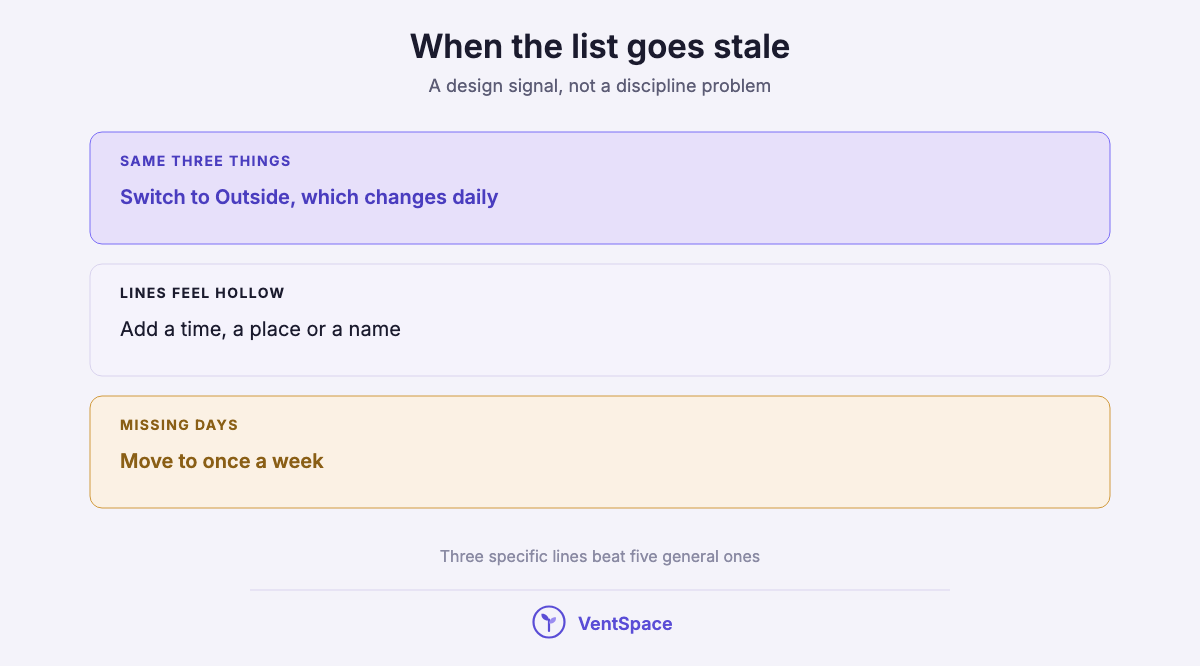
A common way for a gratitude list to end is repetition, not laziness: the same three items appear, we notice them appearing, and the noticing ends it. We treat that as a design signal rather than a discipline problem. Here is how to choose what to change.
- Your list says the same things every time: switch to the “Outside” or “Home, work and the things that run quietly” group, which change on their own.
- Your lines feel hollow: add a time, a place or a name to each. Write three specific lines instead of five general ones.
- You keep missing days: move to once a week. The largest review found that the number of sessions did not change the effect.
- It feels like lying this week: write one “and still ___” line from “Before you sleep”, or skip the week. Both are fine.
- You want something to reread: use “The people around you”, one name per line.
On the number of items: three to five specific lines is plenty, in our view. Our list has 100 so you have choices, not so you can fill a page.
If you would rather keep your list on your phone, VentSpace is one option: a journaling app that turns what you write into a clear read on your life balance, plus small, doable next steps. It is ours, it is Android only and free to start, and it is no substitute for care. Not on Android, or at a desk? VentSpace Live runs in your browser, free, with nothing to install. For other places to keep a list, see our honest roundup of gratitude journal apps, and for gratitude in specific lives, our gratitude examples.
Quick Summary
Q: How often should you write a gratitude list?
A: Once a week is enough. In the largest review of gratitude exercises, people who did more sessions did not get a larger effect. Three to five specific lines a week will last longer than a daily list that repeats.
Does a gratitude list work?
The honest answer is: a little, on average, and no more than other kind things we might do for ourselves. That is a smaller claim than most gratitude pages make, and it is the one the research supports.
The largest synthesis so far is a 2025 meta-analysis in PNAS by Choi, Cha, McCullough, Coles and Oishi. It pooled 145 papers covering 24,804 participants in 28 countries and concluded that “gratitude interventions led to small overall increases in well-being.” The overall effect was g = 0.19. The number of sessions people completed made no difference to the effect, and the authors wrote that effects “were not significantly different from those for other positively valenced activities.” Those interventions included letters and visits as well as lists, so this is evidence about gratitude exercises in general, not lists alone.
An earlier meta-analysis points the same way. Don Davis and colleagues, writing in the Journal of Counseling Psychology in 2016, found that gratitude interventions did a little better than an alternative activity on well-being (d = .17), did not beat it on anxiety (d = .11, with a confidence interval crossing zero), and performed as well as, but no better than, a psychologically active comparison (d = −.03).
What this means in practice is modest and useful. A gratitude list is one reasonable thing to do. It does not need to be daily to count, and if another small practice suits you better, the research does not say gratitude is the better choice.
Insight In the 2025 PNAS meta-analysis, across 716 effect sizes, the number of sessions did not moderate the effect of gratitude interventions. For a reader who has stopped and restarted a list many times, that is the finding worth keeping: there is no evidence that doing it more often would have made it work better.
When gratitude is the wrong tool this week
Some weeks a gratitude list is not what is needed, and noticing that is not a failure. If the list feels like being told to cheer up, put it down. Grief, anger and exhaustion are not problems of insufficient gratitude, and a list will not argue them away.
If you have felt flat for weeks, it is worth talking to a doctor or a therapist. Low mood that does not lift has causes worth checking, and therapy is one option. For a lot of people it is the right one, and seeking it is not a sign that a gratitude practice failed.
If things feel heavier than this
If you are in crisis or thinking about harming yourself, please reach out now. In the United States you can call or text 988 for the Suicide and Crisis Lifeline. Outside the US, findahelpline.com lists the number where you are. This article is not a substitute for that.
Questions people ask
What is a gratitude list?
A short written record of specific things you were glad of: people, moments, places, things your body or your home did. It can live in a notebook, a notes app or a journal.
How many things should be on a gratitude list?
In our view, three to five specific lines is plenty. A few lines that feel true are worth more than a long list written to fill a page.
Do I have to write a gratitude list every day?
No. In the largest review of gratitude exercises, the number of sessions did not change the effect. Once a week is a reasonable default, and that is our suggestion rather than a proven rule.
What if I cannot think of anything to be grateful for?
Then write one small, concrete thing, like a meal or a warm room, or skip the week. A blank week is not a sign that something is wrong with you. If the flatness lasts for weeks, talk to a doctor.
Does a gratitude list help you live longer?
That claim comes from a 2024 JAMA Psychiatry study led by Ying Chen, which followed 49,275 older women in the Nurses’ Health Study and found that those in the highest third of a gratitude questionnaire had a 9% lower risk of death over four years. It measured gratitude as a trait in one population. It did not test a gratitude list, and an observational study cannot show that gratitude caused the difference.
Is a gratitude list toxic positivity?
It can be, if it is used to deny hard feelings or to compare yourself with people who have less. A list of specific things you noticed, written beside whatever else you feel, is not.
Two things to take with you
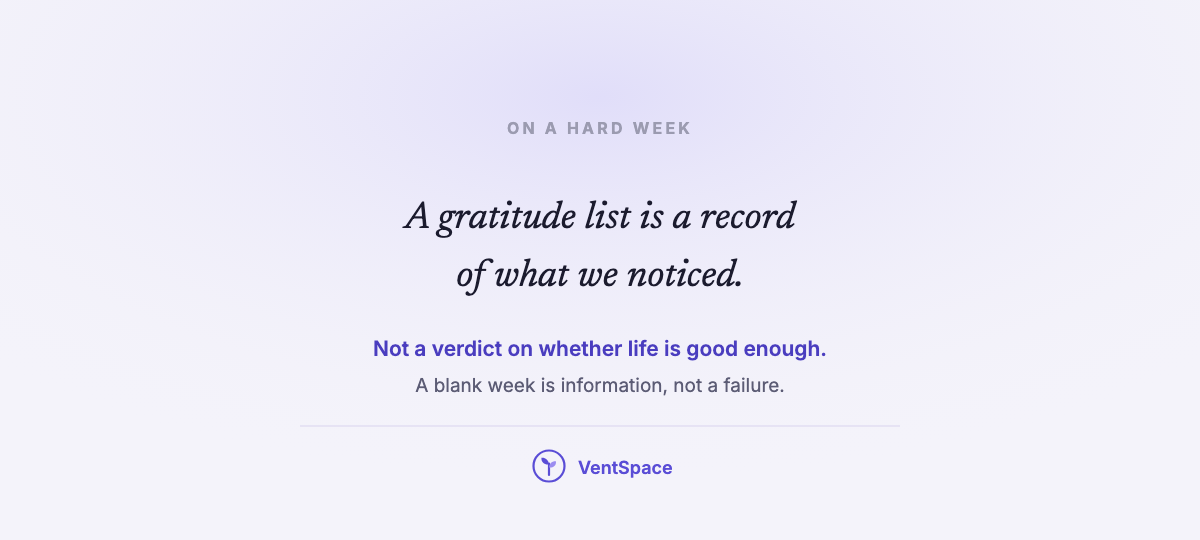
First, a gratitude list is a record of what we noticed, not a verdict on our life. It can sit beside a hard week without needing to fix it.
Second, specific and occasional beats general and daily. One name, one act, one evening a week. On the weeks when even that is too much, the list will still be there, and so will you.

About this article

Written by
Sai Subramaniam
Founder, VentSpace
I write these guides because I have been where you are. I am working through my own hard seasons, and I share the things that actually helped me, so that anyone going through it has a steady companion close by instead of facing it alone. VentSpace is the app I built for exactly that: a journaling app that turns what you write into a clear read on your life balance, plus small, doable next steps toward feeling more like yourself.
This writing is honest and every claim is sourced, and it is not a substitute for professional care. If you are struggling, reaching out to a professional is a strong move, not a failure.
Explore VentSpaceTry VentSpace LiveHow this one was checked. Every factual claim traces to a named source, and the source is printed next to the claim rather than kept in a footnote. Quotes are pinned to the work they come from, with the year, the letter or the chapter where one exists. Where a widely repeated claim could not be traced, it was left out and the omission recorded. Where a figure is contested, both sides are printed.
No affiliate links, no paid placements, and nobody paid to appear here. Where we mention our own app, we say that it is ours, we state its limits, and we never position it as a substitute for care.
Reviewed: October 2026. Prices, platforms and product availability move quickly, and anything we could not verify at the time of writing is marked as unverified rather than turned into a number.
Corrections. If something here is wrong, we would rather know. Corrections are made in place, with a note saying what changed.