
“The choice to love is a choice to connect, to find ourselves in the other.”
bell hooks, All About Love: New Visions (2000)
We nearly kept the old version of this list, and the reason is worth admitting. The first page we published on relationship building activities, in 2022, was a warm list of things that had worked for the person writing it: love nights, bathing together, skydiving. Some of it still rings true. But when we went looking for what the research says couples should do together, we found something that changed the order of the whole list. What if most of the hours couples spend together are not the hours that bring them closer?
You may know the week that sends people searching for this. You talk about groceries, the car, whose turn it is to call your mom. You eat dinner with the TV on and fall asleep scrolling side by side. Nothing is wrong, exactly. So why does it feel like you have become good roommates and little else?
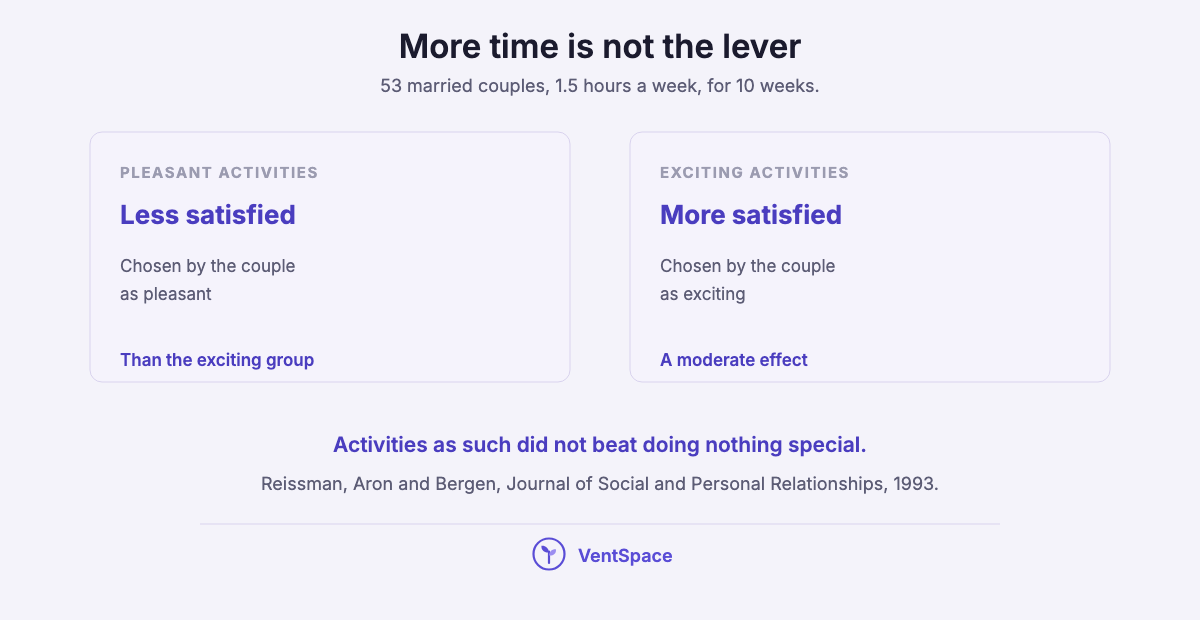
There is a small, careful study that speaks to that feeling. In 1993, Charlotte Reissman, Arthur Aron and Merlynn Bergen randomly assigned 53 married couples to spend 1.5 hours a week for 10 weeks on activities they found exciting, on activities they found pleasant, or on nothing special. Doing activities together, as such, did not beat doing nothing special. But the couples who did exciting things ended up more satisfied than the couples who did pleasant ones. So this list starts with new things, then turns to the small daily moments that research links to closeness, and labels every one honestly.
The activities at a glance
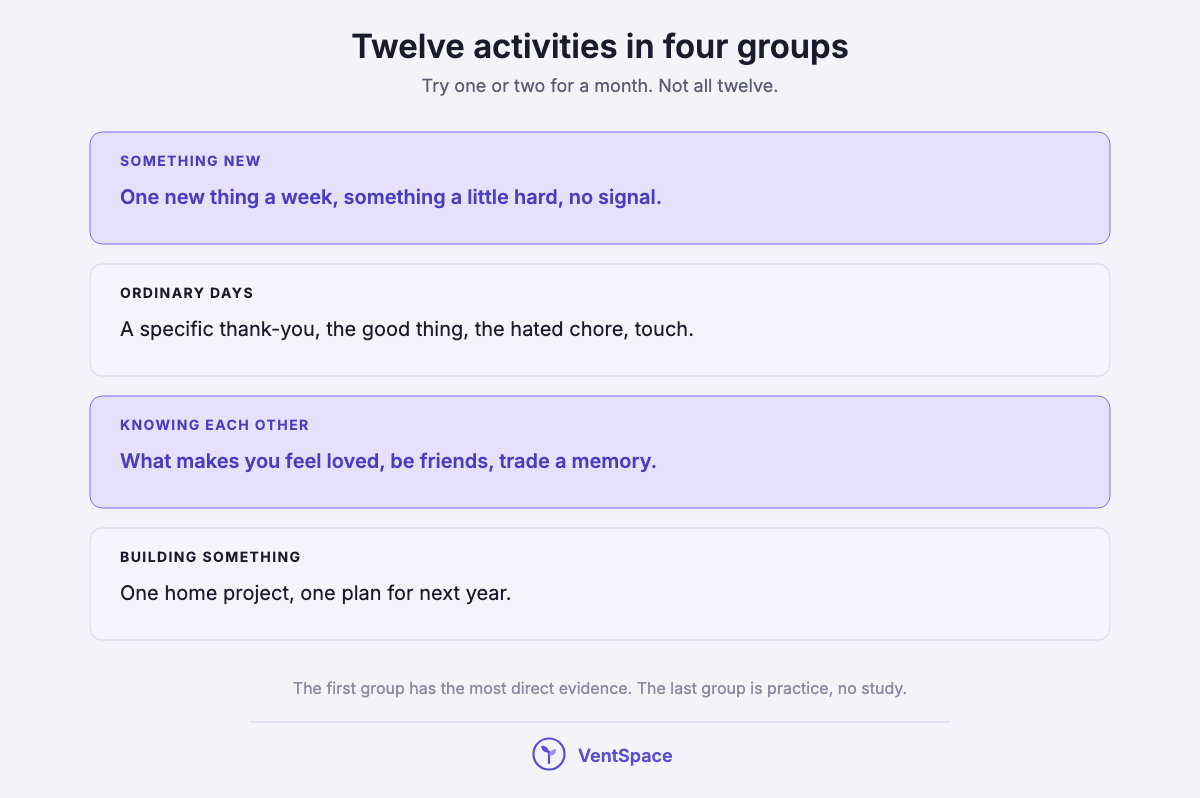
These are couple bonding activities sorted by what they do, not by how cute they look on a calendar.
- 1. Try one new thing a week: best for the “same restaurant, same show” rut.
- 2. Do something a little hard side by side: best for couples who feel like spectators of each other.
- 3. Go somewhere with no signal: best for conversations that keep getting interrupted.
- 4. Say one specific thank-you a day: best for feeling taken for granted.
- 5. Share the good thing from your day: best for evenings that only cover problems.
- 6. Split the chore you both hate: best for quiet resentment about who does what.
- 7. Touch with no agenda: best for couples who only touch on the way to sex, or not at all.
- 8. Ask what makes them feel loved, then widen it: best for love-language fans and skeptics.
- 9. Be friends, including with their friends: best for couples whose fun lives elsewhere.
- 10. Trade one memory each: best for long-term couples who think they know every story.
- 11. Make or fix one thing in the place you share: best for couples who like to see progress.
- 12. Plan one thing for next year: best for couples stuck in the next two weeks.
If your relationship does not feel safe, these activities are not what you need. If a partner frightens you, controls who you see or what you spend, or hurts you, that is not something an activity can fix. You can call The National Domestic Violence Hotline at 1-800-799-7233 or text START to 88788, free, confidential and open 24/7. If you are thinking about harming yourself, call or text 988 in the US, or find a line in your country at findahelpline.com.
How we chose them
- Evidence label on every activity. “Studied directly” means a study tested something close to the activity in couples. “Studied indirectly” means research on the ingredient (thanks, touch, shared chores) without testing the exact activity. “Practice, no study” means it is ours, offered as an idea.
- Small enough for this week. Every item can start this week, and most cost nothing.
- Both of you have to want it. Nothing here asks one partner to put up with an activity for the other’s sake, and nothing involving touch or sex is a test.
- What we left out. Skydiving and other extreme sports as the default, “never go to bed angry” as a rule, and any activity designed to find out which of you is the problem.
Why sort by evidence at all? Because the most common advice, spend more time together, is the one the 1993 trial did not support on its own. It is the kind of time that seems to matter.
Quick Summary
Q: What are the best relationship building activities?
A: Activities that are new to both of you, plus small daily habits: thanking each other for something specific, sharing good news, splitting chores fairly and affectionate touch. In one 10-week trial, couples who did exciting things together ended up more satisfied than couples who did pleasant routine things, and activity as such did not beat doing nothing special.
Something new together
The first two have the most direct evidence on this page. All three work on the oldest problem in long relationships, which is that familiar becomes invisible.
1. Try one new thing a week
Pick something neither of you has done, and do it together once a week. A cooking class, a neighborhood you have never walked, a board game you do not know the rules to, a dance lesson, a museum on a weeknight. In the Reissman trial, couples chose their own “exciting” activities, and that freedom is part of the point. What feels new to you is the test, not what a list says.
Arthur Aron’s later lab work points the same way. In three experiments, couples who spent just seven minutes on a novel, mildly arousing task together reported a bigger rise in relationship quality than couples given a mundane task, and the effect showed up in outside ratings of their conversations too. In his surveys, boredom seemed to be the link between not doing exciting things and feeling less satisfied. Have you noticed how a new place makes you look at your partner as if for the first time?
| Time | 60 to 90 minutes, once a week |
| Cost | Free to moderate |
| Best for | The “same restaurant, same show” rut |
| Evidence | Studied directly: one 10-week trial of 53 married couples and three lab experiments |
| Watch-out | New to one of you and familiar to the other is not new |
Who it’s for: Couples who are fine together and a little bored.
In practice: Take turns choosing, and agree in advance that a bad class still counts.
Verdict: The activity with the strongest case on this page. Start here.
2. Do something a little hard side by side
Choose something that takes effort from both of you at once. A long hike, a climbing wall, a beginner’s run, a workout you do together, an escape room. The original version of this page suggested skydiving. We have kept the idea and dropped the danger. The lab task that improved how couples felt about each other lasted seven minutes, and it did not need a plane.
There is something about being a team against a small problem that a dinner cannot give you. You see your partner frustrated, determined, laughing at themselves. You need each other for a moment. When was the last time the two of you had to figure something out together, with your hands?
| Time | 30 minutes to a morning |
| Cost | Free to moderate |
| Best for | Couples who feel like spectators of each other |
| Evidence | Studied directly in the lab: a 7-minute “novel and arousing” shared task |
| Watch-out | Keep it a challenge, not a competition, and pick a level that suits the less fit person |
Who it’s for: Couples who like doing more than talking.
In practice: Choose something where you are both beginners, so neither of you is the coach.
Verdict: Cheap, quick and well grounded. Leave the extreme versions for when you both want them.
3. Go somewhere with no signal
Put the phones away, or go where they will not work, and see what you talk about. A night drive, a park after dark, a campsite, a long walk with both phones left at home.
From Sai, who writes this site
Ever since I was a kid, the idea of stargazing dates and road trip dates fascinated me. I had always wanted to do it, and when I got the chance to experience that with a person I truly loved, it rocked my world.
We should be honest about the research here, because it is less tidy than the advice. A 2013 study by Andrew Przybylski and Netta Weinstein found that the mere presence of a phone on the table lowered feelings of closeness between strangers. A close replication with 356 people, published in 2021 by Claire Linares and Anne-Laure Sellier, failed to find the effect. So we cannot tell you a phone on the table ruins a conversation. What we can say is what Sai noticed in the first version of this page: the moments we remember most rarely involve a screen. Do you remember the last conversation the two of you had that nobody interrupted?
| Time | An evening |
| Cost | Free |
| Best for | Conversations that keep getting interrupted |
| Evidence | Mixed: one positive study in strangers, one failed replication |
| Watch-out | Agree on a way to be reached for emergencies, especially with kids or caregiving |
Who it’s for: Couples whose evenings are split between two screens.
In practice: Pick a place first. A plan to “use our phones less” rarely survives the couch.
Verdict: Worth doing for the conversation, not because a study promised it.
Quick Summary
Q: Do new activities help a relationship?
A: There is good evidence they can. In a 10-week trial, married couples who spent 1.5 hours a week on activities they found exciting became more satisfied than couples who did pleasant routine activities. Lab studies found that even seven minutes on a new, mildly challenging task together raised how couples rated their relationship.
Insight: time together is not the whole story
“A planned linear contrast comparing the two activities groups to the control group was not significant and had a small effect size; thus the theory that any kind of activity enhances marital satisfaction was not supported as an explanation for the well-established association of time together and satisfaction.” Charlotte Reissman, Arthur Aron and Merlynn Bergen, Journal of Social and Personal Relationships, 1993.
On ordinary days
Most of a relationship is not weekends. These four take minutes and fit inside the week you already have. None was tested as an “activity”, so each is labeled as studied indirectly.
4. Say one specific thank-you a day
Once a day, thank your partner for one specific thing they did, and say why it mattered. Not “thanks for everything”. More like: “Thank you for taking the car in. I was dreading it.” The original page said to thank them for the love, the presence, the good and the bad times. We agree, and we would add: name the small thing, because that is the part they can hear.
In a series of studies published in 2012, Amie Gordon, Emily Impett and colleagues found that people who felt appreciated by their partners were more appreciative in return, and that more appreciative partners were more responsive to each other’s needs, more committed, and more likely to still be together over time. Outside observers could see it in how they behaved. Most of that is correlation, so it does not prove a thank-you causes commitment. But what would it cost you to find out?
| Time | Under a minute a day |
| Cost | Free |
| Best for | Feeling taken for granted |
| Evidence | Studied indirectly: appreciation measured in daily life, the lab and over time |
| Watch-out | A thank-you used to soften a complaint stops landing as thanks |
Who it’s for: Every couple, especially the ones who say “we know we appreciate each other”.
In practice: Say it out loud, at a moment that is not already a goodbye.
Verdict: The smallest activity on this page, with real research behind the ingredient.
5. Share the good thing from your day
At dinner or before bed, each of you tells the other one good thing that happened, and the other asks one question about it. It is easy for a couple’s evening talk to become a list of problems and logistics. This turns part of it toward what went right.
Shelly Gable and colleagues studied exactly this kind of moment in four studies published in 2004. Telling someone about a good event was linked to more positive feeling that day, beyond the event itself, and in close relationships, a partner who usually responded with enthusiasm went with more intimacy and daily satisfaction. The question afterward is the activity. How often does your partner’s good news get a “nice” and nothing more?
| Time | Five minutes |
| Cost | Free |
| Best for | Evenings that only cover problems |
| Evidence | Studied indirectly: daily diaries and surveys on sharing good news |
| Watch-out | Do not turn their good news into your story or your advice |
Who it’s for: Couples who talk a lot but mostly about what is wrong.
In practice: One good thing each, one question each. Keep it that small.
Verdict: Easy to start tonight, and the follow-up question is what makes it work.
6. Split the chore you both hate
Pick the household job that causes the most quiet resentment and do it together, or split it so it is fair. The original page suggested building a home together, and a fair home is part of that. It is not romantic. It may matter more than romance.
Daniel Carlson and colleagues compared US survey data from the early 1990s with data from 2006. In the older data, couples who shared routine housework reported less sex. In the 2006 data that difference was gone, and how a couple split the housework mattered more for sexual satisfaction than it used to, with perceived fairness as the likely reason. A 2018 follow-up by the same group found equal sharing more positively linked to intimacy and relationship satisfaction in recent cohorts, and that among all the chores, how a couple split the dishes was the most closely tied to relationship quality, especially for women. Which chore in your home has a silent scoreboard?
| Time | Whatever the chore takes |
| Cost | Free |
| Best for | Quiet resentment about who does what |
| Evidence | Studied indirectly: two analyses of US couple surveys, correlational |
| Watch-out | Fair is what both of you think is fair, which may not be half and half |
Who it’s for: Couples who argue about the dishes and say it is not about the dishes.
In practice: Put music on and do the worst one together once a week.
Verdict: Unglamorous, and closer to the heart of things than it looks.
7. Touch with no agenda
Spend ten minutes close with no plan for it to lead anywhere. Lying on the couch together, a long hug when one of you gets home, a bath together, holding hands on a walk. The original page called this a love night and included bathing together. We have kept both, with one rule: only touch that both of you want, every time. It is not a test, and it is not a lead-in that anyone owes.
In a 2013 diary study of 102 dating couples, Anik Debrot and colleagues found that on the occasions people were touched by their partner, they felt better, and the link ran through feeling closer. People who were touched more during the study week reported better well-being six months later. It was one week of diaries, so it shows a pattern, not a cause. When did the two of you last touch without it meaning something else?
| Time | Ten minutes |
| Cost | Free |
| Best for | Couples who only touch on the way to sex, or not at all |
| Evidence | Studied indirectly: a one-week diary study of 102 dating couples |
| Watch-out | Ask, and take a no or a pulled-back hand as a full answer |
Who it’s for: Couples whose affection has dried up into logistics.
In practice: Make it a habit attached to a moment, like the first five minutes after work.
Verdict: Simple, and one of the better-studied small habits here. Never use it as pressure.
Quick Summary
Q: What can couples do every day to strengthen a relationship?
A: Thank each other for one specific thing, share one good thing from the day and ask about the other’s, split the chores you both dislike fairly, and spend a few minutes close with no agenda. Research links appreciation, enthusiastic responses to good news, fair housework and affectionate touch with closer relationships, though mostly as associations.
Insight: appreciation travels
“Across studies, we show that people who feel more appreciated by their romantic partners report being more appreciative of their partners. In turn, people who are more appreciative of their partners report being more responsive to their partners’ needs (Study 1), and are more committed and more likely to remain in their relationships over time (Study 2).” Amie Gordon, Emily Impett and colleagues, Journal of Personality and Social Psychology, 2012.
Getting to know each other again
You can live with someone for years and stop being curious about them. These three are about the person, not the routine.
8. Ask what makes them feel loved, then widen it
Ask your partner: “What is something I do, or could do, that makes you feel loved?” Then ask for three more. The original version of this page was built around love languages, the idea from Gary Chapman’s 1992 book that each of us has one main way of giving and receiving love. Asking the question is still a good activity. The research suggests you should not stop at one answer.
In a 2024 review, Emily Impett, Haeyoung Gideon Park and Amy Muise concluded that the evidence does not strongly support the book’s central claims: that each person has a preferred love language, that there are five, and that couples are happier when they speak each other’s. In a preregistered 2025 study of 499 people in long-term relationships, fewer than half had an identifiable primary love language, and satisfaction with the “right” one predicted relationship quality no better than satisfaction with the others. A wider range of loving behaviors mattered more. The 2024 review’s image is a balanced diet rather than a language. What would your partner put on their list that you have never thought of?
| Time | 20 minutes, then a week of trying |
| Cost | Free |
| Best for | Love-language fans and skeptics |
| Evidence | The question is practice. The love-language theory behind it has weak support |
| Watch-out | A label (“you’re acts of service”) can stop you seeing everything else they need |
Who it’s for: Couples who took a love-languages quiz once and have not talked about it since.
In practice: Each of you writes four answers separately, then swap lists and pick one to do this week.
Verdict: Keep the question, drop the single answer.
9. Be friends, including with their friends
Do something with your partner that you would normally do with a friend, and once a month, spend time with their friends. Watch a game, play a video game, gossip about a show, go to the thing their friends always invite them to.
From Sai, who writes this site
The best thing about the relationship I am in right now is that we are not just lovers. Be their best friend sometimes. It makes things so much easier, and you get to understand each other in a whole deeper dimension. Just don’t be too intrusive with their friends.
We could not load a study testing this as an activity, so treat it as practice. It does fit the pattern from the first group: the version of your partner you meet with their friends may be one you rarely see at home. Do you know who your partner is when they are laughing with people who knew them before you?
| Time | An evening, once a month |
| Cost | Free to moderate |
| Best for | Couples whose fun lives elsewhere |
| Evidence | Practice, no study |
| Watch-out | Some nights with friends should stay theirs. Ask before you join |
Who it’s for: Couples who are close at home and separate everywhere else.
In practice: Let your partner choose which friend night you join, and leave before the end sometimes.
Verdict: Unstudied by us, and true to how many couples describe their best stretches.
10. Trade one memory each
Each of you tells a story from before you met that the other has never heard. A teacher you loved, the worst job you had, a summer you think about. The original page suggested spending the whole night talking and sharing memories, and that still describes it.
There is no study on this exact exercise that we could cite. If it helps to have questions ready, our list of questions that turn an acquaintance into a friend works between partners too, and it goes slowly on purpose. Which story would your partner be surprised you have never told?
| Time | An hour |
| Cost | Free |
| Best for | Long-term couples who think they know every story |
| Evidence | Practice, no study |
| Watch-out | Go at the pace of the person sharing. Nobody owes a painful story |
Who it’s for: Couples who have stopped asking each other questions.
In practice: One story each, no fixing, no “that reminds me of”.
Verdict: Costs nothing and tends to be remembered.
Quick Summary
Q: Do love languages help relationships?
A: Asking what makes your partner feel loved is useful. The theory that each person has one main love language, out of five, has weak support. In a 2025 study of 499 people, fewer than half had a clear primary love language, and satisfaction with a wide range of loving behaviors predicted relationship quality better.
Insight: more than one way to feel loved
“Findings failed to support Chapman’s key claims: less than half of participants had an identifiable primary love language, and satisfaction with a partner’s expression of that behavior was no stronger a predictor of relationship quality than satisfaction with other love language behaviors.” Sharon Flicker, Flavia Sancier-Barbosa and Emily Impett, Journal of Marital and Family Therapy, 2025.
Building something together
The last two are about making something that belongs to both of you, from a shelf to a plan.
11. Make or fix one thing in the place you share
Choose one small project for your home and finish it together this month. Paint a wall, build a shelf, plant a window box, rearrange the room you both avoid. The original page suggested making over your house together, and the smaller version is easier to finish.
We have no study on home projects for couples, so this is practice. It borrows from two things above: it is new, and it is a shared task with a visible end. Finishing is part of it. How many half-done projects in your home are waiting for the two of you?
| Time | A weekend, or a few evenings |
| Cost | Low to moderate |
| Best for | Couples who like to see progress |
| Evidence | Practice, no study |
| Watch-out | Agree on the plan before the store, not in the aisle |
Who it’s for: Couples who bond by doing.
In practice: Pick a project you can finish in one month, and take a photo when it is done.
Verdict: Good for teams. Keep it small enough to finish.
12. Plan one thing for next year
Sit down with a calendar and plan one thing you will do together next year. A trip, a class, a race, a visit. It does not have to be big. It has to be shared.
This is also practice, offered without a study. It is easy, deep in work and childcare, to live two weeks at a time. Something on the calendar that is yours is a reason to talk about what you both want, and that conversation is half the activity. When did you last plan something just for the two of you?
| Time | An hour |
| Cost | Free to plan |
| Best for | Couples stuck in the next two weeks |
| Evidence | Practice, no study |
| Watch-out | If you want different things, that is a conversation, not a scheduling problem |
Who it’s for: Couples who are busy and loyal and a little lost in it.
In practice: Each of you writes three ideas, and you pick the one that appears on both lists or comes closest.
Verdict: A small plan with a long tail.
Quick Summary
Q: What are activities to strengthen a relationship long-term?
A: Shared projects with a visible end, like fixing something in your home, and plans you make together for the coming year. We found no studies on these exact activities, so treat them as ideas. They combine two things the research does support: novelty and working as a team.
Insight: a balanced diet, not a language
“We offer an alternative metaphor that we believe more accurately reflects a large body of empirical research on relationships: love is not akin to a language one needs to learn to speak but can be more appropriately understood as a balanced diet in which people need a full range of essential nutrients to cultivate lasting love.” Emily Impett, Haeyoung Gideon Park and Amy Muise, 2024 (preprint abstract of their Current Directions in Psychological Science review).
All twelve side by side
| Activity | Time | Cost | Evidence | The watch-out |
|---|---|---|---|---|
| 1. One new thing a week | 60 to 90 min weekly | Free to moderate | Studied directly | New to both of you |
| 2. Something a little hard | 30 min to a morning | Free to moderate | Studied directly (lab) | Challenge, not competition |
| 3. No signal | An evening | Free | Mixed | Emergency contact plan |
| 4. One specific thank-you | Under a minute | Free | Studied indirectly | Not to soften a complaint |
| 5. Share the good thing | Five minutes | Free | Studied indirectly | Do not make it your story |
| 6. Split the hated chore | As long as it takes | Free | Studied indirectly | Fair is what you both agree |
| 7. Touch with no agenda | Ten minutes | Free | Studied indirectly | Only when both want it |
| 8. What makes you feel loved | 20 minutes | Free | Practice, weak theory | One label hides the rest |
| 9. Be friends | An evening monthly | Free to moderate | Practice | Ask before joining |
| 10. Trade a memory | An hour | Free | Practice | Nobody owes a painful story |
| 11. One home project | A weekend | Low to moderate | Practice | Agree on the plan first |
| 12. Plan for next year | An hour | Free to plan | Practice | Different wants need a talk |
How do you pick one?
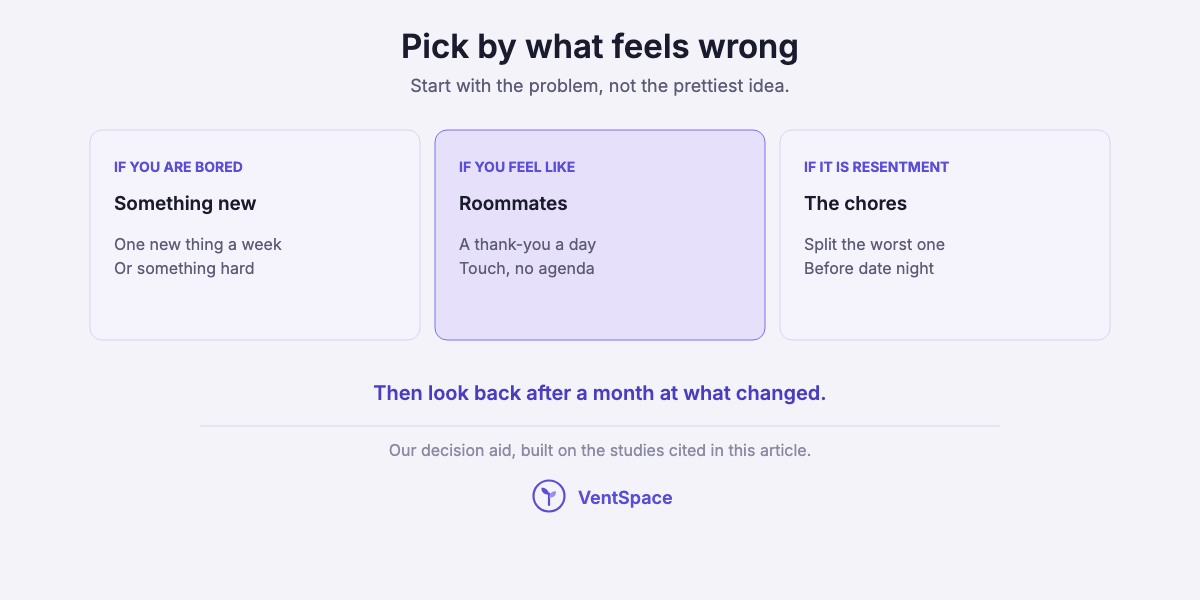
Start with what feels wrong, not with what sounds nice. These are things to do together, and the right one depends on where the two of you are.
- If you are bored: start with 1 or 2. This is where the evidence is strongest.
- If you feel like roommates: start with 4 and 7, every day for two weeks.
- If your evenings are all problems: start with 5, tonight.
- If one of you does more at home: start with 6 before anything romantic.
- If you feel unknown: start with 8 or 10.
- If you are busy and drifting: start with 12, then add one item from the first group.
Then give it a month. Try one or two, not all twelve. At the end of the month, it can help to look back at what you tried and what changed, in writing, so you are not relying on memory. Paper works. If you would rather keep it on your phone, VentSpace is a journaling app that turns what you write into a clear read on your life balance, plus small, doable next steps. It is ours, so read that as a declared interest. It is Android only and free to start as of October 2026, it has no published evidence on outcomes, and it is not therapy. Not on Android, or at a desk? VentSpace Live runs in your browser, free, with nothing to install. It is also not a substitute for talking to each other, which is what the month is for.
If you want more date-style ideas once you have a rhythm, our list of romantic things to do is built for that.
Quick Summary
Q: How do you choose relationship building activities?
A: Match the activity to the problem. Boredom responds best to new or challenging things together. Feeling like roommates calls for daily thanks and touch. Resentment about housework calls for a fairer split first. Try one or two for a month, then look back at what changed.
Where activities stop
Activities help a relationship that is mostly working and has gone quiet. They are not a fix for a fight that keeps coming back, or for a partner who is unkind.
If the same argument returns every week, a new hobby will not settle it, and adding pressure to have fun can make it worse. Couples therapy is a route, not a last resort, and individual therapy is one too, if your partner does not want to go. Therapy is one option. For a lot of people it’s the right one.
If something in the safety note near the top of this page sounded familiar, go back to it.
Quick Summary
Q: Can relationship building activities fix a relationship?
A: Not on their own. They can help a relationship that has gone flat, but they do not resolve recurring conflict or make an unsafe relationship safe. For a fight that keeps returning, couples or individual therapy is a reasonable next step.
Questions couples ask
Does spending more time together strengthen a relationship?
Not by itself, according to the one 10-week trial we found on the question. Taken together, the couples given activities did not do better than couples who did nothing special. Within the activity groups, couples who did things they found exciting ended up more satisfied than couples who did things they found pleasant. The kind of time seems to matter more than the amount.
Are love languages real?
People do differ in what makes them feel loved, so asking is worthwhile. But the evidence does not strongly support the idea that each of us has one main love language out of five, or that matching it is the key to a happy relationship. In a 2025 study of 499 people, fewer than half had a clear primary love language.
Do strong relationships affect your health?
There is a large association. A review of 148 studies covering 308,849 people found that those with stronger social relationships had about a 50% greater likelihood of survival over the study periods (Holt-Lunstad, Smith and Layton, 2010). It is observational, so it does not show that adding activities adds years, and it is not a reason to feel afraid of a quiet patch.
How often should couples do relationship building activities?
Nobody has a proven number. The 1993 trial used 1.5 hours a week for 10 weeks. The daily items on this page take minutes. Weekly for the new things and daily for the small ones is our suggestion, not a research finding.
What if my partner does not want to do any of these?
Start with the ones that need no agreement: a specific thank-you, a question about their good news, doing your share of the chore you both hate. If they say no to more, that is worth a calm conversation about what they would like instead, not a campaign.
Two things to take with you
It is not how many hours you spend together. It is whether any of them are new, and whether the small moments get answered. One new thing a week and one specific thank-you a day are where we would start.
This takes months, not a weekend. The trial behind this list ran for ten weeks, and nobody can tell you how long it will take for the two of you. The aim is not to stop being roommates. It is to become teammates who still notice each other.
Pick one activity tonight, and put the next one on the calendar.
About this article

Written by
Sai Subramaniam
Founder, VentSpace
I write these guides because I have been where you are. I am working through my own hard seasons, and I share the things that actually helped me, so that anyone going through it has a steady companion close by instead of facing it alone. VentSpace is the app I built for exactly that: a journaling app that turns what you write into a clear read on your life balance, plus small, doable next steps toward feeling more like yourself.
This writing is honest and every claim is sourced, and it is not a substitute for professional care. If you are struggling, reaching out to a professional is a strong move, not a failure.
Explore VentSpaceTry VentSpace LiveHow this one was checked. Every factual claim traces to a named source, and the source is printed next to the claim rather than kept in a footnote. Quotes are pinned to the work they come from, with the year, the letter or the chapter where one exists. Where a widely repeated claim could not be traced, it was left out and the omission recorded. Where a figure is contested, both sides are printed.
No affiliate links, no paid placements, and nobody paid to appear here. Where we mention our own app, we say that it is ours, we state its limits, and we never position it as a substitute for care.
Reviewed: October 2026. Prices, platforms and product availability move quickly, and anything we could not verify at the time of writing is marked as unverified rather than turned into a number.
Corrections. If something here is wrong, we would rather know. Corrections are made in place, with a note saying what changed.