
“Despite the lack of evidence for negative health effects of masturbation, abstinence from masturbation is frequently recommended as a strategy to improve one’s sexual self-regulation.” · Felix Zimmer and Roland Imhoff, Archives of Sexual Behavior, 2020
You have probably seen the counters. Day 1, day 14, day 90. You have seen people argue about hard mode and normal mode, and whether a wet dream resets the clock. Maybe you reset your own counter last night and felt the floor drop. So what are the rules, and who decided them?
Here is the part most guides skip. There is no official NoFap rulebook. NoFap’s own website describes itself as “a peer support website for recovering porn addicts”, and its home page and FAQ set out no modes and no rules. The modes you have read about come from forums and from app companies’ blogs, and one of those blogs, while defining them, calls them “not official rules of Nofap”.
That changes the question. If nobody hands you the rules, then you are writing house rules: the kind every household sets for itself, that only the people living there have to follow, and that work best when they are few, written down before anyone arrives, and about the house you live in. This guide gives you the common rules, an honest check on the claims behind them, and five rules worth writing down for yourself.
The short version
There is no official NoFap rulebook. “Hard mode”, “normal mode” and “easy mode” are community conventions, and guides define them differently.
Masturbation has no established health harms. The testosterone study NoFap is often linked to was retracted, and long-term data found no causal link between porn use and erectile problems.
Some people do have a real problem with control. The World Health Organization’s classification has a category for it, and moral distress alone does not qualify.
Rules built on fear and shame can keep distress going. Rules built on your own reason and your own cues are easier to live with.
Five rules worth keeping, and the first one takes one sentence and a pen.
New from The Digital Hope · Try it
Urge AI: notice the urge, choose again
For anyone doing NoFap, or cutting down on porn and masturbation. A free, private tool for the moment an urge hits. Tap one button, ride it out with a small challenge, and write one line before and after. Over a few weeks it shows you your own pattern: when it happens, what sits underneath, and what to put in that hour instead. Nothing ever resets to zero, and you can use it without an account.
What are the NoFap rules?
“Fapping is a normal thing to do, and doing it does not make you unusual.” · Sai Subramaniam, in the first version of this page, 2022
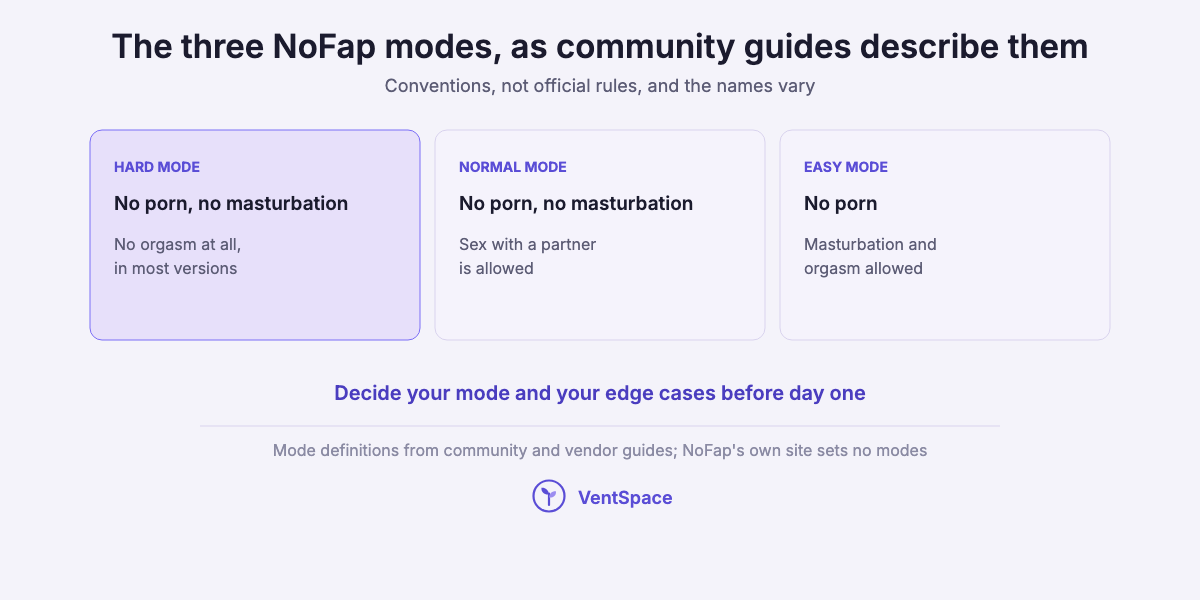
The NoFap rules are self-chosen limits on porn, masturbation and orgasm, kept for a set number of days, usually in one of three “modes” that community guides describe. None of the modes is official. They are house rules that a lot of houses happen to share.
Here is how one widely read guide defines them. Notice that it uses “easy mode” for two different things, which tells you how loose the terms are.
| Mode, as community guides describe it | Porn | Masturbation | Orgasm with a partner |
|---|---|---|---|
| Hard mode | No | No | No (no orgasm at all, in most versions) |
| Normal mode (sometimes called easy mode) | No | No | Allowed |
| Easy mode (porn only) | No | Allowed | Allowed |
Most of the arguments happen at the edges. Does edging count? The guides we read say yes. Does seeing something by accident count? They say no, as long as you look away. Does a wet dream count? It is not a choice, which is worth weighing when you decide. The point is not who is right. The point is that you decide before day one, so you are not deciding at 1am.
And the famous 90 days? You will see 30, 60 and 90 used as targets, and NoFap’s own site quotes its team saying people “should be able to manage to get by without it for 30-90 days”. We found no study that establishes any of those numbers as the length that produces a result. They are targets people pick, not findings.
Why do people sign up at all? A 2020 survey of 1,063 people recruited through Reddit by Felix Zimmer and Roland Imhoff found that most had tried abstaining from masturbation at some point. The strongest link with wanting to abstain was believing that masturbation is unhealthy, rather than behavioral measures such as their maximum number of orgasms. That is worth knowing before you choose your mode. Is your reason about your behavior, or about what you have been told about it?
Quick Summary
Q: What are the rules of NoFap?
A: There is no official rulebook. Community guides describe modes: hard mode (no porn, masturbation or orgasm), normal mode (no porn or masturbation, sex with a partner allowed) and easy mode (no porn only). People also set their own lines on edging, accidental exposure and wet dreams, and pick a target length such as 30 or 90 days.
Insight: Felix Zimmer and Roland Imhoff, Archives of Sexual Behavior (2020), from a survey of 1,063 people: “As visible from zero-order correlations and multiple linear regression, motivation for abstinence was mostly associated with attitudinal correlates, specifically the perception of masturbation as unhealthy. While there were associations with hypersexuality, no significant correlation with behavioral markers such as maximum number of orgasms was found.”
Is porn or masturbation bad for you?
“The proposed diagnostic guidelines also emphasize that compulsive sexual behaviour disorder should not be diagnosed based on psychological distress related to moral judgments or disapproval about sexual impulses, urges or behaviours that would otherwise not be considered indicative of psychopathology.” · Shane Kraus and colleagues, for the ICD-11 working group, World Psychiatry, 2018
For most people, the research does not show that masturbation harms health, and the scariest claims behind NoFap do not hold up. For a smaller group, losing control over sexual behavior is real, and the World Health Organization’s classification has a category for it. Both are true, and you deserve both.
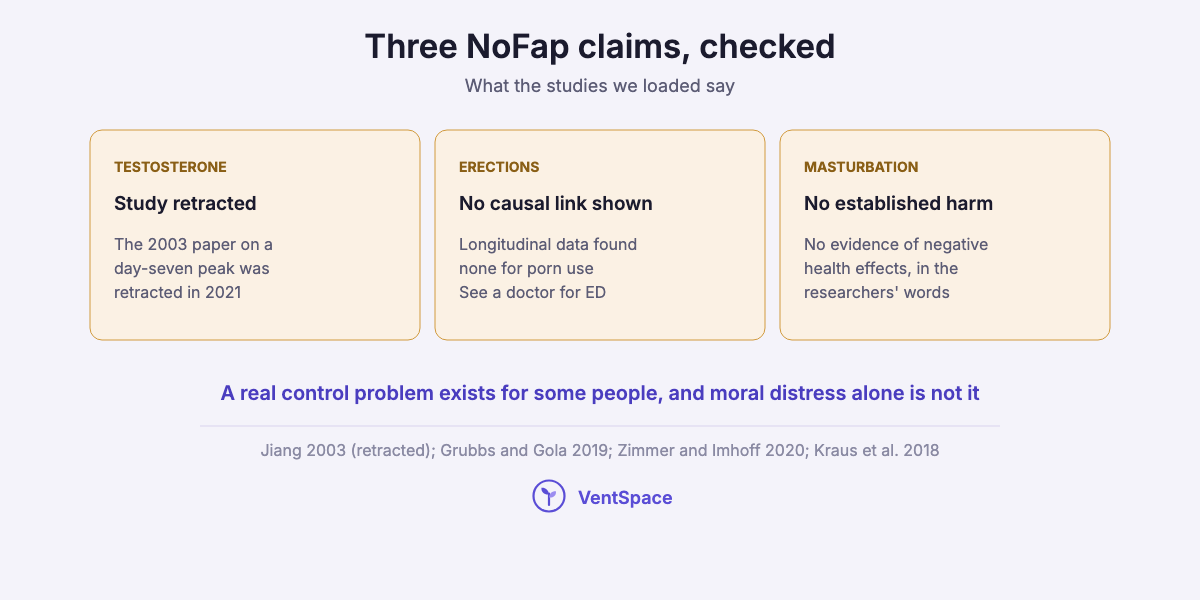
Start with the claims. The testosterone claim. A 2003 study of 28 men reported a testosterone peak on the seventh day without ejaculation. That paper was retracted in 2021, and PubMed now marks it as a retracted article. A retracted paper is not evidence for anything, including the opposite.
The erection claim. In 2019, Joshua Grubbs and Mateusz Gola looked at three samples of men, including one followed over a year. People who felt their porn use was a problem were more likely to report erectile difficulties at the same time. But there was no consistent link between just watching porn and erectile problems, and no evidence that porn caused them. A 2022 survey of 669 people familiar with “reboot” programs, by Nicole Prause, found that anxiety predicted erectile difficulties, and how often people watched porn did not change that. Prause has a public position in this debate, so treat that one as a single survey. Erection problems are worth taking to a doctor, because there are many causes, and a page cannot tell you which is yours.
The control problem. Some people do lose control. In 2018 the working group behind the WHO’s ICD-11 described compulsive sexual behaviour disorder as a persistent pattern of failing to control intense, repetitive sexual urges, over an extended period, causing marked distress or problems in daily life. They placed it with impulse control disorders, not addictions, because the evidence on whether it works like substance addiction was not yet definitive. And they were explicit, in the line above, that distress that comes from moral disapproval alone is not the disorder.
That last point matters for a lot of readers. Joshua Grubbs and colleagues reviewed the research in 2019 and proposed that the feeling of being addicted to porn may, in many cases, be better explained by moral incongruence: the gap between what you believe about porn and what you do. Their model does not say your values are wrong. It says the pain may be coming from the gap, and that matters for which rules will help.
Sai, who wrote the first version of this page in 2022, describes himself as having been “seriously addicted” and still working on quitting, and he was direct about the claims: “I never had problems with any of this. Never.” His advice was not to blame anxiety, dating or productivity on masturbation, because whatever is behind them “will not magically disappear” when you stop.
Quick Summary
Q: Is masturbation bad for you?
A: Research has not established negative health effects of masturbation. The study linking abstinence to a testosterone peak was retracted, and longitudinal data found no causal link between porn use and erectile problems. A minority of people have a real control problem, which the WHO’s ICD-11 working group classed as an impulse control disorder, separate from moral distress.
Insight: Joshua Grubbs and Mateusz Gola, Journal of Sexual Medicine (2019), across three samples of men: “In conjunction with prior literature, we conclude that there is little or no evidence of an association between mere pornography use and ED, consistent evidence of an association between self-reported problematic use and ED cross-sectionally, and no evidence of causal links between any pornography variables and ED.”
Why rules built on fear and shame tend to backfire
“Furthermore, commitment to abstinence, framed by the notions of recovery and relapse, was found to be a major factor for maintaining distress.” · Dimitra Chasioti and James Binnie, Archives of Sexual Behavior, 2021
Because the shame can become part of the problem. When a rule is enforced by fear, every slip feels like proof that something is wrong with you, and that feeling can keep the cycle going.
The 2022 version of this page told readers to use fear and guilt as fuel: to remember the shame and fear it would come back. We have taken that section out, and it is worth saying why. Dimitra Chasioti and James Binnie studied posts in NoFap and PornFree communities and found that commitment to abstinence, framed around recovery and relapse, was a major factor in keeping distress going. That is a qualitative study, not a trial. It fits the moral-incongruence picture above: if the gap between belief and behavior is what hurts, a rule that makes every slip a moral failure widens the gap.
What about the fear of the first few days? A lot of guides warn about withdrawal. In a 2023 randomized trial, David Fernandez and colleagues asked 176 students who used porn at least three times a week to stop for seven days, and compared them with students who carried on. They found no evidence of withdrawal-related symptoms in the group that stopped. An exploratory result suggested more craving only for people who rated their use as highly problematic and were using daily, and the authors ask for that to be tested properly. So the first week may be harder for some people than others. For most, it is not a medical event.
None of this means your reason for trying is wrong. It means the tone of your house rules matters as much as what they say. Before you write yours, ask yourself:
- When you broke a rule last time, what did you call yourself?
- Would you say that to a friend who did the same?
- Is your reason about how you want to live, or about being afraid of yourself?
- Who taught you to feel the way you feel about this?
Quick Summary
Q: Can NoFap make you feel worse?
A: It can if it runs on shame. A 2021 qualitative study of NoFap and PornFree forum posts found that commitment to abstinence framed around recovery and relapse helped keep distress going. A 2023 trial found no withdrawal symptoms when regular users stopped for seven days.
Insight: David Fernandez and colleagues, Archives of Sexual Behavior (2023), from a randomized trial of 176 regular users: “These findings indicate that no evidence of withdrawal-related symptoms was found for abstaining participants, and this was not dependent on level of PPU.”
So what rules are worth writing down?
Five NoFap rules worth keeping
“Successfully achieving and maintaining abstinence was typically experienced to be very challenging due to habitual behavior patterns and/or cravings triggered by a multiplicity of cues for pornography use, but a combination of internal (e.g., cognitive-behavioral strategies) and external (e.g., social support) resources made abstinence attainable for many members.” · David Fernandez, Daria Kuss and Mark Griffiths, Archives of Sexual Behavior, 2021
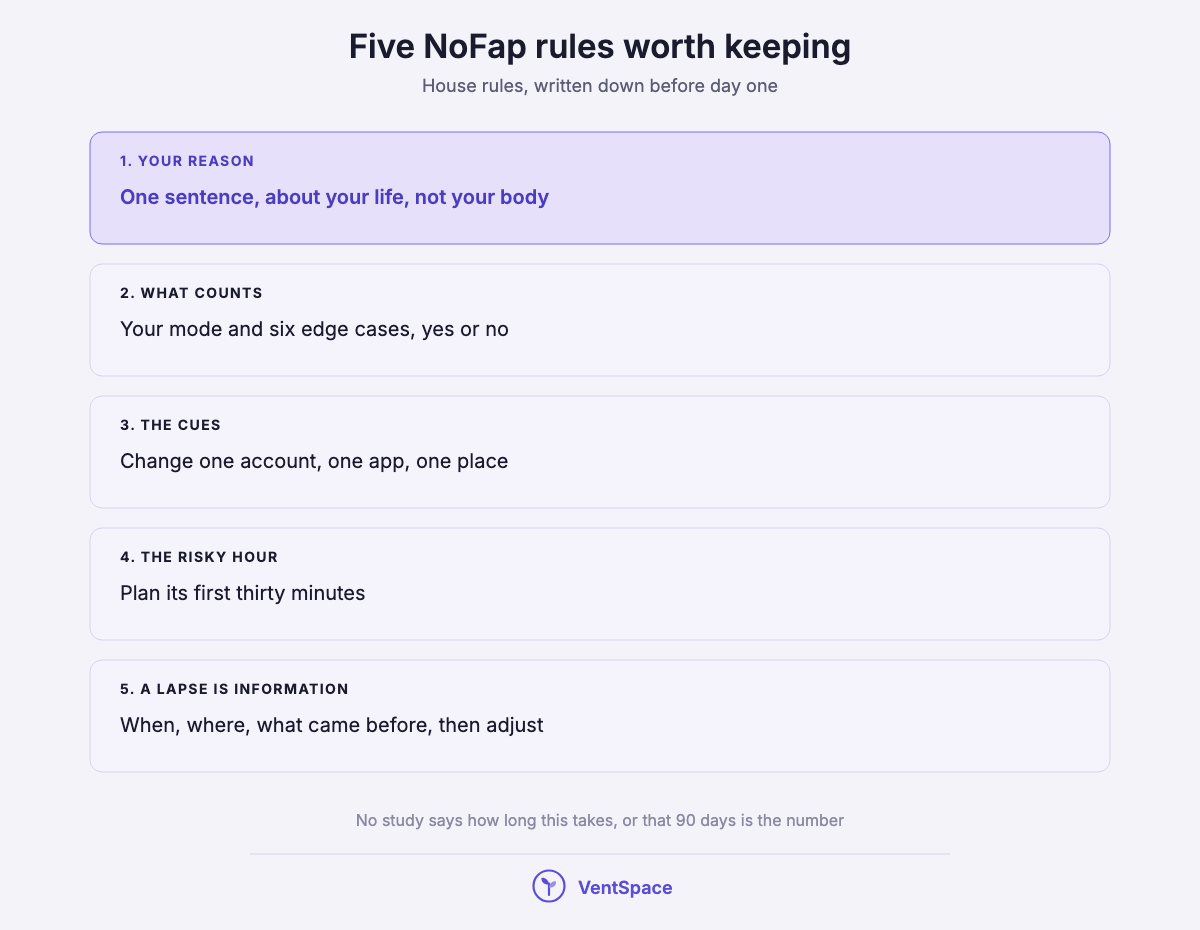
Five house rules, in the order to write them: your own reason, what counts, the cues you will change, a routine for your risky hours, and what you will do after a lapse. They come from what people who have done this describe, from the research above, and from Sai’s own 2022 rules. Grab a pen. You will need it for the first two.
1. Write your own reason in one sentence
Before day one, write one sentence that starts “I am doing this because…”, and make it about your life, not about your body being broken. Sai’s first rule in 2022 was the same: find the right reason. “Do it for the right reasons,” he wrote, because the borrowed ones run out.
A reason built on a claim, such as testosterone or confidence, collapses the day you learn the claim is weak. A reason built on how you want to spend your evenings, or on matching what you do to what you value, does not depend on any study.
Ask yourself:
- What do I want more time or attention for?
- What does my use cost me that I can name, this month?
- Is this reason mine, or something I read on a forum?
- Would it still hold if every benefit claim turned out to be false?
Don’t overthink the wording. One honest sentence beats a page of reasons.
2. Decide what counts before day one
Write your mode and your edge cases on paper: porn, masturbation, partner sex, edging, accidental exposure, wet dreams. One line each, yes or no.
This is the house-rule part at its plainest. Rules made in advance are about the house you live in. Rules made at 1am are made by whoever is most tired. You may also decide that your rule is about porn only, or about cutting down rather than stopping. That is still a rule, and it is yours.
Ask yourself:
- Which mode fits my reason from rule 1?
- If I am in a relationship, have I talked about this with my partner?
- What will I count as a lapse, and what will I just notice?
- How long am I committing to for now, knowing no number is proven?
Be honest, no one is checking this but you. A clear rule is easier to keep than a strict one.
3. Change the cues, not just your willpower
Tonight, change the three things that most often lead to watching: an account, an app, a place or a time. Unfollow, uninstall, block, or move the phone out of the bedroom.
The men whose abstinence journals Fernandez and colleagues analyzed described the hard part as habits and cravings set off by many different cues, and what helped was a mix of their own strategies and other people’s support. Sai’s 2022 list was practical: unfollow accounts that set you off, uninstall apps, delete saved files, block sites, and “Try not to be alone” at the times you are most likely to slip. He added the line that matters most: “Your pattern or your triggers might be completely different when compared to others.”
Ask yourself:
- Where am I, and what time is it, most times I watch?
- What was I doing in the ten minutes before?
- Which single change would remove the most of those moments?
- Who could I tell, so I am not doing this alone?
Start with three. You can add more next week.
4. Build a routine for your risky hours
Pick the time of day you are most likely to slip, and plan the first thirty minutes of it. Write it down as a short list.
Here is the morning routine Sai shared in 2022, as he wrote it:
- Wake up and spend a few minutes in bed relaxing
- Gratitude meditation
- Workout for at least half hour
- Make breakfast
- Eat and bathe
- Start working on my website and my full time job
Yours will look different. His point was that the routine should be strongest at the times you are most at risk, and that if you hate routines, you can “just take this up as a challenge for one or two weeks”.
Ask yourself:
- Which hour is my riskiest: morning, after work, late night?
- What is the first thing I do in that hour now?
- What could I do instead that gets me out of the room?
- What would make the new routine easy to start tomorrow?
You do not need a perfect routine. A short one you keep beats a long one you skip.
5. Treat a lapse as information, not a verdict
If you break your rule, write down what time it was, where you were and what happened just before, then go back to rule 3. That is the whole response. No new punishment rule, no longer streak to make up for it.
This rule exists because of the finding in the last section: framing everything as recovery and relapse can keep distress going. A lapse tells you which cue you missed. That is useful. A lapse treated as a moral collapse tells you nothing new and makes the next one more likely to feel inevitable. If lapses are your main problem right now, our page on handling a NoFap relapse goes into it in more detail.
Ask yourself, the next morning:
- What time was it, and where was I?
- What happened in the hour before?
- Which of my house rules did not cover that moment?
- What one change would cover it next time?
You are allowed to be annoyed with yourself for a few minutes. Then turn the annoyance into a note.
Quick Summary
Q: What are the most important NoFap rules?
A: Write your own reason in one sentence, decide what counts before day one, change the cues that lead to watching, build a routine for your riskiest hour, and treat a lapse as information about a missed cue rather than a moral failure.
Insight: David Fernandez, Daria Kuss and Mark Griffiths, Archives of Sexual Behavior (2021), on what the 104 abstinence journals can and cannot show: “A range of benefits attributed to abstinence by members suggest that abstaining from pornography could potentially be a beneficial intervention for problematic pornography use, although future prospective studies are needed to rule out possible third variable explanations for these perceived effects and to rigorously evaluate abstinence as an intervention.”
Pulling it all together
“These will not magically disappear after you stop fapping.” · Sai Subramaniam, in the first version of this page, 2022
The five rules are one set of house rules, written once and revisited, not five tests to pass. Here is how they fit together.
Rule 1, your reason, is what the rest hangs on. Commit: “Tonight I write one sentence that starts ‘I am doing this because’.”
Rule 2, what counts, removes the 1am arguments. Commit: “Before tomorrow, I write my mode and my six edge cases, yes or no.”
Rule 3, the cues, does more than willpower. Commit: “Tonight I change three things: one account, one app, one place.”
Rule 4, the routine, covers your riskiest hour. Commit: “I plan the first thirty minutes of my riskiest hour and do it tomorrow.”
Rule 5, lapses as information, keeps one bad night from becoming a bad month. Commit: “If I slip, I write down when, where and what happened before, and then I adjust rule 3.”
And keep Sai’s warning in view. Whatever else is going on in your life, the stress, the loneliness, the work you are avoiding, will still be there on day 30. The rules can give you back time and attention. What you do with them is a different project, and a worthwhile one.
Quick Summary
Q: How do I make NoFap rules I can actually keep?
A: Write them down before you start: your reason, your mode and edge cases, three cue changes, a routine for your riskiest hour, and a plan for lapses. Keep the tone practical rather than punishing, and review them when something is not working.
Insight: Shane Kraus and colleagues, World Psychiatry (2018), describing the ICD-11 category: “It is characterized by a persistent pattern of failure to control intense, repetitive sexual impulses or urges, resulting in repetitive sexual behaviour over an extended period (e.g., six months or more) that causes marked distress or impairment in personal, family, social, educational, occupational or other important areas of functioning.”
Questions people ask
Is NoFap healthy?
Stopping porn or masturbation for a while is not known to be harmful, and plenty of people choose it for their own reasons. What the research does not support is the idea that masturbation itself is unhealthy: in Zimmer and Imhoff’s words, there is a “lack of evidence for negative health effects of masturbation”. The risk worth watching is the emotional one. If your rules leave you more ashamed and anxious than before, that is a sign to change the rules, not to try harder.
Does NoFap increase testosterone?
There is no reliable evidence that it does. The 2003 study that reported a testosterone peak on the seventh day of abstinence, in 28 men, was retracted in 2021. Claims built on it should be treated as unsupported.
Does porn cause erectile dysfunction?
The best data we found says no causal link has been shown. Grubbs and Gola’s 2019 analysis, including a sample followed for a year, found no consistent association between just using porn and erectile problems, though feeling that your use is a problem went with reporting more of them. If you have erection problems, see a doctor: there are many possible causes, including anxiety, and some are medical.
Is porn addiction real?
Some people genuinely struggle to control their sexual behavior, and the WHO’s ICD-11 working group described a category for it, compulsive sexual behaviour disorder, in 2018. They classed it as an impulse control disorder rather than an addiction, because the evidence was not definitive. They also said distress from moral disapproval alone is not the disorder. Whether your own use is a problem is a conversation for a professional, not a quiz on a website.
How long should NoFap last?
No study establishes a number. Thirty, sixty and ninety days are common targets, and NoFap’s own site mentions 30 to 90 days as encouragement. Pick a length that fits your reason, review it when you get there, and remember that a rule about cutting down is also a valid rule.
When should I talk to someone?
If you keep trying to stop and cannot, if it is affecting your work, relationships or sleep, or if the shame is heavy, a therapist who works with sexual health is a good next step. Our page on whether you need therapy can help you think it through. If you are having thoughts of harming yourself, call or text 988 in the US, or find a local line at findahelpline.com, today.
In a nutshell
Two things to take with you.
First, the rules are yours to write. There is no official NoFap rulebook, and the strongest health claims behind it do not hold up. House rules built on your own reason, your own cues and a calm response to lapses are the ones people can live with.
Second, the honest timeline: no study says how long this takes, or that 90 days is the number. Changing a habit with this many cues takes weeks of noticing and adjusting, and some weeks will go backward. Those weeks are information too.
If it would help to keep your reason and your notes in one place, VentSpace is a journaling app that turns what you write into a clear read on your life balance, plus small, doable next steps. Prefer to try it on your laptop first? VentSpace Live runs in your browser, free, with nothing to install.
About this article

Written by
Sai Subramaniam
Founder, VentSpace
I write these guides because I have been where you are. I am working through my own hard seasons, and I share the things that actually helped me, so that anyone going through it has a steady companion close by instead of facing it alone. VentSpace is the app I built for exactly that: a journaling app that turns what you write into a clear read on your life balance, plus small, doable next steps toward feeling more like yourself.
This writing is honest and every claim is sourced, and it is not a substitute for professional care. If you are struggling, reaching out to a professional is a strong move, not a failure.
Explore VentSpaceTry VentSpace LiveHow this one was checked. Every factual claim traces to a named source, and the source is printed next to the claim rather than kept in a footnote. Quotes are pinned to the work they come from, with the year, the letter or the chapter where one exists. Where a widely repeated claim could not be traced, it was left out and the omission recorded. Where a figure is contested, both sides are printed.
No affiliate links, no paid placements, and nobody paid to appear here. Where we mention our own app, we say that it is ours, we state its limits, and we never position it as a substitute for care.
Reviewed: October 2026. Prices, platforms and product availability move quickly, and anything we could not verify at the time of writing is marked as unverified rather than turned into a number.
Corrections. If something here is wrong, we would rather know. Corrections are made in place, with a note saying what changed.