
“[N]either follower count nor whether the account has had previous high-performing videos are direct factors in the recommendation system.”
TikTok Newsroom, “How TikTok recommends videos #ForYou” (18 June 2020)
Last updated: October 2026.
Your reels stop at a few hundred views. The follower count hasn’t moved in a quarter, someone on the team says the account is shadowbanned, and someone else says organic is dead and the budget should go to ads. So which is it?
Neither, on what the platforms themselves have published. Instagram, TikTok and YouTube say they rank each post for each viewer, using what that viewer watches, finishes and shares. TikTok said in June 2020 that follower count is not a direct factor in its For You feed. Instagram started showing new reels to a small test audience first in April 2024, according to TechCrunch’s report of the change. YouTube said in September 2021 that it does not connect viewers to videos through their social network.
Organic reach is earned one post at a time, from people who don’t follow you. That one law decides what a social media marketing strategy should contain in 2026, and this guide builds the strategy around it: the planning layer first, then how each platform says it decides, then five steps you can start this week, then what Google says about social media and SEO, including where social posts show up in search and AI answers.
How we know: Platform documentation and executive statements from Instagram (May 2023, April 2024, January 2025, December 2025), TikTok (June 2020), YouTube (September 2021 and the Shorts help page, read 29 October 2026) and Google (Search Central documentation read 29 October 2026, the Google blog in May 2023 and February 2024). Audience data from Pew Research Center (5,022 US adults, February to June 2025). Posting-frequency data from Buffer (2.1 million Instagram posts across 102,000 accounts, published August 2025). AI citation data from two vendor studies, Peec AI (March 2026) and Ahrefs (September 2026). The limit: platforms list the signals they use, never the weights, and some explainers are years old. Three Instagram changes and Google’s most recent statement on social signals are known only through press reports, and they are labelled as such below.
Quick Digest
– The planning layer: one goal, one metric, two platforms chosen by where your audience already is, and a decision on what paid is for.
– How reach works: each platform tests a post on people who don’t follow you and widens it if they watch, share and like it.
– The five steps: goal and metric, two platforms, original posts built to be finished and sent, a test on non-followers read per reach, and a cadence you can hold.
– Social and SEO: Google says social signals are not a ranking factor, but social posts are search results in their own right, and Reddit, YouTube and LinkedIn are among the sources AI answers cite most.
– The honest timeline: expect a quarter of steady posting before the pattern is readable.
A social media marketing strategy starts with one goal, one audience and two platforms
A social media marketing strategy is a written plan that ties your posting to one business goal, names the audience you need to reach, picks the platforms where that audience already spends time, and decides what organic posting is for and what paid is for. Without the goal, nothing that happens on the account can be judged.
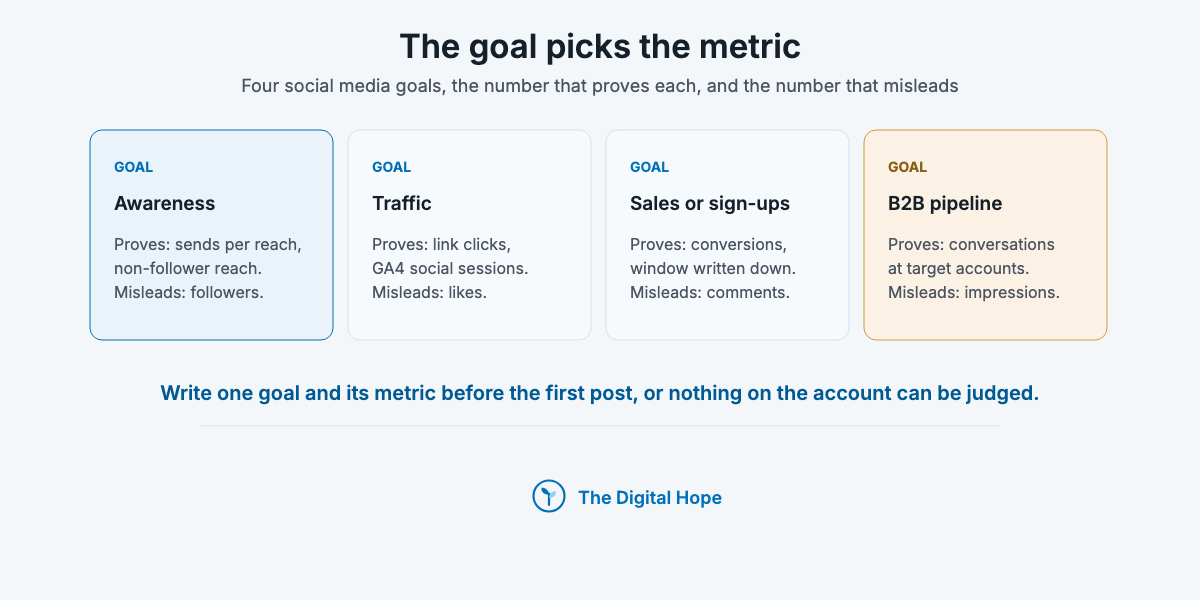
Start with the goal, because the goal picks the metric. Most stalled accounts are measured on followers because followers are the number on the profile, not because followers are the goal.
| Goal | Metric that proves it | Metric that misleads |
|---|---|---|
| Awareness with a consumer audience | Reach from non-followers, sends per reach, profile visits | Follower count |
| Traffic to a site or shop | Link clicks, and sessions from social in GA4 | Likes |
| Sales or sign-ups | Conversions credited to social, with the attribution window written down | Comments |
| B2B pipeline | Conversations with people at accounts you want to sell to | Impressions |
Choose platforms by where your audience is, not where you feel at home. In Pew Research Center’s 2025 survey of 5,022 US adults (February to June 2025), 84% use YouTube, 71% Facebook, 50% Instagram and 37% TikTok. The spread by age is wide: about eight in ten adults aged 18 to 29 use Instagram, against 19% of those 65 and older, and roughly half of 18 to 29 year olds use TikTok every day, against 5% of those 65 and older, per the same report. If you sell to under-30s, Instagram and TikTok are where they are. If your buyer is 65 or older, Instagram reaches about one in five of them, so YouTube and Facebook, the two most used platforms overall, are the safer start.
The condition that splits this advice is the buyer. For a consumer product that shows well on video, short-form video on Instagram Reels, TikTok and YouTube Shorts is the default surface. For a narrow B2B buyer, short-form reach tends to land on the wrong room, and the feed that matters is usually LinkedIn, which since 12 March 2026 matches posts to members by topic rather than only by connection, per LinkedIn Engineering. There the measure is buyer conversations, not impressions. This page stays with Instagram, TikTok and YouTube.
Decide the organic and paid split before the first post. Organic posting is how you find out which posts earn distribution. Paid buys certainty: reach for a post that has already proved itself, or a fixed audience on a fixed date, such as a launch. A workable rule for a small budget is to put paid only behind posts that passed their organic test, unless the goal is a dated launch. The paid mechanics for Meta are in the Facebook Ads conversions playbook.
So the plan comes first.
Quick Summary
Q: What should a social media marketing strategy include?
A: One business goal and the metric that proves it, the audience you need to reach, two platforms chosen by where that audience already is (Pew 2025: YouTube 84%, Instagram 50%, TikTok 37% of US adults), and a rule for what organic and paid are each for.
Insight “YouTube and Facebook remain the most widely used online platforms.” Pew Research Center, Americans’ Social Media Use 2025 (20 November 2025). Half of US adults use Instagram and 37% use TikTok in the same survey, so platform choice is an audience decision before it is a content decision.
Organic reach is earned post by post, from people who don’t follow you
“Unlike other platforms, we don’t connect viewers to content through their social network.”
Cristos Goodrow, VP of Engineering, YouTube Official Blog (15 September 2021)
All three platforms say they rank each post for each viewer on predicted interest, and none names follower count as the lever. Instagram tests a new reel on a small audience and widens it for top performers, TikTok said in 2020 that follower count is not a direct factor, and YouTube ranks on viewer satisfaction rather than the social graph.
| Platform | What it says it predicts or weighs | What it shows less | Source and date |
|---|---|---|---|
| Instagram Reels | How likely you are to reshare, watch all the way through and like (2023). Watch time, likes and sends as the top three signals, with sends weighing more for reaching non-followers (January 2025) | Low-resolution or watermarked reels, reels already posted on Instagram, and reposts when the original exists (April 2024) | Instagram Ranking Explained, 31 May 2023. Mosseri via Social Media Today, 22 January 2025 (secondary). TechCrunch, 30 April 2024 (secondary) |
| TikTok For You | User interactions (likes, shares, follows, comments, what you create), video information (captions, sounds, hashtags), and device and account settings at lower weight. Finishing a longer video counts as a strong signal | Duplicated content, content already seen, spam, and videos seeking to artificially increase traffic | TikTok Newsroom, 18 June 2020 (read from an archived copy, the live page returned an error) |
| YouTube | Clicks, watch time, survey responses, sharing, likes and dislikes. Only watch time rated four or five stars in surveys counts as “valued watchtime” | Not stated in the explainer | YouTube Official Blog, 15 September 2021 |
A post earns its own distribution. Here’s the reason a follower-first plan stalls:
- On Instagram, a new reel goes to a small test audience first and widens only if it performs, per TechCrunch’s April 2024 report of Instagram’s change.
- On TikTok, a viewer finishing a longer video counts for more than a weak signal such as the viewer and creator being in the same country, per TikTok’s June 2020 explainer.
- On YouTube, only watch time that viewers rate four or five stars in surveys counts as valued watchtime, per YouTube’s September 2021 explainer.
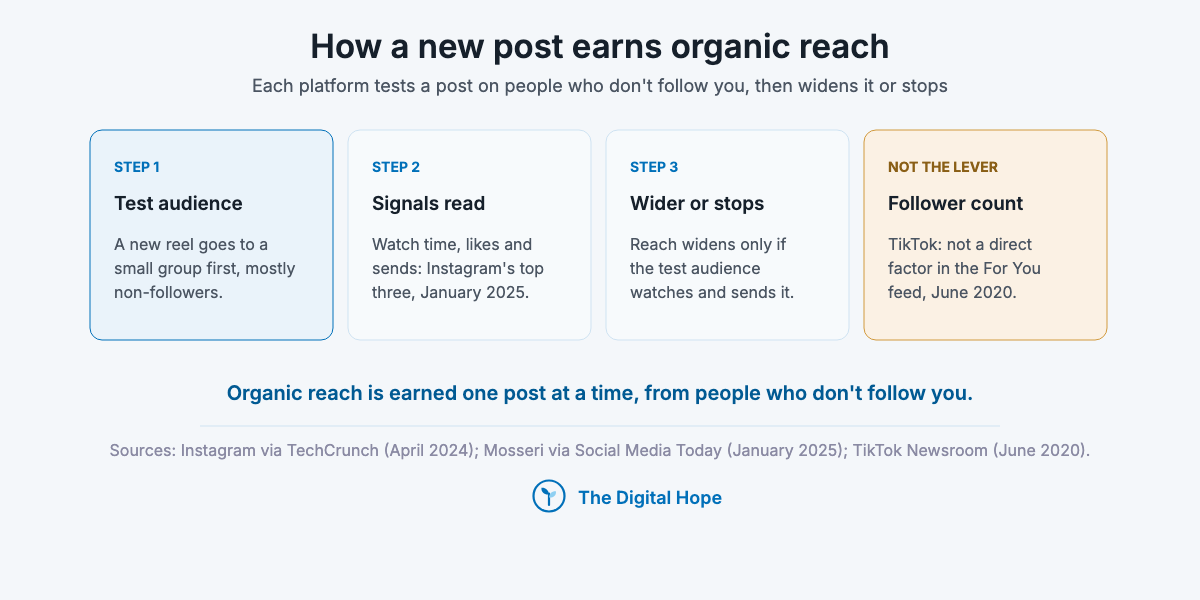
Followers still help, but as a result, not a lever. TikTok’s own explainer says a video from an account with more followers is likely to get more views because of that larger base, and in the same paragraph says follower count is not a direct ranking factor. Growth tactics aimed at the follower number therefore move the wrong dial.
What these explainers can’t tell you is the weighting. They list signals, TikTok’s is six years old, YouTube’s is five, and any platform can change its weights without notice. Design posts for the signals the platforms name, then test in your own account.
Followers are a result, not the lever.
Quick Summary
Q: How does organic reach work on Instagram, TikTok and YouTube?
A: Each platform ranks a post for each viewer on predicted interest: Instagram on watch time, likes and sends, TikTok on interactions and completion, YouTube on clicks, watch time and survey ratings. None names follower count as the lever.
Insight “A strong indicator of interest, such as whether a user finishes watching a longer video from beginning to end, would receive greater weight than a weak indicator, such as whether the video’s viewer and creator are both in the same country.” TikTok Newsroom, “How TikTok recommends videos #ForYou” (18 June 2020).
So the plan has to be built around the single post, and the test it gets.
How to build your social media marketing strategy in five steps
“The top three signals that matter most for ranking are watch time, likes and sends.”
Adam Mosseri, head of Instagram, as reported by Social Media Today (22 January 2025)
Write one goal and its metric, pick two platforms where your audience already is, make original posts built to be watched to the end and sent, test them on non-followers and read the results per reach, then set a cadence you can hold and keep paid for posts that have already proved themselves. Each step below starts with a first action in a named tool.
1. Write one goal and the metric that proves it
First action: open your plan document and write one sentence: “By [date], social will [goal], measured by [metric] in [tool].” The tool is where you will read it: Instagram Insights, TikTok Analytics, YouTube Analytics or GA4. If you sell B2B, the metric is conversations with people at target accounts, which no platform dashboard reports, so log them by hand.
- Which one business result would make this quarter of posting worth the time?
- Which number on the dashboard could rise while that result stays flat?
- Who reads the metric, and on which day of the month?
- What happens to the plan if the metric hasn’t moved by the date?
One goal is enough for the first quarter.
2. Pick two platforms where your audience already spends time
First action: write your buyer’s age band and where they buy, then check it against the Pew 2025 figures above and pick two platforms, not five. Two lets you post well and read results. If your buyer is under 30 and the product shows well on video, start with Instagram Reels and TikTok. If your buyer is older, or the product needs explaining, YouTube carries more of them and ranks on watch time and survey ratings rather than on a quick swipe. Skip short-form entirely only when your buyer is a narrow B2B role, where reach lands on peers rather than buyers.
- Which two platforms do your last ten customers use, if you ask them?
- Which format can your team produce every week without a freelancer?
- Is there a platform you are on only because a competitor is?
You can add a third platform later, only when two are running on schedule.
3. Make original posts built to be finished and sent
First action: before filming, write the one line a viewer would send to a friend, and cut everything before it. Instagram says in its ranking explainer that it predicts whether you will watch a reel all the way through and reshare it (May 2023), and TikTok weights a finished longer video above weak signals (June 2020). Post the original, with no other app’s watermark, because Instagram shows watermarked and already-posted reels less. Use up to five hashtags, Instagram’s limit since December 2025, as labels that say what the post is about. Shorts can run up to three minutes, per YouTube Help, so let the idea set the length. For the editorial system behind a weekly content supply, see the content marketing strategy guide.
- What would make someone send this to one specific person?
- Where in the video would a viewer decide to leave, and can that part go?
- Could a competitor post a near-identical version tomorrow?
- Is anything in it filmed or clipped from someone else’s account?
A rough original beats a polished copy.
4. Test each post on non-followers and read it per reach
First action: on Instagram, where your account has it, switch on the Trial Reels toggle before publishing, which sends the reel to non-followers instead of your followers and shows views, shares, likes and comments after 24 hours, per Engadget’s December 2024 report of the launch. Then read the three ratios Mosseri told creators to watch in January 2025: average watch time, likes per reach and sends per reach. On YouTube, read Shorts on engaged views in YouTube Analytics: since 31 March 2025 a plain view counts any start or replay. On TikTok, read how many viewers finish the video, since completion is the signal TikTok names.
- Which of your last ten posts had the highest sends per reach, and what did it do in the first seconds?
- Did any post reach mostly non-followers, and what was different about it?
- Are your Shorts comparisons on engaged views rather than plain views?
- What will you change in the next post because of this one?
Read ratios, not totals.
5. Set a cadence you can keep, and decide what paid is for
First action: put a weekly posting number in your calendar that you can hold for 12 weeks. In Buffer’s August 2025 analysis of 2.1 million Instagram posts from 102,000 accounts, the same account saw about 12% more reach per post in weeks it posted 3 to 5 times than in weeks it posted 1 or 2 times, and about 24% more at 10 or more, with diminishing returns. That data is observational, Buffer sells scheduling software, and it does not show cause. If your goal is buyer conversations rather than impressions, volume is not a strategy on its own.
Paid comes after the test. Put budget behind a post that already earned distribution, or behind a dated launch, and set it up as a proper campaign in Meta Ads Manager rather than paying to rescue a post that stalled. The Meta setup is in the conversions playbook linked in the planning section above. If you pay or gift creators to post, US rules apply: the FTC says a creator must disclose any material connection, including free products, in the post itself with clear words such as “ad” or “sponsored”, and tags like “#collab” or “#sp” are not enough. If you run a giveaway on Instagram, its promotion guidelines bar encouraging inaccurate tagging, require each entrant to release Instagram, and put legal compliance on the account that runs it.
- How many posts a week can you make at the quality of your best post?
- Which post from the last month earned enough to deserve paid reach?
- Does every creator agreement say where and how the post discloses the deal?
Twelve steady weeks beat four frantic ones.
Quick Summary
Q: How do you build a social media marketing strategy step by step?
A: Write one goal and its metric, pick two platforms by audience, make original posts built for watch-through and sends, test on non-followers and read watch time, likes and sends per reach, then hold a weekly cadence for 12 weeks and use paid only behind posts that passed the test.
Insight “Starting 3/31/2025, we’re updating how Shorts views are counted. Views will count the number of times a Short starts to play or replay, with no minimum watch time requirement.” YouTube Help, “Get started creating YouTube Shorts” (read 29 October 2026). Any Shorts comparison across that date needs engaged views.
Does social media help SEO? What Google says, and where social shows up in search and AI answers
“The answer is no. And for the future is also likely no.”
Gary Illyes, Google, asked whether social shares and views are ranking signals, in an interview with Kenichi Suzuki reported by Search Engine Journal (14 August 2025)
Social activity does not rank your site on Google, but social posts rank on their own, and AI answers cite social platforms heavily. So the useful question is not whether likes move your rankings. It is where your buyers’ questions are answered on social platforms, inside search results and inside AI answers, and whether you are in that answer.
What Google says about social signals. Google’s position has been consistent for over a decade. In a January 2014 video, Matt Cutts, then head of Google’s webspam team, said Facebook and Twitter pages get no special treatment and that, to his knowledge, Google had no ranking signal counting followers or likes, as Search Engine Land and others reported at the time. In August 2025, Gary Illyes gave the reason: “we need to be able to control our own signals”, and a social network’s signals are not in Google’s control. Google’s SEO Starter Guide (last updated 10 December 2025) lists social media promotion as a way for interested people to discover new content, and warns that overdoing promotion can harm a site. Social is a route to discovery, not a ranking input.
Links in social posts are not ranking votes either. Google asks sites to mark links in user-generated content with ugc or nofollow in its guidance on qualifying outbound links, and a post on a platform is that platform’s user content. Treat a link in a post as a path for people, and earn links through the people who see it.
Where social content shows up in Google Search. Google built surfaces for it:
- Forum, video and social results: on 10 May 2023 Google announced a Perspectives filter showing “long- and short-form videos, images and written posts” from “discussion boards, Q&A sites and social media platforms”, and said its helpful content system would surface more “hidden gems” such as forum comments.
- Reddit specifically: on 22 February 2024 Google announced an expanded Reddit partnership, saying “people increasingly use Google to search for helpful content on Reddit”, with access to Reddit’s Data API.
- AI Overviews and AI Mode: Google’s AI features documentation (last updated 10 December 2025) says there are no extra requirements to appear beyond being indexed and eligible for a snippet, so a forum thread or a video page is as eligible as your blog post.
Where social content shows up in AI answers. Two vendor studies, measured differently, agree on the direction:
| Study | What it measured | What it found |
|---|---|---|
| Peec AI, March 2026 | 30 million sources cited in US answers from ChatGPT, Google AI Mode, Gemini, Perplexity and AI Overviews | Most cited domains, in order: Reddit, YouTube, LinkedIn, Wikipedia |
| Ahrefs, September 2026 | ChatGPT citations on a broad sample of US queries, from Ahrefs’ own Brand Radar data | Reddit held 16.8% of citations among the top sources, Wikipedia 7.0%, YouTube 2.5% |
Both are vendors that sell AI visibility tracking, neither shares its full query set, and the rankings shift month to month. What holds across both is the pattern: community and video platforms are among the sources AI answers cite most.
What to do with this, by situation:
- If your category’s searches already show forum or video results, answer those questions where they are asked: a YouTube video that answers the query, a disclosed reply from a real person in the thread. That post can be the result.
- If AI answers in your category cite Reddit, YouTube or LinkedIn, check which threads and videos they cite for your top ten buyer questions, and decide which ones you can credibly add to.
- If your searches show neither, social’s SEO value is indirect: people who discover you on social search for you by name later. Track branded queries in Search Console rather than expecting a ranking lift on your own pages.
Since August 2025, Search Console’s generative AI performance report shows how often your pages appeared in Google’s AI features, as impressions only, so if you want your own site’s share, measure it there and read the cited threads by hand.
Quick Summary
Q: Does social media help SEO?
A: Not as a ranking factor: Google said in August 2025 that social shares and views are not ranking signals, because it cannot control them. Social helps indirectly, through discovery and branded search, and directly in that social posts appear in Google results and are among the sources AI answers cite most (Reddit, YouTube and LinkedIn led Peec AI’s March 2026 study).
Insight Google’s 10 May 2023 announcement said its helpful content ranking system “will soon show more of these ‘hidden gems’ on Search”, naming forum comments among them. Read with the February 2024 Reddit partnership, Google’s own statements point the same way as the AI citation data: a useful answer in a thread can rank where a brand page does not.
What stopped being true
| What | When | Primary source |
|---|---|---|
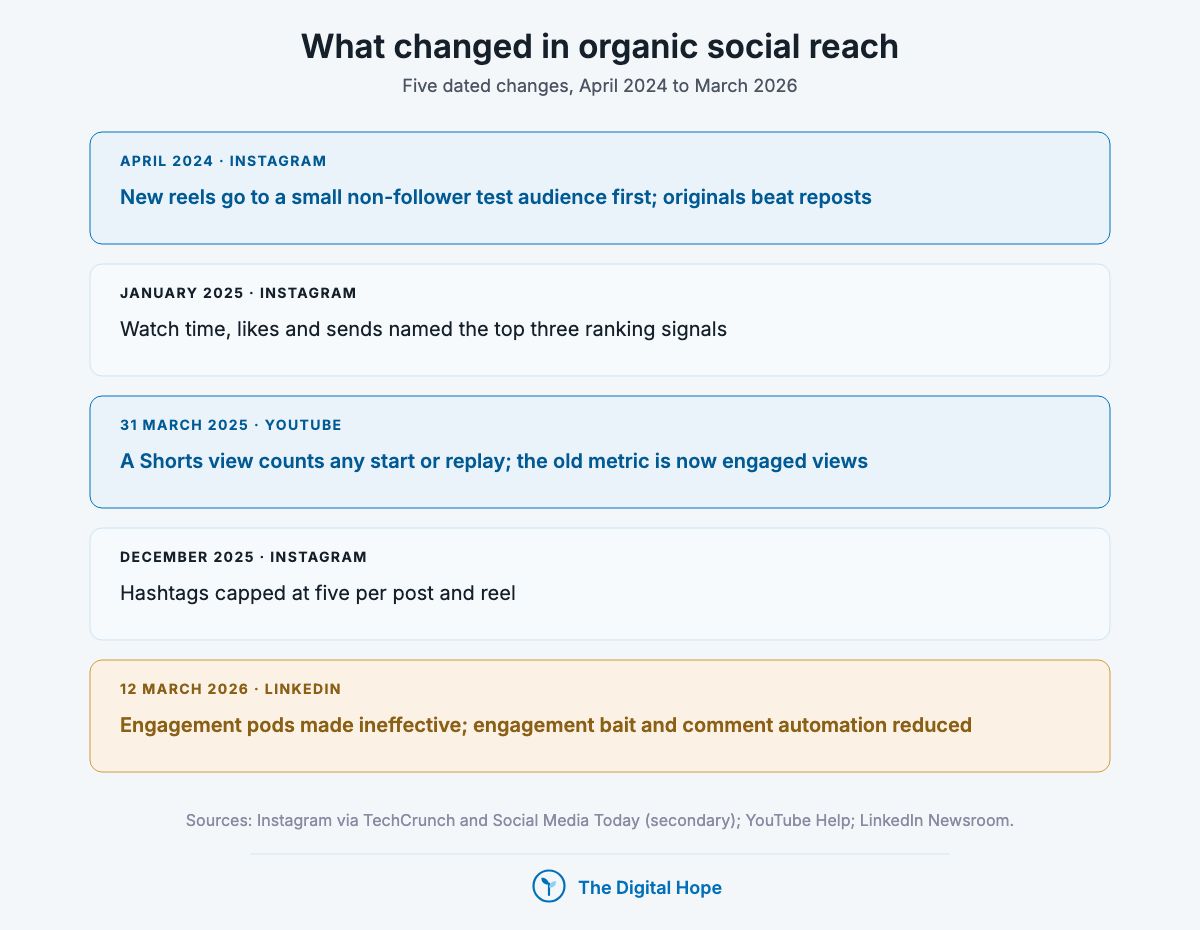
| 20 to 30 hashtags per Instagram post for reach | Capped at five per post and reel, December 2025 (Mosseri said in February 2025 that hashtags “don’t work” for reach) | Instagram @creators on Threads, via Social Media Today, 18 December 2025 (secondary) |
| Reposting popular clips, or running a repost page | Instagram recommends the original, labels reposts and removes aggregator accounts from recommendations, April 2024 | Instagram, via TechCrunch, 30 April 2024 (secondary) |
| Growing followers first so reach follows | New reels go to a small non-follower test audience first, April 2024 | Instagram, via TechCrunch, 30 April 2024 (secondary) |
| Likes and comments as the signals to chase | Watch time, likes and sends are the top three, with sends weighing more for non-follower reach, January 2025 | Adam Mosseri, via Social Media Today, 22 January 2025 (secondary) |
| A Shorts view meaning someone watched | Any start or replay counts from 31 March 2025, and the old metric is now “engaged views” | YouTube Help, read 29 October 2026 |
| Shorts capped at 60 seconds | Up to three minutes | YouTube Help, read 29 October 2026 |
| Bots that follow, like and comment for you | Barred: no automated account creation or automated access without permission | Instagram Terms of Use, read 29 October 2026 |
| “Tag three friends to win” contests | Inaccurate tagging barred, and an entrant release and a non-sponsorship statement required | Instagram Promotion guidelines, read 29 October 2026 |
| Engagement pods and “comment YES” bait on LinkedIn | LinkedIn is making pods ineffective and reducing engagement bait and comment automation, 12 March 2026 | LinkedIn Newsroom, 12 March 2026 |
| LinkedIn Creator Mode as a switch | Toggle removed, its tools opened to all members, 2024 | LinkedIn, via Social Media Today, 5 February 2024 (secondary) |
Pulling it all together
The goal comes first. Write the one sentence with a date, a metric and the tool you will read it in, and send it to whoever signs off on the time.
Two platforms, chosen by audience. Check your buyer’s age band against the Pew figures and commit to two platforms for the quarter.
Original posts, built to be finished and sent. For each post, write the line a viewer would forward before you film it.
A test on non-followers, read per reach. After each post, record watch time, likes per reach and sends per reach in one sheet, and when you compare Shorts, use engaged views.
A cadence you can hold, and paid with a rule. Fix the weekly number for 12 weeks, and name the condition under which a post gets budget.
Search as a second payoff. Search your top ten buyer questions in Google and in one AI assistant, note which forum threads and videos come up, and answer where you credibly can.
Frequently asked questions
What is a social media marketing strategy? It is a written plan that ties social posting to one business goal, names the audience, picks the platforms where that audience is, and sets what organic and paid are each for. In 2026 it also has to account for recommendation-first distribution, where each post is tested on people who don’t follow you.
Is organic social media marketing still worth it? It is worth it if your audience uses the platform and you can produce original posts at a steady cadence, because Instagram, TikTok and YouTube all say they recommend posts to non-followers on their merits. It is a poor bet if you need guaranteed reach on a date, which is what paid is for.
Am I shadowbanned? Probably not in the way the word suggests. None of the platform explainers cited on this page describes a “shadowban”, and a stalled account usually means posts that did not earn distribution beyond their first test audience. Platforms do make some content ineligible for recommendation: TikTok listed spam and videos seeking to artificially increase traffic in June 2020, so check your posts against the platform’s rules before assuming a penalty.
How many hashtags should I use on Instagram? Up to five, the maximum since December 2025, chosen to describe what the post is about. Instagram’s head has said hashtags don’t increase reach, so treat them as labels.
Are social signals a Google ranking factor? No, on Google’s own statements: Gary Illyes said in August 2025 that social shares and views are not ranking signals because Google cannot control them. Social posts can still rank in Google themselves, and they are cited in AI answers, which is where social pays off in search.
How often should I post? As often as you can keep the quality of your best post, which depends on your team’s capacity more than on any benchmark. Buffer’s 2025 data shows modestly higher reach per post at 3 to 5 posts a week than at 1 to 2 on Instagram, with diminishing returns above that, and the data does not show cause. For YouTube depth, including long-form, see the YouTube marketing strategy guide.
In a nutshell
The unit of a social media marketing strategy is the post and its test, not the follower. Each platform says it shows a new post to people who don’t follow you and widens it on watch-through, sends and likes, so the plan is a goal, two platforms, original posts and a test you read per reach. In search, the same posts can be the answer, even though they never move your own site’s rankings directly.
Give it a quarter before you judge a platform. Frequency gains in the best published data are around 12% per post, not multiples, so a fair test is about 12 weeks of steady posting: at 3 posts a week that is 36 posts, enough to see a pattern in your own ratios. If two platforms show nothing after that, change the format or the platform, not the hashtags. What would change this call is a platform returning to follower-first distribution, which none has announced as of October 2026.
About this article

Written by
Sai Subramaniam
SEO, GEO and Paid Ads Manager · 8+ years in growth marketing
I have run SEO, paid media and ABM for B2B AI companies, consumer apps and live-entertainment brands, from a solo operator at an AI infrastructure company to a team of 20 recovering a million-visitor site after a Google update. I write these guides from that work, and every number in them carries its source.
See my portfolioConnect on LinkedInHow this one was checked. Every number traces to a named source with its dataset and period, and every platform feature, policy or limit cites the platform’s own documentation with the date it was verified. Where the author’s own results appear, they are labelled as one account’s results, with the budget and context, not as a rule.
No affiliate links and no paid placements. Tools are named because they are what practitioners use, not because anyone paid to appear here.
Reviewed: October 2026. Ad platforms and search features change every few months; anything we could not verify at the time of writing is marked as unverified rather than turned into a number.
Corrections. If something here is wrong or has changed since, we would rather know. Corrections are made in place, with a note saying what changed.