
A worry is already made of sentences.
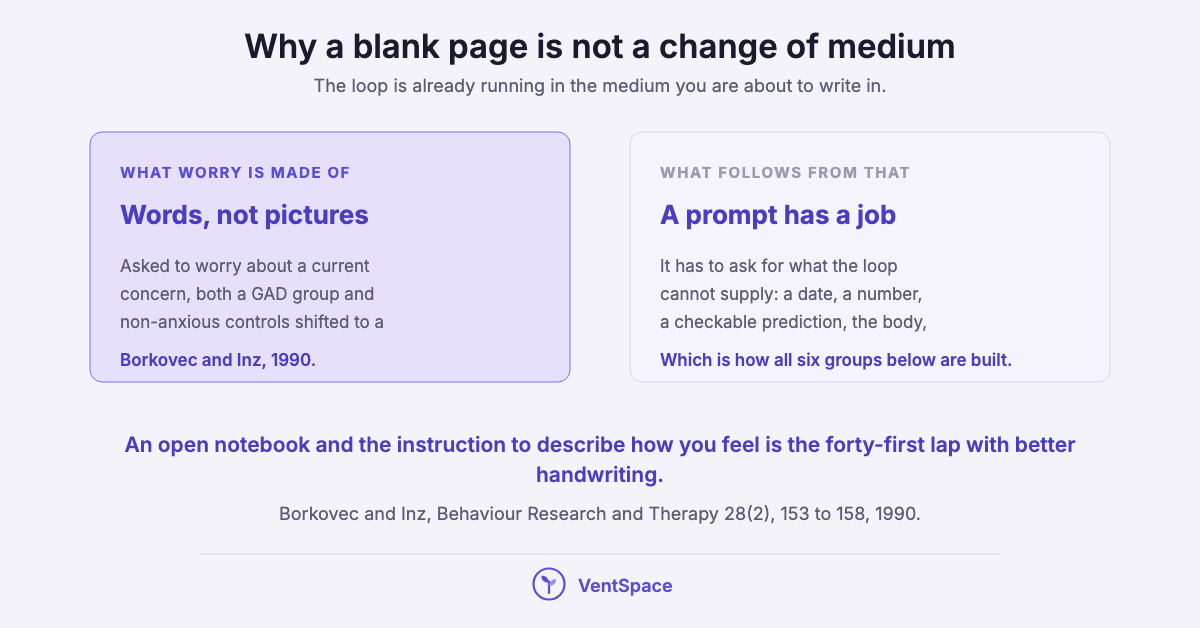
That is the part this genre tends to skip, and it changes what a blank page can be expected to do for us. When researchers sampled what was going through people’s minds during worry, what they found was not pictures. It was talk. The loop we are trying to get out of is running in the same medium we are about to write in.
Which means an open notebook and the instruction to describe how you feel is not a change of anything. It is the forty-first lap with better handwriting. A prompt earns its place only if it asks for something the loop cannot supply: a date, a number, a prediction somebody could check, the body instead of the commentary, or the other person’s actual words instead of the ones we have written for them.
These forty-eight are built that way. They are sorted by what the worry is doing, because that is the one thing you can usually tell from inside it, and none of the six groups is named after a condition. Nothing here decides anything about you.
If you are in crisis or thinking about harming yourself, please contact a crisis line now. In the US you can call or text 988 for the Suicide and Crisis Lifeline. Outside the US, findahelpline.com will find the equivalent where you are. This page is not a substitute for that, and on the worst nights writing is not the thing to reach for first.
The short version
Forty-eight prompts in six groups, sorted by what the worry is doing rather than by what it is about.
Worry runs on words already. A prompt has to supply what the loop cannot: a date, a number, a prediction, the body.
Each one carries why it helps and how to answer it. One or two a sitting, fifteen to twenty minutes.
One group asks for a prediction you can check later. It is the only prompt shape on this page with a published procedure behind it.
There is a section on when writing is the wrong tool, and it is the most important part of the page.
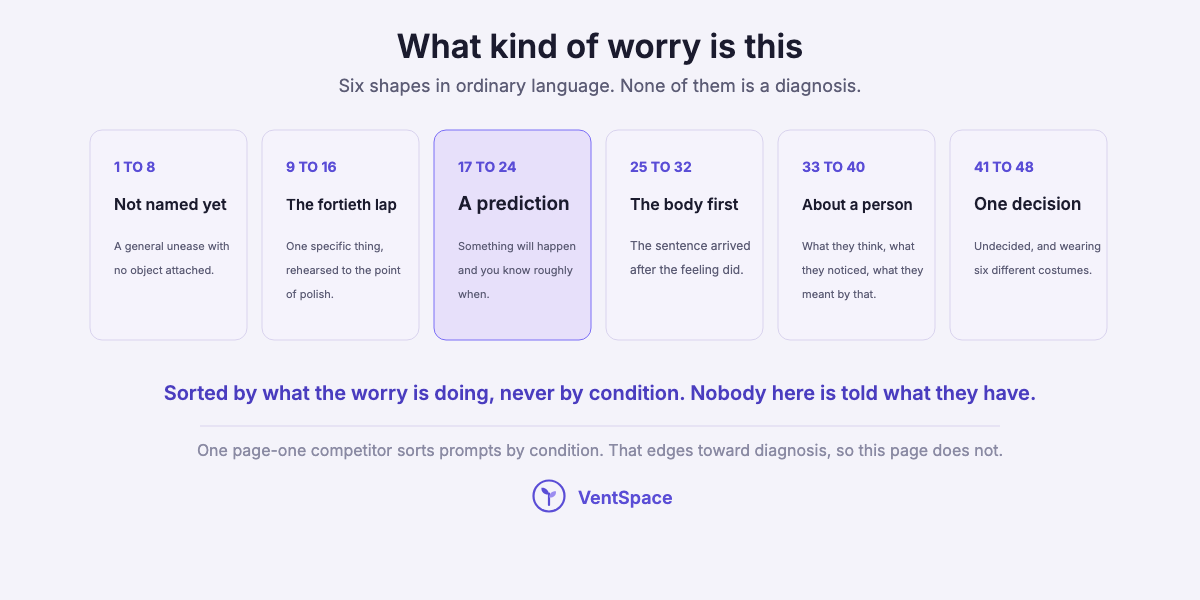
What kind of worry is this
- It has not named itself yet. A general unease with no object. → prompts 1 to 8
- You have been over it forty times. One specific thing, rehearsed. → prompts 9 to 16
- It is a prediction. Something is going to happen and you know when. → prompts 17 to 24
- It is in the body first. The sentence arrived after the feeling did. → prompts 25 to 32
- It is about a person. What they think, what they noticed, what they meant. → prompts 33 to 40
- It is one undecided thing wearing six costumes. → prompts 41 to 48
How to actually use these
One or two a sitting, fifteen to twenty minutes. That length is borrowed from the expressive-writing research, which ran sessions of fifteen to twenty minutes across three to five occasions. Two researchers who went looking for its basis found it was “driven primarily by convention rather than empirical evidence”, so treat it as a sensible shape, not a tested dose.
The failure mode on this page is volume. Answering twelve prompts in one evening produces twelve paragraphs with the same sentence inside all of them, because the loop is happy to supply the material for as long as you will keep writing it down. Two prompts and a closed notebook is the harder and more useful version.
Write the date and the time. On this topic the time of night is half the information, and the prediction group in the middle of this page does not work at all without a date on it.
Three to five times a week, not daily. Daily turns a record into a ritual, and a ritual is something we stop reading.
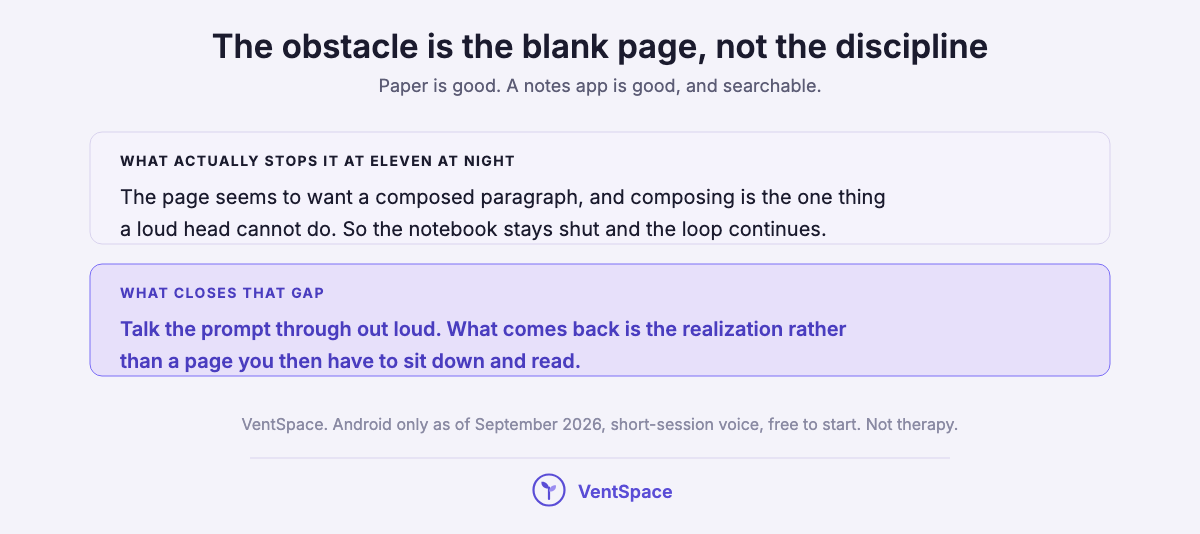
Where you write matters less than whether the page will accept a half-finished thought. Paper is good. A notes app is good, and searchable, which is the thing that pays off in the review section below. The obstacle many of us run into at eleven at night is that a blank page seems to want a composed paragraph, and composing is the one thing a loud head cannot do, so the notebook stays shut and the loop continues uninterrupted.
Quick Summary
Q: How often should you journal for anxious thinking?
A: One or two prompts a sitting, fifteen to twenty minutes, three to five times a week. That is the shape used in the expressive-writing research, which its own researchers describe as a convention rather than a tested dose. Working through many prompts in one evening tends to produce the same sentence repeatedly, which is the loop rather than a record of it.
Why a blank page is not a change of medium
Worry is predominantly verbal. That description goes back to Thomas Borkovec’s work around 1990 and has held up across several independent groups since. In a 2012 study that sampled thoughts every ten seconds, the 20 people with a generalized anxiety diagnosis, all in treatment, reported far fewer images while worrying than 20 matched controls did, which leaves the worry mostly as verbal thought. Worry, in other words, talks.
What the writing research shows is real and modest. Karen Baikie and Kay Wilhelm’s 2005 review gathers it. In healthy participants, one meta-analysis of thirteen studies found a benefit of d = 0.47. In clinical populations, a review of nine studies found d = 0.19 overall, d = 0.21 for physical health, and d = 0.07 for psychiatric outcomes, which was not statistically significant. Later and larger poolings widen that range rather than settle it. One of 30 randomised trials found no significant effect at all, and another of 44 trials found a moderate effect against a waiting list at long-term follow-up, with neutral writing doing almost as well. The honest range runs from about zero to moderate.
Put the two findings beside each other and you get something more useful than an instruction to write it all out. If the loop is already sentences, then the prompt has to ask for what the loop does not have. Every group below is built on that single constraint.
Insight “It should not replace appropriate medical or psychological treatment in clinical populations.” The review positions expressive writing as an adjunct to standard treatment rather than an alternative to it.
Karen A. Baikie and Kay Wilhelm, Advances in Psychiatric Treatment 11(5), 338 to 346, 2005
Quick Summary
Q: Does journaling help with anxious thinking?
A: Modestly and inconsistently. Pooled estimates across the expressive-writing research run from about zero to moderate. An older review put it at 0.19 in clinical populations and 0.47 in healthy ones, the effect on psychiatric outcomes was not statistically significant, and a later pooling of 30 trials found no significant effect overall. It works better as something done alongside care than instead of it.
How these forty-eight are grouped
Not by theme, because a theme is a conclusion and nobody arrives with one. By what the worry is doing, which is the thing available to us from the inside at two in the morning.
Six groups, eight prompts each. Read the finder above, pick the group that sounds like tonight, answer one.
When the worry has not named itself yet
A general unease with no object attached. These eight try to give it one, on the grounds that a named fear is smaller than an unnamed one even when the news is bad.
1.What are you afraid is about to happen, in one sentence, with a time attached?
Why this helps: Unattached dread can lose some of its grip the moment it has to name a date, and many of ours cannot.
How to sit with it: Two minutes, standing up, before you sit down to write anything else.
2.If the feeling had an object, what would it be? Write three candidates.
Why this helps: The first candidate is usually the socially acceptable one. The third is more often the live one.
How to sit with it: Number them one to three and do not rank them afterwards. Leave all three on the page.
3.What were you doing in the ten minutes before this started?
Why this helps: Dread rarely arrives from nowhere, and the ordinary thing that preceded it is often unremarkable enough to have gone unrecorded.
How to sit with it: Work backwards out loud rather than on paper, then write only the one line you land on.
4.What is the earliest moment today you can remember feeling fine?
Why this helps: It establishes that there was one, which is a claim the feeling itself is currently denying.
How to sit with it: Name the hour. If nothing comes, go back to yesterday and say so on the page.
5.Which of your ordinary days does this belong to?
Why this helps: Patterns hide in the week rather than in the feeling. Sundays and Thursday evenings carry different freight for many of us.
How to sit with it: Write the weekday first, then the entry. Over a month the weekday column becomes the interesting one.
6.What would have to be true for this to be about something that has already happened?
Why this helps: A good deal of what presents itself as fear of the future is unfinished business with last week, and it will keep arriving dressed as forecast.
How to sit with it: Answer it as a hypothesis, not a confession. “It would have to be true that” is a useful way to start the sentence.
7.Is there a piece of news you are waiting for?
Why this helps: Waiting produces a specific and deeply unpleasant flavour of unease that is frequently mistaken for something more general.
How to sit with it: One line. If the answer is yes, write the date you expect to hear and stop there.
8.What would you say to a friend who described this exact feeling at this exact hour?
Why this helps: Many of us are clearer, and kinder, about somebody else’s two in the morning than about our own.
How to sit with it: Use their name and write it as an addressed note. Read it back tomorrow rather than tonight.
Quick Summary
Q: What do you write when you feel anxious but cannot say why?
A: Give the feeling an object and a time before you write anything else, then check what happened in the ten minutes before it started and which weekday it belongs to. An unattached unease tends to shrink once it has to commit to a specific claim about the future.
When you have been over it forty times already
One particular thing, rehearsed to the point of polish. These eight do not ask for another lap. They ask what the last forty produced.
9.Write the sentence you have been repeating, word for word.
Why this helps: Written down once exactly, a rehearsed line tends to look thinner than it sounds, and we can stop reconstructing it from memory.
How to sit with it: Exact wording, in quotation marks, then nothing else for a full minute.
10.What is in the hundredth version that was not in the first?
Why this helps: Usually nothing, and discovering that on paper is more persuasive than being told to stop thinking about it.
How to sit with it: Two columns headed first and latest. Fill both before comparing them.
11.What question are you hoping the next round will answer?
Why this helps: Naming the question shows whether an answer is even available, and an unanswerable question is not a reason to keep going.
How to sit with it: Write it as a question with a question mark. If you cannot, that is the finding.
12.Which part of this is information and which part is rehearsal?
Why this helps: Information adds something new. Rehearsal repeats the old sentence in fresh clothing, and the difference is visible on paper.
How to sit with it: Split the page vertically. Anything that appears twice goes in the rehearsal column.
13.What would change if you learned nothing more about this for a week?
Why this helps: It separates the worry that is waiting on facts from the worry that is waiting on nothing at all.
How to sit with it: Answer in the future tense, then note the actual date one week out beside it.
14.What are you protecting by continuing to think about this?
Why this helps: Rehearsal often feels like responsibility, and naming what it is guarding is the only thing that loosens it.
How to sit with it: Write the first answer, cross it out, write the second. The second is generally the honest one.
15.If you had to stop at the bottom of this page, what would you want written down?
Why this helps: It forces a summary, and a summary is the first thing the loop has refused to produce all evening.
How to sit with it: Set a three-minute timer and stop when it goes, mid-sentence if necessary.
16.What would you have to accept for this to be finished?
Why this helps: Loops are frequently held open by one thing we are unwilling to concede, and seeing it named is not the same as conceding it.
How to sit with it: Write it, then close the notebook without answering whether you are willing. That is a separate evening.
Quick Summary
Q: How do you stop writing in circles about the same worry?
A: Write the repeated sentence once, exactly, then ask what the hundredth version contains that the first did not. Splitting the page into information and rehearsal makes the distinction visible, and a worry that is not waiting on any new fact is not waiting on your attention either.
The prediction you can check later
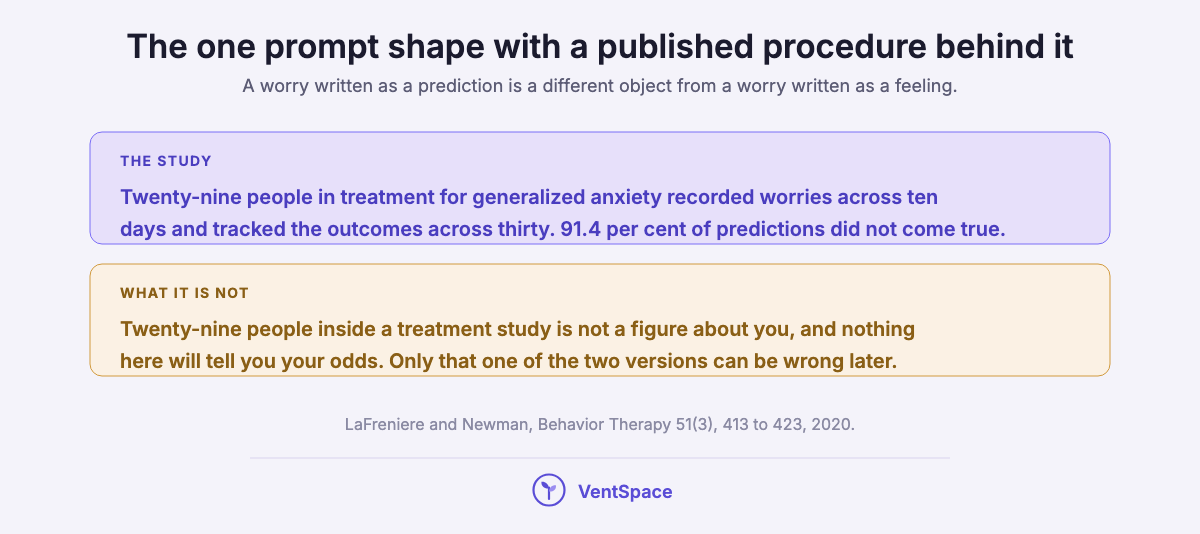
This is the group with a procedure behind it. In 2020, Lucas LaFreniere and Michelle Newman ran what they called a worry outcome journal with twenty-nine people in treatment for generalized anxiety: worries recorded when prompted across ten days, reviewed each night, and outcomes tracked across thirty. In that sample, 91.4% of worry predictions did not come true, and most participants had none come true at all. More evidence of inaccuracy predicted a better treatment outcome.
Twenty-nine people inside a treatment study is not a promise to you, and nothing here will tell you your odds. What it does suggest is that a worry written as a checkable prediction is a different object from a worry written as a feeling, because only one of the two can be wrong later.
17.What exactly do you think will happen, and when will you know?
Why this helps: A prediction with a date can be graded. A dread cannot, which is partly why it never closes.
How to sit with it: Leave four blank lines underneath for the outcome. Write the check-back date in the margin.
18.How likely is it, out of ten?
Why this helps: Numbers are harder to revise quietly than adjectives are, and we revise adjectives constantly.
How to sit with it: Write the number before you write any reasoning. Reasoning first moves the number.
19.What would count as this having gone badly? Be specific enough to check.
Why this helps: Vague criteria can be met by almost any outcome, which is how a day that went fine gets filed as evidence.
How to sit with it: If the answer would be obvious to somebody reading over your shoulder, it is specific enough.
20.What has this particular worry predicted before, and what happened?
Why this helps: Recurring worries have a track record, and few of us have ever looked at it.
How to sit with it: Two or three past instances with rough dates. Do not soften the ones it got right.
21.Who else would be affected, and how would you find out?
Why this helps: It tests whether the feared event is even detectable, and a fair number are not.
How to sit with it: Name real people. If you would never learn of it, write that and underline it.
22.What is the version you would be embarrassed to have predicted?
Why this helps: The most catastrophic version usually stays unwritten, and unwritten is exactly the state in which it keeps its authority.
How to sit with it: Write it fully, once, then fold the page over and leave it until the check-back date.
23.If it did happen, what is the first thing you would do?
Why this helps: Forecasting is frightening in a way that planning is not, and this prompt moves one sentence into the other.
How to sit with it: Three steps, each a physical action. No feelings in this answer.
24.What would you need to see to mark this one closed?
Why this helps: Without a closing condition a worry has no way of ending other than exhaustion.
How to sit with it: Write the condition, then put a tick box beside it. The box does the work.
Quick Summary
Q: What is a worry journal and does it work?
A: A worry outcome journal records a worry as a dated prediction and then records what actually happened. In a 2020 study of twenty-nine people in treatment for generalized anxiety, 91.4% of predictions did not come true, and greater evidence of inaccuracy predicted a better treatment outcome. That is a finding in a small clinical sample rather than a figure that applies to any individual.
When it arrives in the body before the sentence
Sometimes the thought is the second event, not the first. These eight ask for description rather than interpretation, because interpretation is the part the loop is already good at.
25.Where is it, and what shape is it?
Why this helps: Description is one of the few demands a loud head can meet, and it occupies the part of us that would otherwise be narrating.
How to sit with it: Lie down for this one. Four lines, present tense, no causes.
26.What did your body do first, before you had a sentence for it?
Why this helps: The order matters. A feeling that preceded the thought is not evidence that the thought is correct.
How to sit with it: Answer for this morning specifically, not in general terms.
27.What time did it start, and what is different about that hour?
Why this helps: Certain hours carry a load that has nothing to do with the content of our thinking, and the hour is checkable where the content is not.
How to sit with it: Write the clock time at the top of the page, then one line about what that hour usually holds.
28.Describe it for somebody who has never felt it.
Why this helps: Writing for an imagined stranger strips out the shorthand we use on ourselves, and the shorthand is where the exaggeration lives.
How to sit with it: Ten minutes, plain words, no metaphors allowed. This restriction is the active part.
29.What made it louder and what made it quieter this week?
Why this helps: Week-level evidence beats any theory about ourselves, and we almost never gather it.
How to sit with it: Two short lists from the past seven days only. Anything older is memory, not evidence.
30.What has your body been doing for three days that you had stopped noticing?
Why this helps: Jaw, shoulders, sleep and appetite keep a record whether or not we consult it.
How to sit with it: Walk through the body from the top down and write only what you find, not what it means.
31.If the feeling stayed and the thoughts went, what would be left?
Why this helps: It tests which of the two we are actually frightened of, and the answer is not always the one we assume.
How to sit with it: A single paragraph. Do not resolve it. Stop when the paragraph stops.
32.What do you need in the next hour, in physical terms only?
Why this helps: A physical answer is one we can act on tonight, which almost nothing else on this page is.
How to sit with it: Water, food, a window, a phone call, sleep. Pick one, then get up and do it.
Quick Summary
Q: What should you write when anxious feelings show up in your body first?
A: Describe rather than interpret. Where it is, what shape it is, what time it started, and what made it louder or quieter in the past week. Description is a demand a loud head can meet, and it produces checkable week-level evidence that no theory about yourself can match.
The worries that are about other people
What they think, what they noticed, what they meant by that message. These eight keep trying to return to the actual record.
33.What do you think they think, and what did they actually say?
Why this helps: Laid out side by side, the gap between the two is often wide and largely of our own construction.
How to sit with it: Two columns. The right-hand one may only contain words they used out loud.
34.What is the worst interpretation you are carrying, written in their voice?
Why this helps: Attributed out loud to a real person, the harshest reading often becomes implausible, because we know them.
How to sit with it: Write it as dialogue with their name in front of it. Read it aloud once.
35.What would it take to find out, and what stops you asking?
Why this helps: Many of these worries are sustained by a question we have decided not to ask, and the reason is worth seeing written down.
How to sit with it: One sentence for the method, three for the obstacle. The obstacle is the real subject.
36.Whose opinion is this, originally?
Why this helps: A good many of the standards we fear falling short of were installed long before the person currently holding them arrived.
How to sit with it: Go back as far as you can. A name and an approximate year is enough.
37.What are you afraid they have noticed?
Why this helps: Naming the specific observed thing converts a general social dread into one manageable fact.
How to sit with it: One line, no qualifying clauses. Resist explaining why it would matter.
38.If they were worried about you in this same way, what would you want them to do?
Why this helps: The reciprocal question reliably produces more generous advice than we would ever issue to ourselves.
How to sit with it: Answer in the second person, as though writing to them, then change the pronouns back.
39.What have you decided about yourself on their behalf?
Why this helps: We regularly convict ourselves using a verdict the other person has not delivered and may not hold.
How to sit with it: Write the verdict as a sentence beginning “I have decided that I am”. Then leave it.
40.Write the message you would send if there were no consequence.
Why this helps: The unsendable version contains the actual request, which the sendable version usually buries.
How to sit with it: Write it in the notebook, not in the messaging app. That distinction matters more than it sounds.
Quick Summary
Q: How do you journal about worrying what other people think?
A: Put what you believe they think beside what they actually said, using only their real words in the second column. Then name the question you have decided not to ask and what stops you asking it. The gap between the two columns is usually the whole worry.
The worries that are one undecided thing in six costumes
One unmade decision radiates outward and attaches itself to whatever else is available. These eight drag it into the open, where it is less comfortable and considerably smaller.
41.What decision have you been carrying unmade?
Why this helps: An undecided thing radiates. It will attach itself to whatever else is available until it is named.
How to sit with it: One sentence, written first thing in the morning rather than at night. Morning is more honest about this one.
42.What are the two options, as two sentences?
Why this helps: Much of what feels like a fog of possibilities turns out to be a binary that we have been avoiding stating.
How to sit with it: Exactly two. If a third appears, it is a version of one of the first two and should be folded in.
43.What are you waiting for permission to do?
Why this helps: The answer names both the wanted thing and the person whose approval we have quietly appointed ourselves to need.
How to sit with it: Answer on a walk and dictate it. This one goes better when nobody is watching the page.
44.What is the smaller version of this decision?
Why this helps: Large decisions are often avoidable only because a reversible version of them exists and has not been noticed.
How to sit with it: Write three smaller versions, then mark the one you could begin this week.
45.What is the delay costing, stated in weeks?
Why this helps: Indecision reads as free because its cost is paid in small instalments that never appear on a single line.
How to sit with it: Count back to when this started and write that number of weeks at the top of the page.
46.Which option are you already living as though you had chosen?
Why this helps: Behaviour has usually decided well before we have, and reading that off the past month is faster than deliberating.
How to sit with it: Use the last month’s calendar as your evidence rather than your intentions.
47.What would you have to stop believing to decide this today?
Why this helps: A decision held open for months is generally held open by a belief, not by missing information.
How to sit with it: Name the belief in one line, then write where you picked it up.
48.What is the date by which you will have decided?
Why this helps: A date converts an open loop into a scheduled event, which is a different thing to carry around.
How to sit with it: Write a real date, put it in the calendar, and close the notebook. Nothing else tonight.
Quick Summary
Q: Can journaling help with a decision you keep avoiding?
A: It helps when it forces the decision out of the fog and into two written sentences, a date, and a named belief. Much of what feels like generalised worry is one unmade decision attaching itself to whatever else is available, and writing the deadline down changes what you are carrying.
What to do with what you wrote
On this particular topic, this is where the practice is most likely to go wrong.
Do not reread a worry entry the same night. A same-evening reread is not review, it is the loop with a written script. Leave at least a day, and preferably leave it until the morning.
Read three entries together, never one. One entry invites another round about that evening. Three side by side show what recurs, and what recurs is the finding, not whatever felt most urgent at the time.
Know which reread you are doing. Researchers split rumination into brooding and reflective pondering, and the split is not simply bad and good. In the paper that named it, reflection went with more low mood at the time and less a year later, and the finding is correlational. The test for a reread is narrower: if the reread generates a sentence you had not written before, keep going. If it generates the same sentence, the useful part is over. Our piece on why journaling does not always stop overthinking goes further into that distinction.
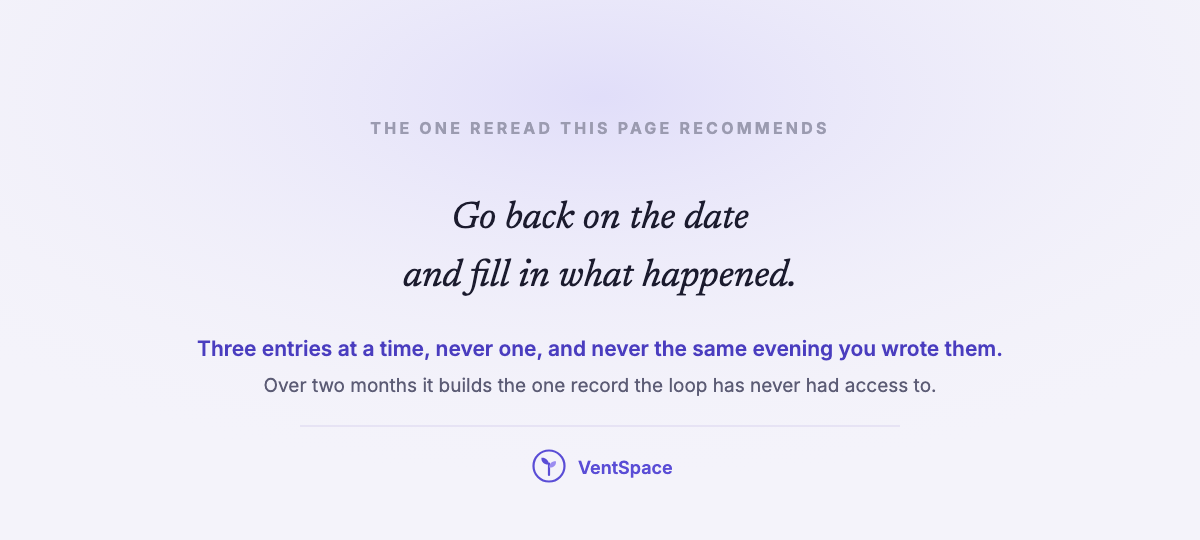
The prediction pages are the exception, and they get reread on purpose. Go back on the date you wrote in the margin and fill in what happened. That is the only reread on this page that is meant to be deliberate, and over a couple of months it builds the one record the loop has never had access to.
Keep descriptions apart from verdicts. “I checked my phone eleven times” is a description. “I am a mess” is a verdict, and a verdict closes the inquiry before it has started.
When writing is the wrong tool
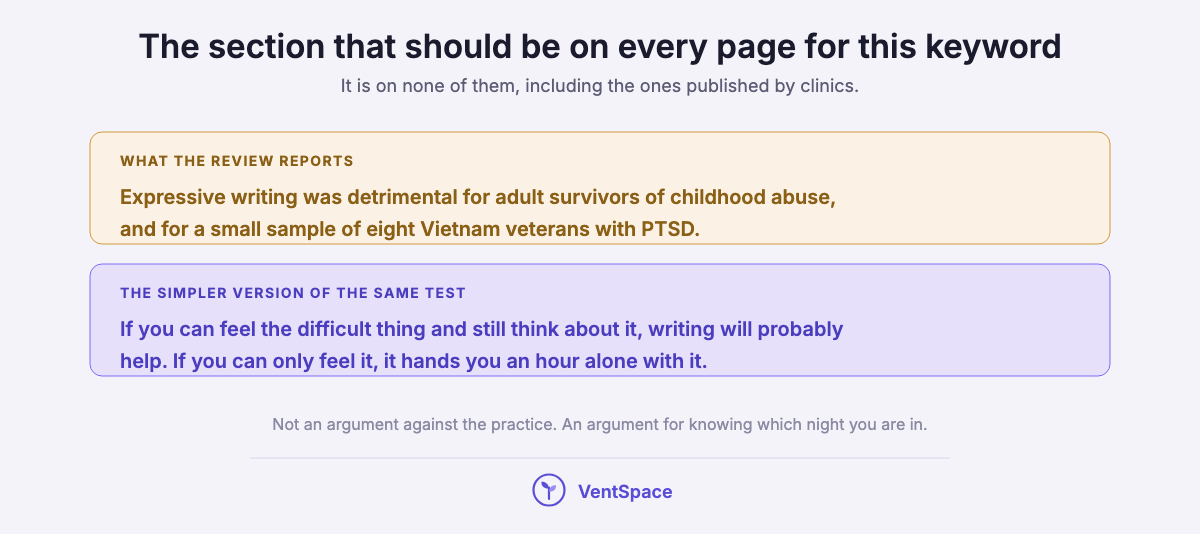
The same review that supplies the effect sizes above also reports that results are inconsistent, and that expressive writing was detrimental for adult survivors of childhood abuse, and for a small sample of eight Vietnam veterans with post-traumatic stress disorder. Those are the findings, stated as the review states them.
What that means in practice. If the material you would be writing about is trauma of that kind, this is not the low-risk activity the rest of the internet describes. It is something with a mixed record in precisely that situation, and the better setting for it is with somebody trained, who can see what is happening while it is happening.
There is a simpler version of the same test. If you can feel the difficult thing and still think about it, writing will probably help. If you can only feel it, writing will mostly hand you an hour alone with it. That is not an argument against the practice. It is an argument for knowing which night you are in.
Therapy is one option here and for many people it is the right one. So is a doctor, particularly where sleep or appetite has changed. Neither is a consolation prize for having failed at journaling.
Quick Summary
Q: Can journaling make anxious thinking worse?
A: For some people and some material, the research says yes. Baikie and Wilhelm report inconsistent results and specific detrimental effects for adult survivors of childhood abuse and for a small veteran sample. Writing the same worry repeatedly in one sitting can also extend a loop rather than interrupt it.
A five-week run
| Week | Where to work | Sittings | Note |
|---|---|---|---|
| 1 | Prediction group, 17 to 24 | 3 | Start here even if tonight is not a prediction. It is the group that builds a record |
| 2 | Whichever group matches the week | 3 | Use the finder near the top |
| 3 | The body group, 25 to 32 | 3 | Morning sittings this week, not evening |
| 4 | Reread weeks 1 to 3, and grade the predictions | 2 | Three entries at a time. This is the week the other three were for |
| 5 | The undecided group, 41 to 48 | 2 | Finish on prompt 48 and put the date in a calendar |
If you only answer five
Prompt 1, because an unattached dread that has to name a date usually cannot. Prompt 10, because discovering that the hundredth version contains nothing new is more convincing than being told to stop. Prompt 17, because a dated prediction is the only worry on this page that can be graded later. Prompt 33, because the two-column version of what somebody said is the fastest correction available. Prompt 48, because a good deal of what arrives as worry is one decision with no date on it.
Questions people ask
Does journaling help with anxious thinking, or is that just something people say?
Modestly, and the figures are above. Across the expressive-writing research the pooled effects run from about zero to moderate, with 0.19 in clinical populations and 0.47 in healthy ones in an older review, and the effect on psychiatric outcomes specifically was not statistically significant. That is a real finding and a small one.
What do I write when I am too wound up to think straight?
Prompt 25 or prompt 32. Description and physical need are the two demands a loud head can meet. Both produce something on the page within two minutes, and neither requires you to have a view about yourself.
Should I write at night or in the morning?
Night is when the search happens and morning is when the rereading should. The prediction prompts and prompt 41 go better in the morning. The body prompts and prompt 8 are fine at midnight.
Should I reread what I wrote?
Yes, but not the same evening, and in threes rather than singly. The exception is the prediction pages, which are written specifically to be reread on a date you set at the time.
Can writing about it make it worse?
Sometimes, briefly, and that is different from sustained deterioration. The section above covers the material where the evidence is genuinely mixed, and writing the same sentence twelve times in one sitting is its own way of making an evening longer. If it is consistently worse afterwards across weeks, stop and take it to somebody.
Is this a substitute for therapy?
No, and the review these figures come from says so directly: it should not replace medical or psychological treatment and works as an adjunct to it. Therapy is one option and for many people it is the right one.
Related. Journaling vs Venting.
Related. Therapy vs Journaling.
The part that does not resolve
Running under this whole genre is a suggestion that somebody who wrote their worries down often enough would eventually get ahead of them.
Nothing above supports that. What forty-eight prompts can do is narrower: they interrupt a loop that is made of sentences by asking for something a sentence cannot supply, and they leave behind a record with dates in it, which is the one thing the loop has never had. Some weeks that will be the difference between an evening spent circling and an evening that ends. Some weeks it will not help at all.
Those weeks are not evidence about the practice, and they are not evidence about us either.
If you would rather keep these entries somewhere that holds onto the dates for you, VentSpace is ours: a journaling app that turns what you write into a clear read on your life balance, plus small, doable next steps. It is Android only and free to start. Not on Android, or at a desk? VentSpace Live runs in your browser, free, with nothing to install. It is not therapy, and on the nights described in the section on when writing is the wrong tool, it is not the right tool either.
About this article

Written by
Sai Subramaniam
Founder, VentSpace
I write these guides because I have been where you are. I am working through my own hard seasons, and I share the things that actually helped me, so that anyone going through it has a steady companion close by instead of facing it alone. VentSpace is the app I built for exactly that: a journaling app that turns what you write into a clear read on your life balance, plus small, doable next steps toward feeling more like yourself.
This writing is honest and every claim is sourced, and it is not a substitute for professional care. If you are struggling, reaching out to a professional is a strong move, not a failure.
Explore VentSpaceTry VentSpace LiveHow this one was checked. Every factual claim traces to a named source, and the source is printed next to the claim rather than kept in a footnote. Quotes are pinned to the work they come from, with the year, the letter or the chapter where one exists. Where a widely repeated claim could not be traced, it was left out and the omission recorded. Where a figure is contested, both sides are printed.
No affiliate links, no paid placements, and nobody paid to appear here. Where we mention our own app, we say that it is ours, we state its limits, and we never position it as a substitute for care.
Reviewed: October 2026. Prices, platforms and product availability move quickly, and anything we could not verify at the time of writing is marked as unverified rather than turned into a number.
Corrections. If something here is wrong, we would rather know. Corrections are made in place, with a note saying what changed. Updated 15 October 2026: the expressive-writing figures now give the full range from later reviews, the worry-is-verbal finding is credited to a study we could read in full, the reflective-pondering line no longer calls reflection the healthy half, the fifteen-to-twenty-minute length is described as a convention, unverifiable claims about other pages were removed, an off-topic link was removed, and the app mention was moved to the end and corrected to describe a journaling app.