

Grief is not a problem with a solution inside it.
That ought to be obvious, and a surprising amount of what we are handed after a death quietly assumes otherwise. There are stages to pass through, work to be done, a thing to be reached. None of that describes what is happening, and a page of prompts that implies it would be one more thing asking us to make progress.
So this page promises nothing. The honest position, which is further down in full, is that the research specific to bereavement has not found writing to help. What a prompt can still do is narrower and real: it gives the thing somewhere to go for twenty minutes on an afternoon when there is nowhere else to put it, and it does not require us to arrive with a conclusion.
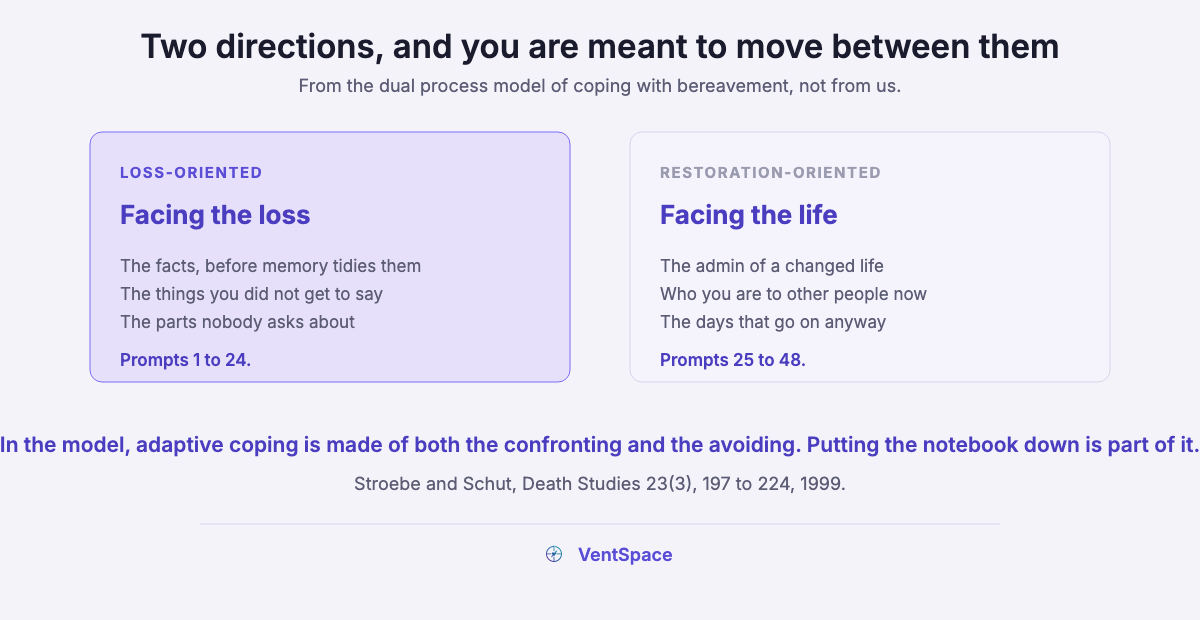
The forty-eight below are arranged in two directions, because the field’s dominant model of how people cope with a death describes grieving as moving back and forth rather than working straight through. Three groups face the loss. Three face the life that is carrying on around it. Moving between them is allowed, and so is stopping.
Support, plainly stated. If you are in crisis or thinking about harming yourself, please contact a crisis line now. In the US you can call or text 988 for the Suicide and Crisis Lifeline. Outside the US, findahelpline.com will find the equivalent where you are. If your grief is severe, is not easing and is stopping you living, that is a reason to talk to a doctor or a bereavement service, whatever the calendar says. This page is not a substitute for any of them.
The short version
Forty-eight prompts in two directions, three groups facing the loss and three facing the life going on around it.
There is no order to work through. The two directions come from a model of grieving, and its back and forth has barely been tested, so it is a description, not an instruction.
Each one carries why it helps and how to answer it. One a sitting, and stopping early counts as finishing.
The evidence specific to grief is not encouraging, and it is printed before the prompts rather than left out.
There are no stages on this page, and the reason is sourced.
What this page is built on
In 1999 Margaret Stroebe and Henk Schut proposed the dual process model of coping with bereavement, written in explicit response to the shortcomings of the grief work hypothesis: imprecise definition, a failure to represent how grieving actually moves, and a lack of empirical evidence. Their model names two kinds of stressor, loss-oriented and restoration-oriented, and a regulatory process of oscillation, in which the grieving person at times confronts and at other times avoids each of them. In that account, adaptive coping is made of both the confronting and the avoiding. Putting the notebook down is part of it. A 2021 systematic review of 22 studies found the model a good description of bereavement, while noting that its central idea, the back and forth itself, has barely been tested.
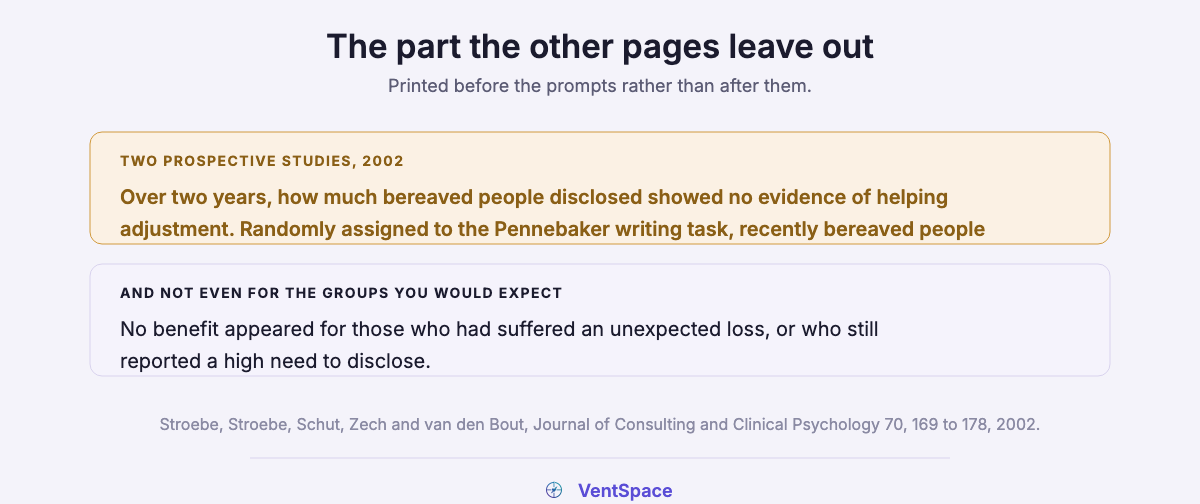
Now the part the other pages leave out. In 2002, the same research group published two prospective studies in the Journal of Consulting and Clinical Psychology. Over two years, how much bereaved people talked about the loss and disclosed their emotions showed no evidence of helping adjustment. In the second study, recently bereaved people were randomly assigned either to the Pennebaker writing task or to no essay at all. The writing task did not reduce distress or doctor visits, immediately or at six months, and no benefit appeared even for those who had suffered an unexpected loss or who still reported a high need to disclose.
That is not a reason to close the page. It is the reason this one makes no promises.
Insight “Most disturbingly, the expectation that bereaved persons will, even should, go through stages of grieving can be harmful to those who do not.” The authors conclude that stage theory should be discarded by all concerned.
Margaret Stroebe, Henk Schut and Kathrin Boerner, Omega: Journal of Death and Dying 74(4), 455 to 473, 2017
Quick Summary
Q: Does journaling help with grief?
A: The bereavement-specific research does not show that it does. A 2002 randomised comparison found the standard expressive-writing task produced no reduction in distress in recently bereaved people, and a two-year prospective study found no link between disclosure and adjustment. Writing can still be somewhere to put something down, which is a smaller claim and an honest one.
How to actually use these
One prompt a sitting, and stopping early counts as finishing. Where the expressive-writing research used fifteen to twenty minutes across three to five occasions, that is the shape borrowed here. On this topic the upper end of it is often too long.
There is no order to work through. A loss-oriented prompt one day and a restoration-oriented one the next is one way to use them, or two of the second kind if the first is not available this week. That shape is editorial judgement borrowed from a model that describes grieving rather than prescribing it. Both halves belong on the page.
The failure mode here is the afternoon spent in group three. Eight prompts about what nobody asks you is not a sitting, it is a day you will not get back.
Write the date, and write where you were. Months later the date is what turns a pile of pages into something readable. Nothing else on this page depends on it, and that one does.
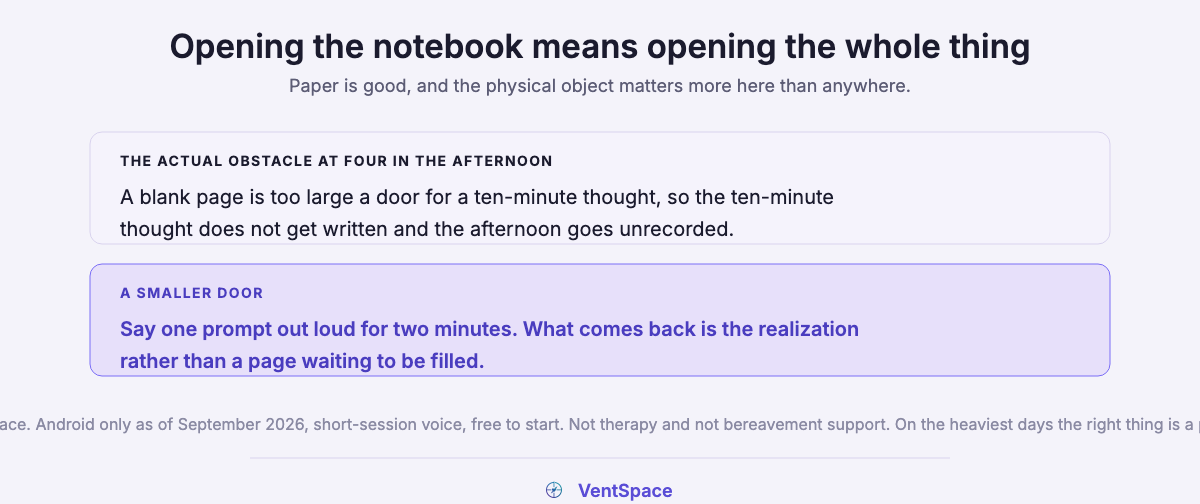
Where you write is a smaller question than whether the page can be opened at all. Paper is good, and the physical object matters more here than in any other kind of journaling. A notes app is good and searchable. The difficulty, for some of us, is that opening the notebook means opening the whole thing, and at four in the afternoon that is too large a door for a ten-minute thought. Something smaller than the notebook can be the whole fix.
Quick Summary
Q: How often should you write when you are grieving?
A: One prompt a sitting, somewhere under twenty minutes, and stopping early counts. Moving between the prompts that face the loss and the ones that face the ordinary business of a changed life is one way to use them, because the model this page is built on describes coping as a movement between the two rather than a progression through one.
How these forty-eight are grouped
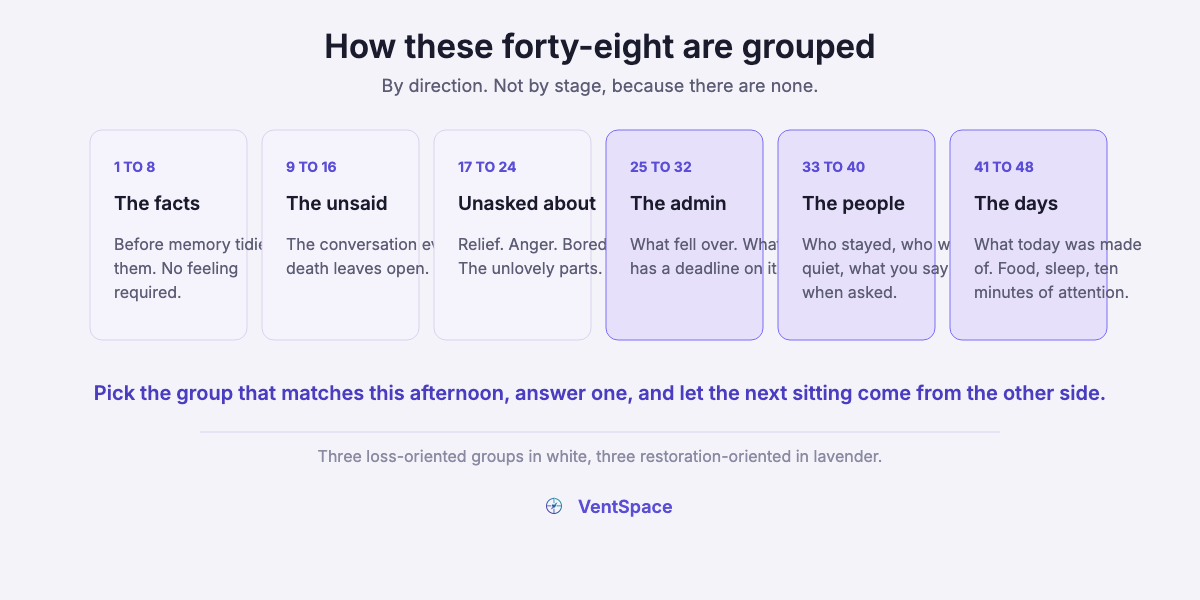
Not by stage, because there are none, and not by how hard they are, because that varies by the week rather than by the prompt.
By direction. Three groups face the loss: the facts, the unsaid things, and the parts nobody asks about. Three face the life still going on: the admin, the people, the ordinary days. Pick a group that matches this afternoon, answer one, and the next sitting can come from either side.
The facts, before memory tidies them
Memory is an editor and it starts work early. These eight are not about feeling anything. They are about getting the record down while it is still accurate.
1.What happened, written as plainly as you can manage?
Why this helps: The plain account is the one that gets written least often and changes least over time. Everything else can be built on it later.
How to sit with it: Short sentences, no adjectives. Ten minutes at a table, not in bed.
2.Where were you when you found out, and what was in your hands?
Why this helps: The physical detail holds the moment in place, which matters because this is the memory that tends to blur first.
How to sit with it: Write the objects before the feelings. The objects are easier and they lead somewhere.
3.What did the room look like that week?
Why this helps: The week around a death is full of specifics none of us expect to lose, and they are easy to lose.
How to sit with it: Five details, listed, no paragraph. Flowers, a chair, who sat where.
4.What did people say to you that you want to keep?
Why this helps: One or two of the things said in the first fortnight are worth having in writing, and they are surrounded by so much else that they go missing.
How to sit with it: Quotation marks and a name beside each. Two is enough.
5.What did people say that you would rather not carry?
Why this helps: A clumsy sentence written down once is on the page rather than only in your head.
How to sit with it: Write it, then close the book. Do not answer it on the page.
6.What is the last ordinary thing that happened between you?
Why this helps: The last ordinary exchange is usually more like them than the last significant one, and it is the one we forget to write down.
How to sit with it: Answer this one aloud first, to nobody, then write what you said.
7.What did they look like, in a detail nobody photographs?
Why this helps: Hands, the way they stood in a doorway, how they said your name. Photographs do not keep these and we assume we will.
How to sit with it: Three details, present tense. Stop before it becomes a tribute.
8.What do you already notice yourself rounding off?
Why this helps: We smooth the difficult parts of a person within weeks, often out of loyalty, and the smoothing costs us the real version.
How to sit with it: Write what you have been leaving out when you talk about them. Nobody is reading this.
Quick Summary
Q: What do you write first in a grief journal?
A: The plain facts, before memory edits them. Where you were, what was in your hands, what the room looked like, what people said that you want to keep. These entries require no feeling and no conclusion, and they are the ones that become unrecoverable soonest.
The things you did not get to say
Almost every death leaves a conversation open. These eight are not about closing it, which is not available, but about putting the contents somewhere.
9.What were you going to tell them?
Why this helps: There is usually one specific piece of news waiting to be delivered, and its homelessness is part of what aches.
How to sit with it: Address it to them by name. Do not write a preface.
10.What would you apologise for, if they were here to hear it?
Why this helps: Unsaid apologies accumulate interest. Writing one down does not discharge it, and it does stop it being only in our head.
How to sit with it: One apology, not a list. Fifteen minutes, then leave the page open on the table.
11.What did you never thank them for?
Why this helps: The unthanked things tend to be the structural ones, the kind nobody notices until the person providing them is gone.
How to sit with it: Start with something small and practical. The large version usually arrives behind it.
12.What would you ask them, if you got one question?
Why this helps: The question we would choose says a good deal about what is actually unfinished, which is not always what we have been telling people.
How to sit with it: One question, then stop. Resist answering it on their behalf.
13.What did you not say because there was going to be time?
Why this helps: This is the particular regret of an expected death and of a sudden one equally, and it is worth seeing that in writing.
How to sit with it: Write it as a sentence starting “I thought there would be time to”. Once is enough.
14.What would you want them to know about the last year?
Why this helps: The part of us that keeps narrating to somebody who has died is not confused. It is maintaining a habit of attention, and it can be written to.
How to sit with it: Write it as a letter. Date it at the top. Do not reread it tonight.
15.What would they find funny about all of this?
Why this helps: Grief has comedy in it and few pages will admit that to us. Naming theirs specifically returns a little of them to the room.
How to sit with it: Answer it in their voice, using the words they would have used.
16.What would you tell them about the hardest person you have had to deal with since?
Why this helps: The practical aftermath of a death generates friction with the living, and the person who would have understood it best is the one unavailable.
How to sit with it: Write it as a complaint. Unedited, uncharitable, and for nobody else.
Quick Summary
Q: Should you write a letter to someone who died?
A: It is one of the oldest forms this kind of writing takes and it asks nothing unreasonable of you. Address it by name, date it, and do not reread it the same evening. What it will not do is close the conversation, and a prompt that claimed otherwise would be lying.
The parts nobody asks about
Relief. Anger. Boredom. The thoughts we have decided are disqualifying. These eight exist because the page that omits them leaves the reader alone with exactly the material that is hardest to hold.
17.What have you felt that you have not said out loud to anybody?
Why this helps: The unspoken feeling gets one place to exist where nobody has to react to it.
How to sit with it: Write it in one line, then put the notebook somewhere only you go.
18.What has been a relief?
Why this helps: Relief after a long illness, or after a difficult relationship, is hard to say out loud, and naming it is not a betrayal of anybody.
How to sit with it: Write the relief and the thing it is attached to on the same line. No explanation.
19.Who are you angry with?
Why this helps: Anger after a death goes to strange addresses: a doctor, a sibling, the person who died, ourselves. Naming the address is the useful part.
How to sit with it: Make a list of names. Do not justify any entry.
20.What has been boring about this?
Why this helps: Long stretches of bereavement are tedious rather than dramatic, and nobody warns us, so the tedium arrives feeling like a failure of feeling.
How to sit with it: Five minutes, plain, slightly ungenerous. That register is allowed here.
21.What do you resent having to manage?
Why this helps: Forms, accounts, other people’s expectations. Resenting the administration of a death is not the same as resenting the person, whatever our guilt suggests.
How to sit with it: A numbered list of tasks and one honest adjective each.
22.What are you afraid somebody will ask you?
Why this helps: Identifying the dreaded question lets you answer it once here, where the cost of getting it wrong is nothing.
How to sit with it: Write the question, then the answer you would give if you were not managing their reaction.
23.What version of them are you presenting to other people?
Why this helps: It is easy to curate the dead a little, usually kindly, and the gap between the curated one and the real one is lonely to carry unwritten.
How to sit with it: Two columns. What you say about them, and what you know. Nobody audits this.
24.What would you write here if you knew nobody would ever read it?
Why this helps: This is the whole reason a private page is worth having, and it is worth using at least once rather than keeping in reserve.
How to sit with it: Set a timer for ten minutes and do not stop to choose the wording. Tear it out afterwards if you want to.
Quick Summary
Q: Is it normal to feel relief, or anger, or nothing?
A: There is no correct feeling to have after a death, and none of these three is evidence about your character or about how much you loved somebody. Writing them down privately is one of the few places they can exist without being managed for an audience.
The admin of a changed life
This is the other direction, and the model this page is built on treats it as equally part of coping rather than as a distraction from the real thing. These eight are practical on purpose.
25.What has fallen over since, in practical terms?
Why this helps: Naming the collapsed logistics separates them from the grief they have been filed under, and only one of the two can be tidied.
How to sit with it: A plain list, no feelings column. Fifteen minutes at a kitchen table.
26.What is the next thing with a deadline on it?
Why this helps: One dated obligation usually sits underneath a general sense of being behind, and it is often smaller than the feeling.
How to sit with it: Write the thing and the date. Then put the date in a phone.
27.What are you doing now that used to be theirs?
Why this helps: Inherited tasks carry a weight out of proportion to the work, and the weight is easier to bear once it is identified as inheritance.
How to sit with it: Three tasks. Beside each, how long it takes. The gap between the two is the point.
28.What do you keep meaning to deal with and walking past?
Why this helps: The avoided object is doing real work on us every time we pass it, and it is easy to stop seeing it.
How to sit with it: Walk through the house with the notebook. Write what you find where you find it.
29.Who has offered help that you have not taken?
Why this helps: Unaccepted offers expire quietly, and a written list makes one of them easier to take up.
How to sit with it: Names and the specific offer beside each. Circle one.
30.What would you like somebody to do for you this week, specifically?
Why this helps: “Let me know if you need anything” cannot be answered in the abstract, and a specific request is the only kind anybody can act on.
How to sit with it: One request, small enough to be said out loud. Then say it to somebody.
31.What can wait six months without any consequence?
Why this helps: A great deal of what feels urgent after a death is not, and permission to defer is easier to accept in your own handwriting.
How to sit with it: Write the list, then write the month. Close the book and do none of it.
32.What one thing would make tomorrow morning easier?
Why this helps: Tomorrow morning is a small enough horizon to plan for when the year is not.
How to sit with it: One physical action, done tonight. Clothes, a note, a closed door.
Quick Summary
Q: Should you write about practical things in a grief journal?
A: The dual process model treats the practical business of a changed life as part of coping rather than as avoidance of the real work, and the prompts here are built accordingly. Naming the collapsed logistics also separates them from the loss they have been filed under, and only one of the two can be tidied.
Who you are to other people now
A death rearranges a social world, usually without consulting anybody. These eight are about that rearrangement rather than about the person who died.
33.Who has been there, and who has gone quiet?
Why this helps: Both columns surprise us, and having them in writing is more useful than the vague ache of noticing.
How to sit with it: Two lists. Resist explaining anybody’s absence for them.
34.What do you say when somebody asks how you are?
Why this helps: Many of us settle on one stock sentence, and seeing it written down tells us what we have decided to hide.
How to sit with it: Write your actual sentence in quotation marks. Then write the true one underneath.
35.What do you wish people would say instead?
Why this helps: Knowing the answer makes it possible to tell somebody, and a fair number of people would genuinely like to be told.
How to sit with it: Draft the sentence you want to hear. Three attempts, pick one.
36.Who are you being careful around, and why?
Why this helps: The carefulness is exhausting and invisible, and naming its objects shows how much of the week is being spent on it.
How to sit with it: Names, then one reason each, in five words or fewer.
37.Who else is grieving this, and how differently?
Why this helps: Two people who loved the same person rarely grieve in the same register at the same time, and that mismatch causes more damage when it is unnamed.
How to sit with it: Pick one person and write what this looks like from inside their week.
38.What role have you taken on that nobody assigned you?
Why this helps: Someone usually becomes the competent one, or the one who holds others together, and it is generally decided by accident.
How to sit with it: Name the role in three words. Then write who would notice if you stopped.
39.Who have you not told?
Why this helps: Every untold person is a conversation still pending, and the list is usually shorter and less frightening on paper.
How to sit with it: Write the names. Beside each, telling or not telling, and leave it at that.
40.What do you need from the people who are still here?
Why this helps: Grief can make us quietly withdraw from the living, and this question interrupts the withdrawal without arguing about it.
How to sit with it: Answer in the morning rather than the evening. The morning answer is usually kinder.
Quick Summary
Q: How do you journal about people who disappeared after a death?
A: Two columns, who has been there and who has gone quiet, without explaining anybody’s absence on their behalf. Then the sentence you use when asked how you are, and the sentence you would rather hear. That last one is worth having drafted, because some people genuinely want to be told.
The days that go on anyway
Not progress. Just the days, which continue regardless and contain things. These eight are the smallest on the page and they are meant to be.
41.What was today made of?
Why this helps: A factual account of one day contains no verdict on how anybody is doing, which is precisely its value.
How to sit with it: Six lines, chronological, no assessment at the end.
42.What did you eat, and when did you sleep?
Why this helps: Both tend to go unrecorded and both are information, particularly over a fortnight.
How to sit with it: One line a day for a week before you look at it. Keep it in the same place.
43.What, if anything, held your attention for ten minutes?
Why this helps: The answer is often small and unlikely, and it is worth knowing which of our attentions still works.
How to sit with it: If the answer is nothing, write nothing down as the answer. That is a real entry.
44.What is coming up that you are dreading?
Why this helps: A dated thing on a calendar can be prepared for. An undated dread cannot be, and it sits heavier on us for that.
How to sit with it: The event, the date, and one thing that would make it fractionally easier.
45.What do you want to do on the anniversary, or the birthday?
Why this helps: Deciding in advance, on an ordinary day, is considerably easier than deciding on the day itself.
How to sit with it: Write it months early. Include who you want there and who you do not.
46.What do you want to keep, in the most literal sense?
Why this helps: Objects get dispersed quickly and by committee, and knowing your own answer in advance prevents a specific kind of later grief.
How to sit with it: Name three objects. Say where each one is now.
47.What have you done this week that you did not think you could?
Why this helps: Not a lift and not a silver lining. A factual entry, and the factual version is the only one that holds up later.
How to sit with it: One thing, described without adjectives. A phone call counts.
48.What would you like tomorrow to contain?
Why this helps: Tomorrow is a horizon you may still be able to look at, and containing something is a lower bar than being better.
How to sit with it: Two items. One for somebody else and one for you. Write them before bed.
Quick Summary
Q: What do you write when nothing has happened and you still feel terrible?
A: The factual contents of the day. What it was made of, what you ate, when you slept, what held your attention for ten minutes. These entries pass no verdict on how you are doing, which is why they are possible on the days when nothing else is.
What to do with what you wrote
Here the most useful half of the guidance is about restraint.
Do not reread the letters for a while. Entries addressed to somebody who has died are not neutral to reopen, and a same-week reread tends to be an experience rather than a review. Leave them. They are not going anywhere, and there will be a month when you want them.
Read three of the factual entries together. The day-level ones from group six are the ones that repay rereading, because three of them side by side show what the fortnight was actually like, which is often not what we remember it being.
Separate what you wrote from what you concluded. “I did not leave the house on Thursday” is a record. “I am not coping” is a verdict, and a verdict closes the page.
You may notice which direction you have been writing in. If the last six entries are all from the first three groups, that is worth knowing and nothing more. The model this page is built on does not say how much of either direction is right, and the reverse is equally unalarming.
And if rereading makes the afternoon worse, stop rereading. That is not a failure of method. It is the method working, in the sense that you now know something you did not.

When writing is the wrong thing to reach for
Twice over, the evidence here points away from the page. The 2002 studies above found no benefit from disclosure and none from the writing task. And the wider expressive-writing review by Baikie and Wilhelm reports results that are inconsistent, and specifically detrimental outcomes for adult survivors of childhood abuse and for a small sample of eight Vietnam veterans with post-traumatic stress disorder.
Read as permission rather than as discouragement, that is a useful pair of findings. If writing is not helping, the research agrees with you. Nothing is being left undone by closing the notebook.
The simpler test. If you can feel this and still think about it, writing may give the thinking somewhere to go. If you can only feel it, writing will mostly hand you an hour alone with it, and an hour alone is something some bereaved people already have too much of.
Grief counselling and therapy are both legitimate options and for many people they are the right one. So is a doctor, particularly where sleep, appetite or breathing has changed. So is a bereavement service. If grief is severe, is not easing and is stopping you living, that is a reason to talk to one of them, whatever the calendar says. None of them is a consolation prize for having failed at journaling, and none of them requires you to be in a worse state than you are.
Quick Summary
Q: Can writing make grief worse?
A: It can make an afternoon worse, and the research is not in a position to promise otherwise. Baikie and Wilhelm report inconsistent results and specific detrimental effects for adult survivors of childhood abuse and a small veteran sample, and the bereavement-specific studies found no benefit at all. If it is not helping, closing the notebook is supported by the evidence rather than a failure of discipline.
A run you can abandon
| Week | Direction | Sittings | If you skip it |
|---|---|---|---|
| 1 | Group one, the facts | 2 | Skip freely. These can be written in six months and still be worth having |
| 2 | Group six, the days | 3 | This is the one worth keeping. One line a day |
| 3 | Group four, the admin | 2 | Skipping costs something practical. Do prompt 26 at minimum |
| 4 | Group two or three, whichever is available | 1 | Entirely optional. One prompt, and stopping early counts |
| 5 | Group five, the people | 2 | Do prompt 30 even if you skip the rest of the week |
| 6 | Reread the group six entries only | 1 | Skip if rereading has been going badly |
If you only answer five
Prompt 1, because the plain account is the one that becomes unrecoverable and nothing else can be built without it. Prompt 7, because photographs do not keep hands or the way somebody stood in a doorway. Prompt 18, because relief is hard to say out loud after a death and it needs one page that will hold it. Prompt 30, because a specific request is the only kind the people around you can act on. Prompt 42, because food and sleep are information and nobody is writing them down.
Questions people ask
Does journaling help with grief?
The bereavement-specific research does not show that it does. A randomised comparison in 2002 found the standard expressive-writing task produced no reduction in distress or doctor visits in recently bereaved people, immediately or six months later, and a two-year prospective study found no link between disclosure and adjustment. What writing can offer is somewhere to put something down for twenty minutes. That is the claim this page makes and it is the only one it can support.
What about the stages of grief?
The five stages came from Elisabeth Kübler-Ross’s 1969 work with dying patients. She extended them to patients’ families in the same book, but they were never tested in bereaved people before being taught as a sequence. Reviewing stage theory in 2017, Stroebe, Schut and Boerner found the absence of sound empirical evidence, conceptual clarity or explanatory potential, and concluded that it should be discarded. Their sharpest point is the one that matters most here: the expectation that bereaved people will, or should, move through stages can be harmful to those who do not. If you have been waiting to reach acceptance and have not, nothing is wrong with you.
What do I write if I do not want to write about them?
Groups four, five and six, which is half the page. The model this article is built on treats the ordinary business of a changed life as part of coping rather than as avoidance of the real work. Prompt 41 asks only what today was made of.
Should I write a letter to the person who died?
Prompts 9 to 16 are that, and addressing them by name is the part that makes it work. Date it, and do not reread it the same evening. It will not close the conversation, and a page that promised otherwise would be selling you something.
Is it normal to feel relief, or anger, or nothing at all?
There is no correct feeling to have after a death, and none of these three is evidence about your character or about how much you loved somebody. Prompts 17 to 24 exist for exactly this material, because a page that leaves it out leaves the reader alone with the hardest part.
Is this a substitute for grief counselling?
No. Grief counselling and therapy are legitimate options and for many people they are the right one, as is a bereavement service. A notebook is not in competition with any of them.
Related. Grief Quotes That Don’t Rush You Through It, and Grief vs Sadness.
Related. If the question underneath this is whether writing is enough on its own, see Therapy vs Journaling.
The part that does not resolve
There is a version of this genre in which somebody writes forty-eight entries and arrives somewhere.
That is not what is on offer. What these prompts can do is give the thing somewhere to go on a particular afternoon, and leave a record that will mean something to you later, and ask nothing of you in the meantime. There is no stage being worked through and no progress being measured. If half of them stay unanswered, that is not an unfinished practice. That is what the practice looks like.
Some afternoons the notebook will be the wrong object entirely. On those ones the numbers at the top of this page are better than anything further down it.
If you are carrying a death right now, there is no right way to be doing it, and nothing here has to be done well. If writing some of it down would help, VentSpace, the journaling app we make, is a quiet place to do it. If you are on a computer, VentSpace Live runs in your browser, with nothing to install.
About this article

Written by
Sai Subramaniam
Founder, VentSpace
I write these guides because I have been where you are. I am working through my own hard seasons, and I share the things that actually helped me, so that anyone going through it has something steady to read instead of facing it alone. No ads, no affiliate links, and nothing here is a sales pitch.
This writing is honest and every claim is sourced, and it is not a substitute for professional care, bereavement support or medical advice. If this is heavy right now, the numbers above are a better answer than anything else on this page.
How this one was checked. Every factual claim traces to a named source, and the source is printed next to the claim rather than kept in a footnote. Where a widely repeated claim could not be traced, it was left out and the omission recorded. Where a figure is contested, both sides are printed.
No affiliate links, no paid placements, and nobody paid to appear here. Our own app appears once, in a short note at the end and nowhere near the support numbers, because a page about a death is not a place to sell anything.
Reviewed: October 2026. Anything we could not verify at the time of writing is marked as unverified rather than turned into a number.
Corrections. If something here is wrong, we would rather know. Corrections are made in place, with a note saying what changed. Updated 15 October 2026: the support box now names only the 988 Lifeline and findahelpline.com, plus when to see a doctor or bereavement service. The Kübler-Ross attribution was corrected, the dual process model is now described as a model whose back and forth is barely tested rather than an instruction, unsourced lines about what writing does were cut, unrelated links were removed, and a short closing note about our journaling app was added.