
You may have arrived at a page like this on a day when the sentences are not going to work.
That is worth saying at the start, because the genre tends to assume the opposite: that we are here to be topped up, and that the right arrangement of words will produce a feeling we could not produce ourselves. It rarely does. A sentence cannot install a feeling, and a bad afternoon is not going to be argued with.
What a good line can do is smaller and more durable. It can name something we had not named, and it can tell us that somebody else has been here, which is not nothing at four in the afternoon. So these thirty-five are grouped by why the words might not be landing, rather than by theme, and every one of them is traced to a named work, with a year where we could confirm one.
If you are in crisis or thinking about harming yourself, please contact a crisis line now. In the US you can call or text 988 for the Suicide and Crisis Lifeline. Outside the US, findahelpline.com will find the equivalent where you are. Several of the writers here are describing serious distress, and none of this replaces help.
The short version
Thirty-five quotes, all traced to a work. No anonymous lines, no quote sites.
Grouped by why they are not landing, not by theme.
The word doing the damage is “esteem”. There is a better construct underneath this and it does not require you to be doing well.
One category is about the body, which this genre has almost entirely forgotten.
The Audre Lorde line is here in full. The half that usually gets cut is the important half.
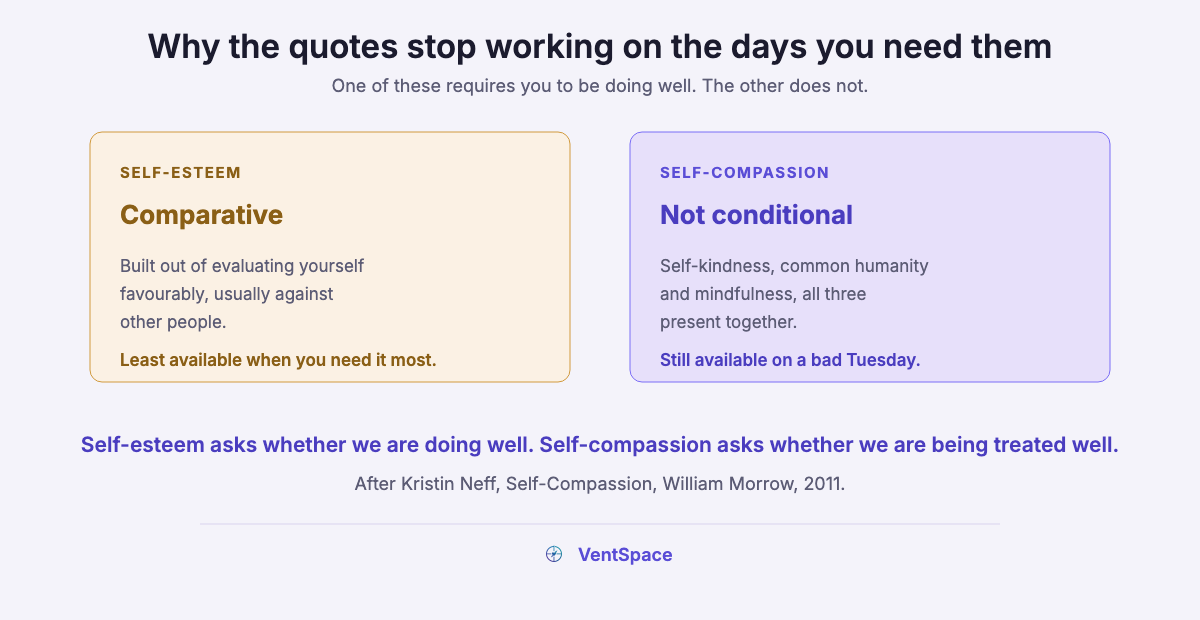
The word doing the damage is “esteem”
Here is why these quotes stop working on the days we need them.
Self-esteem is comparative. It is built out of evaluating ourselves favourably, usually against other people, and it therefore requires us to be doing reasonably well at something. Which means it is least available exactly when we most need it. Almost everything filed under self-love is really self-esteem language, and self-esteem is a fair-weather structure.
Kristin Neff’s work proposes a different foundation. Self-compassion has three parts, and all three have to be present together: self-kindness rather than harsh judgement, common humanity rather than the sense that our difficulty is uniquely ours, and mindfulness rather than either suppressing the pain or being swallowed by it.
The difference that matters is the second one. Self-esteem asks whether we are doing well. Self-compassion asks whether we are being treated well, including by ourselves, and it does not become unavailable on a bad Tuesday. It is also, unlike most of what this phrase attracts, a construct somebody has actually measured.
None of which makes a quote work. It does explain why the encouraging ones so often bounce, and why the ones below are sorted the way they are.
Quick Summary
Q: What is the difference between self-love and self-compassion?
A: Self-love in popular use is usually self-esteem, which is comparative and depends on evaluating yourself favourably. Self-compassion, as Kristin Neff describes it, requires self-kindness, a sense of common humanity and mindfulness, and does not depend on doing well, which is why it remains available on bad days.
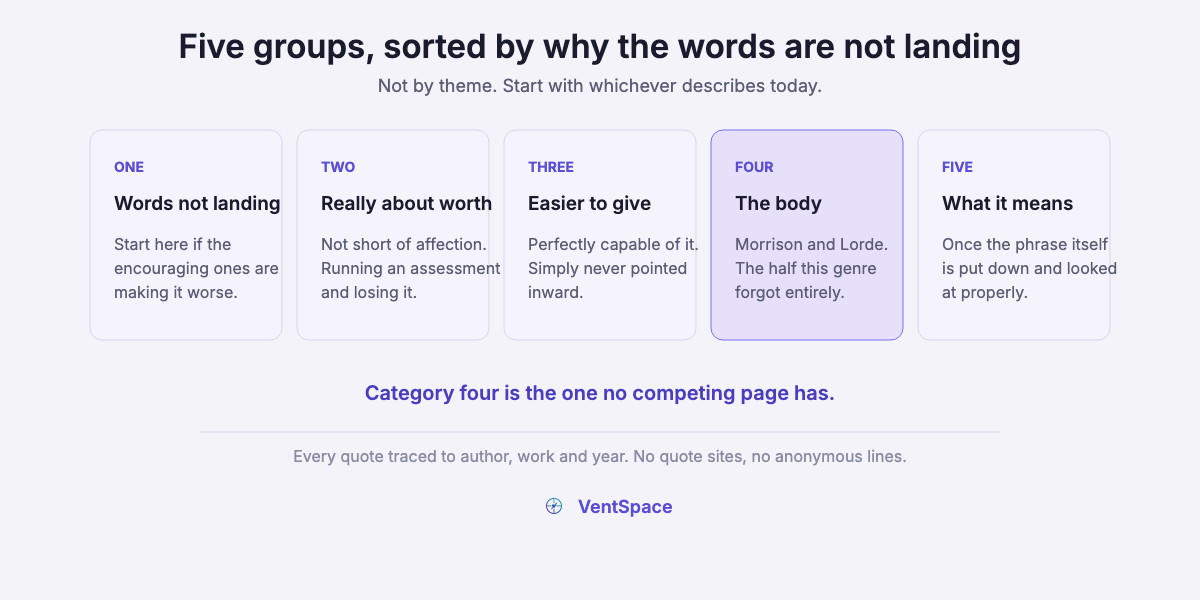
For the days the words do not land
Start here if the encouraging ones are currently making it worse.
“It is not your job to make other people comfortable with who you are.”
Maggie Smith, Keep Moving: Notes on Loss, Creativity, and Change, 2020
“Accept that you are a work in progress, both a revision and a draft: you are better and more complete than earlier versions of yourself, but you also have work to do.”
Maggie Smith, Keep Moving, 2020
⭐ If you only take one from this category, take this. It is the only line here that does not require us to have arrived anywhere.
“Maturity begins with the capacity to sense and, in good time and without defensiveness, admit to our own craziness. If we are not regularly deeply embarrassed by who we are, the journey to self-knowledge hasn’t begun.”
Alain de Botton, The Course of Love, 2016
A disclosure, since he appears twice on this page: de Botton’s School of Life is the house influence on how this site writes. We think he is right about this and we are not disinterested.
“i am mine. before i am ever anyone else’s.”
Nayyirah Waheed, salt.
Only one of hers appears here, and the reason is at the bottom of the page.
“Whatever happens to you belongs to you. Make it yours. Feed it to yourself even if it feels impossible to swallow.”
Cheryl Strayed, Tiny Beautiful Things, 2012
“The meaning of life differs from man to man, from day to day and from hour to hour.”
Viktor E. Frankl, Man’s Search for Meaning
Worth holding on a day when the meaning has gone. He is not saying it is absent. He is saying it moves.
Quick Summary
Q: Why don’t self-love quotes work when you need them most?
A: Because most of them are written in the language of self-esteem, which depends on evaluating yourself favourably. On a day when you cannot do that, the sentence asks for something you do not have. Lines that describe rather than encourage tend to survive that day better.
For when it is really about worth, not love
Often the trouble is not a shortage of affection for ourselves. It is an ongoing assessment we keep losing.
“When we experience our lives through the lens of personal insufficiency, we are imprisoned in what I call the trance of unworthiness.”
Tara Brach, Radical Acceptance
⭐ If you only take one, take this. The word trance is doing the work. It names the state as something we are inside rather than something we have concluded, and a trance can be interrupted.
“Fear of being a flawed person lay at the root of my trance, and I had sacrificed many moments over the years in trying to prove my worth.”
Tara Brach, Radical Acceptance
“On this sacred path of Radical Acceptance, rather than striving for perfection, we discover how to love ourselves into wholeness.”
Tara Brach, Radical Acceptance
“Worthy now. Not if, not when, we’re worthy of love and belonging now. Right this minute. As is.”
Brené Brown, The Gifts of Imperfection, 2010
“When we can let go of what other people think and own our story, we gain access to our worthiness.”
Brené Brown, The Gifts of Imperfection, 2010
“My worth is tied not to my productivity but to my existence.”
Glennon Doyle, Untamed, 2020
“What we need are women who are full of themselves. A woman who is full of herself knows and trusts herself enough to say and do what must be done.”
Glennon Doyle, Untamed, 2020
Quick Summary
Q: Is self-love the same as self-worth?
A: They come apart in practice. Often the trouble is not a shortage of affection for yourself so much as a continuous assessment you keep losing. Tara Brach’s phrase for that state, the trance of unworthiness, describes it more usefully than the word love does.
For when it is easier to give it than to receive it
The most common shape of this difficulty. We are perfectly capable of the thing. We simply do not point it inward.
“One of the best guides to how to be self-loving is to give ourselves the love we are often dreaming about receiving from others.”
bell hooks, All About Love: New Visions, 2000
⭐ If you only take one, take this. It converts an abstraction into an instruction. Whatever we have been waiting for somebody to say, say it.
“Do not expect to receive the love from someone else you do not give yourself.”
bell hooks, All About Love, 2000
“The light of love is always in us, no matter how cold the flame. The choice to love is a choice to connect, to find ourselves in the other.”
bell hooks, All About Love, 2000
“The foundation of metta practice is to know how to be our own friend.”
Sharon Salzberg, Lovingkindness
“You can search throughout the entire universe for someone who is more deserving of your love and affection than you are yourself, and that person is not to be found anywhere.”
the Buddha, quoted by Sharon Salzberg in Lovingkindness
“Self-love is the quality that determines how much we can be friends with ourselves and, day to day, remain on our own side.”
Alain de Botton, The School of Life: An Emotional Education, 2019
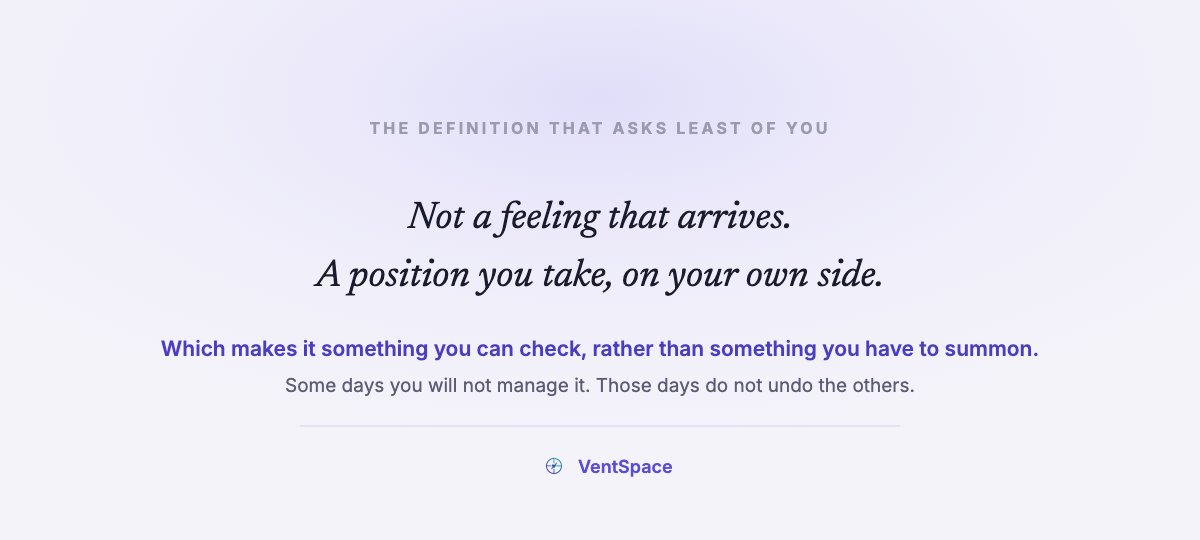
The plainest definition on this page, and the one that asks least of us. Not a feeling. A position we hold or fail to hold.
Quick Summary
Q: How do you start practising self-love?
A: The most workable version in this collection is bell hooks’s: give yourself the thing you have been waiting for somebody else to give you. It converts a vague aspiration into a specific sentence you can say, which is the difference between an idea and a practice.
For the body, which this genre mostly forgets
Two of the most serious writers on this subject are writing about flesh, and both have been reduced to captions.
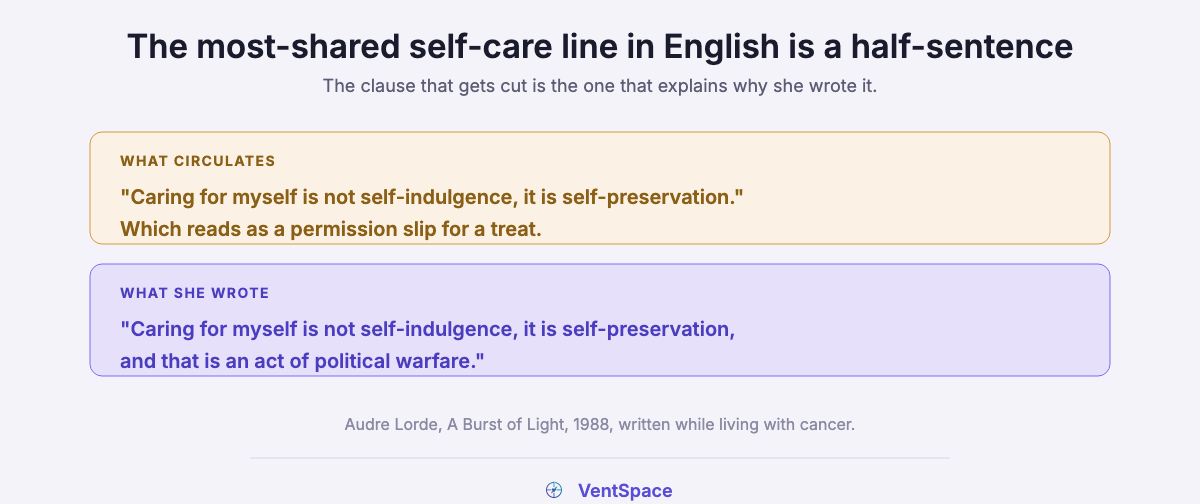
“Caring for myself is not self-indulgence, it is self-preservation, and that is an act of political warfare.”
Audre Lorde, A Burst of Light, 1988
⭐ If you only take one, take the whole of this one. The clause that gets cut everywhere is the political half, and cutting it turns a statement about survival under hostile conditions into a licence for a bath. Lorde wrote it while living with cancer.
“I respect the time I spend each day treating my body, and I consider it part of my political work. It is possible to have some conscious input into our physical processes, a kind of training in self-love and physical resistance.”
Audre Lorde, A Burst of Light, 1988
“Love it hard. Yonder they do not love your flesh. They despise it.”
Toni Morrison, Beloved, 1987, from Baby Suggs’ sermon in the clearing
“This is flesh. Flesh that needs to be loved.”
Toni Morrison, Beloved, 1987
The sermon runs considerably longer and is excerpted here rather than reproduced. It is the most complete account of this subject in English and it is worth reading whole.
“You do not have to be good. You do not have to walk on your knees for a hundred miles through the desert repenting.”
Mary Oliver, “Wild Geese”, Dream Work, 1986
“I celebrate myself, and sing myself.”
Walt Whitman, “Song of Myself”, Leaves of Grass
The first line of the poem, written in 1855, and still the least apologetic sentence anyone has produced on this subject.
“you will love again the stranger who was your self.”
Derek Walcott, “Love After Love”, Collected Poems 1948–1984, 1986
“Give back your heart to itself, to the stranger who has loved you all your life.”
Derek Walcott, “Love After Love”, 1986
Quick Summary
Q: What did Audre Lorde actually say about self-care?
A: The full line is “Caring for myself is not self-indulgence, it is self-preservation, and that is an act of political warfare”, from A Burst of Light, 1988. The circulating version usually stops before the last clause, which changes a statement about survival under hostile conditions into a justification for a treat.
For what the phrase means once it is put down
The last eight are less about loving ourselves than about what is actually there to love, which turns out to be a moving target.
Self-compassion requires three things together: self-kindness rather than harsh judgement, common humanity rather than isolation in our suffering, and mindfulness rather than either ignoring the pain or exaggerating it.
Kristin Neff, Self-Compassion, 2011
⭐ If you only take one, take this. It is the only entry here with an instrument behind it, and the middle component is the one people skip.
“All that you touch You Change. All that you Change Changes you. The only lasting truth Is Change.”
Octavia E. Butler, Parable of the Sower, 1993
“I do not portray being: I portray passing.”
Montaigne, “Of Repentance”, Essays Book III, Frame translation
“be patient toward all that is unsolved in your heart and to try to love the questions themselves like locked rooms and like books that are written in a very foreign tongue.”
Rainer Maria Rilke, Letters to a Young Poet, Letter Four
“The art is not one of forgetting but letting go. And when everything else is gone, you can be rich in loss.”
Rebecca Solnit, A Field Guide to Getting Lost
“To know nothing about yourself is to live. To know yourself badly is to think.”
Fernando Pessoa, The Book of Disquiet
“We tell ourselves stories in order to live.”
Joan Didion, The White Album, 1979
Including, and perhaps especially, the story about whether we are worth much.
“Live the questions now.”
Rainer Maria Rilke, Letters to a Young Poet, Letter Four
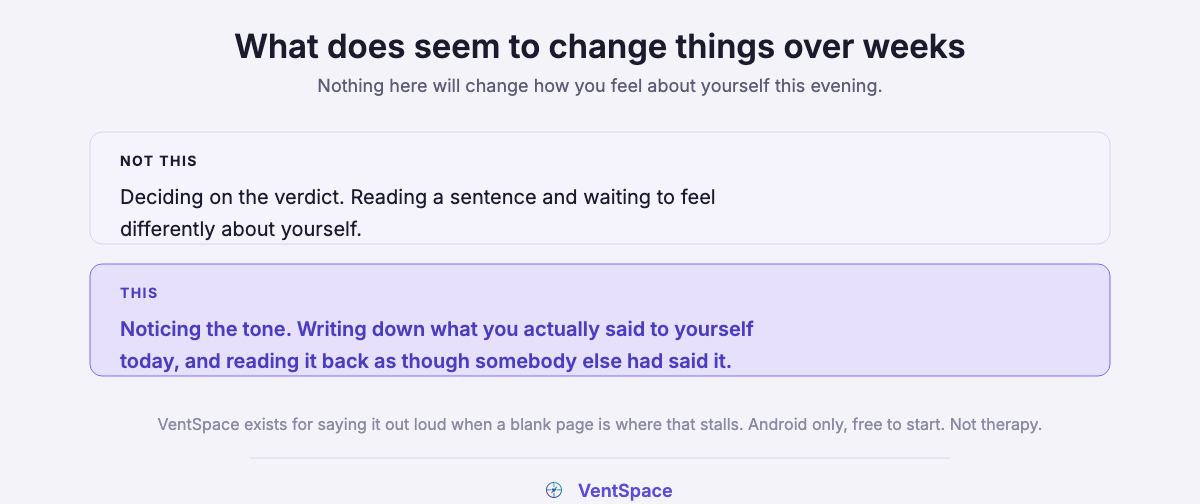
One practical note before the corrections. Nothing on this page will change how you feel about yourself this evening, and it would be dishonest to imply otherwise. What may help over time is noticing the tone rather than deciding on the verdict: writing down, in your own words, what you actually said to yourself today, and reading it back a few days later as though somebody else had said it. That gap between saying it and reading it is where most of the recognition lives, and if a blank page is where it stalls for you, VentSpace, our own app, is a journaling app that turns what you write into a clear read on your life balance, plus small, doable next steps. Android only, free to start. Not on Android, or at a desk? VentSpace Live runs in your browser, free, with nothing to install. Not therapy.
Quick Summary
Q: What does self-love actually mean?
A: The most usable definition here is Alain de Botton’s: the quality that determines how much we can be friends with ourselves and remain, day to day, on our own side. It describes a position rather than a feeling, which makes it something you can check rather than something you have to summon.
Two things this genre gets wrong
The Lorde line is truncated almost everywhere. What circulates is “caring for myself is not self-indulgence, it is self-preservation”, and the clause that gets dropped is “and that is an act of political warfare”. Audre Lorde wrote it in A Burst of Light in 1988, while living with cancer, about surviving in conditions that were not designed for her survival. Cutting the last clause turns it into a permission slip. Any page quoting the short version is quoting a version she did not write.
And a note on micro-poetry. Nayyirah Waheed’s poems in salt. often run to about twenty words, which means that quoting one does not excerpt it, it reproduces it. That is why only one appears here, and it is why the pages carrying fifteen of them are doing something other than quoting. Her books are inexpensive and the whole of salt. is better than any selection from it.
Insight The most-shared self-care line in the English language is a half-sentence. Audre Lorde, A Burst of Light, 1988: “Caring for myself is not self-indulgence, it is self-preservation, and that is an act of political warfare.” She was writing while living with cancer, and the clause that gets cut is the one that explains why she bothered to write it.
Questions people ask
Is self-love selfish?
This is the myth worth putting down, and the research answer is more interesting than the reassurance. Self-compassion’s middle component is common humanity, the recognition that difficulty is a shared condition rather than a private failing. A construct built on noticing that other people suffer too is a strange candidate for selfishness.
Why do the quotes stop working after a few minutes?
Because a sentence is not a state. Reading something true produces recognition, which is real and brief, and recognition is not the same as change. The lines worth keeping are the ones that describe accurately rather than the ones that encourage, because a description is still true tomorrow.
Where do I actually start?
With bell hooks’s instruction, which is the most concrete thing on this page. Work out what you have been waiting for somebody else to say to you. Then say it, in writing, in your own words.
Is this a substitute for therapy?
No. Reading is not treatment, and if this is persistent enough to be reaching your sleep, your work or the people around you, that is worth taking to somebody whose job it is. Therapy is one option and for a lot of people it is the right one.
Why are there only thirty-five, when other pages have two hundred?
Because every one of these is traced to a book, an essay or a poem, with a year where we could confirm one. Very long lists often include lines that are anonymous or attributed to somebody who did not write them.
The part that stays unresolved
There is something slightly cruel in the construction of this phrase, which asks us to produce, on demand and toward ourselves, the one thing everybody agrees cannot be produced on demand toward anybody.
So perhaps the more honest version is de Botton’s, and it is deliberately unexciting. Not a feeling that arrives. A position we take, most days, imperfectly, on our own side. Some days we will not manage it, and those days do not undo the others.
About this article

Written by
Sai Subramaniam
Founder, VentSpace
I write these guides because I have been where you are. I am working through my own hard seasons, and I share the things that actually helped me, so that anyone going through it has a steady companion close by instead of facing it alone. VentSpace is the app I built for exactly that: a journaling app that turns what you write into a clear read on your life balance, plus small, doable next steps toward feeling more like yourself.
This writing is honest and every claim is sourced, and it is not a substitute for professional care. If you are struggling, reaching out to a professional is a strong move, not a failure.
Explore VentSpaceTry VentSpace LiveHow this one was checked. Every factual claim traces to a named source, and the source is printed next to the claim rather than kept in a footnote. Quotes are pinned to the work they come from, with the year, the letter or the chapter where one exists. Where a widely repeated claim could not be traced, it was left out and the omission recorded. Where a figure is contested, both sides are printed.
No affiliate links, no paid placements, and nobody paid to appear here. Where we mention our own app, we say that it is ours, we state its limits, and we never position it as a substitute for care.
Reviewed: October 2026. Prices, platforms and product availability move quickly, and anything we could not verify at the time of writing is marked as unverified rather than turned into a number.
Corrections. If something here is wrong, we would rather know. Corrections are made in place, with a note saying what changed. Updated 15 October 2026: we removed five quotes that had no work attached (Melody Beattie, Anne Lamott, Ocean Vuong and two from Thich Nhat Hanh), which takes the page from forty quotes to thirty-five, softened two claims about what most readers feel, rewrote the note about our app so it describes a journaling app, and removed four unrelated links and a duplicate app link.