
There are two ways of looking at the first appointment, and most of us hold both at once. One says that if we book a psychiatrist we are admitting something serious. The other says that if we book a therapist we might spend months talking when something else would have helped sooner.
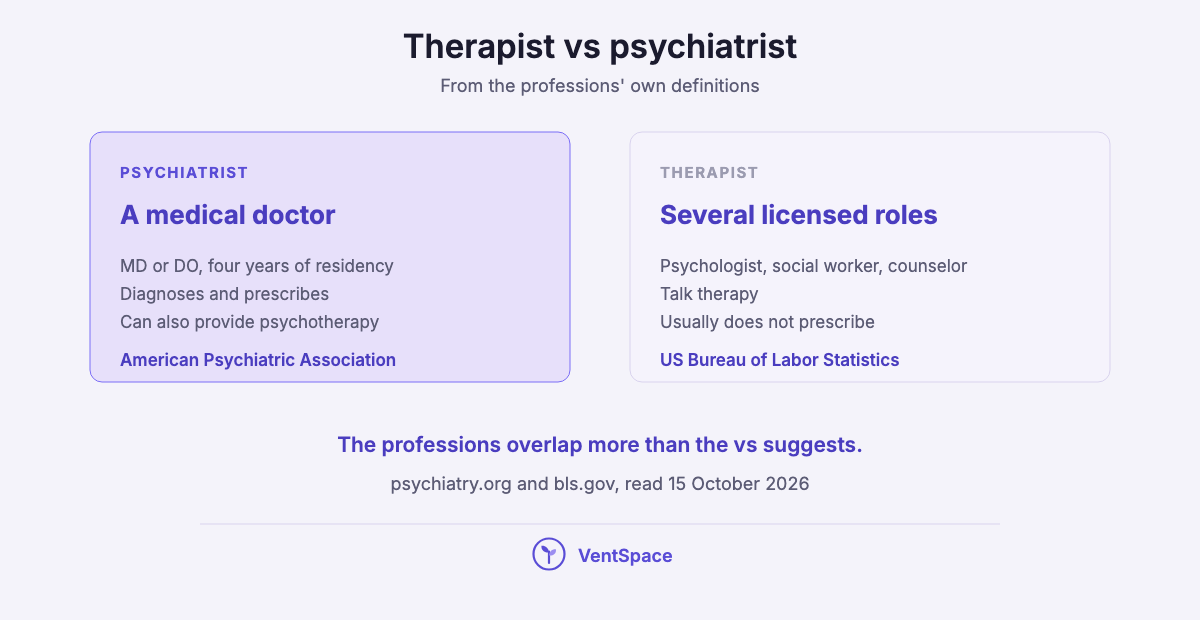
Neither fear is a good guide. Here is the plain difference. A psychiatrist is a medical doctor who specializes in mental health and can prescribe medication, and can also provide talk therapy. “Therapist” is not one credential. It covers several licensed professions, including psychologists, clinical social workers and licensed counselors, who provide talk therapy and in most cases do not prescribe.
The more useful news is that you do not have to settle the medication question to book. Either first appointment can lead to the other.
Quick Digest
– Psychiatrist: a medical doctor (MD or DO) with four years of psychiatry residency. Diagnoses, prescribes, and can do psychotherapy.
– Therapist: a psychologist, clinical social worker, licensed counselor or similar. Provides talk therapy. In some states, clinical psychologists can prescribe.
– Psychiatric nurse practitioners also manage medication. On one large booking marketplace we checked, the first five providers featured were nurse practitioners.
– Where to start if you are unsure: a primary care provider can screen and refer, according to the US National Institute of Mental Health.
– Sometimes the answer is both, and that is a sign the system is working, not that you chose wrong.
What a psychiatrist is
The American Psychiatric Association puts it plainly: “A psychiatrist is a medical doctor (an M.D. or D.O.) who specializes in mental health, including substance use disorders.” After medical school, psychiatrists “complete four years of psychiatry residency.”
What they do follows from the training. They “evaluate medical and psychological data, make a diagnosis, and work with patients to develop treatment plans”, and the same page adds that a psychiatrist “is able to conduct psychotherapy and prescribe medications and other medical treatments.”
In short: a psychiatrist is a physician, and medication is part of what they can offer, though not the only part.
What a therapist is
“Therapist” describes a role rather than a single license. The person doing your therapy might be a psychologist, who typically needs “an advanced degree, such as a master’s or doctoral degree, in psychology”, a clinical social worker, who needs “a master’s degree, supervised clinical experience, and a license”, or a licensed counselor, who in private practice needs a master’s degree, supervised clinical hours and an exam, according to the US Bureau of Labor Statistics.
Their core work is talk therapy. Clinical social workers, the BLS notes, “diagnose and treat mental, behavioral, and emotional problems.” Most do not prescribe. The exception is real but narrow: “Some states permit clinical psychologists to prescribe medication.”
In short: a therapist is one of several licensed professionals whose main tool is conversation.
Therapist vs psychiatrist side by side
| Psychiatrist | Therapist | |
|---|---|---|
| Training | Medical school, then four years of psychiatry residency | A master’s or doctoral degree, depending on the profession |
| License | Medical license | State license as a psychologist, clinical social worker, counselor or similar |
| Can prescribe | Yes | Usually not. Some states permit clinical psychologists to prescribe |
| What an appointment mostly is | Evaluation, diagnosis, treatment planning, and medication management, sometimes psychotherapy | Talk therapy |
| Can diagnose | Yes | Clinical social workers diagnose and treat, per the BLS |
| How people often reach one | Referral, insurer directory, or a marketplace | Insurer directory, a marketplace, or a referral |
Quick Summary
Q: What is the difference between a therapist and a psychiatrist?
A: A psychiatrist is a medical doctor who can diagnose, prescribe medication and provide psychotherapy. A therapist is one of several licensed professionals, such as a psychologist, clinical social worker or counselor, who provides talk therapy and usually does not prescribe.
If you need help right now
If you need help right now
If you are in crisis or thinking about harming yourself, please reach out now. In the United States you can call or text 988 for the Suicide and Crisis Lifeline, or text HOME to 741741. Outside the US, findahelpline.com lists the number where you are. You do not need to have chosen a kind of professional to call.
Difference one: training and license
The training gap is the one everyone mentions, and it is real. A psychiatrist has been through medical school and then a residency in psychiatry. A therapist has trained in psychology, social work or counseling, often for years, and is licensed by the state for that profession.
What the gap means for us, as patients, is narrower than it sounds. It does not mean one is more serious about our minds than the other. It means they were trained to look through different instruments: the psychiatrist through medicine as well as psychology, the therapist through the relationship and the conversation. We tend to rank them, and the ranking is mostly our own anxiety talking.
The licenses also differ in ways worth knowing when you read a profile. Psychologists’ “licensing requirements vary by state and position”, in the BLS’s words. “All states require clinical social workers to be licensed.” Licensed counselors in private practice must have a master’s degree, a set number of supervised clinical hours and a passed examination, and they keep up continuing education every year. A psychiatrist holds a medical license. The letters after a name tell you which of these routes someone took, and it is reasonable to ask what they mean before a first session.
Quick Summary
Q: Is a psychiatrist more qualified than a therapist?
A: Differently qualified. A psychiatrist is trained in medicine and psychiatry. A therapist is trained and licensed in psychology, social work or counseling. Each is qualified for what they do.
Difference two: what happens in the appointment
A first appointment with a psychiatrist is usually built around evaluation: the APA describes psychiatrists evaluating “medical and psychological data”, making a diagnosis and developing a treatment plan with the patient. Medication may or may not be part of that plan.
A first appointment with a therapist is usually built around conversation: what brought you, what you have tried, what you would like to be different. Clinical social workers can diagnose as well, according to the BLS, so a therapist is not limited to listening.
The overlap matters more than the difference. A psychiatrist can provide psychotherapy, and a therapist can tell you, after a few sessions, that a medication evaluation might be worth having. We are not choosing a single road. We are choosing a first conversation.
The APA’s wording is worth reading slowly, because one phrase in it does a lot of quiet work: psychiatrists “work with patients to develop treatment plans.” With, not for. Whatever we fear about being handed a prescription and shown the door, the profession’s own description puts us in the room for the decision. The same is true, in a different register, of a therapist, whose plan can be built out of what we say in the first few sessions about what we want to be different.
Quick Summary
Q: What happens at a first psychiatrist appointment compared with a therapist?
A: A psychiatrist usually starts with an evaluation and a treatment plan, which may or may not include medication. A therapist usually starts with a conversation about what brought you and what you want to change.
Difference three: who can prescribe
This is the practical difference, and it is less tidy than most pages suggest.
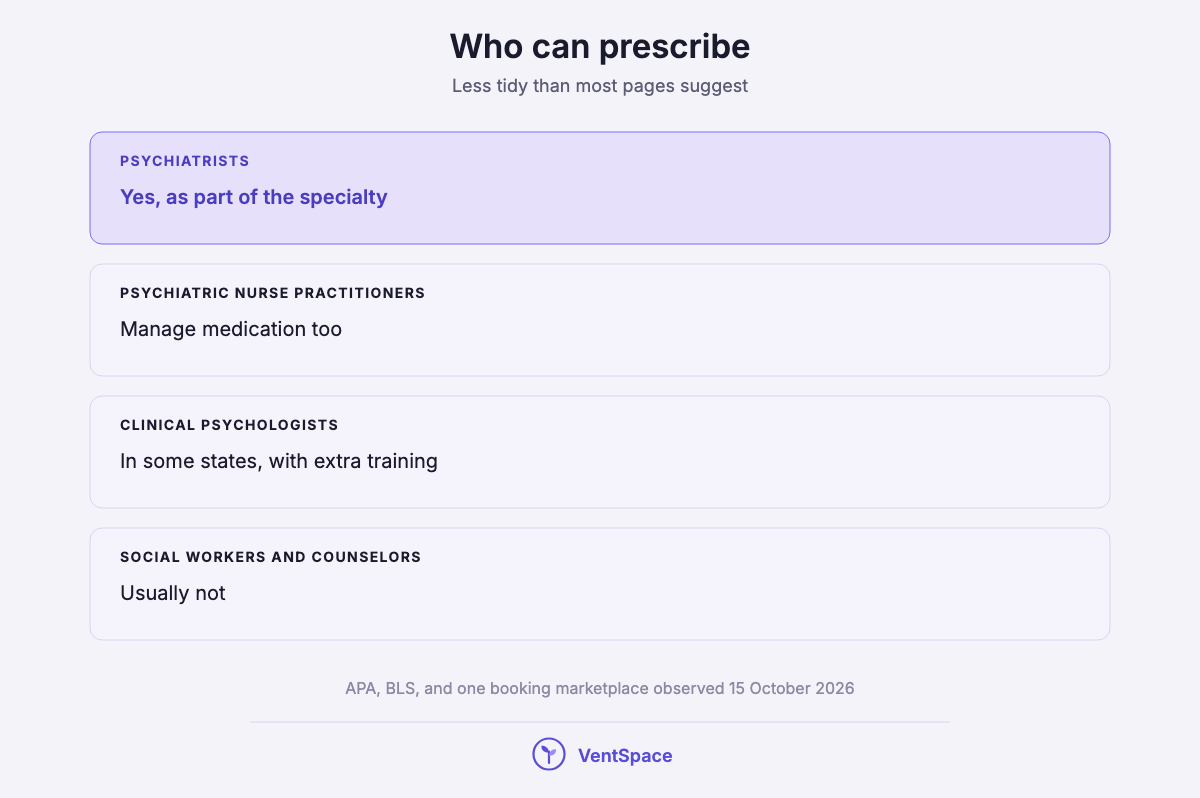
- Psychiatrists prescribe. It is part of their specialty.
- Clinical psychologists prescribe in some states, according to the BLS.
- Psychiatric nurse practitioners manage medication too. On 15 October 2026, the first five providers featured on Headway’s home page were all listed as “Psychiatric Mental Health NP”, with profiles describing medication management.
- Most therapists, including clinical social workers and licensed counselors, do not prescribe.
So if a medication evaluation has been recommended to you, “psychiatric care” on a booking site may mean a nurse practitioner rather than a psychiatrist. Both are licensed to do this work. It is worth knowing which you are booking. A profile will usually say, and if it does not, a short message before the first appointment can settle it in a line.
Quick Summary
Q: Can a therapist prescribe medication?
A: Usually not. Psychiatrists and psychiatric nurse practitioners prescribe, and some states permit clinical psychologists to prescribe. Clinical social workers and counselors usually do not.
Insight “A psychiatrist is able to conduct psychotherapy and prescribe medications and other medical treatments.” (American Psychiatric Association, What is Psychiatry?, physician-reviewed August 2026.)
Difference four: how you reach each
There is no single front door, which is part of why this decision feels harder than it should.
The US National Institute of Mental Health suggests one honest starting point if we do not know where to begin: a primary care provider can “perform an initial mental health screening and refer you to a mental health professional.” Insurer directories and online marketplaces list therapists and psychiatric providers side by side, and a therapist you already see can refer you on.
What this means is reassuring. The first door does not lock the others. A primary care visit, a therapist or a psychiatrist can each send you to the rest.
On the booking sites themselves, the two often sit on the same page. Headway’s home page lists therapists and psychiatric nurse practitioners together, and Headway’s own comparison page describes Grow Therapy’s providers as offering “therapy, medication management, or both”. The filter you choose at the top of the search is the real decision point, and it is easy to change later. If you are not sure which box to tick, the profile text usually says whether someone offers talk therapy, medication management, or both, and a short message before booking can settle it.
Quick Summary
Q: Should I see my doctor before a therapist or psychiatrist?
A: You can. NIMH notes that a primary care provider can do an initial mental health screening and refer you on. It is one good starting point, not a required step.
Which one to book first
This is a practical check about what is already true for you. It is not an assessment, and it does not tell you how unwell you are or whether you need medication. Only the professional you see can work that out with you.
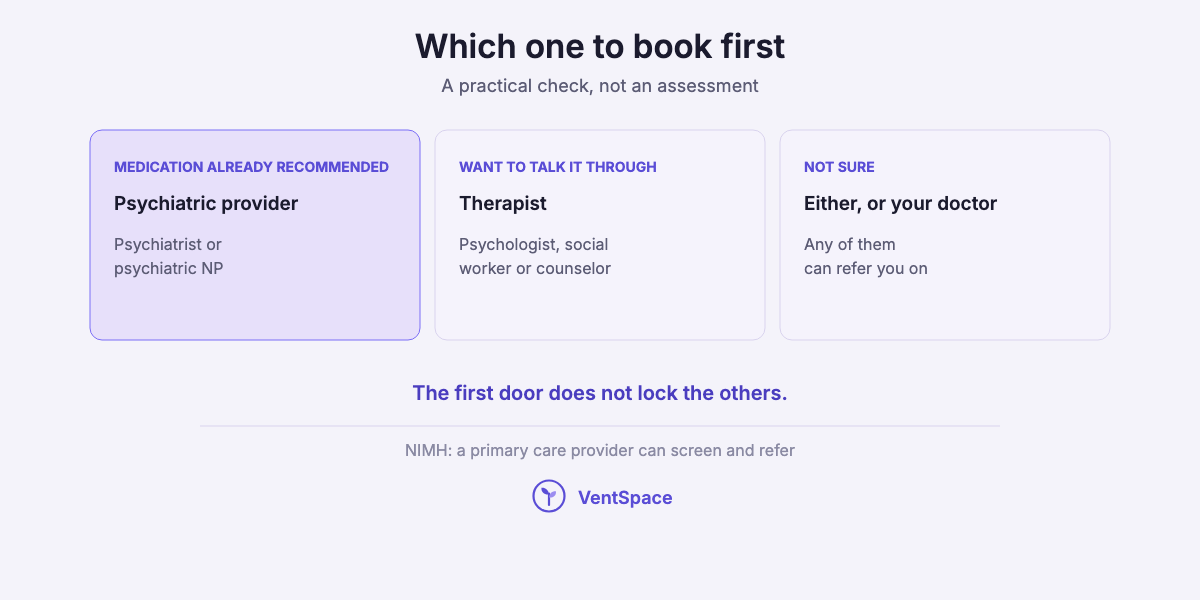
- A clinician has already recommended a medication evaluation: book a psychiatrist or a psychiatric nurse practitioner.
- You already take a psychiatric medication that needs managing: a psychiatric provider.
- You want to talk something through: a therapist.
- You do not know: a therapist or your primary care provider. Either can refer you.
- Mixed, or several apply: book whichever you can see soonest, and say what you are unsure about in the first session.
If you are still circling, it may help to ask ourselves a gentler question: which appointment could we make this week? Our guide to whether you need therapy or just someone to talk to covers the step before this one.
Quick Summary
Q: Should I see a therapist or a psychiatrist first?
A: If medication has already been recommended, or you already take one, start with a psychiatric provider. Otherwise, a therapist or your primary care provider is a sound first step, and either can refer you on.
What to do in each case
If you book a therapist: ask in the first session how they work, how you will both know if it is helping, and whether they would ever suggest a medication evaluation. Our page on whether therapy is worth it covers how to tell if it is working.
If you book a psychiatrist or psychiatric nurse practitioner: bring a short list of what has been hard and for how long, any medications you already take, and your questions. Ask whether they provide therapy too, or recommend someone who does.
Where the line blurs
The word “vs” promises a cleaner choice than the field offers. NIMH describes treatment as something that “usually includes therapy (virtual or in person), medication, or a combination of the two.” Some people see both a therapist and a psychiatric provider, and that is not a sign of failure.
For adult depression, there is trial evidence on combining the two. A 2021 network meta-analysis of 81 trials and 13,722 adults found that people who started with combined psychotherapy and medication were more likely to stay well over the following months than people on standard care (Furukawa and colleagues, World Psychiatry). That is a finding about how treatment can be designed, decided with a clinician, not a rule about you.
We are, all of us, rather bad at knowing in advance what will help. The first appointment is a starting point, not a verdict.
Insight NIMH’s advice for anyone unsure where to begin is to talk to a primary care provider, who can “perform an initial mental health screening and refer you to a mental health professional.” (National Institute of Mental Health, Help for Mental Illnesses, last reviewed April 2026.)
Questions people ask
Do I need a therapist or a psychiatrist?
That is a question to work out with a professional, not one a web page can answer. If you are unsure, a therapist or a primary care provider is a reasonable first booking, and either can refer you.
Does seeing a psychiatrist mean I will be put on medication?
No. A psychiatrist evaluates and plans treatment with you, and can provide psychotherapy. Medication may or may not be part of the plan, and you are part of that decision.
Is a psychologist the same as a psychiatrist?
No. A psychiatrist is a medical doctor. A psychologist has an advanced degree in psychology. Some states permit clinical psychologists to prescribe.
Can I see both a therapist and a psychiatrist?
Yes. NIMH describes treatment as usually including therapy, medication or a combination, and seeing a therapist and a psychiatric provider at the same time is one way that combination happens.
Is a psychiatric nurse practitioner the same as a psychiatrist?
No. Both can manage medication, but a psychiatrist is a medical doctor. On booking sites, check the credential listed on the profile.
The first conversation
Two things are worth carrying out of this page. First, you do not have to decide about medication in order to book. Second, give whoever you see a few sessions, and then ask them directly whether the other kind of help would add something.
If you arrived at this question tired and a little ashamed of needing to ask it, that is not a flaw in you. It is what reaching for help can feel like.
If you are carrying a lot while you wait for that first appointment, and writing some of it down would help, VentSpace is a journaling app that turns what you write into a clear read on your life balance, plus small, doable next steps. Prefer to try it on your laptop first? VentSpace Live runs in your browser, free, with nothing to install. It is not therapy and not a substitute for the appointment you are booking.
About this article

Written by
Sai Subramaniam
Founder, VentSpace
I write these guides because I have been where you are. I am working through my own hard seasons, and I share the things that actually helped me, so that anyone going through it has a steady companion close by instead of facing it alone. VentSpace is the app I built for exactly that: a journaling app that turns what you write into a clear read on your life balance, plus small, doable next steps toward feeling more like yourself.
This writing is honest and every claim is sourced, and it is not a substitute for professional care. If you are struggling, reaching out to a professional is a strong move, not a failure.
Explore VentSpaceTry VentSpace LiveHow this one was checked. Every factual claim traces to a named source, and the source is printed next to the claim rather than kept in a footnote. Quotes are pinned to the work they come from, with the year, the letter or the chapter where one exists. Where a widely repeated claim could not be traced, it was left out and the omission recorded. Where a figure is contested, both sides are printed.
No affiliate links, no paid placements, and nobody paid to appear here. Where we mention our own app, we say that it is ours, we state its limits, and we never position it as a substitute for care.
Reviewed: October 2026. Prices, platforms and product availability move quickly, and anything we could not verify at the time of writing is marked as unverified rather than turned into a number.
Corrections. If something here is wrong, we would rather know. Corrections are made in place, with a note saying what changed.