
“Is ACT better than CBT?” and “Which one will I stick with?” sound like the same question, and they are not.
Here is the difference between ACT and CBT in one line. CBT asks you to examine a hard thought and change it if it does not hold up. ACT asks you to notice the thought, hold it more loosely, and do what matters to you anyway. That is a real difference in what you will spend your sessions doing.
It is not, on the evidence so far, a clear difference in how well they work.
If you are looking at an intake form or a therapist’s profile with both acronyms on it, or you have done a course of CBT that never landed, this page sets the two side by side, shows what the head-to-head research found, and ends with the questions worth asking before you start. Nobody paid for this page, and we do not offer either therapy.
Quick Digest
– The core difference: CBT works on what a thought says. ACT works on how much a thought gets to run things.
– Both are therapies, delivered by trained clinicians, and both have research behind them.
– Does one work better? The four larger, later pooled comparisons we read found no significant advantage for ACT over CBT. One smaller 2012 analysis favored ACT.
– They overlap more than their theories say. In two studies, seeing thoughts as thoughts was linked to improvement in CBT as well as in ACT.
– What decides it: what you would rather practice, and the therapist in front of you.
ACT vs CBT at a glance
| CBT (cognitive behavioral therapy) | ACT (acceptance and commitment therapy) | |
|---|---|---|
| Core aim | Change unhelpful thoughts and behavior to solve the problem | Build the ability to act on what matters while hard thoughts and feelings are present |
| What you do with a hard thought | Examine it, test how realistic it is, and look for other ways of seeing it | Notice it as a thought, loosen its grip, and stop arguing with it |
| Difficult feelings | Something to understand and, over time, reduce | Something to make room for rather than fight |
| What counts as progress | Fewer or milder symptoms | Living more by your values, with or without the symptoms |
| Typical session work | Self-monitoring, testing thoughts, gradually facing what you avoid, practice between sessions | Noticing and defusion work, values, committed action, facing what you avoid as practice in making room |
| Theory and origins | Aaron T. Beck’s cognitive model | Steven C. Hayes, Relational Frame Theory, the “third wave” |
| Head to head | No significant gap in the larger pooled comparisons | No significant gap in the larger pooled comparisons |
What CBT is
The NHS describes cognitive behavioral therapy as “a type of talking therapy where a therapist helps you to change how you think and act.” It rests on Aaron T. Beck’s cognitive model, which the Beck Institute puts as “the theory that the way individuals perceive a situation is more closely connected to their reaction than the situation itself.” In practice, “trained therapists help clients identify distressing thoughts and evaluate how realistic these thoughts are.”
On the NHS you would usually have between 5 and 15 sessions, with practice set between them. It is a structured, time-limited therapy, and the homework is part of the treatment, not an extra. There may be worksheets. You can read about the individual CBT techniques in our guide to CBT techniques.
What ACT is
Acceptance and commitment therapy was founded by Steven C. Hayes. Its professional body, the Association for Contextual Behavioral Science, says ACT “takes the view that trying to change difficult thoughts and feelings in a subtractive or eliminative way as a means of coping can be counter productive.” It works on six processes: acceptance, defusion, attention to the present, a noticing sense of self, chosen values and committed action.
The word “acceptance” is easy to misread, so it is worth reading the definition used in the ACT literature in full: “the active and aware embrace of those private events occasioned by one’s history without unnecessary attempts to change their frequency or form, especially when doing so would cause psychological harm.” The last clause is the one that matters. ACT is not asking you to like your pain. It is asking whether the fight with it is costing you more than the pain does. That is a different question.
What you do with a hard thought
This is the difference you will feel in the room, so here is one thought run through both.
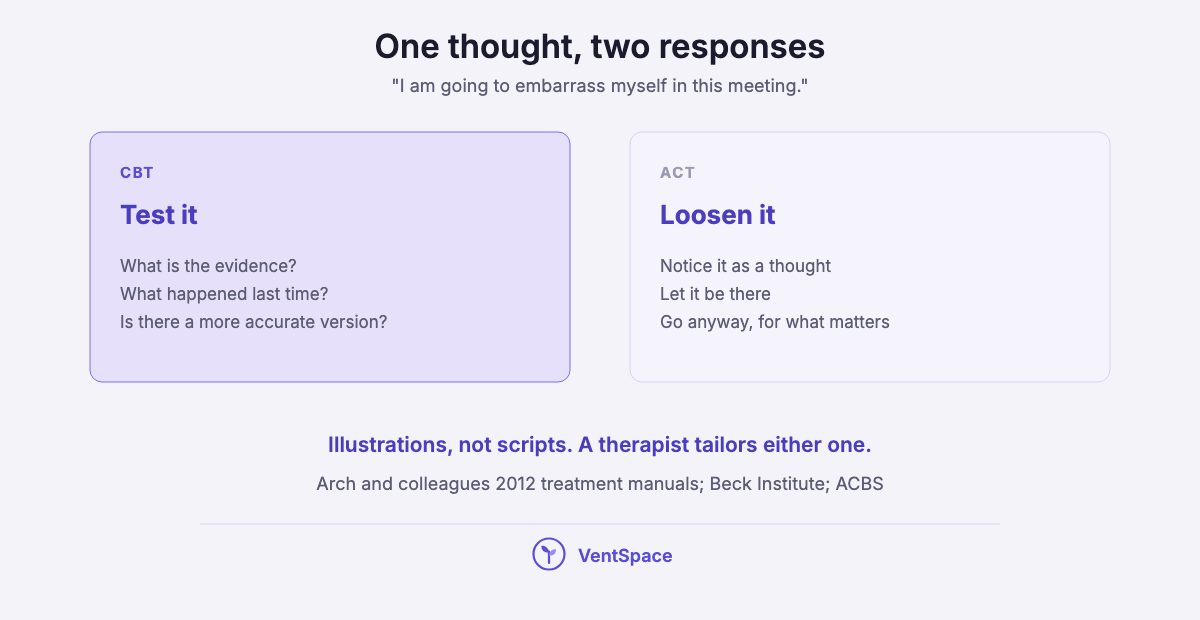
Say the thought is “I am going to embarrass myself in this meeting.” A CBT therapist would likely treat it as a claim to check: what is the evidence, what happened the last few times, what would you say to a friend who thought it, and is there a more accurate version, like “I might stumble on one point and the meeting will carry on.” In the CBT protocol used in one 2012 trial, sessions 2 to 4 emphasized “cognitive restructuring with hypothesis testing”, which is that process done carefully, session after session. An ACT therapist would be less interested in whether the thought is true.
They would help you notice it as a thought your mind produces when something matters, let it be there, and go to the meeting anyway because contributing is something you care about. The ACT manual in the same trial describes this as experiencing thoughts “as part of the broader, ongoing stream of present experience rather than getting stuck in responding to its literal meaning.” Researchers call this defusion. One trial team defined it as “the ability to see one’s thoughts as mental events rather than necessarily as representations of reality.”
Both are illustrations, not scripts, and a real therapist would tailor either one to you. But the shape is different. One argues with the thought. The other stops needing to win.
Insight Every option has a cost, and this is our read rather than a study’s. Arguing with a thought works well when the thought is checkable and wrong. It wears thin when the thought keeps coming back however many times you disprove it. Making room for a thought works well when the fight has become the problem. It feels strange, at first, if what you want is for the thought to stop.
What counts as getting better
CBT, in the NHS’s words, has “the main aim” of “making changes to solve your problems”, so progress means the anxiety, the low mood or the avoidance going down, and the NHS adds that you may be asked to record your progress in a worksheet or diary as you go.
ACT measures something slightly different, and the researchers who compared them head to head had to plan for it. In the 2012 anxiety trial by Joanna Arch and colleagues, the team explained that “CBT emphasized symptom reduction whereas ACT emphasized broader aims of psychological flexibility and valued living”, so they measured both kinds of outcome. In ACT, a week where the anxiety stayed high but you still did the thing you care about can count as progress. In CBT as the NHS describes it, the problem getting smaller is the point.
Neither definition is the honest one and the other a dodge. Both are reasonable. They are different bets about what will help you most.
What happens to the difficult feelings
A 2008 review by Stefan Hofmann and Gordon Asmundson, written to clarify this exact comparison, put it in terms of when each therapy steps in. CBT “promotes adaptive antecedent-focused emotion regulation strategies”, which means changing how you read a situation so the feeling is different to begin with. ACT’s acceptance strategies “counteract maladaptive response-focused emotion regulation strategies, such as suppression”, which means changing what you do once the feeling has already arrived.
So the anxiety in CBT is something you learn to understand and, over time, reduce. In ACT it is something you learn to carry without letting it make the decisions, and the ACT sessions in that 2012 trial used facing feared situations as practice in “making room for, mindfully observing, and accepting anxiety.” Both therapies ask you to stop avoiding things. Avoidance is the shared target. They give you different reasons to.
The theory underneath
CBT grew out of Beck’s cognitive model. In Hayes’s account of the field, it belongs to a second wave that added thoughts to the targets of behavior therapy. ACT is built on Relational Frame Theory, a research program on human language and thinking, and on a philosophy of science called functional contextualism. The “third wave” label is Hayes’s own: he described third-wave treatments as ones that “build on the first- and second-wave treatments, but seem to be carrying the behavior therapy tradition forward into new territory.”
You do not need the philosophy to choose a therapist. It explains one thing. CBT cares whether a thought is accurate. ACT cares whether a thought is useful to hold right now. Everything else follows from that.
Does one work better than the other?
None of the ranking pages we read set the pooled comparisons side by side. Here is what they found, in order.
| Study | What it pooled | What it found on ACT vs CBT |
|---|---|---|
| Ruiz, 2012 | 16 studies, 954 people, ACT vs CBT | Primary outcomes favored ACT (g = 0.40). No significant difference on anxiety |
| Öst, 2014 | 60 trials, 4,234 people | Against cognitive or behavioral treatments, “a small and non-significant effect size of 0.16” |
| A-Tjak and colleagues, 2015 | 39 trials, 1,821 patients | No significant difference between ACT and CBT (p = 0.140) |
| Gloster and colleagues, 2020 | 20 meta-analyses, 12,477 participants | ACT beat most active comparisons, “excluding CBT” |
| Schefft and colleagues, 2023 | 55 depression trials, 5,827 patients | “None of the third-wave therapies were more efficacious than CBT” |
Of these five, the one that favored ACT is the oldest and the smallest, and even it found no significant difference on anxiety. Each of the four larger, later comparisons in this table found no significant advantage for ACT over CBT. On this question, it is a draw. Hayes and his colleagues said as much themselves in 2006: “There are not enough well-controlled studies to conclude that ACT is generally more effective than other active treatments across the range of problems examined, but so far the data are promising.”
The individual trials look the same up close. In a 2007 trial of 101 outpatients with anxiety or depression, people in cognitive therapy and in ACT showed “large, equivalent improvements.” In Arch’s 2012 trial of 128 adults with anxiety disorders, given 12 weekly sessions, both groups “improved similarly across all outcomes from pre- to post-treatment.” At twelve months there were differences in both directions: ACT finishers had lower clinician-rated severity, and the CBT group reported higher quality of life. In a 2018 depression trial of 82 patients, run to test whether CBT would beat ACT, 75% in ACT and 80% in CBT were in remission after treatment, and the difference was not significant. Same story, smaller scale.
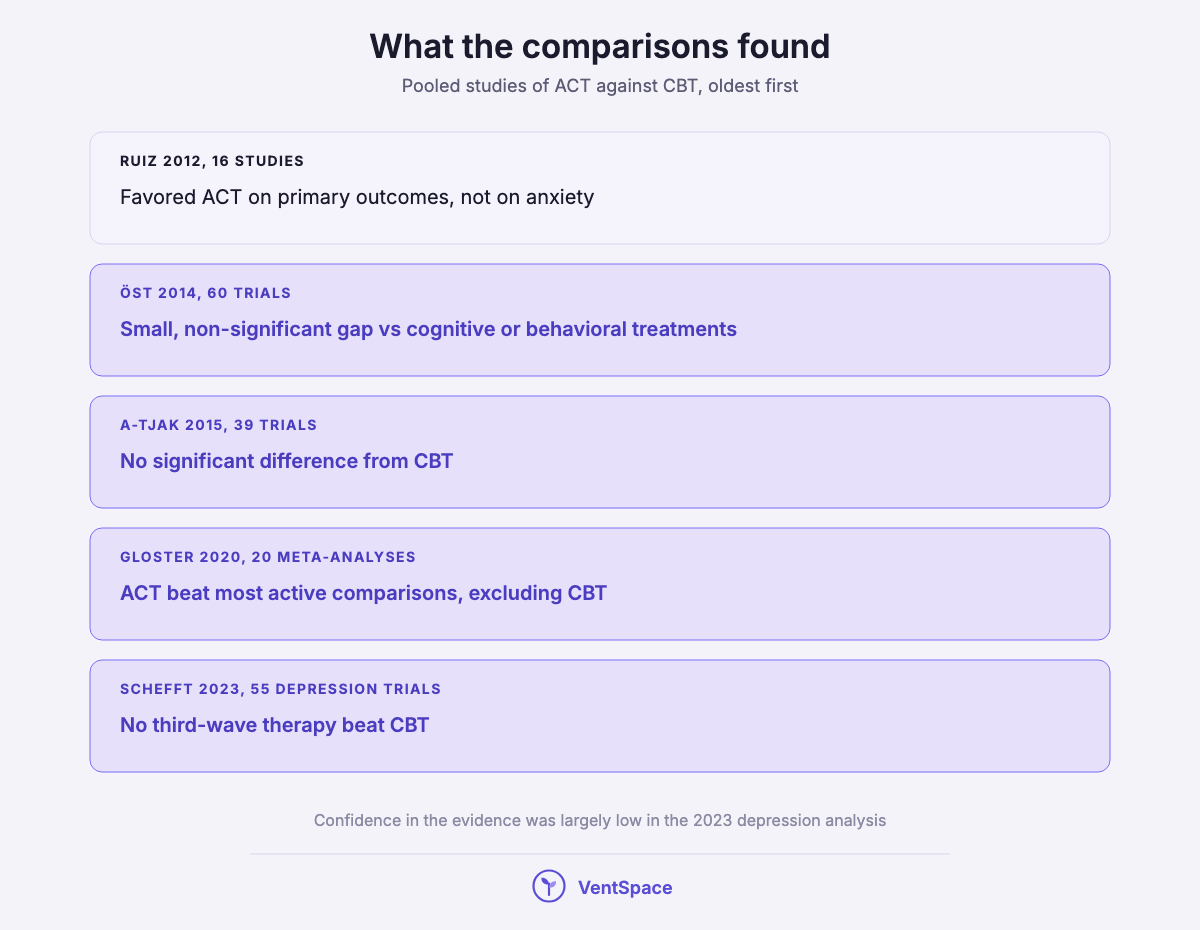
Insight The evidence is not strong in either direction, and that cuts both ways. In the 2023 depression analysis, 27% of trials were at low risk of bias and confidence in the evidence was “largely low.” Öst found no significant improvement in the methodological quality of ACT trials since his 2008 review. “No significant difference” is not the same as “identical”, and the head-to-head trials described here are of anxiety and depression.
This fits a wider pattern. Where researchers compare one established therapy directly against another, for PTSD, for depression, for generalized anxiety, the differences are consistently small or absent. What nobody has shown is why. Pim Cuijpers, Mirjam Reijnders and Marcus Huibers wrote in a 2019 review of the field that “it is still unknown whether therapies work through common or specific factors, or both.” One part of that story is well measured: across 295 studies and more than 30,000 patients, the quality of the working relationship with the therapist tracked outcome at about r = .28. It is a correlation, not proof that the relationship is what heals.
Where the line blurs
The two theories predict different mechanisms. The data were messier. The trials that measured mechanisms found some real differences, and more overlap than the theories predict.
In Arch’s anxiety trial, the team tracked defusion session by session in 67 patients and concluded that “cognitive defusion represents an important source of therapeutic change across both CBT and ACT.” A 2012 study of 174 patients found that less dysfunctional thinking, more defusion and more willingness to act despite unpleasant feelings mediated improvement equally in cognitive therapy and ACT. And in the depression trial, followed for a year, “dysfunctional attitudes and decentering mediated treatment effects of depressive symptoms in both CBT and ACT, whereas experiential avoidance mediated treatment effects in ACT only.” The differences are real too. In the 2007 trial the mechanisms “appeared to differ” between the two groups, and in the 2012 study, using change strategies rather than acceptance strategies mediated outcome in cognitive therapy, with the effect running the opposite way in ACT. So stepping back from a thought seems to help in CBT too, even when nobody calls it that.
The practice overlaps as well. The NHS lists “noticing your emotions and physical feelings without reacting to them” as part of a CBT session. The Beck Institute lists “CBT is aspirational, values based, and goal oriented” among its tenets of good CBT. ACT’s professional body says ACT “uses both traditional behavior therapy techniques (defined broadly to include everything from cognitive therapy to behavior analysis)” and is “not a specific set of techniques or a specific protocol.” Both arms of Arch’s trial included gradually facing feared situations, and Hofmann and Asmundson, whose review was written to clarify the differences between the two, concluded that “ACT techniques are fully compatible with CBT.”
Guidance treats them as neighbors too. For chronic primary pain, NICE’s guideline says to “consider acceptance and commitment therapy (ACT) or cognitive behavioural therapy (CBT) for pain for people aged 16 years and over”, naming both in the same sentence, as of the page we read on 22 October 2026.
How do you choose without a verdict?
This is not a diagnostic, and it is not a recommendation about your condition. That is a call for a clinician who has assessed you. But there is a fair rule of thumb for which method will feel more natural.
If you would rather test a thought and find out whether it is true, CBT’s way of working will probably make sense to you quickly. If arguing with your thoughts has become exhausting, or the same thought comes back however often you disprove it, ACT’s way of working may feel like a relief. Preferring one approach is a legitimate reason to choose it. It is your time in the room.
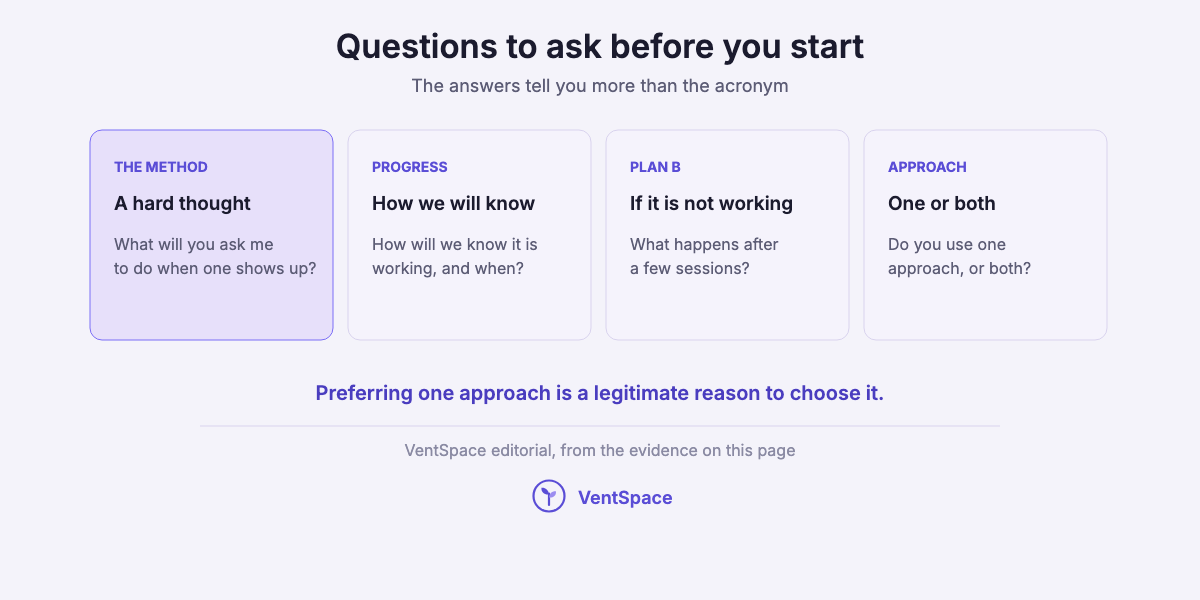
Then ask the therapist, in the first session or the consultation call:
- What will you ask me to do when a hard thought shows up?
- How will we know if this is working, and when will we check?
- What happens if it is not working after a few sessions?
- Do you use one approach, or both?
The answers tell you more than the acronym. With the research where it is, the therapist and the fit are the variables you can do something about. If you are still deciding whether therapy is worth it at all, we have written about whether therapy is worth it and about whether to see a therapist or a psychiatrist first.
If CBT already did not work for you
If you are reading this after a CBT course that did not land, you may be carrying a quiet conclusion with you: that you did it wrong, or that therapy does not work on you. The research points somewhere else. That is worth knowing.
A 2025 review of 11 published case studies of people who left therapy early found seven themes that influenced dropout: misattunement, inert therapeutic relationships, unmanaged therapist responses, unmanaged therapist interventions, rigid protocol adherence, readiness for change, and repeating interpersonal dynamics. Most of that list is about what happened between two people, not about how hard the patient tried. The review also found cases where leaving was a positive act. Across 669 studies and 83,834 clients, about one person in five dropped out of therapy (19.7%), and the rate was not moderated by the type of therapy, although the exact figure depends heavily on how dropping out is defined, which is why you will see much higher numbers quoted elsewhere.
A course that did not fit is information about the fit. It is not a verdict on you, and it is not a verdict on therapy. It may point toward a different approach, a different therapist, or the same approach done differently. What did not work last time is worth telling the next therapist in the first session.
If you are struggling right now
If you are struggling right now
If you are in danger or fear for your safety, call your local emergency number now. If you are in crisis or thinking about harming yourself, in the United States call or text 988 for the Suicide and Crisis Lifeline, or text HOME to 741741 for the Crisis Text Line. Outside the US, findahelpline.com lists the number where you are.
Questions people ask
Is ACT better than CBT?
Not on current evidence. One 2012 analysis of 16 studies favored ACT, while the four larger pooled comparisons we read since, including a 2015 analysis of 39 trials and a 2023 analysis of 55 depression trials, found no significant advantage for ACT.
Is ACT a type of CBT?
It depends on who you ask. ACT is grouped with the “third wave” of behavioral and cognitive therapies, a label its founder used, and it shares CBT’s behavioral roots. Its theory is different, though. Hofmann and Asmundson point to “fundamental differences in the philosophical foundation” even while calling the techniques compatible.
Does ACT mean giving up on feeling better?
No. Acceptance in ACT means not fighting your thoughts and feelings “especially when doing so would cause psychological harm”, and it is paired with committed action toward what matters to you. In the trials above, people in ACT improved on symptoms about as much as people in CBT. ACT just does not make feeling better the only measure.
Is CBT just positive thinking?
No. CBT asks you to evaluate how realistic a thought is, not to swap it for a cheerful one, and the Beck Institute says CBT therapists also work with clients on solving problems.
Can a therapist use both?
Yes. ACT’s own professional body describes it as drawing on traditional behavior therapy techniques, and reviewers have described ACT techniques as fully compatible with CBT.
Two things to take with you
First, the difference between ACT and CBT is in what you are asked to do with a hard thought, not in any clear gap in how well they work. CBT tests the thought. ACT loosens its grip. On the evidence so far, neither has been shown to beat the other consistently.
Second, give whichever you choose a real course before you judge it. On the NHS, a course of CBT usually runs 5 to 15 sessions. Judge the fit with the therapist after the first few, and judge the therapy at the end.
Both are therapy. The choice is about the room.
If you would like somewhere to write down what comes up between sessions, VentSpace is a journaling app that turns what you write into a clear read on your life balance, plus small, doable next steps. Prefer to try it on your laptop first? VentSpace Live runs in your browser, free, with nothing to install. It is not therapy, and it is not a substitute for either of these.
About this article

Written by
Sai Subramaniam
Founder, VentSpace
I write these guides because I have been where you are. I am working through my own hard seasons, and I share the things that actually helped me, so that anyone going through it has a steady companion close by instead of facing it alone. VentSpace is the app I built for exactly that: a journaling app that turns what you write into a clear read on your life balance, plus small, doable next steps toward feeling more like yourself.
This writing is honest and every claim is sourced, and it is not a substitute for professional care. If you are struggling, reaching out to a professional is a strong move, not a failure.
Explore VentSpaceTry VentSpace LiveHow this one was checked. Every factual claim traces to a named source, and the source is printed next to the claim rather than kept in a footnote. Quotes are pinned to the work they come from, with the year, the letter or the chapter where one exists. Where a widely repeated claim could not be traced, it was left out and the omission recorded. Where a figure is contested, both sides are printed.
No affiliate links, no paid placements, and nobody paid to appear here. Where we mention our own app, we say that it is ours, we state its limits, and we never position it as a substitute for care.
Reviewed: October 2026. Prices, platforms and product availability move quickly, and anything we could not verify at the time of writing is marked as unverified rather than turned into a number.
Corrections. If something here is wrong, we would rather know. Corrections are made in place, with a note saying what changed.