
The renewal email lands on a Tuesday, and you count the times you opened the app since the last one. Four, maybe.
Here is the short answer to Calm vs Headspace, because you have two store pages open and a thumb hovering over a free trial: Calm is built around sleep audio you can dip into, with a real free tier inside the app, while Headspace is built around numbered courses you work through session by session, and it has more published trials. Which one wins? Nobody can say. We could not find a single trial that compared the two head to head, and the one systematic review of both apps said, in its own limitations, that it could not compare them either.
So the useful question is smaller.
What would you open it for at 11pm, on the bad night, when you are tired and slightly annoyed at yourself for still being awake? This page answers that, prints today’s prices from the stores, and shows which free trial turns into which bill.
Quick Digest
– Mostly for sleep and dipping in: Calm. Its free tier alone has 230+ meditations and 8 sleep sessions, per its help center.
– Mostly to learn meditation step by step: Headspace. Its courses are numbered session by session, and it has 14 published trials to Calm’s 1, as of a 2021 search.
– Price on Apple, 22 October 2026: Headspace $12.99 a month or $69.99 a year. Calm’s list shows $14.99, $16.99, $69.99 and $79.99.
– The trial is where the money goes: Headspace’s 14-day trial becomes an annual plan. Calm asks you to cancel 24 hours before its trial ends.
– No head-to-head trial exists that we could find. Half of Headspace’s trials had a company tie, and Calm’s 263-adult sleep trial was led by Calm’s Director of Science.
What Calm is
Calm is a meditation and sleep app from Calm.com, Inc., and its pull is Sleep Stories, bedtime stories for adults read by narrators including Matthew McConaughey and Stephen Fry, plus short daily sessions such as Daily Calm with Tamara Levitt and Daily Jay with Jay Shetty, all of it rated 4.8 from 2 million ratings on Apple and 4.5 from 617,000 reviews on Google Play as of 22 October 2026. Its App Store listing promises “100+ exclusive Sleep Stories”.
Some of it is free. Calm’s help center lists 230+ free meditations, 8 free sleep sessions and the first day of every program, without paying anything.
Quick Summary
Q: What is Calm?
A: Calm is a meditation and sleep app built around Sleep Stories and short daily sessions. It has a free tier inside the app and a paid Premium subscription.
What Headspace is
Headspace is a meditation and mindfulness app from Headspace Inc., and its pull is structure: courses such as Basics, numbered session by session, plus sleepcasts, focus music and Move workouts, with a listing that also offers licensed therapists, coaching, psychiatry “through your organization”, and Ebb, which it calls “Headspace’s AI mental health companion”. It is rated 4.8 from 974,000 ratings on Apple and 4.3 from 340,000 reviews on Google Play, as of 22 October 2026.
It also has a new owner. Sword, a health company, announced the deal on 16 September 2026, and Headspace’s own page now says “The acquisition officially closed Fall 2026.” What that means for app subscribers, neither page we read says.
Quick Summary
Q: What is Headspace?
A: Headspace is a meditation app built around step-by-step courses, with therapy, coaching and an AI companion also sold inside it. Sword completed its purchase of Headspace in fall 2026.
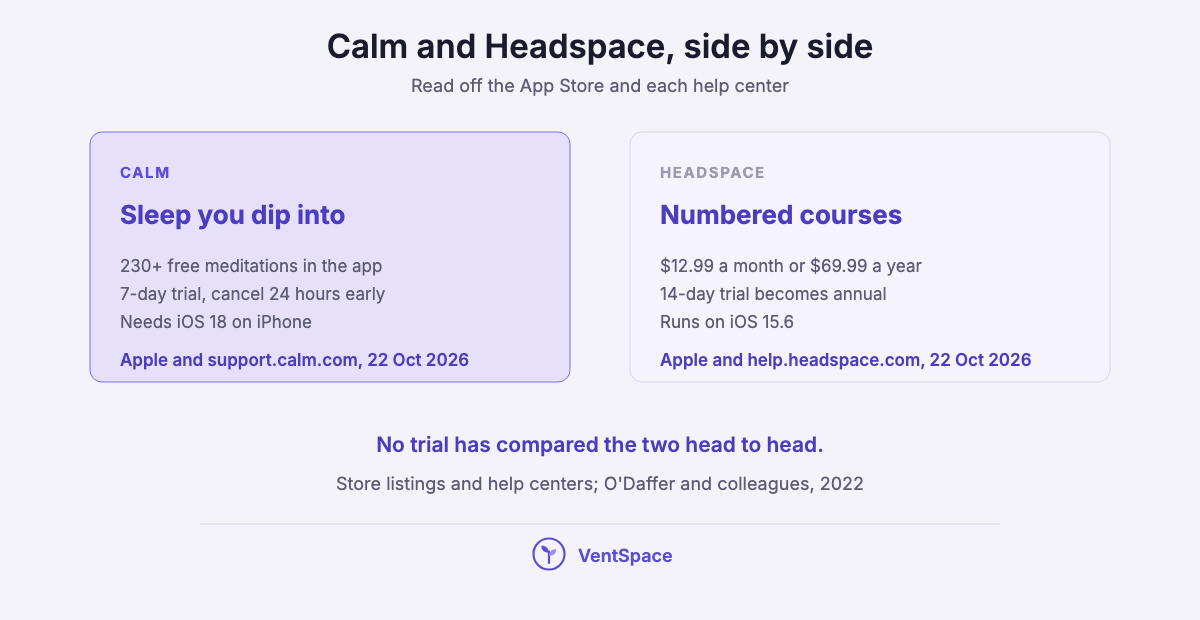
Calm vs Headspace side by side
| Calm | Headspace | |
|---|---|---|
| Built around | Sleep Stories and short daily sessions | Numbered courses such as Basics, plus sleep and focus content |
| Without paying | 230+ meditations and 8 sleep sessions in the app (Calm help center) | Full library during the trial. After it, the help center points to YouTube, Radio Headspace and articles |
| Price on Apple, 22 Oct 2026 | Entries at $14.99, $16.99, $69.99 and $79.99, not labeled by term | $12.99 a month or $69.99 a year (listing, US). A $94.99 entry labeled Headspace Plus also appears |
| What the free trial becomes | A 7-day trial. Cancel at least 24 hours before it ends | The 7-day trial becomes monthly. The 14-day trial becomes annual |
| iPhone needs | iOS 18.0 or later | iOS 15.6 or later |
| Published trials | 1 randomized trial by May 2021, more since, some with company ties | 14 randomized trials by May 2021, half with a company tie |
| Who owns it | Calm.com, Inc. | Sword, since fall 2026 |
Quick Summary
Q: Which is better, Calm or Headspace?
A: Neither has been tested against the other. Calm suits people who want sleep audio and a free tier. Headspace suits people who want a numbered course and want the app with more published trials.
If you need help right now
If you need help right now
If you are in crisis or thinking about harming yourself, please reach out now. In the United States you can call or text 988 for the Suicide and Crisis Lifeline, or text HOME to 741741 for the Crisis Text Line. Outside the US, findahelpline.com lists the number where you are. A meditation app is not an emergency service. A crisis line answers now.
Difference one: what you would use it for
For sleep, Calm has more to dip into. For learning, Headspace walks you through it. That is the real split.
Picture the two nights. On the first, it is 11:40, your shoulders are up near your ears, the group chat has gone quiet, and all you want is a voice reading you a slow story about a village in Provence until you are gone, which is exactly what Calm’s catalog is built for, a shelf you browse in the dark. On the second, it is a Sunday morning, the coffee is still hot, and you have decided, again, to learn how to do this properly, which is what Headspace is built for, since its Basics course starts at Session 1 and counts up from there.
Each design has a cost. One Headspace reviewer wanted “some sleep meditations” and wrote that they were “bombarded with thousands of choices…again leading to more stress than less” (App Store, 20 October 2026), while a Calm reviewer who loved the short sessions and Daily Jay wrote that it is “upsetting that they’re very few sleep stories with female voices” (App Store, 18 October 2026). Two people, not a survey. They still tell you where to look first.
Both apps have been tested on sleep, separately. A Calm trial of 263 adults with sleep problems found less daytime fatigue, daytime sleepiness and pre-sleep arousal after eight weeks against a waitlist (Huberty and colleagues, PLOS ONE, 2021), and a Headspace trial of 135 university staff found better self-rated sleep quality at two, five and eight weeks, longer Fitbit-measured sleep only at week five, and no change in sleep efficiency (Torok and colleagues, Journal of Medical Internet Research, 2026). Neither is a head-to-head. And the wider evidence on meditation programs is cautious about sleep in particular: a review of 47 trials found small-to-moderate improvements in anxiety, depression and pain, and “insufficient evidence” or no effect for sleep, among other outcomes (Goyal and colleagues, JAMA Internal Medicine, 2014).
Quick Summary
Q: Is Calm or Headspace better for sleep?
A: Calm has more sleep content to browse and a free sleep selection. Each has been tested on sleep in its own trials, against a waitlist or no app. No trial has compared them.
Insight “This study continues adding to the ever-developing field of mobile health apps by demonstrating that Headspace can positively impact sleep quality, tiredness, and duration.” (Torok, Gavrilova, Patel and Zawadzki, Journal of Medical Internet Research, 2026. Their own conclusion, from 135 staff at one university, compared with a waitlist.)
Difference two: what you get without paying, and what the trial turns into
Calm gives you something to keep for free. Headspace gives you everything, briefly. Then the trial ends.
Calm’s free tier sits inside the app, with 230+ meditations, 8 sleep sessions, day one of every program and a breathing tool, according to its help center, and the reviews split the way you would expect: one reviewer who had not used “any of the paid aspects” still called the app “so beneficial” (App Store, 20 October 2026), and another wrote on 19 October 2026 that “The free version has most options locked.” Both can be true. It depends on what you came for.
Headspace works the other way round. Its help center says the trial unlocks the entire library, that after it the free options are its YouTube channel, Radio Headspace and its articles, and, in a different article that matters more than anything on its pricing page, that “the 7-day option will become a monthly subscription and the 14-day option will become an annual subscription.” It adds that you will not be charged until the trial is over, and that Apple and Google allow one trial per account.
So the longer trial is the bigger bill.
Pick the 14-day trial, forget about it for two weeks because life happened, and you are paying for a year. One Headspace reviewer said they accepted a 14-day trial and “was immediately charged for an entire year” (App Store, 6 October 2026), which is one person’s report and not a finding about the company. It is still worth five seconds of your calendar.
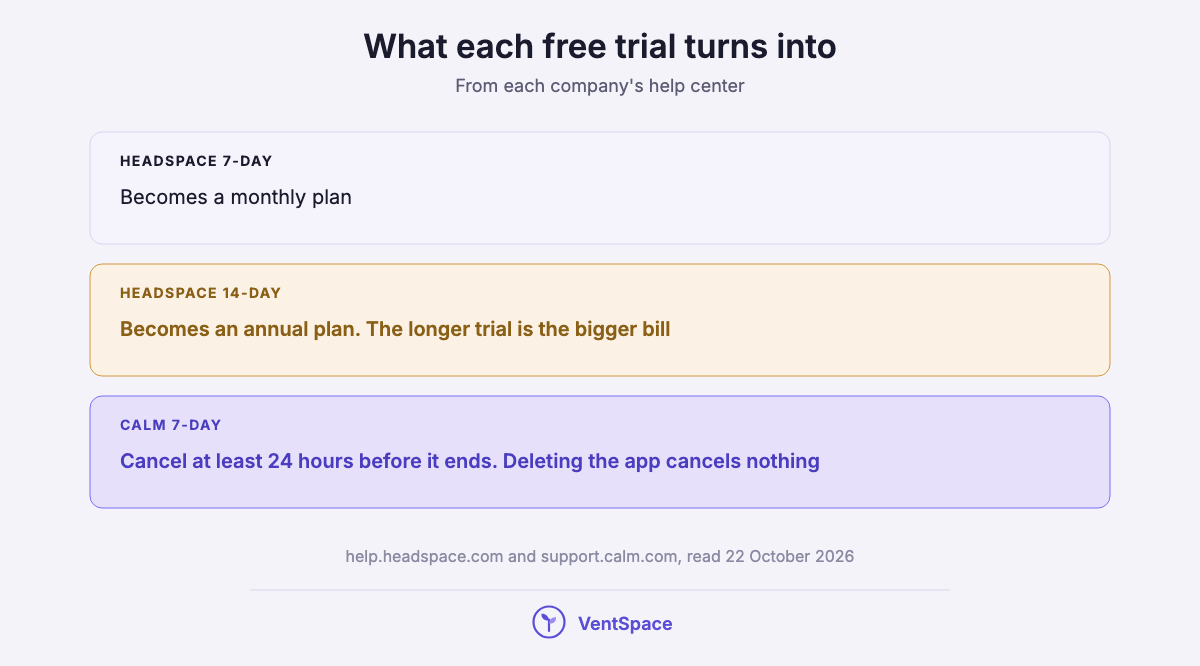
Calm’s rule is plainer. Its help center says “You must cancel at least 24 hours before your trial ends to avoid being charged”, that you keep Premium until the trial runs out, and that uninstalling the app does not cancel anything at all.
Before you tap start, answer these:
- Which trial length am I picking, and what does it turn into?
- What date does it end, and is that date in my calendar right now?
- Did I sign up through Apple, Google or the website? That decides where you cancel.
Quick Summary
Q: Can I use Calm or Headspace for free?
A: Calm has a free tier inside the app, with 230+ meditations and 8 sleep sessions. Headspace unlocks everything during its trial, and its 14-day trial turns into an annual plan unless you cancel.
Insight “You will keep your Premium access until the full trial period is over, even if you cancel immediately.” (Calm Help Center, “Cancel Calm Free Trial”, read 22 October 2026.) Canceling on day one costs you nothing, which is the cheapest insurance on this page.
Difference three: who paid for the evidence
Headspace has far more published trials than Calm. A lot of both apps’ evidence has a company somewhere in it. Most comparison pages print neither fact.
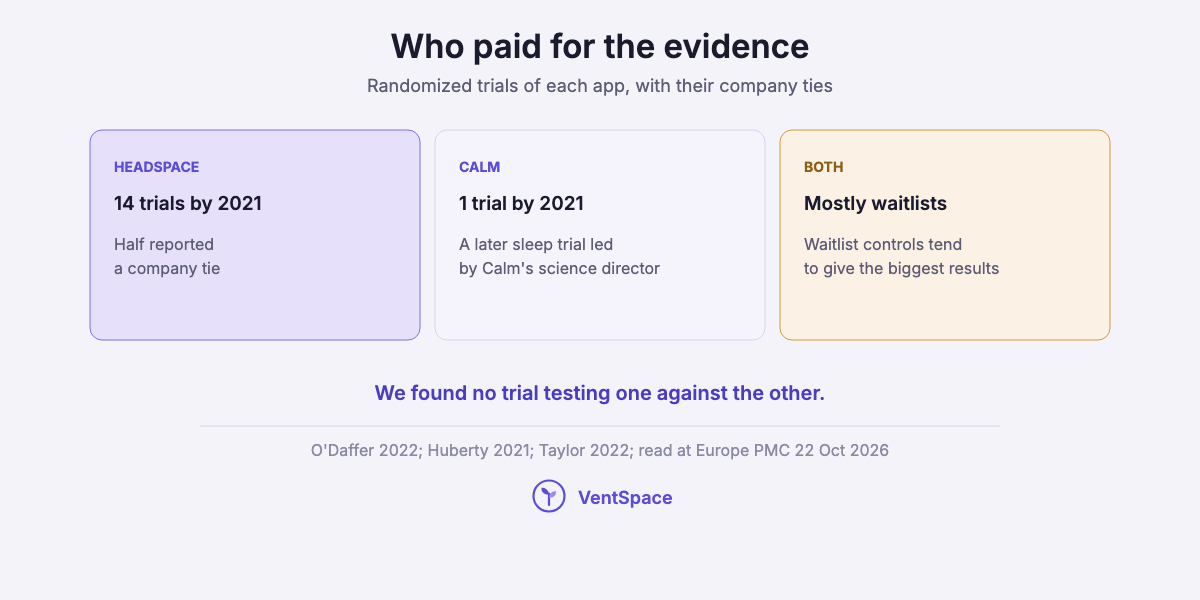
The best count comes from a 2022 systematic review that searched for every randomized trial of either app up to May 2021 and found 14 trials of Headspace and 1 of Calm, with Headspace improving depression in 75% of the studies that measured it and mixed results for stress, anxiety and well-being, in trials that nearly all recruited people from nonclinical groups and were mostly too small to detect small or medium effects. Then the part none of the ten comparison pages we read prints. Half of the Headspace trials reported a conflict of interest involving the company, most often free premium access for participants, and two reported Headspace employee involvement in the study (O’Daffer and colleagues, JMIR Mental Health, 2022).
The biggest Headspace trial since then gave 2,182 NHS staff in England either Headspace or NHS Moodzone, an NHS website of advice on work stress, for four and a half months, and found that Headspace reduced stress, depression and anxiety by small amounts and did nothing measurable for burnout or sick days, in a paper that states the lead researcher’s doctoral studentship was awarded by Headspace (Taylor and colleagues, JMIR mHealth and uHealth, 2022). Small, real, and paid for in part.
Calm’s evidence is thinner and closer to home. The sleep trial in the section above lists its lead author as “the Director of Science for Calm”, with three co-authors on Calm’s scientific advisory board (Huberty and colleagues, 2021), and an earlier Calm stress trial of 88 college students notes that the same author took that role about a year after the study.
Independent trials exist for both. Two Headspace trials at one California university declared no company conflicts, with one saying Headspace supplied the access codes and “had no say over data collection procedures, analyses, or dissemination”, and a pilot of Calm in 80 Canadian undergraduates found lower stress and anxiety and better sleep after 30 days, stating that “The Calm app was not involved in this study in any capacity” (Lew and colleagues, JMIR Formative Research, 2025). One catch runs through almost all of them: the comparison group was a waitlist or no app at all, and in depression trials, comparisons against a waitlist tend to produce the largest results of any kind of control.
None of this makes either app useless. It means the store listings say more than the studies do, and Headspace’s App Store listing reads “Headspace is proven to increase happiness and reduce stress in just 10 days”, with no study named beside it.
Quick Summary
Q: Does Calm or Headspace have more research?
A: Headspace, by a wide margin: 14 randomized trials to Calm’s 1 by 2021. Half of Headspace’s trials reported a company tie, and Calm’s 263-adult sleep trial was led by Calm’s Director of Science.
Insight “The empirical research on Headspace appears promising, whereas there is an absence of randomized trials on Calm.” (O’Daffer, Colt, Wasil and Lau, JMIR Mental Health, 2022.) The same review said it could not compare the two apps because Calm had so few trials.
Difference four: what each says it does with your data
Both collect a lot. Only Calm declares tracking on Apple. These are each developer’s own declarations, which Apple notes it has not verified.
On Apple, Calm lists “Data Used to Track You”: purchases, identifiers and usage data, meaning data that may be used to track you across other companies’ apps and websites, while Headspace’s privacy panel shows no tracking section at all and lists the data linked to you, including health and fitness, location, contact information, search history, customer-support content, and usage. On Google Play, as of 22 October 2026, both say they may share some data types with third parties, both say data is encrypted in transit, and both let you request deletion.
We did not read either privacy policy in full. If what you type matters, spend five minutes there.
Quick Summary
Q: Is Calm or Headspace better for privacy?
A: On Apple, Calm declares data used to track you and Headspace declares none. Both declare sharing some data with third parties on Google Play, and both let you request deletion.
How to tell which one fits you
This is a check about how you would use an app. It is not an assessment of you or of what you need.
- You mostly want help falling asleep: start with Calm’s free tier tonight.
- You want to learn meditation from scratch: start Headspace’s Basics course on the 7-day trial.
- Evidence matters most to you: Headspace has more trials. Read the conflicts above before you count them.
- Your iPhone runs anything below iOS 18: Calm will not install. Headspace needs 15.6.
- Money is tight: Calm’s free tier costs nothing. Headspace’s help center lists no free tier inside the app.
- Mixed result: use Calm’s free tier for a week before paying either. If you missed structure, try Headspace’s 7-day trial next.
Still unsure? Ask these:
- When did I last open a meditation app, and why did I stop?
- Do I want to be put to sleep, or taught something?
- Will I remember the trial date without a reminder?
Quick Summary
Q: Should I get Calm or Headspace?
A: Choose Calm if you mostly want sleep audio or need a free tier. Choose Headspace if you want a numbered course. If you are unsure, start with Calm’s free tier, then try Headspace’s 7-day trial.
What to do in each case
If you choose Calm: use the free tier for three nights first. If you then start the trial, set a reminder for day six, because Calm asks for 24 hours’ notice, and on iPhone you cancel in Settings, then your name, then Subscriptions, not by deleting the app.
If you choose Headspace: pick the 7-day trial if you are unsure. It becomes monthly, not annual. Cancel through the store you signed up with, which on Apple means Settings, your name, Subscriptions, Headspace and Cancel Subscription, per its help center.
On either: open it on the night you most needed it. If two weeks pass and you have not, that is the answer, and it has not cost you anything yet. For the wider map of what different apps are for, our guide to mental health apps sorts them by job, and our list of free mental health apps covers the ones that never charge.
The option that isn’t meditation
Calm and Headspace are closer to each other than either is to some of the jobs people buy them for. Both quiet your head. That is a real job. It is not the only one.
Sometimes the thing keeping you up at 1am is not noise but one thought you have not finished thinking, about the job, the friend who went quiet, or the week that did not add up, and a voice asking you to notice your breath can help you sleep through that thought without helping you understand it at all. Different job. And if what you are carrying is heavier than a bad week, a meditation app is not the right tool, and neither are we: therapy is an ordinary, legitimate next step, with a far larger evidence base than any app on this page.
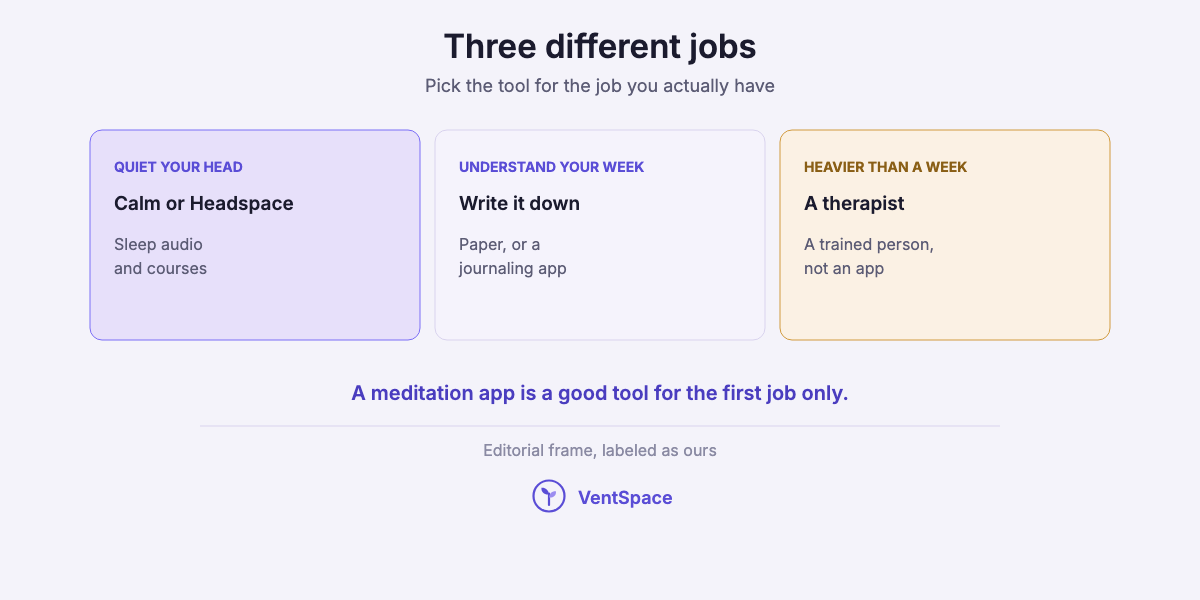
There are roughly three jobs here, with different evidence behind each.
| If what you want is to | Reach for | What has been published |
|---|---|---|
| Quiet your head and sleep | Calm or Headspace | Trials of each app, mostly against a waitlist, several with company ties |
| Understand what is going on in your week | Writing it down, on paper or in an app. VentSpace is ours | VentSpace: none published |
| Work through something with a trained person | A therapist | A large literature. One meta-analysis of the therapy relationship alone pooled 295 studies |
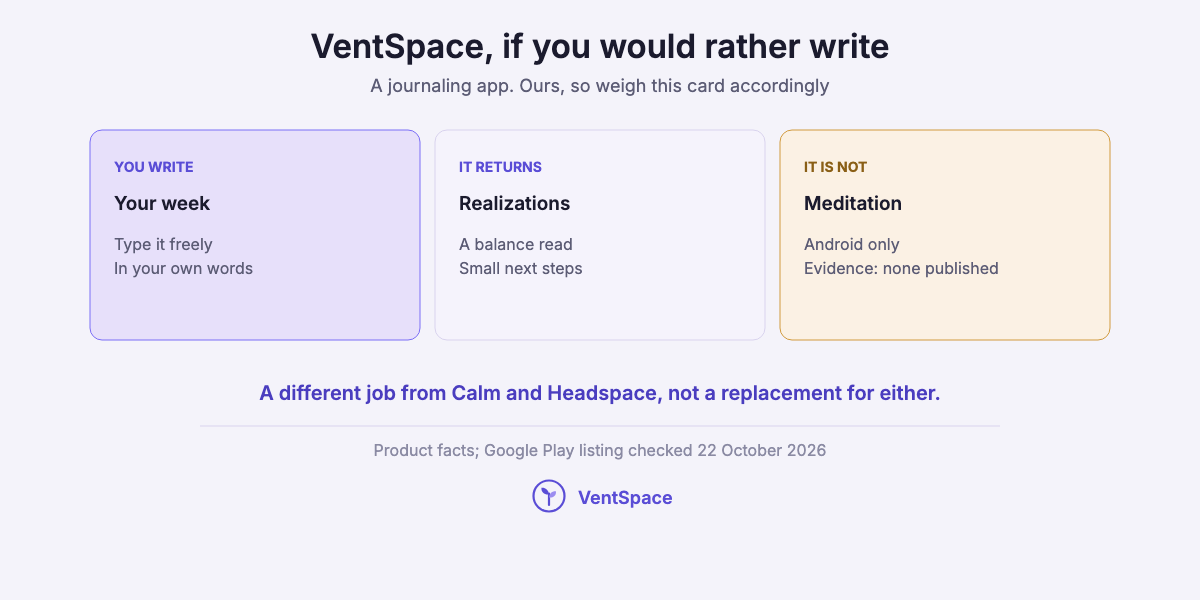
A note on that middle row, because it is ours. VentSpace is a journaling app that turns what you write into a clear read on your life balance, plus small, doable next steps: you write, and over time it hands back named realizations and a short action list. It is free to start, Android only, and newer than both apps above, it is not meditation and it is not therapy, and its evidence cell reads “none published”. Nobody paid to appear on this page. There are no affiliate links.
Get the app: VentSpace on Google Play → Prefer to try it on your laptop first? VentSpace Live runs in your browser, free, with nothing to install.
Quick Summary
Q: Is there an alternative to Calm and Headspace that isn’t meditation?
A: Yes, if what you want is to understand your week rather than quiet it: writing it down, on paper or in a journaling app. If things are heavier than a bad week, therapy is the better-evidenced option.
Questions people ask
Is Calm or Headspace better for anxiety?
Neither has been tested against the other. Headspace has more trials measuring anxiety, with mixed results, and the large NHS trial found a small reduction. Neither is a treatment for an anxiety disorder.
Which is cheaper, Calm or Headspace?
On Apple on 22 October 2026, Headspace listed $12.99 a month or $69.99 a year in the US. Calm’s entries ran from $14.99 to $79.99. Calm’s free tier is the cheapest option of all.
Can I try both?
Yes. Use Calm’s free tier and Headspace’s 7-day trial in the same week. Apple and Google allow one Headspace trial per account, so do not waste it.
Is Headspace proven to reduce stress in 10 days?
That line is from Headspace’s own App Store listing, with no study named beside it. The trials show small effects, mostly in people without a diagnosis, and half reported a company tie.
What happened to Headspace?
Sword announced it would buy Headspace on 16 September 2026, and Headspace says the acquisition closed in fall 2026. Neither company’s page we read says what changes for app subscribers.
Two things to take with you
First, pick by the night you will have, not the person you plan to become. Sleep and a free tier point to Calm, a numbered course you will follow points to Headspace, and nobody has run the test that would crown either one, so anyone who tells you otherwise is guessing.
Second, the clock starts when you tap the trial. You have about a week with Calm, and one or two with Headspace, before money moves. Put the date in your calendar before the first session. Then open it on a bad night. If you have not opened it by the reminder, you already know.
About this article

Written by
Sai Subramaniam
Founder, VentSpace
I write these guides because I have been where you are. I am working through my own hard seasons, and I share the things that actually helped me, so that anyone going through it has a steady companion close by instead of facing it alone. VentSpace is the app I built for exactly that: a journaling app that turns what you write into a clear read on your life balance, plus small, doable next steps toward feeling more like yourself.
This writing is honest and every claim is sourced, and it is not a substitute for professional care. If you are struggling, reaching out to a professional is a strong move, not a failure.
Explore VentSpaceTry VentSpace LiveHow this one was checked. Every factual claim traces to a named source, and the source is printed next to the claim rather than kept in a footnote. Quotes are pinned to the work they come from, with the year, the letter or the chapter where one exists. Where a widely repeated claim could not be traced, it was left out and the omission recorded. Where a figure is contested, both sides are printed.
No affiliate links, no paid placements, and nobody paid to appear here. Where we mention our own app, we say that it is ours, we state its limits, and we never position it as a substitute for care.
Reviewed: October 2026. Prices, platforms and product availability move quickly, and anything we could not verify at the time of writing is marked as unverified rather than turned into a number.
Corrections. If something here is wrong, we would rather know. Corrections are made in place, with a note saying what changed.