
Someone at a wedding asks what you do, and you hear yourself say “oh, it’s just a job” in the slightly apologetic voice people use for a cheap couch. It sounds like a confession.
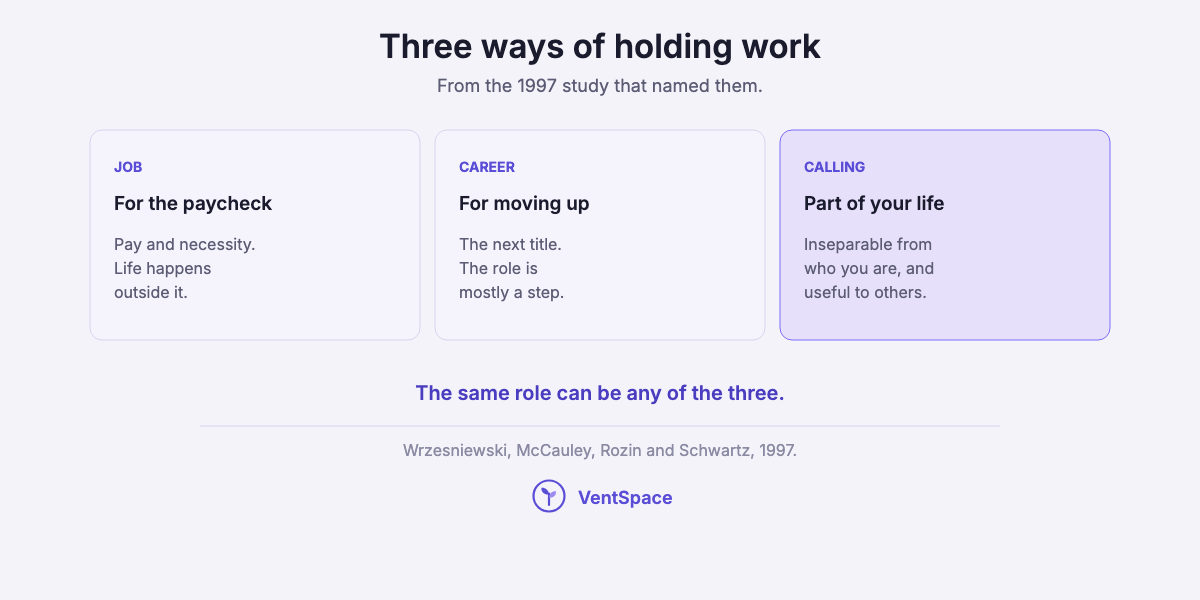
Here is the difference between a job and a career, and a calling, as the researchers who named them describe it. A job is work you do mainly for the money and because you have to. A career is work you do to move up. A calling is work you experience as part of who you are and as useful to other people. Three relationships to work.
Not three rungs. The study that gave us these words did not find the ladder everyone assumes, the one where a job is the floor, a career is the respectable middle and a calling is the prize you are supposed to be out searching for, and the rest of this page shows what it did find, with a side-by-side table, five real differences, and a plain way to tell which one is yours.
The short version
Three ways of holding work, not three ranks. A job is for the paycheck, a career is for advancement, a calling is work that feels inseparable from your life.
The career did not beat the job. In the 1997 study that named them, people with jobs and people with careers were about equally satisfied with life and work.
The calling scored higher, and costs more. It can ask for your evenings, your pay and your comfort.
None of them is fixed to the job title. The same role held all three in one office.
The real question is where your worth is kept, and whether the problem is how you hold the work or the work itself.
What a job is
A job is work you do for what it pays. In the words of the 1997 paper by Amy Wrzesniewski, Clark McCauley, Paul Rozin and Barry Schwartz, the focus is “on financial rewards and necessity rather than pleasure or fulfillment”, and the work is “not a major positive part of life.”
That is a description. Not a verdict. In the paper’s account the work is a means, a way of paying for the life you live outside it, and plenty of people hold their work exactly like that and do it well, on time, with their attention mostly somewhere else.
The idea is older than the psychology. The authors credit the sociologist Robert Bellah and colleagues, whose 1985 book Habits of the Heart argued “that there are three distinct relations people can have to their work”.
What a career is
A career is work you do to move up. The paper’s shorthand is a “focus on advancement”: the next title, the next level, the promotion that tells you, and everyone else, that you are doing well.
People in this frame, the authors write, mark their achievements “not only through monetary gain, but through advancement within the occupational structure.” The current role is mostly a step.
The researchers called this their “thinnest” definition, “focusing almost entirely on the single dimension of advancement.” Hold on to that, because the word “career” carries a great deal more prestige at a wedding than it ever carried in their data, and that gap, we suspect, is where the unease about this question lives.
What a calling is
A calling is work you experience as part of your life rather than separate from it. The paper’s words: “people with Callings find that their work is inseparable from their life,” and the work is felt to be “socially useful”, worth doing for the people it serves.
The word was “originally used in a religious context,” the authors note, for work people felt called by God to do. The modern research use keeps the depth and drops the destiny. Here a calling is a way of relating to the work you do, not a hidden vocation you were born for and must go and find.
It is not reserved for nurses and teachers either. The authors wrote that “salespersons, medical technicians, factory workers, and secretaries could view their work as a Calling.”
Job vs career vs calling, side by side
| Job | Career | Calling | |
|---|---|---|---|
| What the work is for | Pay and necessity | Moving up | Itself, and the people it serves |
| What a good year looks like | Bills paid, life outside work protected | A promotion, a bigger title | Work that felt worth doing |
| What it asks of you | Your hours | Your hours plus your ambition | Your hours, and it can ask for your evenings and your pay |
| Where it can go wrong | Work you can’t stand, done for decades | Advancement stalls and the point goes with it | Sacrifice nobody asked you to stop making |
| In the 1997 study | Satisfaction about the same as the career group | Satisfaction about the same as the job group | Highest satisfaction, and better paid and educated |
| Fixed to a job title? | No | No | No |
Quick Summary
Q: What is the difference between a job, a career and a calling?
A: A job is work done mainly for pay and necessity. A career is work done to advance. A calling is work experienced as inseparable from your life and useful to others. They are three relationships to work, and the same role can be any of them.
A job and a calling sit on one line. A career sits on another
A career is not a better job. It points somewhere else.
The ladder picture puts the career in the middle, halfway between “just a job” and “a calling”, as if the way out of work you don’t love runs through a promotion, and the data in the original study did not draw that picture: when the researchers compared how people rated the three descriptions, the job and the calling behaved like two ends of one line, so that the more someone saw their work as a calling the less they saw it as a job, while the career rating moved on its own, unrelated to either.
Their own summary is that job and calling sit on a single dimension, “work as fulfillment versus work as a boring necessity,” and that seeing your work as a career “seems to be orthogonal to this dimension.” Statistician for “elsewhere.”
So picture two dials. Not three steps. One dial runs from necessity to fulfillment, the other measures how much you care about moving up, and because they are separate you can be high on both, low on both, or anywhere in between, which is exactly why a person can be ruthlessly ambitious about a role they find hollow, and why someone with no interest in promotion can feel their work matters more than almost anything else they do.
A promotion moves one dial. Not the other.
Quick Summary
Q: Is a career just a better version of a job?
A: No. In the study that named the three, seeing work as a job and seeing it as a calling were opposite ends of one scale, while caring about a career was unrelated to either. Advancement and meaning are separate things.
Insight: two dials, not a ladder
“Job and Calling are inversely related, whereas Career is independent of both Job and Calling.” Amy Wrzesniewski, Clark McCauley, Paul Rozin and Barry Schwartz, Journal of Research in Personality, 1997.
Is a career better than a job?
In the study that named them, no. People who saw their work as a job and people who saw it as a career were about equally satisfied with their lives and their work. The gap was small and not statistically significant.
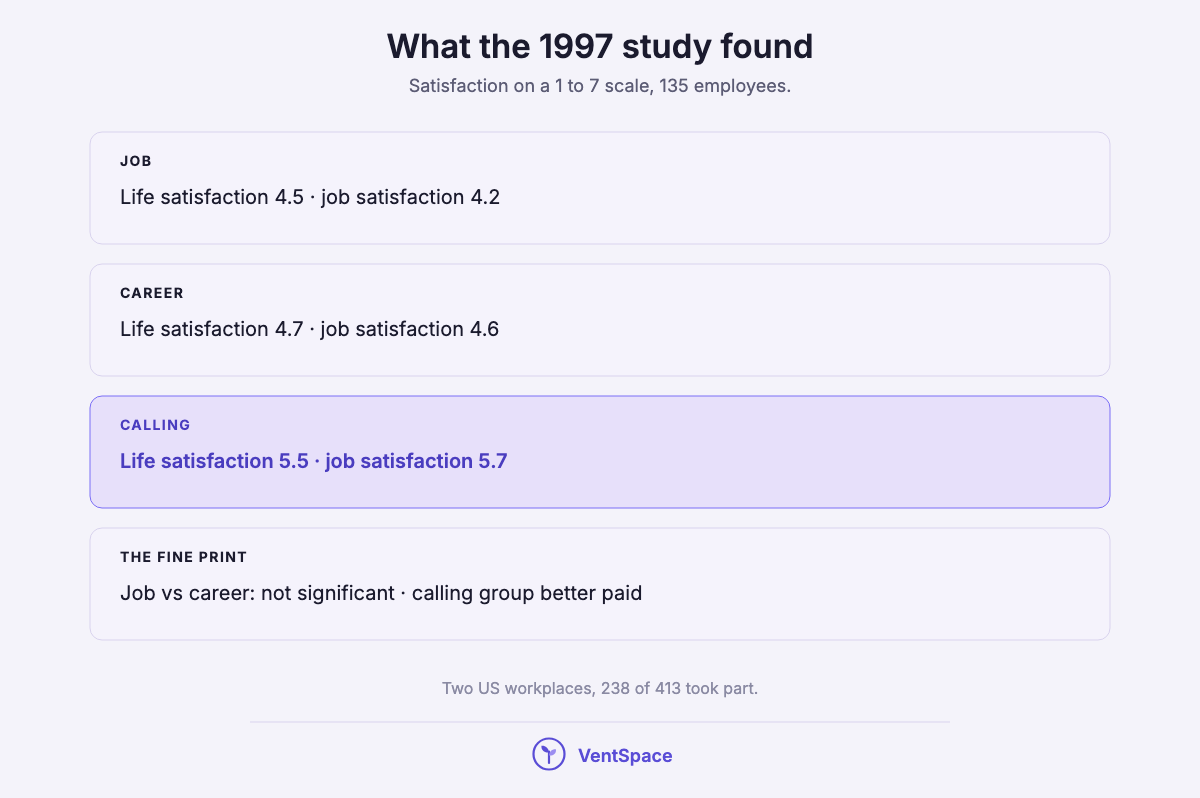
The numbers, on a 1 to 7 scale. Life satisfaction: 4.5 for the job group, 4.7 for the career group, 5.5 for the calling group. Satisfaction with the job itself: 4.2, 4.6 and 5.7. The calling group stood out. The career group did not. In the authors’ words, “the concern with advancement that seems to mark a Career does not appear to confer much advantage over a Job in the various well-being variables we assessed.”
Now the fine print. The study surveyed employees at two American workplaces in the 1990s, a university student health service and a small liberal arts college, where 238 of the 413 people invited took part and 196 of them worked full time, 79% of them women, with an average age of 42, and although the three groups came out almost even in this sample, 44 job, 43 career and 48 calling, that tells you nothing about how the rest of the working world splits.
The calling group also differed in other ways. They were, the paper says, “significantly better paid” and “better educated.” A one-time survey cannot say which came first. A good job may make a calling easier to feel.
The calling’s edge has held up since, in a much larger body of research: a 2023 meta-analysis pooling 201 papers and 185,857 people found that feeling called to your work went with better psychological wellbeing and higher job satisfaction on average, although its authors warn that most of those studies were cross-sectional and self-reported, which limits what anyone can say about cause.
So the honest summary is narrower than the internet’s. Calling: higher, with conditions. Career: no clear edge.
Quick Summary
Q: Is it better to have a career than a job?
A: Not on the evidence that named them. In the 1997 study, job and career groups reported about the same life and work satisfaction. The calling group scored higher, but they were also better paid and better educated, and the study could not show which came first.
Insight: the result nobody quotes
Life satisfaction on a 1 to 7 scale was 4.5 for the job group and 4.7 for the career group, a gap the authors called “small and non-significant.” The calling group averaged 5.5. Wrzesniewski and colleagues, 1997, Table 3, 135 employees.
A calling pays in meaning and charges in other currencies
A calling is not free. It bills you in the things a job leaves alone.
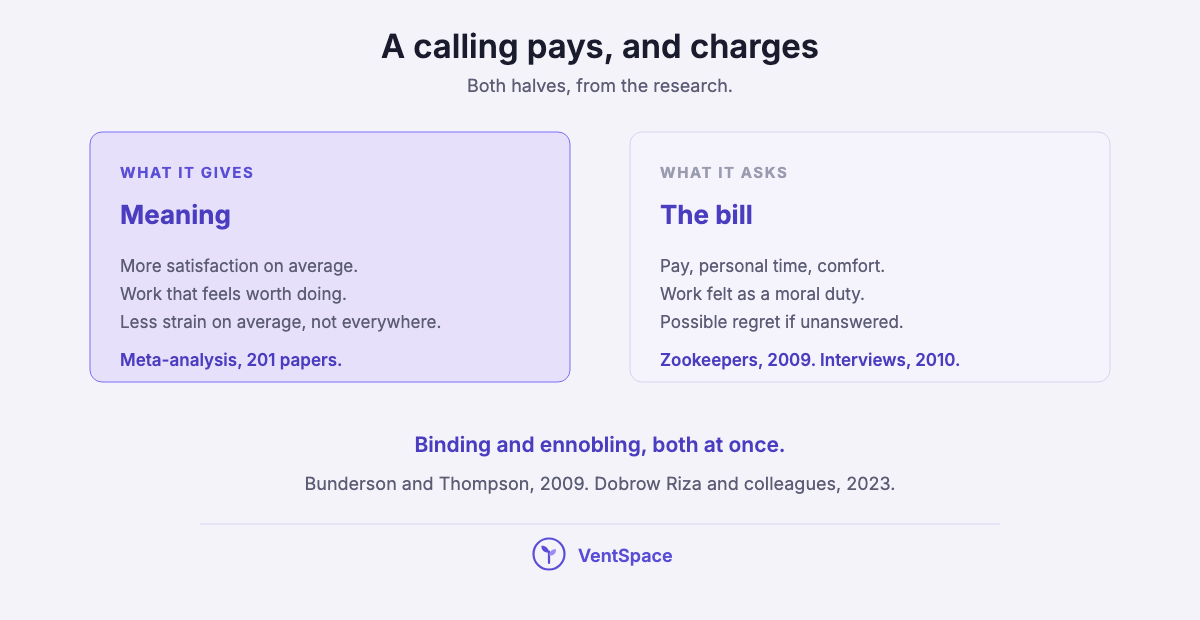
The clearest picture comes from an unlikely place. In 2009 the management researchers Stuart Bunderson and Jeffery Thompson studied zookeepers, a profession in which work as a personal calling turned out to be central, first in interviews and then in a survey of zookeepers from 157 zoos across the US and Canada, and they found that the keepers with a strong sense of calling drew deeper meaning from the work and were also “more likely to see their work as a moral duty, to sacrifice pay, personal time, and comfort for their work, and to hold their zoo to a higher standard.”
Their phrase for it: “both binding and ennobling.”
Picture the Thursday night version. It’s 8:40, everyone else has gone home, and you are still there because the work matters, because nobody else will do it properly, and because leaving on time feels like a small betrayal of the people it’s for. That is the binding half. You signed it yourself, a little at a time.
The bigger research base shows the same double edge in numbers. In the 2023 meta-analysis a calling went with less strain on average, meaning fewer of the costs researchers group under that word, such as exhaustion, irritation and poor sleep, but across the 25 bodies of data on strain the expected range ran from clearly helpful to mildly harmful, so that in some settings a calling seems to protect people and in others it seems to cost them.
One more cost is easy to miss. A 2010 interview study of 31 employees by Justin Berg, Adam Grant and Victoria Johnson started from the observation that “people are frequently unable to work in occupations that answer their callings,” and proposed that pursuing an unanswered calling on the side brings enjoyment and meaning but also “regret over forgone fulfillment” and stress.
Knowing isn’t the same as doing.
Meaning is real. So is the bill.
Quick Summary
Q: Is having a calling always good?
A: No. On average a calling goes with more satisfaction and less strain, but the result varies a lot between settings. Studies of zookeepers found a calling made people more willing to sacrifice pay, personal time and comfort, and an interview study proposed that unanswered callings can bring regret and stress.
Insight: the double edge, in the researchers' words
“We found that a neoclassical calling is both binding and ennobling.” J. Stuart Bunderson and Jeffery A. Thompson, Administrative Science Quarterly, 2009. Their closing line: “deeply meaningful work can become a double-edged sword.”
None of them is welded to the job title
The same job can be any of the three. The 1997 researchers found this one surprising.
To check whether the whole pattern was about status and pay, they looked separately at the 24 administrative assistants in their sample, people doing the same work at the same college for similar money, and found them split almost evenly: nine saw it as a job, seven as a career and eight as a calling.
Twenty-four people is a tiny group, and the authors said so, warning that it “cannot have more than heuristic value.” Still, it makes a point the job title hides. Your relationship to your work is partly yours. Good news, mostly.
Researchers have a name for the part you can shape. Amy Wrzesniewski and Jane Dutton called it job crafting, meaning the quiet redesign people do when they change what they do, who they do it with and how they think about it, and a 2019 meta-analysis by Bogdan Oprea and colleagues, pooling 14 studies of programs that teach it, found small but real increases in job crafting and in how engaged people felt at work.
Small is the right word. Crafting can make a job feel more like yours. It cannot turn underpaid, unsafe or exhausting work into a calling.
Quick Summary
Q: Can a job become a career, or a calling?
A: It can shift. In the 1997 study, 24 administrative assistants doing the same work split almost evenly across job, career and calling. Job crafting, changing your tasks, people and framing, has small measured effects on engagement. It does not fix bad working conditions.
Insight: what crafting means
Employees “craft their jobs by changing cognitive, task, and/or relational boundaries to shape interactions and relationships with others at work.” Amy Wrzesniewski and Jane E. Dutton, Academy of Management Review, 2001.
Where your worth is kept
The orientation is not the risk. Where you keep your worth is.
A job, a career and a calling can each be a healthy way to hold work. The trouble starts when one of them becomes the only place you feel like anyone.
Researchers who study passion make a useful split here. Harmonious passion is love for an activity you can still put down. Obsessive passion is love that has you, the kind one questionnaire item describes as “difficulties controlling the urge to engage”. A 2015 meta-analysis by Thomas Curran and colleagues found that harmonious passion went with less burnout, as measured in those studies, while obsessive passion went with more negative feelings, and because their data pooled work, sport, school and hobbies together, this is a finding about passion in general rather than about jobs, though the shape is worth knowing.
A Swedish employee in a 2025 interview study put the everyday version plainly: “A great part of oneself is your job given that you spend so much time of your life at work.” Not a problem. It becomes one when a bad week at work stops being a bad week and starts to feel like a verdict on you.
A plainer way to hold it: career is one area of a life, next to relationships, health and the rest, not the score for the whole thing. For purpose beyond work, our piece on purpose versus productivity goes further.
If work has become the only place you feel worth anything, and that thought frightens you, talking to someone is a reasonable next step. Therapy is one option. For a lot of people it’s the right one.
Quick Summary
Q: What if my job has become my whole identity?
A: Caring about your work is not the problem. Researchers separate passion you can step away from, which goes with less burnout, from passion you cannot, which goes with more negative feelings. If work is the only place you feel worth anything, it is worth talking to someone.
Insight: passion that you have, and passion that has you
In a meta-analysis of 94 studies, harmonious passion correlated with burnout at −.44 and obsessive passion at .15 (in the 15 studies that measured burnout), and obsessive passion correlated with negative affect at .25. Thomas Curran, Andrew Hill, Paul Appleton, Robert Vallerand and Martyn Standage, Motivation and Emotion, 2015.
How to tell which one is yours
This is not a test. It has no score, no norms and no validation. It will not hand you a type.
- Picture the money problem solved for good. Does this work stay in the picture, some other work, or none?
- When you imagine five years from now, are you picturing a title, a kind of work, or a life outside work?
- When someone asks what you do, what do you say first: the role, the company, or something that isn’t about work at all?
- When work goes badly, does it spoil your week, or your sense of who you are?
- What did you give up for work this month, and did it feel like a choice?
- If the work disappeared tomorrow, how fast could you say who you are without it?
If the money question and the five-year question pointed away from work, you probably hold it as a job. If they pointed at a title, a career. If they pointed at the work itself, and it costs you things you didn’t fully choose, a calling, with its bill attached.
Mixed answers are normal. In the original study 135 of the 196 full-time respondents could be placed in one description, but some rated two as equally like them, and your answer this year may not be your answer in five.
Quick Summary
Q: How do I know if I have a job, a career or a calling?
A: Ask what you would keep doing if money stopped mattering, what you picture in five years, and what work costs you. Pointing away from work suggests a job, toward a title suggests a career, toward the work itself suggests a calling. Mixed answers are normal.
What to do in each case
If it’s a job: stop apologizing for it. A job that pays the bills and leaves your evenings alone is a legitimate way to hold work, and in the study that named it, it did no worse on wellbeing than a career. Protect the life it pays for. If you want more from the hours, try one small craft this month, one task you would rather do more of or one colleague you would rather work alongside.
If it’s a career: check that the next rung is still something you want. In the 1997 data advancement alone bought no extra satisfaction. Ask what the promotion is for.
If it’s a calling: look at the bill. Write down what it took this month in evenings, money and favors to people who didn’t ask. Keep the meaning. Renegotiate one cost.
If the problem is the job itself: no relabeling will fix it. A workplace that treats you badly is a property of the workplace, not a flaw in how you see your work. Changing jobs is a real option for some people and not for others, depending on money, visas, care and the local job market, and only you can weigh that, but if you do move, expect the lift to fade, because a German panel study found that people who chose to change employers were far more satisfied with the new job “though in the short term only.” The fade is normal. It is not proof you chose wrong.
If you want to see how much room work is taking up in the rest of your life, VentSpace is a journaling app that turns what you write into a clear read on your life balance, plus small, doable next steps. Career is one of the seven areas it reads, alongside relationships, health and growth. It is ours, free to start on Google Play as of October 2026, Android only, with no published evidence on outcomes. Not on Android, or at a desk? VentSpace Live runs in your browser, free, with nothing to install. It will not tell you whether to stay in a job.
Quick Summary
Q: What should I do if my work is just a job?
A: Nothing is wrong with that. Protect the life it pays for, and if you want more from the hours, try one small change in your tasks or the people you work with. If the job itself is harming you, that is a workplace problem, not an attitude problem.
Where the line blurs
These are not boxes. The three descriptions were written starkly, the authors admit, to make the distinctions clear. Real people lean.
They also move. The authors speculated that “many younger people who think they have Careers later become resigned to having only a Job.” A guess, not a finding, and they labeled it as one, but anyone who has watched a promotion track quietly flatten out over a few years, while the job description stayed the same and the excitement did not, will recognize the shape.
And the research is narrower than the conversation. One survey, two American workplaces, mostly women, three decades ago. The later work on callings is far larger and mostly a snapshot in time. Use the distinction to see your work. Not to rank it.
Questions people ask
What is the difference between a job and a career?
A job is work you do mainly for pay and because you need to. A career is work you do with an eye on advancement. In the research that named them, they are two different relationships to work, and neither was linked to higher life satisfaction than the other.
Is it better to have a career than a job?
Not on the study the distinction comes from. In the 1997 study, people who saw their work as a career were no more satisfied with life or work than people who saw it as a job. The idea that a career is automatically more fulfilling is folklore.
Can a job become a career?
Yes, if you start caring about advancement in it. More interesting: the same role can be held as a job, a career or a calling. In one office, 24 administrative assistants split almost evenly across all three.
What is a calling at work, and do I need one?
A calling is work you experience as inseparable from your life and useful to others. You don’t need one. It goes with higher satisfaction on average, and it can also cost pay, personal time and comfort. “Find your passion” is advice, not a finding.
Is “it’s just a job” a bad answer?
No. It is one of three legitimate ways to hold work. It only becomes a problem if the job itself is harming you, which is a different problem with different fixes.
Two things to keep
These are three ways of holding work, not three ranks. A job is not a failed career, and a calling is not a prize. Each one pays you in something and charges you in something else.
And if the work itself is the problem, none of this fixes it. Changing a job is slower, costlier and more tangled up with money and other people than the internet makes it sound, and in the German study the new-job glow was short-lived. That is not a reason to stay. It is a reason to decide with your eyes open.
Know what your work is to you. Then check the bill.
About this article

Written by
Sai Subramaniam
Founder, VentSpace
I write these guides because I have been where you are. I am working through my own hard seasons, and I share the things that actually helped me, so that anyone going through it has a steady companion close by instead of facing it alone. VentSpace is the app I built for exactly that: a journaling app that turns what you write into a clear read on your life balance, plus small, doable next steps toward feeling more like yourself.
This writing is honest and every claim is sourced, and it is not a substitute for professional care. If you are struggling, reaching out to a professional is a strong move, not a failure.
Explore VentSpaceTry VentSpace LiveHow this one was checked. Every factual claim traces to a named source, and the source is printed next to the claim rather than kept in a footnote. Quotes are pinned to the work they come from, with the year, the letter or the chapter where one exists. Where a widely repeated claim could not be traced, it was left out and the omission recorded. Where a figure is contested, both sides are printed.
No affiliate links, no paid placements, and nobody paid to appear here. Where we mention our own app, we say that it is ours, we state its limits, and we never position it as a substitute for care.
Reviewed: October 2026. Prices, platforms and product availability move quickly, and anything we could not verify at the time of writing is marked as unverified rather than turned into a number.
Corrections. If something here is wrong, we would rather know. Corrections are made in place, with a note saying what changed.