
We almost did not write another list of strengths, and the reason is worth admitting. There are already lists of ninety words out there, alphabetical, every word as true and as false as the next. Reading one, you can talk yourself into all of them or none of them. Is that what you were hoping for?
So here is the small reset this page is built on. A strength is not a word. It is something you can show. The word is only a label for a pattern in your ordinary week, and the pattern is what makes it yours.
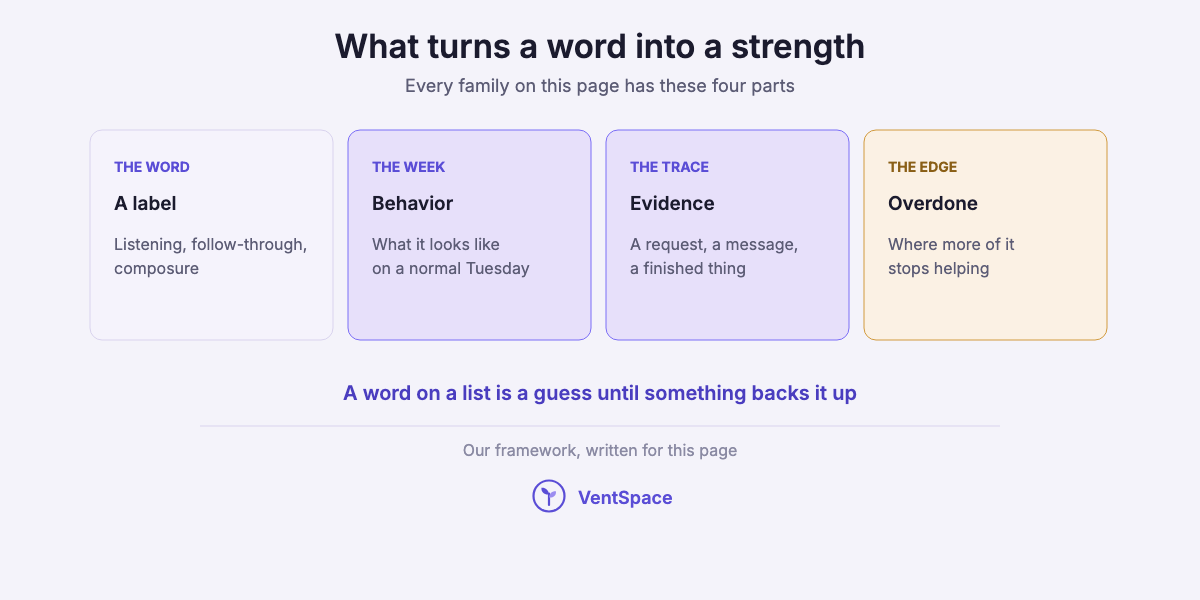
Below are 65 personal strengths in 13 families, each described the way it shows up on a normal Tuesday, with the evidence it leaves, who tends to spot it first (our judgment), and what it looks like when it is overdone. After the list there is a short way to check which ones are yours. There is no test and no top five.
Strengths at a glance
- Reading people: listening, tact, sensing a mood, empathy, knowing when to say nothing.
- Bringing people together: connecting people, hosting, mediating, building trust, including the quiet one.
- Lightening the room: humor, warmth, encouragement, generosity, perspective.
- Making things clear: explaining, summarizing, writing plainly, teaching, translating jargon.
- Seeing problems early: noticing, anticipating, spotting patterns, attention to detail, checking quality.
- Getting things finished: follow-through, reliability, persistence, pacing, closing loops.
- Thinking it through: weighing evidence, judgment, healthy skepticism, deciding, seeing the other side.
- Keeping things organized: planning, scheduling, building systems, budgeting, logistics.
- Staying steady under pressure: composure, triage, staying level, recovering after a setback, patience.
- Holding a line: honesty, fairness, keeping promises, saying no, standing up for someone.
- Starting things: initiative, asking first, making a first draft, volunteering, taking a small risk.
- Making things: craft, fixing, building, designing, cooking.
- Learning fast: curiosity, picking up tools, asking good questions, adapting, teaching yourself.
How we built this list
- Written from scratch. Every family and every description is ours, in plain words. The grouping is our editorial choice, not a scientific classification.
- Behavior, not adjectives. Each strength is described as something a person does in an ordinary week.
- Evidence it leaves. The trace a strength leaves behind: a message, a request, a finished thing.
- Who notices it first. Our judgment of who tends to see it before you do. Some strengths are easier to see from outside.
- Overdone. Many positive traits seem to have a point where more stops helping (see the Insight on overdone strengths). Each family names what that can look like, in our judgment.
- No ranking. The families are not in order of importance, and nothing here produces a top five.
Strengths with people
1. Reading people
You notice the colleague who went quiet halfway through the meeting, and you ask about it later, privately. That is this family. It is mostly invisible to the person who has it, because from inside it just feels like paying attention. Do people tell you things they have not told anyone else at work?
| The five strengths | Listening, tact, sensing a mood, empathy, knowing when to say nothing |
| In a normal week | Catching what someone did not say · choosing the right moment for a hard sentence |
| Evidence it leaves | People who seek you out after meetings · “how did you know?” |
| Who notices it first | The people you have listened to |
| Overdone, it looks like | Carrying everyone’s mood as if it were yours to fix |
Spot it: count how many people confided in you this month without being asked.
In practice: look for it in the groups you belong to that are under strain.
Watch for: being the room’s listener so often that nobody listens to you.
2. Bringing people together
Some people make introductions without thinking about it. They remember who needs to meet whom, and they host the dinner or start the group chat. This family is about the space between people rather than any one conversation. When a team works well, are you somewhere near the reason?
| The five strengths | Connecting people, hosting, mediating, building trust, including the quiet one |
| In a normal week | Introducing two people who should talk · smoothing a disagreement before it hardens |
| Evidence it leaves | Friendships or collaborations that started with you · invitations that go through you |
| Who notices it first | The people you introduced |
| Overdone, it looks like | Keeping the peace by never letting anyone disagree |
Spot it: list three working relationships that exist because you connected two people.
In practice: it is easy to undervalue because the result belongs to other people.
Watch for: organizing everyone’s evenings and none of your own.
3. Lightening the room
A tense meeting gets a little easier when you are in it. Maybe it is a joke at the right moment, maybe it is that you thank people by name. This family is about how a room feels with you in it. It is easy to dismiss as personality rather than strength. Would people miss it if you stopped?
| The five strengths | Humor, warmth, encouragement, generosity, perspective |
| In a normal week | Easing tension · noticing effort and saying so · offering help before being asked |
| Evidence it leaves | People who say they look forward to working with you · thank-you messages |
| Who notices it first | Anyone having a hard week near you |
| Overdone, it looks like | Joking past something that needed to be said seriously |
Spot it: look at the last month of messages for anyone thanking you for something other than a task.
In practice: look for it in other people’s better days.
Watch for: being cheerful for others while nobody checks on you.
Quick Summary
Q: What are examples of personal strengths with people?
A: Reading people, bringing people together and lightening the room. In practice that means listening and tact, connecting and mediating, humor and encouragement. They can be easier for other people to see than for you, because from the inside they feel like ordinary attention.
Insight: who sees what
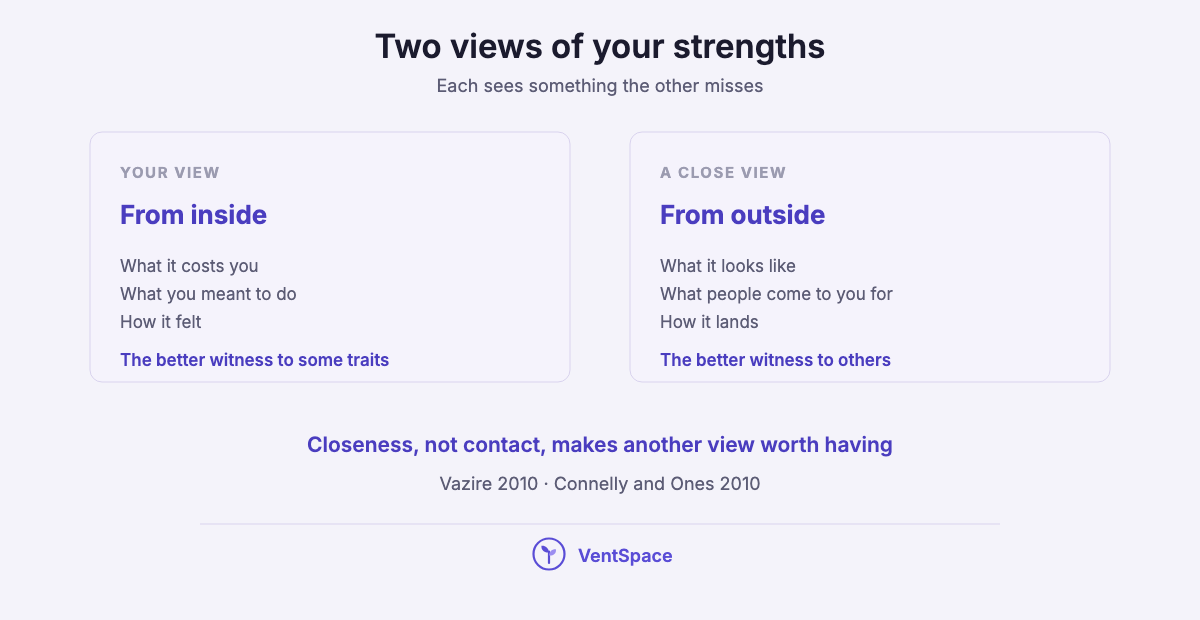
In the study that proposed the self-other knowledge asymmetry, Simine Vazire (2010) compared 165 people’s self-ratings with ratings by friends and strangers against behavioral tests. Her summary: “the self was the best judge of neuroticism-related traits, friends were the best judges of intellect-related traits, and people of all perspectives were equally good at judging extraversion-related traits.” Neither view is the whole picture.
Strengths with problems and work
4. Making things clear
You read a confusing email and can say in one sentence what it is asking. People send you their drafts before they send them to anyone else. This family turns complexity into something usable, and it often goes unnoticed because the result looks simple. When someone says “that makes sense now”, what did you just do?
| The five strengths | Explaining, summarizing, writing plainly, teaching, translating jargon |
| In a normal week | Rewriting a message so it gets read · explaining a process to a new person |
| Evidence it leaves | Fewer repeat questions · drafts sent to you to “look over” |
| Who notices it first | Newcomers and anyone outside your specialty |
| Overdone, it looks like | Simplifying something that needed its complexity kept |
Spot it: count how often this month someone asked you to explain, check or rewrite something.
In practice: it is worth naming in any role where other people need to understand things.
Watch for: becoming everyone’s editor and nobody’s author.
5. Seeing problems early
You spot the error in the spreadsheet before it goes out. You notice the deadline that clashes with a long weekend. This family is about attention that runs ahead of events. Is it often you who says “wait, what about this?” before anyone else does?
| The five strengths | Noticing, anticipating, spotting patterns, attention to detail, checking quality |
| In a normal week | Catching an error · flagging a risk before it lands |
| Evidence it leaves | Problems that did not happen · corrections with your name on them |
| Who notices it first | Whoever would have had to fix the problem |
| Overdone, it looks like | Finding a flaw in every plan until nothing gets started |
Spot it: write down two problems this month that did not happen because you saw them coming.
In practice: it is easy to miss, because success looks like nothing happening.
Watch for: being known only for what is wrong.
6. Getting things finished
Plenty of people start things. Fewer finish them. You close the loop, send the follow-up, do the last ten percent that nobody sees. It is a quiet kind of backbone. Who do people hand things to when they need them done?
| The five strengths | Follow-through, reliability, persistence, pacing, closing loops |
| In a normal week | Finishing what you said you would · chasing the last open item |
| Evidence it leaves | A done list longer than your started list · people who stop checking on your work |
| Who notices it first | Managers and anyone who depends on your output |
| Overdone, it looks like | Finishing things that should have been dropped |
Spot it: compare what you said you would do last month with what got done.
In practice: it is the strength behind the word “reliable”.
Watch for: being given everything because you never drop anything.
7. Thinking it through
You do not take the first answer. You ask what the evidence is, what else could explain it, and what happens if the plan is wrong. This family slows decisions down to the right speed. Do people bring you a decision they want checked?
| The five strengths | Weighing evidence, judgment, healthy skepticism, deciding, seeing the other side |
| In a normal week | Questioning an assumption · making a call when information is incomplete |
| Evidence it leaves | Decisions that held up · “glad you asked that” |
| Who notices it first | People who once disagreed with you and later came around |
| Overdone, it looks like | Analyzing so long that the decision makes itself |
Spot it: find one decision this year you questioned that turned out better for it.
In practice: it can be mistaken for being difficult, at first.
Watch for: using doubt to avoid committing.
8. Keeping things organized
The trip happens because you booked it. The project runs because you built the tracker. This family makes other people’s work easier without anyone seeing how. Is there a system somewhere in your life that runs because you set it up?
| The five strengths | Planning, scheduling, building systems, budgeting, logistics |
| In a normal week | Sorting who does what by when · keeping money or materials on track |
| Evidence it leaves | Calendars, trackers and lists other people rely on |
| Who notices it first | Anyone who has seen what happens when you are away |
| Overdone, it looks like | Planning so tightly there is no room for anything to change |
Spot it: write down one thing that runs smoothly only because you organized it.
In practice: you may only hear about it when you are away.
Watch for: being the family or team administrator by default.
Quick Summary
Q: What are examples of personal strengths at work?
A: Making things clear, seeing problems early, getting things finished, thinking things through and keeping things organized. Each one leaves a trace you can point to, such as drafts people send you, problems that never happened, or systems others rely on. The trace is what turns a word into a strength.
Strengths of steadiness and principle
9. Staying steady under pressure
When something goes wrong, you get calmer, not louder. You sort what needs doing now from what can wait, and you recover from a bad day without taking the team down with you. This family is hard to see in yourself because the moments it shows up in are the stressful ones. Who do people call when something is on fire?
| The five strengths | Composure, triage, staying level, recovering after a setback, patience |
| In a normal week | Handling a crisis call · not reacting to a provocative message |
| Evidence it leaves | People who calm down around you · problems sorted in order |
| Who notices it first | Whoever was panicking next to you |
| Overdone, it looks like | Staying calm on the outside long after you needed help |
Spot it: recall the last thing that went wrong and write what you did in the first hour.
In practice: it can go unthanked, because a crisis that is handled well looks small.
Watch for: never letting anyone see that it costs you something.
10. Holding a line
You tell the truth when it would be easier not to. You say no to the extra project and explain why. You speak up when someone is talked over. This family is about principle in small, daily doses. When was the last time you said the unpopular thing because it was right?
| The five strengths | Honesty, fairness, keeping promises, saying no, standing up for someone |
| In a normal week | Giving an honest answer · keeping a promise that became inconvenient |
| Evidence it leaves | People who trust your word · decisions that stayed fair under pressure |
| Who notices it first | The person you stood up for |
| Overdone, it looks like | Treating every small disagreement as a matter of principle |
Spot it: find one time this year you kept a promise that cost you something.
In practice: others may experience it as safety.
Watch for: rigidity that looks like integrity.
Quick Summary
Q: What does a strength look like when it is overdone?
A: Like more of the same thing, past the point where it helps. Calm becomes never asking for help, honesty becomes rigidity, follow-through becomes finishing things that should have been dropped. Naming the overdone version makes the strength easier to use on purpose.
Insight: too much of a good thing
Adam Grant and Barry Schwartz (2011) traced evidence across psychology for what they called inverted-U effects, where “positive phenomena reach inflection points at which their effects turn negative.” They point back to Aristotle’s idea of the mean. A strength has a sweet spot, not a ceiling.
Strengths of starting, making and learning
11. Starting things
You send the first message. You write the rough draft so there is something to fix. You volunteer before the silence gets awkward. This family is about getting from nothing to something. It can feel like impatience from the inside. Are you usually the one who goes first?
| The five strengths | Initiative, asking first, making a first draft, volunteering, taking a small risk |
| In a normal week | Proposing the meeting · making the first attempt so others can react |
| Evidence it leaves | Projects that began with your message · drafts with your name on version one |
| Who notices it first | People who were waiting for someone to go first |
| Overdone, it looks like | Starting more than you can finish |
Spot it: list three things in the past six months that started because you started them.
In practice: it pairs well with family 6, if someone else has it.
Watch for: being the starter so often you never see anything through.
12. Making things
Some strengths live in your hands. You fix the bike, cook for twenty, build the shelf, design the slide that everyone copies. It is easy to leave off a strengths list because it looks like a hobby. If it is something you do well and others ask for, is it any less a strength?
| The five strengths | Craft, fixing, building, designing, cooking |
| In a normal week | Repairing something instead of replacing it · making something from scratch |
| Evidence it leaves | Objects, meals, designs and repairs that exist because of you |
| Who notices it first | People who use what you made |
| Overdone, it looks like | Perfecting something long after it was good enough |
Spot it: photograph three things you made or fixed this year.
In practice: it can carry into work as care for quality.
Watch for: dismissing it because nobody pays you for it.
13. Learning fast
You pick up the new tool before the training session. You ask the question that saves everyone an hour. You change your approach when the first one is not working. This family is about how quickly you turn not knowing into knowing. What have you taught yourself in the past year?
| The five strengths | Curiosity, picking up tools, asking good questions, adapting, teaching yourself |
| In a normal week | Looking something up and trying it · changing course without fuss |
| Evidence it leaves | Skills you have now that you did not have a year ago |
| Who notices it first | Whoever trained you, or tried to |
| Overdone, it looks like | Moving on to the next new thing before the last one is useful |
Spot it: write down three things you can do now that you could not do a year ago.
In practice: it is worth naming before any career change.
Watch for: learning as a way of not deciding.
Quick Summary
Q: What are examples of personal strengths outside work?
A: Starting things, making things and learning fast are three families that show up as much at home as at work: going first, fixing and building, and teaching yourself something new. If others ask you for it and you do it well, it counts, whether or not anyone pays you.
All thirteen families, side by side
| Family | The five strengths | Evidence it leaves | Overdone, it looks like |
|---|---|---|---|
| 1. Reading people | Listening, tact, sensing a mood, empathy, knowing when to say nothing | People confide in you | Carrying everyone’s mood |
| 2. Bringing people together | Connecting, hosting, mediating, building trust, including the quiet one | Relationships that started with you | Never letting anyone disagree |
| 3. Lightening the room | Humor, warmth, encouragement, generosity, perspective | Thanks for things that were not tasks | Joking past what needed saying |
| 4. Making things clear | Explaining, summarizing, writing plainly, teaching, translating jargon | Drafts sent to you to check | Simplifying what needed its complexity |
| 5. Seeing problems early | Noticing, anticipating, spotting patterns, detail, checking quality | Problems that did not happen | A flaw in every plan |
| 6. Getting things finished | Follow-through, reliability, persistence, pacing, closing loops | A long done list | Finishing what should be dropped |
| 7. Thinking it through | Weighing evidence, judgment, skepticism, deciding, the other side | Decisions that held up | Analysis instead of decision |
| 8. Keeping things organized | Planning, scheduling, systems, budgeting, logistics | Systems others rely on | No room for change |
| 9. Staying steady under pressure | Composure, triage, staying level, recovering, patience | People calm down around you | Never asking for help |
| 10. Holding a line | Honesty, fairness, keeping promises, saying no, standing up for someone | Trust in your word | Rigidity |
| 11. Starting things | Initiative, asking first, first drafts, volunteering, small risks | Things that began with you | Starting more than you finish |
| 12. Making things | Craft, fixing, building, designing, cooking | Things that exist because of you | Perfecting past good enough |
| 13. Learning fast | Curiosity, tools, good questions, adapting, self-teaching | New skills this year | Learning instead of deciding |
Why there is no top five here
The strengths tests we looked at end in a ranked list, and this page deliberately does not. Here is the reasoning, and the strongest case against it.
The first reason is our own observation rather than a finding. If you have spent years in a role, it is easy to pick the strengths you are supposed to have, the ones the job rewards, and rank those first. A list of nice words cannot tell you whether a word fits. A week of your own life can.
The best-known framework here is the VIA classification, from Christopher Peterson and Martin Seligman‘s 2004 handbook, which names 24 character strengths grouped under six virtues. The VIA Institute offers a free survey that its site says takes about 12 minutes (checked October 22, 2026). Its structure is argued about. In the largest analysis we found, Robert McGrath (2014) looked at the survey answers of 458,998 US adults who took it online, and a second-order analysis “suggested five factors” rather than the original six virtues.
The strongest case for a top five is a 2005 study by Seligman and colleagues: a randomized, placebo-controlled internet study in which three of five exercises “lastingly increased happiness and decreased depressive symptoms”. Using a “signature” strength in a new way was one of them. A 2012 replication by Mongrain and Anselmo-Matthews used a better control and added a “positive placebo”. The exercises raised happiness, and so did the placebo, and on depression they did no better than the control. The authors suggest the benefit may come from thinking about positive things about yourself at all. In our view, any honest look at your strengths does that.
That is why this page gives you evidence to check instead of a ranking.
If nothing on this list feels true of you right now, that is information about this moment, not a verdict on you. If that flatness has lasted a while, or it is reaching your sleep, work or relationships, talking to a therapist is a good next step, and our guide on whether you need therapy can help you decide. If you are in crisis or thinking about harming yourself, call or text 988 in the US, the Suicide and Crisis Lifeline, or find your country’s line at findahelpline.com.
Quick Summary
Q: Do I need to know my top five strengths?
A: No. A ranked top five is how the tests we looked at report results, and the classification behind the best-known one is still argued about. The famous 2005 study of using a top strength in new ways was later replicated with a placebo that also raised happiness. Words you can back with evidence are more useful than a rank.
How do you find your own strengths?
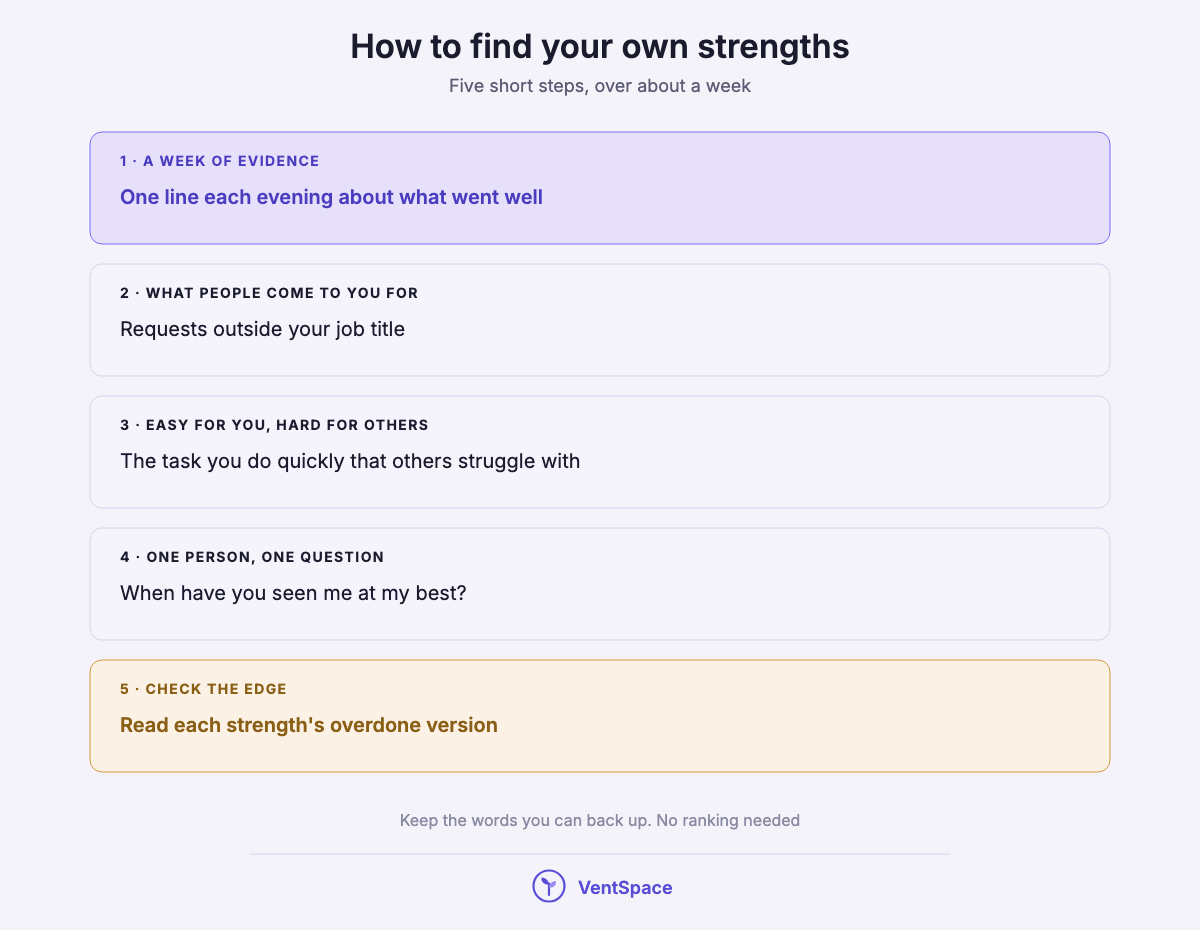
Check the words against your week and against one other person. Five short steps, over about a week.
1. Keep a week of evidence. Each evening for seven days, write one line about something that went well because of what you did. At the end of the week, read the seven lines and circle any family above that more than one of them points to. What did you do this week that you would not want to have to explain away?
2. Look at what people come to you for. Go through the past month of messages and requests. What do people bring you that is not in your job title? A request is evidence someone else has already spotted a strength.
3. Find what is easy for you and effortful for others. Think of a task you do quickly that you have watched someone else struggle with. Was it a small thing, or did it only feel small to you?
4. Ask one person one question. Choose someone who knows you well and is on your side, and ask: “When have you seen me at my best?” A large meta-analysis of personality ratings found that closeness, more than how often someone sees you, is what makes their view more accurate, and the asymmetry runs both ways: you are the better witness to some things, they to others. On average, people did not rate themselves more favorably than people who knew them did. A medical resident in a 2024 study of twelve US residents, describing how others helped her through a struggle over her identity, said: “I needed to reclaim myself with the help of others”. This is not an exercise to run with someone who is unkind to you, or who has a stake in the answer, or whom you are currently fighting with. If there is nobody you can ask right now, a former colleague counts, and so does a therapist. The University of Michigan’s Reflected Best Self Exercise is a fuller, research-born version that gathers this kind of feedback from several people. Our piece on self-awareness covers the inside and outside views in more depth.
5. Check for the overdone version. For each strength you circled, read its “Overdone” row. Does any of it sound familiar? That is not a mark against the strength. It tells you where its edge is.
Before you close the page, answer these on paper:
- Which families came up in more than one step?
- Which word did you want to be true but could not find evidence for?
- What did the person you asked say that you would not have written yourself?
- Which strength would you like to use more next month?
Quick Summary
Q: How do I find out what my strengths are?
A: Collect evidence for a week, look at what people ask you for, notice what is easy for you and hard for others, ask one person who knows you well, and check each strength for its overdone version. Keep the words you can back up. You do not need a test, and you do not need to rank them.
Insight: the outside view, with its limit
Connelly and Ones (2010) pooled 263 samples and 44,178 people rated by others. Their finding: “informants’ interpersonal intimacy with the target is necessary for substantial increases in other-rating accuracy.” Pick someone close, not someone senior. And a 2022 registered study found people were “at least moderately accurate” about their own abilities. The point is two views, not a better judge.
Keeping the evidence
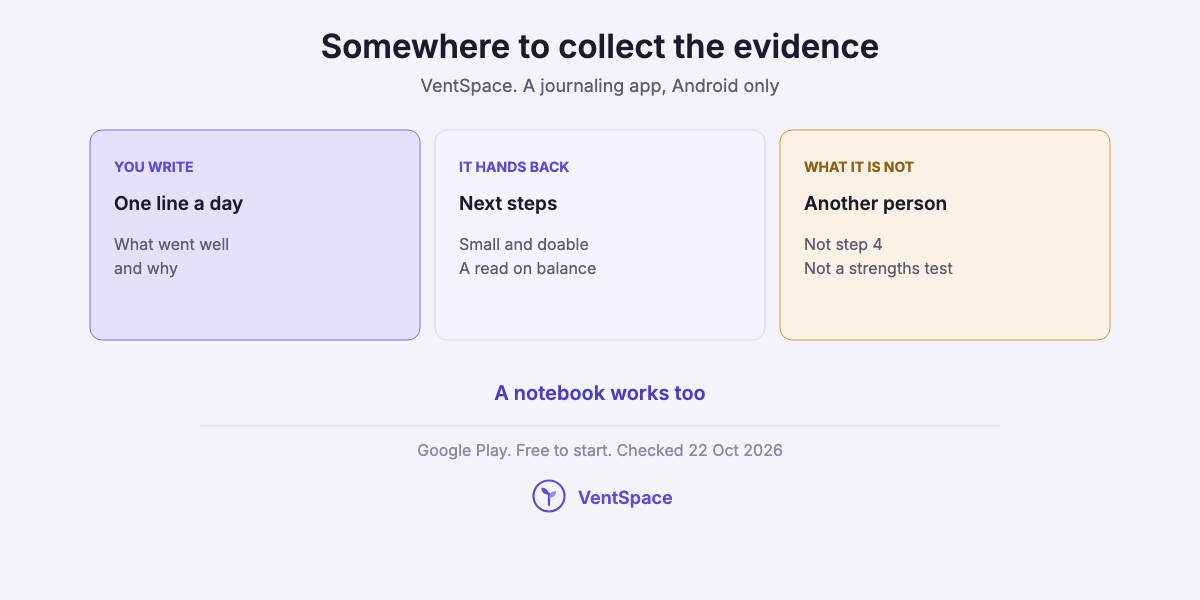
A strength becomes easier to name the more examples you have of it in use, and those examples are easy to lose by Friday. If you want somewhere to collect them, VentSpace is ours: a journaling app that turns what you write into a clear read on your life balance, plus small, doable next steps. It is free to start, on Android only (Google Play, checked October 22, 2026). Not on Android, or at a desk? VentSpace Live runs in your browser, free, with nothing to install. It works on your own view. It is not the person in step 4.
Questions people ask
What are personal strengths?
Things you do well that show up across your ordinary week, and that leave evidence: a request, a finished piece of work, a person who trusts you. A strength is a pattern you can show, not a word you pick.
What are some examples of personal strengths?
Listening, explaining, follow-through, composure, honesty, initiative and curiosity are seven of the 65 on this page. Each belongs to a family, such as reading people or getting things finished, and each is easier to claim when you can point to a time you used it.
What is the difference between personal strengths and character strengths?
“Character strengths” is the term the VIA classification uses, Peterson and Seligman’s 2004 handbook of 24 strengths under six virtues. “Personal strengths” is a looser everyday term that also covers skills and habits, which is how this list uses it.
Should I take a strengths test?
It can be a useful prompt, if you treat the result as a starting list rather than a verdict. A test asks you to rate yourself, so its results come from your own view. Check what it tells you against your week and against one person who knows you.
Is your top five strengths the most important thing to know?
This is the myth worth correcting. A top five is a way some tests report results, not a fact about you. The best-known study of using a top strength was replicated with a placebo that also raised happiness, and the six-virtue structure behind the best-known list is still argued about.
What if I cannot find any strengths that fit me?
Start with step 2 and step 4 rather than the list. What people ask you for, and what one close person says, can surface strengths you would not pick yourself. If the flatness has gone on for a while, talking to a therapist is worth it. If your question turns out to be about what matters to you rather than what you are good at, our piece on turning values into daily habits is closer to it.
The list was never the point
The point was to be able to describe yourself in your own words, with something behind them. A word on a list is a guess until a week of your life or one other person backs it up. Some of yours will turn up in a day. Others may take a month of noticing, and that is normal for a strength you have stopped seeing because you use it all the time.
Tonight, write down one thing from this week that one of these strengths explains, and the name of one person you could ask.
About this article

Written by
Sai Subramaniam
Founder, VentSpace
I write these guides because I have been where you are. I am working through my own hard seasons, and I share the things that actually helped me, so that anyone going through it has a steady companion close by instead of facing it alone. VentSpace is the app I built for exactly that: a journaling app that turns what you write into a clear read on your life balance, plus small, doable next steps toward feeling more like yourself.
This writing is honest and every claim is sourced, and it is not a substitute for professional care. If you are struggling, reaching out to a professional is a strong move, not a failure.
Explore VentSpaceTry VentSpace LiveHow this one was checked. Every factual claim traces to a named source, and the source is printed next to the claim rather than kept in a footnote. Quotes are pinned to the work they come from, with the year, the letter or the chapter where one exists. Where a widely repeated claim could not be traced, it was left out and the omission recorded. Where a figure is contested, both sides are printed.
No affiliate links, no paid placements, and nobody paid to appear here. Where we mention our own app, we say that it is ours, we state its limits, and we never position it as a substitute for care.
Reviewed: October 2026. Prices, platforms and product availability move quickly, and anything we could not verify at the time of writing is marked as unverified rather than turned into a number.
Corrections. If something here is wrong, we would rather know. Corrections are made in place, with a note saying what changed.