
“Trifles light as air / Are to the jealous confirmations strong / As proofs of holy writ.”
William Shakespeare, Othello, Act III, Scene 3 (Iago)
It is late, and her phone is lying face down on the kitchen counter. You notice that it is face down. A month ago you would not have noticed anything about it at all. Now you notice the angle she holds it at, the new passcode, the evening she came home later than she said, the way she seemed lighter on the drive back from her sister’s and heavier when she walked in the door. You are not sure when you started keeping the list. Is she cheating on you?
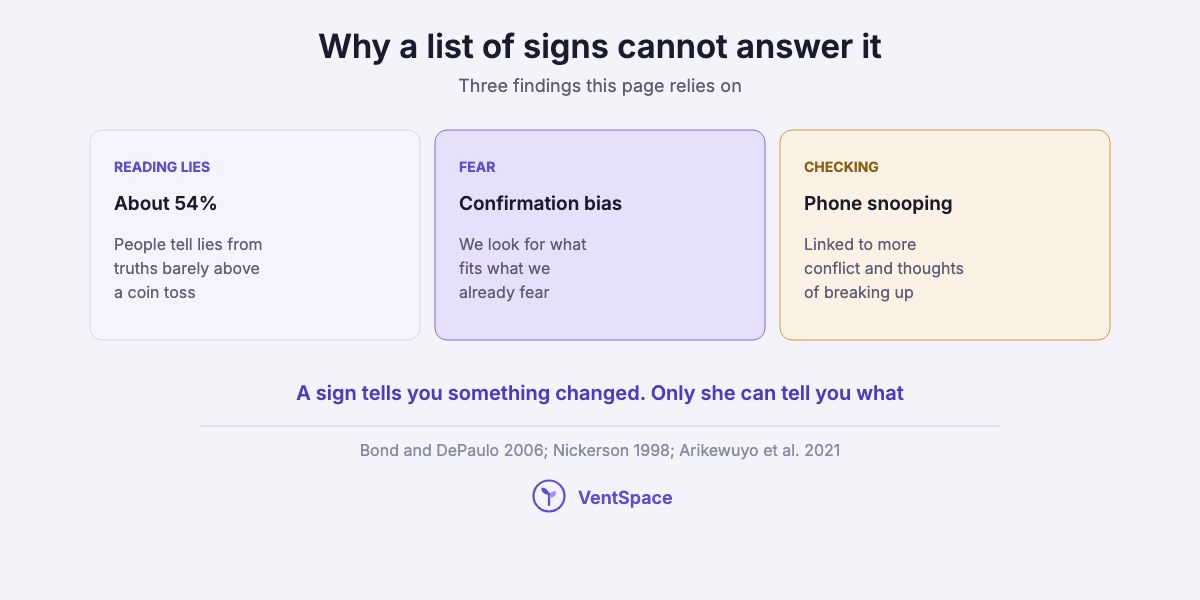
That question deserves a gentler definition before we try to answer it. A sign is not evidence. A sign is a change we have not yet asked about. Each thing on your list is real, in the sense that you saw it, but what it means sits inside another person, and the research on how well we read other people is humbling. Across 206 research reports and nearly 25,000 judges, people telling lies from truths in real time were right 54% of the time, barely above a coin toss (Bond and DePaulo, Personality and Social Psychology Review, 2006).
So this page will not tell you what your wife is doing, because no page can. What it can do is walk through the changes people most often notice, what else each one can mean, and the question each one leads to, then help you decide whether to raise it, and how to do that without making things worse for either of you.
The short version
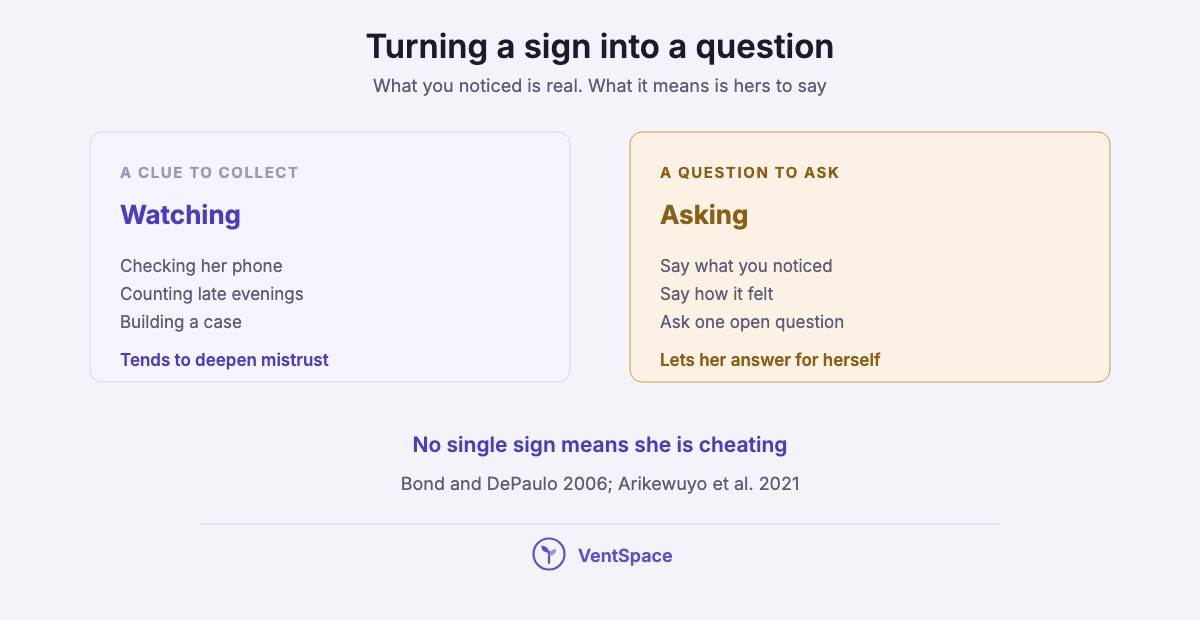
No sign on its own means she is cheating. Each one is a change you can ask her about, and most have ordinary explanations too.
You cannot read it from the outside. In a review of 206 research reports, people told lies from truths about 54% of the time.
Checking her phone, tracking her or testing her tends to make things worse, whatever you find, and the National Domestic Violence Hotline lists checking a partner’s texts as a controlling behavior.
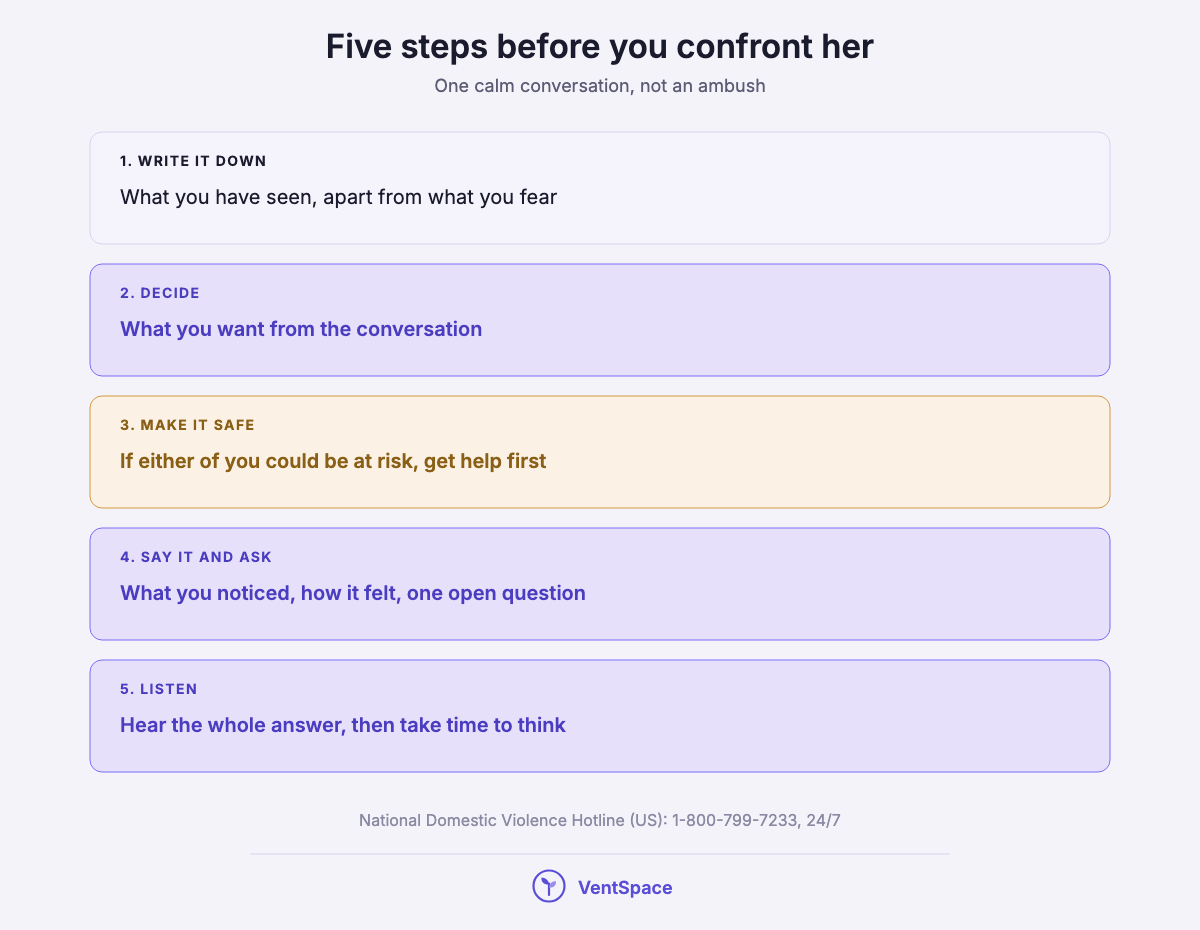
If you decide to confront her, make it a conversation, not an ambush. Write down what you have noticed, decide what you want, make sure it is safe, say what you saw and how it felt, and ask one open question.
Whatever she says, you do not have to decide anything tonight.
If a conversation about this could turn into threats, intimidation or violence, from either of you, stop and get safe first. That includes the moment you notice you are afraid of your own anger. The National Domestic Violence Hotline (US) takes calls from everyone, including people questioning their own behavior: call 1-800-799-7233 or text START to 88788, free, confidential and open 24/7. If anyone is in immediate danger, call 911. If you are thinking about harming yourself, call or text 988 (US), or find a line in your country at findahelpline.com.
The signs people notice, and the question each one raises
“We usually think of betrayal as a big terrible event, like discovering that your partner is having a sexual affair. But it can be more subtle. It can happen in just one interaction.”
John Gottman, “John Gottman on Trust and Betrayal”, Greater Good (2011)
No single sign means your wife is cheating. The changes below are the ones that appear again and again on lists like this one, and every one of them has ordinary explanations as well as painful ones. The useful thing about each is not what it proves. It is the question it lets you ask her, openly, in your own words.
| What you may have noticed | What else it can mean | A question you can ask her openly |
|---|---|---|
| She talks to you less, and shares less about her day | Tiredness, a hard stretch at work, something worrying her that she has not found words for | “It feels like we have stopped telling each other things. Have you felt that too?” |
| Less physical closeness, or less sex | Stress, low energy, unresolved hurt between you, something in her body or mood | “I miss being close to you. Is something getting in the way for you?” |
| A sudden change in sex, more of it at odd times or new requests | Curiosity, a wish to reconnect, a change in how she feels about herself | “Something feels different between us lately. Can we talk about what you want?” |
| She guards her phone, has a new passcode, or mutes her messages | A wish for privacy, work messages, a surprise, a friend’s confidence she is keeping | “I have noticed I am getting anxious about your phone, and I do not like that in myself. Can we talk about how we are doing?” |
| Time that is hard to account for, or coming home later than she said | Work, errands, needing time alone, not wanting to explain small things | “Some evenings I am not sure where you are, and I end up worrying. Can we talk about that?” |
| A new friend you have never met, who she spends a lot of time with | A real friendship she has not thought to bring home | “You mention them a lot. I would like to meet them. Would that be okay?” |
| More attention to how she looks when she goes out | A new job, a new routine, wanting to feel good in her own skin | “You seem to be putting more into yourself lately. What has changed for you?” |
| She asks more about your schedule than she used to | Planning, coordination, a surprise | “You have been asking about my week a lot. Is something on your mind?” |
| You fight less, because she seems to have stopped trying | Exhaustion, giving up on a pattern, feeling unheard | “We do not even argue anymore. I am worried that means we have both given up. Have we?” |
| Sudden gifts, extra attention, or more spending than usual | Generosity, a good month, guilt about something unrelated, a wish to repair | “You have been so generous lately. Is everything okay with you?” |
| She avoids talking about the future, a house, a move, children | Doubt about the plan rather than about you, money worries, fear | “When we talk about the future you go quiet. What is that like for you?” |
| Stories about her day that do not add up | Leaving out dull details, or something she does not want to discuss | “I feel like there is something you are not telling me. Is there anything you want to say?” |
Notice what is missing from this table. There is no score, no “if three or more apply”. A count would turn worry into a verdict, and the person the verdict is about is not in the room to answer it. Several of these changes are also exactly what a struggling marriage looks like when nobody has cheated at all, which is part of why they are worth raising whatever the answer turns out to be.
Quick Summary
Q: What are the signs your wife is cheating?
A: People most often notice distance, less closeness, a guarded phone, time that is hard to account for, a new friend, and less effort in arguments or plans. None of these proves anything. Each has ordinary explanations, and each is best treated as a question to ask her openly rather than a clue to collect.
Insight: Esther Perel, the couples therapist, in her TED talk “Rethinking infidelity” (2015): “But the definition of infidelity keeps on expanding: sexting, watching porn, staying secretly active on dating apps. So because there is no universally agreed-upon definition of what even constitutes an infidelity, estimates vary widely, from 26 percent to 75 percent.”
Why a sign is not proof
“Confirmation bias, as the term is typically used in the psychological literature, connotes the seeking or interpreting of evidence in ways that are partial to existing beliefs, expectations, or a hypothesis in hand.”
Raymond Nickerson, Review of General Psychology (1998)
Fear changes what we see. In Othello, Shakespeare’s play about a husband’s suspicion, Iago does not need to prove anything to Othello. He plans to drop a handkerchief where it will be found, because he knows that to a jealous mind a trifle weighs as much as scripture. Four centuries later, psychologists call the same pull confirmation bias: once we hold a fear, we tend to look for what fits it and read what we find in its favor.
It is worth being kind to ourselves about this. We are not foolish for doing it. We do it because we love the person and are frightened of losing her, and fear is a poor reader but a tireless one. A late evening becomes a lie, a smile at a message becomes a confession, and the ordinary evenings, the ones when nothing at all happened, stop being counted.
There is a second reason the list cannot answer the question. Most of us are worse at spotting lies than we believe. In the meta-analysis by Charles Bond and Bella DePaulo, people correctly classified only 47% of lies as lies and 61% of truths as truths, for an average of 54%. The same review found that people tend to regard the person in front of them as honest. So a suspicious husband is caught between two errors at once: an ordinary tendency to believe his partner, and a fear that pushes the other way. Neither one is a reliable instrument.
From Sai, who wrote the first version of this page: “A phone on silent is ordinary, and I keep mine on silent most of the time.”
That line is a small one, and it carries the whole point. A change matters only as part of a wider shift in how the two of you are with each other, and even then it is something to ask about, not something to conclude.
Quick Summary
Q: Can you tell if your wife is cheating from the signs alone?
A: No. Fear makes us look for what confirms it, and research across 206 reports found people tell lies from truths only about 54% of the time. The signs can tell you something has changed between you. Only she can tell you what.
Insight: Charles Bond and Bella DePaulo, “Accuracy of deception judgments”, Personality and Social Psychology Review (2006): “We analyze the accuracy of deception judgments, synthesizing research results from 206 documents and 24,483 judges. In relevant studies, people attempt to discriminate lies from truths in real time with no special aids or training. In these circumstances, people achieve an average of 54% correct lie-truth judgments, correctly classifying 47% of lies as deceptive and 61% of truths as nondeceptive.”
Why checking her phone tends to make things worse
“Affairs in the digital age are death by a thousand cuts.”
Esther Perel, “Rethinking infidelity”, TED (2015)
When we are frightened, we want certainty, and her phone looks like the shortest route to it. So does following her, checking her location, setting a test, or asking a friend to watch. Each of these feels like taking control. Each of them tends to cost more than it gives.
Perel’s line above comes from the story of a client she calls Heather, who saw one message appear on her husband’s iPad, went digging, and found hundreds more. Even when searching finds something, it rarely brings the relief people hope for. It brings the details one at a time, at two in the morning, without the person who could explain them.
When searching finds nothing, the cost is different but real. In a survey of 329 married people, a lack of trust in a partner predicted relationship problems, and checking a partner’s phone was part of the path from mistrust to conflict and to thinking about breaking up (Arikewuyo and colleagues, Psychological Reports, 2021). It was a single cross-sectional survey, so it shows an association rather than proof that snooping causes the damage. It points the same way as everything else here.
There is a harder truth in this too. The National Domestic Violence Hotline lists checking up on a partner by “reading their personal emails, checking their texts” among the behaviors it asks people to look at in themselves. The Federal Trade Commission describes phone-monitoring apps as tools that “make it possible for stalkers and domestic abusers to track the location of the person they are targeting in real-time.” We are not giving legal advice here, and the rules differ from place to place. The point is simpler. If you find yourself reaching for her phone, the impulse is understandable, and it is also a sign that the fear needs somewhere better to go.
Quick Summary
Q: Should I check my wife’s phone if I think she is cheating?
A: We would not. Searching tends to deepen mistrust whatever you find, a survey of 329 married people linked phone snooping to more conflict and more thoughts of breaking up, and the National Domestic Violence Hotline lists checking a partner’s texts as a controlling behavior. A direct conversation tells you more.
Insight: Arikewuyo, Eluwole and Özad, Psychological Reports (2021), from their study of 329 married people: “Results indicate that lack of trust is a significant predictor of romantic relationship problems. In addition, structural equation modeling results support the theoretical model indicating that cell phone snooping partially mediates the significant relationship between emotional instability, intention to break up, and conflicts.”
So what do we do with what we have noticed?
Should you confront her? Five steps for raising it
“What I’ve found through research is that trust is built in very small moments, which I call “sliding door” moments, after the movie Sliding Doors.”
John Gottman, “John Gottman on Trust and Betrayal”, Greater Good (2011)
Yes, in most cases it is better to raise it than to keep watching, as long as it is safe, and as long as “confront” means an honest conversation rather than a trial. The steps below are for one conversation. They will not make it easy. They make it less likely to do more damage than the silence already has.
Step 1: Write down what you have noticed, apart from what you fear
Take a sheet of paper and draw a line down the middle. On the left, write only what you have seen or heard, with rough dates: “Came home at 10, said 8, three times this month.” On the right, write what you are afraid it means. Keep the two columns apart. You do not need proof to talk about how distant things have felt, and you are not building a case.
- What have I seen with my own eyes, as opposed to what I have imagined?
- When did I first notice things changing between us?
- What else was going on in her life, or in mine, around then?
- Which of these would I mind less if she explained it?
- What am I most afraid is true?
Be as frightened on the page as you are. The right-hand column is for you, not for her.
Step 2: Decide what you want from the conversation
Write one sentence that finishes “What I want from this talk is” It might be the truth, whatever it is. It might be to feel close again. It might be to know whether she still wants the marriage. Knowing what you want keeps the conversation from turning into an interrogation about details.
- Do I want to know what happened, or how we are, or both?
- If she says there is nobody else, what would I still want to change?
- If she says there is someone, what do I need to hear first?
- Am I ready to hear an answer I do not want?
You are allowed not to know what you want yet. If that is where you are, write that down too.
Step 3: Make sure it is safe to talk
Before you choose a time, ask yourself honestly how you are likely to react. If you have ever frightened her, or she has frightened you, or you can feel that your anger might get away from you, this conversation is not safe to have alone. That is not a failure. It is the moment to call the National Domestic Violence Hotline at 1-800-799-7233, which takes calls from people worried about their own behavior as well as from people who feel unsafe, or to have the conversation with a couples counselor in the room.
- Have either of us ever been afraid of the other during an argument?
- Am I calm enough to hear the answer without shouting, blocking a door or grabbing anything?
- Are the children out of earshot?
- Do I have somewhere to go, or someone to call, if it goes badly?
Waiting a day to be safe is not avoiding it. It is part of doing it well.
Step 4: Say what you have noticed, then ask one open question
Choose a private, unhurried time, and start with what you have seen and how it has felt, not with an accusation. Something like: “For a few months I have felt us drifting apart. You are on your phone a lot, and some evenings I do not know where you are. I have started to worry that there might be someone else. I would rather ask you than keep worrying. Is there?” Then stop talking.
- Can I say what I noticed without adding what I fear it means?
- Can I name how it has made me feel, in one sentence?
- What is the one question I most need to ask?
- Can I leave a silence after it, and let her fill it?
Do not lay out your list like evidence, or tell her you already know when you do not. A conversation built like a trap tends to get answers built like a defense.
Step 5: Listen, then decide what comes next
Listen to the whole answer before you respond, even if it is not the one you expected. She may tell you there is someone. She may tell you there is not, and that she has been unhappy, or ill, or frightened, or lonely in the marriage. She may be hurt that you asked. Whatever comes, it is usually wiser to say “I need some time to think about this” than to decide anything in the room.
From Sai, who wrote the first version of this page: “Trust me, I know how hard it is to be in a relationship where only one partner tries to fix problems.”
- What did she say, as opposed to what I expected her to say?
- What do I need before I can talk about this again?
- Is this something we can work on together, or do we need help?
- Who can I talk to, other than her, while I think?
One conversation rarely settles this. Its job is to open the door, not to close the case.
Quick Summary
Q: Should you confront your wife if you think she is cheating?
A: In most cases, yes, as a calm conversation rather than an accusation, and only if it is safe. Write down what you have noticed apart from what you fear, decide what you want from the talk, make sure neither of you is at risk, say what you saw and how it felt, ask one open question, and listen to the whole answer.
Insight: John Gottman, in Greater Good (2011), on what his research found couples were really fighting about: “Can I trust you to be there and listen to me when I’m upset? Can I trust you to choose me over your mother, over your friends? Can I trust you to work for our family? To not take drugs? Can I trust you to not cheat on me and be sexually faithful? Can I trust you to respect me?”
Pulling it all together
“In any interaction, there is a possibility of connecting with your partner or turning away from your partner.”
John Gottman, “John Gottman on Trust and Betrayal”, Greater Good (2011)
Step 1, write it down. Two columns tonight: what you have seen, and what you fear. Your committed action is one page, kept for you.
Step 2, decide what you want. One sentence starting “What I want from this talk is”. Your committed action is to write it, even if the honest answer is “I do not know yet”.
Step 3, make sure it is safe. An honest look at how you and she react under strain. Your committed action is to choose a time when the children are elsewhere, or to call the hotline or a counselor first if you are not sure.
Step 4, say it and ask. What you noticed, how it felt, one open question. Your committed action is to write your opening two sentences in advance.
Step 5, listen. The whole answer, then time to think. Your committed action is to decide in advance that you will not make a decision in the room.
Quick Summary
Q: What should I do if I suspect my wife is cheating?
A: Separate what you have seen from what you fear, then have one calm, safe conversation in which you describe what you noticed and ask her directly. Avoid checking her phone or testing her, and give yourself time after her answer before you decide anything.
Insight: John Gottman, in Greater Good (2011), describing the night he put down a novel to ask his wife why she looked sad: “Now, at that moment, I was building trust; I was there for her. I was connecting with her rather than choosing to think only about what I wanted. These are the moments, we’ve discovered, that build trust.”
If she tells you there has been an affair
“Desire runs deep. Betrayal runs deep. But it can be healed.”
Esther Perel, “Rethinking infidelity”, TED (2015)
If she tells you there has been someone else, the first thing to know is that you do not have to decide what it means for the marriage tonight. Shock, anger, numbness and grief can all arrive in the same hour. None of them is the wrong reaction.
What you do next is your decision, and this page will not make it for you. Some couples rebuild after an affair and some do not, and both can be the right outcome. Perel, who has worked with many couples after infidelity, says in her talk that “the majority of couples who have experienced affairs stay together”, and that some “will merely survive” while others turn the crisis into something new. That is her clinical observation, not a promise about your marriage.
Two things from her talk are worth carrying into the days after. The first is about the questions we ask. She advises the betrayed partner to curb the urge to mine for details, where and how often and with whom, because those questions “only inflict more pain, and keep you awake at night”, and to ask instead what the affair meant: “What did this affair mean for you?” and “What is it about us that you value?” The second is about the partner who had the affair. In Perel’s account, healing begins when that person ends it and expresses guilt and remorse for the hurt they caused.
Couples counseling is a real route here, not a last resort. In one exploratory study, 19 couples dealing with infidelity took part in a larger trial of couple therapy. They started out more distressed than the other couples, and those whose affair had been revealed before or during therapy improved more in satisfaction than couples without infidelity (Atkins and colleagues, Journal of Consulting and Clinical Psychology, 2005). Nineteen couples is a small number, and the authors called the work exploratory. Individual therapy, for you alone, is just as legitimate, whether or not the marriage continues.
If you decide to stay and try, our guide on how to forgive and let go explains why forgiving is not the same as excusing or reconciling. If you are stuck between staying and leaving, our page on analysis paralysis in relationships looks at why that decision is so hard to make.
Quick Summary
Q: What should I do if my wife admits to cheating?
A: Give yourself time before deciding anything about the marriage. Ask what the affair meant rather than mining for details, expect strong and mixed feelings, and consider couples counseling or therapy for yourself. Some couples rebuild and some separate, and the choice is yours.
Insight: Esther Perel, “Rethinking infidelity”, TED (2015), on the partner who was betrayed: “But for Heather, or deceived partners, it is essential to do things that bring back a sense of self-worth, to surround oneself with love and with friends and activities that give back joy and meaning and identity.”
If she says nothing is happening
“Betrayal in a relationship comes in many forms. There are many ways that we betray our partner: with contempt, with neglect, with indifference, with violence. Sexual betrayal is only one way to hurt a partner.”
Esther Perel, “Rethinking infidelity”, TED (2015)
She may tell you there is nobody else, and you may not be able to make the doubt go away. That is one of the hardest places to stand, and it is worth saying honestly: you may never get the certainty you want. Bond and DePaulo’s review is a reminder that none of us can read it reliably from the outside, in either direction.
What you can do is notice that the distance you saw is real, whatever caused it. If the two of you have stopped talking, stopped touching, or stopped trying to fix things, that is a problem worth working on in its own right, and it is the problem you can reach. Couples counseling is built for exactly this, and our page on whether you need therapy can help if the worry has started to take over your days.
From Sai, who wrote the first version of this page: “Your doubts don’t make you toxic. You have all the right to feel how you are feeling right now.”
It is also worth asking, gently and for yourself, whether something older is feeding the fear: a past betrayal, a parent’s marriage, a time you were left. We are not saying the fear is wrong. We are saying it may be carrying more than this one marriage, and that a therapist of your own is a good place to set some of it down.
Quick Summary
Q: What if my wife says she is not cheating, but I still feel something is wrong?
A: Take the distance seriously even if there is no affair. Nobody can read a partner’s honesty reliably, so the useful question becomes how the two of you are doing. Couples counseling, and a therapist of your own if the worry has taken over, are both legitimate next steps.
Insight: John Gottman, in Greater Good (2011): “I believe that by understanding the dynamics of trust and betrayal, we can work to make relationships more trusting. But more than that, we can help people become more trustworthy.”
Questions people ask about a cheating wife
Should I check my wife’s phone?
We would not. Searching her phone tends to deepen mistrust whatever you find, and the National Domestic Violence Hotline lists checking a partner’s texts among controlling behaviors. Tracking apps are described by the Federal Trade Commission as tools used by stalkers and abusers. If the urge is strong, treat it as a sign that it is time to talk to her, or to someone, directly.
How can I tell if my wife is lying about cheating?
Mostly, you cannot, and neither can anyone else. In a review of 206 research reports, people told lies from truths about 54% of the time. Instead of trying to catch a lie, describe what you have noticed and ask her openly. Her answer, and how the two of you talk afterward, will tell you more than her face can.
Am I just being paranoid?
We cannot answer that, and nobody who has not met you both can. What you have noticed is real, and so is the fear it has caused. This page declines to judge an absent person, and it declines to judge you. The honest next step is the same either way: write down what you have seen, and raise it with her calmly.
Is a gut feeling proof that she is cheating?
No, and that is a common myth. A gut feeling tells you that something has changed and that you are frightened. It cannot tell you what the change is. Fear makes all of us look for what confirms it, which is why a feeling is a reason to ask, not a reason to conclude.
Can a marriage survive infidelity?
Some do and some do not. Esther Perel says in her TED talk that most couples who go through an affair stay together, and in one small study couples dealing with infidelity improved in couple therapy. Whether to try is a decision only the two of you can make, and it is just as legitimate to decide that you cannot.
How long does it take to get over an affair?
Nobody can tell you, and we decline to guess. People heal at different speeds, and a page that gives you a number is inventing it. Being kind to yourself about how long it is taking is part of getting through it.
In a nutshell
First, a list of signs cannot tell you what your wife is doing. She can. The trifles you have noticed are real, and they are worth raising, but the way you raise them matters: a calm question, asked safely, does what no amount of watching can.
Second, whatever she says, nobody can tell you how long the next part will take. If there has been an affair, recovering from it, together or apart, is slow and uneven. If there has not, rebuilding closeness after a season of suspicion is slow too. Neither of those is a sign you are doing it wrong.
Carrying a suspicion like this, often alone and often at night, is exhausting in a way that is hard to explain to anyone. If it would help to get some of it out of your head before you talk to her, VentSpace is a journaling app that turns what you write into a clear read on your life balance, plus small, doable next steps. Prefer to try it on your laptop first? VentSpace Live runs in your browser, free, with nothing to install.
About this article

Written by
Sai Subramaniam
Founder, VentSpace
I write these guides because I have been where you are. I am working through my own hard seasons, and I share the things that actually helped me, so that anyone going through it has a steady companion close by instead of facing it alone. VentSpace is the app I built for exactly that: a journaling app that turns what you write into a clear read on your life balance, plus small, doable next steps toward feeling more like yourself.
This writing is honest and every claim is sourced, and it is not a substitute for professional care. If you are struggling, reaching out to a professional is a strong move, not a failure.
Explore VentSpaceTry VentSpace LiveHow this one was checked. Every factual claim traces to a named source, and the source is printed next to the claim rather than kept in a footnote. Quotes are pinned to the work they come from, with the year, the letter or the chapter where one exists. Where a widely repeated claim could not be traced, it was left out and the omission recorded. Where a figure is contested, both sides are printed.
No affiliate links, no paid placements, and nobody paid to appear here. Where we mention our own app, we say that it is ours, we state its limits, and we never position it as a substitute for care.
Reviewed: October 2026. Prices, platforms and product availability move quickly, and anything we could not verify at the time of writing is marked as unverified rather than turned into a number.
Corrections. If something here is wrong, we would rather know. Corrections are made in place, with a note saying what changed.