
“No man can reveal to you aught but that which already lies half asleep in the dawning of your knowledge.” · Kahlil Gibran, The Prophet (1923)
You sit down with a chapter you need to understand by Friday. You read the first paragraph, then the second, and somewhere in the third the words start sliding off the page. Your eyes are open and nothing is going in. You read the same line four times, your head dips, and you jerk upright with the strange guilt of someone caught napping in public. Why does this happen at the desk, of all places, when an hour on your phone keeps you wide awake?
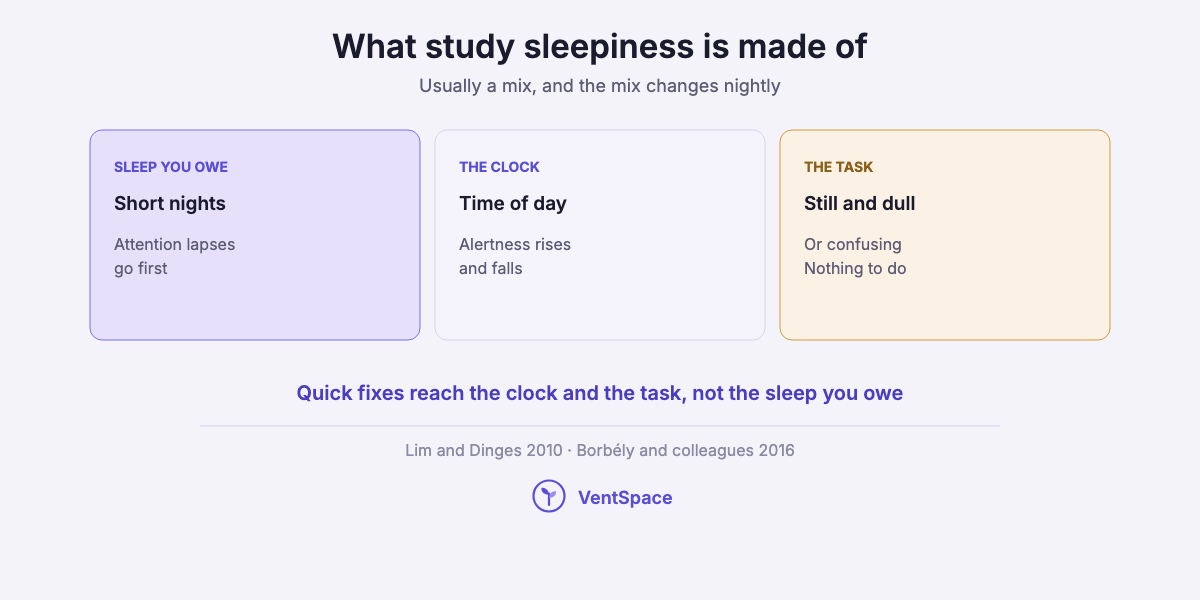
Sleep researchers would tell you that sleepiness is not one thing. It is usually made of three ingredients: the sleep you owe, the time of day, and a task that asks little of your body. A 2014 review by Shelley Hershner and Ronald Chervin reported that about half of college students say they have daytime sleepiness. That is not a character flaw. It is a signal, a bit like a warning light on a car’s dashboard, and it is worth reading before we try to switch it off.
So this guide does two things. First it helps you read the light: whether tonight’s sleepiness is sleep debt, the clock, the task, or something that needs more than a study tip. Then it gives you five small steps you can use in the next ten minutes, each with an honest note on how good the evidence for it is. It is written for university students and adult learners.
The short version: five things for the next ten minutes
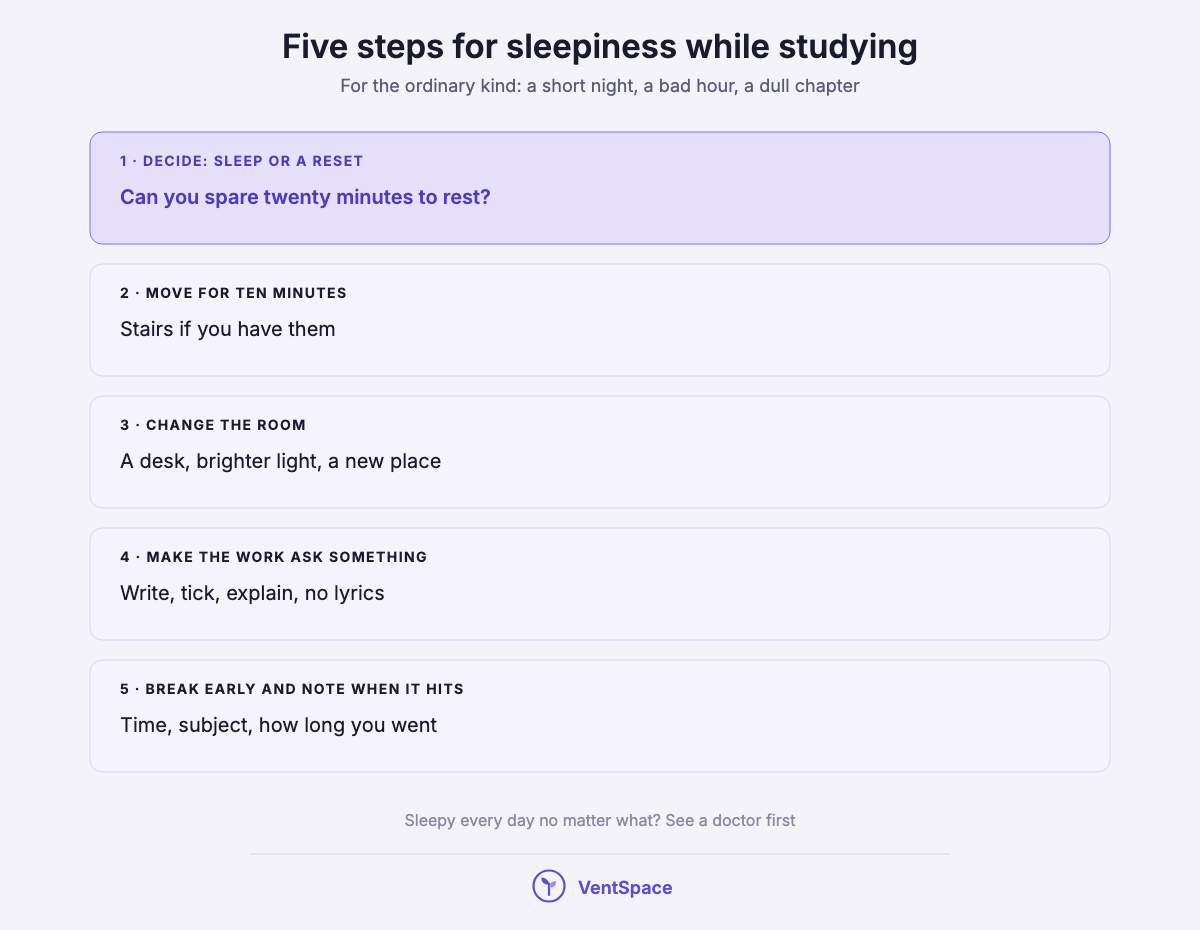
Ask whether you can spare time for a short nap. In one sleep lab study, a 10-minute afternoon nap helped more than 5, 20 or 30 minutes.
Walk for ten minutes, stairs if you have them. In a small trial with sleep-deprived students, ten minutes of stair walking lifted energy more than a low dose of caffeine.
Get off the bed and into a brighter room. The evidence for light is mixed, but a desk and a change of place are cheap to try.
Make the work ask something of you. Write, tick, explain it out loud, and turn off music with lyrics.
If you are sleepy every day no matter what you do, see a doctor. Persistent drowsiness can have medical causes, and a doctor can check them.
Why do I feel sleepy when I study?
“Daytime sleepiness, sleep deprivation, and irregular sleep schedules are highly prevalent among college students, as 50% report daytime sleepiness and 70% attain insufficient sleep.” · Shelley Hershner and Ronald Chervin, Nature and Science of Sleep (2014)
You feel sleepy when you study because three things stack up: the sleep you owe, the time of day, and a task that keeps your body still and asks little of it. Most of the time it is a combination, and the mix changes from night to night. Knowing which ingredient is loudest tonight is what tells you which fix to reach for.
The first ingredient is sleep you owe. Hershner and Chervin’s review summarized studies finding that half of college students report daytime sleepiness and seven in ten get insufficient sleep. When we are short on sleep, attention is often the first thing to go. A 2010 meta-analysis by Julian Lim and David Dinges pooled 70 articles on short-term total sleep deprivation and found the largest effect on lapses in simple attention, the moments when your mind blanks for a second and you miss what was in front of you. That is exactly the experience of reading a line four times. Those studies kept people awake for up to two days, so they describe a harsher state than one short night. The direction is still worth knowing.
The second ingredient is the clock. Sleep scientists describe two systems working together: one that builds pressure the longer you have been awake, and one that rises and falls with the time of day. That framework, the two-process model, was reviewed by Alexander Borbély and colleagues in 2016. In plain terms, the same chapter can feel easier at one hour than at another, even when nothing about you has changed in between except the time.
The third ingredient is the task itself. Reading a dense chapter is one of the stillest things we ask of ourselves. We sit, we stay quiet, our eyes do a little work, and nothing else in our body is asked to do much. It gets worse when we stop understanding. Sai, who wrote the first version of this page in 2022, put it plainly:
From Sai, who writes this blog
I remember how I used to feel drowsy, especially during math class, because I often didn’t follow everything properly and ended up not understanding, which would make me fall asleep. This also happens while reading literature, when I don’t understand the words properly.
That is a useful clue. Sleepiness that arrives the moment the material gets confusing may be less about your body and more about the work having lost you.
Quick Summary
Q: Why do I get sleepy when I study?
A: Usually because three things stack up: not enough sleep, a time of day when alertness naturally dips, and a still, low-demand task like reading. Sleepiness is common among college students. A 2014 review reported that about half say they have daytime sleepiness, and short sleep tends to hit attention first.
Insight: Julian Lim and David Dinges, reporting their meta-analysis in Psychological Bulletin (2010): “Seventy articles containing 147 cognitive tests were found that met inclusion criteria for this study. Effect sizes ranged from small and nonsignificant (reasoning accuracy: g = -0.125, 95% CI [-0.27, 0.02]) to large (lapses in simple attention: g = -0.776, 95% CI [-0.96, -0.60], p < .001).” Reasoning held up. Simple attention did not. That is why tired reading feels like your eyes are working and your mind has left the room.
Sleepy, bored or worn out? How to tell the difference
“First, determine whether your drowsiness is due to depression, anxiety, boredom, or stress.” · MedlinePlus, US National Library of Medicine
Sleepiness, boredom and exhaustion can feel the same at a desk, but they respond to different fixes, so it helps to sort them first. The US National Library of Medicine’s consumer guide to drowsiness opens its home-care advice with the line above, and it is good advice for a study night too. What is the light on the dashboard trying to tell you?
Try three quick questions. Did you sleep badly last night, or for several nights? If yes, sleep debt is probably the loudest ingredient, and the tricks in this guide will buy you an hour, not a cure. Does the sleepiness lift the moment you switch to something else? If a video or a conversation wakes you right up, the task may be the problem rather than your body. Has it felt like this for weeks, even on days you slept well? That is a different signal, and the next section is for you.
Boredom deserves a fairer hearing than it usually gets. The psychologists Fuschia Sirois and Timothy Pychyl, reviewing research on procrastination in 2013, describe avoidance as something that “often occurs when people are faced with tasks that are seen as aversive.” A dull or confusing chapter is aversive in exactly that sense. Heavy eyelids can be one of the ways we step away from a task that feels bad, without ever deciding to. That is not laziness. It is useful information about the task.
Time of day matters more for some of us than for others. A 2025 study by Sara Mehrhof and Camilla Nord at the University of Cambridge, with 994 participants, found that people with later body clocks who were tested in the morning showed a lower willingness to take on effort, on the study’s measure, much like participants who reported low motivation. It is one study and the time-of-day finding has not been repeated yet, so we would not tell anyone their body clock explains their grades. It is still a reason to notice when in the day your studying goes best, and to protect that window.
Quick Summary
Q: How do I know if I’m sleepy or just bored while studying?
A: Check three things. If you slept badly, sleep debt is likely. If switching tasks wakes you up instantly, the task is probably the problem, and boredom or confusion is driving it. If you feel this way for weeks even after good nights, it may be something else, and it is worth talking to a doctor.
Insight: The social psychologist Devon Price, in his 2018 essay “Laziness Does Not Exist”: “I don’t believe that laziness exists.” And: “If a person’s behavior doesn’t make sense to you, it is because you are missing a part of their context.” It is an essay, not a study, and it is a kinder way to look at your own drooping eyelids. Before you call yourself lazy, ask what part of the context you are missing.
When sleepiness is a sign of something else
“Drowsiness refers to feeling more sleepy than normal during the day.” · MedlinePlus, US National Library of Medicine
If you feel sleepy most days no matter how much you sleep, or the sleepiness comes with low mood, worry or a sense that nothing matters, it is no longer a study problem, and a doctor or counselor is the right next step. This section exists because no tip below can fix that, and we would rather say so now than after five steps.
A doctor comes first. Daytime drowsiness that does not lift has a range of possible medical causes, and MedlinePlus lists several, from sleep problems to some medicines. A doctor can check those properly. We will not try to guess which one might apply to you, because a page cannot do that and a short appointment can. If falling asleep at night is the problem, cognitive behavioral therapy for insomnia exists and is the American College of Physicians’ recommended first treatment for chronic insomnia. A clinician is the right person to decide whether it fits.
Low mood counts too. MedlinePlus names depression, anxiety and stress alongside boredom as things to rule out. If the sleepiness sits on top of a heavy few weeks, or the course has stopped meaning anything to you, that is worth raising with your university’s counseling or wellbeing service, or with a doctor. It is worth raising before your exams, not after. It is tempting to park it until the deadlines pass, and that is usually when it has grown. Most universities have a counseling service. What it offers and how quickly it can see you differ, so ask those questions directly.
And one plain safety line: do not drive when you are drowsy. That is MedlinePlus’s own advice, and it matters most after a late session in the library.
If you are struggling right now. If the tiredness has turned into feeling hopeless, or you are having thoughts of harming yourself, please contact a crisis line now. In the US, call or text 988 (Suicide & Crisis Lifeline). Anywhere else, findahelpline.com lists free, confidential services by country. Your studies can wait.
Quick Summary
Q: When should I worry about feeling sleepy while studying?
A: When you are sleepy most days even after enough sleep, when it comes with low mood or anxiety, or when it has lasted for weeks. Daytime drowsiness can have medical causes, so see a doctor first. If mood is part of it, your university’s counseling service or a doctor is the right next step, ideally before exams rather than after.
Insight: Hershner and Chervin, closing their 2014 review of sleepiness in college students: “This paper highlights that addressing sleep issues, which are not often considered as a risk factor for depression and academic failure, should be encouraged.” Sleep and mood tend to travel together. If one has been off for a while, it is worth asking about the other.
So what can you do about it tonight?
How to get rid of sleepiness while studying, in five steps
“These findings suggest that the 10-minute nap was overall the most effective afternoon nap duration of the nap lengths examined in this study.” · Amber Brooks and Leon Lack, Sleep (2006)
These five steps are for the ordinary kind of sleepiness: a short night, a bad hour, a dull chapter. They will not pay back weeks of lost sleep, and they are not meant to. Think of them as ways to read the warning light and respond to it, rather than taping over it. Try them in order the first time, then keep the ones that work for you.
1. Decide whether you need sleep or a reset
Before anything else, answer one question honestly: can you spare twenty minutes to rest? If the answer is yes and your body is properly tired, a short nap may do more than any trick. If the answer is no, skip to step 2.
Ask yourself:
- How much did I sleep last night, and the night before?
- Is this the heavy, can’t-keep-my-eyes-open kind of tired, or the restless, can’t-focus kind?
- If I lay down now, would I wake up in fifteen minutes, or sleep through my alarm?
- Is it late enough that a nap would wreck my sleep tonight?
There is no prize for staying upright. Resting on purpose is a decision, not a defeat.
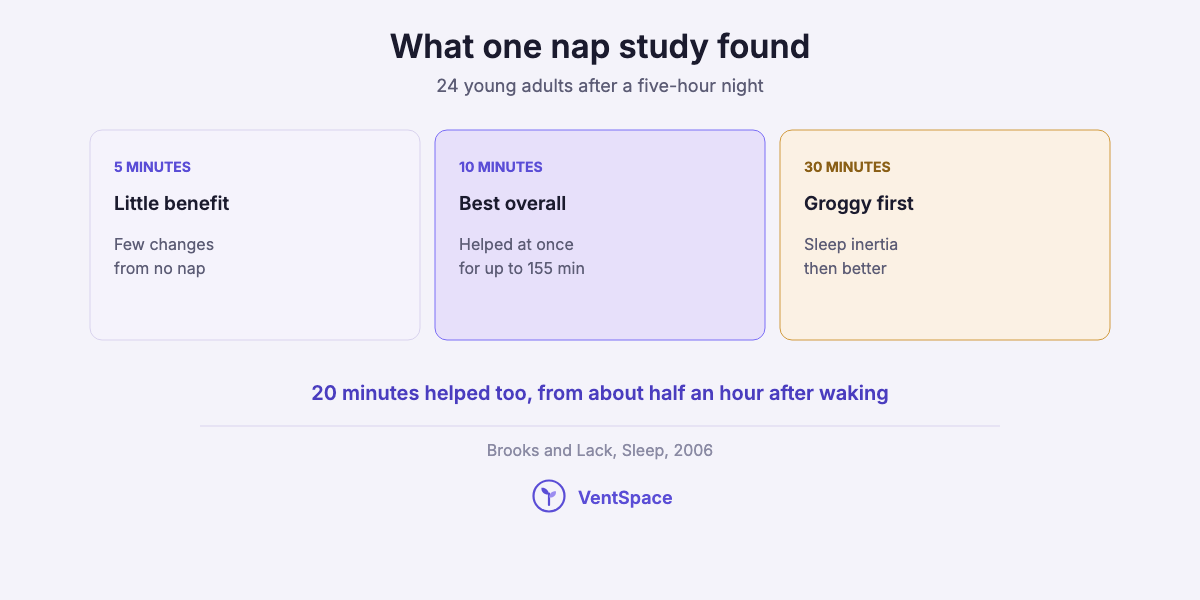
The best controlled evidence on nap length comes from a 2006 study by Amber Brooks and Leon Lack. They restricted 24 healthy young adults to about five hours of sleep, then tested afternoon naps of 5, 10, 20 and 30 minutes. The 10-minute nap helped right away, with some benefits lasting up to about two and a half hours. The 20-minute nap helped too, but only from about half an hour after waking. The 30-minute nap left people groggy first, a state called sleep inertia, before they improved. The 5-minute nap did little. It was one lab, one small group and one afternoon time, so treat it as a guide rather than a rule.
From Sai, who writes this blog: how long I nap
Some say the ideal power nap is anywhere between 20 and 40 minutes. But in my experience I don’t take it longer than 15 to 20 minutes, because longer puts me in a much deeper sleep.
Sai’s rule of thumb sits close to the study’s. Set an alarm before you close your eyes, and if you find you need a nap every single study session, go back to the section above. If nights are the real problem, our guide to feeling tired but wired at night is the better place to start.
2. Move for ten minutes
Stand up and walk for ten minutes, up and down stairs if you have them, then come back to the desk. Not a workout. Just enough movement to change what your body is doing.
Ask yourself:
- Where is the nearest staircase, hallway or block I could walk around?
- Could I take the next page of notes with me and read it on my feet?
- What is the smallest movement I would actually do right now?
- Did I feel different when I sat back down?
Doing this badly still counts. Ten slow minutes beats a perfect workout you skip.
This step has one small but neat trial behind it. In 2017, Derek Randolph and Patrick O’Connor tested 18 college women who were regularly short on sleep. Ten minutes of easy stair walking lifted their feelings of energy more than a capsule with 50 mg of caffeine or a placebo. The boost was in how energetic they felt, and it did not last long. Their attention and memory scores did not change significantly. It is a tiny study, but it fits what most of us know from experience: moving wakes us up for a while.
From Sai, who writes this blog: the quick workout
Working out is probably the last thing you feel like doing, but it gets your heart pumping and the sleepiness goes away. Just a few pushups and squats would do. If you’re not a fan of workouts, at least try jogging or jumping or skipping, anything to raise your heart rate. After that, a quick face wash, so you feel fresh to continue.
One honest exception. If you live with ME/CFS or a condition where exertion makes fatigue worse, this step may not suit you. A 2016 meta-analysis by Brian Loy and colleagues found that a single bout of exercise increased fatigue in people with ME/CFS more than in people without it. Your own doctor’s advice comes first.
3. Change the room, not just the chair
Move off the bed and to a desk, turn the lights up, and if that does not work within a few minutes, change rooms altogether. A library, a kitchen table, a café, a seminar room that is free.
Ask yourself:
- Where am I right now, and is it a place where I usually sleep or relax?
- Is the room dim, warm or very quiet?
- Where have I studied well before?
- Could I study near other people who are also working?
You do not need the perfect study spot. You need a different one from the one that is making you sleepy.
Sai’s 2022 advice was simple: a table and a chair rather than a bed, and a well-lit room rather than lamps and string lights that make a room cozy. Changing location was step 2 of his own routine. On light, the honest picture is mixed. A 2018 systematic review by Jan Souman and colleagues looked at 68 studies and found that brighter white light raised how alert people said they felt in most of them, but many studies found no effect, and few found any change in reaction speed. Most were small. Turning the lights up costs nothing, so it is worth trying, just do not expect it to rescue a night on four hours of sleep.
4. Make the work ask something of you
Change how you are studying so your hands and voice are involved: write notes, tick off questions, explain the idea out loud, or test yourself. If you are stuck because you do not understand something, stop reading and get help with that one point.
Ask yourself:
- Am I reading, or am I doing something with what I read?
- Where exactly did I stop understanding?
- Who could I ask, or what could I look up, to get unstuck?
- Is anything playing in the background with words in it?
You are allowed to slow down. Understanding one page beats skimming ten.
Sai’s 2022 list for this is still a good one: tick through questions as you solve them, highlight, follow lines with a pencil, write rough notes. For lectures and videos, type notes as you go. And where you can, study with someone. Explaining an idea to a friend, or agreeing to message each other every so often to check in, adds a second person to a very still activity.
On background music, Sai found that instrumental tracks and guitar solos worked best for him. The research leans the same way. A 2018 meta-analysis by Martin Vasilev and colleagues pooled 65 studies and found that background noise, speech and music all have a small but reliable negative effect on reading, and that speech you can understand and music with lyrics are the most distracting. If music keeps you awake, keep it quiet and wordless. If you can manage silence, that is better for reading.
5. Take the break before you crash, and note when it hits
Plan a short break before you hit the wall, and each time sleepiness arrives, jot down the time and what you were doing. After a few sessions you will see your own pattern.
Ask yourself:
- What time does the sleepiness usually arrive?
- What was I working on when it did?
- How long had I been going without a break?
- What reward could I give myself for finishing this block?
Notice the pattern before you judge it. It is information, not a grade.
A 2022 meta-analysis by Patricia Albulescu and colleagues, pooling 22 study samples and 2,335 people, found that short breaks reliably helped people feel more energetic and less fatigued, with effects of about a third of a standard deviation. They did not reliably improve how much people got done, especially after demanding mental work. So breaks are for you, not for your output, and that is still worth a lot on a long night.
From Sai, who writes this blog: the reward method
I personally love this method, as it works for me. Set goals in workloads rather than days of work, so you actually get everything done properly, and reward yourself with something you know you will enjoy once you finish.
Over a week, your notes will tell you which ingredient from the first section is loudest. If the times cluster in the afternoon, it is probably the clock. If they cluster around one subject, it is probably the task. If they are everywhere, it is probably sleep, and the section on something else is worth rereading.
Pulling it all together
“recovering from highly depleting tasks may need more than 10-minute breaks” · Patricia Albulescu and colleagues, PLOS ONE (2022)
The five steps are one path through a sleepy session. Step 1 decides whether you need sleep, steps 2 to 4 wake up your body and your task, and step 5 tells you which of them matters most for you.
Step 1 is the honest question. Committed action: next time your eyes close, ask whether you can spare twenty minutes, and if you can, set an alarm for fifteen.
Step 2 wakes the body. Committed action: find the nearest staircase now, so you know where it is when you need it.
Step 3 changes the room. Committed action: choose your desk spot and a backup location for this week.
Step 4 wakes the task. Committed action: for your next session, put a pen in your hand before you open the book, and turn off anything with lyrics.
Step 5 finds your pattern. Committed action: keep a list of every time sleepiness hits this week, with the time and the subject.
Sai still uses his own version of this, in his own words:
From Sai, who writes this blog: my "get rid of sleep" routine
Step 1. Ask yourself if you can afford to spare some time for sleep. Even before exams, if you’re just stressed out and your brain is tired, take a few minutes to power nap. If yes, do so.
Step 2. Change location. If I felt really sleepy in a place, I’d move so I’d have a different atmosphere.
Step 3. Quick workout. A few pushups and squats.
Step 4. Face wash, so you feel fresh.
Step 5. Get back to studying.
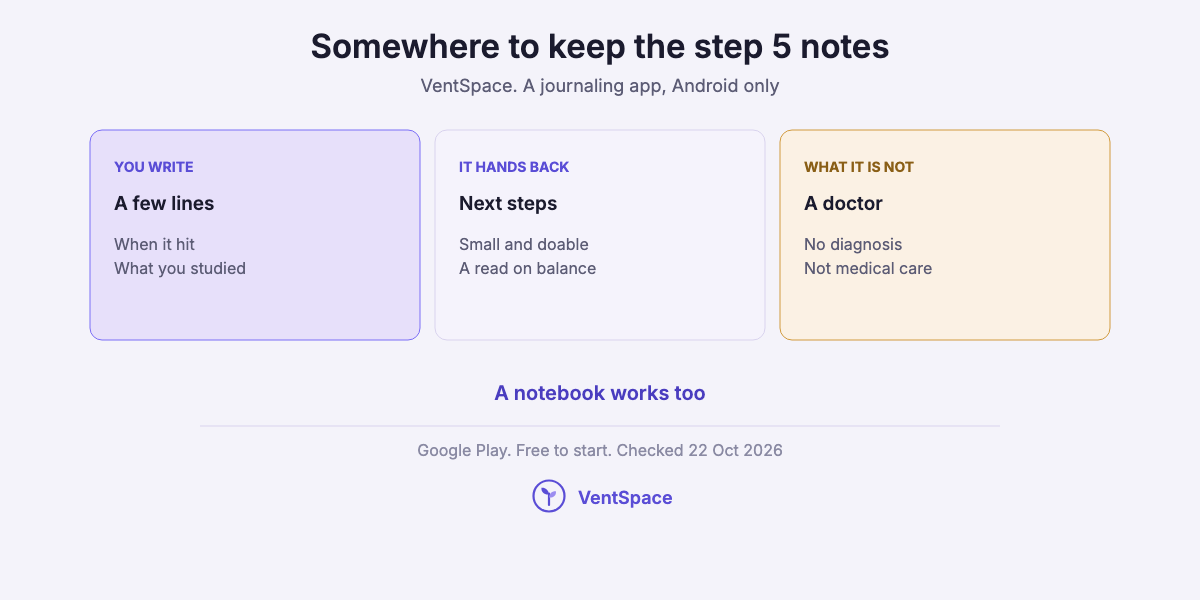
If you want somewhere to keep the step 5 notes, VentSpace is a journaling app that turns what you write into a clear read on your life balance, plus small, doable next steps. It is free to start and Android only as of October 2026. If you are on a computer, VentSpace Live runs in your browser, with nothing to install. A few lines a night about when you got sleepy and what you were doing is enough for a pattern to show. It will not diagnose anything or replace a doctor, and a notebook works too.
Quick Summary
Q: What is the fastest way to stop feeling sleepy while studying?
A: Decide first whether you need a short nap. If you do, a nap of about 10 minutes helped most in one lab study. If you don’t, walk for ten minutes, move to a brighter room and a desk, and switch to active work like writing notes. If you are sleepy every day regardless, see a doctor.
Insight: Albulescu and colleagues, describing what their 2022 meta-analysis could and could not show, wrote that “recovering from highly depleting tasks may need more than 10-minute breaks”. Small breaks help how you feel in the moment. A whole term of short nights needs real sleep, and no study trick on this page replaces it.
Questions people ask about sleepiness while studying
Should I drink coffee to stay awake while studying?
We do not recommend caffeine, energy drinks or any other stimulant as a study strategy, and this page gives no caffeine advice. In our view, leaning on a stimulant to get through every session hides the signal this page is about, which is often that you need more sleep. In one small 2017 trial with sleep-deprived students, ten minutes of stair walking lifted energy more than a low dose of caffeine. If you have questions about caffeine and your health, a doctor or pharmacist can answer them.
Is it bad to study in bed?
There is little direct research on it. Sai found it made him sleepier, and his advice was to use a table and a chair and save the bed for sleeping. Lying down in soft light is, after all, how most of us fall asleep. If you have to study in bed, sit upright, turn the lights up and keep a pen in your hand.
Why do I get sleepy reading but not on my phone?
Because the two tasks are very different. A phone keeps changing, asks you to tap and scroll, and rarely confuses you. A dense chapter is still and demanding, and it can feel unpleasant when you stop understanding it. That is a feature of the task, not proof that you are lazy. Making the reading more active, as in step 4, closes some of the gap.
Does music help you stay awake while studying?
It can help some people stay alert, but it tends to cost a little comprehension. A 2018 meta-analysis of 65 studies found that background noise, speech and music all slightly reduce reading performance, and that music with lyrics is among the most distracting. If you use music, choose quiet instrumental tracks, which is what Sai found worked best for him.
How long should a power nap be?
Short. In a 2006 study of 24 sleep-restricted young adults, a 10-minute afternoon nap gave the quickest benefits. A 20-minute nap helped once people had been awake again for about half an hour, and a 30-minute nap left them groggy first. Set an alarm, and try to nap earlier in the day so it does not disturb your night.
When should I see a doctor about sleepiness?
If you feel sleepy most days even after enough sleep, or if the sleepiness comes with low mood or worry, it is worth seeing a doctor. Daytime drowsiness can have medical causes that a doctor can check. If low mood is part of it, your university’s counseling service is another good place to start, and our guide on whether you need therapy can help you decide.
In a nutshell
Sleepiness at the desk is a warning light, not a verdict on you. Read it before you silence it.
Two things to take with you. First, most sleepiness while studying is made of three things: sleep you owe, the time of day and a still, dull or confusing task, and the quick fixes only reach the last two. Second, the honest timeline: the steps in this guide buy you minutes to a couple of hours. Paying back lost sleep takes nights of sleep, and no study we found says how many. If a week of better nights changes nothing, that is the moment to see a doctor.
Which of the three ingredients is loudest for you tonight?
About this article

Written by
Sai Subramaniam
Founder, VentSpace
I write these guides because I have been where you are. I am working through my own hard seasons, and I share the things that actually helped me, so that anyone going through it has a steady companion close by instead of facing it alone. VentSpace is the app I built for exactly that: a journaling app that turns what you write into a clear read on your life balance, plus small, doable next steps toward feeling more like yourself.
This writing is honest and every claim is sourced, and it is not a substitute for professional care. If you are struggling, reaching out to a professional is a strong move, not a failure.
Explore VentSpaceTry VentSpace LiveHow this one was checked. Every factual claim traces to a named source, and the source is printed next to the claim rather than kept in a footnote. Quotes are pinned to the work they come from, with the year, the letter or the chapter where one exists. Where a widely repeated claim could not be traced, it was left out and the omission recorded. Where a figure is contested, both sides are printed.
No affiliate links, no paid placements, and nobody paid to appear here. Where we mention our own app, we say that it is ours, we state its limits, and we never position it as a substitute for care.
Reviewed: October 2026. Prices, platforms and product availability move quickly, and anything we could not verify at the time of writing is marked as unverified rather than turned into a number.
Corrections. If something here is wrong, we would rather know. Corrections are made in place, with a note saying what changed.