
“be patient toward all that is unsolved in your heart and to try to love the questions themselves like locked rooms and like books that are written in a very foreign tongue.” · Rainer Maria Rilke, Letters to a Young Poet, Letter Four
It tends to arrive late at night, when the day’s noise has stopped and there is nothing left to answer but ourselves. The sentences turn future-tense. What am I going to do with my life? Will this job still be here next year, and do I even want it to be? Should I have moved, stayed, studied something else, settled down, not settled down? During the day you are mostly fine. You go to work, you reply to messages, you make plans for the weekend. And then, in the quiet, the whole of the next ten years seems to rest on decisions you do not feel ready to make. Why does not knowing weigh so much?
We have better evidence on this than the reassuring pages suggest. In 2025, a team led by the psychologist Oliver Robinson asked 2,247 people aged 18 to 29 in eight countries whether they were in a crisis episode right now, using a definition they supplied. Between 40% and 77% said yes, depending on the country. The samples were mainly students and the answer was a self-assessment, so these are not population rates. The more revealing part is what people wrote when asked to describe it. The most common features were fear and harsh judgment of themselves. Confusion about what they wanted was there too, but it came up less often.
That changes what kind of help is useful. If our trouble were confusion, more information would fix it. Because it is mostly fear, the work is learning to live alongside a future we cannot see, without needing it to clear first. This guide explains why uncertainty feels so heavy at this stage of life, whether the “quarter-life crisis” has a deadline, and why not knowing can feel like danger, and then offers five small steps that ask nothing of the future except the next street.
The short version
This uncertainty is mostly fear and self-judgment, not confusion. In a 2025 study across eight countries, those were the commonest things people described.
The “quarter-life” label has no deadline. Research ranges for developmental crises in the twenties, thirties and forties overlap almost completely.
Not knowing can feel like danger. Researchers call the tendency to find uncertainty hard to bear “intolerance of uncertainty”, and it is linked with worry.
Acceptance is a practice, not a decision. You cannot instruct yourself into it once. You return to it.
Start with one step: write down the exact sentence your uncertainty is saying.
| Step | What it involves | One first action |
|---|---|---|
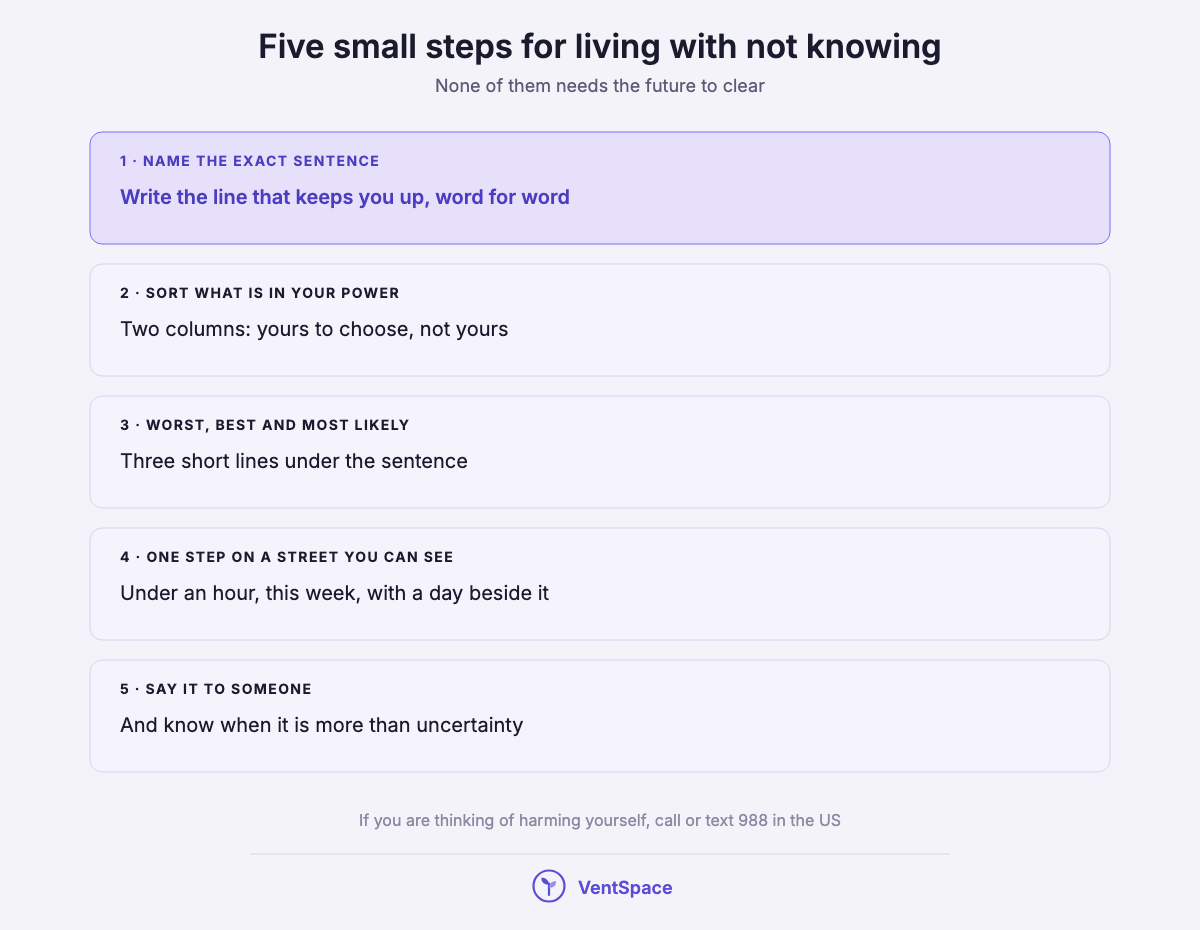
| 1. Name the exact sentence | Turn a fog of dread into one written line | Write the sentence that keeps you up, word for word |
| 2. Sort what is in your power | Separate your choices from what is not yours to settle | Draw two columns and fill both |
| 3. Write worst, best and most likely | Give the fear a fuller picture to sit beside | Three short lines under the sentence |
| 4. Take one step on a street you can see | Act on what matters to you without waiting for certainty | One thing you can do this week in under an hour |
| 5. Say it to someone, and know when it is more | Share the true version, and know the signs that call for help | One message to one person today |
If you are struggling right now. If you are feeling hopeless, or having thoughts of harming yourself, please contact a crisis line now rather than reading on. In the US, call or text 988 (Suicide & Crisis Lifeline). Anywhere else, findahelpline.com lists free, confidential services by country. In an emergency, call 911 or your local emergency number. This page is not a substitute for that help.
Why does uncertainty feel so heavy in your 20s and 30s?
“the repetitious experience of a mind attempting to generate a feeling of security about the future, failing, then trying again and again and again.” · Oliver Burkeman, Four Thousand Weeks (2021)
Uncertainty feels heavy in your 20s and 30s because it is rarely just not knowing. For most people it arrives as fear about what might happen and harsh judgment of themselves for not having it worked out, at a stage of life when many large decisions are open at once.
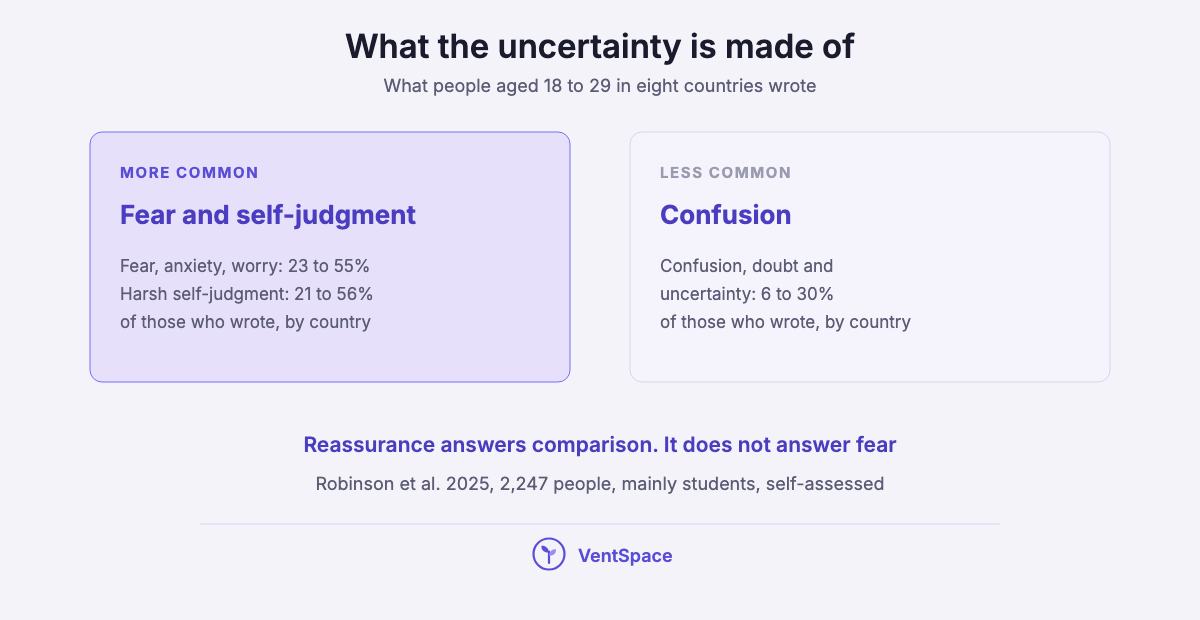
It helps to begin with a correction. We usually describe this period as a time of confusion, as though the problem were a missing piece of information about what we want. The eight-country study suggests something different. Among the people who said they were in a crisis and described it in writing, fear, anxiety and worry appeared in 23% to 55% of accounts depending on the country, and negative judgments of themselves in 21% to 56%. Confusion, doubt and uncertainty appeared less often, in 6% to 30%. Here is how three of them put it:
“The thoughts I have are usually questioning what I am going to do about my life and how to come out of the slump I am currently in.” · A participant from the UK, Robinson et al., Emerging Adulthood (2025)
“Sometimes I feel very restless and anxious, it seems as if something bad is going to happen.” · A participant from Pakistan, Robinson et al. (2025)
“Stressed out – Not knowing if I’ll be good enough for the job market in my field I’ve chosen.” · A participant from the UK, Robinson et al. (2025)
Notice how little of that is about not knowing what we want. It is about being afraid of what is coming and doubting that we will be equal to it. That is a heavier load than confusion, and it is why being told “you are not behind” so often slides off. Reassurance answers comparison. It does not answer fear.
Why this stretch of life in particular? The research we have does not say, so what follows is our own reading. Many of the decisions that shape the next decades tend to cluster here: where to live, what work to do, whom to build a life with, whether to stay or start again. Each is made without being able to see how it turns out. Earlier, school and family supplied much of the structure. Later, many of the big choices have been made. In between, we are asked to choose often, with very little of the map filled in.
That image is worth keeping. Picture a map whose middle is drawn and whose edges are blank. You can see the streets near you in some detail: today’s work, this month’s rent, the people you will see this week. The further out you look, the less is drawn. The fear tends to live at the edges, where nothing is drawn yet, and it can make us forget that we are standing somewhere perfectly visible.
Quick Summary
Q: Why does uncertainty feel so heavy in your 20s and 30s?
A: For many people it is less about not knowing what they want and more about fear of the future and harsh judgment of themselves. In a 2025 study of 2,247 people aged 18 to 29 in eight countries, fear and negative self-evaluation were among the most common features people described, while confusion and uncertainty appeared less often. Many big life decisions also cluster in this period, each made without knowing how it will turn out.
Insight: Oliver Robinson and colleagues, discussing their eight-country findings in Emerging Adulthood (2025): “One of the most salient features of the qualitative findings that has not yet been addressed by other studies on early adult crisis is the preponderance of negative self-evaluation, which emerged as a common feature of descriptions of crisis across all countries.” Our reading: the uncertainty is rarely the whole of it. Much of the weight is what we tell ourselves about being uncertain.
Is a quarter-life crisis real, and does it have a deadline?
“It is perfectly true, as the philosophers say, that life must be understood backwards. But they forget the other proposition, that it must be lived forwards.” · Søren Kierkegaard, Journals (1843)
The experience is real and measurable, but the “quarter-life” label is a name, not a finding, and it has no deadline. Research ranges for developmental crises in the twenties, thirties and forties overlap almost completely, so there is no age by which you are supposed to have got through it.
The term itself did not come from a laboratory. A 2024 systematic review of the field traces it to a popular book about people in their twenties, not to a research program. The same review searched 3,100 publications and found 14 studies that met its criteria, and summed up the state of knowledge in a sentence worth taking seriously: research on the quarter-life crisis “remains quite limited, and interventions for dealing with quarter life crisis have not yet been implemented.”
None of that means the feeling is imaginary. Researchers have built questionnaires for developmental crisis, and the eight-country study found plenty of people willing to say yes to it. What the evidence does not support is the idea that it belongs to one decade. A 2025 paper from Czechia, gathering earlier studies together, reported developmental crises in 19% to 49% of people in their twenties, 25% to 51% in their thirties, and 9% to 59% in their forties. The ranges are wide because the studies measured it in different ways. What matters is that they overlap.
This is consoling in a quiet way. If you are 31 and still uncertain, you have not missed a deadline, because there was never a deadline to miss. And if you are 24 and certain, that certainty may still be revisited later, which is not a failure either. Kierkegaard’s point, in the quote above, is that we only understand our lives looking back, while we have to live them going forward. None of us gets to see the shape of our choices at the moment we make them.
A note on what this page will not do. It will not tell you whether you are “in” a quarter-life crisis. No page can know that, and a label would give you one more thing to measure yourself against. What we can do is help you live with the part that is uncertain, whatever you call it.
Quick Summary
Q: Is a quarter-life crisis real, and is it only a twenties thing?
A: The experience of a developmental crisis is real and has been measured, but the “quarter-life” label comes from a popular book, and a 2024 review found only 14 studies on it. Research ranges for developmental crises in the twenties, thirties and forties overlap almost completely, so there is no age by which you should have resolved it.
Insight: Farah Fadilah Hasyim and colleagues, concluding the first systematic review of the field in Psychology Research and Behavior Management (2024): “Despite recent developments, research on quarter life crisis in emergent adults remains quite limited, and interventions for dealing with quarter life crisis have not yet been implemented.” That is worth knowing whenever a confident page tells you exactly what stage you are in and how long it will last. Nobody has that information yet.
Why does not knowing feel like danger?
“There are more things, Lucilius, likely to frighten us than there are to crush us; we suffer more often in imagination than in reality.” · Seneca, Moral Letters to Lucilius, Letter 13 (trans. Richard Mott Gummere)
Not knowing can feel like danger because many of us find uncertainty itself hard to bear, and that difficulty is closely linked with worry. Researchers call it intolerance of uncertainty. It is a tendency, not a verdict on your character, and it is one reason “just accept it” does not work as an instruction.
A 2019 review of 181 studies with more than 52,000 people described intolerance of uncertainty as “a dispositional trait associated with a range of psychological disorders” and found a moderate association with symptoms overall. An earlier review found links of a similar size with symptoms of generalized anxiety, depression and obsessive-compulsive disorder alike, which is part of why researchers now treat it as something that runs across many kinds of distress rather than belonging to one. These are associations measured at one point in time. They show that finding uncertainty unbearable and worrying go together, not that one causes the other.
Seneca’s line above is two thousand years older than any of this and lands close to it. Most of what frightens us about the future is a picture we have drawn at the blank edges of the map. It is not that nothing bad can happen. It is that our imagination tends to fill the empty space with the worst version, and then we live inside the drawing.
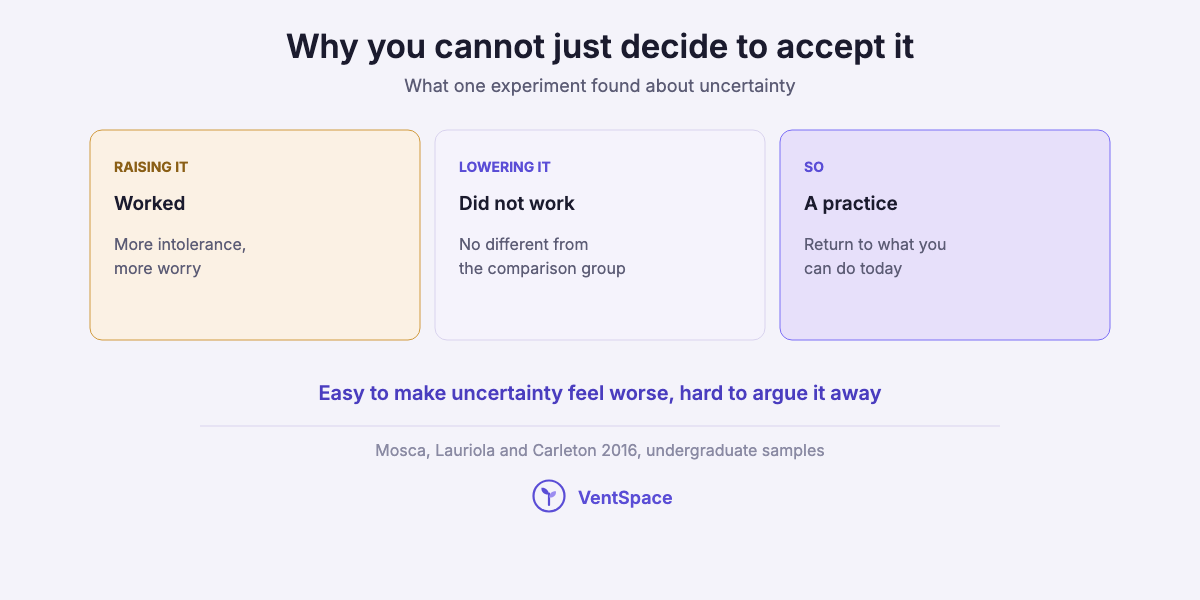
One experiment is useful here, because it explains why acceptance cannot be ordered up. In 2016, Oriana Mosca and colleagues gave groups of students instructions designed either to raise or to lower how intolerant of uncertainty they felt, and compared them with a group given neither. Raising it worked: those students felt more intolerant of uncertainty, worried more and felt worse. Lowering it did not: those students ended up no different from the comparison group. The participants were undergraduates and the authors note that the instructions and the measures were close in wording, so the study has clear limits. Still, the pattern is instructive. It is easy to make uncertainty feel worse, and hard to argue ourselves out of it.
That is why we prefer to think of acceptance as a practice rather than a decision. You do not accept uncertainty once and then stop feeling it. You notice yourself straining toward a certainty that is not available, and you return, again and again, to what you can do today. There is a therapy built around this kind of acceptance, acceptance and commitment therapy, or ACT. It is delivered by trained therapists, and if this struggle is taking over your life, it is a legitimate thing to ask about. What follows is not that therapy. It is a set of small steps in the same direction.
Quick Summary
Q: Why does uncertainty about the future feel so frightening?
A: Many people find uncertainty itself hard to bear, which researchers call intolerance of uncertainty. A 2019 review of 181 studies found it moderately associated with a range of mental health symptoms, including worry. One experiment found it was easy to make people feel less tolerant of uncertainty and much harder to make them feel more tolerant by instruction, which is why acceptance works better as a repeated practice than as a single decision.
Insight: Oriana Mosca, Marco Lauriola and R. Nicholas Carleton, reporting their two experiments in PLOS ONE (2016): “participants in decreasing IU condition resulted in post-test levels of state-IU, Worry and Negative Affect scores that were as large as controls. Accordingly, instructions to increase IU were more effective determinants of change than instructions to decrease IU.” Our reading: we cannot talk ourselves into calm about the future, but we can stop adding to the alarm.
So what can we do with a future we cannot see?
How to accept uncertainty in your 20s and 30s: five small steps
“Of things some are in our power, and others are not.” · Epictetus, The Encheiridion, I (trans. George Long)
To accept uncertainty, name the exact sentence your fear is saying, sort what is in your power from what is not, set the worst outcome beside the best and the most likely, take one small step on a street you can already see, and say the true version to someone. None of these steps asks the future to clear. Each one asks only for today.
They are small on purpose. We tend to respond to a big unknown with a big plan, and the plan becomes one more thing to fail at. A step you can take tonight is more honest about how much any of us can see.
1. Write down the exact sentence the uncertainty is saying
First action: tonight, write the sentence that keeps you up, in full, in the words it uses in your head. Not “I’m stressed about the future”. The real line, such as “I’m 29 and I still don’t know if I’m in the right career.”
Dread is shapeless, which is part of what makes it so tiring. A written sentence has edges. Once it is on paper, you can see that it is one fear rather than everything, and you can see which part of the map it is pointing at: work, money, love, place, or the larger question of whether you are good enough. The people in the eight-country study described their crises in a few lines each, and those few lines were enough to show what the trouble was made of. Yours can do the same for you.
Ask yourself:
- What exactly am I afraid will happen?
- Which part of my life does this sentence belong to?
- Is this a fear about the future, or a judgment about myself?
- How long has this particular sentence been coming back?
There is no wrong way to write it. The rougher and more honest, the more useful it will be.
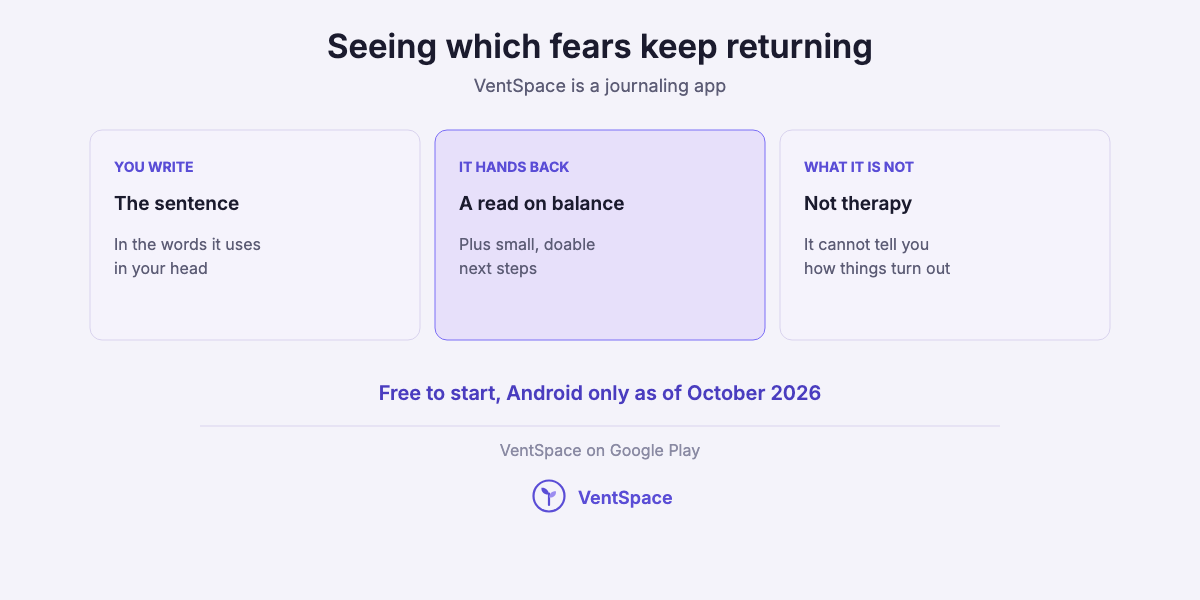
If you would like the sentences to add up to something over time, a journal keeps them for you. VentSpace is a journaling app that turns what you write into a clear read on your life balance, plus small, doable next steps. It is free to start and Android only as of October 2026. Not on Android, or at a desk? VentSpace Live runs in your browser, free, with nothing to install. It is not therapy, and it will not tell you how your future turns out. What it can show you is which of your fears keeps returning, and which areas of your life are steadier than the dread suggests.
2. Sort it into what is in your power and what is not
First action: draw a line down the middle of a page. On the left, write what in your sentence you can choose or influence. On the right, write what you cannot.
This is one of the oldest moves in philosophy, and it opens Epictetus’s handbook for a reason. He was blunt about what belongs where: our opinions, desires and actions on one side, and on the other, “the body, property, reputation, offices”, the things that depend on others or on chance. Translated into our terms, you can choose how you spend this week, whom you ask for advice, which applications you send. You cannot choose whether a company is hiring, whether the market moves, or what other people think of your choices.
Most of us find the right-hand column longer than we would like. That is not a sign of failure. It is an accurate description of being alive. The left-hand column, however short, is where your attention can do some good. If much of the right-hand column turns out to be other people’s expectations rather than your own, our guide to societal expectations versus your internal truth looks at that pressure directly.
Epictetus has a harder sentence too, which we offer gently rather than as an order: “Seek not that the things which happen should happen as you wish; but wish the things which happen to be as they are, and you will have a tranquil flow of life.” Few of us manage that for long. It is still a direction worth facing.
Ask yourself:
- Which of these do I keep trying to control anyway?
- What is one thing in the left column I have been avoiding?
- Whose opinion is in my right column, and why does it weigh so much?
- What would I do differently if the right column were weather?
You do not have to like the right-hand column. You only have to stop carrying it as if it were your job.
3. Write the worst, the best and the most likely
First action: under your sentence, write three short lines: the worst thing that could realistically happen, the best, and the most likely.
This is not a technique for making fear disappear, and we make no claim that it will. It is a way of giving the fear some company on the page. Left alone, the mind tends to draw only the worst picture at the blank edge of the map. Writing the best and the most likely beside it does not erase the worst. It stops it being the only drawing.
Seneca’s observation, that more things are likely to frighten us than to crush us, is the thought behind this step. The most likely outcome is often duller than either extreme: some disappointment, some adjustment, a year that looks different from the plan. Dull is easier to live alongside than catastrophic. And if the worst case truly is likely and serious, then you have learned something important early, which is better than learning it at three in the morning.
If you notice the exercise turning into hours of going round the same three lines, stop. Our piece on overthinking versus problem solving explains how to tell useful thinking from the loop.
Ask yourself:
- What would I do in the first week if the worst case happened?
- Who would still be there?
- What has the most likely outcome looked like for people I know?
- Which of the three lines am I most tempted to skip writing?
Keep each line short. One sentence each is enough.
4. Take one step on a street you can see
First action: choose one thing you can do this week, in under an hour, that moves toward something you care about. Write it down with a day beside it.
Uncertainty tempts us to wait until we know before we act. The difficulty is that knowing usually comes from acting, which is Kierkegaard’s point about living forwards. You will not find out whether you want a different kind of work by thinking about it for another year. You might find out a little by having one conversation with someone who does it.
The step does not need to be a decision. Nobody is asking you to quit, move or commit to anything. It might be emailing a person whose work interests you, signing up for one class, visiting one neighborhood, or having one honest conversation with a partner about what you each want. These are the streets near you on the map, and walking them is how the map fills in.
If you are not sure what you care about enough to step toward, our guide to how personal values evolve is a gentler place to start than a career plan.
Ask yourself:
- What would I do this week if I trusted that I could change course later?
- Which small step have I been saving for when I feel certain?
- What matters to me regardless of how things turn out?
- Who is already doing something I am curious about?
Make the step small enough to feel almost silly. Small steps are the ones that get taken.
5. Say it to someone, and know when it is more than uncertainty
First action: send one message today to someone you trust, telling them one true thing about how the future feels to you at the moment.
Fear of the future is easier to inflate in private. Spoken aloud to a friend, a sibling or a partner, the sentence can sound more human and less final. It also lets someone outside your head notice whether you are struggling more than you have let on.
There is a point where this is no longer only uncertainty. The National Institute of Mental Health advises seeking professional help if you have severe or distressing symptoms that have lasted two weeks or more, such as difficulty sleeping, difficulty concentrating, loss of interest in things you usually enjoy, or being unable to complete your usual tasks, and suggests starting with a primary care provider. Therapy is one option. For a lot of people it is the right one. If you are unsure whether you need it, our guide on whether you need therapy walks through the question, and if cost is the obstacle, what helps when you cannot afford therapy covers the options. If you are still a student and the uncertainty is bound up with exams or your course, our guide to the signs academic pressure is affecting your mental health is more specific.
Ask yourself:
- Who have I been telling “it’s fine” when it is not?
- Has this been affecting my sleep, work or appetite for more than a couple of weeks?
- Is there someone further along who once felt like this?
- What would I want a friend in my position to do?
Asking for help is part of living with uncertainty, not a sign you have failed at it.
Quick Summary
Q: How do you accept uncertainty in your 20s and 30s?
A: Treat acceptance as a practice rather than a single decision. Write down the exact fear, separate what is in your power from what is not, set the worst outcome beside the best and the most likely, take one small step toward something you care about, and tell someone how you feel. If distressing symptoms have lasted two weeks or more, talk to a primary care provider or a therapist.
Insight: Peter McEvoy and colleagues, summarizing 181 studies with 52,402 participants in Clinical Psychology Review (2019): “Intolerance of uncertainty is a dispositional trait associated with a range of psychological disorders.” They found “robust, moderate associations” across many kinds of symptoms. Our reading: finding uncertainty hard is common and widely shared, which is a good reason to practice living with it gently and to ask for help when it takes over.
Pulling it all together
The five steps make one path. Naming the sentence shows you what the fear is, sorting it shows you where your effort belongs, the three outcomes give the fear company, one small step fills in a little of the map, and saying it aloud keeps you from carrying it alone. You might do the first three on the same evening and the last two over the following days.
Step 1 turns dread into a line you can read. Committed action: write the sentence that keeps you up, tonight.
Step 2 puts your attention where it can do something. Committed action: draw the two columns under that sentence.
Step 3 stops the worst case being the only picture. Committed action: write the worst, the best and the most likely, one line each.
Step 4 fills in the map by walking it. Committed action: write one small step for this week, with a day beside it.
Step 5 brings someone else in. Committed action: send one honest message to one person today.
Quick Summary
Q: What is the first step to accepting uncertainty about the future?
A: Write down the exact sentence your fear is saying, in the words it uses in your head. A specific written fear is easier to look at than a general sense of dread, and it shows you which part of your life the uncertainty is really about. From there, you can sort what is in your control and choose one small step.
Insight: The US National Institute of Mental Health, Caring for Your Mental Health (reviewed April 2026): “Seek professional help if you are experiencing severe or distressing symptoms that have lasted 2 weeks or more.” Its examples include difficulty sleeping, difficulty concentrating and loss of interest in things you usually find enjoyable. Living with uncertainty is a practice, and part of the practice is knowing when to stop practicing alone.
Questions people ask about uncertainty in their 20s and 30s
Is it normal to have no idea what you are doing with your life at 25 or 30?
Yes, and it is far from unusual. In a 2025 study of people aged 18 to 29 in eight countries, between 40% and 77% said they were in a crisis episode, though the samples were mostly students and the answers were self-assessments. Research on developmental crises also finds them in people’s thirties and forties, so being uncertain at 30 does not mean you are late. Normal does not mean easy, and if it is affecting your sleep or work for weeks, it is worth talking to someone.
How long does a quarter-life crisis last?
No research gives a reliable duration that applies to everyone, and a 2024 review found only 14 studies on the subject, none of which tested a way of getting through it. It is more useful to ask whether things are slowly moving than to wait for an end date.
What is intolerance of uncertainty?
It is researchers’ term for finding uncertainty hard to bear, so that not knowing feels threatening in itself. A 2019 review of 181 studies found it moderately associated with a range of mental health symptoms, including worry. It is a tendency many people share, not a diagnosis, and therapies such as acceptance and commitment therapy work with it directly.
Should I make a big decision to get rid of the uncertainty?
Not for that reason alone. A big change can feel like relief because it ends one kind of not-knowing, but it opens another, since no decision shows you in advance how it turns out. It can help to separate looking honestly at your situation from deciding what to do about it, and to take small steps first. This page does not tell anyone to quit or stay. Talking it through with someone you trust, or with a therapist, can help with decisions that are hard to reverse.
Will I ever feel certain about my life?
Probably not completely, because nobody can see how their choices will turn out. The aim is not to reach certainty but to become steadier inside its absence. Most of the steps on this page are about acting well without full information, which is something we all have to do at every age.
When is uncertainty a sign I need professional help?
The US National Institute of Mental Health suggests seeking help if severe or distressing symptoms have lasted two weeks or more, such as trouble sleeping, difficulty concentrating, losing interest in things you usually enjoy, or being unable to manage your usual tasks, and recommends starting with a primary care provider. If you are thinking of harming yourself, call or text 988 in the US, or find your local line at findahelpline.com.
In a nutshell
None of us gets the whole map. We get the streets near us, drawn in some detail, and edges that stay blank until we walk toward them.
Two things to take with you. First, what makes uncertainty heavy is mostly fear and self-judgment, not a lack of information, which is why small steps and kind attention help more than another round of thinking it through. Second, the honest timeline: acceptance is not something you finish. The sentence will come back on some nights, and the practice is returning to the street you can see, as many times as it takes.
Perhaps tonight, the next street is writing the sentence down.
About this article

Written by
Sai Subramaniam
Founder, VentSpace
I write these guides because I have been where you are. I am working through my own hard seasons, and I share the things that actually helped me, so that anyone going through it has a steady companion close by instead of facing it alone. VentSpace is the app I built for exactly that: a journaling app that turns what you write into a clear read on your life balance, plus small, doable next steps toward feeling more like yourself.
This writing is honest and every claim is sourced, and it is not a substitute for professional care. If you are struggling, reaching out to a professional is a strong move, not a failure.
Explore VentSpaceTry VentSpace LiveHow this one was checked. Every factual claim traces to a named source, and the source is printed next to the claim rather than kept in a footnote. Quotes are pinned to the work they come from, with the year, the letter or the chapter where one exists. Where a widely repeated claim could not be traced, it was left out and the omission recorded. Where a figure is contested, both sides are printed.
No affiliate links, no paid placements, and nobody paid to appear here. Where we mention our own app, we say that it is ours, we state its limits, and we never position it as a substitute for care.
Reviewed: October 2026. Prices, platforms and product availability move quickly, and anything we could not verify at the time of writing is marked as unverified rather than turned into a number.
Corrections. If something here is wrong, we would rather know. Corrections are made in place, with a note saying what changed.