
“One of the symptoms of approaching nervous breakdown is the belief that one’s work is terribly important, and that to take a holiday would bring all kinds of disaster.” · Bertrand Russell, The Conquest of Happiness (1930)
It is the second week of finals and you have not slept properly in days. Your chest is tight when you open your laptop, your appetite has gone strange, and you have turned down every invitation since the start of the month. You tell yourself it is normal. Everyone in your class looks the same, and the plan is to deal with it once the exams are over. Is this just exam stress, or is it something more?
You are far from alone in asking. In the American College Health Association’s spring 2026 survey of 57,211 students at 86 US schools, 41.6% said they had problems or challenges with academics in the past year, and 84.4% of those said it caused them moderate or high distress. That was a higher share than for any other problem in the survey, including money, family and relationships. Only about one student in ten answered the survey, so treat the figures as a picture, not a census.
This guide is written for university, college and graduate students. It describes what academic pressure tends to look like once it has started to cost you, in the words students themselves have used in published interviews. Then it explains why the signs are so easy to wait out, and gives you five small things to do this week, before the exams rather than after them.
The short version
Stress is a response to pressure, and some of it is expected. The question is whether it lifts when the pressure does, and whether it has spread into your sleep, your body, your mood and the people you see.
The signs are easy to explain away, because everyone around you looks stressed too. That is the main reason students wait.
Most students do not plan to ask for help. In one survey of first-year students in eight countries, only about a quarter said they would definitely seek it.
The best time to raise it is now, not after the exams. Structured help for strong exam anxiety has good trial evidence.
Start with one step, not five. Writing down what the last two weeks have been like is a good first one.
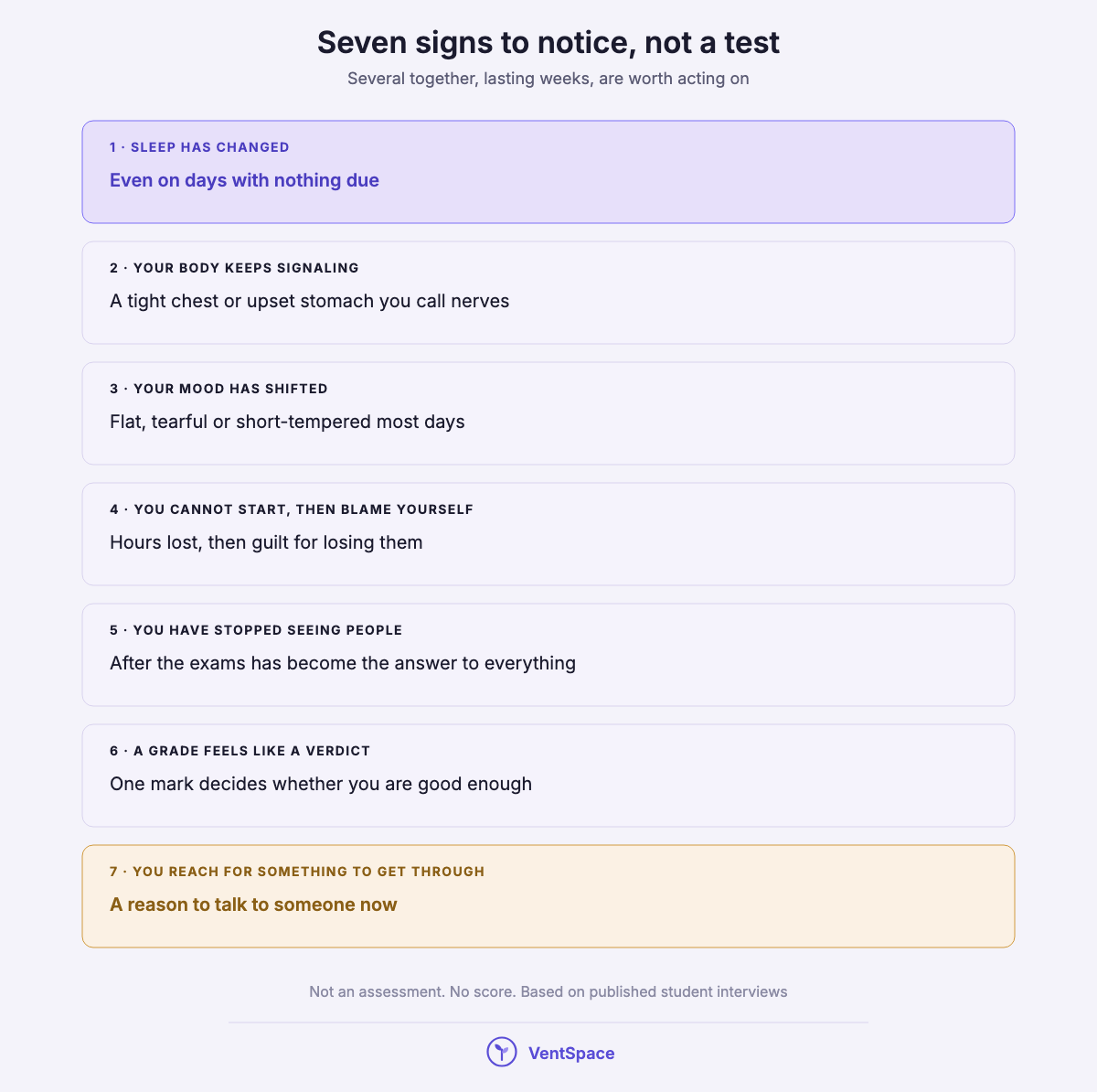
| Sign | What you might notice | One small check this week |
|---|---|---|
| 1. Sleep has changed | Lying awake, waking early, or sleeping through alarms, even on days off | Note what time you fell asleep on the last three nights |
| 2. Your body keeps signaling | A tight chest or an upset stomach you call “nerves” | Write down when it happens and whether it eases after the deadline |
| 3. Your mood has shifted | Flat, tearful or short-tempered most days, not only before an exam | Ask one person who knows you whether you seem different |
| 4. You cannot start, then blame yourself | Hours lost before beginning, then guilt for losing them | Notice what you tell yourself in that moment |
| 5. You have stopped seeing people | “After this is over” has become the answer to every plan | Count the last time you saw a friend for no reason |
| 6. A grade feels like a verdict on you | One mark decides whether you are good enough | Say the worst-case result out loud and what would follow |
| 7. You reach for something to get through | Alcohol, other substances or pills to cope or to keep going | Treat this as a reason to talk to someone now |
If you are struggling right now. If you are feeling hopeless, or having thoughts of harming yourself, please contact a crisis line now rather than reading on. In the US, call or text 988 (Suicide & Crisis Lifeline). Anywhere else, findahelpline.com lists free, confidential services by country. In an emergency, call 911 or your local emergency number. This page is not a substitute for that help.
When does academic pressure stop being ordinary stress?
“Stress seems like it should be typical, so it’s easy to dismiss it.” · The JED Foundation, Understanding Academic Stress in College
Academic pressure has become a problem for your mental health when the stress stops lifting after the deadline, spreads into your sleep, body, mood or friendships, or starts to stop you from doing the work at all. Some stress during exams is expected. Stress that has moved in and stayed is a different thing.
The National Institute of Mental Health defines stress plainly: “the physical or mental response to an external cause, such as having a lot of homework or having an illness.” The important word is external. Stress is a response to something in front of you, which is why it usually eases when the thing in front of you goes away. NIMH contrasts it with anxiety, which “is constant, even if there is no immediate threat.” You do not need to decide which one you have. What helps is noticing whether the feeling still follows you around once the exam, essay or presentation is done.
Picture a warning light on a car’s dashboard. A light that comes on when you are climbing a steep hill and goes off at the top is the car doing its job. A light that stays on all the time is telling you something. The trouble during exam season is that the light is on in every car around you, so everyone learns to drive with it lit, and nobody pulls over.
How common is a lit dashboard? In the same ACHA survey, 24.3% of students rated their stress over the past month as high and another 50.5% as moderate. So stress itself is not unusual. What matters is what it is doing to you.
Four questions tell you more than any list of symptoms:
- Does it lift? After a deadline passes, do you get a day or two of feeling like yourself?
- Has it spread? Is it only in the hour before an exam, or is it in your sleep, your meals and your weekends too?
- Is it stopping you? Are you getting less done because of how you feel, not more?
- How long has it been going on? A bad week is one thing. A whole term is another.
None of these gives you a score, and that is deliberate. They are prompts for noticing, not a test.
Quick Summary
Q: How do I know if my academic stress is normal or affecting my mental health?
A: Some stress around exams is expected, and it usually eases once the deadline passes. It is worth taking seriously when it does not lift afterward, when it spreads into your sleep, body, mood or friendships, when it stops you from working, or when it has lasted most of a term. NIMH advises talking to a professional if you are struggling to cope or your symptoms will not go away.
Insight: Ronny Bruffaerts and colleagues, reporting a survey of 4,921 first-year students at KU Leuven in the Journal of Affective Disorders (2018): “Mental health problems are common in college freshman, and clearly associated with lower academic functioning. Additional research is needed to examine the potentially causal nature of this association.” In their data, students who reported a problem finished the year with marks about three to five percentage points lower. Our reading: looking after how you feel is part of the work, not time taken away from it.
Signs academic pressure is affecting your mental health
“I think I felt, yeah it was normal to be nervous, normal to have chest pain…it’s normal to have abdominal discomfort because it’s just how we feel when you’re nervous, isn’t it?” · A UK medical student interviewed by Winter, Patel and Norman, Academic Psychiatry (2017)
The most common signs are changes in sleep, physical symptoms such as a tight chest or upset stomach, a low or irritable mood that does not lift, being unable to start work and then blaming yourself for it, pulling away from people, feeling that a grade decides your worth, and reaching for something to get through. No single one of them means something is wrong. Several together, lasting weeks, are worth acting on.
The student quoted above was one of twenty in a UK study whose mental health had deteriorated around high-stakes exams. Each symptom came with an explanation, and that was the problem. The researchers who interviewed them found that normalizing what they felt was one of the barriers that kept them from getting help.
A note on how to read this section. The seven signs below are not an assessment. They are not validated, there is no score, and nothing here can tell you whether you have a condition. They describe what students have said academic pressure feels like once it has started to cost them. Read them and ask a simpler question: which of these has my last month looked like?
1. Your sleep has changed, and it is not coming back on the weekend
The first sign is often the plainest. You lie awake running through what you have not done, or you wake at four and cannot get back to sleep, or you sleep through two alarms and still feel heavy. A late night before a deadline is ordinary. A pattern that holds on the days with nothing due is the light staying on. Is Saturday any different from Tuesday?
Poor sleep also makes everything else on this list harder. It is hard to think clearly about whether you are coping when you are exhausted. If tiredness while studying is the main problem, our guide to sleepiness while studying covers it in more depth.
2. Your body keeps sending signals you explain away
Students describe a tight chest, a churning stomach, trouble sleeping, a mind that will not switch off. The student at the top of this section listed chest pain and abdominal discomfort and then talked themselves out of both. These are real physical feelings, and they are also feelings that a busy student can always find a reason for.
Two things are worth knowing. First, a physical symptom that keeps coming back deserves a check with a doctor, whatever you think is causing it. Second, the pattern matters more than the symptom. Does it show up only before exams, or has it started arriving on ordinary mornings too?
3. Your mood has shifted and stays shifted
This one is easier to see from the outside. You might feel flat, tearful or short-tempered most days, not only on the morning of an exam. Small things land hard. A friend’s good result makes you feel worse instead of glad. Things you used to look forward to feel like one more thing to get through.
If someone close to you has said “you don’t seem like yourself”, take that seriously. People who see you every day can sometimes notice a shift before you do, because you are inside it.
4. You cannot start, then you cannot stop blaming yourself
You sit down to work and an hour disappears. The task feels too big to begin, so you wait until the panic arrives to push you, and then you work in a rush and berate yourself for leaving it so late. One student in a five-month diary study in Slovakia and the Czech Republic described the loop like this:
“At school, it’s probably like many students have, procrastinating, then everything piles up towards the end of the semester when we have to submit everything, and that’s a trigger for such guilt for procrastination.” · Participant P7, Majerová and Sokolová, International Journal of Qualitative Studies on Health and Well-being (2025)
This is the most common problem students report. In the ACHA survey, 73.6% said they had problems with procrastination in the past year, and 63.0% of those found it moderately or highly distressing. The guilt is the part to watch. A study plan does not fix a feeling of dread, and the self-blame that follows tends to make the next start harder, not easier.
5. You have stopped seeing people until this is over
You decline one dinner because you have too much work, then another. “After the exams” becomes the answer to everything, and the exams keep moving. You stop going to the thing you used to enjoy, then stop replying to the group chat. When did you last see a friend without a reason? It can feel like discipline. Over a whole term, it can start to feel like being alone.
Pulling back for a short, intense stretch is normal. Not having spoken to anyone about anything except work in weeks is a sign worth noticing. If loneliness is the bigger part of what you are carrying, our guide to coping with loneliness goes further.
6. A grade has started to feel like a verdict on you
The mark stops being information about one piece of work and starts feeling like a ruling on whether you are clever enough, good enough or worth what your family spent. You may notice that the fear is less about the exam than about who will ask how it went. Whose face do you picture when you imagine opening the result?
Bertrand Russell, writing about fatigue in 1930, described the trap from the inside: “The more tired a man becomes, the more impossible he finds it to stop.” When a grade carries your whole sense of yourself, taking an evening off feels dangerous, even when it is exactly what would help you work better the next day.
7. You are reaching for something to get through
This sign needs a plainer answer than the others. If you are using alcohol, other substances, or pills that were not prescribed to you, to cope with the pressure or to keep going, that is a sign the load has become too much. It is not a strategy to manage better. It is a reason to talk to someone now: your campus counseling or health service, a doctor, or someone you trust.
If you are having thoughts of harming yourself, please call or text 988 in the US, or find your local line at findahelpline.com.
Quick Summary
Q: What are the signs that academic pressure is affecting your mental health?
A: Common signs include sleep that has changed even on days off, physical symptoms such as a tight chest or upset stomach, a low, tearful or irritable mood that does not lift, being unable to start work and then blaming yourself, pulling away from friends, feeling that a grade decides your worth, and using alcohol or other substances to cope. One sign alone is not a diagnosis. Several lasting weeks are worth acting on.
Insight: Rachel Winter and colleagues, introducing their study of students who failed high-stakes assessment at two UK medical schools in Academic Psychiatry (2017): “Despite efforts by faculty to raise awareness about this risk, many students choose to suffer in silence in the face of psychological distress.” The barriers they found included normalization of symptoms, failure to recognize a problem existed, fear of stigmatization and beliefs about a punitive response. Our reading: most of those barriers are about noticing, not about access.
Why is it so easy to miss until the exams are over?
“I think a lot of people have this fear about saying something because it might be used against them if they go to an appeal…” · A UK medical student interviewed by Winter, Patel and Norman, Academic Psychiatry (2017)
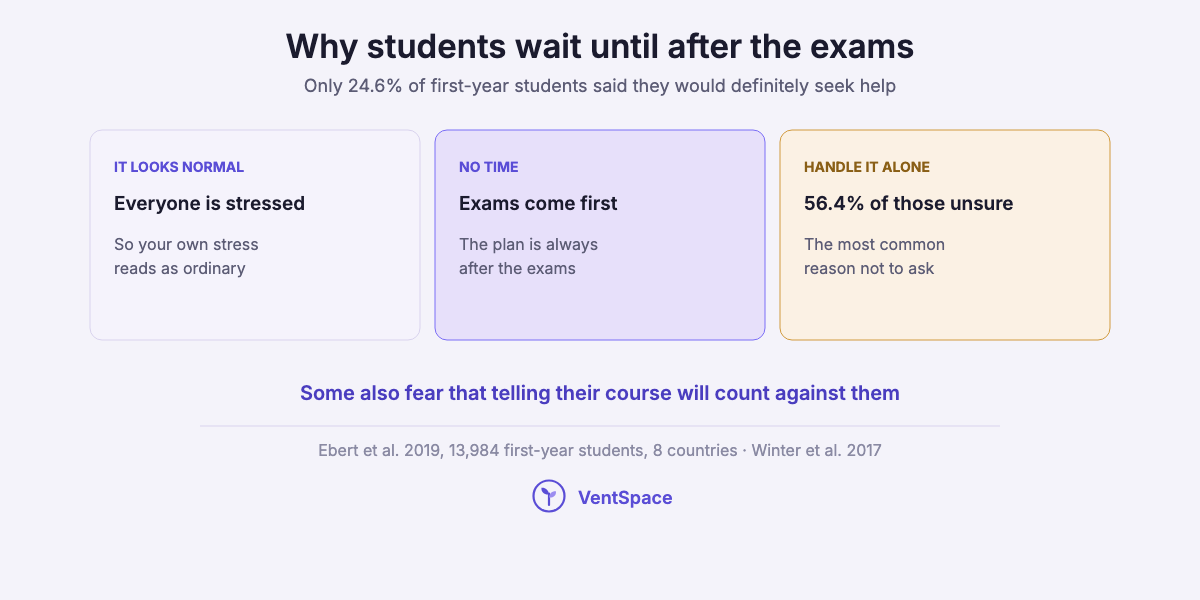
Academic pressure is easy to miss because the signs look like ordinary exam stress, everyone around you seems to have them too, there is no time to deal with them, and many students would rather handle it alone or worry that telling anyone will count against them. So the plan becomes “after the exams”, and the exams are exactly when it would have helped.
The first reason is that it looks normal. Every car on the road has its warning light on. When everyone in the library looks exhausted, your own exhaustion reads as proof that you are a normal, committed student. One student in the Slovak and Czech study said stress is “visible even on some students when they are about to collapse during exams”. When that is ordinary, it is hard to tell when yours has gone past it.
The second is time. Another student in the UK study put it in a sentence many people will recognize:
“That [exams] is what I focused on, yes. The actual mood I didn’t appreciate was that bad, well I knew it was bad but my focus was on the exams so much, I knew it was bad but I left it…it wasn’t the priority.” · A UK medical student interviewed by Winter, Patel and Norman (2017)
The third is wanting to handle it yourself. When nearly 14,000 first-year students in eight countries were asked, only 24.6% said they would definitely seek treatment if they had an emotional problem. Among the rest, the most common reason was a preference to handle the problem alone (56.4%), followed by wanting to talk to friends or relatives instead (48.0%). Cost and waiting lists were not the main reasons. Wanting to cope alone was. One student in the UK study described the same instinct and the regret that came after it: “I’ve always felt that I was quite, I handle pressure quite well…”
The fourth is fear of consequences. In the UK study, some students avoided staff as much as they could because they worried that a mental health problem would be used against them at an appeal or a progress review. That fear is not always irrational. Some courses, especially in medicine, nursing and other regulated professions, have formal processes. It is still worth knowing how they work before you decide, and the next section covers how to ask.
What does waiting cost? The research cannot say that pressure causes poorer results, only that the two go together. In the Belgian study above, students who reported a mental health problem finished the year about three to five percentage points lower. That is a real cost and a modest one. It is also a reason that looking after yourself is part of doing well, not a distraction from it.
The load does not land evenly. In the ACHA survey, 45.8% of students had problems with finances and 76.9% of those found it moderately or highly distressing, and money pressure often means paid hours on top of a full course. First-generation students carry a different gap: in the US Healthy Minds data, among students with symptoms, 32.8% of first-generation students had received therapy in the past year, against 42.8% of other students. The difference was in what reached them, not in how much they were struggling. Graduate students, international students and LGBTQ+ students may also face pressures the general advice does not cover. If you are LGBTQ+, it is reasonable to look for LGBTQ+-specific support, on campus or nationally, alongside the general routes.
Quick Summary
Q: Why do students wait until after exams to get help?
A: Because the signs look like ordinary exam stress, everyone around them seems stressed too, there is no time, and many prefer to handle problems alone. In a survey of nearly 14,000 first-year students in eight countries, only 24.6% said they would definitely seek help for an emotional problem, and the most common reason for hesitating was wanting to handle it alone. Some also fear that telling their course will count against them.
Insight: David Daniel Ebert and colleagues, reporting the World Health Organization’s international college student surveys in the International Journal of Methods in Psychiatric Research (2019): “The most commonly reported reasons not to seek treatment among students who failed to report that they would definitely seek help were the preference to handle the problem alone (56.4%) and wanting to talk with friends or relatives instead (48.0%).” Our reading: the barrier most students describe is less about access to help than about deciding to ask for it.
So what do you do with that, this week?
What to do when academic pressure is affecting your mental health
“You don’t have to be in crisis to deserve support; getting help early makes a real difference.” · The JED Foundation, Understanding Academic Stress in College
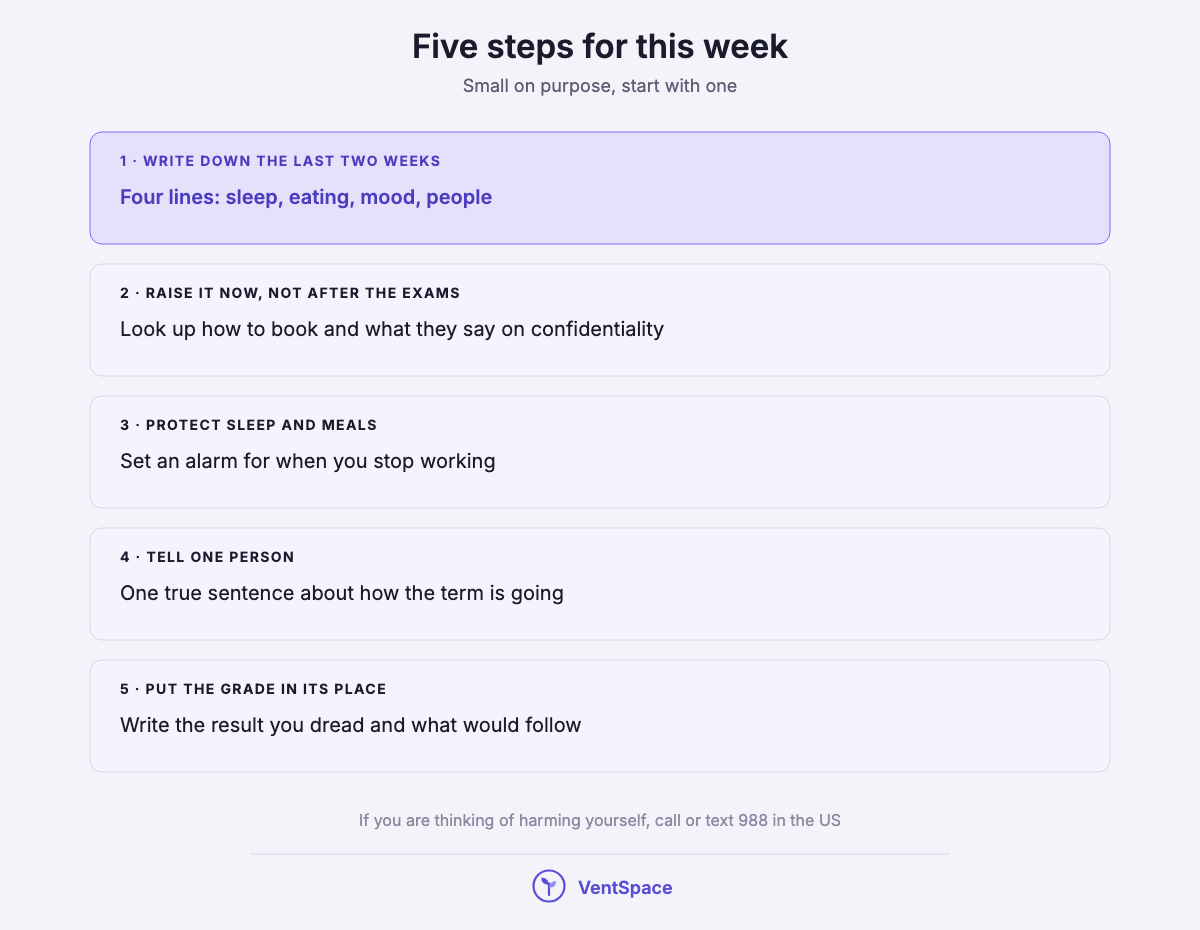
When academic pressure is affecting your mental health, start by writing down what the last two weeks have been like, raise it with your counseling service or a doctor before the exams rather than after, protect sleep and meals as a floor, tell one person the truth about this term, and put the grade back in proportion. These are small on purpose. You are busy, and a plan you can start tonight beats one you will start after finals.
None of these steps is a treatment, and none of them replaces help if you need it. They are ways of noticing the warning light and pulling over for a minute, so you can decide what it is telling you.
1. Write down what the last two weeks have honestly been like
First action: tonight, take a sheet of paper and write four short lines: how you have been sleeping, eating, feeling, and who you have seen. Not a score. Just what has happened.
Why write it down? Because memory is generous during a stressful stretch. It tells you this week was fine because nothing dramatic happened. A few plain lines on paper show you whether the light has been on for three days or three weeks, and they give you something concrete to say if you decide to talk to someone.
One thing this step is not. You may have read that writing your worries down just before an exam calms you down. When researchers pooled 21 studies with 1,457 students, that one-off exercise had no reliable effect on test anxiety. The point of this step is a record you can look back on, not a trick for the morning of the exam.
Ask yourself:
- How many nights in the last two weeks did I sleep the way I normally would?
- When did I last have a day that felt like me?
- What have I stopped doing since the term got heavy?
- If a friend told me they had been like this for two weeks, what would I tell them?
Do not overthink the wording. Four honest lines are enough.
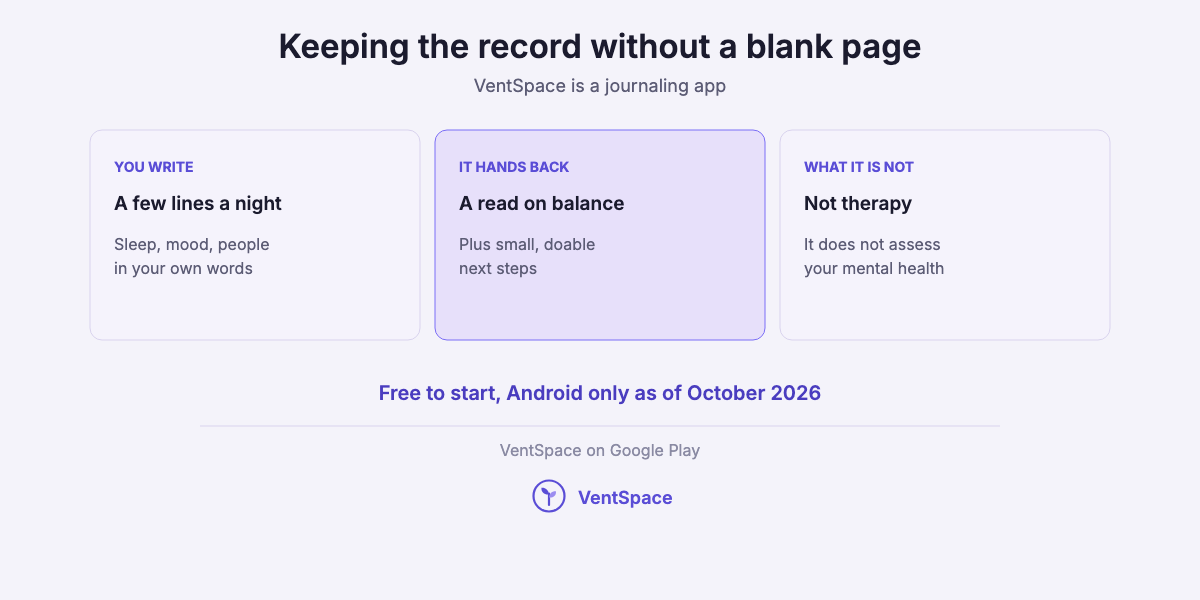
If you would rather not start from a blank page each night, this is the step where an app can carry the record for you. VentSpace is a journaling app that turns what you write into a clear read on your life balance, plus small, doable next steps. It is free to start and Android only as of October 2026. Not on Android, or at a desk? VentSpace Live runs in your browser, free, with nothing to install. It is not therapy, it does not assess your mental health, and it is not a substitute for talking to someone if the light has been on for weeks.
2. Raise it now, not after the exams
First action: look up your college’s counseling or health service today and write down three things: how to book, how long the wait is, and what they say about confidentiality. You do not have to book yet. Just find out.
In the UK study, one of the things that helped students seek help was having built trust with someone beforehand. That can be a counselor, a doctor, an advisor or a tutor you feel safe with. Most universities have a counseling or wellbeing service. What it offers, how long it takes and how it handles confidentiality differ, so it is worth asking those questions directly. A primary care doctor is another place to start, especially if physical symptoms or sleep are part of it.
If you are worried about what disclosure would mean for your course, ask before you share. Some courses have formal processes. You can usually ask the counseling service or a student advice service how disclosure works, and how extensions or extenuating circumstances are handled, before you decide what to tell your department.
If exam anxiety is strong and long-running, know that structured help for it has good evidence. A review of 44 randomized trials with 2,209 university students found that treatments for test-anxious students reduced that anxiety considerably and improved results more modestly, with the most support for behavior therapy. The authors caution that publication bias and weak reporting mean the true effect may be smaller. Those are structured programs, not tips, which is why it is worth asking for them rather than trying to manage alone.
Therapy is one option. For a lot of people it is the right one. If you are unsure whether you need it, our guide on whether you need therapy walks through the question, and if cost is the obstacle, what helps when you cannot afford therapy covers the options.
Ask yourself:
- Who at my college do I trust enough to tell the short version to?
- What would I need to know about confidentiality before I said anything?
- Is there a deadline coming that I might need more time for?
- What am I telling myself will happen if I ask?
You do not need to be in crisis to ask. Asking early is the whole point.
3. Protect sleep and meals as the floor, not the reward
First action: pick a time you will stop working tonight and set an alarm for it. When it goes off, close the laptop, even if the task is not finished.
During exams, sleep and meals tend to become the things you earn after the work is done. Treat them as the floor instead. NIMH’s own short list for coping with stress includes sticking to a sleep routine and getting enough sleep, eating regular meals, avoiding excess caffeine, and reaching out to friends or family who help you cope. None of that is new. What changes it is deciding in advance, rather than at 1 a.m. When did a meal last feel like a break rather than an interruption?
Pills, energy drinks and all-nighters are often passed around as exam strategy. They are not one. If you find you cannot get through the day without them, that belongs with sign 7 above.
If the practical side of your days needs rebuilding, our page on a daily study routine for students under pressure covers routine. This page is about how you are doing, not how you study.
Ask yourself:
- What time did I stop working on each of the last three nights?
- Which meal do I skip most often during exams?
- What is the last thing I do before trying to sleep?
- What would a “good enough” night look like this week?
Do not aim for perfect. One protected evening is a start.
4. Tell one person how this term is going
First action: send one message today to someone you trust, saying one true sentence about how the term is going. Not “fine”. The real version, in one line.
Talking to friends or family is what many students prefer. In the international survey, 48.0% of students who would not definitely seek treatment said they would rather talk to friends or relatives. That is a good instinct and an incomplete one. One first-generation student in a US focus-group study put the limit well:
“Although I talk to friends about what I am going through, they don’t know any more than I do. That type of support system is like coping, it’s not a solution” · A first-year, first-generation student, Horne and Chukwuere, Healthcare (2025)
Telling one person does two things at once. It makes the light visible to someone outside the car, and it often makes the next step, talking to someone trained, easier to take.
Ask yourself:
- Who would notice if I disappeared for a week?
- Who have I been giving the “fine” answer to?
- Is there someone further along in my course who has been through this?
- What is one sentence I could say without explaining everything?
One sentence is enough. You do not owe anyone the whole story.
5. Put the grade back in its place
First action: write down the result you are most afraid of, then underneath it, three things that would realistically happen next. Resit, a lower classification, a hard conversation. Write the real ones, not the imagined ones.
Written down, a worst case becomes something specific, and something specific can be looked up and planned around, in a way a vague dread cannot. This is also where family pressure tends to sit. If the dread is mostly about who will ask how it went, that is worth naming to yourself, and maybe to them.
It can also help to remember the size of what you are protecting. In the Belgian study, the gap linked with mental health problems was a few percentage points of a year mark.
Our reading of that number: an evening spent looking after yourself is unlikely to be what decides your degree.
If you notice you are speaking to yourself far more harshly than you would to a friend, our self-compassion exercises for difficult days are a gentler place to go next.
Ask yourself:
- What am I telling myself this grade says about me?
- Whose disappointment am I most afraid of?
- What would I say to a friend who got the result I am dreading?
- Has a bad result ever been the end of the road for someone I know?
Be honest here. No one else is reading it.
Quick Summary
Q: What should I do if academic pressure is affecting my mental health?
A: Write down what the last two weeks have been like, find out how your college’s counseling or health service works and raise it before the exams, protect sleep and regular meals, tell one person the truth about how the term is going, and put the grade you fear in proportion. If exam anxiety is strong and long-running, structured help has good trial evidence. If you are in crisis, call or text 988 in the US.
Insight: Christopher Huntley and colleagues, summarizing 44 randomized trials in the Journal of Anxiety Disorders (2019): “Interventions were superior to control conditions at post-treatment for reducing TA (g = -0.76) and improving academic performance (g = 0.37). Interventions were superior to control conditions at follow-up. Subgroups analyses found most support for behaviour therapy.” The authors add that publication bias was found and confidence should be moderated. Structured help is worth asking for, which is why step 2 comes early.
Pulling it all together
The five steps are one path, not five projects. Writing it down shows you the pattern, raising it gets you help while it can still change the term, sleep and meals keep you steady, one person keeps you connected, and putting the grade in its place takes some of the weight off. Most people find it easiest to start with step 1 and add the others over the following week.
Step 1 shows you what has been happening. Committed action: write four lines tonight on sleep, eating, mood and people.
Step 2 gets the right people involved early. Committed action: look up how to book your counseling service and what it says about confidentiality, today.
Step 3 sets a floor under your days. Committed action: set an alarm for the time you stop working tonight.
Step 4 keeps you from carrying it alone. Committed action: send one true sentence to one person today.
Step 5 shrinks the fear to its real size. Committed action: write the result you dread and three realistic next steps under it.
Quick Summary
Q: What is the first thing to do if exam stress is affecting my mental health?
A: Write down what the last two weeks have been like: sleep, eating, mood and who you have seen. That record shows whether the stress is a short spike or something that has stayed, and it gives you something concrete to bring to a counselor or doctor. Then find out how your college’s support service works before the exams, not after.
Insight: Patti O’Meara and Benjamin Lovett, concluding their meta-analysis of 21 studies in Anxiety, Stress, & Coping (2026): “The available research literature fails to support single sessions of expressive writing as a treatment for test anxiety. However, other treatments with more supportive evidence are available.” The popular quick fix did not hold up. The slower route of noticing, and then asking, is the one with evidence behind it.
Questions students ask about academic pressure and mental health
Is it normal to feel this stressed at college?
Feeling stressed around exams and deadlines is common, and in a large US survey about three in four students rated their stress over the past month as moderate or high. But common is not the same as harmless. If the stress does not lift after deadlines, has spread into your sleep, mood or friendships, or has lasted most of a term, it is worth acting on, even if everyone around you feels the same.
What are the physical signs of academic stress?
Students often describe a tight chest, an upset stomach and sleep that has changed, even on days off. These are easy to explain away as nerves. A physical symptom that keeps coming back is worth checking with a doctor, whatever you think is causing it, and the pattern matters more than any single symptom.
Is test anxiety a real thing?
Researchers use the term “test anxiety” for strong anxiety around exams, and they study it as a reaction to a specific situation rather than a general disorder. It is real in the sense that it is common, measurable and treatable: a review of 44 randomized trials found that structured help reduced it considerably in university students. If exam anxiety is strong and long-running, ask your counseling service what they offer.
Will telling my college about my mental health affect my degree?
It depends on your course and your institution. Some courses, especially in professions like medicine and nursing, have formal processes, so it is reasonable to ask how disclosure works before you share anything. A counseling service or a student advice service can usually explain confidentiality, extensions and extenuating circumstances first.
Does writing down my worries before an exam help?
When researchers pooled 21 studies with 1,457 students, writing about your worries once, just before a test, had no reliable effect on test anxiety. Keeping a simple record over a couple of weeks is different: it is a way of noticing a pattern, not a quick fix for the morning of an exam.
When should I see a counselor or a doctor?
NIMH advises talking to a professional if you are struggling to cope or your symptoms of stress or anxiety will not go away. Raise it before the exams rather than after if your sleep, eating or mood has changed for weeks, if you are using alcohol or other substances to cope, or if you cannot do the work at all. If you are thinking of harming yourself, call or text 988 in the US, or find your local line at findahelpline.com.
In a nutshell
Academic pressure is supposed to rise and fall with the term. When the warning light stays on after the hill has flattened out, it is telling you something, even if every other car on the road has its light on too.
Two things to take with you. First, the signs are easy to explain away, and “everyone is like this” is not a reason to wait: the best time to raise it is before the exams. Second, the honest timeline: a heavy term does not turn around in a weekend, and the first night’s four lines will not show you much on their own. It is the second and third week of the record that shows whether the light has been on, which is a reason to start this week, not after finals.
Which of the five steps will you start tonight?
About this article

Written by
Sai Subramaniam
Founder, VentSpace
I write these guides because I have been where you are. I am working through my own hard seasons, and I share the things that actually helped me, so that anyone going through it has a steady companion close by instead of facing it alone. VentSpace is the app I built for exactly that: a journaling app that turns what you write into a clear read on your life balance, plus small, doable next steps toward feeling more like yourself.
This writing is honest and every claim is sourced, and it is not a substitute for professional care. If you are struggling, reaching out to a professional is a strong move, not a failure.
Explore VentSpaceTry VentSpace LiveHow this one was checked. Every factual claim traces to a named source, and the source is printed next to the claim rather than kept in a footnote. Quotes are pinned to the work they come from, with the year, the letter or the chapter where one exists. Where a widely repeated claim could not be traced, it was left out and the omission recorded. Where a figure is contested, both sides are printed.
No affiliate links, no paid placements, and nobody paid to appear here. Where we mention our own app, we say that it is ours, we state its limits, and we never position it as a substitute for care.
Reviewed: October 2026. Prices, platforms and product availability move quickly, and anything we could not verify at the time of writing is marked as unverified rather than turned into a number.
Corrections. If something here is wrong, we would rather know. Corrections are made in place, with a note saying what changed.