
“If they be two, they are two so / As stiffe twin compasses are two, / Thy soule the fixt foot, makes no show / To move, but doth, if the’other doe.”
John Donne, “A Valediction: forbidding mourning” (original spelling)
We nearly left this page alone. The tips in the first version had aged, but the heart of it had not, and the heart of it was not advice at all. It was Sai, who writes this blog, standing in an airport in 2022 with thousands of people walking past him, crying because he was leaving the person he loved on the other side of the world. That is how this one began: not with a plan, but with a goodbye. So where do you go from the goodbye?
Here is a reframe worth holding before anything else. Distance is not the verdict on your relationship. In a nationally representative study of 870 people, those in long-distance relationships reported higher relationship quality and more dedication than people who lived close to their partners, and they were no more likely to have broken up by the follow-up (Kelmer and colleagues, Family Process, 2013). What decides it is less the miles than what the two of you do with them.
So this page does two things. It names the real challenges, including two that most lists skip, and then gives you five steps you can start this week, with Sai’s own story running through the middle of it.
The short version
Long distance is hard, and it is not a disadvantage in itself. In a study of 870 people, long-distance couples reported higher quality than couples nearby and broke up at the same rate.
The hardest parts: missing touch, a conversation that shrinks to logistics, insecurity, and seeing an idealized version of each other.
Five steps: talk about how the distance ends, say the insecurity out loud instead of checking, build a rhythm of small contact, share the ordinary days, and keep your own life full.
Plan for the reunion too. Couples who moved back together reported losing some independence and more conflict and jealousy.
Nobody can tell you how long the missing stays this sharp. It changes, and it is allowed to take its time.
From Sai, who wrote the first version of this page (2022): “I still remember crying at the airport, with thousands of people walking by me. I just couldn’t hold my tears. I cried my heart out and I had a million thoughts of running back to the entrance.”
The real challenges of a long-distance relationship
“Dull sublunary lovers love / (Whose soule is sense) cannot admit / Absence, because it doth remove / Those things which elemented it.”
John Donne, “A Valediction: forbidding mourning” (original spelling)
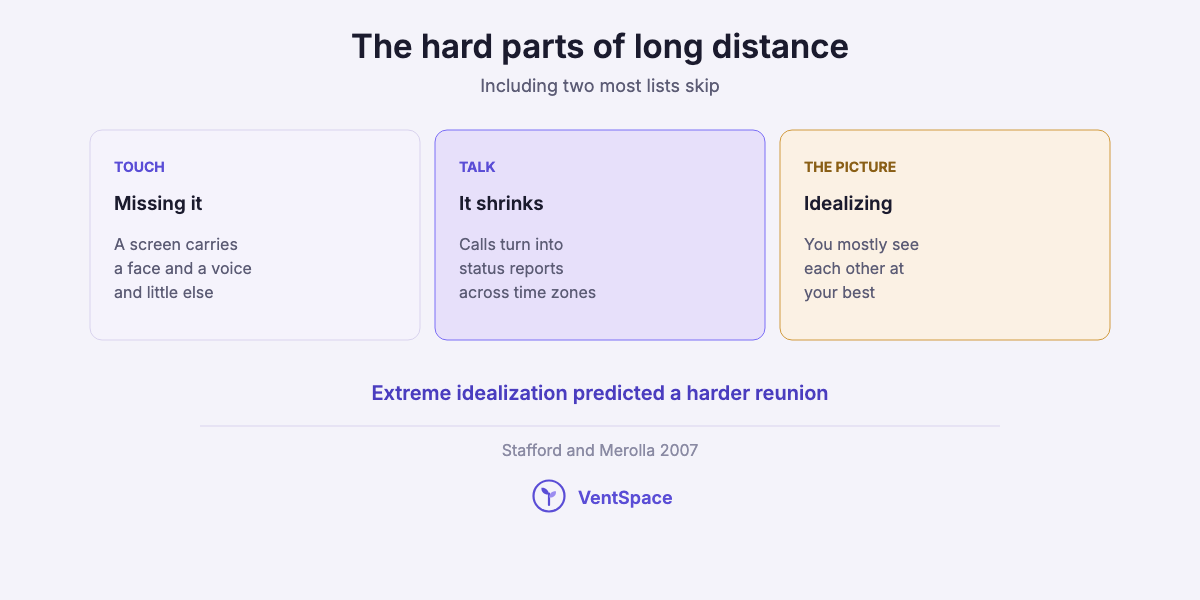
The challenges of a long-distance relationship are missing touch, a conversation that shrinks, time zones, insecurity, an idealized picture of each other, and not knowing when it ends. Donne’s lines above name the fear underneath all of them: that a love made of being near cannot survive being far. Is that true of yours? Usually the honest answer is that some of it travels and some of it has to be rebuilt.
Missing touch is the first and the loudest. The hug at the door, the hand on your back in a crowded room, falling asleep next to someone. A screen carries a face and a voice and almost nothing else. Sai wrote that missing her was the hardest part, the craving for “love, touch and comfort”, more than anything practical.
The conversation shrinks. At first you talk for hours. Then the calls start to sound like a status report: work was fine, the flight is booked, the landlord called. Add a time difference and you may only get one good hour a day, often when one of you is tired. When Sai moved from India to Berlin, the two of them were a twelve-hour flight apart and in different time zones, so even small news had to wait.
Insecurity visits. A slow reply, a photo from a party you were not at, a name you do not recognize. Little things land harder when you cannot see the context around them. That does not make you jealous by nature. It makes you someone who cannot see the room the other person is in.
You may start seeing an edited version of each other. At a distance, each of you mostly sees the other at their best: dressed for the video call, saving the good stories. Research on long-distance dating found that partners idealized each other more than couples nearby, and that extreme idealization during the separation predicted instability once they were back together (Stafford and Merolla, Journal of Social and Personal Relationships, 2007). The edited version is lovely. It is also not the person you will live with.
There may be no end date. Distance with a date on it is a countdown. Distance without one is a question that sits in the background of every call. Do you know when yours ends? Does your partner have the same answer?
And one of you left while the other stayed. The one who moved has a new city to learn, often alone. The one who stayed has the same streets with a gap in them. Both are hard, in different ways, and it helps to say out loud which one you are carrying. If you are the one who moved, our guide to overcoming loneliness in a new city covers your side of it.
Quick Summary
Q: What are the biggest challenges in a long-distance relationship?
A: Missing touch, conversations that shrink to logistics, time zones, insecurity, seeing an idealized version of each other, and not knowing when the distance ends. One partner is also usually adjusting to a new place while the other is adjusting to an absence.
Insight: Laura Stafford and Andy Merolla, Journal of Social and Personal Relationships (2007): “LDDRs were more stable than GCDRs as long as LDDR partners remained geographically separated, but LDDR partners were likely to terminate their relationship upon becoming proximal. Longer absences between face-to-face visits and extreme idealization during separation predicted instability upon reunion.” (LDDRs are long-distance dating relationships, GCDRs geographically close ones.)
Do long-distance relationships work?
“The long-distance couples try harder than geographically close couples in communicating affection and intimacy, and their efforts do pay back.”
Crystal Jiang, communication researcher, Cornell Chronicle (2013)
Yes, many do, and the research does not show that distance itself makes a relationship worse. It shows something more useful: what happens inside the relationship matters more than how far apart you live.
Three findings are worth knowing. In the nationally representative study of 870 people, those in long-distance relationships reported higher quality, more dedication and less feeling of being trapped, though they were as likely as close couples to have broken up by the follow-up (Kelmer and colleagues, 2013). In a study of 717 people in long-distance dating relationships and 425 in close ones, the authors found few differences and concluded that long-distance partners “are not at a disadvantage”, with individual and relationship characteristics predicting quality instead (Dargie and colleagues, Journal of Sex & Marital Therapy, 2015). And in a diary study at Cornell, long-distance couples had fewer interactions each day but disclosed more and felt more intimate, partly because they idealized each other (Jiang and Hancock, Journal of Communication, 2013).
So the honest answer has two halves. Distance does not doom you, and it does not protect you either. The same idealization that makes calls feel close can make the reunion harder, which is why this page gives the end of the distance its own section. Some couples end, during the distance or after it, and that does not mean they did it wrong.
From Sai, who wrote the first version of this page (2022): “I trust my partner with everything I have. That’s the kind of communication and trust we have built up over the years.”
Which of these sounds more like your relationship right now: two people trying harder, or two people waiting it out?
Quick Summary
Q: Do long-distance relationships work?
A: Many do. In a nationally representative study of 870 people, long-distance partners reported higher relationship quality than couples living nearby and broke up at the same rate. What predicts how it goes is the relationship itself, how you talk and how honest you are, more than the miles.
Insight: Gretchen Kelmer and colleagues, Family Process (2013): “Individuals in long-distance relationships generally reported higher levels of relationship quality on a number of relationship quality variables, as well as higher levels of dedication to their relationships and lower levels of feeling trapped (i.e., felt constraint), but were similar to individuals in close-proximity relationships in terms of perceived and material constraints.”
So what helps?
How to make a long-distance relationship work: five steps
“Sing and dance together and be joyous, but let each one of you be alone, / Even as the strings of a lute are alone though they quiver with the same music.”
Kahlil Gibran, The Prophet, “On Marriage” (1923)
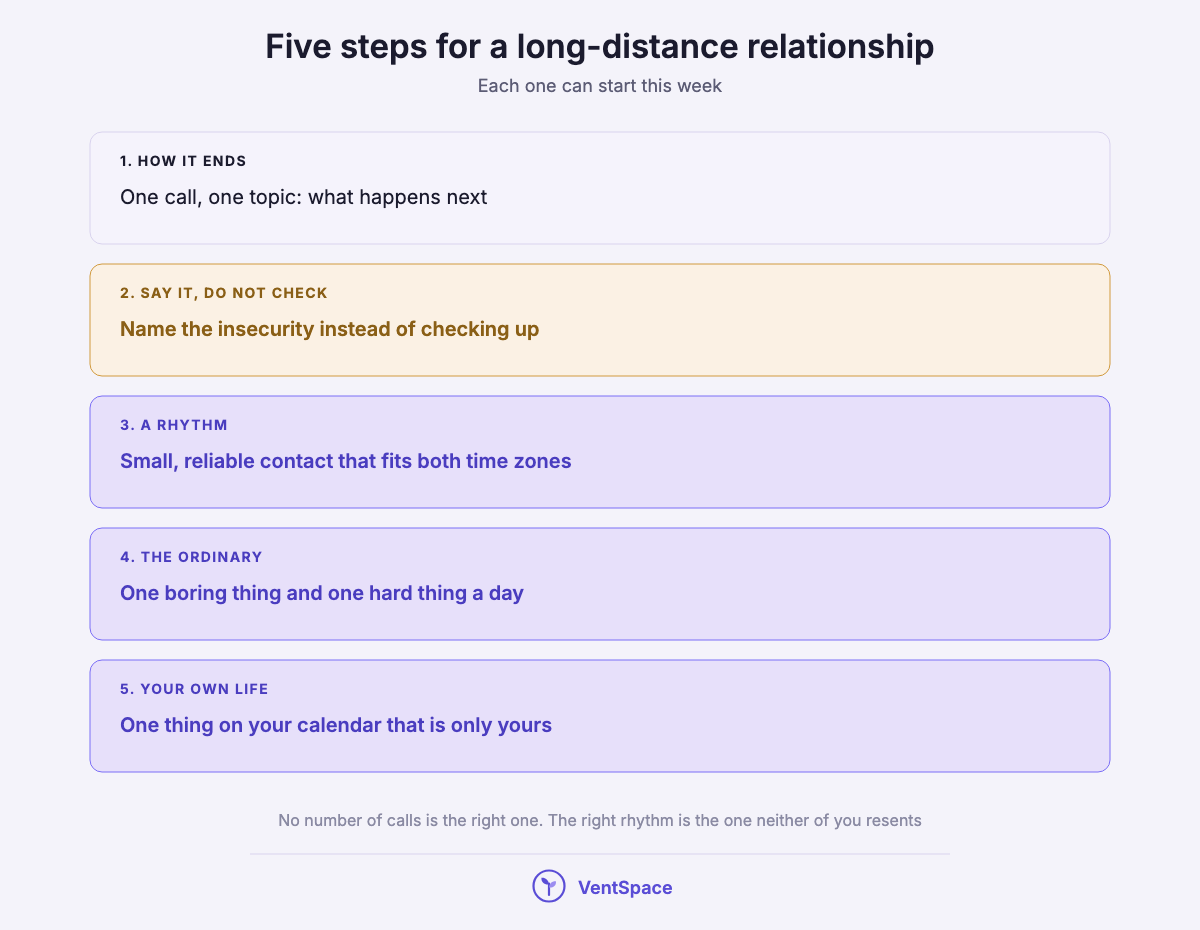
These five steps are built from what the studies above found and from what Sai wrote down while he was living it. None of them needs money or a plane ticket. Each starts with something you can do this week.
Step 1: Talk about how the distance ends
Book one unhurried call this week with a single topic: what happens next. Not the next visit, the bigger picture. Is there a date when one of you moves? A condition, like a visa or the end of a course? Or is it open? You do not need to agree on everything in one call. You need to know whether you are hoping for the same thing.
- What is this distance for, in one sentence?
- What would have to happen for it to end?
- Who would move, and how does each of us feel about that?
- If we do not know yet, when will we talk about it again?
It is fine if the answer is “we do not know yet”. Saying that together is different from each of you guessing alone.
Step 2: Say the insecurity out loud instead of checking
The next time a slow reply or an unfamiliar name sets off a knot in your stomach, write down what happened and what you felt before you do anything else. Then, if it is still there an hour later, tell your partner about the feeling, not the accusation. Sai’s original version of this step is still the best one: tell them it is something you are having trouble with, and that you are not blaming them for it.
- What exactly happened, and what did I assume it meant?
- Is this a pattern in us, or an old fear of mine?
- What would help me feel steadier: a call, a plan, a reassurance?
- Can I ask for that without asking them to prove anything?
One line belongs here plainly. Checking a partner’s location, reading their messages or demanding passwords is not reassurance, it is control, and the National Domestic Violence Hotline lists checking a partner’s texts among the behaviors to look at in yourself. If either of you is doing that, or you feel unsafe with your partner, the Hotline is free and open 24/7 at 1-800-799-7233, or text START to 88788. If the worry is specifically that your partner is cheating, our page on signs your partner may be cheating, and whether to confront them explains why asking works better than watching.
Feeling insecure does not make you an insecure person. It makes you someone who misses someone.
Step 3: Build a rhythm of small contact
Instead of one long call that becomes an obligation, agree on a few small, reliable touchpoints that fit both time zones. A voice note when you wake up. A photo of lunch. One call when you are both awake enough to enjoy it. An article from the Gottman Institute, the relationship researcher John Gottman’s organization, calls these moments bids: “any attempt from one partner to another for attention, affirmation, affection, or any other positive connection.” At a distance, most of your relationship is made of them.
The Cornell diary study is reassuring here. Long-distance couples had fewer interactions a day, but used more texts, calls and video chats, and felt more intimate when they used text-based, mobile messages, the kind you send in the middle of a day. Small and often can beat long and rare. A few ideas from Sai’s first version of this page that still hold up:
- Watch the same movie at the same time, with a call open.
- Cook the same recipe on a video call.
- Make a shared playlist of songs that remind you of each other.
- Write a real letter or an email, once in a while, instead of a text.
- Send a small surprise to their door.
For more, our lists of romantic things to do and deep questions to ask your girlfriend translate well to a video call.
- What time of day are we both most ourselves?
- Which kind of contact makes me feel closest: voice, video, words, or things in the mail?
- What does my partner seem to light up at?
- Is any part of our routine starting to feel like a chore?
There is no right number of calls a day. The right rhythm is the one neither of you resents.
Step 4: Share the ordinary days, not only the highlights
Tonight, tell your partner one boring thing and one hard thing about your day. The commute, the colleague who got on your nerves, the moment you felt lonely in the grocery store. Distance pulls us toward performing the highlights, and the research suggests that the edited version has a cost: the more idealized the picture during the separation, the harder the reunion tended to be.
Sai wrote the same instinct into his first version: tell them everything, even the small things, the people you met, the fears and the worries as well as the joys.
This is also where a popular idea deserves a gentler grip. The old version of this page suggested learning your partner’s “love language”. A preregistered 2025 study of 499 people in long-term relationships found that less than half had an identifiable primary love language, and that being loved in that one preferred way predicted relationship quality no better than other loving behaviors did (Flicker and colleagues, Journal of Marital and Family Therapy). What mattered more was satisfaction across a wider range of loving behaviors. So instead of guessing their one language, try a little of several.
- What did I leave out of today’s call because it seemed too dull?
- What is something hard I have been saving for “when we are together”?
- Do I know what an ordinary Tuesday looks like for my partner now?
- Which small loving things have I stopped doing because of the distance?
Dull is not a failure of romance. It is how two people stay real to each other.
Step 5: Keep your own life full
This week, add one thing to your own calendar that has nothing to do with your partner: a class, a team, a standing dinner with a friend, a walk you take every Sunday. Sai’s original advice here was not to count the days, and to fill them instead, so that each of you is on your own path until the paths cross again. Gibran’s image above says the same: two strings, each alone, playing the same music.
From Sai, who wrote the first version of this page (2022): “In my personal experience, meditation, journaling and practicing gratitude is helping me through my long distance journey.”
Some of what you feel on the in-between days will not fit into a call: the evening the missing comes back hard, a worry you have not found words for yet. Writing some of it down before you talk can help you find the words, not replace the talk. If that would help, VentSpace is a journaling app that turns what you write into a clear read on your life balance, plus small, doable next steps. Prefer to try it on your laptop first? VentSpace Live runs in your browser, free, with nothing to install. It is not a substitute for telling your partner, or a friend, how you are.
- What did I enjoy before this relationship that I have let slip?
- Who near me can I see in person this week?
- What am I building here that I would want to show my partner?
- Am I living my days, or waiting through them?
A full life is not disloyal. It is what you bring back to the circle.
Quick Summary
Q: How do you make a long-distance relationship work?
A: Talk about how the distance ends, say insecurity out loud instead of checking, build a rhythm of small contact that fits both time zones, share the ordinary days as well as the good ones, and keep your own life full. None of these needs money, and each can start this week.
Insight: Flicker, Sancier-Barbosa and Impett, Journal of Marital and Family Therapy (2025), on love languages: “Findings failed to support Chapman’s key claims: less than half of participants had an identifiable primary love language, and satisfaction with a partner’s expression of that behavior was no stronger a predictor of relationship quality than satisfaction with other love language behaviors.”
Pulling it all together
“fire needs air. Desire needs space.”
Esther Perel, “The secret to desire in a long-term relationship”, TED (2013)
Step 1, how it ends. One call with one topic. Your committed action is to put that call in both calendars this week.
Step 2, say it instead of checking. One written line about what you felt, then one sentence to your partner about the feeling. Your committed action is to try it the next time the knot shows up.
Step 3, a rhythm. Two or three small, reliable touchpoints. Your committed action is to agree on them on your next call.
Step 4, the ordinary. One boring thing and one hard thing. Your committed action is to share both tonight.
Step 5, your own life. One thing on your calendar that is only yours. Your committed action is to book it.
Perel’s line is about desire, but it holds for the whole of a long-distance relationship. The space between you is not only something to close. It is something to look after.
Quick Summary
Q: What is the most important thing in a long-distance relationship?
A: Honest, regular contact about the real days, not only the highlights, plus a shared sense of where it is going. Research suggests the effort couples put into communicating matters more than the distance itself.
Insight: The Cornell Chronicle (2013), reporting Jiang and Hancock’s diary study: “Long distance couples in the study felt more intimate with each other, as they disclosed more and they idealized their partner’s behaviors and conquered the miles when they used text-based, asynchronous and mobile media.”
When the distance ends
“I am most drawn to my partner when she is away, when we are apart, when we reunite.”
Esther Perel, reporting a common answer to her question “when do you find yourself most drawn to your partner?”, TED (2013)
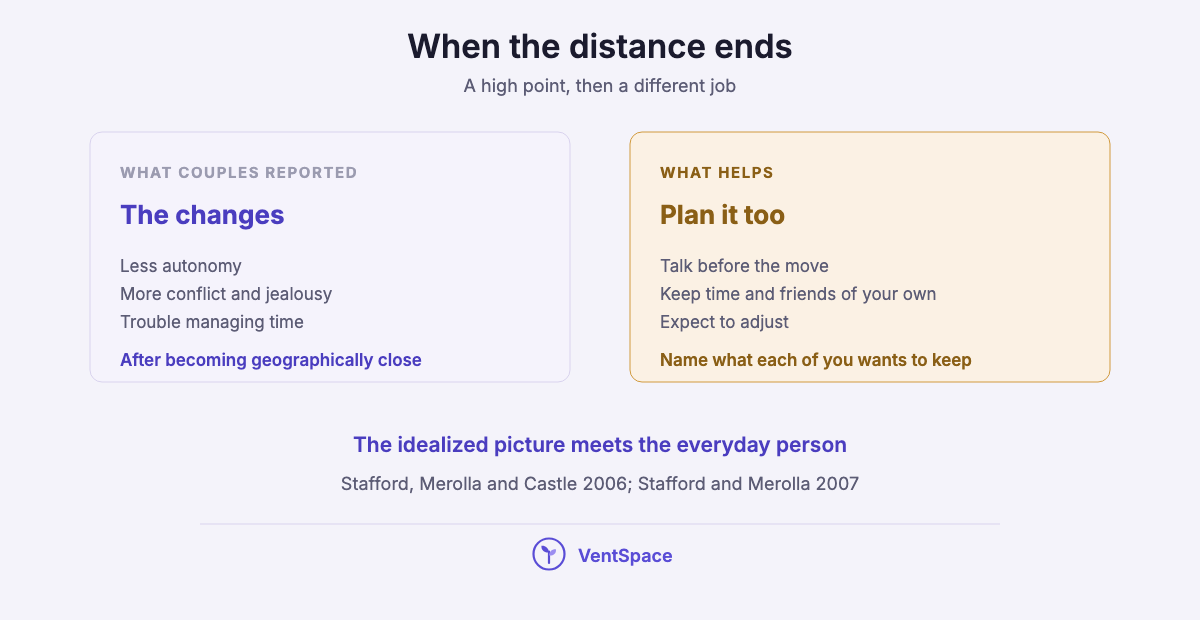
When the distance ends, expect an adjustment, not only a celebration. The reunion is a high point. The weeks after it are a different job: learning to share space, time and plans again.
A study of long-distance dating partners who became geographically close found that the changes they reported included losing some autonomy, learning more about each other, good and bad, struggling to manage time, and more conflict and jealousy. Some missed parts of the long-distance arrangement, like the independence and the novelty, and those whose relationships ended after the reunion were more likely to report missing it (Stafford, Merolla and Castle, Journal of Social and Personal Relationships, 2006). The 2007 study adds the reason this happens: the idealized picture meets the everyday person.
None of that means the reunion will go badly. It means it deserves the same planning as the distance did. Before you move, talk about the parts of the long-distance life each of you wants to keep: time alone, friends of your own, the way you used to tell each other about your day. Who does the dishes matters too.
If you find yourselves stuck between staying together and ending it, during the distance or after, that is a hard decision and a common one. Our page on analysis paralysis in relationships looks at why it is so hard to decide, and couples counseling, including online sessions while you are apart, is a legitimate place to work it through.
Quick Summary
Q: What happens when a long-distance relationship becomes close-distance?
A: Usually an adjustment. Couples who moved back together reported losing some independence, learning more about each other, good and bad, struggling with time, and more conflict and jealousy. Talking before the move about what each of you wants to keep makes the change easier to name.
Insight: Laura Stafford, Andy Merolla and Janessa Castle, Journal of Social and Personal Relationships (2006): “Desirable features of LDDRs (e.g., autonomy and novelty) appear to be lost, and missed, upon reunion. Individuals whose relationships terminated upon reunion were more likely to report missing aspects of LDDRs. Overall, we propose reunions facilitate relational and partner knowledge acquisition, the dissipation of quixotic ideals, and increased partner interdependence.”
Questions people ask about long-distance relationships
Do long-distance relationships work?
Many do. A nationally representative study of 870 people found long-distance partners reported higher relationship quality than partners living close by, and broke up at the same rate. Distance is not the deciding factor. How you talk, how honest you are and whether you share a plan matter more.
How often should you talk in a long-distance relationship?
There is no right number, and we would be wary of any page that gives you one. The useful question is what rhythm both of you can keep without resentment. A few small, reliable touchpoints that fit both time zones usually serve better than one long call that starts to feel like a duty.
How do I deal with insecurity in a long-distance relationship?
Name what happened and what you felt, then tell your partner about the feeling rather than accusing them. Ask for something specific that would help, like a call or a plan. Checking their location or messages tends to deepen the worry, and it crosses into control.
Are love languages real?
They are a popular idea with weak research behind them. A preregistered 2025 study of 499 people in long-term relationships found that fewer than half had an identifiable primary love language, and that receiving love in that preferred way did not predict relationship quality better than other loving behaviors. Doing a range of loving things matters more than finding the one.
How do you keep intimacy alive at a distance?
Share more of your real day, not only the highlights. In a Cornell diary study, long-distance couples disclosed more and felt more intimate than couples nearby. Watching something together, voice notes, letters and planned visits all help, and so does talking honestly about what you miss physically.
When should a long-distance relationship end?
We cannot answer that for you, and nobody outside the relationship can. Some couples end during the distance or after it, and that is not proof they did it wrong. If you keep going back and forth, couples counseling, including online sessions, or a counselor of your own, is a legitimate place to think it through.
In a nutshell
First, distance is not the verdict. The research says long-distance couples are not at a disadvantage in themselves. What decides it is the honest, ordinary contact between you, a shared sense of where it is going, and a plan for the day the distance ends.
Second, nobody can tell you how long the missing stays this sharp. It changes, and it does not run on a schedule. When he wrote the first version of this page, Sai put it plainly: “I have accepted it mentally. But emotionally, I am still processing it.” Both of those can be true for a long time.
Donne’s compass only draws a circle because one foot holds steady while the other travels, each leaning toward the other. Which foot are you this week, and what would help you lean?
About this article

Written by
Sai Subramaniam
Founder, VentSpace
I write these guides because I have been where you are. I am working through my own hard seasons, and I share the things that actually helped me, so that anyone going through it has a steady companion close by instead of facing it alone. VentSpace is the app I built for exactly that: a journaling app that turns what you write into a clear read on your life balance, plus small, doable next steps toward feeling more like yourself.
This writing is honest and every claim is sourced, and it is not a substitute for professional care. If you are struggling, reaching out to a professional is a strong move, not a failure.
Explore VentSpaceTry VentSpace LiveHow this one was checked. Every factual claim traces to a named source, and the source is printed next to the claim rather than kept in a footnote. Quotes are pinned to the work they come from, with the year, the letter or the chapter where one exists. Where a widely repeated claim could not be traced, it was left out and the omission recorded. Where a figure is contested, both sides are printed.
No affiliate links, no paid placements, and nobody paid to appear here. Where we mention our own app, we say that it is ours, we state its limits, and we never position it as a substitute for care.
Reviewed: October 2026. Prices, platforms and product availability move quickly, and anything we could not verify at the time of writing is marked as unverified rather than turned into a number.
Corrections. If something here is wrong, we would rather know. Corrections are made in place, with a note saying what changed.