
“It is about a search, too, for daily meaning as well as daily bread, for recognition as well as cash, for astonishment rather than torpor; in short, for a sort of life rather than a Monday through Friday sort of dying.”
Studs Terkel, introduction to Working (1974)
It usually arrives on an ordinary evening, the kind where nothing is wrong exactly: dinner eaten, phone in hand, tomorrow already loading in the back of your head, and somewhere in there a quiet, slightly embarrassing sum, five days for them and two days for you, repeated until some date so far away it barely feels real. Then the question. What is all of this for?
The phrase for it is unglamorous. The American Heritage Dictionary defines a rat race as “a difficult, tiring, often competitive activity or routine,” which is accurate as far as it goes, but it leaves out the part that stings, which is that it was not supposed to turn out this way: in 1930 the economist John Maynard Keynes predicted that a century later people would work about fifteen hours a week, and that our real problem would be what to do with all the free time.
We are four years short of his deadline. The free time did not arrive on schedule. This page is about why that keeps happening, why most of us stay anyway, and what can change without burning a life down to change it.
From Sai, who writes this blog
Here I am staring at the clouds, wondering: how did I go from living 30 days a month to living 4 days a month? Isn’t freedom the goal? And what’s the price I need to pay for it? Should I grind during my free time to build a side hustle, and sacrifice the present completely for the hope of a free future? Wouldn’t that change me as a person? What is the point of it all?
Quick Digest
– What the rat race is: a tiring, repetitive, competitive routine that takes most of the week and returns very little of it.
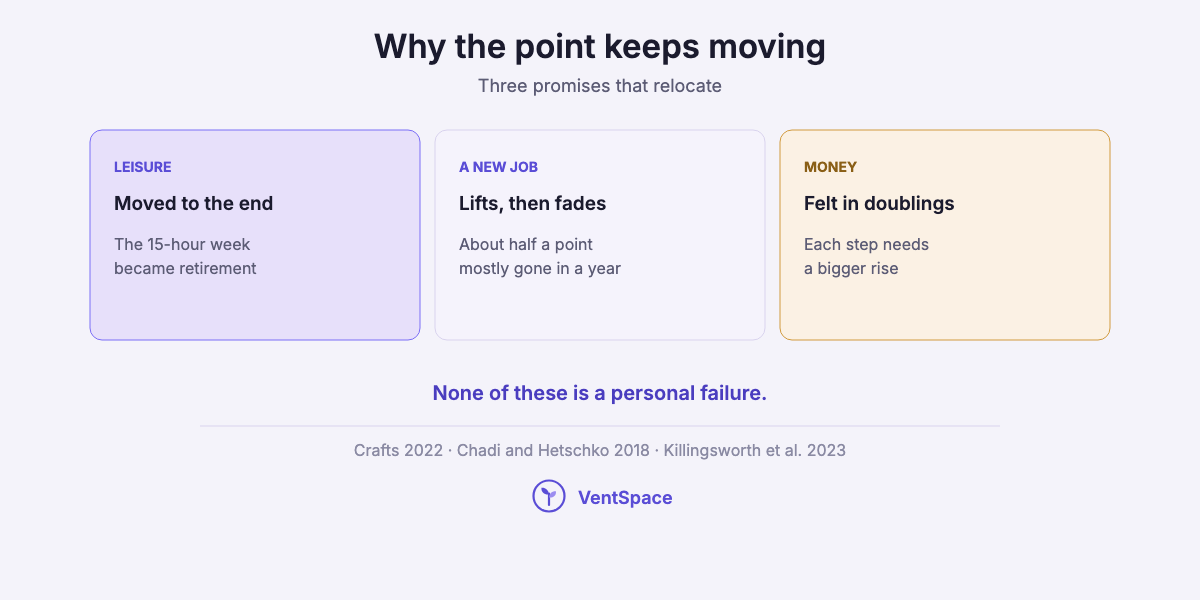
– Why it feels pointless: what it promises keeps moving. Predicted leisure became retirement, a new job’s lift fades within about a year, and extra money is felt in doublings, not raises.
– Why we stay: money, dependents, a boss who says you will never find anything else, and the need to belong somewhere. These are real, not weakness.
– What can change: usually not everything at once. See where last week went, name what holds you, picture what is outside the room, and move one thing inside the week.
– What this page will not do: tell you to quit, tell you to stay, or give financial advice.
If "what's the point" has started to mean more than work
If you are in crisis or thinking about harming yourself, please reach out now. In the United States you can call or text 988 for the Suicide and Crisis Lifeline. Outside the US, findahelpline.com lists the number where you are. This article is not a substitute for that.
What the rat race is
“The part of life we really live is small. For all the rest of existence is not life, but merely time.”
Seneca, On the Shortness of Life, quoting an unnamed poet in the first sentence (trans. John W. Basore, 1932)
The rat race is a routine that takes most of your waking week and gives back the edges. The work itself might be fine. Some days it is even good. The problem is the shape, which looks something like this: you wake up early to beat traffic so you can sit at a desk so you can earn the money that pays for the apartment near the job and the car that gets you to the job and the takeout on the nights you were too tired from the job to cook, and on the weekend you recover, and on Sunday evening the whole thing starts loading again.
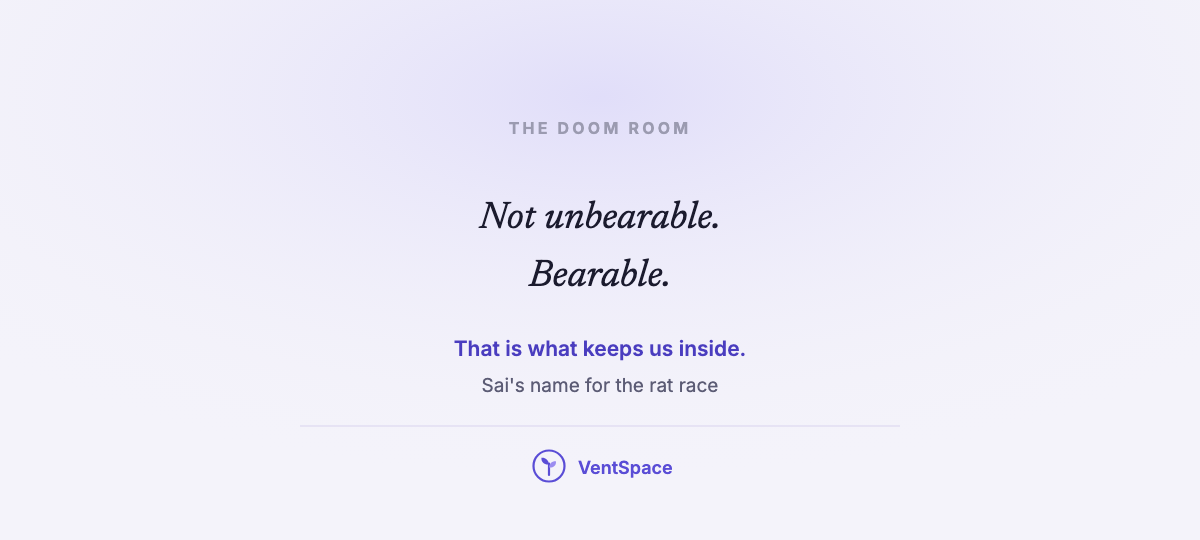
Sai’s phrase for it is the doom room. You walk in on Monday. You come out on Friday. Inside, the paycheck keeps you there. And the strange thing about the room is not that it is unbearable. It is that it is bearable. Bearable is what keeps us inside.
It helps to be clear about what this is not. The rat race is not the same thing as burnout. The World Health Organization describes burnout as resulting from “chronic workplace stress that has not been successfully managed.” That is a description of being worn down, whereas what this page is about is something slightly different and in some ways stranger, the feeling that the effort, however well you manage it, is going around in a circle and coming back to the same Sunday night. The two can travel together. If exhaustion is the main thing you feel, a doctor is a better first stop than this page. If it is the sense that effort no longer adds up to anything, our page on purpose versus productivity goes further.
Quick Summary
Q: What does rat race mean?
A: A difficult, tiring, often competitive routine, in the American Heritage Dictionary‘s words. In everyday use it means a working life that takes most of the week, keeps you running in the same circle, and leaves only the edges for yourself.
Insight** Seneca, writing around 49 AD to Paulinus, the official who ran Rome's grain supply, asked him to count "how few days have passed as you had intended." The complaint is almost two thousand years old. **The rat race is not a modern invention, only a modern arrangement.
Why it starts to feel pointless
“how to occupy the leisure, which science and compound interest will have won for him”
John Maynard Keynes, “Economic Possibilities for Our Grandchildren” (1930), on what he called man’s “real, his permanent problem”
The rat race feels pointless because what it promises keeps moving. You were told, at school and at home and at every career fair you ever walked through, that the running would get you somewhere, and every time you get close enough to see it, the somewhere has quietly relocated a few years further down the track. There are at least three ways this happens. None of them are in your head.
The leisure moved to the end
Keynes’s fifteen-hour week never came. In a 2022 paper, the economist Nicholas Crafts concluded that the prediction “will not be realised.” But he also found something stranger: in the UK, expected lifetime hours of leisure and home production rose by 58 percent between 1931 and 2011, mostly because people now live longer and spend much longer in retirement.
So the free time did arrive. It just got moved to the end of your life, packed into a block at the far end of a career that you are told to save up for, decade after decade, which is exactly the trade Sai was asking about when he wondered whether to sacrifice the present completely for the hope of a free future. The trade is old. Nobody asked you whether you wanted it.
The new job fades
The obvious exit is a different room. And a different room does help, for a while. The economists Chadi and Hetschko followed German workers through job changes and found that a new job lifts satisfaction by about half a point on a ten-point scale, and then the lift mostly fades within a year. People who resigned did stay somewhat better off than before.
This matters because it explains a particular kind of despair, the one where you finally changed jobs after two years of wanting to, told everyone, felt something close to freedom for about six months, and then woke up one Monday to find it felt like the old job with a different logo and a longer commute. That fade is the normal pattern. It is not proof the move was wrong, and it is not proof that nothing will ever change. It is proof that a new room is still a room.
Money keeps helping, but in doublings
The other promise is money, and here the research is more interesting than either side of the usual argument. In 2023 the researchers Matthew Killingsworth, Daniel Kahneman and Barbara Mellers, two of whom had published contradictory answers to whether a bigger income makes people happier, ran what is called an adversarial collaboration, which is a polite way of saying that people who disagreed agreed to reanalyze the data together until they could explain both results. They found that for most people, “Happiness increases steadily with log(income)”, while for the least happy group it flattened out.
Log income means that, on average, each similar step up in how you feel needs a similar proportional rise in income, a doubling rather than a raise. That is our reading of the math, not their words. So the next raise may matter less than you hoped, especially if you were counting on it to fix the feeling rather than the bills, and for people who are already unhappy, more money appears to stop helping at some point, which is worth remembering on the evening you are tempted to take on a second job in order to buy your way out of the first. Money is not pointless. It is just not the thing that answers the question you are asking on Sunday night.
Quick Summary
Q: Why does the rat race feel pointless?
A: Because what it promises keeps moving. The leisure economists predicted arrived mostly as retirement, the lift from a new job tends to fade within about a year, and more income is felt in proportion, so each raise matters less than the one before. None of that is a personal failure.
Insight Chadi and Hetschko put the new-job finding in one sentence: “the hangover costs almost the whole honeymoon within one year.” A different room helps. It does not help forever, which is a reason to ask what you want from the next room before you walk into it.
Why we stay in the room anyway
“I had to earn money. […] It is especially your bosses who convey this feeling of dependency to you: ‘You’ll never find a new job if you quit now.’ This is really exhausting.”
A former medical assistant, Germany, interviewed in Mambrey, Dreher and Loerbroks (2024)
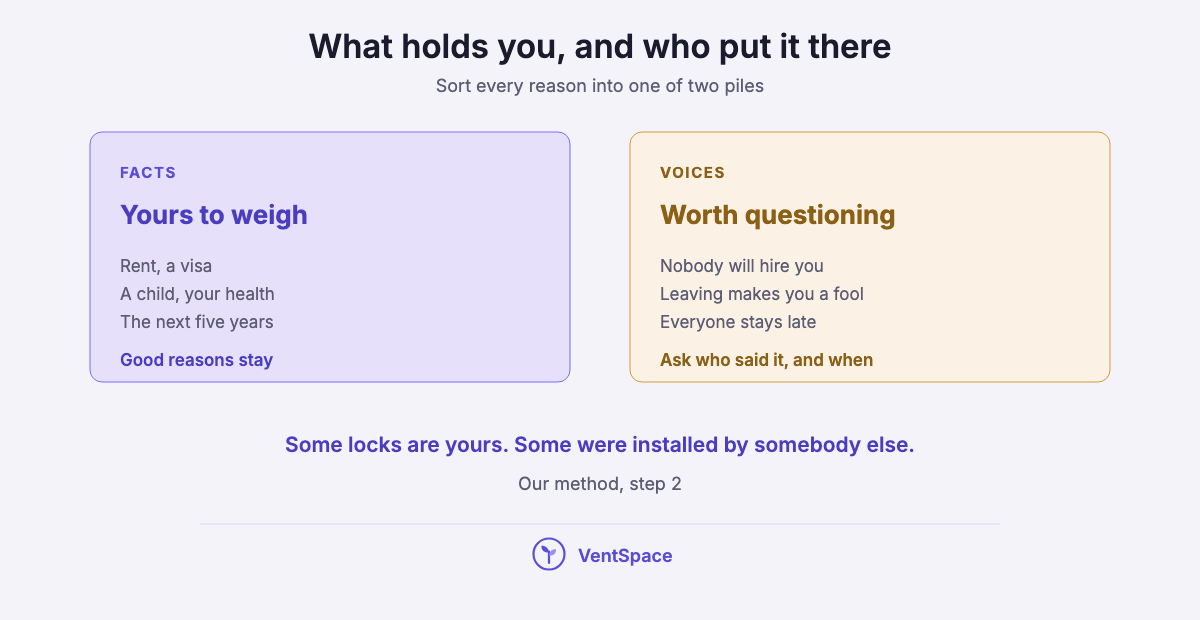
Most people stay in the rat race for reasons that are real, not weak. Rent is real. Children are real. A visa that depends on your job is real. A boss who keeps telling you nobody else will hire you may not be telling the truth, but the effect of hearing it is real. Calling all of that “fear” makes it sound like a character flaw, as if a braver person would walk straight out on a Monday morning, when for many people staying is a fairly sober calculation about rent, children, health insurance and the next five years that keeps producing an answer they do not like. It is closer to a set of locks, and some of them are yours, and some of them were installed by somebody else.
From Sai, who writes this blog
The thing that scares me the most is that I don’t think I want to leave the doom room, even though it sucks the juices out of my life. What kind of a drug is this? And even if I did leave, I would be called a loser and a fool by people. Not just any people, but the people I love.
There is also the need to belong somewhere. Sai wondered whether we stay because we need a direction, any direction, and a place to be part of something “so we won’t feel like we don’t belong.” A job gives you a team, a title, a reason to get dressed in the morning, a group chat that knows your coffee order, somewhere to be on a Tuesday when everything else in your life is uncertain, and an easy answer to “so what do you do?” at a party. That is not nothing. Losing it can feel like losing a self, which is why the room is hard to leave even on the days we hate it.
From Sai, who writes this blog
We just jump into the running roller coasters hoping we land a seat. And if we don’t, we jump again.
And sometimes the room is not your choice at all. In one published study of IT workers in China, an employee explained: “sometimes we work overtime because the leader is still in the office.” Nobody leaves first. If that is your workplace, the problem is a norm, and a norm is not something one person fixes by trying harder or by reading one more article about boundaries, because the cost of being the first to stand up at six o’clock lands on you alone, while the benefit, if it ever comes, is shared by everybody who was waiting for someone else to go first.
If the room has started to feel lonely, too, our page on loneliness is about that need to belong.
Quick Summary
Q: Why is it so hard to leave the rat race?
A: Because what holds people in it is usually real: money, dependents, visas, a boss who says nothing better exists, and the identity and belonging a job provides. Some of those holds are yours. Some were put there by someone else, and telling them apart is the first useful step.
Insight Seneca again, from the same short book: “There is nothing the busy man is less busied with than living.” Busy is the room’s best disguise. It feels like progress from the inside.
So what can change, if not everything?
How to find the point again, without burning your life down
“It is not that we have a short space of time, but that we waste much of it.”
Seneca, On the Shortness of Life (trans. John W. Basore, 1932)
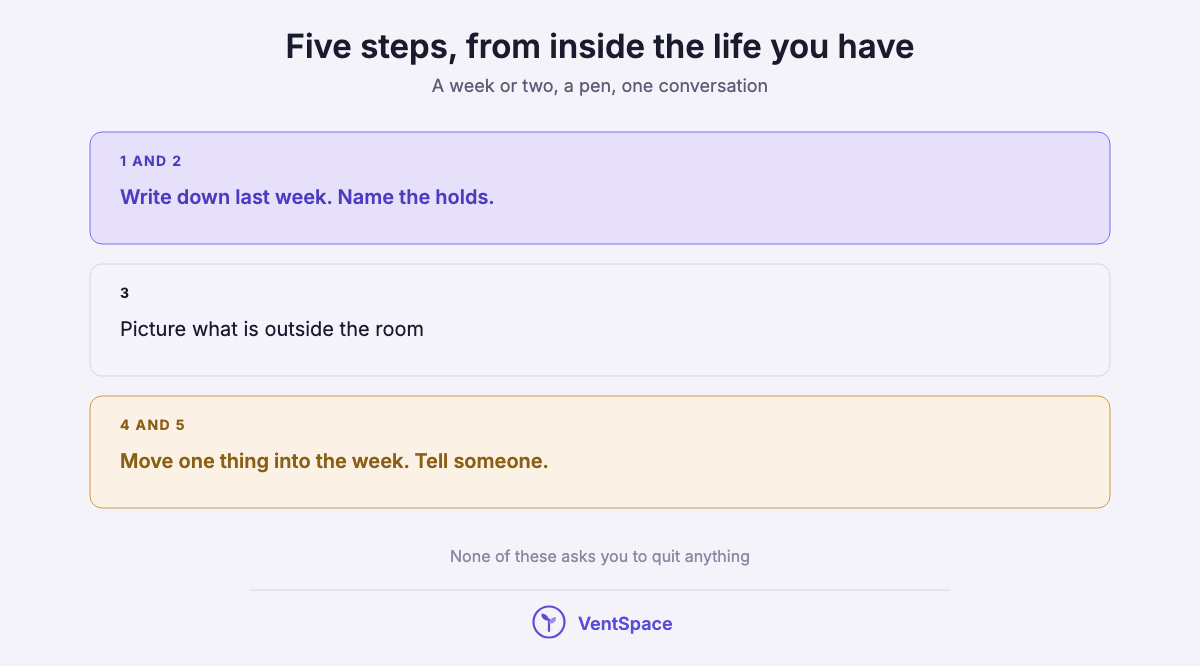
For most people the answer is not a great escape. It is a smaller and more specific one, done from inside the life you already have, with a pen, a week of honest attention and one conversation, on the working assumption that the rent will still be due on the first of the month no matter what you discover along the way. These five steps take a week or two. None of them asks you to quit anything, and if the steps feel like too much right now, start with the first one only.
1. Write down where last week went
First action: take a sheet of paper and list last week, day by day, in rough blocks: work, commute, chores, sleep, recovery, and the hours that were truly yours. Use the real week, not the one you meant to have. Do it from memory rather than from a calendar, because the goal is not precision but a rough and honest picture of how many of the week’s hours you would describe, without flinching, as your own.
- How many hours were yours, honestly?
- Which hours did you spend recovering from work rather than living?
- Which “yours” hours went to something you did not choose, like scrolling until midnight?
- What would you have done with two more of them?
Permission: the number will probably be smaller than you want. That is the point.
2. Name what is holding you, and who put it there
First action: write every reason you have not changed anything, as a list. Then, next to each one, write whether it is a fact (rent, a visa, a child), a belief (nobody will hire me), or someone else’s voice (my father, my boss).
- Which of these would still be true if you asked someone outside your job?
- Which ones did someone else tell you, and when?
- If one hold disappeared tomorrow, which one would change the most?
- Which hold are you protecting someone else with?
Permission: some of the holds are good reasons. Keep those. You are not trying to talk yourself out of them, only to see which ones are real.
3. Picture what is outside the room
First action: Sai’s original exercise, in his words, below. Do it slowly, and write down what comes up.
From Sai, who writes this blog
Close your eyes. Think of any place, and a person or people you want to be with at this moment in time. Think of something on your to-do list that’s been there forever. Think of a delicious food you want to eat, a restaurant you want to be in right now. Think of your passion, something you would do for fun even if no one paid you to do it. Think of a way you can contribute to this world, something you want to do to help people.
- Which of these could you have in the next month, without quitting anything?
- Which ones have been on the list for years?
- Which ones are about rest, which about people, and which about meaning?
- Which one did you feel most strongly about?
Permission: this varies from person to person, and none of it has to be grand. A restaurant counts.
If you would like a place to write these answers down, VentSpace is one option: a journaling app that turns what you write into a clear read on your life balance, plus small, doable next steps. It is ours, it is Android only and free to start, and a notebook works too. Not on Android, or at a desk? VentSpace Live runs in your browser, free, with nothing to install.
4. Move one thing inside the week
First action: pick one item from step 3 and give it a fixed slot in the coming week, the way you would a meeting. One evening, one lunch, one Saturday morning.
- What would have to move to make room for it?
- Who would you need to tell?
- What is the smallest version that still counts?
Permission: this will not fix the rat race. It is not supposed to. It is supposed to make one more day a month feel like yours, and, almost as a side effect, to show you which of the holds you wrote down in step 2 are as fixed as you assumed and which ones give way the first time you lean on them with a calendar invite and a polite sentence.
If the thing you love is the work itself, keep an eye on the difference researchers draw between passion you can put down and passion that has you. In a large review across sport, the arts and work, the first went with less burnout and the second with more negative feelings.
5. Talk it through with someone
First action: tell one person what you wrote in step 2. Anyone outside the room. A friend, a partner, a mentor, or a therapist, ideally someone who has nothing to gain or lose from what you decide and who will still be around next month to ask how it went.
- Who in your life has changed something like this before?
- Who would tell you the truth, rather than what you want to hear?
- Who is outside your workplace entirely?
Permission: therapy is one option. For a lot of people it is the right one, and it is not an overreaction to a job. If the flatness has spread beyond work, into weekends, food, sleep and the people you love, and it has lasted for weeks, talk to a doctor too.
Quick Summary
Q: How do you escape the rat race?
A: For most people, not all at once. Write down where last week went, name what holds you and who put it there, picture what you want outside work, move one of those things into the coming week, and talk it through with someone. Big changes, if they come, come easier after those.
Pulling it all together
Step 1 gives you the honest number. Write it at the top of a page: this many hours last week were mine.
Step 2 sorts the locks. Circle the one hold that came from someone else’s voice. That is the one to question first.
Step 3 tells you what the hours are for. Pick the answer you felt most strongly about.
Step 4 puts one of those into the week. One slot, written down, this week.
Step 5 means you are not doing this alone. One name, one conversation, before the end of the month.
Questions people ask
What does rat race mean?
The American Heritage Dictionary defines it as “a difficult, tiring, often competitive activity or routine.” In everyday speech it describes a working life that takes most of your week and keeps you running in the same circle.
Should I quit my job to escape the rat race?
This page cannot tell you that, because it cannot see your money, your dependents, your visa or your health, and anyone who tells you to quit or to stay without knowing those four things is guessing with your life rather than with their own. What the research can say is that a new job usually lifts satisfaction at first and that the lift mostly fades within about a year. If you are thinking of leaving, the official employment and immigration advice where you live matters more than anything here.
Will more money make the rat race feel worth it?
Partly. In a 2023 study by Killingsworth, Kahneman and Mellers, happiness rose steadily with the logarithm of income for most people, so money keeps helping, but each step needs a bigger rise. For the least happy group, the effect flattened. Money is unlikely to answer the question on its own.
Is it normal to feel like the rat race is pointless?
The feeling is old enough that Seneca wrote about it in the first century. It does not mean you are ungrateful or lazy. Often it means that what the routine promises has kept moving.
Is feeling this way a sign of depression?
This page cannot tell you that, and nobody should diagnose you from an article. If the flatness has spread beyond work and has lasted for weeks, talk to a doctor or a therapist. If you are in crisis, call or text 988 in the US.
In a nutshell
The rat race feels pointless because what it promises keeps moving, not because of some flaw in you. The leisure went to retirement, the new room fades, the money works in doublings. Seeing that clearly is not giving up. It is the beginning of choosing, which is a slower, quieter and far less dramatic thing than escaping, and which, unlike most escapes, you can start on an ordinary Tuesday without telling anyone.
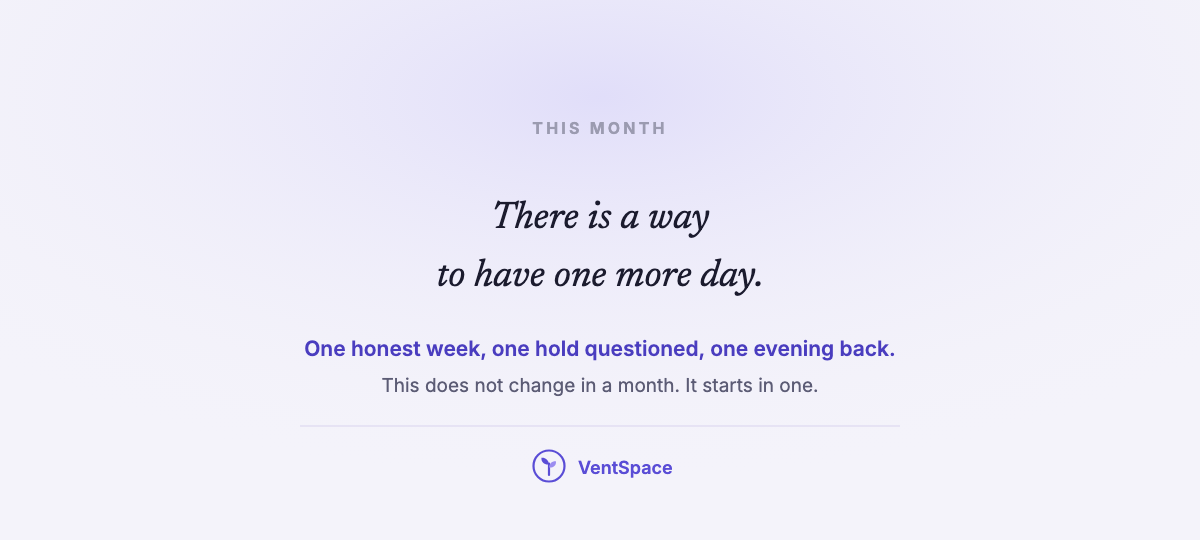
This does not change in a month. One week of honest numbers, one hold questioned, one evening reclaimed. Sai’s honest answer to “is there a way out?” was “I honestly don’t know.” Ours is smaller and more certain. There is a way to have one more day.
About this article

Written by
Sai Subramaniam
Founder, VentSpace
I write these guides because I have been where you are. I am working through my own hard seasons, and I share the things that actually helped me, so that anyone going through it has a steady companion close by instead of facing it alone. VentSpace is the app I built for exactly that: a journaling app that turns what you write into a clear read on your life balance, plus small, doable next steps toward feeling more like yourself.
This writing is honest and every claim is sourced, and it is not a substitute for professional care. If you are struggling, reaching out to a professional is a strong move, not a failure.
Explore VentSpaceTry VentSpace LiveHow this one was checked. Every factual claim traces to a named source, and the source is printed next to the claim rather than kept in a footnote. Quotes are pinned to the work they come from, with the year, the letter or the chapter where one exists. Where a widely repeated claim could not be traced, it was left out and the omission recorded. Where a figure is contested, both sides are printed.
No affiliate links, no paid placements, and nobody paid to appear here. Where we mention our own app, we say that it is ours, we state its limits, and we never position it as a substitute for care.
Reviewed: October 2026. Prices, platforms and product availability move quickly, and anything we could not verify at the time of writing is marked as unverified rather than turned into a number.
Corrections. If something here is wrong, we would rather know. Corrections are made in place, with a note saying what changed.