
We resisted rewriting this page for a while, and the reason is worth admitting. The 2022 version was a fan’s notebook. Sai, who founded VentSpace, wrote it after watching Jay Shetty’s videos, and he said so plainly: these teachers had helped a lot of people, “including myself”. Rewriting it felt a little like correcting someone’s diary.
But a notebook copies lines without asking where they came from, and some of the best-loved lines on that page turned out not to be Shetty’s at all. So we went back to his own books and interviews, found where each lesson is said, and asked a second question of every one. Does the research agree?
What follows is ten lessons from Jay Shetty that held up as his, each with a source, a research check, something to try this week and an honest watch-out. Which one do you need right now?
The lessons at a glance
- 1. Your feed is feeding your mind: what you watch and scroll becomes what you value, by default.
- 2. Make room to hear yourself: a few minutes alone with your thoughts, on purpose.
- 3. Start with the breath: your breathing changes with every emotion, so it is a place to begin.
- 4. Look for the root, not the leaf: deal with causes, not only symptoms.
- 5. Practice gratitude, and know where the shoes story comes from: small effect, real, and the famous story is Saadi’s.
- 6. Spend time with people who have the values you want: not the things you want.
- 7. Put it on the calendar, not a list: he timeboxes instead of keeping a to-do list.
- 8. Serve someone: he believes service makes you happier, and the research gives that a modest yes.
- 9. Solitude is the beginning of love: time alone is practice, not failure.
- 10. A relationship won’t fix your relationship with yourself: do your own homework first.
How we chose and checked them
Every lesson had to pass three checks, because the 2022 version of this page did not.
- He said it, and we can show where: each lesson is traced to his book, a published excerpt or an interview. Lines we could not trace are in a separate section at the end, not in the list.
- The research gets its own row: where a study supports the idea, it is named with its size. Where nothing direct exists, the row says “none direct” and the lesson stands on judgment.
- It has to be something you can try: every lesson ends with one small action for this week and one honest watch-out.
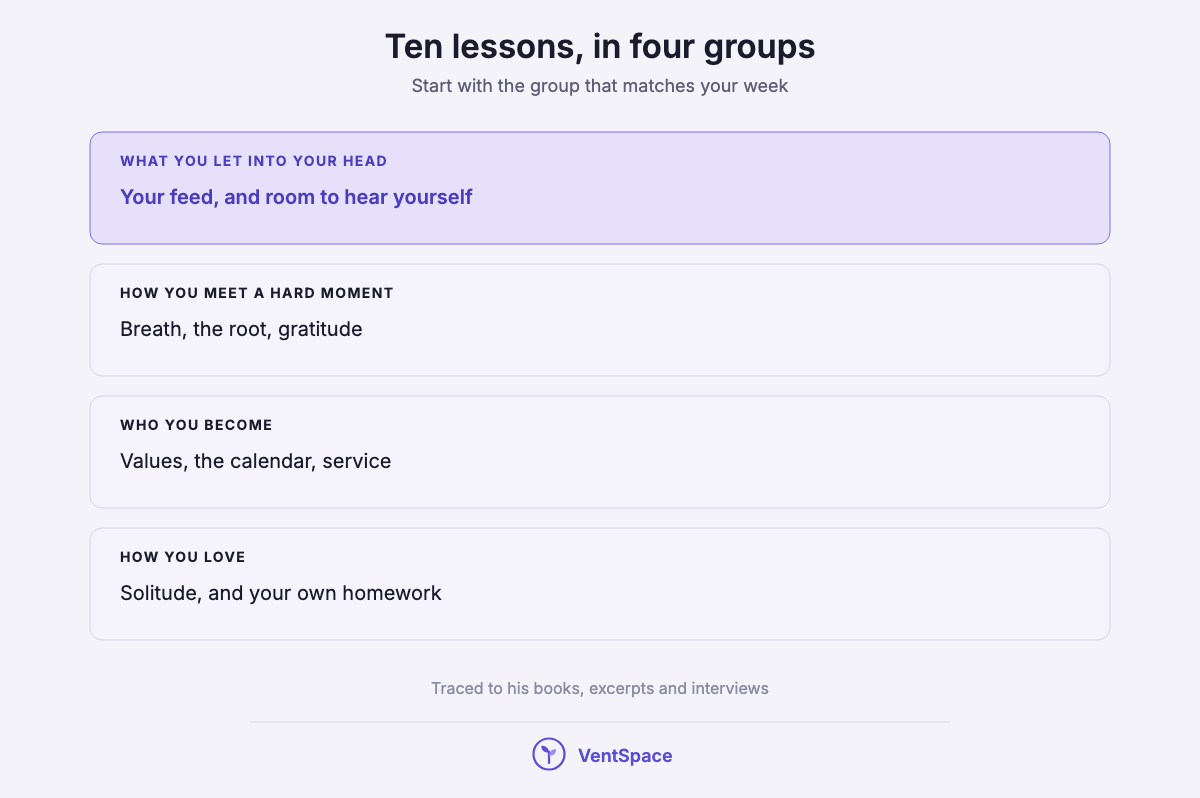
What you let into your head
The first two lessons are about inputs. What goes in, and whether you ever leave room to hear what is already there.
1. Your feed is feeding your mind
In an excerpt from Think Like a Monk published by CBS in 2020, Shetty argues that our values are shaped by whatever absorbs our attention. The movies, the music, the people we follow. His line for it is short enough to remember on a bad scroll: “What’s on your news feed is feeding your mind.” Think about the last hour you spent on your phone. What did it teach you to want?
| Where he says it | Think Like a Monk (2020), excerpt published by CBS New York, 23 September 2020 |
| The idea | What absorbs your attention shapes what you value, often without your noticing |
| What the research says | None direct that we loaded. This one stands on judgment |
| Try this | For three days, write down the three accounts or shows you spent the most time on, and one word for how you felt after each |
| The watch-out | Swapping one feed for a “better” one can become another way to avoid being alone with your thoughts |
Who it’s for: anyone who notices their mood dips after an evening of scrolling and cannot say why.
In practice: the list is the useful part. A name with “drained” next to it three days running is information.
Verdict: a sound starting point, worth testing on yourself rather than taking on trust.
2. Make room to hear yourself
Shetty’s case is that values get chosen by default when there is no quiet in which to choose them. In the same excerpt he writes: “When we fill up our lives and leave ourselves no room to reflect, those distractions become our values by default.” His first suggestion is plain: sit down each day to reflect on how the day went and what you are feeling. Sai’s own 2022 tip was the same idea in his words: “Be alone with your thoughts for at least half an hour in a day.”
| Where he says it | Same CBS excerpt, which also suggests a monthly visit somewhere new and getting involved in something meaningful |
| The idea | Space and silence are how you start to hear your own voice under everyone else’s |
| What the research says | Shetty cites it himself: in 11 studies by Timothy Wilson and colleagues (Science, 2014), people typically did not enjoy 6 to 15 minutes alone with their thoughts, and many chose to give themselves electric shocks rather than sit with nothing to do |
| Try this | Ten minutes tonight, phone in another room, then write two lines: how the day went, and what you felt |
| The watch-out | Quiet time can turn into replaying the same worry. If it does, write it down and stop, rather than sitting longer |
Who it’s for: anyone who fills every gap with a podcast, and wonders why their own opinions feel faint.
In practice: expect the first few sessions to feel uncomfortable. Wilson’s participants found it hard too, which makes the discomfort normal rather than a sign you are doing it wrong.
Verdict: the most quietly radical lesson on the list, and the one the research makes look hardest.
Quick Summary
Q: What does Jay Shetty say about social media and attention?
A: In Think Like a Monk he argues that whatever absorbs your attention shapes your values by default, and he recommends daily time to reflect on how the day went and what you feel. Research he cites found that many people find even 6 to 15 minutes alone with their thoughts hard to bear.
Insight: Jay Shetty, Think Like a Monk (2020), from the excerpt published by CBS: “When we tune out the opinions, expectations, and obligations of the world around us, we begin to hear ourselves. In that silence I began to recognize the difference between outside noise and my own voice. I could clear away the dust of others to see my core beliefs.”
How you meet a hard moment
The next three are for the moment something goes wrong. What you do first, where you look, and what you are thankful for after.
3. Start with the breath
The Introduction to Think Like a Monk tells of Shetty’s first day at monk school, when a child monk, no more than ten by his description, explained why the youngest pupils learned to breathe before anything else. “Because the only thing that stays with you from the moment you’re born until the moment you die is your breath.” And then the line that matters: “We experience every emotion with the change of the breath.” Have you noticed what your breathing does in an argument?
| Where he says it | Think Like a Monk (2020), Introduction |
| The idea | Breathing changes with emotion, so slowing it is a place to start when you are upset |
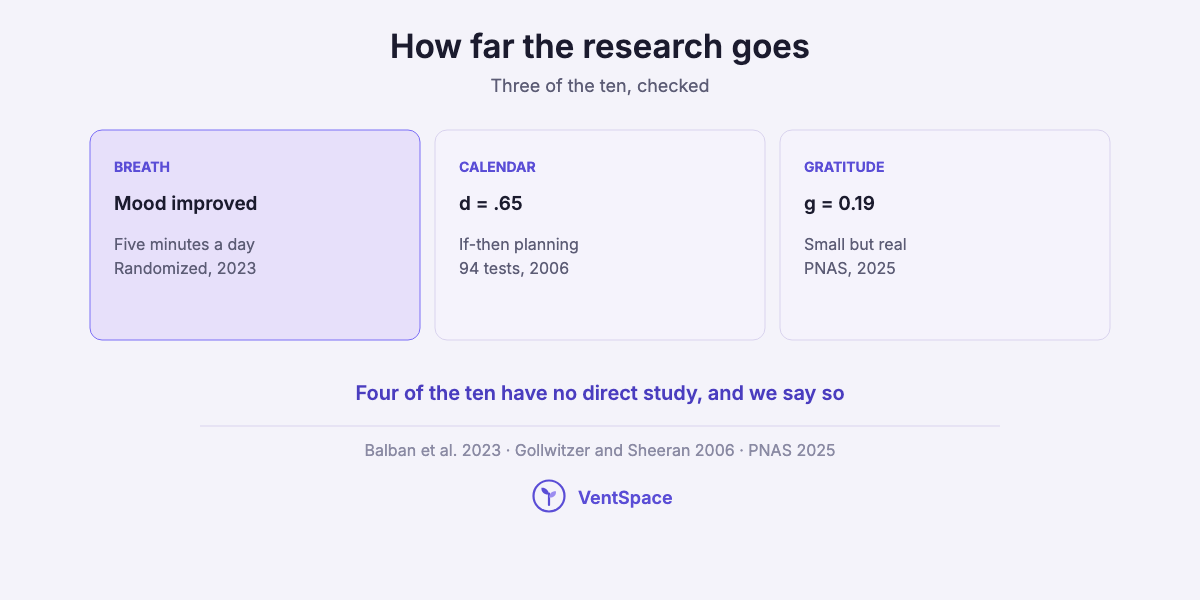
| What the research says | In a remote randomized study by Melis Yilmaz Balban and colleagues (Cell Reports Medicine, 2023), five minutes a day of breathwork for a month, especially “cyclic sighing” with long exhales, improved mood more than the same time spent in mindfulness meditation |
| Try this | Next time you feel your chest tighten, take five slow breaths with the out-breath longer than the in-breath, then decide what to do |
| The watch-out | It calms the moment. It does not solve what caused it |
Who it’s for: anyone who reacts first and regrets it later.
In practice: Sai’s 2022 side note still holds, so we kept it. “Breathing deep and slow can help you relax a bit but this isn’t a solution to your problems. This makes you feel calm so you can go find the solutions.” If you are carrying a heartbreak or a loss, give yourself room to grieve and lean on people you trust, as that note also said.
Verdict: the best-supported lesson in the hard-moment group, as long as you treat it as a first step and not the whole answer.
4. Look for the root, not the leaf
Shetty says the most important lesson from that first day was to deal with causes. In his words, “to focus on the root of things, not the leaf of the tree or symptoms of the problem.” It is a good instinct. A fight about the dishes is rarely about the dishes. So what is the one you keep having about?
| Where he says it | Think Like a Monk (2020), Introduction |
| The idea | Trace a recurring problem to its cause instead of treating each flare-up |
| What the research says | A caution rather than a support: the organizational psychologist Tasha Eurich, writing in Harvard Business Review in 2018, argues that “why” is an ineffective self-awareness question because we lack reliable access to our own motives, and that “what” questions work better. An argument, not a study we read |
| Try this | Pick one recurring problem. Write “What happens right before it?” and answer it for the last three times it came up |
| The watch-out | Digging for the root can turn into endless “why am I like this”. If an hour of digging produces a theory about your character, stop |
Who it’s for: anyone whose week keeps repeating the same bad Tuesday.
In practice: the pattern often shows up in the sequence, not the explanation. Three “what happened right before” answers can tell you more than one long “why”.
Verdict: right in spirit. Use what-questions to follow it.
5. Practice gratitude, and know where the shoes story comes from
Shetty lists gratitude among the things monks have long believed are good for you, and it shows up in almost every list of his lessons. The 2022 version of this page illustrated it with a famous line about being sad to have no shoes until meeting a man with no feet. That story is not Shetty’s. It is from Saadi’s Gulistan, the Persian classic, in the chapter “On the Preciousness of Contentment”. Does knowing it is centuries older than any video change how it lands?
| Where he says it | Think Like a Monk (2020), Introduction: monks believed “that gratitude is good for you” |
| The idea | Noticing what you have changes how heavy the day feels |
| What the research says | The largest meta-analysis of gratitude practices (PNAS, 2025, 145 papers, nearly 25,000 people) found a small effect on wellbeing (g = 0.19), no difference by how many sessions people did, and effects no larger than other positive activities |
| Try this | Once this week, write three specific things from the day you are glad of. Specific means “the bus driver waited”, not “my health” |
| The watch-out | Gratitude that turns into “other people have it worse, so I should not feel this” is not gratitude. It is a way of telling yourself off |
Who it’s for: anyone who likes the practice and wants an honest sense of its size.
In practice: the research found the number of sessions made no difference, so the old advice to do it as the first and last thing of every day has no special support. Do it when it helps.
Verdict: worth doing if you enjoy it. Small, real, and not a fix. Our gratitude list has ideas if you want them.
Quick Summary
Q: What does Jay Shetty teach about handling hard emotions?
A: Start with the breath, because breathing changes with every emotion, and look for the root of a recurring problem rather than its symptoms. A 2023 randomized study found five minutes a day of exhale-focused breathing improved mood more than mindfulness meditation. Gratitude helps a little, by about the size of other pleasant activities.
Insight: Saadi, Gulistan, chapter III, “On the Preciousness of Contentment”, in James Ross’s translation: “I had never complained of the vicissitudes of fortune, nor murmured at the ordinances of heaven, excepting on one occasion, that my feet were bare, and I had not wherewithal to shoe them. In this desponding state I entered the metropolitan mosque at Cufah, and there I beheld a man that had no feet.”
Who you become
These three are about direction. Who you spend time around, how you plan, and who you help.
6. Spend time with people who have the values you want
The most personal moment in the Introduction is Shetty at eighteen, hearing a monk speak and pushing through the crowd afterward. He writes: “I felt the urge to be around people who had the values I wanted, not the things I wanted.” The 2022 page put this lesson as “we can’t be what we can’t see”, and Sai’s version was practical: watch the people you admire closely enough to see the hard work, not only the outcome. Who in your life has a value you would like more of?
| Where he says it | Think Like a Monk (2020), Introduction |
| The idea | Choose company by values, not by status or possessions |
| What the research says | None direct that we loaded. This one stands on judgment |
| Try this | Write one value you want more of (patience, honesty, steadiness) and the name of one person who has it. Arrange one coffee or call this month |
| The watch-out | Admiration can turn into comparison. If time with them leaves you feeling smaller, look at what they do, not what they have |
Who it’s for: anyone whose circle is full of people chasing the same things they are trying to stop chasing.
In practice: the shift is in the question. “Who do I want to be around” lands differently from “who can help me get ahead”.
Verdict: simple and easy to skip. Worth the coffee.
7. Put it on the calendar, not a list
Shetty does not use to-do lists. In a 2023 CNBC interview drawn from his On Purpose podcast, he explained that he timeboxes instead: every task for the week goes into one calendar with a set amount of time, and the time is a hard stop. “I can just open up my calendar every day and look at what I have to do next,” he said. Sai’s own version of this lesson was different and worth keeping. Instead of a to-do list, a to-be list: “Who do I have to be if I want to reach my goals?” What would yours say?
| Where he says it | CNBC Make It, 3 March 2023, from On Purpose |
| The idea | Give each task a time and a place, so you do not have to decide what is next |
| What the research says | Planning the when and where has strong support: a 2006 meta-analysis by Peter Gollwitzer and Paschal Sheeran pooled 94 tests of “if-then” plans and found a medium-to-large effect on reaching goals (d = .65). That is planning in general, not timeboxing specifically |
| Try this | Take the one task you keep moving. Give it a 30-minute block on a named day this week, and stop when the time is up |
| The watch-out | A calendar packed edge to edge is a to-do list in a new shape. Leave gaps |
Who it’s for: anyone whose list is longer every evening than it was in the morning.
In practice: Shetty’s point about lists is the overwhelm. “Even if you ticked everything off your to-do list, there’s always more to do and it feels overwhelming.” A calendar has an end to each day.
Verdict: the best-supported lesson in this group, because it is planning with a time attached.
8. Serve someone
Shetty writes that monks have long believed “service makes you happier”, and the research gives that a modest yes. It was the old page’s third lesson, put as “in service we find true happiness”. The useful version is smaller than the slogan. When did you last do something for someone that they did not ask for?
| Where he says it | Think Like a Monk (2020), Introduction |
| The idea | Helping other people is good for the helper too |
| What the research says | A 2018 meta-analysis led by Oliver Scott Curry (27 studies, 4,045 people) found acts of kindness had a small-to-medium effect on the wellbeing of the person doing them (δ = 0.28) |
| Try this | Do one unrequested kind thing for someone this week, and write down how you felt an hour later |
| The watch-out | Service that leaves you with nothing for yourself stops being good for either of you |
Who it’s for: anyone stuck inside their own head who wants a way out that is not more thinking.
In practice: the effect is about how you feel, not about fixing anything. That is still worth having on a flat week.
Verdict: true at the size the research measured. Do not expect more from it than that.
Quick Summary
Q: What does Jay Shetty say about productivity and purpose?
A: He prefers timeboxing to to-do lists, giving each task a set block in his calendar, and he encourages spending time with people whose values you want and serving others. Research on planning when and where you will act gives the calendar habit strong support, and acts of kindness have a small-to-medium effect on the doer’s wellbeing.
Insight: Jay Shetty, interviewed by CNBC Make It (3 March 2023), on why he gave up to-do lists: “Most successful and productive people don’t even use to-do lists. They have scheduled tasks.” And on what changed for him: “I can just open up my calendar every day and look at what I have to do next. I don’t have to think about what I have to do next.”
How you love
The last two come from 8 Rules of Love. They are about the relationship you have with yourself before anyone else arrives.
9. Solitude is the beginning of love
In an excerpt from 8 Rules of Love published by Yoga Journal in 2023, Shetty separates loneliness from solitude. “Solitude is not a failure to love. It is the beginning of love.” Time alone, in his telling, is where you practice giving yourself what you need before you expect it from someone else. He follows it with questions worth copying into a notebook. “Are you kind to yourself? Are you honest with yourself? Are you emotionally available to yourself? Are you supportive of your own efforts?”
| Where he says it | 8 Rules of Love (2023), excerpt in Yoga Journal, 10 February 2023 |
| The idea | Time alone is a chance to get to know yourself, not proof that something is wrong |
| What the research says | None direct that we loaded. This one stands on judgment |
| Try this | Spend one evening this week alone on purpose, and answer his four questions in a line each |
| The watch-out | Solitude you choose is different from isolation you slide into. If alone has started to mean lonely most days, reach out to someone |
Who it’s for: anyone who has started treating every evening alone as a verdict on their love life.
In practice: the four questions are the useful part. If the first one gets a no, our guide on how to love yourself more starts exactly there.
Verdict: a kind reframe, and the questions make it doable.
10. A relationship won’t fix your relationship with yourself
The same excerpt holds its sharpest line: “A relationship with someone else won’t cure your relationship with yourself.” Shetty adds that therapy, friends and a partner can help, but if you are not trying to understand yourself, nobody else can do it for you. The 2022 page put the same lesson more personally, under “let people earn your trust”, and Sai wrote it from experience: “I have tremendous experience in failing in this. I gave away my trust, my heart and my soul” only to have it treated “like it meant nothing. So, don’t repeat my mistakes.” Have you ever hoped someone would fix the part you had not looked at yet?
| Where he says it | 8 Rules of Love (2023), Yoga Journal excerpt |
| The idea | A partner can support your work on yourself but cannot do it for you |
| What the research says | None direct that we loaded. This one stands on judgment |
| Try this | Write one thing you have been hoping a partner would fix about how you feel, and one small thing you could do about it yourself |
| The watch-out | “Fix yourself first” can become a reason to never let anyone close. You can do the work and be in a relationship at the same time |
Who it’s for: anyone moving from one relationship to the next, looking for the one that will make it stop hurting.
In practice: Shetty names therapy as one of the things that can help, and that is right. Therapy is one option. For a lot of people it’s the right one.
Verdict: the hardest lesson to hear and the most useful to keep.
Quick Summary
Q: What does Jay Shetty teach about love?
A: In 8 Rules of Love he argues that solitude is the beginning of love, a time to practice giving yourself what you need, and that a relationship with someone else will not cure your relationship with yourself. Therapy, friends and partners can help, but the self-understanding is your own work.
Insight: Jay Shetty, 8 Rules of Love (2023), from the excerpt published by Yoga Journal: “By itself, solitude doesn’t give us the skills we need for relationships. But if we use it to get to know ourselves, there are many ways in which it prepares us for love. In solitude we practice giving ourselves what we need before we expect it from someone else.”
All ten lessons, side by side
| # | Lesson | Where he says it | Research behind it | Try this week | The watch-out |
|---|---|---|---|---|---|
| 1 | Your feed is feeding your mind | Think Like a Monk, CBS excerpt | None direct | Log three feeds, three days | A new feed is still a feed |
| 2 | Make room to hear yourself | Think Like a Monk, CBS excerpt | Wilson et al. 2014, 11 studies | Ten quiet minutes, two lines | Quiet can become replay |
| 3 | Start with the breath | Think Like a Monk, Intro | Balban et al. 2023, randomized | Five long out-breaths | Calms, does not solve |
| 4 | Root, not the leaf | Think Like a Monk, Intro | Caution: Eurich on “why” questions | “What happens right before it?” | Digging into theories |
| 5 | Gratitude | Think Like a Monk, Intro | PNAS 2025, g = 0.19 | Three specific things, once | “Others have it worse” |
| 6 | Values, not things | Think Like a Monk, Intro | None direct | One value, one coffee | Admiring into comparing |
| 7 | Calendar, not a list | CNBC 2023 | If-then plans, d = .65 | One 30-minute block | A full calendar is a list |
| 8 | Serve someone | Think Like a Monk, Intro | Curry et al. 2018, δ = 0.28 | One unrequested kindness | Nothing left for you |
| 9 | Solitude | 8 Rules of Love, excerpt | None direct | One evening, four questions | Isolation is different |
| 10 | Your own homework | 8 Rules of Love, excerpt | None direct | Name it, do one thing | Never letting anyone close |
Lines that circulate as his, but are not
Several famous lines travel under Jay Shetty’s name, and some were on the 2022 version of this page. We checked the ones we had printed. This is about getting the credit right, not about him, since a speaker who quotes other people is not claiming their words.
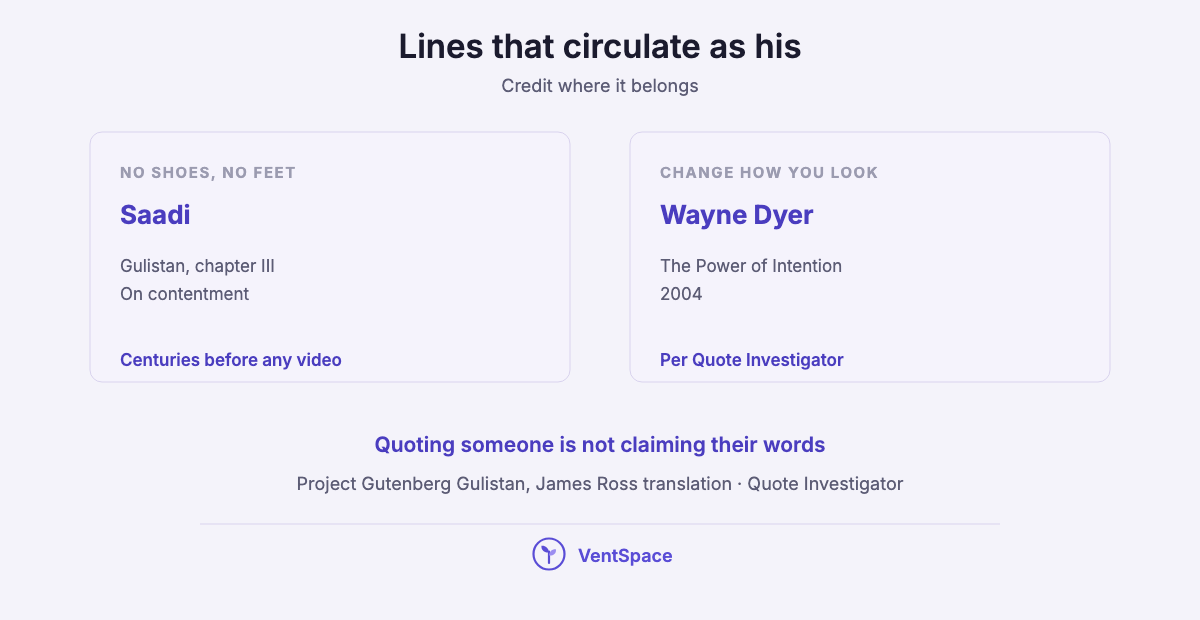
- “I was sad that I had no shoes, until I met a man who had no feet”: this is Saadi’s story, from the Gulistan, chapter III. In James Ross’s translation the man with no feet is seen in “the metropolitan mosque at Cufah”, the city of Kufa.
- “Change the way you look at things, and the things you look at change”: Quote Investigator credits the self-help author Wayne Dyer, with the earliest firm source his 2004 book The Power of Intention.
- “I am not what I think I am, I am not what you think I am, I am what I think you think I am”: usually credited to the sociologist Charles Horton Cooley. We searched his book Human Nature and the Social Order, where he names “the reflected or looking-glass self”, and the sentence is not in it. Treat it as a later paraphrase of his idea unless someone finds it in his own writing.
- “Detachment is not that you should own nothing, but that nothing should own you”: commonly credited to Ali ibn Abi Talib. We could not find a primary source, so we do not credit anyone.
- “A year from now you may wish you had started today”: commonly credited to Karen Lamb. We could not locate where it first appeared.
Which lesson to start with
Pick by what your week keeps doing to you, not by which line you like best. One lesson for seven days is enough.
- If your evenings disappear into your phone: lesson 1, then lesson 2.
- If you react fast and regret it: lesson 3.
- If the same problem keeps coming back: lesson 4, with “what” questions.
- If your to-do list wins every day: lesson 7.
- If you feel stuck inside your own head: lesson 8.
- If you keep hoping the next relationship will fix things: lessons 9 and 10.
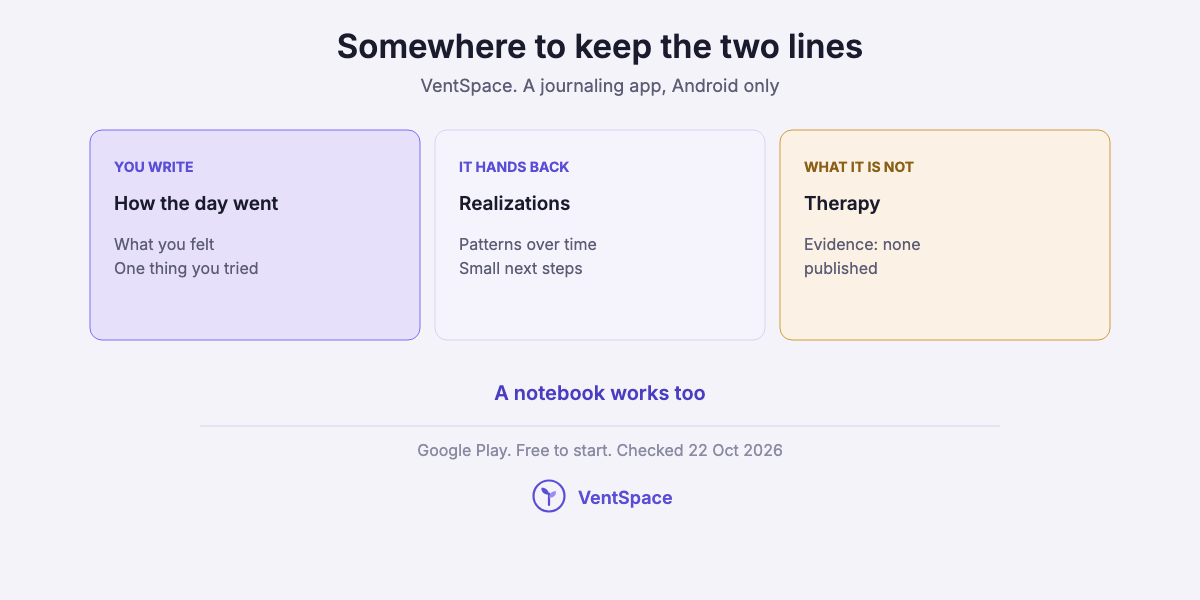
If lesson 2 is the one, it helps to keep the two lines you write each night somewhere you can reread them. A notebook works. So does VentSpace, a journaling app that turns what you write into a clear read on your life balance, plus small, doable next steps. It is free to start, Android only as of October 2026, and it is not therapy. Not on Android, or at a desk? VentSpace Live runs in your browser, free, with nothing to install.
Questions people ask
What are Jay Shetty’s main lessons?
Across Think Like a Monk (2020) and 8 Rules of Love (2023), the recurring ideas are that your inputs shape your values, that you need quiet to hear yourself, that the breath is a place to start in a hard moment, that service and gratitude are good for the person practicing them, and that a relationship cannot do your self-understanding for you. The ten above are the ones we could trace to his own text or interviews.
Which Jay Shetty book should I read first?
Think Like a Monk if you want the general framework, because the Introduction alone holds several of the lessons above. 8 Rules of Love if your question is about relationships. Our page on lessons from Think Like a Monk goes through the first book in more depth.
Are Jay Shetty’s lessons backed by science?
Some are and some are not, and it is worth knowing which. Breathwork, planning when and where you will act, and acts of kindness have research behind them, at modest sizes. Gratitude has a small effect. Several lessons, such as choosing company by values, stand on judgment, which is fine as long as nobody calls them science.
Is “I was sad I had no shoes until I met a man who had no feet” a Jay Shetty quote?
No. It is a story from Saadi’s Gulistan, the Persian classic, in the chapter “On the Preciousness of Contentment”. It circulates widely under other names, including on the 2022 version of this page.
Does Jay Shetty use a to-do list?
Not according to a 2023 CNBC interview. He timeboxes instead, putting every task for the week into one calendar with a set amount of time and a hard stop, so each day has a finish line. Planning tasks with a time and place has strong research support in general.
The one thing underneath all ten
Read the ten together and they turn out to be about one value: paying attention to who you are becoming, rather than collecting lines about it. The feed, the quiet, the breath, the calendar, the company you keep. Each is a way of noticing.
That is also the honest limit of any list like this. A clip can make a hard week feel lighter for ten minutes. The week is still there when the clip ends, and only something you try changes it.
So pick one lesson. Run its “Try this” for seven days. What will you notice by Sunday?
About this article

Written by
Sai Subramaniam
Founder, VentSpace
I write these guides because I have been where you are. I am working through my own hard seasons, and I share the things that actually helped me, so that anyone going through it has a steady companion close by instead of facing it alone. VentSpace is the app I built for exactly that: a journaling app that turns what you write into a clear read on your life balance, plus small, doable next steps toward feeling more like yourself.
This writing is honest and every claim is sourced, and it is not a substitute for professional care. If you are struggling, reaching out to a professional is a strong move, not a failure.
Explore VentSpaceTry VentSpace LiveHow this one was checked. Every factual claim traces to a named source, and the source is printed next to the claim rather than kept in a footnote. Quotes are pinned to the work they come from, with the year, the letter or the chapter where one exists. Where a widely repeated claim could not be traced, it was left out and the omission recorded. Where a figure is contested, both sides are printed.
No affiliate links, no paid placements, and nobody paid to appear here. Where we mention our own app, we say that it is ours, we state its limits, and we never position it as a substitute for care.
Reviewed: October 2026. Prices, platforms and product availability move quickly, and anything we could not verify at the time of writing is marked as unverified rather than turned into a number.
Corrections. If something here is wrong, we would rather know. Corrections are made in place, with a note saying what changed.