
“I write entirely to find out what I’m thinking, what I’m looking at, what I see and what it means.” · Joan Didion, “Why I Write” (1976)
You open the journal because something will not settle. A conversation that went wrong, a decision you keep reopening, a feeling you cannot name. You write it down so it will stop going round, and forty minutes later there are three pages, the same question is still at the top of every one of them, and it is louder than when you started. Sound familiar?
The researchers who study this have a plain sentence for it. In their 2008 review of rumination, Susan Nolen-Hoeksema, Blair Wisco and Sonja Lyubomirsky wrote: “Sometimes, people may attempt to understand their emotions through disclosure and processing, but instead fall into rumination.” The notebook is not the problem. The page holds whatever kind of thinking you bring to it, and some kinds of thinking go round in a circle with nowhere to land.
This guide is about giving the entry somewhere to land. First, why a journal so often keeps the circle going: what the research says writing does and does not do, why the shape of a sentence matters more than its subject, and why a looping entry feels like progress while it is happening. Then three changes you can make to tonight’s entry, and the signs that it is time to put the pen down.
Quick Digest
– Why it happens: writing is a container, not a cure. In the pooled studies its effect runs from none detectable to small, and the kind of thinking you do on the page decides more than the act of writing.
– The tell: entries built on “why” about yourself tend to circle. In one experiment, people who wrote about a setback by asking “Why did you feel this way?” and who tended to ruminate had more low mood twelve hours later than people who wrote how it felt moment by moment.
– Why it feels useful: looping produces a sense of gaining insight, which is exactly what keeps it going.
– The three changes: turn the why into a what or a how, write the experience instead of the verdict, and give the entry an ending.
– The honest limit: changing the shape of the entry changes the quality of the thinking. It has not been shown to lift a low mood on its own.
– When to stop: if writing leaves you markedly worse for a day or two, that is a signal, not progress.
If things feel heavier than this
If you are in crisis or thinking about harming yourself, please reach out now. In the United States you can call or text 988 for the Suicide and Crisis Lifeline. Outside the US, findahelpline.com lists the number where you are. This article is not a substitute for that.
Why writing it down does not settle it on its own
“I find at night that any worries you’ve got are multiplied and it all seems much worse. At one stage I actually would write down solutions, but I found that made it worse as well.” · A 71-year-old woman interviewed for Sleep problems in later life, Health Experience Insights, University of Oxford
Writing does not reliably stop overthinking, because the act of writing is not what does the work. What you do with the words decides whether the entry ends or goes round again, and the research on writing is far more modest than its reputation.
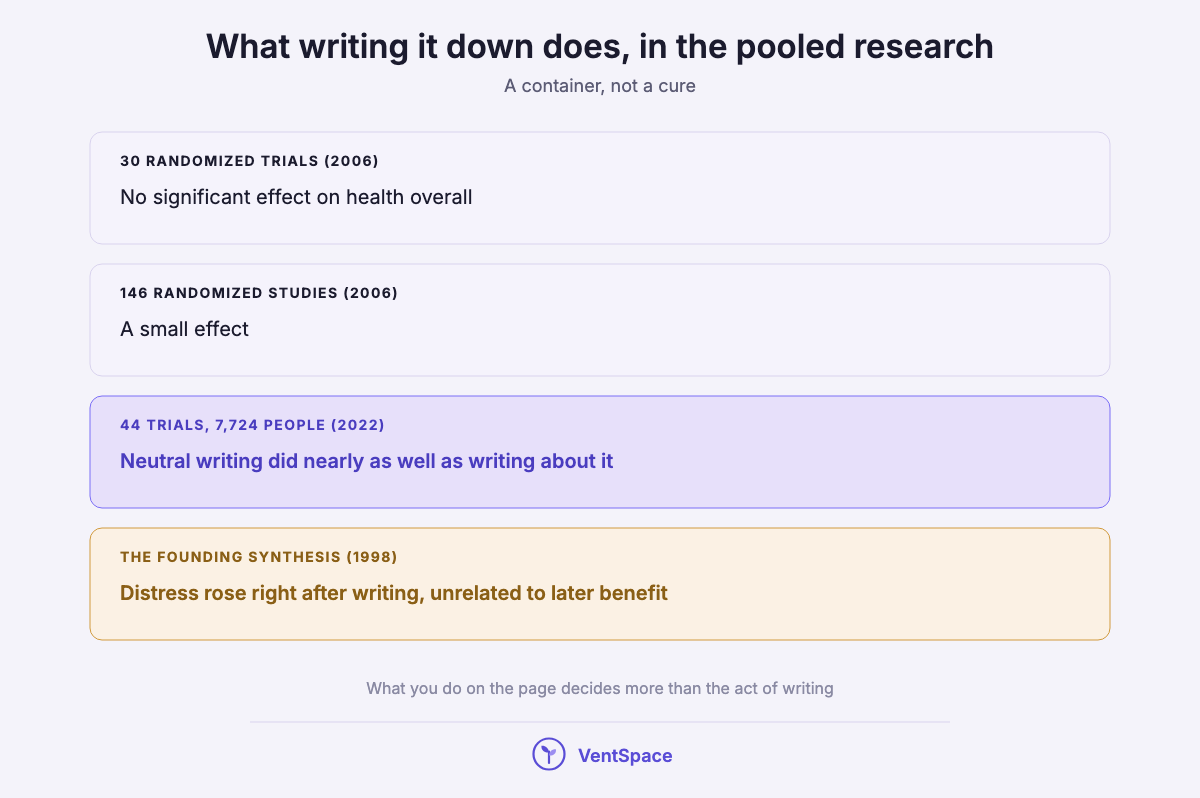
Start with the size of the effect. The best-studied form of this is expressive writing, a short protocol of a few sessions about something difficult. In the pooled evidence its effect runs across a wide range. A 2006 meta-analysis of thirty randomized trials found no significant effect on health overall, and its authors wrote that this was “contrary to earlier findings.” The largest meta-analysis, of 146 randomized studies, found a small effect. A 2023 review of 31 studies with about 4,000 participants found a small effect on depression, anxiety and stress (g = −0.12) that showed up at follow-up rather than straight away. None of that is nothing. None of it is a reliable off switch either.
What you write about seems to matter less than people assume. In a 2022 network meta-analysis of 44 randomized trials with 7,724 trauma survivors, writing about the trauma beat a waiting list in the long run (SMD −0.43), and writing about something neutral beat it by nearly as much (−0.37). If the topic were the active ingredient, that gap would be wider.
And feeling worse straight afterward is common. The 1998 meta-analysis that gave this field its reputation recorded that writing increased distress immediately afterward, and that this distress was unrelated to the later health outcomes. So the rough feeling at the end of a long entry is not proof that it is working, and it is not proof that it is failing.
Who was studied matters too. In the clinical studies, the effect on psychiatric outcomes did not reach statistical significance, and in two groups, adult survivors of childhood abuse and a small sample of veterans with PTSD, the writing was recorded as detrimental. Those findings come back in the last section of this guide, because they are where the pen should go down.
None of this means a journal is useless for an overthinking mind. It means the notebook is a container. Put a circle in it and you get a circle on paper. The question is what kind of thinking you are doing on the page, and that is where the research gets specific. If you want the protocol itself, its timings and its history, our page on expressive writing vs journaling covers it.
Quick Summary
Q: Why doesn’t journaling stop my overthinking?
A: Because writing is a container, not a cure. Pooled studies put its effect between none detectable and small, and writing about something neutral did nearly as well as writing about the problem in the largest review. What decides whether an entry settles or circles is the kind of thinking you do on the page.
Insight From Joshua Smyth’s 1998 synthesis of 13 studies, the paper that made expressive writing famous, verbatim: “Writing also increased immediate (pre- to postwriting) distress, which was unrelated to health outcomes.” Feeling worse at the end of an entry was common in the founding research, and it did not predict whether anyone benefited later. It is not a progress signal.
The shape of the sentence decides where it goes
“Why did you feel this way?” against “How did you feel moment-by-moment?” · The two writing instructions in Edward Watkins’s 2004 experiment, Behaviour Research and Therapy
An entry built on why-questions about yourself tends to circle, while one built on what happened and how it felt tends to end. That is the closest thing this research has to a rule, and it was tested on people writing.
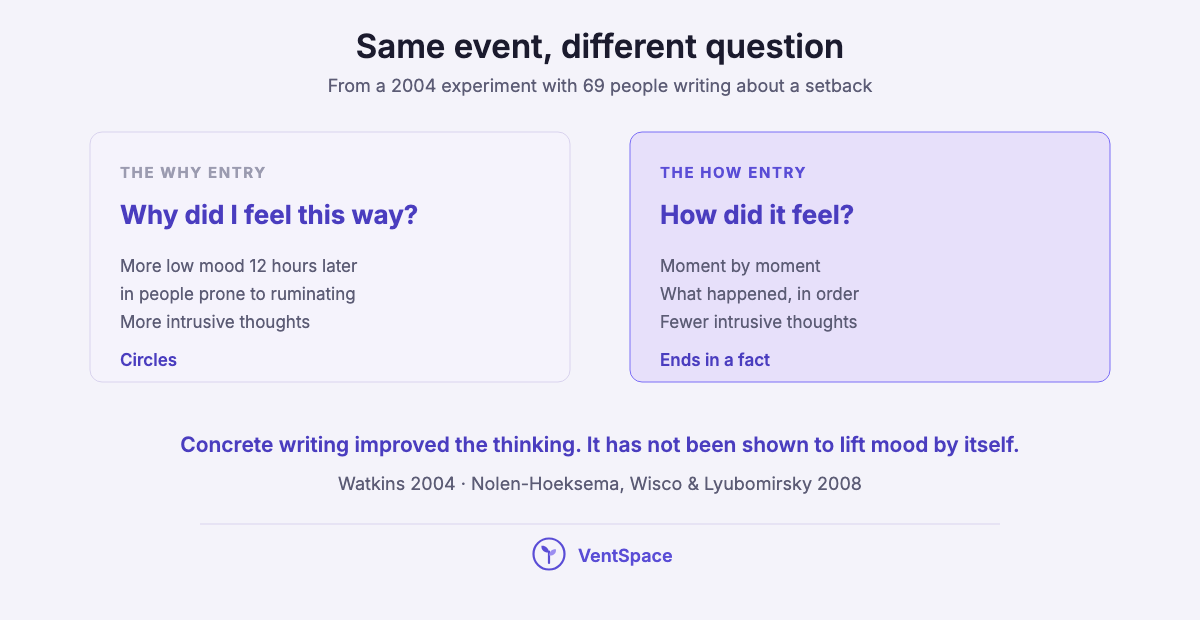
In a 2004 experiment, Edward Watkins had 69 people write about a failure that had just been set up for them in the lab. Half were asked to write in an evaluative way, with questions like “Why did you feel this way?” Half were asked to write about the experience itself: “How did you feel moment-by-moment?” Among people with a stronger habit of ruminating, the why-condition went with a bigger rise in low mood twelve hours later, and the why-writers had more intrusive thoughts about the failure than the moment-by-moment writers. Same event, same notebook, different question.
A second experiment points the same way with problem solving. In 2002, Watkins and Sarah Baracaia gave 84 people, some currently depressed, some recovered and some never depressed, a problem-solving test while asking them either no questions, questions about why they had a problem, or questions about how they were deciding to solve it. The how-questions improved problem solving in the depressed group. The why-questions made it worse in the recovered group. The study reports direction and significance, not the size of the effect, and it is one experiment in a clinical sample, so hold it lightly.
Why would a why-question do that?
A why-question about yourself has no natural end. “Why do I always do this?” can be answered a hundred ways, none of them checkable, each one a little harsher than the last. “What happened at 4 p.m.?” runs out. It ends in a fact. The 2008 review describes the unhelpful kind of rumination in the measure itself as partly “a focus on abstract ‘why me?’ issues”, and the researchers who split the standard rumination scale into two parts found that one of the items on the side called reflection reads “Write down what you are thinking and analyze it.” The second half of that sentence is doing the work, and our page on journaling vs venting walks through that split in full.
Now the limit, because it travels with this finding every time. The same 2008 review reports that switching people from the abstract mode to the concrete one improved the quality of their thinking and did not lift their depressed mood. So changing the shape of your sentences is a way to think more clearly about the thing. It is not a mood treatment, and nobody should promise you it is.
Quick Summary
Q: What kind of journaling makes overthinking worse?
A: Writing that keeps asking why about yourself. In a 2004 experiment, people prone to rumination who wrote about a setback by asking why they felt that way had more low mood twelve hours later and more intrusive thoughts than people who wrote how it felt moment by moment. Concrete writing improved the thinking. It has not been shown to lift mood by itself.
Insight From Susan Nolen-Hoeksema, Blair Wisco and Sonja Lyubomirsky, “Rethinking Rumination”, Perspectives on Psychological Science (2008), verbatim: “Watkins’ experiential induction does not lift participants’ depressed moods, but it does improve the quality of their thinking.” That sentence is the honest ceiling on everything in this section. Change the question to think better about the problem, not because it will make tonight feel good.
Why a looping entry feels like progress
“when ruminating, people report feeling that they are gaining insight into the meanings of their feelings and problems” · Susan Nolen-Hoeksema, Blair Wisco and Sonja Lyubomirsky, “Rethinking Rumination” (2008)
A looping entry feels like progress because rumination produces a sense of insight while it is happening. That feeling is real, and it is the reason people keep writing for another hour when the page stopped moving forty minutes ago.
This has been tested. In laboratory studies published in 1993, Sonja Lyubomirsky and Susan Nolen-Hoeksema found that students in a low mood who were asked to ruminate felt they were gaining insight into their problems and emotions, and were less willing to do pleasant, distracting things even when they believed they would enjoy them. Low mood on its own, without the rumination, did not produce either effect. In other words, the looping is what makes the loop feel worth continuing.
The belief that it is useful sits close to the habit itself. In a 2024 study of 498 UK adults, broadly representative of the population on age, sex and ethnicity, believing that rumination is useful was one of three things most directly connected to how much people ruminated, alongside weaker effortful control and a habit of monitoring one’s own thoughts. The method is correlational, so it maps what travels together rather than what causes what. Still, it is worth asking of your own journal: am I writing because it is moving, or because stopping feels like giving up?
There is also a reason the circle has no exit. Edward Watkins’s 2008 review of repetitive thought describes one account in which the thinking is set off by a gap between where you are and where you want to be, and keeps going until that gap closes or you let the goal go. An entry that asks a question with no possible answer never meets either condition. It cannot close the gap, and it never gives you permission to let go.
Meaning-searching on the page can make things worse for some people. In a 2013 trial with 90 adults who had recently separated from a spouse, those who were judged to be actively searching for meaning about the separation did worse up to nine months later when they were assigned to expressive writing than when they did a control writing task. That is one study in one situation. It is a reason to watch whether your entries are searching or arriving.
And it is not one-way. In a 2006 study of college students prone to low mood, three days of expressive writing went with lower depressive symptoms six months later among those who tended to suppress their feelings, and the benefit ran through a drop in brooding. Writing can loosen a loop as well as tighten one. The difference is in the shape of the entry, and in whether you are already low when you sit down: Watkins’s 2008 review notes that the harmful effect of a ruminative mode in the lab showed up in people who were already in a low mood before they started.
Quick Summary
Q: Why does ruminating in a journal feel productive?
A: Because rumination produces a sense of gaining insight. In laboratory studies, people in a low mood who ruminated felt they were understanding their problems better and were less willing to do something distracting, even something they expected to enjoy. The feeling of progress is part of the loop, not evidence of it.
Insight From Edward Watkins, “Constructive and unconstructive repetitive thought”, Psychological Bulletin (2008), describing the goal-discrepancy account, verbatim: “the RT will continue either until the goal is met or until the individual disengages from and abandons the goal.” RT is repetitive thought. An entry needs one of those two endings written into it, or it has no reason to stop.
So what does an entry that lands look like?
How to journal without going in circles: three changes
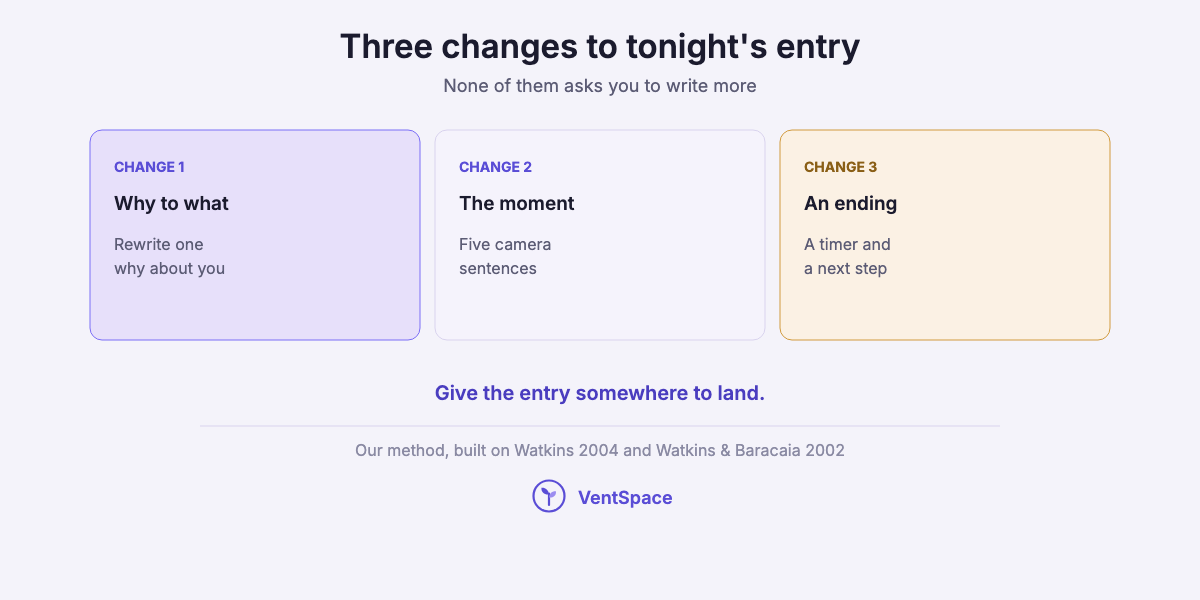
Three small changes to the entry itself give the thinking somewhere to land. None of them asks you to write more, and none of them asks you to stop journaling. Do them in order the first time. After that, use whichever one the night needs.
1. Turn the why into a what or a how
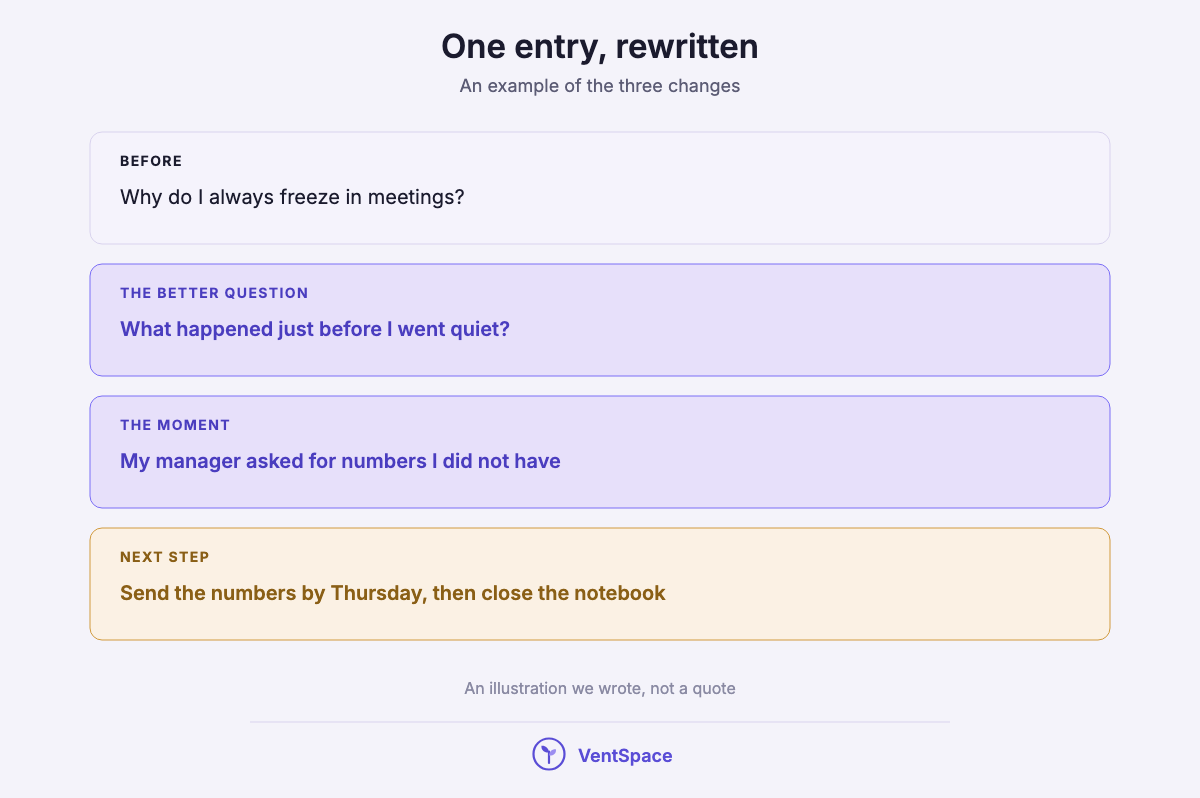
First action: open your last entry, circle every question that begins with “why” and is about you, and rewrite one of them as a what or a how. “Why do I always freeze in meetings?” becomes “What happened in the meeting just before I went quiet?”
Ask yourself:
- What happened, in the order it happened?
- What did I do next, and what did I do after that?
- How am I deciding what to do about it?
- What would I need to know that I do not know yet?
- Which of my questions could only ever be answered with a judgment of myself?
Permission: you do not have to delete the why. Leave it on the page if it helps to see it. Just do not let it be the question the entry is trying to answer.
2. Write the experience, not the verdict
First action: pick the moment the entry is about and describe it the way a camera would. Where you were, what was said, what your body did, what you did with your hands. Five sentences, no adjectives about yourself.
Ask yourself:
- Where was I, and what could I see and hear?
- What did I feel in my body, moment by moment?
- What were the exact words, as near as I can remember them?
- Where in this entry did I start writing about what kind of person I am?
- What would someone standing beside me have noticed?
Permission: this will feel flat and a little pointless the first few times. That is fine. Concrete writing is less satisfying than a verdict, and the satisfaction of a verdict is part of what keeps the circle going.
The honest limit, again: this is the moment-by-moment condition from the 2004 experiment, and the wider research says it improves the thinking rather than the mood. Expect clearer, not necessarily better.
3. Give the entry an ending
First action: before you write tonight, set a timer for fifteen minutes, and write the last line first at the bottom of the page: “Next step:” and leave it blank. When the timer goes, fill it in, close the notebook and do something with your hands.
Ask yourself:
- What is one thing I will do about this, and when?
- If there is nothing I can do tonight, can I write “not mine to solve tonight” and mean it?
- Has anything on this page changed since the first paragraph?
- Am I still writing because it is moving, or because stopping feels like giving up?
Permission: fifteen minutes is a convention, not a finding. The researchers who went looking for the basis of the standard session length said it had been “driven primarily by convention rather than empirical evidence.” Pick a number and keep it. The point is that the entry ends on purpose, with either a next step or a decision to let the question go for now, which are the two exits the 2008 review describes.
Quick Summary
Q: How do I journal without spiraling?
A: Change three things about the entry. Rewrite why-questions about yourself as what or how questions, describe the moment concretely instead of passing a verdict on yourself, and give the entry an ending: a timer and a final line that names one next step or lets the question go for tonight.
Insight From the abstract of Edward Watkins and Sarah Baracaia’s 2002 experiment, Behaviour Research and Therapy, verbatim: “the process-focused questions significantly improved social problem solving in depressed patients, compared to no questions and state-oriented questions”. The process questions were about how you decide to solve a problem. That is the kind of question step 1 asks you to write.
Pulling it all together
Change 1 gives you a better question. Tonight, find one why-question about yourself in your journal and write its what or how version underneath it.
Change 2 gives you the facts. Write five camera sentences about the moment, with no adjectives about yourself, and notice where you were tempted to add one.
Change 3 gives you an exit. Set a fifteen-minute timer, write “Next step:” at the bottom of the page first, and fill it in when the timer goes, even if the answer is “not mine to solve tonight.”
Quick Summary
Q: What is the simplest version of this?
A: One better question, five concrete sentences, fifteen minutes, and a last line that names a next step or lets it go for tonight. That is a whole entry.
When to put the pen down
Sometimes the right change to the entry is not writing one. Some loops need a person, not a page, and some kinds of writing have been recorded as doing harm.
If writing leaves you markedly worse for a day or two, treat that as a signal to stop, not as progress. Feeling unsettled at the end of an entry is common, as the 1998 research showed. Feeling worse for days is different. We found no evidence for the idea that hurting means it is working.
Some material belongs with someone trained to help. In the research on expressive writing, it was recorded as detrimental for adult survivors of childhood abuse and for a small sample of veterans with PTSD, and in clinical samples the effect on psychiatric outcomes did not reach significance. If the thing your journal keeps circling is a trauma, or a low mood that has settled in for weeks, a therapist can do what a notebook cannot, which is respond. Therapy is one option. For a lot of people it’s the right one. Our page on therapy vs journaling explains how the two do different jobs, and if you are in crisis, the support line near the top of this page is the place to start.
Reflecting is not automatically safe either. In a large study of 1,130 adults, the reflective side of rumination went with more low mood at the time and less a year later. So reflecting is not the harmless half of anything. It can cost you the evening, and what it feels like in the moment is not the test of whether it is helping.
Quick Summary
Q: When should I stop journaling about something?
A: When an entry leaves you markedly worse for a day or two, when the same loop has not moved in weeks, or when the subject is a trauma. Feeling unsettled at the end of an entry is common, but lasting worsening is a stop signal, and some material is better taken to a therapist than to a page.
Insight From Wendy Treynor, Richard Gonzalez and Susan Nolen-Hoeksema, “Rumination Reconsidered” (2003), verbatim: “The reflection factor of rumination was associated with less depression over time in our longitudinal analyses, although it was correlated with more depression concurrently.” The same kind of thinking went with feeling worse now and better later, in one community sample. The mood of tonight’s entry is not the verdict on it.
Questions people ask
Should I stop journaling if I overthink?
Not necessarily. The research points at the kind of thinking you do on the page, not at the notebook. Try changing the shape of the entry first: what and how questions, concrete description, a fixed ending. Stop if it leaves you markedly worse for a day or two, and take trauma to a therapist.
Is it a good sign if journaling makes me feel worse?
No. This is a common belief and the evidence does not support it. In the founding research, the distress straight after writing was unrelated to whether anyone benefited later. Feeling unsettled for an hour is common. Feeling worse for days is a reason to stop.
How long should I journal when I am overthinking?
There is no tested answer. The usual fifteen to twenty minutes was, in the words of two researchers who checked, set by convention rather than evidence. Choose a limit, use a timer, and end on a next step rather than when you run out of things to say.
Does it matter whether I write by hand or type?
Not in the pooled studies. In the largest meta-analysis, writing by hand, typing and talking did not significantly change the effect on any outcome. The shape of what you write matters more than the tool.
Why does writing about it at night sometimes make it worse?
Many people find worries feel bigger at night, and an entry that tries to solve everything at that hour can keep the circle going. If writing at night leaves you more wound up, that is worth noticing. It is not a rule that applies to everyone, and if night-time thinking is affecting your sleep for weeks, a doctor is a sensible person to talk to.
In a nutshell
First, a journal holds whatever kind of thinking you bring to it. Why-questions about yourself tend to circle. What and how questions, concrete description and a fixed ending give the entry somewhere to land. That changes the quality of the thinking. It is not a mood treatment, and it was never meant to be.
Second, this is slow, and the payoff is late. Where writing helps at all, the pooled research found the effect showed up at follow-up rather than straight away, so the first few entries in a new shape will feel no better than the old ones. Give it weeks, not nights. And if your journal keeps circling the same thing for months, that is not a failure of yours. It may be a sign the thing needs a person to talk to.
If it helps to have somewhere to write that ends each entry on a step rather than a verdict, VentSpace is the app we built: a journaling app that turns what you write into a clear read on your life balance, plus small, doable next steps. It is Android only and free to start, it is not therapy, and it cannot stop a loop for you. Not on Android, or at a desk? VentSpace Live runs in your browser, free, with nothing to install.
About this article

Written by
Sai Subramaniam
Founder, VentSpace
I write these guides because I have been where you are. I am working through my own hard seasons, and I share the things that actually helped me, so that anyone going through it has a steady companion close by instead of facing it alone. VentSpace is the app I built for exactly that: a journaling app that turns what you write into a clear read on your life balance, plus small, doable next steps toward feeling more like yourself.
This writing is honest and every claim is sourced, and it is not a substitute for professional care. If you are struggling, reaching out to a professional is a strong move, not a failure.
Explore VentSpaceTry VentSpace LiveHow this one was checked. Every factual claim traces to a named source, and the source is printed next to the claim rather than kept in a footnote. Quotes are pinned to the work they come from, with the year, the letter or the chapter where one exists. Where a widely repeated claim could not be traced, it was left out and the omission recorded. Where a figure is contested, both sides are printed.
No affiliate links, no paid placements, and nobody paid to appear here. Where we mention our own app, we say that it is ours, we state its limits, and we never position it as a substitute for care.
Reviewed: October 2026. Prices, platforms and product availability move quickly, and anything we could not verify at the time of writing is marked as unverified rather than turned into a number.
Corrections. If something here is wrong, we would rather know. Corrections are made in place, with a note saying what changed.