
It is Thursday, 11:40pm, and a name you love lights up your phone. Your stomach drops before you answer. Then the guilt arrives.
Several of the pages that rank for this say venting is healthy and emotional dumping is toxic. Venting and emotional dumping can use exactly the same words. The difference is in the conversation around them: whether the listener was asked, whether there is any room in it for them, and whether anything moves from one call to the next. That makes it something a conversation does, which can change, rather than something a person is.
Below you will find a side-by-side table, a six-point check, actual words for four moments, and what to do if what you are hearing is more than a friendship can hold.
The short version
Same words, different conversation. The topic and the tears do not decide it.
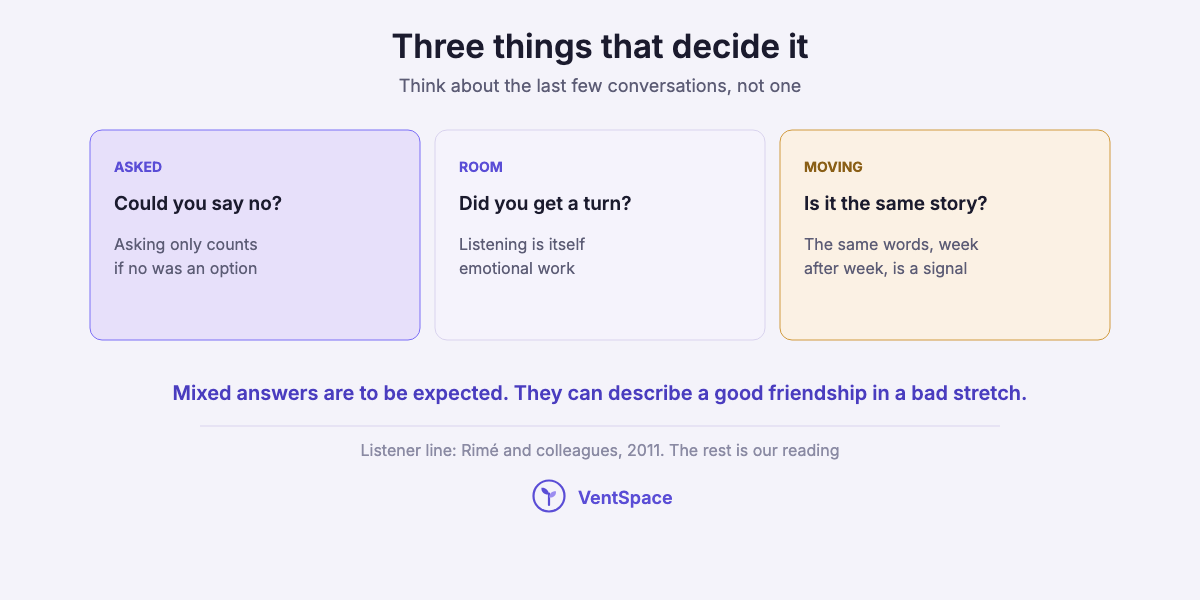
Three things do: whether you were asked, whether you get a turn, and whether anything moves.
Listening is itself work. Feeling drained afterward is not a sign you are a bad friend.
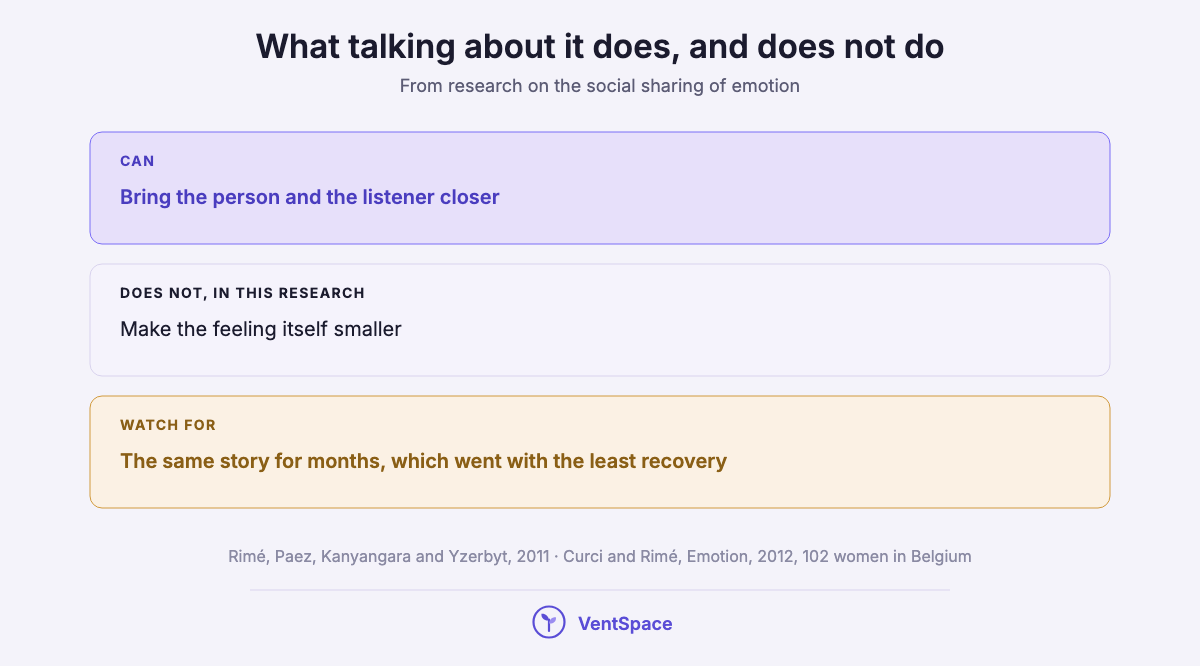
Talking tends to bring people closer without making the feeling smaller. That may be one reason the same call keeps happening.
There is a check and there are words below, plus what to do if a friend talks about harming themselves.
What venting is
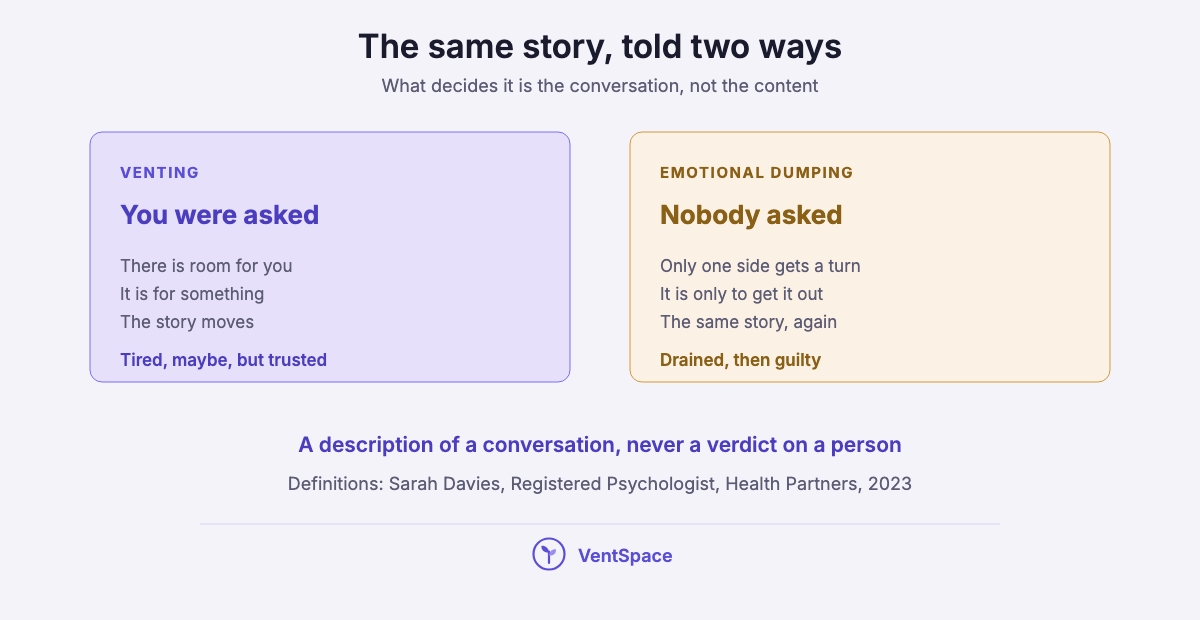
Venting is telling someone how you feel about something because you want to be heard, understood, or helped to think. The psychologist Sarah Davies, writing for the Australian health insurer Health Partners in 2023, puts it this way: “Venting is when someone shares their emotions with the goal of seeking validation or finding a solution to their problem.”
Two things sit inside that sentence. There is a goal, even a loose one: to be understood, to think out loud, to decide something. And there is a listener who agreed to listen, even if the agreement was only “go on, what happened?” Venting is ordinary. Friends are for this.
What emotional dumping is
Emotional dumping is an informal term, not a diagnosis. It is everyday language for unloading feelings onto someone without regard for whether they can take it right now. Davies again: “Emotional dumping is when someone shares their emotions, thoughts, and feelings without considering the emotional wellbeing of the person they are confiding in. It is also often very one-sided, and without any clear intention or direction.”
You will also see it called trauma dumping. On the pages that rank for both terms they are used almost interchangeably, and the word “trauma” signals heavier material. Look at what that describes. It describes how a conversation goes, not what kind of person is having it. Nobody wakes up as a dumper. It can happen to anyone when something is too heavy to hold and the nearest person is you.
Emotional dumping vs venting, side by side
| Venting | Emotional dumping | |
|---|---|---|
| Was the listener asked? | Yes, even if only “do you have a minute?” | No, or not in a way they could say no to |
| Whose conversation is it? | Mostly yours, with room for them | One-sided, with no room for them |
| What is it for? | To be heard, to think, sometimes to decide | To get it out, with no aim beyond that |
| What happens next time? | The story moves, or it is a new story | The same story, in close to the same words |
| How the listener feels after | Tired maybe, but trusted | Drained, then guilty for feeling drained |
| What it does to the friendship | Can bring you closer | Can bring you closer and wear one of you down at the same time |
The first difference: whether anyone asked
The plainest line between venting and dumping is consent. Was the listener asked, and could they have said no?
Picture the same story told twice. At 7pm on a Sunday, your friend texts “can I tell you about the thing with my sister, or is tonight bad?” and you are on the couch with nothing to do, so you say go on, and for forty minutes you listen, ask questions, and at the end she says thank you and asks how your week was. That is venting. It is a good thing. Now move the same story to 1am on a Tuesday, ring after ring until you pick up, while you are driving home from a shift and have nothing left. The story is the same. The sister is the same. The conversation is not.
Nobody asked you first. That is most of it.
Your capacity on a given night is a fact about that night, not a measure of how much you love someone, and the friend calling at 1am may not have thought about your evening at all, which is not the same as not caring about you. A friend can be important to you and still be someone you cannot listen to at 1am. Both of those can be true at the same time, which is exactly why the guilt shows up: it feels as if the second fact cancels the first. It does not.
There is also a kind of asking that does not leave room for an answer. “You’re the only one who gets it” at the start of a two-hour call is a compliment, and it is also a sentence that makes “not tonight” hard to say. So is a string of missed calls followed by “are you ignoring me?” Asking counts when no would have been a real option, which means the person asking has to be able to hear it without punishing you for it, and you have to be able to say it without a speech. If you could not have said no, you were not asked.
Quick Summary: whether anyone asked
Q: Is it emotional dumping if they don’t ask first?
A: Not always, but consent is the plainest line. The same story can be venting when the listener said “go on” and dumping when it arrives at a moment they had no room for and no real way to say no.
Insight: talking is what people do
Bernard Rimé and colleagues, who have studied emotional sharing since the early 1990s, summarize their research this way: after an emotional experience, the person who went through it “talks with others about this episode in 80 to 95% of the cases.” Wanting to tell someone is normal. The question this page is asking is only how, when, and to whom.
The second difference: whether there is room for the listener
Listening to a friend can leave you drained partly because listening to an emotional story is itself emotional, and in a one-sided conversation your side never gets a turn.
This part gets talked about as if the listener were a wall. You are not a wall. Rimé’s group reports, from one of their own studies, that the more intense the story a listener hears, the more intense the listener’s own feelings, and they put it plainly: “listening to an emotional story is emotion eliciting.” (That is their description of an earlier study of theirs, and we give no figure for it.) The same review notes that this is also what makes people want to help, which is the good half. But it means an hour of someone else’s worst week lands somewhere, and on the nights you are the one who picked up, it lands in you. That is not weakness.
One reader wrote to Psychology Today’s friendship column in 2013 that, with one friend, she felt “expected to hear her out on everything”, and then described the feeling better than any definition: “I feel like a sponge that soaks up all the negativity and misery she feels.” If you are reading this, you may recognize the sponge.
Venting has room in it for you, not equal room on every call, because sometimes it is their week and that is what friends are for, but over a month you also get to talk, to be asked how you are, to say “mine was hard too” and have someone stay with it. Dumping does not. The test is not one conversation. It is whether you have had a turn lately.
A turn does not have to mean equal airtime. It can be one question back, “how are you doing with all this?”, or a call that starts with your news for once, or a friend noticing that you went quiet. These are small things. In our reading, the draining part is less the length of a call than the sense that, in this friendship, your own life has stopped being a topic. That is lonely.
Quick Summary: room for the listener
Q: Why does listening to a friend vent leave me so drained?
A: Because listening is emotional work, not a neutral act. Researchers who study emotional sharing report that listeners feel more as the story gets more intense. In a one-sided pattern, nobody ever asks how you are doing with it.
Insight: the listener is part of the conversation
Rimé and colleagues describe what happens on the other side of a hard story: “The empathetic feelings experienced by person B stimulate a willingness to help and support person A.” The same feeling that makes you want to help is the one you carry home. Both are part of listening.
The third difference: whether anything moves
One reason people keep venting about the same thing is that talking about a feeling, in the research on this, tends to bring people closer without making the feeling itself smaller. And in one long study, for about half the people in it, the sharing did not taper off.
None of the ranking pages we read mention this. It changes the picture. In a review of their studies, Rimé and colleagues write that “both correlative and experimental studies failed to support the belief that sharing an emotion brings emotional relief.” People in the experiments still said talking had helped, both in “putting order in themselves” and in being comforted by the person they told, and elsewhere in the same review the authors write that sharing “has the potential to bring the sender and the receiver closer to one another.” The experiments they describe had people share with a psychology student or an experimenter, not with a friend over months, so take it as a strong hint rather than a law. The authors make one exception: sharing that deliberately works on making sense of what happened. The call can help. In this research, it did not shrink the feeling. (Whether venting at least gets the anger out is a different question, and our page on journaling vs venting takes it on directly.)
They propose one reason advice can bounce off. Soon after something hard, which is when most sharing happens, people are not yet ready to rethink it. In their words: “They stand by their initial appraisal of the emotional situation. They do not feel ready to reframe it nor to change their perspective.” That may be why “have you thought about leaving him?” lands badly in week one. It is not stubbornness. It is timing.
Then there is what happens over time. Antonietta Curci and Bernard Rimé followed 102 pregnant women in Belgium who completed all three interviews over about nine months, asking about an emotional experience from early in their pregnancy or shortly before (Emotion, 2012). For 49%, the sharing never tapered off: they were still talking about it at every interview. That group reported the lowest recovery of anyone in the study, and the authors describe persistent sharing as “comparable to dysfunctional mental rumination.” They also warn that a sample of pregnant women may not generalize to everyone, and that while their results pointed more to habits of sharing than to the event itself, sometimes the event is the bigger factor. Still, the shape will be familiar. The story that comes back every week, in the same words, is a story that is not moving.
There is a friendship version of the same pattern, and it cuts both ways. Researchers call repeatedly going over a problem with a friend co-rumination. Across 38 studies and 12,829 young people, it was modestly linked to more depression and anxiety, and the authors note that it also goes with more satisfying friendships (Spendelow, Simonds and Avery, 2017). That evidence comes only from children, teenagers and young adults, and only from snapshots in time, so it says nothing about cause and nothing certain about adults. What it does show is why this is so hard to see from the inside: the conversation that goes around in circles can also be the one that makes the friendship feel closest.
Quick Summary: whether anything moves
Q: Why does my friend keep venting about the same thing?
A: One reason, from research on emotional sharing: talking can bring comfort and closeness, and in those studies it did not shrink the feeling itself. In one nine-month study of 102 women, about half never stopped sharing the same experience, and that group recovered least. It is a pattern, not a character flaw.
Insight: when sharing does not taper off
Across their sample, Curci and Rimé found that the need to talk tended to fade with time, “leading to an increasing sense of recovery.” For the group whose sharing never stopped, “the beneficial effects of time passing were reduced for these respondents as compared with the others” (Emotion, 2012). Repetition is the thing to watch.
How to tell which one is happening
This is a way of looking at the last few conversations, not a verdict on your friend and not an assessment of anyone. It has no score. Think back over the past few weeks and notice:
- Before it started, were you asked, and could you have said no?
- In the last few conversations, did your side get a turn?
- Is it the same story, in close to the same words, as last week?
- When you offer something, a question or a different view, does it land anywhere?
- Afterward, do you feel trusted, or emptied?
- Would your friend want to know how these calls are landing for you?
If most of your answers lean toward being asked, getting a turn and seeing the story move, it is venting, and if most lean the other way, the conversation has drifted into dumping, which is a description of where it has ended up and not of who your friend is. Mixed answers are to be expected. They can describe a good friendship in a bad stretch. These are descriptions of conversations, and conversations change.
What to do in each case
If you’re the one listening
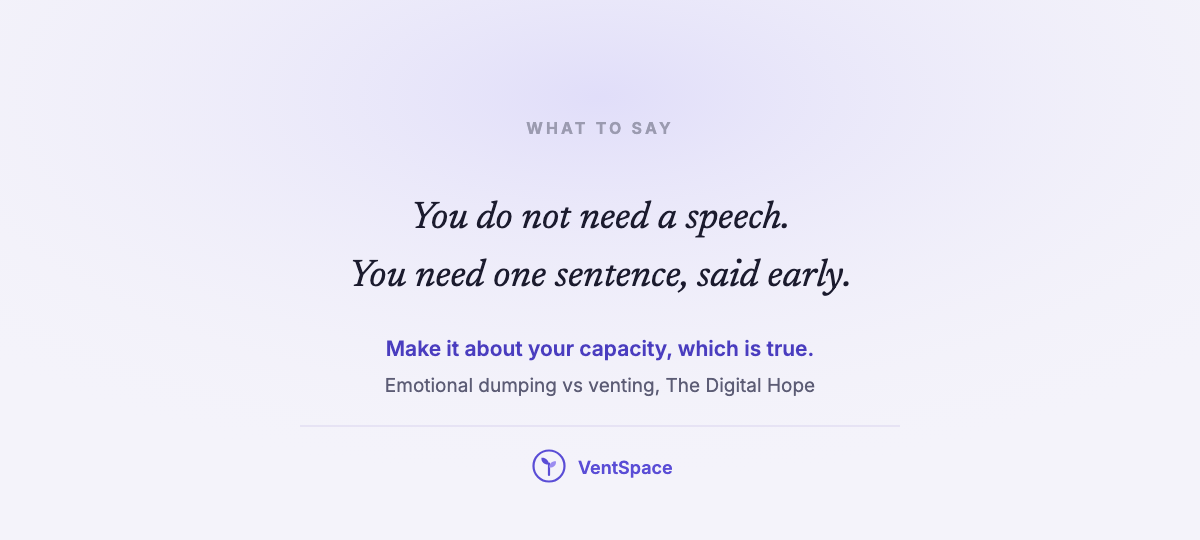
You do not need a speech. You need one sentence, said early, in your own words. Here are four moments and a line for each, with the way each one goes wrong.
- Before it starts. “I want to hear this properly, and I can’t tonight. Can I call you tomorrow at lunch?” It fails if tomorrow never comes, so name the time and keep it.
- In the middle. “Can I stop you for a second? I’m tired and I’m losing the thread, and I don’t want to half-listen to this.” It fails if it comes out as a sigh. Say it as care, because it is.
- When it keeps coming back. “We’ve talked about this a lot, and I’m not sure I’m helping anymore. What would help right now?” It fails if it sounds like a test. Ask it once and listen to the answer.
- When you need a longer step back. “I’ve had a hard few weeks and I don’t have much left. I still love you. I need to talk a bit less for a while.” It fails if you blame them. Make it about your capacity, which is true.
None of these needs the word “boundaries”. None is a rule. They are small, honest sentences, and the first one you say will be the hardest, because the first one is the one that changes a pattern you may both have been living inside for months without naming it. Some friends will take it badly at first. Say it kindly anyway.
If you’re worried you’re the one dumping
Asking is a good sign. Start with one habit, a question before you begin: “Do you have room for something heavy, or is tonight bad?” Then believe the answer. After that, look at the last month and ask whether your friend’s life has had a turn. And if the same story has come out in the same words for weeks, it may need more than one listener, and more than one kind of help, such as a therapist.
Some of us find it easier to know what we want to say to a friend after a first, messier pass somewhere private. If that is you, VentSpace is a journaling app that turns what you write into a clear read on your life balance, plus small, doable next steps. It is ours, free to start, and on Google Play for Android as of October 2026. Not on Android, or at a desk? VentSpace Live runs in your browser, free, with nothing to install. It can hold the rawest version, so the call can be about the part you want to share. It is not a substitute for the person, and the friend is still worth calling.
Where the line blurs
Real conversations do not sort neatly. A friend in the worst week of their year may lean hard on someone, and the friend who catches it is doing something good. What separates that from the pattern on this page is time: one awful week is a crisis, the same awful call every week for six months is a stuck conversation.
One person’s venting is another person’s dumping, too. Some people can listen for an hour and feel close afterward, and some are emptied in ten minutes, depending on the week. Your capacity is not a constant, which is why the check above asks about the last few weeks rather than the whole friendship.
Quick Summary: where the line blurs
Q: Is it ever okay to dump on someone?
A: In a real crisis, leaning hard on someone is normal. The trouble starts when the same heavy conversation becomes the only conversation, for months, with the same one person.
Insight: comfort in, dump out
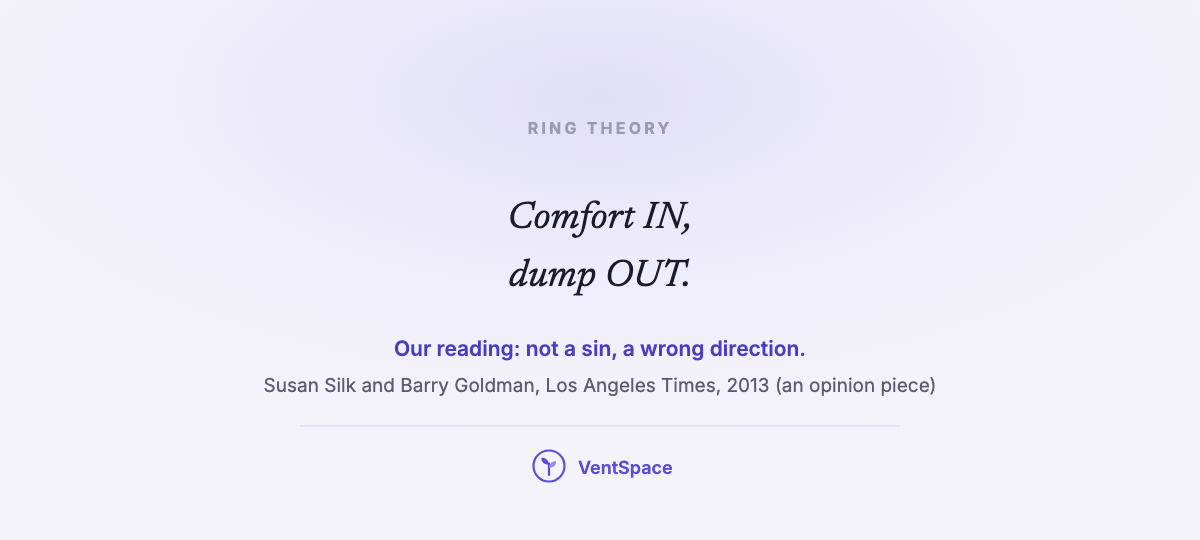
The clinical psychologist Susan Silk and the arbitrator and mediator Barry Goldman, writing in the Los Angeles Times in 2013 about what to say to someone in a crisis, described a rule Silk calls Ring Theory: “If you want to scream or cry or complain, if you want to tell someone how shocked you are or how icky you feel, or whine about how it reminds you of all the terrible things that have happened to you lately, that’s fine. It’s a perfectly normal response. Just do it to someone in a bigger ring. Comfort IN, dump OUT.” It is an opinion piece, not research, and it is the kindest framing of dumping we know: not a sin, a wrong direction.
When it’s bigger than a friendship
When the same story has gone around for months without moving, or what your friend is carrying is more than a friend can hold, it is time for more help than you can give. That might be a therapist, a doctor, or a support line. Suggesting it is not getting rid of them. It is saying that the problem deserves more than one tired person on the phone at midnight, and that they deserve someone whose whole job, for that hour, is them. That is a kindness.
You can say it plainly: “I love talking to you, and I think this needs someone who can do more than I can. Would you look for a therapist if I helped?” And you are allowed support too. Talking to someone about what you have been carrying, a friend of your own or a therapist, is an ordinary thing to do, not a betrayal.
One different situation, named so it is not missed: if the person unloading on you is a partner, and it comes with control, threats or fear, that is not what this page is about. The next section has a line for that too.
Quick Summary: when it's bigger than a friendship
Q: When should a friend see a therapist instead of venting to me?
A: When the same story has not moved in months, or it is more than a friend can carry. Suggesting help is a way of taking it seriously, not a way of handing them off, and the listener is allowed support too.
If what they’re telling you includes harm
If a friend talks about harming themselves or ending their life, take it seriously and do not carry it alone.
- In the US, call or text 988, the 988 Suicide & Crisis Lifeline. Its own guidance says: “Contact 988 at any time for help if a friend is struggling.”
- Outside the US, find a local line at findahelpline.com.
- If you are afraid of a partner, call the National Domestic Violence Hotline at 1-800-799-7233, or text START to 88788.
- If someone is in immediate danger, call your local emergency number.
Questions people ask about emotional dumping
Is emotional dumping toxic?
It is a pattern in a conversation, not a type of person. Calling someone toxic misses what is in front of you: a person with too much to hold, and one listener holding it. The pattern can still wear a friendship down, especially when it runs one way for months, which is why it is worth changing kindly rather than ignoring.
How do I tell a friend they are emotionally dumping on me?
Talk about your capacity and the pattern, not their character. Something like “I’ve noticed we keep having the same conversation, and I’m running low. Can we find another way to do this?” One honest sentence goes further than a list of complaints.
How do I stop emotionally dumping on people?
Ask before you start, and believe the answer. Spread what you are carrying across more than one person and more than one kind of support. Notice when the same story keeps coming out in the same words, because that can be a sign it needs more than another listener.
Is trauma dumping the same thing?
On the pages that rank for both, the terms are used almost interchangeably. The word “trauma” in the name points to heavier material. Neither is a clinical term.
How long should venting last?
We found no research that gives a number. Pages that suggest 10, 15 or 20 minutes do not say where the figure comes from. What matters more is whether the listener has room tonight, and whether they get a turn.
Two things to take with you
First, same words, different conversation. Venting and dumping can sound identical. What separates them is whether the listener was asked, whether they get a turn, and whether anything moves.
Second, changing a conversation with someone you love is uncomfortable, and the first try may land badly. It is still kinder than months of dreading the phone. If you dread the call, the call needs to change. The friendship might not.
About this article

Written by
Sai Subramaniam
Founder, VentSpace
I write these guides because I have been where you are. I am working through my own hard seasons, and I share the things that actually helped me, so that anyone going through it has a steady companion close by instead of facing it alone. VentSpace is the app I built for exactly that: a journaling app that turns what you write into a clear read on your life balance, plus small, doable next steps toward feeling more like yourself.
This writing is honest and every claim is sourced, and it is not a substitute for professional care. If you are struggling, reaching out to a professional is a strong move, not a failure.
Explore VentSpaceTry VentSpace LiveHow this one was checked. Every factual claim traces to a named source, and the source is printed next to the claim rather than kept in a footnote. Quotes are pinned to the work they come from, with the year, the letter or the chapter where one exists. Where a widely repeated claim could not be traced, it was left out and the omission recorded. Where a figure is contested, both sides are printed.
No affiliate links, no paid placements, and nobody paid to appear here. Where we mention our own app, we say that it is ours, we state its limits, and we never position it as a substitute for care.
Reviewed: October 2026. Prices, platforms and product availability move quickly, and anything we could not verify at the time of writing is marked as unverified rather than turned into a number.
Corrections. If something here is wrong, we would rather know. Corrections are made in place, with a note saying what changed.